This document discusses buffer overflow attacks and how they work at exploiting vulnerabilities in programs. It begins by providing background on buffer overflow attacks and their significance in computer security history. It then describes how a program's memory is laid out, including the stack, heap, and other segments. The key aspect of buffer overflows discussed is how overflowing buffers stored on the stack can overwrite adjacent memory areas like return addresses, allowing an attacker to hijack program execution by supplying malicious input that overwrites a return address with the memory address of attacker-supplied exploit code.
![2 CHAPTER 4. BUFFER OVERFLOW ATTACK
Stack
Heap
(High address)
(Low address)
BSS segment
Data segment
Text segment
Figure 4.1: Program memory layout
int x = 100;
int main()
{
// data stored on stack
int a=2;
float b=2.5;
static int y;
// allocate memory on heap
int *ptr = (int *) malloc(2*sizeof(int));
// values 5 and 6 stored on heap
ptr[0]=5;
ptr[1]=6;
// deallocate memory on heap
free(ptr);
return 1;
}
In the above program, the variable x is a global variable initialized inside the program;
this variable will be allocated in the Data segment. The variable y is a static variable that is
uninitialized, so it is allocated in the BSS segment. The variables a and b are local variables,
so they are stored on the program’s stack. The variable ptr is also a local variable, so it is
also stored on the stack. However, ptr is a pointer, pointing to a block of memory, which is
dynamically allocated using malloc(); therefore, when the values 5 and 6 are assigned to
ptr[1] and ptr[2], they are stored in the heap segment.](https://image.slidesharecdn.com/bufferoverflowattack-190220060337/85/Buffer-overflow-attack-2-320.jpg)
![4 CHAPTER 4. BUFFER OVERFLOW ATTACK
instruction—the instruction placed right after the function invocation instruction—into
the top of the stack, which is the “return address” region in the stack frame.
• Previous Frame Pointer: The next item pushed into the stack frame by the program is the
frame pointer for the previous frame. We will talk about the frame pointer in more details
in § 4.2.2.
• Local Variables: The next region is for storing the function’s local variables. The actual
layout for this region, such as the order of the local variables, the actual size of the
region, etc., is up to the compilers. Some compilers may randomize the order of the local
variables, or give extra space for this region [Bryant and O’Hallaron, 2015]. Programmers
should not assume any particular order or size for this region.
4.2.2 Frame Pointer
Inside func(), we need to access the arguments and local variables. The only way to do that
is to know their memory addresses. Unfortunately, the addresses cannot be determined during
the compilation time, because compilers cannot predict the run-time status of the stack, and will
not be able to know where the stack frame will be. To solve this problem, a special register
is introduced in the CPU. It is called frame pointer. This register points to a fixed location in
the stack frame, so the address of each argument and local variable on the stack frame can be
calculated using this register and an offset. The offset can be decided during the compilation
time, while the value of the frame pointer can change during the runtime, depending on where a
stack frame is allocated on the stack.
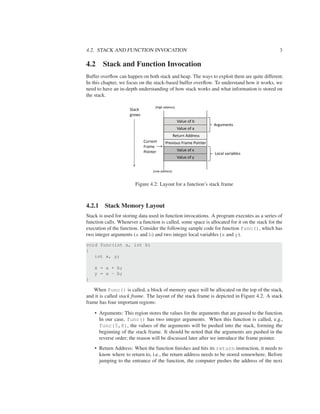
Let us use an example to see how the frame pointer is used. From the code example shown
previously, the function needs to execute the x = a + b statement. CPU needs to fetch the
values of a and b, add them, and then store the result in x; CPU needs to know the addresses
of these three variables. As shown in Figure 4.2, in the x86 architecture, the frame pointer
register (ebp) always points to the region where the previous frame pointer is stored. For the
32-bit architecture, the return address and frame pointer both occupy 4 bytes of memory, so the
actual address of the variables a and b is ebp + 8, and ebp + 12, respectively. Therefore,
the assembly code for x = a + b is the following (we can compile C code into assembly
code using the -S option of gcc like this: gcc -S <filename>):
movl 12(%ebp), %eax ; b is stored in %ebp + 12
movl 8(%ebp), %edx ; a is stored in %ebp + 8
addl %edx, %eax
movl %eax, -8(%ebp) ; x is stored in %ebp - 8
In the above assembly code, eax and edx are two general-purpose registers used for
storing temporary results. The "movl u w" instruction copies value u to w, while "addl
%edx %eax" adds the values in the two registers, and save the result to %eax. The notation
12(%ebp) means %ebp+12. It should be noted that the variable x is actually allocated 8
bytes below the frame pointer by the compiler, not 4 bytes as what is shown in the diagram. As
we have already mentioned, the actual layout of the local variable region is up to the compiler.
In the assembly code, we can see from -8(%ebp) that the variable x is stored in the location
of %ebp-8. Therefore, using the frame pointer decided at the runtime and the offsets decided
at the compilation time, we can find the address of all the variables.
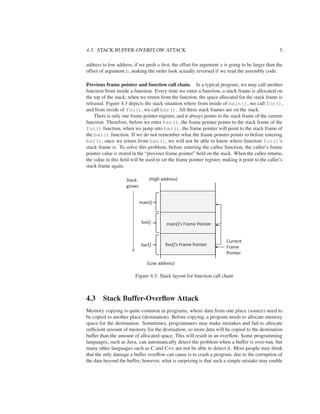
Now we can explain why a and b are pushed in the stack in a seemly reversed order.
Actually, the order is not reversed from the offset point of view. Since the stack grows from high](https://image.slidesharecdn.com/bufferoverflowattack-190220060337/85/Buffer-overflow-attack-4-320.jpg)
![6 CHAPTER 4. BUFFER OVERFLOW ATTACK
attackers to gain a complete control of a program, rather than simply crashing it. If a vulnerable
program runs with privileges, attackers will be able to gain those privileges. In this section, we
will explain how such an attack works.
4.3.1 Copy Data to Buffer
There are many functions in C that can be used to copy data, including strcpy(), strcat(),
memcpy(), etc. In the examples of this section, we will use strcpy(), which is used to copy
strings. An example is shown in the code below. The function strcpy() stops copying only
when it encounters the terminating character '0'.
#include <string.h>
#include <stdio.h>
void main ()
{
char src[40]="Hello world 0 Extra string";
char dest[40];
// copy to dest (destination) from src (source)
strcpy (dest, src);
}
When we run the above code, we can notice that strcpy() only copies the string "Hello
world" to the buffer dest, even though the entire string contains more than that. This
is because when making the copy, strcpy() stops when it sees number zero, which is
represented by '0' in the code. It should be noted that this is not the same as character '0',
which is represented as 0x30 in computers, not zero. Without the zero in the middle of the
string, the string copy will end when it reaches the end of the string, which is marked by a
zero (the zero is not shown in the code, but compilers will automatically add a zero to the end of
a string).
4.3.2 Buffer Overflow
When we copy a string to a target buffer, what will happen if the string is longer than the size of
the buffer? Let us see the following example.
#include <string.h>
void foo(char *str)
{
char buffer[12];
/* The following statement will result in buffer overflow */
strcpy(buffer, str);
}
int main()
{
char *str = "This is definitely longer than 12";](https://image.slidesharecdn.com/bufferoverflowattack-190220060337/85/Buffer-overflow-attack-6-320.jpg)
![4.3. STACK BUFFER-OVERFLOW ATTACK 7
foo(str);
return 1;
}
The stack layout for the above code is shown in Figure 4.4. The local array buffer[] in
foo() has 12 bytes of memory. The foo() function uses strcpy() to copy the string from
str to buffer[]. The strcpy() function does not stop until it sees a zero (a number zero,
'0') in the source string. Since the source string is longer than 12 bytes, strcpy() will
overwrite some portion of the stack above the buffer. This is called buffer overflow.
str (pointer)
Return Address
Previous Frame Pointer
buffer[0]
buffer[11]
Buffercopy
main()
stack
frame
foo()
stack
frame
Stack
grows
(High address)
(Low address)
Figure 4.4: Buffer overflow
It should be noted that stacks grow from high address to low address, but buffers still grow
in the normal direction (i.e., from low to high). Therefore, when we copy data to buffer[],
we start from buffer[0], and eventually to buffer[11]. If there are still more data to be
copied, strcpy() will continue copying the data to the region above the buffer, treating the
memory beyond the buffer as buffer[12], buffer[13], and so on.
Consequence. As can be seen in Figure 4.4, the region above the buffer includes critical
values, including the return address and the previous frame pointer. The return address affects
where the program should jump to when the function returns. If the return address field is
modified due to a buffer overflow, when the function returns, it will return to a new place.
Several things can happen. First, the new address, which is a virtual address, may not be mapped
to any physical address, so the return instruction will fail, and the program will crash. Second,
the address may be mapped to a physical address, but the address space is protected, such as
those used by the operating system kernel; the jump will fail, and the program will crash. Third,
the address may be mapped to a physical address, but the data in that address is not a valid
machine instruction (e.g. it may be a data region); the return will again fail and the program
will crash. Fourth, the data in the address may happen to be a valid machine instruction, so the](https://image.slidesharecdn.com/bufferoverflowattack-190220060337/85/Buffer-overflow-attack-7-320.jpg)
![8 CHAPTER 4. BUFFER OVERFLOW ATTACK
program will continue running, but the logic of the program will be different from the original
one.
4.3.3 Exploiting a Buffer Overflow Vulnerability
As we can see from the above consequence, by overflowing a buffer, we can cause a program
to crash or to run some other code. From the attacker’s perspective, the latter sounds more
interesting, especially if we (as attackers) can control what code to run, because that will allow
us to hijack the execution of the program. If a program is privileged, being able to hijack the
program leads to privilege escalation for the attacker.
Let us see how we can get a vulnerable program to run our code. In the previous program
example, the program does not take any input from outside, so even though there is a buffer
overflow problem, attackers cannot take advantage of it. In real applications, programs usually
get inputs from users. See the following program example.
Listing 4.1: The vulnerable program stack.c
/* stack.c */
/* This program has a buffer overflow vulnerability. */
#include <stdlib.h>
#include <stdio.h>
#include <string.h>
int foo(char *str)
{
char buffer[100];
/* The following statement has a buffer overflow problem */
strcpy(buffer, str);
return 1;
}
int main(int argc, char **argv)
{
char str[400];
FILE *badfile;
badfile = fopen("badfile", "r");
fread(str, sizeof(char), 300, badfile);
foo(str);
printf("Returned Properlyn");
return 1;
}
The above program reads 300 bytes of data from a file called "badfile", and then copies
the data to a buffer of size 100. Clearly, there is a buffer overflow problem. This time, the
contents copied to the buffer come from a user-provided file, i.e., users can control what is
copied to the buffer. The question is what to store in "badfile", so after overflowing the
buffer, we can get the program to run our code.](https://image.slidesharecdn.com/bufferoverflowattack-190220060337/85/Buffer-overflow-attack-8-320.jpg)
![4.4. SETUP FOR OUR EXPERIMENT 9
We need to get our code (i.e., malicious code) into the memory of the running program first.
This is not difficult. We can simply place our code in "badfile", so when the program reads
from the file, the code is loaded into the str[] array; when the program copies str to the
target buffer, the code will then be stored on the stack. In Figure 4.5, we place the malicious
code at the end of "badfile".
Next, we need to force the program to jump to our code, which is already in the memory. To
do that, using the buffer overflow problem in the code, we can overwrite the return address field.
If we know the address of our malicious code, we can simply use this address to overwrite the
return address field. Therefore, when the function foo returns, it will jump to the new address,
where our code is stored. Figure 4.5 illustrates how to get the program to jump to our code.
Arguments
Return Address
Previous Frame Pointer
buffer[0]
buffer[99]
New Address
Malicious
Code
(badfile)
Arguments
buffer[0]
buffer[11]
Malicious
Code
New Return Address
ebp
(Overwrite)
(Overwrite)
(Overwrite)
Stack before the buffer copy Stack after the buffer copy
Figure 4.5: Insert and jump to malicious code
In theory, that is how a buffer overflow attack works. In practice, it is far more complicated.
In the next few sections, we will describe how to actually launch a buffer overflow attack against
the vulnerable Set-UID program described in Listing 4.1. We will describe the challenges in
the attack and how to overcome them. Our goal is to gain the root privilege by exploiting the
buffer overflow vulnerability in a privileged program.
4.4 Setup for Our Experiment
We will conduct attack experiments inside our Ubuntu12.04 virtual machine. Because the
buffer overflow problem has a long history, most operating systems have already developed
countermeasures against such an attack. To simplify our experiments, we first need to turn
off these countermeasures. Later on, we will turn them back on, and show that some of the
countermeasures only made attacks more difficult, not impossible. We will show how they can
be defeated.](https://image.slidesharecdn.com/bufferoverflowattack-190220060337/85/Buffer-overflow-attack-9-320.jpg)
![10 CHAPTER 4. BUFFER OVERFLOW ATTACK
4.4.1 Disable Address Randomization
One of the countermeasures against buffer overflow attacks is the Address Space Layout
Randomization (ASLR) [Wikipedia, 2017a]. It randomizes the memory space of the key data
areas in a process, including the base of the executable and the positions of the stack, heap and
libraries, making it difficult for attackers to guess the address of the injected malicious code. We
will discuss this countermeasure in § 4.8 and show how it can be defeated. For this experiment,
we will simply turn it off using the following command:
$ sudo sysctl -w kernel.randomize_va_space=0
4.4.2 Vulnerable Program
Our goal is to exploit a buffer overflow vulnerability in a Set-UID root program. A Set-UID
root program runs with the root privilege when executed by a normal user, giving the normal
user extra privileges when running this program. The Set-UID mechanism is covered in
details in Chapter 1. If a buffer overflow vulnerability can be exploited in a privileged Set-UID
root program, the injected malicious code, if executed, can run with the root’s privilege. We
will use the vulnerable program (stack.c) shown in Listing 4.1 as our target program. This
program can be compiled and turned into a root-owned Set-UID program using the following
commands:
$ gcc -o stack -z execstack -fno-stack-protector stack.c
$ sudo chown root stack
$ sudo chmod 4755 stack
The first command compiles stack.c, and the second and third commands turn the
executable stack into a root-owned Set-UID program. It should be noted that the order
of the second and third commands cannot be reversed, because when the chown command
changes the ownership of a file, it clears the Set-UID bit (for the sake of security). In the first
command, we used two gcc options to turn off two countermeasures that have already been
built into the gcc compiler.
• -z execstack: The option makes the stack non-executable, which prevents the
injected malicious code from getting executed. This countermeasure is called non-
executable stack [Wikipedia, 2017c]. A program, through a special marking in the binary,
can tell the operating system whether its stack should be set to executable or not. The
marking in the binary is typically done by the compiler. The gcc compiler marks stack
as non-executable by default, and the "-z execstack" option reverses that, making
stack executable. It should be noted that this countermeasure can be defeated using the
return-to-libc attack. We will cover the attack in Chapter 5.
• -fno-stack-protector: This option turns off another countermeasure called Stack-
Guard [Cowa et al., 1998], which can defeat the stack-based buffer overflow attack. Its
main idea is to add some special data and checking mechanisms to the code, so when a
buffer overflow occurs, it will be detected. More details of this countermeasure will be
explained in § 4.9. This countermeasure has been built into the gcc compiler as a default
option. The -fno-stack-protector tells the compiler not to use the StackGuard
countermeasure.](https://image.slidesharecdn.com/bufferoverflowattack-190220060337/85/Buffer-overflow-attack-10-320.jpg)
![4.5. CONDUCT BUFFER-OVERFLOW ATTACK 13
Arguments
buffer[0]
buffer[11]
Malicious
Code
New Return Address
(Overwrite)
(Overwrite)
(Overwrite)
(Without NOP)
buffer[0]
buffer[11]
Malicious
Code
New Return Address
(Overwrite)
(Overwrite)
(With NOP)
Inaccurate
Guess –
Failed Attack
NOP
NOP
NOP
Inaccurate
Guess –
Successful Attack
ebp ebp
Figure 4.6: Using NOP to improve the success rate
Listing 4.2: The program exploit.c used for generating malicious input
/* exploit.c */
... code is omitted for this sample chapter ...
}
In the given code, the array shellcode[] contains a copy of the malicious code. We
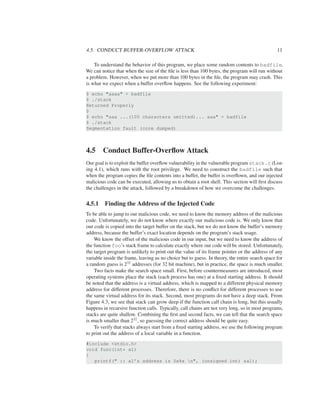
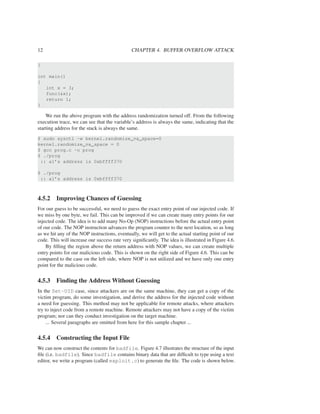
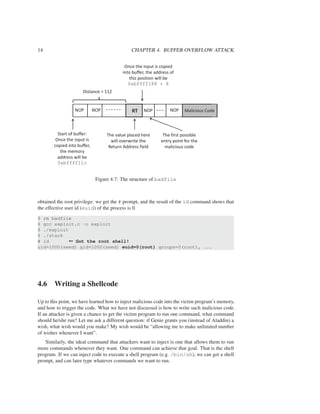
will discuss how to write such code later. Statement A fills the buffer with NOP instructions.
Statement B fills the return address field of the input with the value derived using gdb. Statement
C places the malicious shell code at the end of the buffer.
It should be noted that in Statement B, we do not use 0xbffff188 + 8, as we have
calculated before; instead, we use a larger value 0xbffff188 + 0x80. There is a reason for
this: the address 0xbffff188 was identified using the debugging method, and the stack frame
of the foo function may be different when the program runs inside gdb as opposed to running
directly, because gdb may push some additional data onto the stack at the beginning, causing the
stack frame to be allocated deeper than it would be when the program runs directly. Therefore,
the first address that we can jump to may be higher than 0xbffff188 + 8. Therefore, we
chose to use 0xbffff188 + 0x80. Readers can try different offsets if their attacks fail.
Another important thing to remember is that the result of 0xbffff188 + nnn should
not contain a zero in any of its byte, or the content of badfile will have a zero in the middle,
causing the strcpy() function to end the copying earlier, without copying anything after the
zero. For example, if we use 0xbffff188 + 0x78, we will get 0xbffff200, and the last
byte of the result is zero.
Run the exploit. We can now compile exploit.c, and run it to generate badfile. Once
the file is constructed, we run the vulnerable Set-UID program, which copies the contents from
badfile, resulting in a buffer overflow. The following result shows that we have successfully](https://image.slidesharecdn.com/bufferoverflowattack-190220060337/85/Buffer-overflow-attack-13-320.jpg)
![4.6. WRITING A SHELLCODE 15
4.6.1 Writing Malicious Code Using C
Let us write such code using C. The following code executes a shell program (/bin/sh) using
the execve() system call.
#include <stddef.h>
void main()
{
char *name[2];
name[0] = "/bin/sh";
name[1] = NULL;
execve(name[0], name, NULL);
}
A naive thought is to compile the above code into binary, and then save it to the input
file badfile. We then set the targeted return address field to the address of the main()
function, so when the vulnerable program returns, it jumps to the entrance of the above code.
Unfortunately this does not work for several reasons.
• The loader issue: Before a normal program runs, it needs to be loaded into memory and
its running environment needs to be set up. These jobs are conducted by the OS loader,
which is responsible for setting up the memory (such as stack and heap), copying the
program into memory, invoking the dynamic linker to link to the needed library functions,
etc. After all the initialization is done, the main() function will be triggered. If any of
the steps is missing, the program will not be able to run correctly. In a buffer overflow
attack, the malicious code is not loaded by the OS; it is loaded directly via memory copy.
Therefore, all the essential initialization steps are missing; even if we can jump to the
main() function, we will not be able to get the shell program to run.
• Zeros in the code: String copying (e.g. using strcpy()) will stop when a zero is found
in the source string. When we compile the above C code into binary, at least three zeros
will exist in the binary code:
– There is a '0' at the end of the "/bin/sh" string.
– There are two NULL’s, which are zeros.
– Whether the zeros in name[0] will become zeros in the binary code depends on
the program compilation.
4.6.2 Writing a Shellcode: Main Idea
Given the above issues, we cannot use the binary generated directly from a C program as our
malicious code. It is better to write the program directly using the assembly language. The
assembly code for launching a shell is referred to as shellcode [Wikipedia, 2017d]. The core
part of a shellcode is to use the execve() system call to execute "/bin/sh". To use the
system call, we need to set four registers as follows:
• %eax: must contain 11, which is the system call number for execve().
• %ebx: must contain the address of the command string (e.g. "/bin/sh").](https://image.slidesharecdn.com/bufferoverflowattack-190220060337/85/Buffer-overflow-attack-15-320.jpg)
![16 CHAPTER 4. BUFFER OVERFLOW ATTACK
• %ecx: must contain the address of the argument array; in our case, the first element of
the array points to the "/bin/sh" string, while the second element is 0 (which marks
the end of the array).
• %edx: must contain the address of the environment variables that we want to pass to the
new program. We can set it to 0, as we do not want to pass any environment variable.
Setting these four registers are not difficult; the difficulty is in preparing the data, finding the
addresses of those data, and making sure that there is no zeros in the binary code. For example,
to set the value for %ebx, we need to know the address of the "/bin/sh" string. We can
put the string on the stack using the buffer overflow, but we may not be able to know its exact
memory address. To eliminate guessing involved in finding the address, a common idea is to
use the stack pointer (the %esp register), as long as we can figure out the offset of the string
from the current stack pointer’s position. To achieve this goal, instead of copying the string to
the stack via a buffer overflow, we can dynamically push the string into the stack; this way, we
can get its address from the %esp register, which always points to the top of the stack.
To ensure that the entire code is copied into the target buffer, it is important not to include any
zeros in the code, because some functions treat zero as the end of the source buffer. Although
zeros are used by the program, we do not need to have zeros in the code; instead, we can
generate zeros dynamically. There are many ways to generate zeros. For example, to place a
zero in the %eax register, we can use the mov instruction to put a zero in it, but that will cause
zero to appear in the code. An alternative is to use "xorl %eax, %eax", which XORs the
register with itself, causing its content to become zero.
4.6.3 Explanation of a Shellcode Example
There are many ways to write a shellcode, more details about shellcode writing can be found
in [One, 1996] and many online articles. We use a shellcode example to illustrate one way to
write such code. The code is shown below. We have already placed the machine instructions
into a C array in the following C code, and the comment fields show the assembly code for each
machine instruction.
const char code[] =
"x31xc0" /* xorl %eax,%eax */
"x50" /* pushl %eax */
"x68""//sh" /* pushl $0x68732f2f */
"x68""/bin" /* pushl $0x6e69622f */
"x89xe3" /* movl %esp,%ebx */ ¥ set %ebx
"x50" /* pushl %eax */
"x53" /* pushl %ebx */
"x89xe1" /* movl %esp,%ecx */ ¥ set %ecx
"x99" /* cdq */ ¥ set %edx
"xb0x0b" /* movb $0x0b,%al */ ¥ set %eax
"xcdx80" /* int $0x80 */ ¥ invoke execve()
;
The goal of the above code is similar to the C program shown before, i.e. to use the
execve() system call to run /bin/sh. A system call is executed using the instruction int
$0x80 (the last instruction in the shellcode above). To run it, several parameters need to be
prepared in various registers (%eax, %ebx, %ecx, and %edx) as mentioned before. If the](https://image.slidesharecdn.com/bufferoverflowattack-190220060337/85/Buffer-overflow-attack-16-320.jpg)
![18 CHAPTER 4. BUFFER OVERFLOW ATTACK
Malicious
Code
NOP
NOP
NOP
esp
0
//sh
/bin
eax
ebx
ecx
edx0
0
0x2000
0x2000
11
Malicious
Code
NOP
NOP
NOP
esp
0
//sh
/bin
ebx
(a) Set the ebx register (b) Set the eax, ecx, and edx registers
Figure 4.9: Shellcode Execution
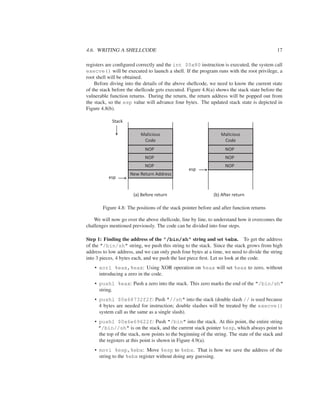
Step 2. Finding the address of the name[] array and set %ecx. The next step is to find the
address of the name[] array, which needs to contain two elements, the address of "/bin/sh"
for name[0] and 0 for name[1]. We will use the same technique to get the address of the
array. Namely, we dynamically construct the array on the stack, and then use the stack pointer
to get the array’s address.
... Contents are omitted here for this sample chapter ...
Step 3. Setting %edx to zero. The %edx register needs to be set to zero. We can use the
XOR approach, but in order to reduce the code size by one byte, we can leverage a different
instruction (cdq). This one-byte instruction sets %edx to zero as a side effect. It basically
copies the sign bit (bit 31) of the value in %eax (which is 0 now), into every bit position in
%edx.
Step 4. Invoking the execve() system call. ... Contents are omitted here for this sample
chapter ...
4.7 Countermeasures: Overview
The buffer overflow problem has quite a long history, and many countermeasures have been
proposed, some of which have been adopted in real-world systems and software. These coun-
termeasures can be deployed in various places, from hardware architecture, operating system,
compiler, library, to the application itself. We first give an overview of these countermea-
sures, and then study some of them in depth. We will also demonstrate that some of the
countermeasures can be defeated.
Safer Functions. Some of the memory copy functions rely on certain special characters in the
data to decide whether the copy should end or not. This is dangerous, because the length of the](https://image.slidesharecdn.com/bufferoverflowattack-190220060337/85/Buffer-overflow-attack-18-320.jpg)
![4.7. COUNTERMEASURES: OVERVIEW 19
data that can be copied is now decided by the data, which may be controlled by users. A safer
approach is to put the control in the developers’ hands, by specifying the length in the code. The
length can now be decided based on the size of the target buffer, instead of on the data.
For memory copy functions like strcpy, sprintf, strcat, and gets, their safer
versions are strncpy, snprintf, strncat, fgets, respectively. The difference is that
the safer versions require developers to explicitly specify the maximum length of the data
that can be copied into the target buffer, forcing the developers to think about the buffer size.
Obviously, these safer functions are only relatively safer, as they only make a buffer overflow
less likely, but they do not prevent it. If a developer specifies a length that is larger than the
actual size of the buffer, there will still be a buffer overflow vulnerability.
Safer Dynamic Link Library. The above approach requires changes to be made to the
program. If we only have the binary, it will be difficult to change the program. We can use the
dynamic linking to achieve the similar goal. Many programs use dynamic link libraries, i.e.,
the library function code is not included in a program’s binary, instead, it is dynamically linked
to the program. If we can build a safer library and get a program to dynamically link to the
functions in this library, we can make the program safer against buffer overflow attacks.
An example of such a library is libsafe developed by Bell Labs [Baratloo et al., 2000]. It
provides a safer version for the standard unsafe functions, which does boundary checking based
on %ebp and does not allow copy beyond the frame pointer. Another example is the C++ string
module libmib [mibsoftware.com, 1998]. It conceptually supports “limitless” strings instead
of fixed length string buffers. It provides its own versions of functions like strcpy() that are
safer against buffer overflow attacks.
Program Static Analyzer. Instead of eliminating buffer overflow, this type of solution warns
developers of the patterns in code that may potentially lead to buffer overflow vulnerabilities.
The solution is often implemented as a command-line tool or in the editor. The goal is to notify
developers early in the development cycle of potentially unsafe code in their programs. An
example of such a tool is ITS4 by Cigital [Viega et al., 2000], which helps developers identify
dangerous patterns in C/C++ code. There are also many academic papers on this approach.
Programming Language. Developers rely on programming languages to develop their pro-
grams. If a language itself can do some check against buffer overflow, it can remove the burden
from developers. This makes programming language a viable place to implement buffer overflow
countermeasures. The approach is taken by several programming languages, such as Java and
Python, which provide automatic boundary checking. Such languages are considered safer for
development when it comes to avoiding buffer overflow [OWASP, 2014].
Compiler. Compilers are responsible for translating source code into binary code. They
control what sequence of instructions are finally put in the binary. This provides compilers an
opportunity to control the layout of stack. It also allows compilers to insert instructions into
the binary that can verify the integrity of a stack, as well as eliminating the conditions that are
necessary for buffer overflow attacks. Two well-known compiler-based countermeasures are
Stackshield [Angelfire.com, 2000] and StackGuard [Cowa et al., 1998], which check whether
the return address has been modified or not before a function returns.
The idea of Stackshield is to save a copy of the return address at some safer place. When
using this approach, at the beginning of a function, the compiler inserts instructions to copy the](https://image.slidesharecdn.com/bufferoverflowattack-190220060337/85/Buffer-overflow-attack-19-320.jpg)
![20 CHAPTER 4. BUFFER OVERFLOW ATTACK
return address to a location (a shadow stack) that cannot be overflown. Before returning from
the function, additional instructions compare the return address on the stack with the one that
was saved to determine whether an overflow has happened or not.
The idea of StackGuard is to put a guard between the return address and the buffer, so if
the return address is modified via a buffer overflow, this guard will also be modified. When
using this approach, at the start of a function, the compiler adds a random value below the return
address and saves a copy of the random value (referred to as the canary) at a safer place that is
off the stack. Before the function returns, the canary is checked against the saved value. The
idea is that for an overflow to occur, the canary must also be overflown. More details about
StackGuard will be given in § 4.9.
Operating System. Before a program is executed, it needs to be loaded into the system, and
the running environment needs to be set up. This is the job of the loader program in most oper-
ating systems. The setup stage provides an opportunity to counter the buffer overflow problem
because it can dictate how the memory of a program is laid out. A common countermeasure
implemented at the OS loader program is referred to as Address Space Layout Randomization or
ASLR. It tries to reduce the chance of buffer overflows by targeting the challenges that attackers
have to overcome. In particular, it targets the fact that attackers must be able to guess the
address of the injected shellcode. ASLR randomizes the layout of the program memory, making
it difficult for attackers to guess the correct address. We will discuss this approach in details in
§ 4.8.
Hardware Architecture. The buffer overflow attack described in this chapter depends on
the execution of the shellcode, which is placed on the stack. Modern CPUs support a feature
called NX bit [Wikipedia, 2017c]. The NX bit, standing for No-eXecute, is a technology used in
CPUs to separate code from data. Operating systems can mark certain areas of memory as non-
executable, and the processor will refuse to execute any code residing in these areas of memory.
Using this CPU feature, the attack described earlier in this chapter will not work anymore, if
the stack is marked as non-executable. However, this countermeasure can be defeated using
a different technique called return-to-libc attack. We will discuss the non-executable stack
countermeasure and the return-to-libc attack in Chapter 5.
4.8 Address Randomization
To succeed in buffer overflow attacks, attackers need to get the vulnerable program to “return”
(i.e., jump) to their injected code; they first need to guess where the injected code will be. The
success rate of the guess depends on the attackers’ ability to predict where the stack is located
in the memory. Most operating systems in the past placed the stack in a fixed location, making
correct guesses quite easy.
Is it really necessary for stacks to start from a fixed memory location? The answer is no.
When a compiler generates binary code from source code, for all the data stored on the stack,
their addresses are not hard-coded in the binary code; instead, their addresses are calculated
based on the frame pointer %ebp and stack pointer %esp. Namely, the addresses of the data
on the stack are represented as the offset to one of these two registers, instead of to the starting
address of the stack. Therefore, even if we start the stack from another location, as long as the
%ebp and %esp are set up correctly, programs can always access their data on the stack without
any problem.](https://image.slidesharecdn.com/bufferoverflowattack-190220060337/85/Buffer-overflow-attack-20-320.jpg)
![4.8. ADDRESS RANDOMIZATION 21
For attackers, they need to guess the absolute address, instead of the offset, so knowing the
exact location of the stack is important. If we randomize the start location of a stack, we make
attackers’ job more difficult, while causing no problem to the program. That is the basic idea of
the Address Layout Randomization (ASLR) method, which has been implemented by operating
systems to defeat buffer overflow attacks. This idea does not only apply to stack, it can also be
used to randomize the location of other types of memory, such as heap, libraries, etc.
4.8.1 Address Randomization on Linux
To run a program, an operating system needs to load the program into the system first; this is
done by its loader program. During the loading stage, the loader sets up the stack and heap
memory for the program. Therefore, memory randomization is normally implemented in the
loader. For Linux, ELF is a common binary format for programs, so for this type of binary
programs, randomization is carried out by the ELF loader.
To see how the randomization works, we wrote a simple program with two buffers, one on
the stack and the other on the heap. We print out their addresses to see whether the stack and
heap are allocated in different places every time we run the program.
#include <stdio.h>
#include <stdlib.h>
void main()
{
char x[12];
char *y = malloc(sizeof(char)*12);
printf("Address of buffer x (on stack): 0x%xn", x);
printf("Address of buffer y (on heap) : 0x%xn", y);
}
After compiling the above code, we run it (a.out) under different randomization settings.
Users (privileged users) can tell the loader what type of address randomization they want by
setting a kernel variable called kernel.randomiza va space. As we can see that when
the value 0 is set to this kernel variable, the randomization is turned off, and we always get the
same address for buffers x and y every time we run the code. When we change the value to 1,
the buffer on the stack now have a different location, but the buffer on the heap still gets the
same address. This is because value 1 does not randomize the heap memory. When we change
the value to 2, both stack and heap are now randomized.
$ sudo sysctl -w kernel.randomize va space=0
kernel.randomize_va_space = 0
$ a.out
Address of buffer x (on stack): 0xbffff370
Address of buffer y (on heap) : 0x804b008
$ a.out
Address of buffer x (on stack): 0xbffff370
Address of buffer y (on heap) : 0x804b008
$ sudo sysctl -w kernel.randomize va space=1
kernel.randomize_va_space = 1
$ a.out](https://image.slidesharecdn.com/bufferoverflowattack-190220060337/85/Buffer-overflow-attack-21-320.jpg)
![22 CHAPTER 4. BUFFER OVERFLOW ATTACK
Address of buffer x (on stack): 0xbf9deb10
Address of buffer y (on heap) : 0x804b008
$ a.out
Address of buffer x (on stack): 0xbf8c49d0
Address of buffer y (on heap) : 0x804b008
$ sudo sysctl -w kernel.randomize va space=2
kernel.randomize_va_space = 2
$ a.out
Address of buffer x (on stack): 0xbf9c76f0
Address of buffer y (on heap) : 0x87e6008
$ a.out
Address of buffer x (on stack): 0xbfe69700
Address of buffer y (on heap) : 0xa020008
4.8.2 Effectiveness of Address Randomization
The effectiveness on address randomization depends on several factors. A complete imple-
mentation of ASLR wherein all areas of process are located at random places may result in
compatibility issues. A second limitation sometimes is the reduced range of the addresses
available for randomization [Marco-Gisbert and Ripoll, 2014].
One way to measure the available randomness in address space is entropy. If a region of
memory space is said to have n bits of entropy, it implies that on that system, the region’s
base address can take 2n
locations with an equal probability. Entropy depends on the type of
ASLR implemented in the kernel. For example, in the 32-bit Linux OS, when static ASLR is
used (i.e., memory regions except program image are randomized), the available entropy is 19
bits for stack and 13 bits for heap [Herlands et al., 2014].
In implementations where the available entropy for randomization is not enough, attackers
can resolve to brute-force attacks. Proper implementations of ASLR (like those available in
grsecurity [Wikipedia, 2017b]) provide methods to make brute force attacks infeasible.
One approach is to prevent an executable from executing for a configurable amount of time if it
has crashed a certain number of times [Wikipedia, 2017a].
Defeating stack randomization on 32-bit machine. As mentioned above, on 32-bit Linux
machines, stacks only have 19 bits of entropy, which means the stack base address can have
219
= 524, 288 possibilities. This number is not that high and can be exhausted easily with
the brute-force approach. To demonstrate this, we write the following script to launch a buffer
overflow attack repeatedly, hoping that our guess on the memory address will be correct by
chance. Before running the script, we need to turn on the memory randomization by setting
kernel.randomize va space to 2.
#!/bin/bash
... code is ommited for this sample chapter ...
In the above attack, we have prepared the malicious input in badfile, but due to the
memory randomization, the address we put in the input may not be correct. As we can see
from the following execution trace, when the address is incorrect, the program will crash
(core dumped). However, in our experiment, after running the script for a little bit over 19](https://image.slidesharecdn.com/bufferoverflowattack-190220060337/85/Buffer-overflow-attack-22-320.jpg)
![4.9. STACKGUARD 23
minutes (12524 tries), the address we put in badfile happened to be correct, and our
shellcode gets triggered.
......
19 minutes and 14 seconds elapsed.
The program has been running 12522 times so far.
...: line 12: 31695 Segmentation fault (core dumped) ./stack
19 minutes and 14 seconds elapsed.
The program has been running 12523 times so far.
...: line 12: 31697 Segmentation fault (core dumped) ./stack
19 minutes and 14 seconds elapsed.
The program has been running 12524 times so far.
# ¥ Got the root shell!
We did the above experiment on a 32-bit Linux machine (our pre-built VM is a 32-bit
machine). For 64-bit machines, the brute-force attack will be much more difficult.
Address randomization on Android. A popular attack on Android called stagefright was
discovered in 2015 [Wikipedia, 2017e]. The bug was in Android’s stagefright media library, and
it is a buffer overflow problem. Android has implemented ASLR, but it still had a limitation. As
discussed by Google’s researchers, exploiting the attack depended on the available entropy in
the mmap process memory region. On Android Nexus 5 running version 5.x (with 32-bit), the
entropy was only 8-bit or 256 possibilities, making brute-force attacks quite easy [Brand, 2015].
4.9 StackGuard
Stack-based buffer overflow attacks need to modify the return address; if we can detect whether
the return address is modified before returning from a function, we can foil the attack. There
are many ways to achieve that. One way is to store a copy of the return address at some other
place (not on the stack, so it cannot be overwritten via a buffer overflow), and use it to check
whether the return address is modified. A representative implementation of this approach is
Stackshield [Angelfire.com, 2000]. Another approach is to place a guard between the return
address and the buffer, and use this guard to detect whether the return address is modified
or not. A representative implementation of this approach is StackGuard [Cowa et al., 1998].
StackGuard has been incorporated into compilers, including gcc. We will dive into the details
of this countermeasure.
4.9.1 The Observation and the Idea
The key observation of StackGuard is that for a buffer overflow attack to modify the return
address, all the stack memory between the buffer and the return address will be overwritten.
This is because the memory-copy functions, such as strcpy() and memcpy(), copy data
into contiguous memory locations, so it is impossible to selectively affect some of the locations,
while leaving the other intact. If we do not want to affect the value in a particular location during
the memory copy, such as the shaded position marked as Guard in Figure 4.10, the only way to
achieve that is to overwrite the location with the same value that is stored there.](https://image.slidesharecdn.com/bufferoverflowattack-190220060337/85/Buffer-overflow-attack-23-320.jpg)
![24 CHAPTER 4. BUFFER OVERFLOW ATTACK
Return Address
buffer[0]
buffer[11]
Buffercopy
Stack
grows
(High address)
(Low address)
Guard
Figure 4.10: The idea of StackGuard
Based on this observation, we can place some non-predictable value (called guard) between
the buffer and the return address. Before returning from the function, we check whether the
value is modified or not. If it is modified, chances are that the return address may have also
been modified. Therefore, the problem of detecting whether the return address is overwritten is
reduced to detecting whether the guard is overwritten. These two problems seem to be the same,
but they are not. By looking at the value of the return address, we do not know whether its value
is modified or not, but since the value of the guard is placed by us, it is easy to know whether
the guard’s value is modified or not.
4.9.2 Manually Adding Code to Function
Let us look at the following function, and think about whether we can manually add some
code and variables to the function, so in case the buffer is overflown and the return address
is overwritten, we can preempt the returning from the function, thus preventing the malicious
code from being triggered. Ideally, the code we add to the function should be independent from
the existing code of the function; this way, we can use the same code to protect all functions,
regardless of what their functionalities are.
void foo (char *str)
{
char buffer[12];
strcpy (buffer, str);
return;
}
First, let us place a guard between the buffer and the return address. We can easily achieve
that by defining a local variable at the beginning of the function. It should be noted that in](https://image.slidesharecdn.com/bufferoverflowattack-190220060337/85/Buffer-overflow-attack-24-320.jpg)
![4.9. STACKGUARD 25
reality, how local variables are placed on the stack and in what order is decided by the compiler,
so there is no guarantee that the variable defined first in the source code will be allocated closer
to the return address. We will temporarily ignore this fact, and assume that the variable (called
guard) is allocated between the return address and the rest of the function’s local variables.
We will initialize the variable guard with a secret. This secret is a random number
generated in the main function, so every time the program runs, the random number is different.
As long as the secret is not predictable, if the overflowing of the buffer has led to the modification
of the return address, it must have also overwritten the value in guard. The only way not to
modify guard while still being able to modify the return address is to overwrite guard with
its original value. Therefore, attackers need to guess what the secret number is, which is difficult
to achieve if the number is random and large enough.
One problem we need to solve is to find a place to store the secret. The secret cannot be
stored on the stack; otherwise, its value can also be overwritten. Heap, data segment, and BSS
segment can be used to store this secret. It should be noted that the secret should never be
hard-coded in the code; or it will not be a secret at all. Even if one can obfuscate the code, it is
just a matter of time before attackers can find the secret value from the code. In the following
code, we define a global variable called secret, and we initialize it with a randomly-generated
number in the main function (not shown). As we have learned from the beginning of the section,
uninitialized global variables are allocated in the BSS segment.
// This global variable will be initialized with a random
// number in the main function.
int secret;
void foo (char *str)
{
int guard;
guard = secret;
char buffer[12];
strcpy (buffer, str);
if (guard == secret)
return;
else
exit(1);
}
From the above code, we can also see that before returning from the function, we always
check whether the value in the local variable guard is still the same as the value in the global
variable secret. If they are still the same, the return address is safe; otherwise, there is a
high possibility that the return address may have been overwritten, so the program should be
terminated.
4.9.3 StackGuard Implementation in gcc
The manually added code described above illustrates how StackGuard works. Since the added
code does not depend on the program logic of the function, we can ask compilers to do that for
us automatically. Namely, we can ask compilers to add the same code to each function: at the
beginning of each function, and before each return instruction inside the function.](https://image.slidesharecdn.com/bufferoverflowattack-190220060337/85/Buffer-overflow-attack-25-320.jpg)
![26 CHAPTER 4. BUFFER OVERFLOW ATTACK
The gcc compiler has implemented the StackGuard countermeasure. If you recall, at
the beginning of this chapter, when we launched the buffer overflow attack, we had to turn
off the StackGuard option when compiling the vulnerable program. Let us see what code is
added to each function by gcc. We use our pre-built 32-bit x86-based Ubuntu VM in our
investigation. The version of gcc is 4.6.3. The following listing shows the program from before,
but containing no StackGuard protection implemented by the developer.
#include <string.h>
#include <stdio.h>
#include <stdlib.h>
void foo(char *str)
{
char buffer[12];
/* Buffer Overflow Vulnerability */
strcpy(buffer, str);
}
int main(int argc, char *argv[]){
foo(argv[1]);
printf("Returned Properly nn");
return 0;
}
We run the above code with arguments of different length. In the first execution, we use a
short argument, and the program returns properly. In the second execution, we use an argument
that is longer than the size of the buffer. Stackguard can detect the buffer overflow, and terminates
the program after printing out a "stack smashing detected" message.
seed@ubuntu:˜$ gcc -o prog prog.c
seed@ubuntu:˜$ ./prog hello
Returned Properly
seed@ubuntu:˜$ ./prog hello00000000000
*** stack smashing detected ***: ./prog terminated
To understand how StackGuard is implemented in gcc, we examine the assembly code of
the program. We can ask gcc to generate the assembly code by using the "-S" flag (gcc -S
prog.c). The assembly code is shown in the listing below. The section where the guard is set
and checked is highlighted and will be explained next.
foo:
.LFB0:
.cfi_startproc
pushl %ebp
.cfi_def_cfa_offset 8
.cfi_offset 5, -8
movl %esp, %ebp
.cfi_def_cfa_register 5](https://image.slidesharecdn.com/bufferoverflowattack-190220060337/85/Buffer-overflow-attack-26-320.jpg)
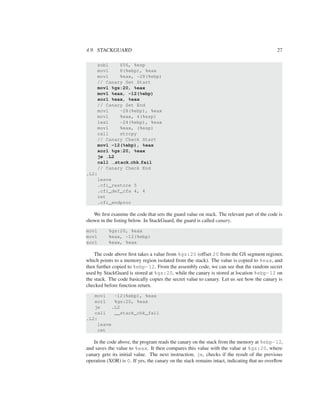
![28 CHAPTER 4. BUFFER OVERFLOW ATTACK
has happened. The code will proceed to return from the function. If je detected that the XOR
result is not zero, i.e., the canary on stack was not equal to the value at %gs:20, an overflow has
occurred. The program call stack chk fail, which prints an error message and terminates
the program.
Ensuring Canary Properties As discussed before, for the StackGuard solution, the secret
value that the canary is checked against needs to satisfy two requirements:
• It needs to be random.
• It cannot be stored on the stack.
The first property is ensured by initializing the canary value using /dev/urandom. More
details about it can be found at the link [xorl, 2010]. The second property is ensured by keeping
a copy of the canary value in %gs:20. The memory segment pointed by the GS register in
Linux is a special area, which is different from the stack, heap, BSS segment, data segment,
and the text segment. Most importantly, this GS segment is physically isolated from the stack,
so a buffer overflow on the stack or heap will not be able to change anything in the GS segment.
On 32-bit x86 architectures, gcc keeps the canary value at offset 20 from %gs and on 64-bit
x86 architectures, gcc stores the canary value at offset 40 from %gs.
4.10 Summary
Buffer overflow vulnerabilities are caused when a program puts data into a buffer but forgets to
check the buffer boundary. It does not seem that such a mistake can cause a big problem, other
than crashing the program. As we can see from this chapter, when a buffer is located on the
stack, a buffer overflow problem can cause the return address on the stack to be overwritten,
resulting in the program to jump to the location specified by the new return address. By putting
malicious code in the new location, attackers can get the victim program to execute the malicious
code. If the victim program is privileged, such as a Set-UID program, a remote server, a
device driver, or a root daemon, the malicious code can be executed using the victim program’s
privilege, which can lead to security breaches.
Buffer overflow vulnerability was the number one vulnerability in software for quite a long
time, because it is quite easy to make such mistakes. Developers should use safe practices when
saving data to a buffer, such as checking the boundary or specifying how much data can be
copied to a buffer. Many countermeasures have been developed, some of which are already
incorporated in operating systems, compilers, software development tools, and libraries. Not
all countermeasures are fool-proof; some can be easily defeated, such as the randomization
countermeasure for 32-bit machines and the non-executable stack countermeasure. In Chapter 5,
we show how to use the return-to-libc attack to defeat the non-executable stack countermeasure.](https://image.slidesharecdn.com/bufferoverflowattack-190220060337/85/Buffer-overflow-attack-28-320.jpg)


