Classification and Taxonomy of Plant Pathogenic
Bacteria(PPB
 Hierarchical classifications at the levels of
Domain, Phylum, Class, Order, Family, and
Genus are mainly based on phylogenetic
analyses using 16S rRNA sequences.
 Classification at the Species level is mainly
based on DNA-DNA hybridization analyses..
Classification and Taxonomy of Plant Pathogenic Bacteria(PPB
General hierarchical classifications
Domain
Phylum,
Class,
Order,
Family, and
Genus
Based on phylogenetic analyses using 16S rRNA
sequences
Classification and Taxonomy of Plant Pathogenic Bacteria(PPB
 Although the resulting bacterial taxa are not
“official” in that an official bacterial
classification system does not exist, the taxa
that are presented by Bergey’s Manual
represent the best consensus available
Classification and Taxonomy of Plant Pathogenic Bacteria(PPB
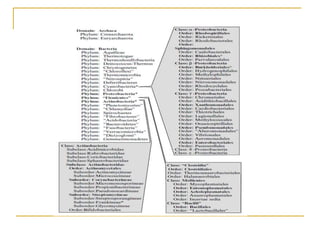
 The current taxonomic outline: Bergey’s Manual of Systematic Bacteriology.
 Bacteria and mollicutes are prokaryotes
 Prokaryotes fall within 2 phyla that comprise the Archaeal Domain and 24 phyla
that comprise the Bacterial Domain.
 This outline requires continuous updating because of the current pace of change
in bacterial taxonomy.
 improved methods for characterizing cultivated organisms:
 Genotypic and molecular level
 Discovery of new organisms
Figure 1. The Actinobacteria, Firmicutes and Proteobacteria diverged early in
evolutionary history.
Classification and Taxonomy of Plant Pathogenic
Bacteria(PPB)
 Uncultivated organisms are included in the taxonomic
overview compiled by Bergey’s Manual of Systematic
Bacteriology only when they meet at least a minimal
level of characterization criteria and are published in, or
approved by, the International Journal of Systematic
and Evolutionary microbiology.
Classification and Taxonomy of Plant Pathogenic
Bacteria(PPB)
 At present, the taxonomy of bacterial phytopathogens is
reviewed and regularly updated by the International Society
for Plant Pathology.
 In addition to the standard taxonomic ranks of family, genus
and species, phytopathogens are commonly divided into
subspecies designated with descriptors such as subspecies,
pathovars, and races
Classification and Taxonomy of Plant Pathogenic
Bacteria(PPB)
 It is difficult to verify all characteristics of a bacterium,
and differentiation between species is not always
apparent.
 Intermediate strains occur. Some groups of
phytopathogenic bacteria can only be differentiated by
their pathogenecity on plants; an intraspecific division
called pathovar.
 Some phytopathogenic bacteria attack only specific
plant species; some have a narrow host range while
others have a wide host range.
Classification and Taxonomy of Plant Pathogenic
Bacteria(PPB
 Pathovar indicates that an organism is a pathogen on
one or more host species, and is usually applied to
pathogens with a fairly narrow host range.
 In 1991, the term pathovar was extended to organisms
that induce distinct symptoms on a single plant species,
and most notably to distinguish Xanthomonas oryzae pv.
oryzae from X. oryzae pv. oryzicola, which cause leaf
blight and leaf streak of rice, respectively.
Classification and Taxonomy of Plant Pathogenic
Bacteria(PPB
 Race is used to distinguish among strains that infect
distinct sets of cultivars, or other identifiable germplasm,
within a host species.
 As an exception, the term race is also used to divide
Ralstonia solanacearum into subspecies based on the
ability to infect distinct plant species, such as most
solanaceous plants (race 1) versus only a single species,
bananas (race 2).
 The term biovar has also been used to divide R.
solanacearum into subspecies based on differences in
carbohydrate utilization profiles.
PPB Classification and Taxonomy
Classification and Taxonomy of Plant Pathogenic Bacteria(PPB)
 The Archaea and the Bacteria are the currently accepted names for
the two distinct lineages of prokaryotes
 These lineages were deduced primarily based on the sequence of
the 16S ribosomal RNA (rRNA) subunit found in all prokaryotic cells.
 The current, standard polyphasic approach to bacterial taxonomy
involves:
 Constructing a phylogenetic, or evolutionary, tree based on 16S
rRNA sequence validating the tree multi-dimensionally by examining
many phenotypic characteristics (physiological and biochemical
traits),
 Genotypic characteristics (G+C content, DNA-DNA similarity, and
DNA-rRNA similarity), and other chemotaxonomic
characteristics(e.g., cellular fatty acids).
Classification and Taxonomy of Plant Pathogenic Bacteria(PPB
Kingdom: Procaryotae
Bacteria — Have cell membrane and cell wall
Division: Gracilicutes — Gram-negative bacteria
Class: Proteobacteria — Mostly single-celled bacteria
Family: Enterobacteriaceae
Genus: Erwinia, causing fire blight of pear and apple, Stewart’s wilt in corn, and soft
rot of fleshy vegetables Pantoea, causing wilt of corn Serratia, S. marcescens, being
a phloem-inhabiting bacterium causing yellow vine disease of cucurbits
Sphingomonas, causing brown spot of yellow Spanish melon fruit
Family: Pseudomonadaceae
Genus: Acidovorax, causing leaf spots in corn, orchids, and watermelon
Pseudomonas, causing numerous leaf spots, blights, vascular wilts, soft rots,
cankers, and galls
Ralstonia, causing wilts of solanaceous crops.
Rhizobacter, causing the bacterial gall of carrot
Rhizomonas, causing the corky root rot of lettuce
Xanthomonas, causing numerous leaf spots, fruit spots, and blights of annual and
perennial plants, vascular wilts, and citrus canker
Xylophilus, causing the bacterial necrosis and canker of grapevines
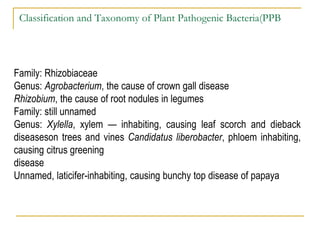
Classification and Taxonomy of Plant Pathogenic Bacteria(PPB
Family: Rhizobiaceae
Genus: Agrobacterium, the cause of crown gall disease
Rhizobium, the cause of root nodules in legumes
Family: still unnamed
Genus: Xylella, xylem — inhabiting, causing leaf scorch and dieback
diseaseson trees and vines Candidatus liberobacter, phloem inhabiting,
causing citrus greening
disease
Unnamed, laticifer-inhabiting, causing bunchy top disease of papaya
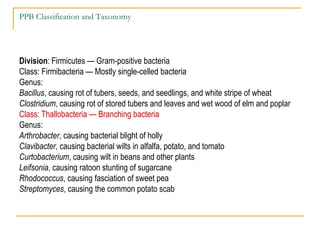
PPB Classification and Taxonomy
Division: Firmicutes — Gram-positive bacteria
Class: Firmibacteria — Mostly single-celled bacteria
Genus:
Bacillus, causing rot of tubers, seeds, and seedlings, and white stripe of wheat
Clostridium, causing rot of stored tubers and leaves and wet wood of elm and poplar
Class: Thallobacteria — Branching bacteria
Genus:
Arthrobacter, causing bacterial blight of holly
Clavibacter, causing bacterial wilts in alfalfa, potato, and tomato
Curtobacterium, causing wilt in beans and other plants
Leifsonia, causing ratoon stunting of sugarcane
Rhodococcus, causing fasciation of sweet pea
Streptomyces, causing the common potato scab
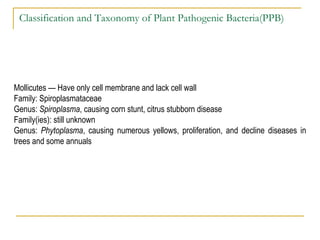
Classification and Taxonomy of Plant Pathogenic Bacteria(PPB)
Mollicutes — Have only cell membrane and lack cell wall
Family: Spiroplasmataceae
Genus: Spiroplasma, causing corn stunt, citrus stubborn disease
Family(ies): still unknown
Genus: Phytoplasma, causing numerous yellows, proliferation, and decline diseases in
trees and some annuals
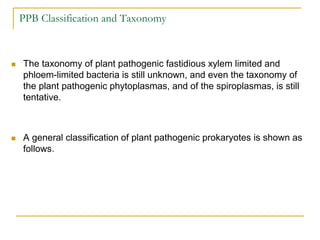
PPB Classification and Taxonomy
 The taxonomy of plant pathogenic fastidious xylem limited and
phloem-limited bacteria is still unknown, and even the taxonomy of
the plant pathogenic phytoplasmas, and of the spiroplasmas, is still
tentative.
 A general classification of plant pathogenic prokaryotes is shown as
follows.
PPB Classification and Taxonomy
 Classification at the Species level is mainly based on
 DNA-DNA hybridization analyses
 Although the resulting bacterial taxa are not “official” in that
an official bacterial classification system does not exist
 The taxa that are presented by Bergey’s Manual represent
the best consensus available.
Different Methods used in modern Taxonomy of PPB
Technique Family Genus Species strain
DNA RFLP
Serology
Phage and Bactericin typing
Protein electrophoretic
pattens
Zymograms
Pyralysis GLC (MS)
Phenotypic analysis
DNA-DNA HYBRIDIZATION
Cellular fatty acid
Other chemotaxonomy
markers
DNA PROBES
DNA:rRNA Hybridization
rRNA sequencing

Chapter_ 4 Plant pathogenic Bacteria_taxonomy.ppt

  • 1.
    Classification and Taxonomyof Plant Pathogenic Bacteria(PPB  Hierarchical classifications at the levels of Domain, Phylum, Class, Order, Family, and Genus are mainly based on phylogenetic analyses using 16S rRNA sequences.  Classification at the Species level is mainly based on DNA-DNA hybridization analyses..
  • 2.
    Classification and Taxonomyof Plant Pathogenic Bacteria(PPB General hierarchical classifications Domain Phylum, Class, Order, Family, and Genus Based on phylogenetic analyses using 16S rRNA sequences
  • 3.
    Classification and Taxonomyof Plant Pathogenic Bacteria(PPB  Although the resulting bacterial taxa are not “official” in that an official bacterial classification system does not exist, the taxa that are presented by Bergey’s Manual represent the best consensus available
  • 4.
    Classification and Taxonomyof Plant Pathogenic Bacteria(PPB  The current taxonomic outline: Bergey’s Manual of Systematic Bacteriology.  Bacteria and mollicutes are prokaryotes  Prokaryotes fall within 2 phyla that comprise the Archaeal Domain and 24 phyla that comprise the Bacterial Domain.  This outline requires continuous updating because of the current pace of change in bacterial taxonomy.  improved methods for characterizing cultivated organisms:  Genotypic and molecular level  Discovery of new organisms
  • 6.
    Figure 1. TheActinobacteria, Firmicutes and Proteobacteria diverged early in evolutionary history.
  • 7.
    Classification and Taxonomyof Plant Pathogenic Bacteria(PPB)  Uncultivated organisms are included in the taxonomic overview compiled by Bergey’s Manual of Systematic Bacteriology only when they meet at least a minimal level of characterization criteria and are published in, or approved by, the International Journal of Systematic and Evolutionary microbiology.
  • 8.
    Classification and Taxonomyof Plant Pathogenic Bacteria(PPB)  At present, the taxonomy of bacterial phytopathogens is reviewed and regularly updated by the International Society for Plant Pathology.  In addition to the standard taxonomic ranks of family, genus and species, phytopathogens are commonly divided into subspecies designated with descriptors such as subspecies, pathovars, and races
  • 9.
    Classification and Taxonomyof Plant Pathogenic Bacteria(PPB)  It is difficult to verify all characteristics of a bacterium, and differentiation between species is not always apparent.  Intermediate strains occur. Some groups of phytopathogenic bacteria can only be differentiated by their pathogenecity on plants; an intraspecific division called pathovar.  Some phytopathogenic bacteria attack only specific plant species; some have a narrow host range while others have a wide host range.
  • 10.
    Classification and Taxonomyof Plant Pathogenic Bacteria(PPB  Pathovar indicates that an organism is a pathogen on one or more host species, and is usually applied to pathogens with a fairly narrow host range.  In 1991, the term pathovar was extended to organisms that induce distinct symptoms on a single plant species, and most notably to distinguish Xanthomonas oryzae pv. oryzae from X. oryzae pv. oryzicola, which cause leaf blight and leaf streak of rice, respectively.
  • 11.
    Classification and Taxonomyof Plant Pathogenic Bacteria(PPB  Race is used to distinguish among strains that infect distinct sets of cultivars, or other identifiable germplasm, within a host species.  As an exception, the term race is also used to divide Ralstonia solanacearum into subspecies based on the ability to infect distinct plant species, such as most solanaceous plants (race 1) versus only a single species, bananas (race 2).  The term biovar has also been used to divide R. solanacearum into subspecies based on differences in carbohydrate utilization profiles.
  • 12.
  • 13.
    Classification and Taxonomyof Plant Pathogenic Bacteria(PPB)  The Archaea and the Bacteria are the currently accepted names for the two distinct lineages of prokaryotes  These lineages were deduced primarily based on the sequence of the 16S ribosomal RNA (rRNA) subunit found in all prokaryotic cells.  The current, standard polyphasic approach to bacterial taxonomy involves:  Constructing a phylogenetic, or evolutionary, tree based on 16S rRNA sequence validating the tree multi-dimensionally by examining many phenotypic characteristics (physiological and biochemical traits),  Genotypic characteristics (G+C content, DNA-DNA similarity, and DNA-rRNA similarity), and other chemotaxonomic characteristics(e.g., cellular fatty acids).
  • 14.
    Classification and Taxonomyof Plant Pathogenic Bacteria(PPB Kingdom: Procaryotae Bacteria — Have cell membrane and cell wall Division: Gracilicutes — Gram-negative bacteria Class: Proteobacteria — Mostly single-celled bacteria Family: Enterobacteriaceae Genus: Erwinia, causing fire blight of pear and apple, Stewart’s wilt in corn, and soft rot of fleshy vegetables Pantoea, causing wilt of corn Serratia, S. marcescens, being a phloem-inhabiting bacterium causing yellow vine disease of cucurbits Sphingomonas, causing brown spot of yellow Spanish melon fruit Family: Pseudomonadaceae Genus: Acidovorax, causing leaf spots in corn, orchids, and watermelon Pseudomonas, causing numerous leaf spots, blights, vascular wilts, soft rots, cankers, and galls Ralstonia, causing wilts of solanaceous crops. Rhizobacter, causing the bacterial gall of carrot Rhizomonas, causing the corky root rot of lettuce Xanthomonas, causing numerous leaf spots, fruit spots, and blights of annual and perennial plants, vascular wilts, and citrus canker Xylophilus, causing the bacterial necrosis and canker of grapevines
  • 15.
    Classification and Taxonomyof Plant Pathogenic Bacteria(PPB Family: Rhizobiaceae Genus: Agrobacterium, the cause of crown gall disease Rhizobium, the cause of root nodules in legumes Family: still unnamed Genus: Xylella, xylem — inhabiting, causing leaf scorch and dieback diseaseson trees and vines Candidatus liberobacter, phloem inhabiting, causing citrus greening disease Unnamed, laticifer-inhabiting, causing bunchy top disease of papaya
  • 16.
    PPB Classification andTaxonomy Division: Firmicutes — Gram-positive bacteria Class: Firmibacteria — Mostly single-celled bacteria Genus: Bacillus, causing rot of tubers, seeds, and seedlings, and white stripe of wheat Clostridium, causing rot of stored tubers and leaves and wet wood of elm and poplar Class: Thallobacteria — Branching bacteria Genus: Arthrobacter, causing bacterial blight of holly Clavibacter, causing bacterial wilts in alfalfa, potato, and tomato Curtobacterium, causing wilt in beans and other plants Leifsonia, causing ratoon stunting of sugarcane Rhodococcus, causing fasciation of sweet pea Streptomyces, causing the common potato scab
  • 17.
    Classification and Taxonomyof Plant Pathogenic Bacteria(PPB) Mollicutes — Have only cell membrane and lack cell wall Family: Spiroplasmataceae Genus: Spiroplasma, causing corn stunt, citrus stubborn disease Family(ies): still unknown Genus: Phytoplasma, causing numerous yellows, proliferation, and decline diseases in trees and some annuals
  • 18.
    PPB Classification andTaxonomy  The taxonomy of plant pathogenic fastidious xylem limited and phloem-limited bacteria is still unknown, and even the taxonomy of the plant pathogenic phytoplasmas, and of the spiroplasmas, is still tentative.  A general classification of plant pathogenic prokaryotes is shown as follows.
  • 19.
    PPB Classification andTaxonomy  Classification at the Species level is mainly based on  DNA-DNA hybridization analyses  Although the resulting bacterial taxa are not “official” in that an official bacterial classification system does not exist  The taxa that are presented by Bergey’s Manual represent the best consensus available.
  • 20.
    Different Methods usedin modern Taxonomy of PPB Technique Family Genus Species strain DNA RFLP Serology Phage and Bactericin typing Protein electrophoretic pattens Zymograms Pyralysis GLC (MS) Phenotypic analysis DNA-DNA HYBRIDIZATION Cellular fatty acid Other chemotaxonomy markers DNA PROBES DNA:rRNA Hybridization rRNA sequencing