Chapter 5 - Microbial Metabolism
• Metabolism is all of the chemical reactions in an
organism.
• is the energy-releasing
processes.
• Occurs when molecular bonds (and thus,
molecules) are broken down.
• Generates ATP
• is the energy-using
processes.
• Occurs when molecular bonds (and thus,
molecules) are formed.
• Uses ATP
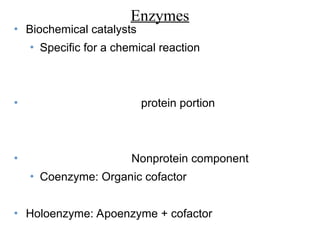
Enzymes
• Biochemical catalysts
• Specific for a chemical reaction
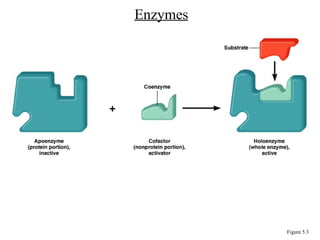
• protein portion
• Nonprotein component
• Coenzyme: Organic cofactor
• Holoenzyme: Apoenzyme + cofactor
Enzymes
Figure 5.3
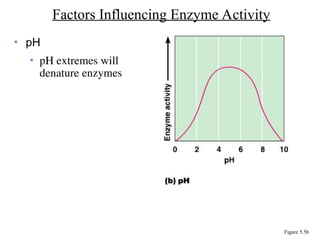
• pH
• pH extremes will
denature enzymes
Factors Influencing Enzyme Activity
Figure 5.5b
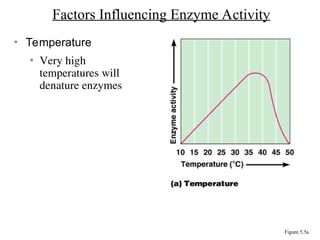
• Temperature
• Very high
temperatures will
denature enzymes
Factors Influencing Enzyme Activity
Figure 5.5a
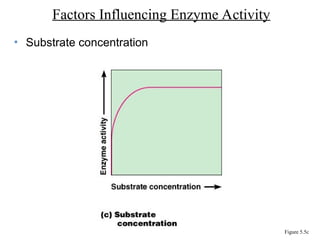
• Substrate concentration
Factors Influencing Enzyme Activity
Figure 5.5c
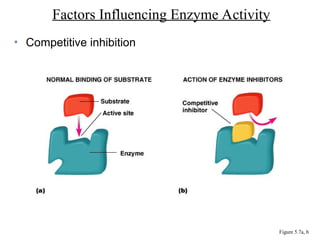
• Competitive inhibition
Factors Influencing Enzyme Activity
Figure 5.7a, b
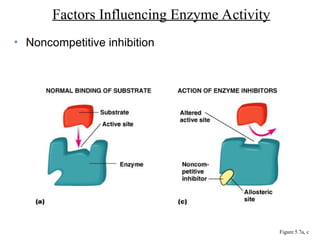
• Noncompetitive inhibition
Factors Influencing Enzyme Activity
Figure 5.7a, c
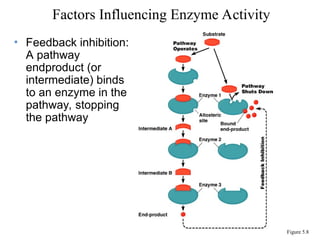
• Feedback inhibition:
A pathway
endproduct (or
intermediate) binds
to an enzyme in the
pathway, stopping
the pathway
Factors Influencing Enzyme Activity
Figure 5.8
Oxidation-Reduction
• is the loss of electrons.
• is the gain of electrons.
• Redox reaction is an oxidation reaction paired with a
reduction reaction.
The Generation of ATP
• ATP is the main energy currency in living cells
• Energy released from the transfer of electrons of
one compound to another is used to generate ATP.
Carbohydrate Catabolism
• The breakdown of carbohydrates to release energy
• Glycolysis
• Krebs cycle
• Electron transport chain
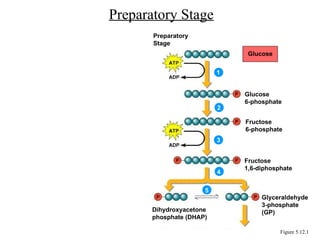
• The oxidation of glucose to pyruvic acid; produces
• Preparatory Stage
• 2 ATPs are used
• Glucose is split to form two Glyceraldehyde-3-
phosphates
Glycolysis
Preparatory Stage
Figure 5.12.1
Preparatory
Stage
Glucose
Glucose
6-phosphate
Fructose
6-phosphate
Fructose
1,6-diphosphate
Dihydroxyacetone
phosphate (DHAP)
Glyceraldehyde
3-phosphate
(GP)
1
2
3
4
5
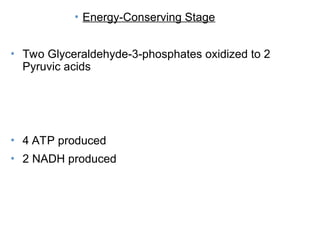
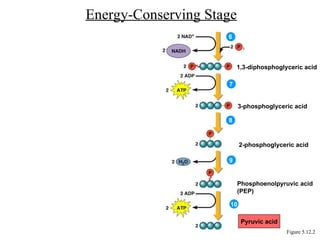
• Energy-Conserving Stage
• Two Glyceraldehyde-3-phosphates oxidized to 2
Pyruvic acids
• 4 ATP produced
• 2 NADH produced
Energy-Conserving Stage
Figure 5.12.2
1,3-diphosphoglyceric acid
3-phosphoglyceric acid
2-phosphoglyceric acid
Phosphoenolpyruvic acid
(PEP)
6
7
8
9
10
Pyruvic acid
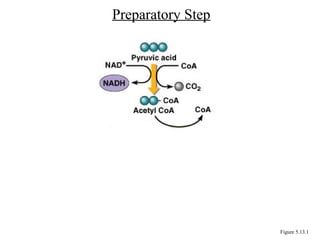
• Preparatory Step:
• Pyruvic acid (from glycolysis) is oxidized and
decarboyxlated
• Acetyl CoA is produced
Krebs Cycle
Preparatory Step
Figure 5.13.1
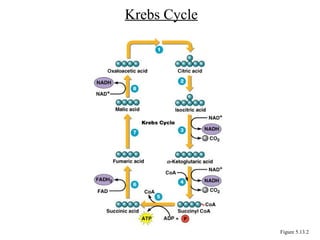
Krebs Cycle
• Oxidation of acetyl CoA produces 6 NADH and 2
FADH2
• 2 ATP produced; CO2 produced
Krebs Cycle
Figure 5.13.2
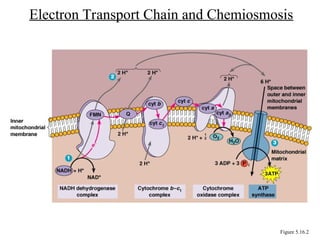
• A series of molecules that pass electrons down the
chain. (oxidation – reduction reactions)
• Energy released can be used to produce ATP by
The Electron Transport Chain
Electron Transport Chain and Chemiosmosis
Figure 5.16.2
Cellular Respiration
• The final electron
acceptor in the electron transport chain is O2.
• The final electron
acceptor in the electron transport chain is not O2.
Net Yield:
• 1 Glucose oxidized aerobically = ~38 ATP
• 1 Glucose oxidized anaerobically = much less ATP
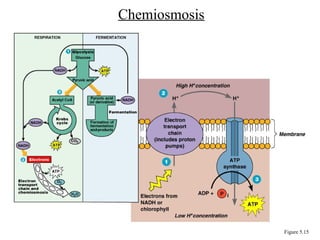
Chemiosmosis
Figure 5.15
• Does not require oxygen
• Does not use the Krebs cycle or ETC
• Uses an organic molecule as the final electron acceptor
• Alcohol fermentation. Produces ethyl alcohol + CO2
• Lactic acid fermentation. Produces lactic acid.
Fermentation
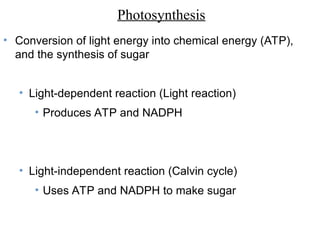
• Conversion of light energy into chemical energy (ATP),
and the synthesis of sugar
• Light-dependent reaction (Light reaction)
• Produces ATP and NADPH
• Light-independent reaction (Calvin cycle)
• Uses ATP and NADPH to make sugar
Photosynthesis
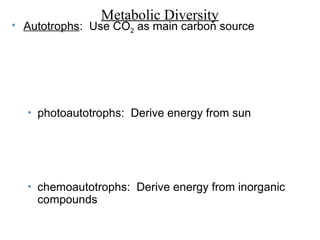
Metabolic Diversity
• Autotrophs: Use CO2 as main carbon source
• photoautotrophs: Derive energy from sun
• chemoautotrophs: Derive energy from inorganic
compounds
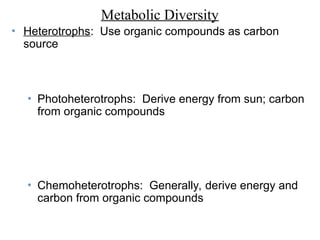
Metabolic Diversity
• Heterotrophs: Use organic compounds as carbon
source
• Photoheterotrophs: Derive energy from sun; carbon
from organic compounds
• Chemoheterotrophs: Generally, derive energy and
carbon from organic compounds
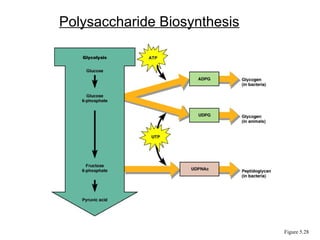
Polysaccharide Biosynthesis
Figure 5.28
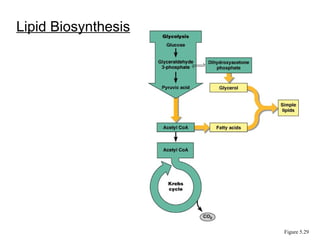
Lipid Biosynthesis
Figure 5.29

Chao5 Microbial Metabolism Frontdoor.ppt