Biotechnology
is the use of biological systems,
such as microorganisms, whole
cells or their molecules, to solve
problems or to make useful
products.
Tools of Biotechnology
1. Bioprocessing technology
• Using whole living cells or components of
them to manufacture desired products.
• Most common whole cells used are yeast and
bacteria (one-celled organisms).
• Most common components are enzymes
(proteins that catalyze chemical reactions).
• Microbial fermentation
• Cells isolated from animals and plants also
are used to produce desired products.
2. Genetic engineering
• The technique of removing, modifying or adding
genes to a DNA molecule to change the
information it contains.
• Is known more specifically as recombinant DNA
(rDNA) technology.
• The product of rDNA technology is known as a
genetically modified organism, or GMO.
• Example: Gene for human insulin inserted into
E.coli → bacteria that make human insulin (a
biopharmaceutical).
Tools of Biotechnology
Practical Applications of Biotechnology
1. Agricultural applications
• Better crops
• Improved animal health
2. Medical and health care applications
• New tests
• New vaccines
• New medicines
3. Chemical and environmental applications
• Better manufacturing processes
• Improved consumer products
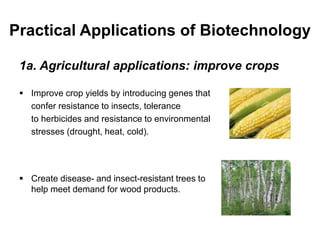
1a. Agricultural applications: improve crops
 Improve crop yields by introducing genes that
confer resistance to insects, tolerance
to herbicides and resistance to environmental
stresses (drought, heat, cold).
 Create disease- and insect-resistant trees to
help meet demand for wood products.
Practical Applications of Biotechnology
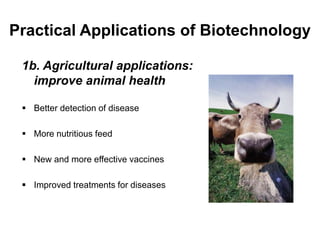
1b. Agricultural applications:
improve animal health
 Better detection of disease
 More nutritious feed
 New and more effective vaccines
 Improved treatments for diseases
Practical Applications of Biotechnology
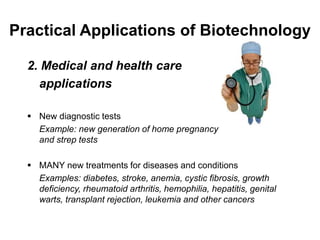
2. Medical and health care
applications
 New diagnostic tests
Example: new generation of home pregnancy
and strep tests
 MANY new treatments for diseases and conditions
Examples: diabetes, stroke, anemia, cystic fibrosis, growth
deficiency, rheumatoid arthritis, hemophilia, hepatitis, genital
warts, transplant rejection, leukemia and other cancers
Practical Applications of Biotechnology
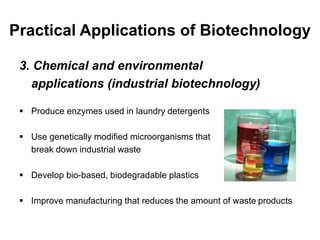
3. Chemical and environmental
applications (industrial biotechnology)
 Produce enzymes used in laundry detergents
 Use genetically modified microorganisms that
break down industrial waste
 Develop bio-based, biodegradable plastics
 Improve manufacturing that reduces the amount of waste products
Practical Applications of Biotechnology

unit1_practical-applications-of-biotechnology.ppt

  • 1.
    Biotechnology is the useof biological systems, such as microorganisms, whole cells or their molecules, to solve problems or to make useful products.
  • 2.
    Tools of Biotechnology 1.Bioprocessing technology • Using whole living cells or components of them to manufacture desired products. • Most common whole cells used are yeast and bacteria (one-celled organisms). • Most common components are enzymes (proteins that catalyze chemical reactions). • Microbial fermentation • Cells isolated from animals and plants also are used to produce desired products.
  • 3.
    2. Genetic engineering •The technique of removing, modifying or adding genes to a DNA molecule to change the information it contains. • Is known more specifically as recombinant DNA (rDNA) technology. • The product of rDNA technology is known as a genetically modified organism, or GMO. • Example: Gene for human insulin inserted into E.coli → bacteria that make human insulin (a biopharmaceutical). Tools of Biotechnology
  • 4.
    Practical Applications ofBiotechnology 1. Agricultural applications • Better crops • Improved animal health 2. Medical and health care applications • New tests • New vaccines • New medicines 3. Chemical and environmental applications • Better manufacturing processes • Improved consumer products
  • 5.
    1a. Agricultural applications:improve crops  Improve crop yields by introducing genes that confer resistance to insects, tolerance to herbicides and resistance to environmental stresses (drought, heat, cold).  Create disease- and insect-resistant trees to help meet demand for wood products. Practical Applications of Biotechnology
  • 6.
    1b. Agricultural applications: improveanimal health  Better detection of disease  More nutritious feed  New and more effective vaccines  Improved treatments for diseases Practical Applications of Biotechnology
  • 7.
    2. Medical andhealth care applications  New diagnostic tests Example: new generation of home pregnancy and strep tests  MANY new treatments for diseases and conditions Examples: diabetes, stroke, anemia, cystic fibrosis, growth deficiency, rheumatoid arthritis, hemophilia, hepatitis, genital warts, transplant rejection, leukemia and other cancers Practical Applications of Biotechnology
  • 8.
    3. Chemical andenvironmental applications (industrial biotechnology)  Produce enzymes used in laundry detergents  Use genetically modified microorganisms that break down industrial waste  Develop bio-based, biodegradable plastics  Improve manufacturing that reduces the amount of waste products Practical Applications of Biotechnology