Chapter 4: Government
Learning Objectives What is a government What were the systems of government in ancient India, China and Southeast Asia? What were the strengths/weaknesses of each system?
What Is ‘Government’? Group of people responsible for ruling a country System of ruling What, in your opinion, are the qualities of good government?
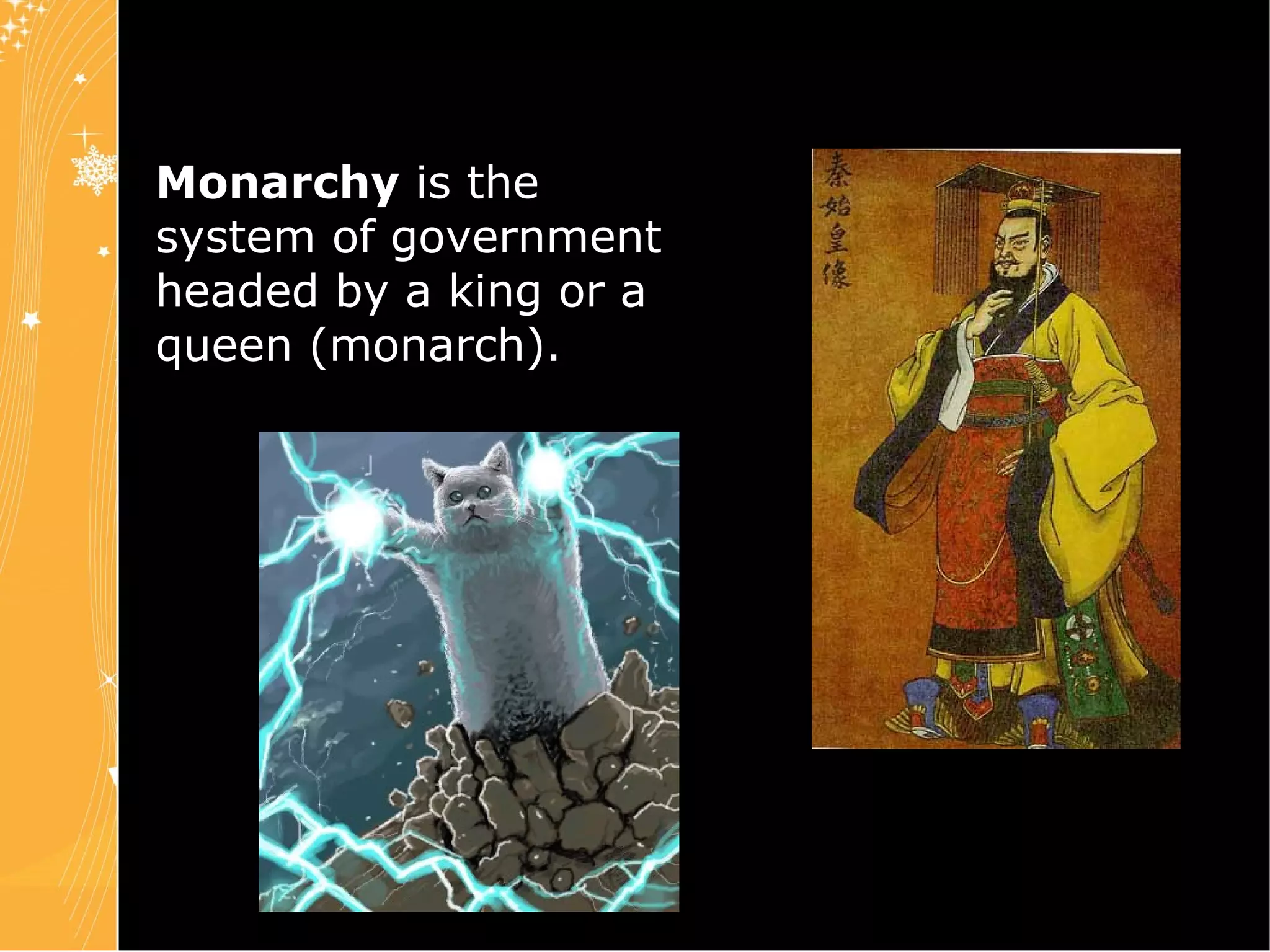
Monarchy  is the system of government headed by a king or a queen (monarch).
Government in India Government in India  Chapter 4 Slide 5 Concentric circles model of government Border Zones:  The king’s power overlapped with those of other kings. People had a choice of which king they wanted to be loyal to. Border Zones Outer Provinces : King’s power was weaker here. The governors had to share power with local kings, who still acknowledged that the king in the capital city was more powerful. Outer Provinces Inner Provinces:  These areas were closest to the capital. In each province, a governor who reported directly to the king was in charge. Inner Provinces Capital City:  King’s palace was located here. He was surrounded by nobles and ministers, or  mantri . Capital city
In 326 BCE, Alexander the Great invaded  the Indus region.The chaos and disorder  that resulted allowed Chandragupta  Maurya to overthrow the Magadha  dynasty, the most powerful kingdom then.  The Mauryan  Period  (c. 322–185 BCE) Chapter 4 Slide 6 When Alexander left, Chandragupta  Maurya was able to expand his power  from Magadha into the Indus region  and form the Mauryan empire and  dynasty (c. 322–185 BCE).
Chandragupta
Chandragupta Maurya’s   System of Government Highly organised with Pataliputra as  the capital city, but empire was  divided into provinces, each ruled by  trusted officials Each city ruled by committees that  took charge of certain main areas,  e.g. public works or trade All committees, however, ultimately  reported to Chandragupta Maurya Chapter 4 Slide 8
Government in China Feudalism  Practised by Shang (1523–1027 BCE)  and Zhou (1027–771 BCE) rulers A system in which some people were  given lands and limited ruling powers  by a ruler in return for their loyalty and support Chapter 4 Slide 10
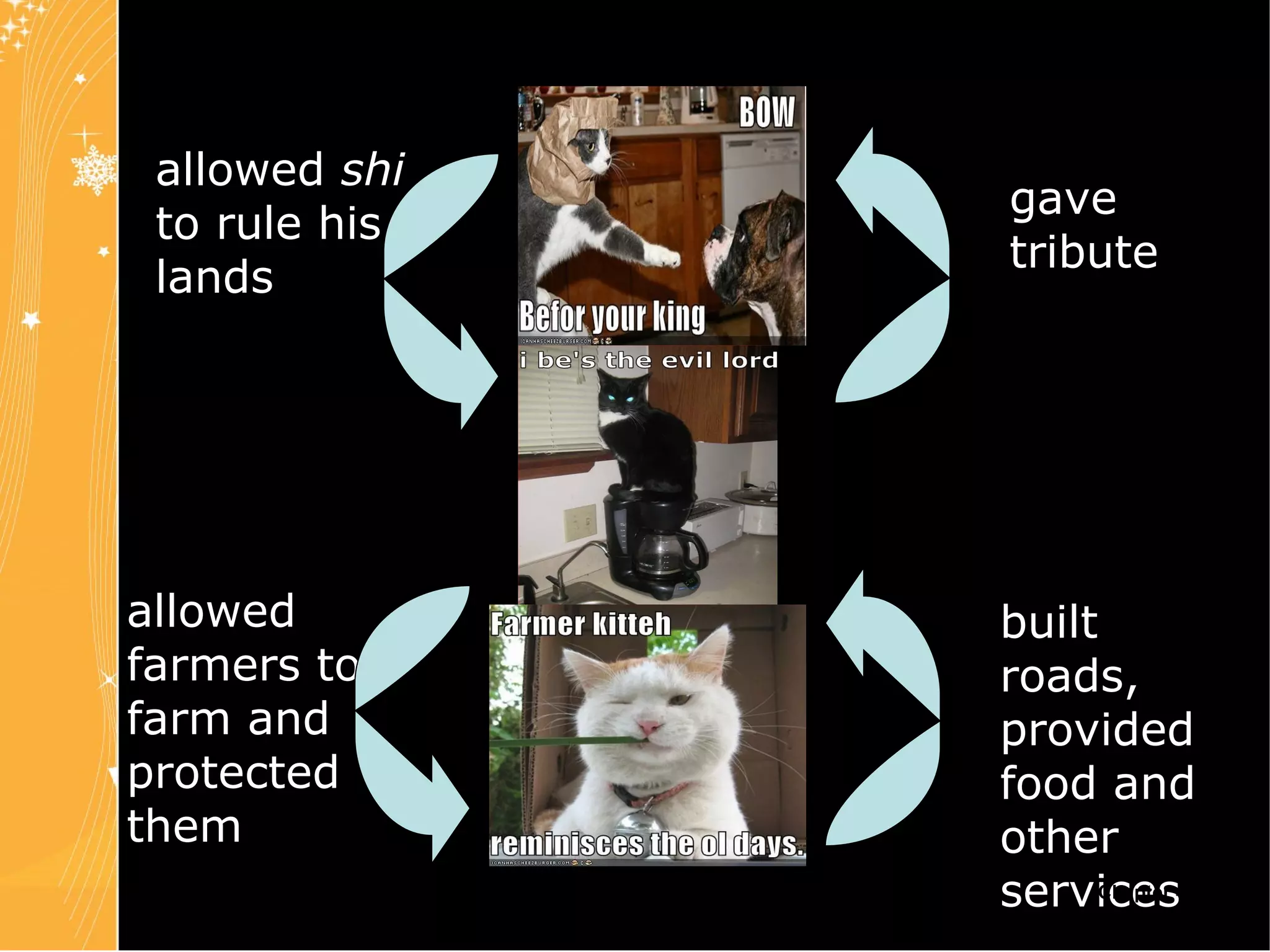
Chapter 4 Slide 11 allowed  shi  to rule his lands allowed farmers to farm and protected them   built roads, provided food and other services gave tribute
Unitary System of   Government  Period of the Warring States saw  fighting between the different  shi  and  their army.  In 221 BCE, Qin Shihuang defeated the  shi  to unify China for the first  time He abolished feudalism and set up a  centralised government — unitary   system of government Chapter 4 Slide 13
 
 
Qin Shihuang’s System of Government Chapter 4 Slide 14 Each managed by an inspector, a military governor and a civilian governor. All reported directly to the emperor. Provinces Capital city Emperor
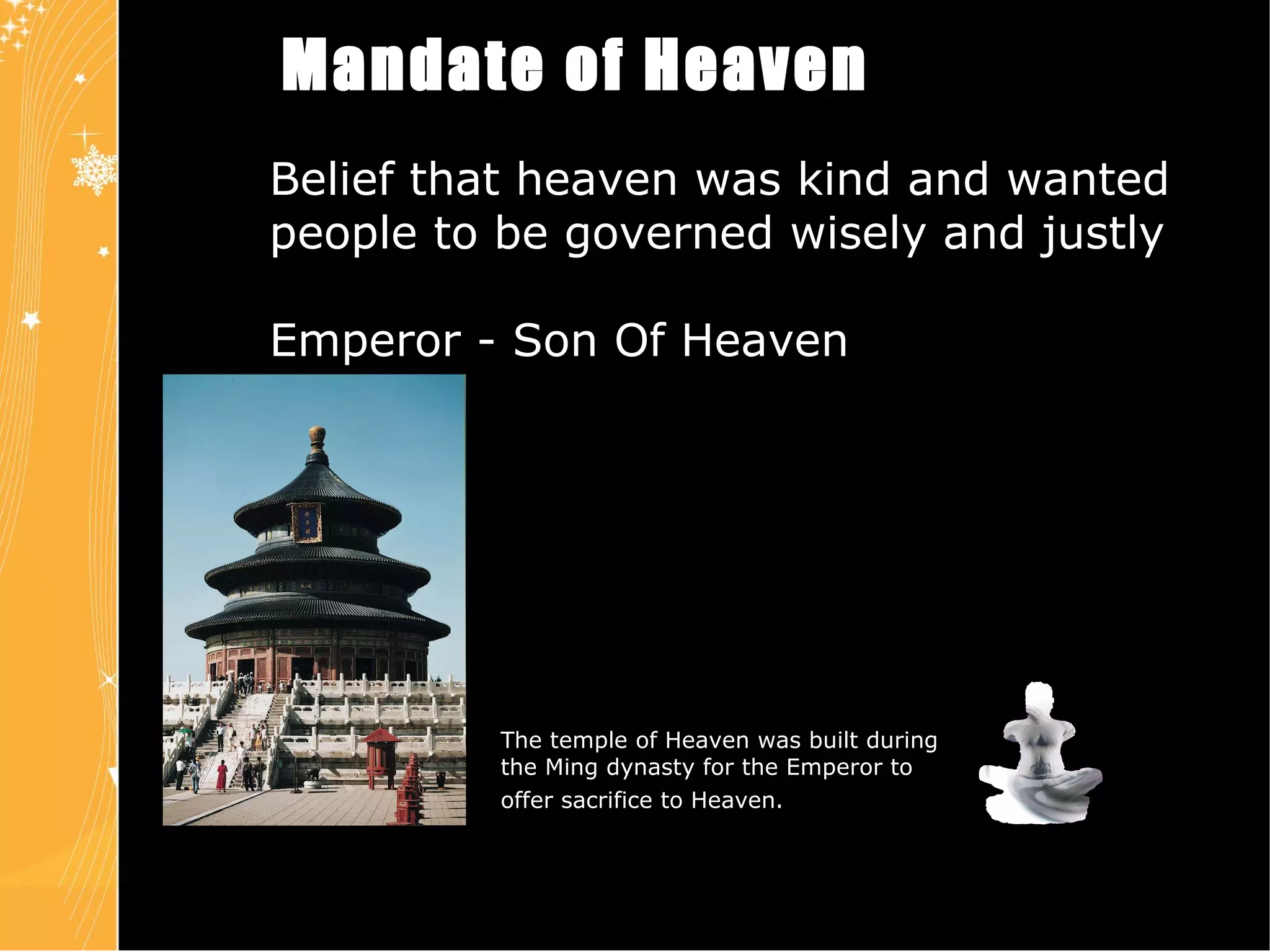
Mandate of Heaven Belief that heaven was kind and wanted people to be governed wisely and justly Emperor - Son Of Heaven Chapter 4 Slide 16 The temple of Heaven was built during the Ming dynasty for the Emperor to offer sacrifice to Heaven.
Strong emperor    peace and good  harvest apter 4 Slide 17 Natural disasters lead to  poor harvests    weak emperor Natural disasters — signs from  heaven that the people had right to  revolt
The Chinese Civil Service ‘ Civil service’ refers to the government  departments and the people who work in them Chapter 4 Slide 19 Before Han Wudi (140–87 BCE)  became emperor, the civil service  was made up of members of rich  and powerful families
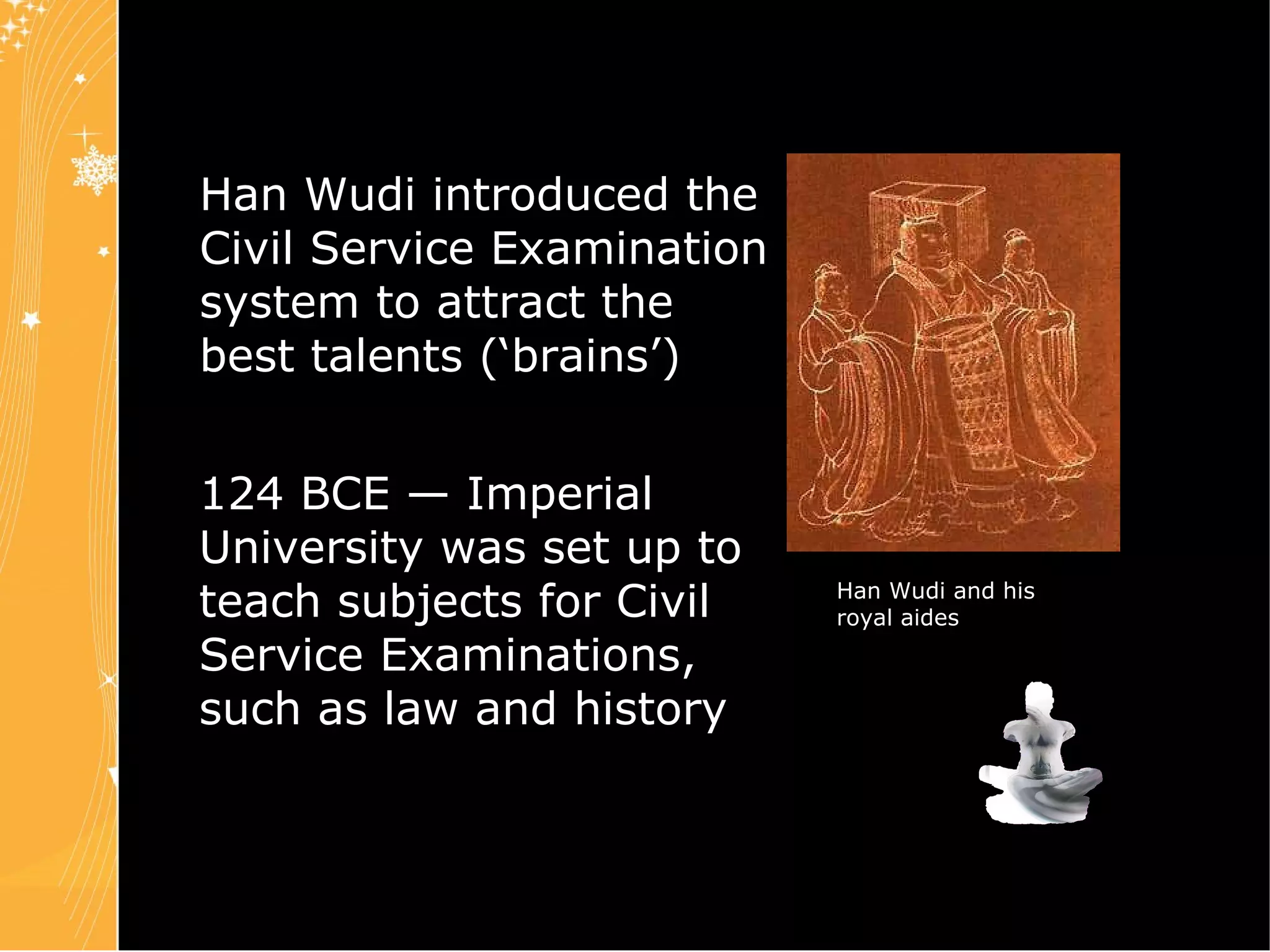
Chapter 4 Slide 20 Han Wudi introduced the Civil Service Examination system to attract the best talents (‘brains’) 124 BCE — Imperial University was set up to teach subjects for Civil Service Examinations, such as law and history Han Wudi and his royal aides
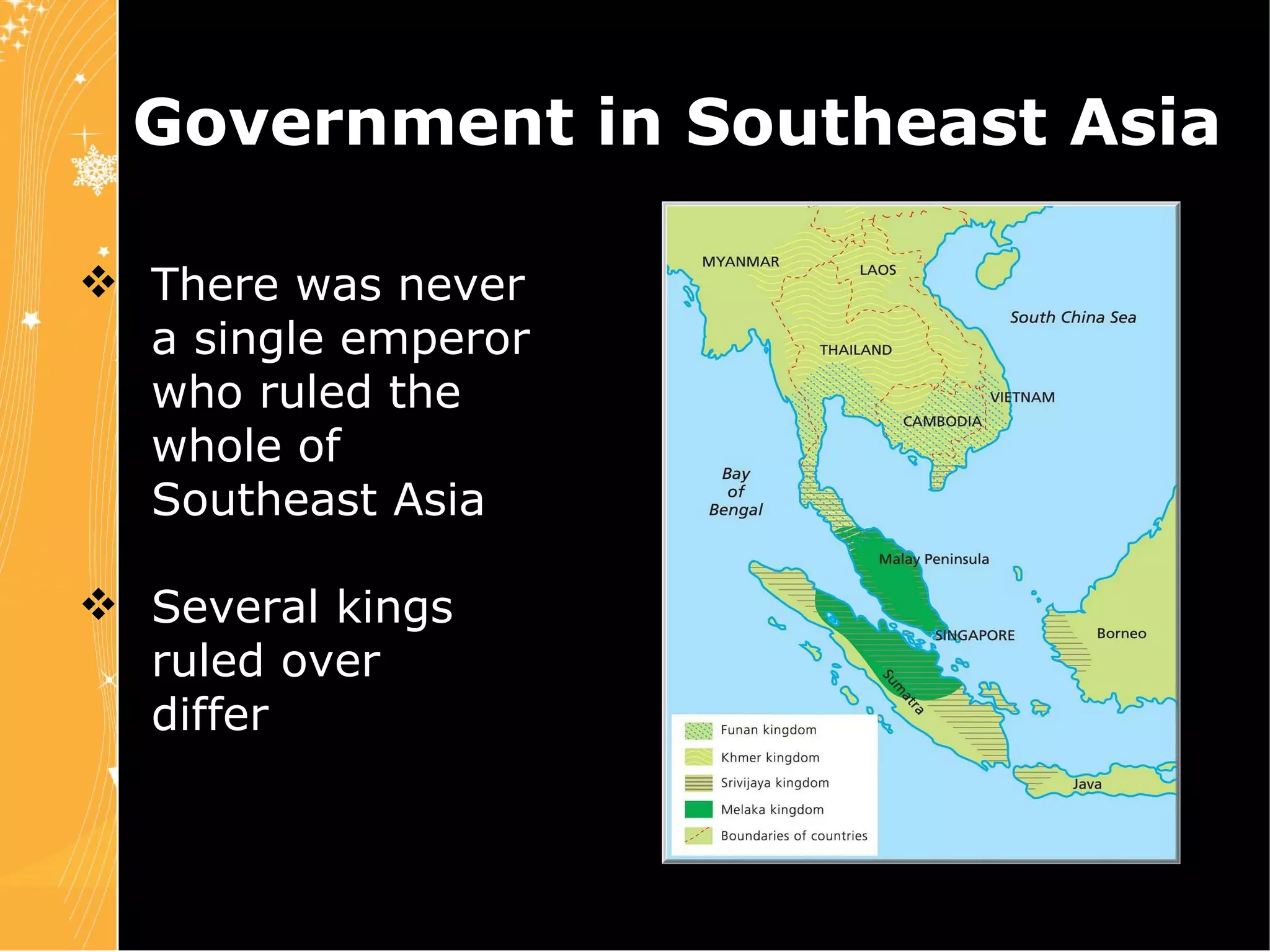
Government in Southeast Asia There was never  a single emperor  who ruled the  whole of  Southeast Asia Several kings  ruled over differ ent sizes of kingdoms
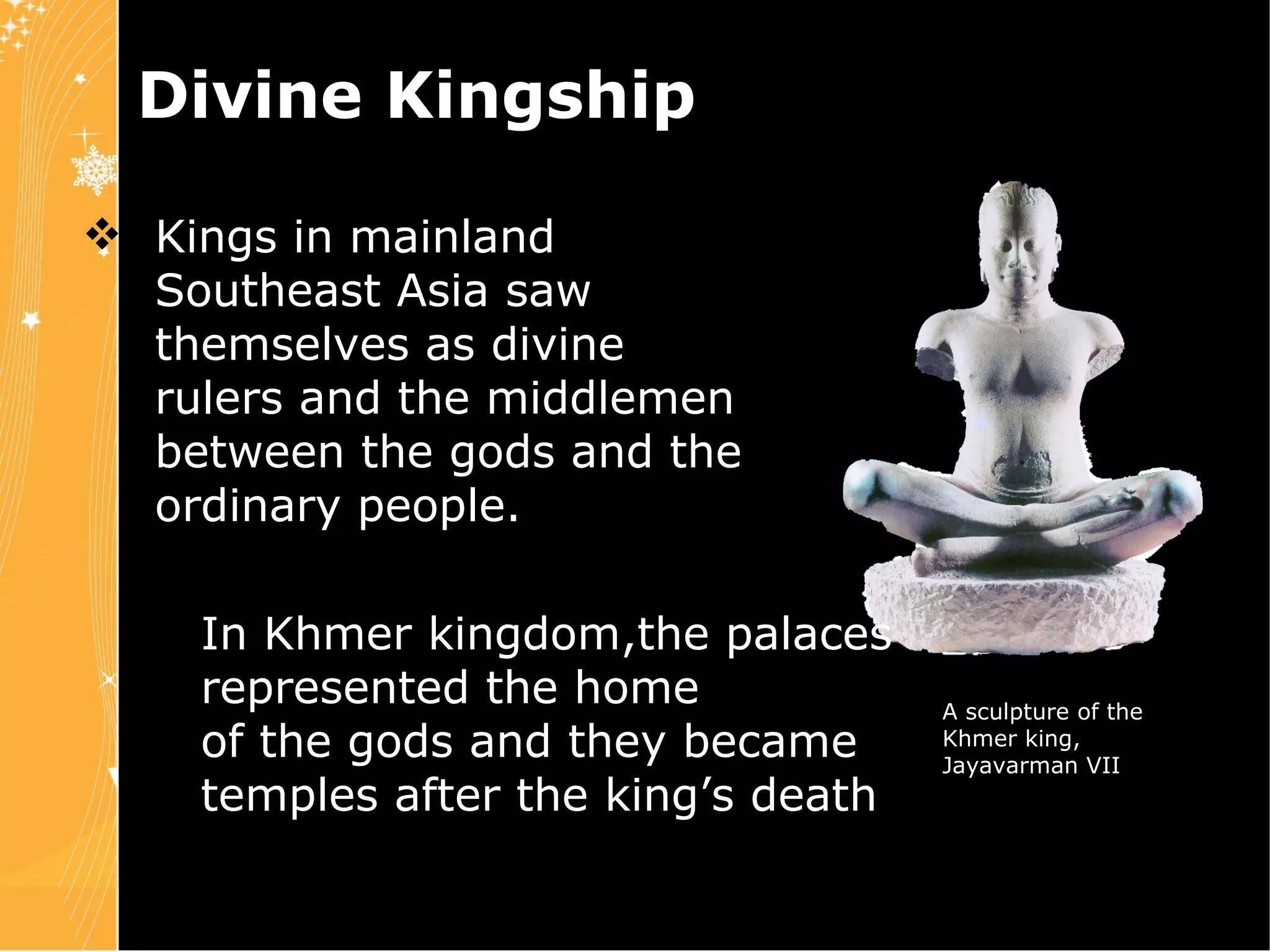
Divine Kingship Kings in mainland  Southeast Asia saw  themselves as divine  rulers and the middlemen  between the gods and the  ordinary people. Chapter 4 Slide 22 In Khmer kingdom,the palaces  represented the home  of the gods and they became  temples after the king’s death . A sculpture of the Khmer king, Jayavarman VII
Cultural Adaptation Borrowing foreign practices that are  useful and rejecting those that are  not useful to suit one’s environment. Chapter 4 Slide 23 For example, kings in island Southeast  Asia, used Indian emblems of kingship  to represent their authority, e.g. the  sacred royal umbrella. However, the  kings did not see themselves as gods  after converting to Islam.
Parameswara Founded Melaka in 1403 C.E. Encouraged trade and made Melaka a  safe place for trader Cultivated friendship with China Converted to Islam, which attracted  Muslim traders from Arabia and India Chapter 4 Slide 24 http://www.youtube.com/watch?v=j7SsVQXMJW8&feature=related
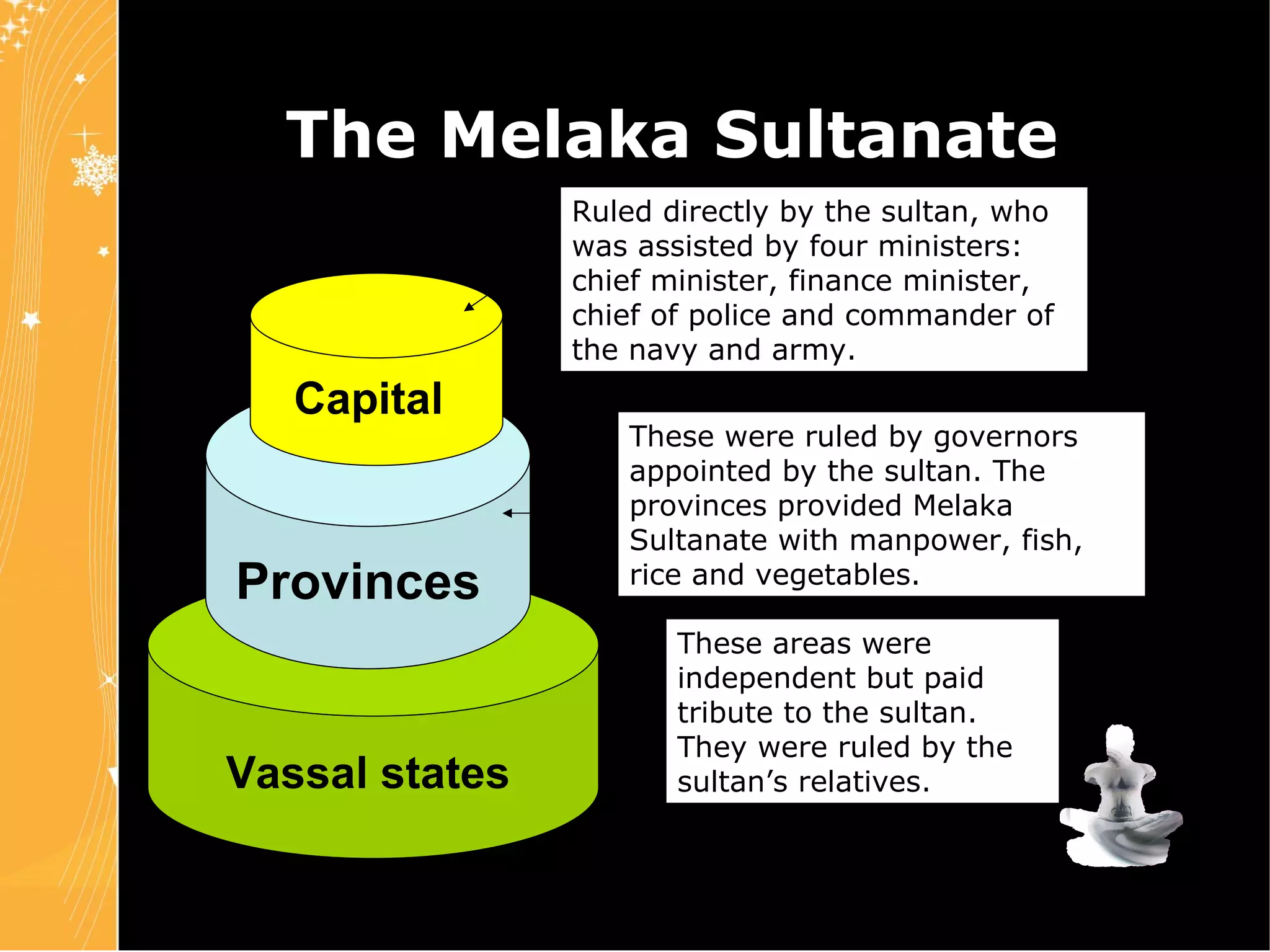
The Melaka Sultanate Chapter 4 Slide 25 The model of the system of government in the Melaka Sultanate Vassal states These areas were independent but paid tribute to the sultan. They were ruled by the sultan’s relatives. Provinces These were ruled by governors appointed by the sultan. The provinces provided Melaka Sultanate with manpower, fish, rice and vegetables. Capital Ruled directly by the sultan, who was assisted by four ministers: chief minister, finance minister, chief of police and commander of the navy and army.

Chapter 4 - Government

  • 1.
  • 2.
    Learning Objectives Whatis a government What were the systems of government in ancient India, China and Southeast Asia? What were the strengths/weaknesses of each system?
  • 3.
    What Is ‘Government’?Group of people responsible for ruling a country System of ruling What, in your opinion, are the qualities of good government?
  • 4.
    Monarchy isthe system of government headed by a king or a queen (monarch).
  • 5.
    Government in IndiaGovernment in India Chapter 4 Slide 5 Concentric circles model of government Border Zones: The king’s power overlapped with those of other kings. People had a choice of which king they wanted to be loyal to. Border Zones Outer Provinces : King’s power was weaker here. The governors had to share power with local kings, who still acknowledged that the king in the capital city was more powerful. Outer Provinces Inner Provinces: These areas were closest to the capital. In each province, a governor who reported directly to the king was in charge. Inner Provinces Capital City: King’s palace was located here. He was surrounded by nobles and ministers, or mantri . Capital city
  • 6.
    In 326 BCE,Alexander the Great invaded the Indus region.The chaos and disorder that resulted allowed Chandragupta Maurya to overthrow the Magadha dynasty, the most powerful kingdom then. The Mauryan Period (c. 322–185 BCE) Chapter 4 Slide 6 When Alexander left, Chandragupta Maurya was able to expand his power from Magadha into the Indus region and form the Mauryan empire and dynasty (c. 322–185 BCE).
  • 7.
  • 8.
    Chandragupta Maurya’s System of Government Highly organised with Pataliputra as the capital city, but empire was divided into provinces, each ruled by trusted officials Each city ruled by committees that took charge of certain main areas, e.g. public works or trade All committees, however, ultimately reported to Chandragupta Maurya Chapter 4 Slide 8
  • 9.
    Government in ChinaFeudalism Practised by Shang (1523–1027 BCE) and Zhou (1027–771 BCE) rulers A system in which some people were given lands and limited ruling powers by a ruler in return for their loyalty and support Chapter 4 Slide 10
  • 10.
    Chapter 4 Slide11 allowed shi to rule his lands allowed farmers to farm and protected them built roads, provided food and other services gave tribute
  • 11.
    Unitary System of Government Period of the Warring States saw fighting between the different shi and their army. In 221 BCE, Qin Shihuang defeated the shi to unify China for the first time He abolished feudalism and set up a centralised government — unitary system of government Chapter 4 Slide 13
  • 12.
  • 13.
  • 14.
    Qin Shihuang’s Systemof Government Chapter 4 Slide 14 Each managed by an inspector, a military governor and a civilian governor. All reported directly to the emperor. Provinces Capital city Emperor
  • 15.
    Mandate of HeavenBelief that heaven was kind and wanted people to be governed wisely and justly Emperor - Son Of Heaven Chapter 4 Slide 16 The temple of Heaven was built during the Ming dynasty for the Emperor to offer sacrifice to Heaven.
  • 16.
    Strong emperor  peace and good harvest apter 4 Slide 17 Natural disasters lead to poor harvests  weak emperor Natural disasters — signs from heaven that the people had right to revolt
  • 17.
    The Chinese CivilService ‘ Civil service’ refers to the government departments and the people who work in them Chapter 4 Slide 19 Before Han Wudi (140–87 BCE) became emperor, the civil service was made up of members of rich and powerful families
  • 18.
    Chapter 4 Slide20 Han Wudi introduced the Civil Service Examination system to attract the best talents (‘brains’) 124 BCE — Imperial University was set up to teach subjects for Civil Service Examinations, such as law and history Han Wudi and his royal aides
  • 19.
    Government in SoutheastAsia There was never a single emperor who ruled the whole of Southeast Asia Several kings ruled over differ ent sizes of kingdoms
  • 20.
    Divine Kingship Kingsin mainland Southeast Asia saw themselves as divine rulers and the middlemen between the gods and the ordinary people. Chapter 4 Slide 22 In Khmer kingdom,the palaces represented the home of the gods and they became temples after the king’s death . A sculpture of the Khmer king, Jayavarman VII
  • 21.
    Cultural Adaptation Borrowingforeign practices that are useful and rejecting those that are not useful to suit one’s environment. Chapter 4 Slide 23 For example, kings in island Southeast Asia, used Indian emblems of kingship to represent their authority, e.g. the sacred royal umbrella. However, the kings did not see themselves as gods after converting to Islam.
  • 22.
    Parameswara Founded Melakain 1403 C.E. Encouraged trade and made Melaka a safe place for trader Cultivated friendship with China Converted to Islam, which attracted Muslim traders from Arabia and India Chapter 4 Slide 24 http://www.youtube.com/watch?v=j7SsVQXMJW8&feature=related
  • 23.
    The Melaka SultanateChapter 4 Slide 25 The model of the system of government in the Melaka Sultanate Vassal states These areas were independent but paid tribute to the sultan. They were ruled by the sultan’s relatives. Provinces These were ruled by governors appointed by the sultan. The provinces provided Melaka Sultanate with manpower, fish, rice and vegetables. Capital Ruled directly by the sultan, who was assisted by four ministers: chief minister, finance minister, chief of police and commander of the navy and army.