Think about thefollowing Q’s and write your
answers down.
Q# 1 What is the ideal age? Why? Explain.
Q# 2 What is the worst age? Why? Explain.
Q# 3 How old do you feel? Why? Explain.
5.
Three Fundamental Issues:
#1- Nature vs. Nurture
How do genetic inheritance (our nature) and
experience (the nurture we receive) influence
our behavior?
Not either/or.
Nature and Nurture
work together.
6.
Three Fundamental Issues:
#2- Is Development Continuous?
Is developmental a gradual, continuous process
or a sequence of separate stages?
Two views of human development:
stage theories: there are distinct phases to
intellectual and personality development
continuity: development is continuous
7.
Three Fundamental Issues:
#3- Stability or Change?
Do our early personality traits persist through
life, or do we become different people as we
age? Can we change?
10
Developing Brain
The developingbrain overproduces neurons more or less at
random. Peaking around 2 months before birth, these neurons
are pruned to keep only the ones that are making connections
appropriate to their part of the brain.
After birth, existing
neurons branch out to
make neural networks.
Pruning will happen
again in adolescence.
11.
Motor Development: Maturation
First,infants begin to roll over. Next,
they sit unsupported, crawl, and
finally walk. Experience has little
effect on this sequence.
13.
13
Cognitive Development
Jean Piagetwas one of the leading
developmental psychologists of his
generation.
Piaget revolutionized our understanding of
children’s cognitive development—all the
mental activities associated with thinking,
knowing, remembering, and
communicating.
14.
14
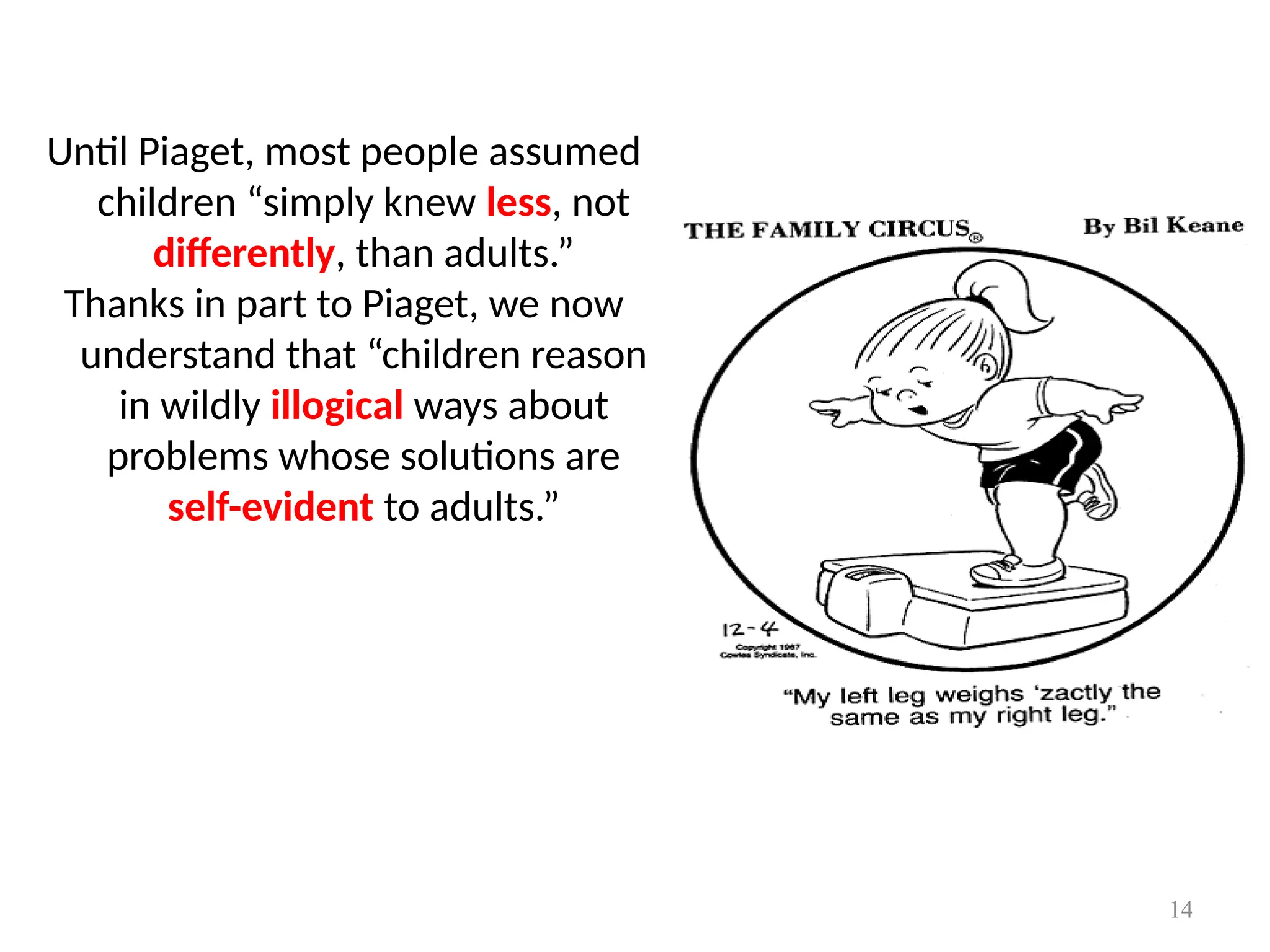
Until Piaget, mostpeople assumed
children “simply knew less, not
differently, than adults.”
Thanks in part to Piaget, we now
understand that “children reason
in wildly illogical ways about
problems whose solutions are
self-evident to adults.”
15.
• Piaget furtherbelieved that a child’s mind develops through a
series of stages, in an upward march from the newborn’s simple
reflexes to the adult’s abstract reasoning power.
• Piaget believed that the driving force behind this intellectual
progression is our unceasing struggle to make sense of our
experiences.
• “Children are active thinkers, constantly trying to construct more
advanced understandings of the world.”
16.
Schemas
For this reason,the maturing brain builds concepts, which
Piaget called schemas—mental molds into which we pour
our experiences
17.
17
Assimilation and Accommodation
Toexplain how we use and adjust our
schemas, Piaget proposed two
processes:
1. First we assimilate new experiences—
we interpret them in terms of our
current understandings (schemas).
Jean Piaget with a subject
Bill
Anderson/
Photo
Researchers,
Inc.
18.
18
Assimilation and Accommodation
2.But we also adjust, or accommodate, our schemas to fit the particulars of new
experiences.
• As children interact with the world, they construct and modify their schemas.
Bill
Anderson/
Photo
Researchers,
Inc.
19.
Schemas involve 2processes
Assimilation is the
interpretation of new
experiences in terms of
present schemas
Accommodation is the
modification of present
schemas to fit with new
experiences
20.
Practice!
• Reese is3 and knows how to use a spoon. She’s given a fork
for the first time, and immediately figures out how to use it.
• Tom is 4 and believes that all cars have 4 doors. When his aunt
shows up in a 2 door sports car, he realizes that car door
numbers vary. He changes his idea about car door numbers.
• Mandy calls all men “Dada”. Eventually she learns that only
one man is her dada. She changes her schema to reflect this.
• Think of a personal example of
– Assimilation
– Accommodation
21.
21
Piaget’s Theory andCurrent Thinking
Piaget believed that children construct their understanding of
the world while interacting with it. Their minds experience
spurts of change, followed by greater stability as they move
from one cognitive plateau to the next, each with distinctive
characteristics that permit specific kinds of thinking.
22.
Sensorimotor Stage
Young infantslack object permanence—the awareness
that objects continue to exist when not perceived.
Today’s researchers see development as more continuous
than Piaget did, and they now view object permanence
as unfolding gradually.
Social Development:
Stranger Anxiety
24
Strangeranxiety is the fear of
strangers that develops at
around 8 months. This is the
age at which infants form
schemas for familiar faces and
cannot assimilate a new face.
26
Preoperational Stage
During thepreschool period and up to about age 6 or 7, children are
in a preoperational stage—too young to perform mental operations.
Ontario
Science
Center
27.
The preoperational childlacks the concept of conservation—the
principle that quantity remains the same despite changes in shape.
29
Egocentrism
Piaget also contendedthat preschool children are egocentric—they have
difficulty perceiving things from another’s point of view.
A 2-year-old whose mother asks her to show her a picture, will hold up the
picture facing her own eyes.
When these youngsters block your view of the television, they assume that you
see what they see.
31
Theory of Mind
Preschoolers,although still
egocentric, develop this ability to
infer others’ mental states when
they begin forming a theory of
mind.
The preschooler’s growing ability to
tease, empathize, and persuade
stems from this growing ability to
take another’s perspective.
32.
32
Theory of Mind
•Researchers showed Toronto children a
Band-Aids box and asked them what was
inside.
• Expecting Band-Aids, the children were
surprised to discover that the box actually
contained pencils.
• Asked what a child who had never seen
the box would think was inside, 3-year-
olds typically answered “pencils.”
• By age 4 to 5, the children’s theory of
mind had leapt forward, and they
anticipated their friends’ false belief that
the box would hold Band-Aids.
33.
Social Development:
Self-Concept
33
Self-concept, asense of
one’s identity and personal
worth, emerges gradually
around 6 months. Around
15-18 months, children can
recognize themselves in the
mirror. By 8-10 years, their
self-image is stable.
34.
34
Concrete Operational Stage
Atabout 6 or 7 years of
age, children enter the
concrete operational
stage—given concrete
materials, they begin to
grasp conservation (that
change in shape does not
mean change in quantity).
35.
35
Concrete Operational Stage
Thisis also the time that children begin to enjoy jokes because
they understand the punch lines.
Q: What does a nosey pepper do?
A: Gets jalapeno business!
During this stage, children fully gain the mental
ability to comprehend mathematical
transformations and conservation.
36.
36
Formal Operational Stage
Byage 12, our reasoning expands from the purely concrete
(involving actual experience) to encompass abstract
thinking (involving imagined realities and symbols).
37.
37
Formal Operational Stage
Manychildren become capable of solving
hypothetical propositions and deducing
consequences: If this, then that.
If John is in school, Mary is in school.
John is in school. What can you say
about Mary?
This systematic reasoning is what Piaget
called formal operational thinking.
38.
38
Reflecting on Piaget’sTheory
Piaget identified significant cognitive milestones and stimulated
worldwide interest in how the mind develops.
His stage theory has been very influential throughout the world
and many have supported his idea that human cognition
unfolds basically in the sequence that he proposed.
39.
Design a gameor a toy for a kid at each stage
Work with the kids’ limitations and imagination of the
cognitive stage they’re in!
• Sensorimotor
• Preoperational
• Concrete operations
• Formal operations
Activity
1. I have2 identical glasses. 1 glass with 100 red
m&m’s and 1 glass with 100 white m&ms’s
2. I will scoop out 20 white m&m’s and put them
in the red glass.
3. Shake glass, mixing the m&m’s
4. I will scoop 20 m&m’s at random from the
mixed glass and put them into the white glass.
42.
Q: Which glasshas more of the other color?
___ The mostly red glass has more white.
___ The mostly white glass has more red.
___ Both glasses have the same amount of the
other color.
___ You can not know because of chance.
Explanation:
• The quantityin each glass is restricted. We
started with 100 red and 100 white.
• I did not add any in and I did not take any
away. So for every white in the mostly red
glass, I must have moved a red into the mostly
white glass.
• The idea of complimentary
Editor's Notes
#4 5-10 min to write. Describe your reasoning. Picture yourself at each age, give examples,
#8 Development is lifelong and at each age we are faced with different issues and challenges. This unit explores the physical, cognitive, and psychosocial changes of human development from birth to death.
#10 OBJECTIVE 5| Describe some developmental changes in the child’s brain, and explain why maturation accounts for many of our similarities.
#13 OBJECTIVE 8| State Piaget’s understanding of how the mind develops, and discuss the importance of assimilation and accommodation in this process.
Read slide.
#14 Read slide.
A great example of this is when my mom asked Kennedy if she wanted to go horseback riding and she looked at her, very solemnly, and said, “No, I want to go horse-forward riding.”
Read “Kids Think Differently!”
#15 Read slide.
Read “Interviews with elementary school-aged children”
Things that we take for granted, we had to learn about when we were children…for example…click for comic on the next slide.
#16 Read slide.
Ok, I am going to show you a picture that is known as the “devil’s tuning fork”. I want you study this object for a few seconds and then try to draw it on the side of your notes…ready? (click for picture and then it will automatically leave the slide after five seconds).
When you look away and try to draw it, you will find it quite difficult because you have no schema for such an image…it is an impossible object!
Click to see picture again.
Definition: Organized units of knowledge about objects, events, and actions
#18 Read slide.
Another good example of simple schemas comes from the Disney movie Bambi.
When the young Bambi is sniffing the flowers with his rabbit friend Thumper, a little skunk pokes his head up through the flowers to say hello.
Bambi, having just learned the word “flower,” immediately calls the skunk “Flower,” mistaking him for what he was smelling.
#19 A child believes that "All furry four legged animals are dogs". He sees a breed of dog that he's never seen before and says, "That's a dog." That's assimilation. Then the child sees a raccoon (or a cat, squirrel whatever) and the child says, "That's a dog." But his parents tell him it isn't a dog, it's a raccoon. So the child accommodates.
Assimilation is like adding air into a balloon. You just keep blowing it up. It gets bigger and bigger. For example, a two year old's schema of a tree is "green and big with bark" -- over time the child adds information (some trees lose their leaves, some trees have names, we use a tree at Christmas, etc.) - Your balloon just gets full of more information that fits neatly with what you know and adds onto it.
Use photos of babies sucking on various styles of bottles as an example of assimilation with pretty easy adaptation to different shaped nipples and bottles. But the first time they try that sucking schema on a sippy cup with a much larger opening the choking and mess usually bring about pretty rapid accommodation.
#20 Reese assimilates new info – forks too are eating tools used similar way
Tom assimilates new info – two door cars also take you A to B
Mandy accommodates – schema of dada gets smaller, only her father
https://www.khanacademy.org/test-prep/mcat/processing-the-environment/cognition/v/schemas-assimilation-and-accommodation-2
#21 OBJECTIVE 9| Outline Piaget’s four main stages of cognitive development, and comment on how children’s thinking changes during these four stages.
Read slide.
Let’s take a closer look at Piaget’s theories and what he believes is happening at each of the different stages.
#22 Very young babies seem to live in the present: out of sight is out of mind.
In one test, Piaget showed an infant an appealing toy and then put something over it to cover it. Before the age of 6 months, the infant acted as if it ceased to exist.
Click once and read first part of slide and the picture.
So does object permanence really blossom at 8 months?
Today’s researchers think not.
Click and read second part of slide.
#23 Read comic.
WATCH Object Permanence Video
https://www.youtube.com/watch?v=NjBh9ld_yIo&list=PLjK7S4emX1J4K52Rah0rZu-orHU0Tb53H&index=2
https://www.youtube.com/watch?v=3AsSHRCl0qU&index=20&list=PLjK7S4emX1J4K52Rah0rZu-orHU0Tb53H
#26 Moving on to Piaget’s second stage, which happens…read slide and picture.
An understanding of conservation depends on an understanding of reversibility.
If children were able to think about situations both forward and backward, they would not have trouble with conservation.
Interestingly, children misunderstand conservation in other ways besides volume:
Length: Children believe that an object’s shape changes its mass. Taking a ball of Play-Doh and making a snake out of it will lead a child to believe that some of the Play-Doh is missing.
Area: Children believe that rearranging parts of an object changes it fundamentally.
#27 SHOW VIDEO of “Piaget conservation task”
https://www.youtube.com/watch?v=gnArvcWaH6I
#29 Read slide.
SHOW VIDEO of egocentrism test
https://www.youtube.com/watch?v=OinqFgsIbh0
#35 Read slide.
It’s important to understand that concrete operational thinking differs from preoperational thinking only in that concrete operational thinkers can understand the concepts preoperational thinkers cannot.
So basically, conservation makes sense to concrete operational children, and they become less egocentric.
#36 Read slide.
Piaget (1970) devised several tests of formal operational thought. One of the simplest was the 'third eye problem'. Children were asked where they would put an extra eye, if they were able to have a third one, and why. Schaffer (1988) reported that when asked this question, 9-year-olds all suggested that the third eye should be on the forehead. However, 11-year-olds were more inventive, for example suggesting that a third eye placed on the hand would be useful for seeing round corners.
https://www.youtube.com/watch?v=TRF27F2bn-A
(show stage 3 and 4)
#37 Read first two parts of slide and then click for picture, which says:
“Hypothetical question: If a guy you knew was cheating on a girl you knew, and you knew, would you try to tell her by asking a hypothetical question?”
Click and read last part of slide.
I want to remind you that formal operational thought is not necessarily the ultimate end stage of cognitive thinking.
Some studies have shown that even college students have trouble with some of Piaget’s formal operational problems, whereas some young children have solved them.
Piaget himself admitted that some people may not reach this stage.
Others have suggested that even more stages exist beyond formal operations.
#38 OBJECTIVE 10| Discuss psychologists’ current views on Piaget’s theory of cognitive development.
Read slide.
#43 It could be repeated endlessly without changing the answer.
#44 Students turn this into a question of probability, focusing on the probability of scooping the same # of red & black beans, they cannot see that the actual # is irrelevant.