How to Improve Automation
Test Coverage
Table of Content
• Introduction
• Assess Current Test Coverage
• Prioritize Test Cases
• Identify Automation Opportunities
• Implement Effective Test Design
• Leverage Data-Driven Testing
• Implement Cross-Browser and Cross-Platform Testing
• Continuous Integration and Deployment
• Monitor and Analyze Test Results
• Conclusion
• Automation test coverage is a critical metric in software testing that measures the extent
to which automated tests verify the functionality and behavior of a software application.
• It is calculated as the percentage of features or functionalities covered by automated
tests compared to the total features of the application.
• High test coverage is essential for ensuring thorough validation of the application, as it
helps identify potential defects and vulnerabilities early in the development process.
• By achieving high test coverage, organizations can mitigate risks, enhance software
quality, and deliver reliable and robust software products to end-users.
Introduction
Evaluate Existing Test Coverage:
• Identify areas with low or no automation coverage by reviewing test suites and test case
documentation.
• Analyze test cases and their execution frequency to prioritize areas for improvement.
Use Code Coverage Tools:
• Utilize code coverage tools to assess the extent to which automated tests exercise the
application code.
• Identify untested code paths and determine areas of the application that require additional
automation tests.
• By leveraging code coverage tools, teams can ensure comprehensive testing coverage and
identify gaps in test automation.
Assess Current Test Coverage
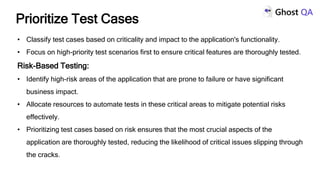
• Classify test cases based on criticality and impact to the application's functionality.
• Focus on high-priority test scenarios first to ensure critical features are thoroughly tested.
Risk-Based Testing:
• Identify high-risk areas of the application that are prone to failure or have significant
business impact.
• Allocate resources to automate tests in these critical areas to mitigate potential risks
effectively.
• Prioritizing test cases based on risk ensures that the most crucial aspects of the
application are thoroughly tested, reducing the likelihood of critical issues slipping through
the cracks.
Prioritize Test Cases
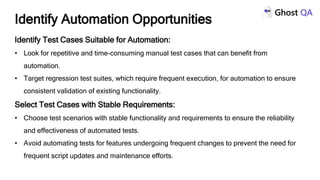
Identify Test Cases Suitable for Automation:
• Look for repetitive and time-consuming manual test cases that can benefit from
automation.
• Target regression test suites, which require frequent execution, for automation to ensure
consistent validation of existing functionality.
Select Test Cases with Stable Requirements:
• Choose test scenarios with stable functionality and requirements to ensure the reliability
and effectiveness of automated tests.
• Avoid automating tests for features undergoing frequent changes to prevent the need for
frequent script updates and maintenance efforts.
Identify Automation Opportunities
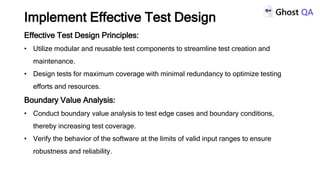
Effective Test Design Principles:
• Utilize modular and reusable test components to streamline test creation and
maintenance.
• Design tests for maximum coverage with minimal redundancy to optimize testing
efforts and resources.
Boundary Value Analysis:
• Conduct boundary value analysis to test edge cases and boundary conditions,
thereby increasing test coverage.
• Verify the behavior of the software at the limits of valid input ranges to ensure
robustness and reliability.
Implement Effective Test Design
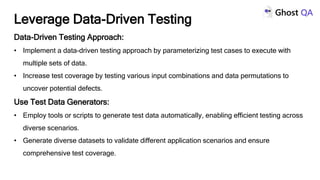
Data-Driven Testing Approach:
• Implement a data-driven testing approach by parameterizing test cases to execute with
multiple sets of data.
• Increase test coverage by testing various input combinations and data permutations to
uncover potential defects.
Use Test Data Generators:
• Employ tools or scripts to generate test data automatically, enabling efficient testing across
diverse scenarios.
• Generate diverse datasets to validate different application scenarios and ensure
comprehensive test coverage.
Leverage Data-Driven Testing
Cross-Browser Testing:
• Validate application functionality across multiple web browsers, ensuring consistent
behavior and compatibility across different browser versions.
• Conduct thorough tests to identify and address any browser-specific issues that may affect
user experience.
Cross-Platform Testing:
• Test application compatibility across various operating systems and devices, including
desktops, mobile phones, and tablets.
• Verify responsiveness and performance across different platforms to ensure a seamless
user experience regardless of the device used.
Implement Cross-Browser and Cross-
Platform Testing
Continuous Integration (CI):
• Integrate automated tests into CI pipelines for frequent validation.
• Automatically execute tests on code commits to identify issues early in the
development process.
Continuous Deployment (CD):
• Automate deployment pipelines to ensure that thoroughly tested code reaches
production promptly.
• Enable rapid feedback loops and expedite software delivery without compromising
quality or reliability.
Continuous Integration and Deployment
Monitor Test Execution:
• Regularly monitor automated test runs for failures or anomalies.
• Investigate and triage failed tests promptly to identify root causes and address them
effectively.
Analyze Test Coverage Metrics:
• Track automation test coverage metrics over time to gauge progress.
• Identify gaps and areas for improvement to enhance overall coverage and effectiveness
of automated testing efforts.
Monitor and Analyze Test Results
• Test coverage is crucial for ensuring comprehensive validation of software applications,
reducing the risk of defects and enhancing software quality.
• Improving automation test coverage necessitates strategic planning and meticulous
implementation, involving the assessment of current coverage, prioritization of test cases,
effective test design, and leveraging various techniques such as data-driven testing and
cross-browser testing.
Encourage Continuous Improvement:
• Emphasize the significance of ongoing optimization and refinement in testing processes.
• Foster a culture of collaboration and innovation to drive continuous improvement and testing
excellence.
Conclusion
Thank You
805-776-3451
548 Market St #795256,
San Francisco, California, US 94104
www.ghostqa.com

How to Improve Automation Test Coverage_.pptx

  • 1.
    How to ImproveAutomation Test Coverage
  • 2.
    Table of Content •Introduction • Assess Current Test Coverage • Prioritize Test Cases • Identify Automation Opportunities • Implement Effective Test Design • Leverage Data-Driven Testing • Implement Cross-Browser and Cross-Platform Testing • Continuous Integration and Deployment • Monitor and Analyze Test Results • Conclusion
  • 3.
    • Automation testcoverage is a critical metric in software testing that measures the extent to which automated tests verify the functionality and behavior of a software application. • It is calculated as the percentage of features or functionalities covered by automated tests compared to the total features of the application. • High test coverage is essential for ensuring thorough validation of the application, as it helps identify potential defects and vulnerabilities early in the development process. • By achieving high test coverage, organizations can mitigate risks, enhance software quality, and deliver reliable and robust software products to end-users. Introduction
  • 4.
    Evaluate Existing TestCoverage: • Identify areas with low or no automation coverage by reviewing test suites and test case documentation. • Analyze test cases and their execution frequency to prioritize areas for improvement. Use Code Coverage Tools: • Utilize code coverage tools to assess the extent to which automated tests exercise the application code. • Identify untested code paths and determine areas of the application that require additional automation tests. • By leveraging code coverage tools, teams can ensure comprehensive testing coverage and identify gaps in test automation. Assess Current Test Coverage
  • 5.
    • Classify testcases based on criticality and impact to the application's functionality. • Focus on high-priority test scenarios first to ensure critical features are thoroughly tested. Risk-Based Testing: • Identify high-risk areas of the application that are prone to failure or have significant business impact. • Allocate resources to automate tests in these critical areas to mitigate potential risks effectively. • Prioritizing test cases based on risk ensures that the most crucial aspects of the application are thoroughly tested, reducing the likelihood of critical issues slipping through the cracks. Prioritize Test Cases
  • 6.
    Identify Test CasesSuitable for Automation: • Look for repetitive and time-consuming manual test cases that can benefit from automation. • Target regression test suites, which require frequent execution, for automation to ensure consistent validation of existing functionality. Select Test Cases with Stable Requirements: • Choose test scenarios with stable functionality and requirements to ensure the reliability and effectiveness of automated tests. • Avoid automating tests for features undergoing frequent changes to prevent the need for frequent script updates and maintenance efforts. Identify Automation Opportunities
  • 7.
    Effective Test DesignPrinciples: • Utilize modular and reusable test components to streamline test creation and maintenance. • Design tests for maximum coverage with minimal redundancy to optimize testing efforts and resources. Boundary Value Analysis: • Conduct boundary value analysis to test edge cases and boundary conditions, thereby increasing test coverage. • Verify the behavior of the software at the limits of valid input ranges to ensure robustness and reliability. Implement Effective Test Design
  • 8.
    Data-Driven Testing Approach: •Implement a data-driven testing approach by parameterizing test cases to execute with multiple sets of data. • Increase test coverage by testing various input combinations and data permutations to uncover potential defects. Use Test Data Generators: • Employ tools or scripts to generate test data automatically, enabling efficient testing across diverse scenarios. • Generate diverse datasets to validate different application scenarios and ensure comprehensive test coverage. Leverage Data-Driven Testing
  • 9.
    Cross-Browser Testing: • Validateapplication functionality across multiple web browsers, ensuring consistent behavior and compatibility across different browser versions. • Conduct thorough tests to identify and address any browser-specific issues that may affect user experience. Cross-Platform Testing: • Test application compatibility across various operating systems and devices, including desktops, mobile phones, and tablets. • Verify responsiveness and performance across different platforms to ensure a seamless user experience regardless of the device used. Implement Cross-Browser and Cross- Platform Testing
  • 10.
    Continuous Integration (CI): •Integrate automated tests into CI pipelines for frequent validation. • Automatically execute tests on code commits to identify issues early in the development process. Continuous Deployment (CD): • Automate deployment pipelines to ensure that thoroughly tested code reaches production promptly. • Enable rapid feedback loops and expedite software delivery without compromising quality or reliability. Continuous Integration and Deployment
  • 11.
    Monitor Test Execution: •Regularly monitor automated test runs for failures or anomalies. • Investigate and triage failed tests promptly to identify root causes and address them effectively. Analyze Test Coverage Metrics: • Track automation test coverage metrics over time to gauge progress. • Identify gaps and areas for improvement to enhance overall coverage and effectiveness of automated testing efforts. Monitor and Analyze Test Results
  • 12.
    • Test coverageis crucial for ensuring comprehensive validation of software applications, reducing the risk of defects and enhancing software quality. • Improving automation test coverage necessitates strategic planning and meticulous implementation, involving the assessment of current coverage, prioritization of test cases, effective test design, and leveraging various techniques such as data-driven testing and cross-browser testing. Encourage Continuous Improvement: • Emphasize the significance of ongoing optimization and refinement in testing processes. • Foster a culture of collaboration and innovation to drive continuous improvement and testing excellence. Conclusion
  • 13.
    Thank You 805-776-3451 548 MarketSt #795256, San Francisco, California, US 94104 www.ghostqa.com