The embedded computing platform
The CPU BusThe bus is the mechanism by which the CPU communicates with memory and devices.A bus is, at a minimum, a collection of wires, but the bus also defines a protocol by which the CPU, memory and devices communicate.One of the major role  of the bus is to provide an interface to memory.
Bus ProtocolsBus protocol determines how devices communicate.Devices on the bus go through sequences of states.Protocols are specified by state machines, one state machine per actor in the protocol.May contain asynchronous logic behavior.
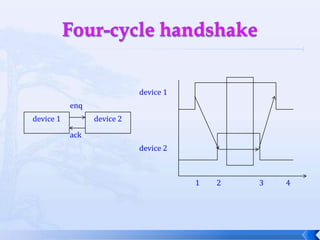
Four-cycle handshakeDevice1 raises its o/p to signal an enquiry, which tells device2 that it should get ready to listen for data.	When device2 is ready to receive, it raises its o/p to signal an acknowledgement. At this point, device1 and 2 can transmit or receive.	Once the data transfer is complete, device2 lowers its o/p, signaling that it has received the data.	After seeing that ack has been released, device1 lowers its o/p.
Four-cycle handshakedevice 1enqdevice 1device 2ackdevice 21234
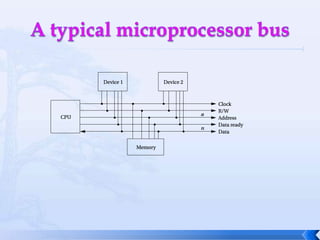
Microprocessor bussesClock provides synchronization to the bus components,R/W’ is true when the bus is reading and false when the bus is writing,Address is an a bit bundle of signals that transmits the address for an access,Data is an n bit bundle of signals that can carry data to or from the CPU,Data ready’ signals when the values on the data bundle are valid
A typical microprocessor bus
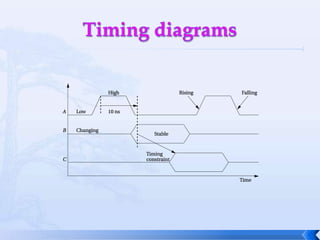
Timing diagramsA timing diagram shows how the signals on a bus vary over time, since values like the address and data can take on many values, some standard notation is used to describe signals.A signal can go between 0/1 state and a stable/changing state.To be sure that signals go to their proper values at the proper time, timing diagram sometimes show timing constraints.
Timing diagrams
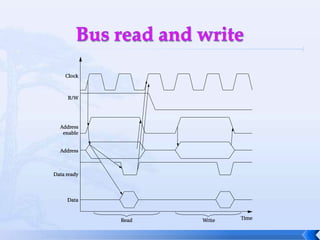
Timing diagram for the example busTiming diagram shown with timing constraints for the example bus.The diagram shows a read and a write.Timing constraints shown only for read operation,   but similar constraints applies to the write operation.The bus is normally in read mode, since that does not change any state.During a read the external device or memory is sending a value on the data lines, while during a write the CPU is controlling the data lines.
Bus read and write
Read Operation on timing diagramA read or write is initiated by setting address enable high after the clock starts to rise. We set R/W’=1 to indicate a read and the address lines are set to the desired address.One clock cycle later, the memory or device is expected to assert the data value  at that address on the data lines. simultaneously, the external device specifies that the data are valid by pulling down the data ready’ line. This line is active low, meaning that a logically true value is indicated by a low voltage, in order to provide increased immunity to electrical noise.The CPU is free to remove the address at the end of clock  cycle and must do so before the beginning of the next cycle. The external device has a similar requirement for removing the data value from the data lines.
Bus wait state
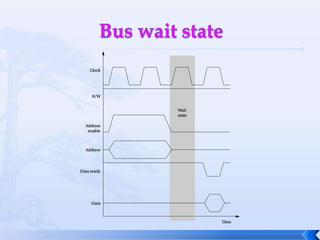
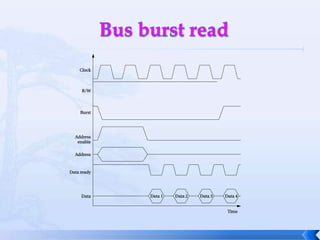
Burst readThe handshake that tells the CPU and devices when data are to be transferred is formed by data ready  for the acknowledge side, but Is implicit for the inquiry side.The data ready signal allows the bus to be connected to devices that are slower than bus.The cycle between the minimum time at which data can be asserted and when it  is actually inserted are known as wait states.In this burst read transaction the CPU sends one address but receives of data values.
Bus burst read
State diagrams for bus readGet dataSenddataDoneRelease ackSee ackAckAdrsAdrsWaitWaitdeviceCPUstart
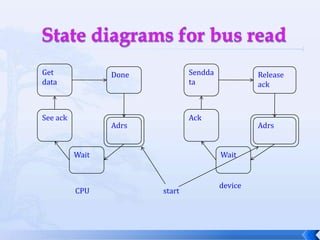
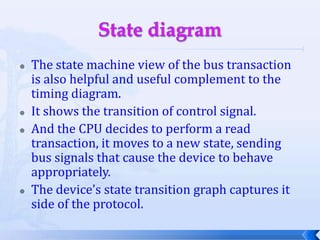
State diagramThe state machine view of the bus transaction is also helpful and useful complement to the timing diagram.It shows the transition of control signal.And the CPU decides to perform a read transaction, it moves to a new state, sending bus signals that cause the device to behave appropriately.The device’s state transition graph captures it side of the protocol.
Bus multiplexingdevicedata enableCPUdataadrsadrsAdrs enable
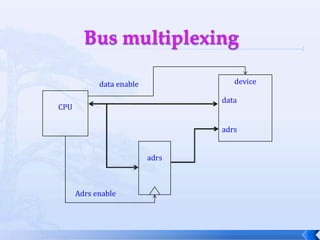
Bus multiplexingSome buses use multiplexed address and data.Additional control lines are provided to tell whether the value on the address/data lines is an address or data.Typically, the address comes first followed by the data.The address can be held in a register until the data arrive so that both can be presented to the device at the same time.
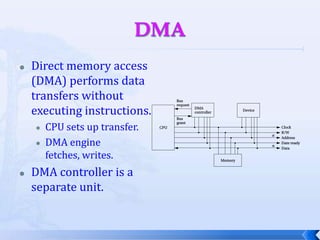
DMADirect memory access (DMA) performs data transfers without executing instructions.CPU sets up transfer.DMA engine fetches, writes.DMA controller is a separate unit.
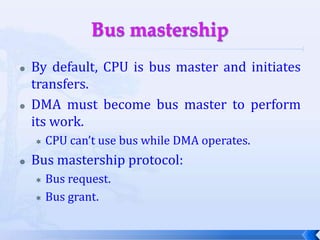
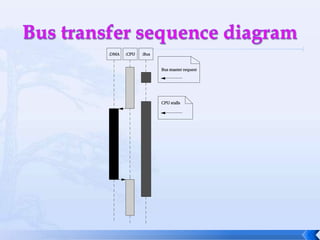
Bus mastershipBy default, CPU is bus master and initiates transfers.DMA must become bus master to perform its work.CPU can’t use bus while DMA operates.Bus mastership protocol:Bus request.Bus grant.
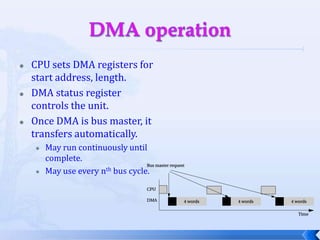
DMA operationCPU sets DMA registers for start address, length.DMA status register controls the unit.Once DMA is bus master, it transfers automatically.May run continuously until complete.May use every nth bus cycle.
Bus transfer sequence diagram
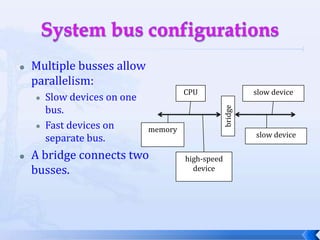
System bus configurationsMultiple busses allow parallelism:Slow devices on one bus.Fast devices on separate bus.A bridge connects two busses.CPUslow devicebridgememoryslow devicehigh-speeddevice
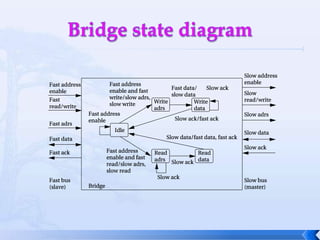
Bridge state diagram
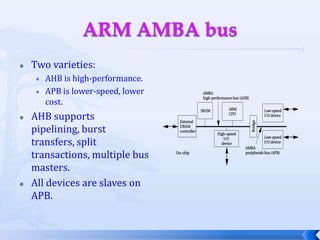
ARM AMBA busTwo varieties:AHB is high-performance.APB is lower-speed, lower cost.AHB supports pipelining, burst transfers, split transactions, multiple bus masters.All devices are slaves on APB.
Memory DevicesSeveral different types of memory:Read Only MemoriesFlash.Read/Write MemoriesDRAM.SRAM.Each type of memory comes in varying:Capacities.Widths.
Memory Device Organization4-Mbit memory may be 1M x 4-bit array – single memory access obtain 4-bit data item, with maximum of 2^20 different addresses.4M x 1-bit array – single memory access obtain 1-bit data item, with maximum of 2^22 different addresses.The height width ratio of memory is known as its aspect ratio.
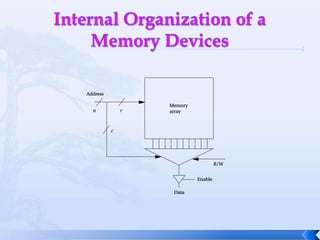
The data are stored in 2-D array of memory cells.
n-bit (n = r + c) address
A row address
A column addressInternal Organization of a Memory Devices
Random-access memoryDynamic RAM is dense, requires refresh.Synchronous DRAM is dominant type.SDRAM uses clock to improve performance, pipeline memory accesses.Static RAM is faster, less dense, consumes more power.
Static RAM and its operationCE is the chip enable input. It is active low. When CE=1 the SRAM’s data pins are disabled, and when CE=0, the data pins are enabled.R/W controls whether the current operation is a read (R/W=1) or a write (R/W=0). Read and write are normally specified relative to the CPU, so read means reading from RAM and write means writing to RAM.Adrs specifies the address for the read or write.Data is a bidirectional bundle of signals for data transfer. When R/W=1, the pins are o/p, and when R/W=0, the data pins are input.
Timing diagramInterface
A read operation on the SRAM occurs as follows:CE is set to zero enabling the chip with R/W=1.An address is presented on the address lines.After some delay, data appear on the data lines.A write operation is similar:CE is set to zero.R/W is set to 0 for writing.An address is set on the address line and data is set on the data lines.
Timing diagramInterface
Timing diagram for ReadFirst, RAS is set to 0 and the row part of the address is set on the address lines.Next, CAS is set to 0 and the column part of the address are put on the address lines.
Read-only memoryROM may be programmed at factory.Flash is dominant form of field-programmable ROM.Electrically erasable, must be block erased.Random access, but write/erase is much slower than read.NOR flash is more flexible.NAND flash is more dense.
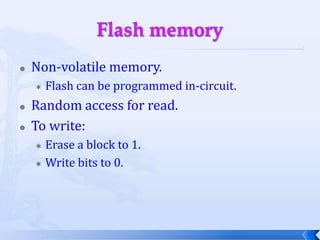
Flash memoryNon-volatile memory.Flash can be programmed in-circuit.Random access for read.To write:Erase a block to 1.Write bits to 0.
Flash writingWrite is much slower than read.1.6 ms write, 70 ns read.Blocks are large (approx. 1 Mb).Writing causes wear that eventually destroys the device.Modern lifetime approx. 1 million writes.
Types of flashNOR:Word-accessible read.Erase by blocks.NAND:Read by pages (512-4K bytes).Erase by blocks.NAND is cheaper, has faster erase, sequential access times.
I/O DevicesI/O devices are commonly used in embedded computing systems.
Some devices are often found as on-chip devices in microcontrollers.
Other devices are interfaced externally.
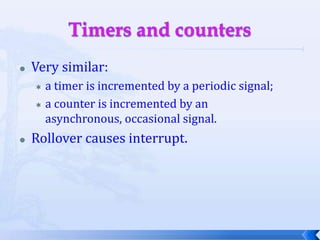
We need to understand the requirements of devices interfacing and its uses in programming.Timers and countersVery similar:a timer is incremented by a periodic signal;a counter is incremented by an asynchronous, occasional signal.Rollover causes interrupt.
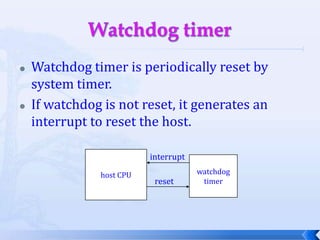
Watchdog timerWatchdog timer is periodically reset by system timer.If watchdog is not reset, it generates an interrupt to reset the host.host CPUinterruptwatchdogtimerreset
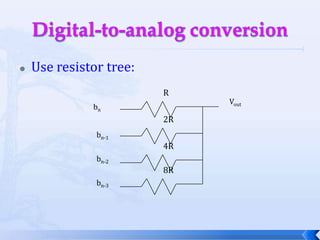
Digital-to-analog conversionUse resistor tree:RVoutbn2Rbn-14Rbn-28Rbn-3
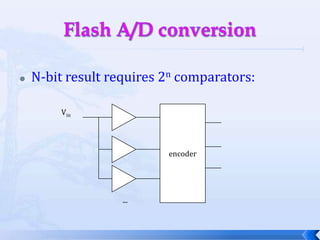
Flash A/D conversionN-bit result requires 2n comparators:encoderVin...
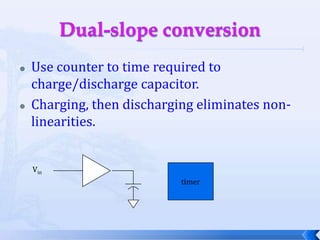
Dual-slope conversionUse counter to time required to charge/discharge capacitor.Charging, then discharging eliminates non-linearities.Vintimer
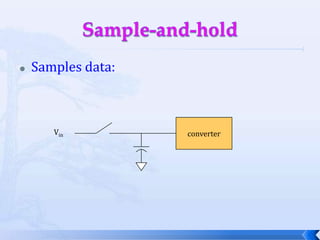
Sample-and-holdSamples data:converterVin
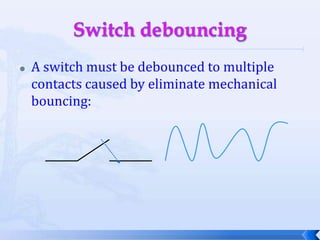
Switch debouncingA switch must be debounced to multiple contacts caused by eliminate mechanical bouncing:
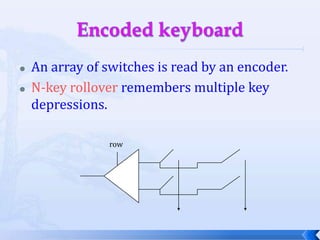
Encoded keyboardAn array of switches is read by an encoder.N-key rollover remembers multiple key depressions.row
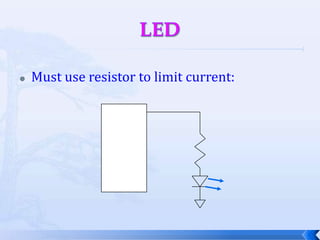
LEDMust use resistor to limit current:
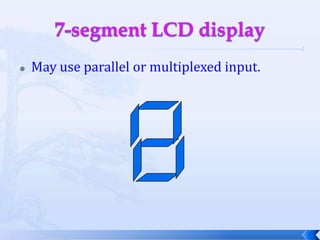
7-segment LCD displayMay use parallel or multiplexed input.
Types of high-resolution displayLiquid crystal display (LCD) is dominant form.Plasma, OLED, etc.Frame buffer holds current display contents.Written by processor.Read by video.
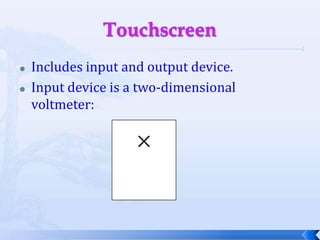
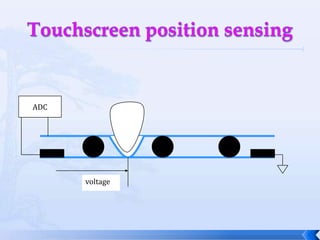
TouchscreenIncludes input and output device.Input device is a two-dimensional voltmeter:
Touchscreen position sensingvoltageADC
Component Interfacing : Memory interfacingStatic RAM is simpler to interface to a bus than is DRAM, due to both the DRAM’s RAS/CAS multiplexing and the need for refresh.The R/W on the bus can often be directly connected to the SRAM.The main issue in interfacing SRAM is decoding the address.The chip enable pin is used in RAM’s to simplify the interfacing of large memories.If the required number of memory words fits within the height of an available memory, then the interface is simple: the CE signal is permanently wired to the ground so that the chip is always enabled.
DRAM interfacingThe bus address can be split in to row and column address with a small amount of logic-a register captures the address, a multiplexer selects the row or column portion of the address, and a state machine generates RAS and CAS.The refresh signal can be generated with a counter and a state machine as shown.The counter times the wait between successive refresh actions, the controller  generates the required  signal.In idle state, the bus signals are passed through the DRAM to enable reads and writes.When the counter roles over, the controller generates CAS and then RAS to induce the next refresh cycle.
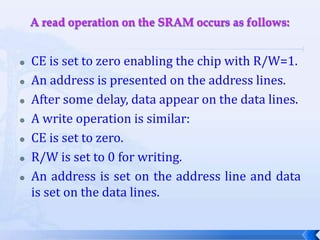
Device interfacingSome I/O devices are designed to interface directly to a particular bus, forming glueless interfaces.But glue logic is required when a device is required when a device is connected to a bus for which it is not designed.An I/O device typically requires a much smaller range of addresses than a memory, so addresses must be decoded much more finely.Some additional logic is required to cause the bus to read and write the device’s register.
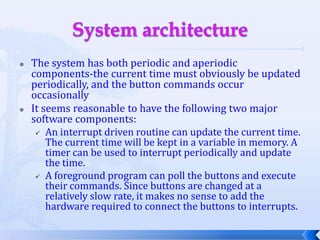
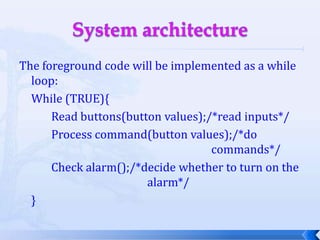
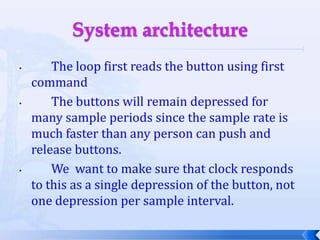
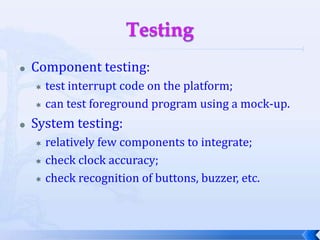
System architecture	An architecture is a set of elements and the relationships between them that together form a single unit.
	The architecture of an embedded computing system is the blue-print for implementing that system.
	The architecture of an embedded computing system includes both hardware and software elements.Hardware: Hardware architecture of an embedded system is more obvious manifestation that you can touch it and feel.CPU: 	There are many different architectures and even within an architecture we can select between models that vary in clock speed, integrated peripherals and so on
	The choice of the CPU cannot be made considering the software that will execute on the machine.System architectureBus:	In applications that make intensive use of the bus due to I/O or other data traffic, the bus may be more of a limiting factor than the CPU.
	Attention must be paid to the required data bandwidths to be sure that the bus can handle the traffic.Memory:	The ratio of ROM to RAM and selection of DRAM versus SRAM can have a significant influence on the cost of the system.
	The speed of memory will play a large part in determining system performanceI/O devices: networking, sensors, actuators, etc.How big/fast much each one be?
Software architectureFunctional description must be broken into pieces:division among people;conceptual organization;performance;testability;maintenance.
Hardware and software architecturesHardware and software are intimately related:software doesn’t run without hardware;how much hardware you need is determined by the software requirements:speed;memory.
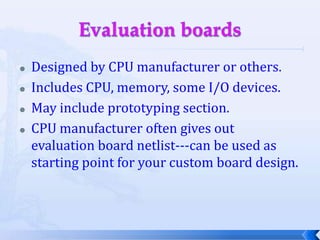
Evaluation boardsDesigned by CPU manufacturer or others.Includes CPU, memory, some I/O devices.May include prototyping section.CPU manufacturer often gives out evaluation board netlist---can be used as starting point for your custom board design.
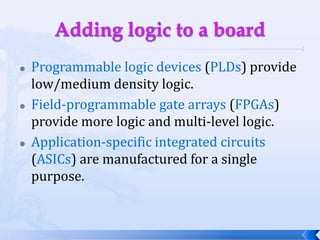
Adding logic to a boardProgrammable logic devices (PLDs) provide low/medium density logic.Field-programmable gate arrays (FPGAs) provide more logic and multi-level logic.Application-specific integrated circuits (ASICs) are manufactured for a single purpose.
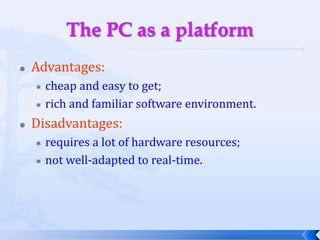
The PC as a platformAdvantages:cheap and easy to get;rich and familiar software environment.Disadvantages:requires a lot of hardware resources;not well-adapted to real-time.
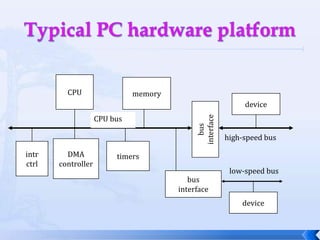
Typical PC hardware platformCPUmemorydeviceCPU busbusinterfacehigh-speed busDMAcontrollertimersintrctrllow-speed busbusinterfacedevice
Typical PC hardware platformThe CPU provides basic computational facilities.RAM is used for program storage.ROM holds the boot program.A DMA controller provides DMA capabilities.Timers are used by the operating system for a variety of purposes.A high speed bus connected to the CPU bus through a bridge, allows fast devices to communicate efficiently with the rest of the system.A low speed bus provides an inexpensive way to connect simpler devices and may be necessary for backward compatibility as well.
Typical bussesPCI: standard for high-speed interfacing33 or 66 MHz.PCI Express.USB (Universal Serial Bus), Firewire (IEEE 1394): relatively low-cost serial interface with high speed.
Software elementsIBM PC uses BIOS (Basic I/O System) to implement low-level functions:boot-up;minimal device drivers.BIOS has become a generic term for the lowest-level system software.
Example: StrongARMStrongARM system includes:CPU chip (3.686 MHz clock)system control module (32.768 kHz clock).Real-time clock;operating system timergeneral-purpose I/O;interrupt controller;power manager controller;reset controller.
Strong ARM SA-1100
Peripheral devices of system control module:A real time clock.An operating system timer.28 general-purpose I/Os(GPIOs).An interrupt controller.A power manager controller.A reset controller that handles resetting the processor.
Debugging embedded systemsChallenges:target system may be hard to observe;target may be hard to control;may be hard to generate realistic inputs;setup sequence may be complex.
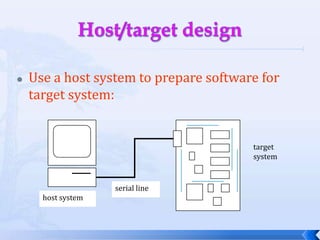
Host/target designUse a host system to prepare software for target system:targetsystemserial linehost system
Host/target design	Load the programs into the target,
	Start and stop program execution on the target, and
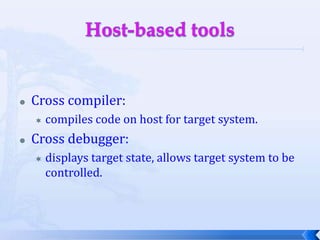
	Examine memory and CPU registers.Host-based toolsCross compiler:compiles code on host for target system.Cross debugger:displays target state, allows target system to be controlled.
Software debuggersA monitor program residing on the target provides basic debugger functions.Debugger should have a minimal footprint in memory.User program must be careful not to destroy debugger program, but , should be able to recover from some damage caused by user code.
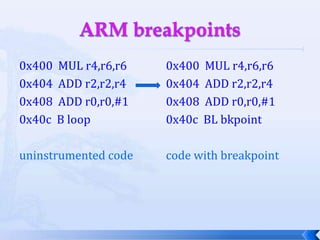
BreakpointsA breakpoint allows the user to stop execution, examine system state, and change state.Replace the breakpointed instruction with a subroutine call to the monitor program.
ARM breakpoints0x400  MUL r4,r6,r60x404  ADD r2,r2,r40x408  ADD r0,r0,#10x40c  B loopuninstrumented code0x400  MUL r4,r6,r60x404  ADD r2,r2,r40x408  ADD r0,r0,#10x40c  BL bkpointcode with breakpoint
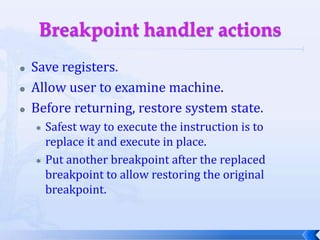
Breakpoint handler actionsSave registers.Allow user to examine machine.Before returning, restore system state.Safest way to execute the instruction is to replace it and execute in place.Put another breakpoint after the replaced breakpoint to allow restoring the original breakpoint.
In-circuit emulatorsA microprocessor in-circuit emulator is a specially-instrumented microprocessor.Allows you to stop execution, examine CPU state, modify registers.
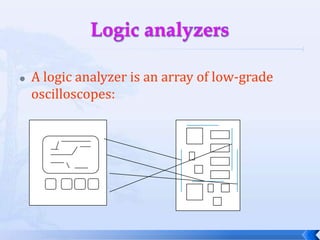
Logic analyzersA logic analyzer is an array of low-grade oscilloscopes:
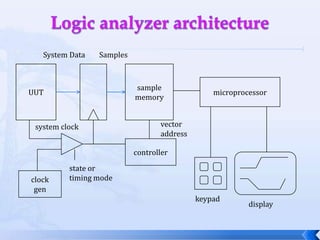
Logic analyzer architectureSystem DataSamplesUUTsamplememorymicroprocessorvectoraddresssystem clockcontrollerstate ortiming modeclockgenkeypaddisplay
Hardware/software co-verificationAn instruction level simulation may be used to debug code running on the CPU.A cycle-level simulation tool may be used for faster simulation of parts of the system.A hardware/software co-simulator may be used to simulate various parts of the system at different level of detail.
Bus-Based Computer SystemsDesigning with microprocessors.Development and debugging.System-level performance analysis.Example: alarm clock
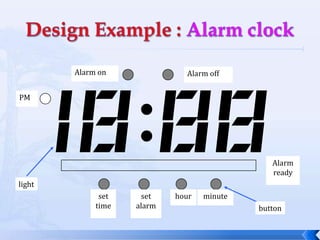
Design Example : Alarm clockAlarm onAlarm offPMAlarmreadylightsettimesetalarmhourminutebutton
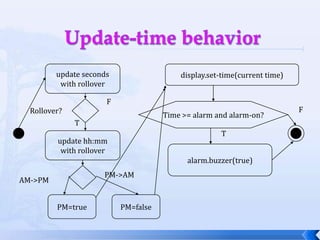
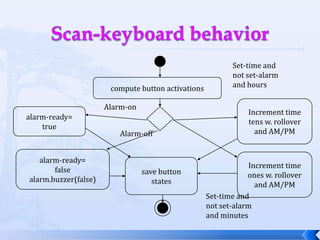
OperationsSet time: hold set time, depress hour, minute.Set alarm time: hold set alarm, depress hour, minute.Turn alarm on/off: depress alarm on/off.
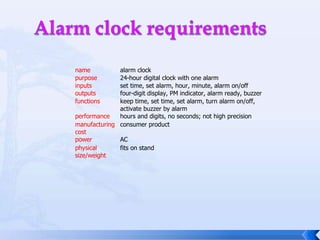
Alarm clock requirements
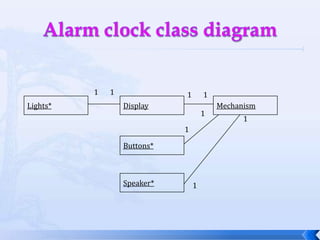
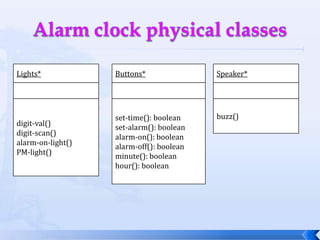
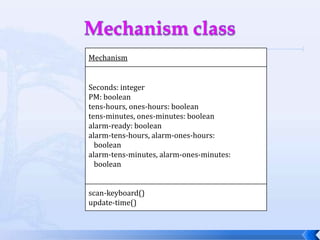
Alarm clock class diagram1111Lights*DisplayMechanism111Buttons*Speaker*1

Chapter 3

  • 1.
  • 2.
    The CPU BusThebus is the mechanism by which the CPU communicates with memory and devices.A bus is, at a minimum, a collection of wires, but the bus also defines a protocol by which the CPU, memory and devices communicate.One of the major role of the bus is to provide an interface to memory.
  • 3.
    Bus ProtocolsBus protocoldetermines how devices communicate.Devices on the bus go through sequences of states.Protocols are specified by state machines, one state machine per actor in the protocol.May contain asynchronous logic behavior.
  • 4.
    Four-cycle handshakeDevice1 raisesits o/p to signal an enquiry, which tells device2 that it should get ready to listen for data. When device2 is ready to receive, it raises its o/p to signal an acknowledgement. At this point, device1 and 2 can transmit or receive. Once the data transfer is complete, device2 lowers its o/p, signaling that it has received the data. After seeing that ack has been released, device1 lowers its o/p.
  • 5.
  • 6.
    Microprocessor bussesClock providessynchronization to the bus components,R/W’ is true when the bus is reading and false when the bus is writing,Address is an a bit bundle of signals that transmits the address for an access,Data is an n bit bundle of signals that can carry data to or from the CPU,Data ready’ signals when the values on the data bundle are valid
  • 7.
  • 8.
    Timing diagramsA timingdiagram shows how the signals on a bus vary over time, since values like the address and data can take on many values, some standard notation is used to describe signals.A signal can go between 0/1 state and a stable/changing state.To be sure that signals go to their proper values at the proper time, timing diagram sometimes show timing constraints.
  • 9.
  • 10.
    Timing diagram forthe example busTiming diagram shown with timing constraints for the example bus.The diagram shows a read and a write.Timing constraints shown only for read operation, but similar constraints applies to the write operation.The bus is normally in read mode, since that does not change any state.During a read the external device or memory is sending a value on the data lines, while during a write the CPU is controlling the data lines.
  • 11.
  • 12.
    Read Operation ontiming diagramA read or write is initiated by setting address enable high after the clock starts to rise. We set R/W’=1 to indicate a read and the address lines are set to the desired address.One clock cycle later, the memory or device is expected to assert the data value at that address on the data lines. simultaneously, the external device specifies that the data are valid by pulling down the data ready’ line. This line is active low, meaning that a logically true value is indicated by a low voltage, in order to provide increased immunity to electrical noise.The CPU is free to remove the address at the end of clock cycle and must do so before the beginning of the next cycle. The external device has a similar requirement for removing the data value from the data lines.
  • 13.
  • 14.
    Burst readThe handshakethat tells the CPU and devices when data are to be transferred is formed by data ready for the acknowledge side, but Is implicit for the inquiry side.The data ready signal allows the bus to be connected to devices that are slower than bus.The cycle between the minimum time at which data can be asserted and when it is actually inserted are known as wait states.In this burst read transaction the CPU sends one address but receives of data values.
  • 15.
  • 16.
    State diagrams forbus readGet dataSenddataDoneRelease ackSee ackAckAdrsAdrsWaitWaitdeviceCPUstart
  • 17.
    State diagramThe statemachine view of the bus transaction is also helpful and useful complement to the timing diagram.It shows the transition of control signal.And the CPU decides to perform a read transaction, it moves to a new state, sending bus signals that cause the device to behave appropriately.The device’s state transition graph captures it side of the protocol.
  • 18.
  • 19.
    Bus multiplexingSome busesuse multiplexed address and data.Additional control lines are provided to tell whether the value on the address/data lines is an address or data.Typically, the address comes first followed by the data.The address can be held in a register until the data arrive so that both can be presented to the device at the same time.
  • 20.
    DMADirect memory access(DMA) performs data transfers without executing instructions.CPU sets up transfer.DMA engine fetches, writes.DMA controller is a separate unit.
  • 21.
    Bus mastershipBy default,CPU is bus master and initiates transfers.DMA must become bus master to perform its work.CPU can’t use bus while DMA operates.Bus mastership protocol:Bus request.Bus grant.
  • 22.
    DMA operationCPU setsDMA registers for start address, length.DMA status register controls the unit.Once DMA is bus master, it transfers automatically.May run continuously until complete.May use every nth bus cycle.
  • 23.
  • 24.
    System bus configurationsMultiplebusses allow parallelism:Slow devices on one bus.Fast devices on separate bus.A bridge connects two busses.CPUslow devicebridgememoryslow devicehigh-speeddevice
  • 25.
  • 26.
    ARM AMBA busTwovarieties:AHB is high-performance.APB is lower-speed, lower cost.AHB supports pipelining, burst transfers, split transactions, multiple bus masters.All devices are slaves on APB.
  • 27.
    Memory DevicesSeveral differenttypes of memory:Read Only MemoriesFlash.Read/Write MemoriesDRAM.SRAM.Each type of memory comes in varying:Capacities.Widths.
  • 28.
    Memory Device Organization4-Mbitmemory may be 1M x 4-bit array – single memory access obtain 4-bit data item, with maximum of 2^20 different addresses.4M x 1-bit array – single memory access obtain 1-bit data item, with maximum of 2^22 different addresses.The height width ratio of memory is known as its aspect ratio.
  • 29.
    The data arestored in 2-D array of memory cells.
  • 30.
    n-bit (n =r + c) address
  • 31.
  • 32.
    A column addressInternalOrganization of a Memory Devices
  • 33.
    Random-access memoryDynamic RAMis dense, requires refresh.Synchronous DRAM is dominant type.SDRAM uses clock to improve performance, pipeline memory accesses.Static RAM is faster, less dense, consumes more power.
  • 34.
    Static RAM andits operationCE is the chip enable input. It is active low. When CE=1 the SRAM’s data pins are disabled, and when CE=0, the data pins are enabled.R/W controls whether the current operation is a read (R/W=1) or a write (R/W=0). Read and write are normally specified relative to the CPU, so read means reading from RAM and write means writing to RAM.Adrs specifies the address for the read or write.Data is a bidirectional bundle of signals for data transfer. When R/W=1, the pins are o/p, and when R/W=0, the data pins are input.
  • 35.
  • 36.
    A read operationon the SRAM occurs as follows:CE is set to zero enabling the chip with R/W=1.An address is presented on the address lines.After some delay, data appear on the data lines.A write operation is similar:CE is set to zero.R/W is set to 0 for writing.An address is set on the address line and data is set on the data lines.
  • 37.
  • 38.
    Timing diagram forReadFirst, RAS is set to 0 and the row part of the address is set on the address lines.Next, CAS is set to 0 and the column part of the address are put on the address lines.
  • 39.
    Read-only memoryROM maybe programmed at factory.Flash is dominant form of field-programmable ROM.Electrically erasable, must be block erased.Random access, but write/erase is much slower than read.NOR flash is more flexible.NAND flash is more dense.
  • 40.
    Flash memoryNon-volatile memory.Flashcan be programmed in-circuit.Random access for read.To write:Erase a block to 1.Write bits to 0.
  • 41.
    Flash writingWrite ismuch slower than read.1.6 ms write, 70 ns read.Blocks are large (approx. 1 Mb).Writing causes wear that eventually destroys the device.Modern lifetime approx. 1 million writes.
  • 42.
    Types of flashNOR:Word-accessibleread.Erase by blocks.NAND:Read by pages (512-4K bytes).Erase by blocks.NAND is cheaper, has faster erase, sequential access times.
  • 43.
    I/O DevicesI/O devicesare commonly used in embedded computing systems.
  • 44.
    Some devices areoften found as on-chip devices in microcontrollers.
  • 45.
    Other devices areinterfaced externally.
  • 46.
    We need tounderstand the requirements of devices interfacing and its uses in programming.Timers and countersVery similar:a timer is incremented by a periodic signal;a counter is incremented by an asynchronous, occasional signal.Rollover causes interrupt.
  • 47.
    Watchdog timerWatchdog timeris periodically reset by system timer.If watchdog is not reset, it generates an interrupt to reset the host.host CPUinterruptwatchdogtimerreset
  • 48.
    Digital-to-analog conversionUse resistortree:RVoutbn2Rbn-14Rbn-28Rbn-3
  • 49.
    Flash A/D conversionN-bitresult requires 2n comparators:encoderVin...
  • 50.
    Dual-slope conversionUse counterto time required to charge/discharge capacitor.Charging, then discharging eliminates non-linearities.Vintimer
  • 51.
  • 52.
    Switch debouncingA switchmust be debounced to multiple contacts caused by eliminate mechanical bouncing:
  • 53.
    Encoded keyboardAn arrayof switches is read by an encoder.N-key rollover remembers multiple key depressions.row
  • 54.
    LEDMust use resistorto limit current:
  • 55.
    7-segment LCD displayMayuse parallel or multiplexed input.
  • 56.
    Types of high-resolutiondisplayLiquid crystal display (LCD) is dominant form.Plasma, OLED, etc.Frame buffer holds current display contents.Written by processor.Read by video.
  • 57.
    TouchscreenIncludes input andoutput device.Input device is a two-dimensional voltmeter:
  • 58.
  • 59.
    Component Interfacing :Memory interfacingStatic RAM is simpler to interface to a bus than is DRAM, due to both the DRAM’s RAS/CAS multiplexing and the need for refresh.The R/W on the bus can often be directly connected to the SRAM.The main issue in interfacing SRAM is decoding the address.The chip enable pin is used in RAM’s to simplify the interfacing of large memories.If the required number of memory words fits within the height of an available memory, then the interface is simple: the CE signal is permanently wired to the ground so that the chip is always enabled.
  • 60.
    DRAM interfacingThe busaddress can be split in to row and column address with a small amount of logic-a register captures the address, a multiplexer selects the row or column portion of the address, and a state machine generates RAS and CAS.The refresh signal can be generated with a counter and a state machine as shown.The counter times the wait between successive refresh actions, the controller generates the required signal.In idle state, the bus signals are passed through the DRAM to enable reads and writes.When the counter roles over, the controller generates CAS and then RAS to induce the next refresh cycle.

  • 61.
    Device interfacingSome I/Odevices are designed to interface directly to a particular bus, forming glueless interfaces.But glue logic is required when a device is required when a device is connected to a bus for which it is not designed.An I/O device typically requires a much smaller range of addresses than a memory, so addresses must be decoded much more finely.Some additional logic is required to cause the bus to read and write the device’s register.
  • 62.
    System architecture An architectureis a set of elements and the relationships between them that together form a single unit.
  • 63.
    The architecture ofan embedded computing system is the blue-print for implementing that system.
  • 64.
    The architecture ofan embedded computing system includes both hardware and software elements.Hardware: Hardware architecture of an embedded system is more obvious manifestation that you can touch it and feel.CPU: There are many different architectures and even within an architecture we can select between models that vary in clock speed, integrated peripherals and so on
  • 65.
    The choice ofthe CPU cannot be made considering the software that will execute on the machine.System architectureBus: In applications that make intensive use of the bus due to I/O or other data traffic, the bus may be more of a limiting factor than the CPU.
  • 66.
    Attention must bepaid to the required data bandwidths to be sure that the bus can handle the traffic.Memory: The ratio of ROM to RAM and selection of DRAM versus SRAM can have a significant influence on the cost of the system.
  • 67.
    The speed ofmemory will play a large part in determining system performanceI/O devices: networking, sensors, actuators, etc.How big/fast much each one be?
  • 68.
    Software architectureFunctional descriptionmust be broken into pieces:division among people;conceptual organization;performance;testability;maintenance.
  • 69.
    Hardware and softwarearchitecturesHardware and software are intimately related:software doesn’t run without hardware;how much hardware you need is determined by the software requirements:speed;memory.
  • 70.
    Evaluation boardsDesigned byCPU manufacturer or others.Includes CPU, memory, some I/O devices.May include prototyping section.CPU manufacturer often gives out evaluation board netlist---can be used as starting point for your custom board design.
  • 71.
    Adding logic toa boardProgrammable logic devices (PLDs) provide low/medium density logic.Field-programmable gate arrays (FPGAs) provide more logic and multi-level logic.Application-specific integrated circuits (ASICs) are manufactured for a single purpose.
  • 72.
    The PC asa platformAdvantages:cheap and easy to get;rich and familiar software environment.Disadvantages:requires a lot of hardware resources;not well-adapted to real-time.
  • 73.
    Typical PC hardwareplatformCPUmemorydeviceCPU busbusinterfacehigh-speed busDMAcontrollertimersintrctrllow-speed busbusinterfacedevice
  • 74.
    Typical PC hardwareplatformThe CPU provides basic computational facilities.RAM is used for program storage.ROM holds the boot program.A DMA controller provides DMA capabilities.Timers are used by the operating system for a variety of purposes.A high speed bus connected to the CPU bus through a bridge, allows fast devices to communicate efficiently with the rest of the system.A low speed bus provides an inexpensive way to connect simpler devices and may be necessary for backward compatibility as well.
  • 75.
    Typical bussesPCI: standardfor high-speed interfacing33 or 66 MHz.PCI Express.USB (Universal Serial Bus), Firewire (IEEE 1394): relatively low-cost serial interface with high speed.
  • 76.
    Software elementsIBM PCuses BIOS (Basic I/O System) to implement low-level functions:boot-up;minimal device drivers.BIOS has become a generic term for the lowest-level system software.
  • 77.
    Example: StrongARMStrongARM systemincludes:CPU chip (3.686 MHz clock)system control module (32.768 kHz clock).Real-time clock;operating system timergeneral-purpose I/O;interrupt controller;power manager controller;reset controller.
  • 78.
  • 79.
    Peripheral devices ofsystem control module:A real time clock.An operating system timer.28 general-purpose I/Os(GPIOs).An interrupt controller.A power manager controller.A reset controller that handles resetting the processor.
  • 80.
    Debugging embedded systemsChallenges:targetsystem may be hard to observe;target may be hard to control;may be hard to generate realistic inputs;setup sequence may be complex.
  • 81.
    Host/target designUse ahost system to prepare software for target system:targetsystemserial linehost system
  • 82.
    Host/target design Load theprograms into the target,
  • 83.
    Start and stopprogram execution on the target, and
  • 84.
    Examine memory andCPU registers.Host-based toolsCross compiler:compiles code on host for target system.Cross debugger:displays target state, allows target system to be controlled.
  • 85.
    Software debuggersA monitorprogram residing on the target provides basic debugger functions.Debugger should have a minimal footprint in memory.User program must be careful not to destroy debugger program, but , should be able to recover from some damage caused by user code.
  • 86.
    BreakpointsA breakpoint allowsthe user to stop execution, examine system state, and change state.Replace the breakpointed instruction with a subroutine call to the monitor program.
  • 87.
    ARM breakpoints0x400 MUL r4,r6,r60x404 ADD r2,r2,r40x408 ADD r0,r0,#10x40c B loopuninstrumented code0x400 MUL r4,r6,r60x404 ADD r2,r2,r40x408 ADD r0,r0,#10x40c BL bkpointcode with breakpoint
  • 88.
    Breakpoint handler actionsSaveregisters.Allow user to examine machine.Before returning, restore system state.Safest way to execute the instruction is to replace it and execute in place.Put another breakpoint after the replaced breakpoint to allow restoring the original breakpoint.
  • 89.
    In-circuit emulatorsA microprocessorin-circuit emulator is a specially-instrumented microprocessor.Allows you to stop execution, examine CPU state, modify registers.
  • 90.
    Logic analyzersA logicanalyzer is an array of low-grade oscilloscopes:
  • 91.
    Logic analyzer architectureSystemDataSamplesUUTsamplememorymicroprocessorvectoraddresssystem clockcontrollerstate ortiming modeclockgenkeypaddisplay
  • 92.
    Hardware/software co-verificationAn instructionlevel simulation may be used to debug code running on the CPU.A cycle-level simulation tool may be used for faster simulation of parts of the system.A hardware/software co-simulator may be used to simulate various parts of the system at different level of detail.
  • 93.
    Bus-Based Computer SystemsDesigningwith microprocessors.Development and debugging.System-level performance analysis.Example: alarm clock
  • 94.
    Design Example :Alarm clockAlarm onAlarm offPMAlarmreadylightsettimesetalarmhourminutebutton
  • 95.
    OperationsSet time: holdset time, depress hour, minute.Set alarm time: hold set alarm, depress hour, minute.Turn alarm on/off: depress alarm on/off.
  • 96.
  • 97.
    Alarm clock classdiagram1111Lights*DisplayMechanism111Buttons*Speaker*1