Chapter 1: Introduction to
Pharmacy
Learning Outcomes
• Compare & contrast technician & pharmacist roles
• Understand licensing, certification, registration terms
• Describe advantages of formal training for technicians
• Describe a variety of pharmacy practice settings
• Describe characteristics of a professional
Learning Outcomes
 List tasks that pharmacy technicians perform in
various pharmacy settings
 Describe the concept of pharmaceutical care
 Define medication therapy management
 Explain why the use of outpatient pharmacy & medical
services is increasing
Key Terms
 Pharmacist
 Pharmacy technician
 Certification
 Licensure
 Registration
Key Terms
 Accreditation
 Health-system pharmacy
 Home health care
 Medication therapy management (MTM)
 Pharmaceutical care
Basics
 Pharmacology: study of drugs & their actions
 Pharmacokinetics: understanding of how drugs are
absorbed, distributed, metabolized, & eliminated by
body
 Pharmaceutics: preparation & dispensing of drugs
Roles of Pharmacy Staff
• Pharmacy technicians
– Skilled in practical or mechanical aspects
– Perform routine, day-to-day functions that do not
require judgment of pharmacist
• repackaging medications
• maintaining medication inventory
• Pharmacists
– Responsible for technicians’ activities & performance
– Engage in activities that require professional judgment
– Educating patients about their medications
– Suggesting medication alternatives to physicians
Training
• Pharmacy Technician Certification Board (PTCB)
– National certification program
• administers nationally-accredited pharmacy technician
certification examination
• pharmacy technician performs activities as the result of
having certain knowledge & skills
• Training requirements for pharmacy technicians vary
from state to state & from employer to employer
Hospital Technician Example
– Might require high school diploma
– Experience and position related to level of responsibility
• Hospital pharmacy technician 1 (PT-1)
– newly hired technician
– fills automated medication dispensing cabinets
• Hospital pharmacy technician 2 (PT-2)
– 5 years job experience
– fills automated medication dispensing cabinets
– charges & credits patient accounts
– compounds intravenous solutions
– inventories narcotics
Community Technician Example
• PT-1
– receives prescriptions from patients
– checks out patients at cash register
• PT-2
– enters data in computerized patient profiles
– fill & label prescriptions
– review patient insurance information
Technician Advanced Practice
 Tech-check-tech
 allowed in some states
 technicians check work of other technicians
 under the supervision of a pharmacist
 Automated technology
 day-to-day operations & upkeep of systems
 computerized narcotic inventory control
 preparation & compounding of IV & sterile products
Patient safety
• Top priority for all pharmacists & pharmacy technicians
right drug right route
right dose right patient
right time
• Technicians
– may be responsible for preparation of drugs
– enter patient information into computer profile for later
verification by pharmacist
• Errors can cause potentially fatal outcomes
• Technicians play key role in minimizing risk of errors
Technician Training
• Informal on-the-Job Training
• Learn skills needed to perform a particular job
– fill prescriptions
– automated medication dispensing cabinets
– compound IV solutions or medications
– enter prescription information into computer database
• Informal training situations
– pharmacist or technician who is familiar with job often
instructs trainee
Technician Training
• Structured on-the-job Training
– training course developed by the employer
– classroom teaching combined with hands-on experience
– may last from a week to six months
• aseptic (sterile) technique,
• pharmaceutical calculations
• technician responsibilities
• pharmacy rules & regulations
• patient confidentiality
• organizational policies & procedures
• employee responsibilities
Technician Training
• Formal Programs
Community & technical college programs
– broader in scope than on-the-job training
– six to twenty-four months to complete
– programs typically include:
• technical duties related to pharmacy
• medical terminology
• pharmaceutical calculations
• drug distribution systems
• IV admixture procedures
• medication packaging techniques
Technician Training
• Formal Programs Continued
• Technicians gain skills, knowledge, & experience by
– attending classes
– participating in labs
– completing clerkships
• After completion of many of these programs students may earn
– associate degrees
– pharmacy technician certificates
• Most programs offer
– full-time, part-time, & night classes
– financial assistance to those individuals who qualify
– online distance learning programs
Pharmacist Training
• School
– Two years of prerequisite courses
– Professional college degree is doctor of pharmacy
(PharmD)
– Older pharmacists may hold a bachelor of science (BS)
in pharmacy
• License
– pharmacists must be licensed by the state’s BOP
– licensed pharmacists supervise technicians
– pharmacists must have degree in pharmacy to take the
licensing examination
Pharmacist Training
• Includes advanced training in pharmaceutical sciences
• Learn to use professional judgment
• Must determine appropriateness for each patient every
time prescription is filled:
– verify that medication is appropriate for patient’s condition
– dosage is correct
– patient is not allergic to drug
– prescribed medication will not interact with other meds
– must educate patient on how to take medication properly
– alert patient to possible side effects of drug
Advanced Pharmacist Training
• Elective Residency
– 1 or 2 year postgraduate training programs
– provide opportunity to gain clinical experience
– usually in hospital, ambulatory, or community settings
– after earning a degree
• Elective Fellowships
– usually 2-3 years long
– focus on pharmacy research rather than clinical
pharmacy practice
Levels of Endorsement
 Accreditation
 Process of vouching for conformance with criteria
 Certification
 voluntary process to grant recognition to individual
 lets public know of level of knowledge & skill
 Credentialing
 verification of pharmacist’s ability to provide patient care
 Licensure
 government agency grants permission to individual
 public health, safety, & welfare will be reasonably well protected
 Registration
 process of making list or being enrolled in an existing list
Accreditation/Certification
• Accredited pharmacy technician programs
• Certification examinations
– assure that pharmacy technicians:
• have met a predefined set of standards
• possess an established set of skills & knowledge
• May provide advantages in terms of job
responsibilities, salary, & seniority
Technician Certification
• Scope of Pharmacy Technician Practice developed from
• validated task analysis
– what pharmacy technicians actually do
– what knowledge they need to effectively perform those task
• Pharmacy Technician Certification Board (PTCB)
• a national pharmacy technician certification program
• States differ in technician requirements
• some states require registration of pharmacy technicians
• some states require certification
• No national requirement for certification at this time
PTCE
• Pharmacy Technician Certification Examination
• To take examination candidates must
– have high school diploma or GED
– submit appropriate application form
– pay fee
– ineligible if
– convicted of drug- or pharmacy- related felony
– any felony convictions any time during previous 5 years
PTCE
• 2-hour, closed-book, computer based examination
• 80 multiple-choice questions + 10 non-scored
questions
• Score is based on number of correctly answered
questions
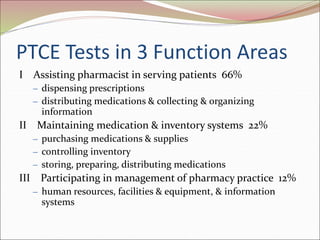
PTCE Tests in 3 Function Areas
I Assisting pharmacist in serving patients 66%
– dispensing prescriptions
– distributing medications & collecting & organizing
information
II Maintaining medication & inventory systems 22%
– purchasing medications & supplies
– controlling inventory
– storing, preparing, distributing medications
III Participating in management of pharmacy practice 12%
– human resources, facilities & equipment, & information
systems
Passing the PTCE
 Candidates who pass the exam may use designation
CPhT (certified pharmacy technician)
after their names
To Maintain Certification
• Technicians must recertify every two years
– complete at least 20 hours of continuing education
– maximum of 10 hours may be earned at the technician’s
workplace under the direct supervision of a pharmacist
• hours must be special assignments or training
• regular work hours do not apply
– at least 1 hour of continuing education must be related
to pharmacy law
ICPT
 Institute for the Certification of Pharmacy Technicians
 Exam for Pharmacy Technicians Certification (ExCPT)
 On-demand, computer-based format
 Eligibility requirements to take ExCPT are similar to
those of PTCE
 Two-hour test with 110 multiple-choice questions
 10 are not counted in score
ExCPT-Question Categories
1. Regulations & Technician Duties (25%)
– Technician duties & general information, controlled
substances, & other laws & regulations
2. Drugs & Therapy (23%)
– drug classification & most frequently prescribed
medications
3. Dispensing Process (52%)
– Prescription information, preparing/dispensing
prescriptions, calculations, sterile products, & unit dose
& repackaging
Program Accreditation
 ASHP is the only organization that specifically
accredits pharmacy technician training programs
 vocational, technical, & community colleges
 hospitals
 chain drug stores
 military branches
Accreditation
 Accreditation standardizes the formal training that
pharmacy technicians receive
 guidelines on how to train competent pharmacy
technicians
 training programs must meet minimum requirements
set by ASHP to earn accreditation
Goals of ASHP Accreditation
• Upgrade & standardize technician training
• assist & recognize training programs
• Provide criteria to help trainees select a program
• Provide pharmacies with a competency tool
• Assist in advancement & professional development of
pharmacy technicians
Professionalism
 Definition: Actively demonstrating attitudes, qualities,
& behaviors of a person well educated in an area of
specialized knowledge
 putting the needs of others before one’s own
 refers to way in which members of a profession present
themselves & communicate with others
Professionalism
• Code of Ethics for Pharmacy Technicians
– Outlines 10 guiding principles for technicians
• Practical examples of professional conduct include
– respect for patients’ privacy
– keeping patient information confidential
– participation in continuing education courses
– honest, conscientious attitude
Professionalism
• Personal appearance communicates a message
• Join a membership organization
– continuing education opportunities
– job placement services
– subscriptions to pharmacy technician journals &
newsletters
– online discussion groups & networks
Pharmacy Practice Settings
• Community Pharmacy
• Mail-Order Pharmacy
• Pharmacy Benefit Managers & Managed Care
• Hospital Pharmacy
• Home Health Care
• Long-Term Care
• Specialty Pharmacy Services
Community Pharmacy
• Corner drugstore
• Local retail or grocery store pharmacy
• chain or independently owned
• Technicians in community settings
– prepare prescription labels for checking by a pharmacist
– order & maintain drug inventory
– process insurance claims
– operate a cash register
Mail-Order Pharmacy
 Prescriptions filled & refilled through the mail
 No face-to-face contact with patients
 Technicians’ duties in a mail-order pharmacy are
similar to those in community setting
Pharmacy Benefit Managers
• PBM
• Oversees prescription medication programs
• Processes & pays prescription medication insurance
claims
• Develops & maintains a medication formulary
• Technicians who work in a PBM environment
• do not have direct patient contact
• Pharmacists manage drug therapy on a global scale
Managed Care
• Type of health insurance program
– Patients pay a blanket fee for their health care services
• “The application of management principles to achieve
maximum health outcomes at the lowest cost”
• Managed care programs often operate ambulatory
clinics & hospitals
Hospital Pharmacy
• Pharmacists are directly involved with patient care
– daily interactions with physicians, nurses, & other s
– develop plans of pharmaceutical care
– monitor the patients’ drug therapy
– may provide specialized services
– pediatrics
– oncology
– infectious diseases
– nutrition support
– drug information
Hospital Pharmacy
 Pharmacists
 evaluate trends in medication use
 develop guidelines for medication use
 educate patients & health care professionals,
 implement & maintain drug distribution systems
 interdisciplinary work within & outside pharmacy
department
Hospital Pharmacy
 Pharmacy technicians in hospitals
 work with pharmacists to accomplish many of the
pharmacy’s goals
 may enter physician medication orders into the
pharmacy computer system
 prepare IV drug admixtures
 repackage & label unit dose medications
Hospital Pharmacy
 Pharmacy technicians in hospitals
 restock automated dispensing cabinets
 deliver medications
 complete paperwork for quality assurance or billing
purposes
 may dispense medications from a preapproved list
Home Health Care
 Home care pharmacists
 assess patient for the appropriateness of home
medication administration
 develop a medication management plan to educate &
monitor the patient
 medications administered may be oral tablets or
capsules or continuous infusions of pain medications or
total parenteral nutrition (TPN)
Home Health Care
 Technician duties in a home care setting may include
 preparing sterile injectable products
 maintaining computerized patient profiles
 delivering medications & supplies to a patient’s home
Long-Term Care
• Includes
• nursing homes
• psychiatric or behavioral health institutions
• intermediate care facilities for mentally disabled
patients
• skilled nursing facilities
• May contract with local community pharmacies
• Pharmacists & technicians may not have direct patient
interaction
Long-Term Care
• Hospice care
– patients with incurable diseases
– not expected to live more than six months
• Hospice care may be offered
– long-term care settings
– hospitals
– patients’ own homes
• Provides dying patients with best possible quality of life
– focus on relief of symptoms rather than on treating disease
Specialty Pharmacy Services
 Technicians may specialize in areas such as
 inventory purchasing & management
 sterile product preparation
 surgical pharmacy
 nuclear pharmacy
 veterinary pharmacy
 nonsterile (extemporaneous) compounding
 management roles
Pharmaceutical Care
 Pharmaceutical care
 “the direct, responsible provision of medication-related
care for the purpose of achieving definite outcomes that
improve a patient’s quality of life”
 Practice of pharmacy evolving
 pharmacist & technician roles will continue to change
Pharmaceutical Care Process
1. Identification of potential & actual drug-related
problems
2. Resolution of actual drug-related problems
3. Prevention of potential drug-related problems
MTM
• MTM is current pharmacy practice model
• Medicare Modernization Act (2003)
– MTM programs mandated
 Medication Therapy Management includes
 assessment of a patient’s health status
 formulation of a medication treatment plan
 selection, initiation, modification, or administration of
medication therapy
 monitoring of the patient’s response to therapy
 review of medications for medication-related problems
Impact of Technology
• Computers, bar coding, & robotic systems
• Provides checks & balances
• Allows pharmacists more time
• Technicians operate & maintain these new systems
Impact of Technology
• More accurate & faster than human
• Improves safety for patients
• Cannot assume technology is correct 100% of the time
• Pharmacists & pharmacy technicians must still apply
judgment when checking the work of a machine

Introduction to pharmacy practice chapter 1

  • 1.
  • 2.
    Learning Outcomes • Compare& contrast technician & pharmacist roles • Understand licensing, certification, registration terms • Describe advantages of formal training for technicians • Describe a variety of pharmacy practice settings • Describe characteristics of a professional
  • 3.
    Learning Outcomes  Listtasks that pharmacy technicians perform in various pharmacy settings  Describe the concept of pharmaceutical care  Define medication therapy management  Explain why the use of outpatient pharmacy & medical services is increasing
  • 4.
    Key Terms  Pharmacist Pharmacy technician  Certification  Licensure  Registration
  • 5.
    Key Terms  Accreditation Health-system pharmacy  Home health care  Medication therapy management (MTM)  Pharmaceutical care
  • 6.
    Basics  Pharmacology: studyof drugs & their actions  Pharmacokinetics: understanding of how drugs are absorbed, distributed, metabolized, & eliminated by body  Pharmaceutics: preparation & dispensing of drugs
  • 7.
    Roles of PharmacyStaff • Pharmacy technicians – Skilled in practical or mechanical aspects – Perform routine, day-to-day functions that do not require judgment of pharmacist • repackaging medications • maintaining medication inventory • Pharmacists – Responsible for technicians’ activities & performance – Engage in activities that require professional judgment – Educating patients about their medications – Suggesting medication alternatives to physicians
  • 8.
    Training • Pharmacy TechnicianCertification Board (PTCB) – National certification program • administers nationally-accredited pharmacy technician certification examination • pharmacy technician performs activities as the result of having certain knowledge & skills • Training requirements for pharmacy technicians vary from state to state & from employer to employer
  • 9.
    Hospital Technician Example –Might require high school diploma – Experience and position related to level of responsibility • Hospital pharmacy technician 1 (PT-1) – newly hired technician – fills automated medication dispensing cabinets • Hospital pharmacy technician 2 (PT-2) – 5 years job experience – fills automated medication dispensing cabinets – charges & credits patient accounts – compounds intravenous solutions – inventories narcotics
  • 10.
    Community Technician Example •PT-1 – receives prescriptions from patients – checks out patients at cash register • PT-2 – enters data in computerized patient profiles – fill & label prescriptions – review patient insurance information
  • 11.
    Technician Advanced Practice Tech-check-tech  allowed in some states  technicians check work of other technicians  under the supervision of a pharmacist  Automated technology  day-to-day operations & upkeep of systems  computerized narcotic inventory control  preparation & compounding of IV & sterile products
  • 12.
    Patient safety • Toppriority for all pharmacists & pharmacy technicians right drug right route right dose right patient right time • Technicians – may be responsible for preparation of drugs – enter patient information into computer profile for later verification by pharmacist • Errors can cause potentially fatal outcomes • Technicians play key role in minimizing risk of errors
  • 13.
    Technician Training • Informalon-the-Job Training • Learn skills needed to perform a particular job – fill prescriptions – automated medication dispensing cabinets – compound IV solutions or medications – enter prescription information into computer database • Informal training situations – pharmacist or technician who is familiar with job often instructs trainee
  • 14.
    Technician Training • Structuredon-the-job Training – training course developed by the employer – classroom teaching combined with hands-on experience – may last from a week to six months • aseptic (sterile) technique, • pharmaceutical calculations • technician responsibilities • pharmacy rules & regulations • patient confidentiality • organizational policies & procedures • employee responsibilities
  • 15.
    Technician Training • FormalPrograms Community & technical college programs – broader in scope than on-the-job training – six to twenty-four months to complete – programs typically include: • technical duties related to pharmacy • medical terminology • pharmaceutical calculations • drug distribution systems • IV admixture procedures • medication packaging techniques
  • 16.
    Technician Training • FormalPrograms Continued • Technicians gain skills, knowledge, & experience by – attending classes – participating in labs – completing clerkships • After completion of many of these programs students may earn – associate degrees – pharmacy technician certificates • Most programs offer – full-time, part-time, & night classes – financial assistance to those individuals who qualify – online distance learning programs
  • 17.
    Pharmacist Training • School –Two years of prerequisite courses – Professional college degree is doctor of pharmacy (PharmD) – Older pharmacists may hold a bachelor of science (BS) in pharmacy • License – pharmacists must be licensed by the state’s BOP – licensed pharmacists supervise technicians – pharmacists must have degree in pharmacy to take the licensing examination
  • 18.
    Pharmacist Training • Includesadvanced training in pharmaceutical sciences • Learn to use professional judgment • Must determine appropriateness for each patient every time prescription is filled: – verify that medication is appropriate for patient’s condition – dosage is correct – patient is not allergic to drug – prescribed medication will not interact with other meds – must educate patient on how to take medication properly – alert patient to possible side effects of drug
  • 19.
    Advanced Pharmacist Training •Elective Residency – 1 or 2 year postgraduate training programs – provide opportunity to gain clinical experience – usually in hospital, ambulatory, or community settings – after earning a degree • Elective Fellowships – usually 2-3 years long – focus on pharmacy research rather than clinical pharmacy practice
  • 20.
    Levels of Endorsement Accreditation  Process of vouching for conformance with criteria  Certification  voluntary process to grant recognition to individual  lets public know of level of knowledge & skill  Credentialing  verification of pharmacist’s ability to provide patient care  Licensure  government agency grants permission to individual  public health, safety, & welfare will be reasonably well protected  Registration  process of making list or being enrolled in an existing list
  • 21.
    Accreditation/Certification • Accredited pharmacytechnician programs • Certification examinations – assure that pharmacy technicians: • have met a predefined set of standards • possess an established set of skills & knowledge • May provide advantages in terms of job responsibilities, salary, & seniority
  • 22.
    Technician Certification • Scopeof Pharmacy Technician Practice developed from • validated task analysis – what pharmacy technicians actually do – what knowledge they need to effectively perform those task • Pharmacy Technician Certification Board (PTCB) • a national pharmacy technician certification program • States differ in technician requirements • some states require registration of pharmacy technicians • some states require certification • No national requirement for certification at this time
  • 23.
    PTCE • Pharmacy TechnicianCertification Examination • To take examination candidates must – have high school diploma or GED – submit appropriate application form – pay fee – ineligible if – convicted of drug- or pharmacy- related felony – any felony convictions any time during previous 5 years
  • 24.
    PTCE • 2-hour, closed-book,computer based examination • 80 multiple-choice questions + 10 non-scored questions • Score is based on number of correctly answered questions
  • 25.
    PTCE Tests in3 Function Areas I Assisting pharmacist in serving patients 66% – dispensing prescriptions – distributing medications & collecting & organizing information II Maintaining medication & inventory systems 22% – purchasing medications & supplies – controlling inventory – storing, preparing, distributing medications III Participating in management of pharmacy practice 12% – human resources, facilities & equipment, & information systems
  • 26.
    Passing the PTCE Candidates who pass the exam may use designation CPhT (certified pharmacy technician) after their names
  • 27.
    To Maintain Certification •Technicians must recertify every two years – complete at least 20 hours of continuing education – maximum of 10 hours may be earned at the technician’s workplace under the direct supervision of a pharmacist • hours must be special assignments or training • regular work hours do not apply – at least 1 hour of continuing education must be related to pharmacy law
  • 28.
    ICPT  Institute forthe Certification of Pharmacy Technicians  Exam for Pharmacy Technicians Certification (ExCPT)  On-demand, computer-based format  Eligibility requirements to take ExCPT are similar to those of PTCE  Two-hour test with 110 multiple-choice questions  10 are not counted in score
  • 29.
    ExCPT-Question Categories 1. Regulations& Technician Duties (25%) – Technician duties & general information, controlled substances, & other laws & regulations 2. Drugs & Therapy (23%) – drug classification & most frequently prescribed medications 3. Dispensing Process (52%) – Prescription information, preparing/dispensing prescriptions, calculations, sterile products, & unit dose & repackaging
  • 30.
    Program Accreditation  ASHPis the only organization that specifically accredits pharmacy technician training programs  vocational, technical, & community colleges  hospitals  chain drug stores  military branches
  • 31.
    Accreditation  Accreditation standardizesthe formal training that pharmacy technicians receive  guidelines on how to train competent pharmacy technicians  training programs must meet minimum requirements set by ASHP to earn accreditation
  • 32.
    Goals of ASHPAccreditation • Upgrade & standardize technician training • assist & recognize training programs • Provide criteria to help trainees select a program • Provide pharmacies with a competency tool • Assist in advancement & professional development of pharmacy technicians
  • 33.
    Professionalism  Definition: Activelydemonstrating attitudes, qualities, & behaviors of a person well educated in an area of specialized knowledge  putting the needs of others before one’s own  refers to way in which members of a profession present themselves & communicate with others
  • 34.
    Professionalism • Code ofEthics for Pharmacy Technicians – Outlines 10 guiding principles for technicians • Practical examples of professional conduct include – respect for patients’ privacy – keeping patient information confidential – participation in continuing education courses – honest, conscientious attitude
  • 35.
    Professionalism • Personal appearancecommunicates a message • Join a membership organization – continuing education opportunities – job placement services – subscriptions to pharmacy technician journals & newsletters – online discussion groups & networks
  • 36.
    Pharmacy Practice Settings •Community Pharmacy • Mail-Order Pharmacy • Pharmacy Benefit Managers & Managed Care • Hospital Pharmacy • Home Health Care • Long-Term Care • Specialty Pharmacy Services
  • 37.
    Community Pharmacy • Cornerdrugstore • Local retail or grocery store pharmacy • chain or independently owned • Technicians in community settings – prepare prescription labels for checking by a pharmacist – order & maintain drug inventory – process insurance claims – operate a cash register
  • 38.
    Mail-Order Pharmacy  Prescriptionsfilled & refilled through the mail  No face-to-face contact with patients  Technicians’ duties in a mail-order pharmacy are similar to those in community setting
  • 39.
    Pharmacy Benefit Managers •PBM • Oversees prescription medication programs • Processes & pays prescription medication insurance claims • Develops & maintains a medication formulary • Technicians who work in a PBM environment • do not have direct patient contact • Pharmacists manage drug therapy on a global scale
  • 40.
    Managed Care • Typeof health insurance program – Patients pay a blanket fee for their health care services • “The application of management principles to achieve maximum health outcomes at the lowest cost” • Managed care programs often operate ambulatory clinics & hospitals
  • 41.
    Hospital Pharmacy • Pharmacistsare directly involved with patient care – daily interactions with physicians, nurses, & other s – develop plans of pharmaceutical care – monitor the patients’ drug therapy – may provide specialized services – pediatrics – oncology – infectious diseases – nutrition support – drug information
  • 42.
    Hospital Pharmacy  Pharmacists evaluate trends in medication use  develop guidelines for medication use  educate patients & health care professionals,  implement & maintain drug distribution systems  interdisciplinary work within & outside pharmacy department
  • 43.
    Hospital Pharmacy  Pharmacytechnicians in hospitals  work with pharmacists to accomplish many of the pharmacy’s goals  may enter physician medication orders into the pharmacy computer system  prepare IV drug admixtures  repackage & label unit dose medications
  • 44.
    Hospital Pharmacy  Pharmacytechnicians in hospitals  restock automated dispensing cabinets  deliver medications  complete paperwork for quality assurance or billing purposes  may dispense medications from a preapproved list
  • 45.
    Home Health Care Home care pharmacists  assess patient for the appropriateness of home medication administration  develop a medication management plan to educate & monitor the patient  medications administered may be oral tablets or capsules or continuous infusions of pain medications or total parenteral nutrition (TPN)
  • 46.
    Home Health Care Technician duties in a home care setting may include  preparing sterile injectable products  maintaining computerized patient profiles  delivering medications & supplies to a patient’s home
  • 47.
    Long-Term Care • Includes •nursing homes • psychiatric or behavioral health institutions • intermediate care facilities for mentally disabled patients • skilled nursing facilities • May contract with local community pharmacies • Pharmacists & technicians may not have direct patient interaction
  • 48.
    Long-Term Care • Hospicecare – patients with incurable diseases – not expected to live more than six months • Hospice care may be offered – long-term care settings – hospitals – patients’ own homes • Provides dying patients with best possible quality of life – focus on relief of symptoms rather than on treating disease
  • 49.
    Specialty Pharmacy Services Technicians may specialize in areas such as  inventory purchasing & management  sterile product preparation  surgical pharmacy  nuclear pharmacy  veterinary pharmacy  nonsterile (extemporaneous) compounding  management roles
  • 50.
    Pharmaceutical Care  Pharmaceuticalcare  “the direct, responsible provision of medication-related care for the purpose of achieving definite outcomes that improve a patient’s quality of life”  Practice of pharmacy evolving  pharmacist & technician roles will continue to change
  • 51.
    Pharmaceutical Care Process 1.Identification of potential & actual drug-related problems 2. Resolution of actual drug-related problems 3. Prevention of potential drug-related problems
  • 52.
    MTM • MTM iscurrent pharmacy practice model • Medicare Modernization Act (2003) – MTM programs mandated  Medication Therapy Management includes  assessment of a patient’s health status  formulation of a medication treatment plan  selection, initiation, modification, or administration of medication therapy  monitoring of the patient’s response to therapy  review of medications for medication-related problems
  • 53.
    Impact of Technology •Computers, bar coding, & robotic systems • Provides checks & balances • Allows pharmacists more time • Technicians operate & maintain these new systems
  • 54.
    Impact of Technology •More accurate & faster than human • Improves safety for patients • Cannot assume technology is correct 100% of the time • Pharmacists & pharmacy technicians must still apply judgment when checking the work of a machine