2
Developing Marketing
Strategies and Plans
1
Chapter Questions
 How does marketing affect customer value?
 How is strategic planning carried out at
different levels of the organization?
 What does a marketing plan include?
Copyright © 2011 Pearson Education, Inc. Publishing as Prentice Hall 2-2
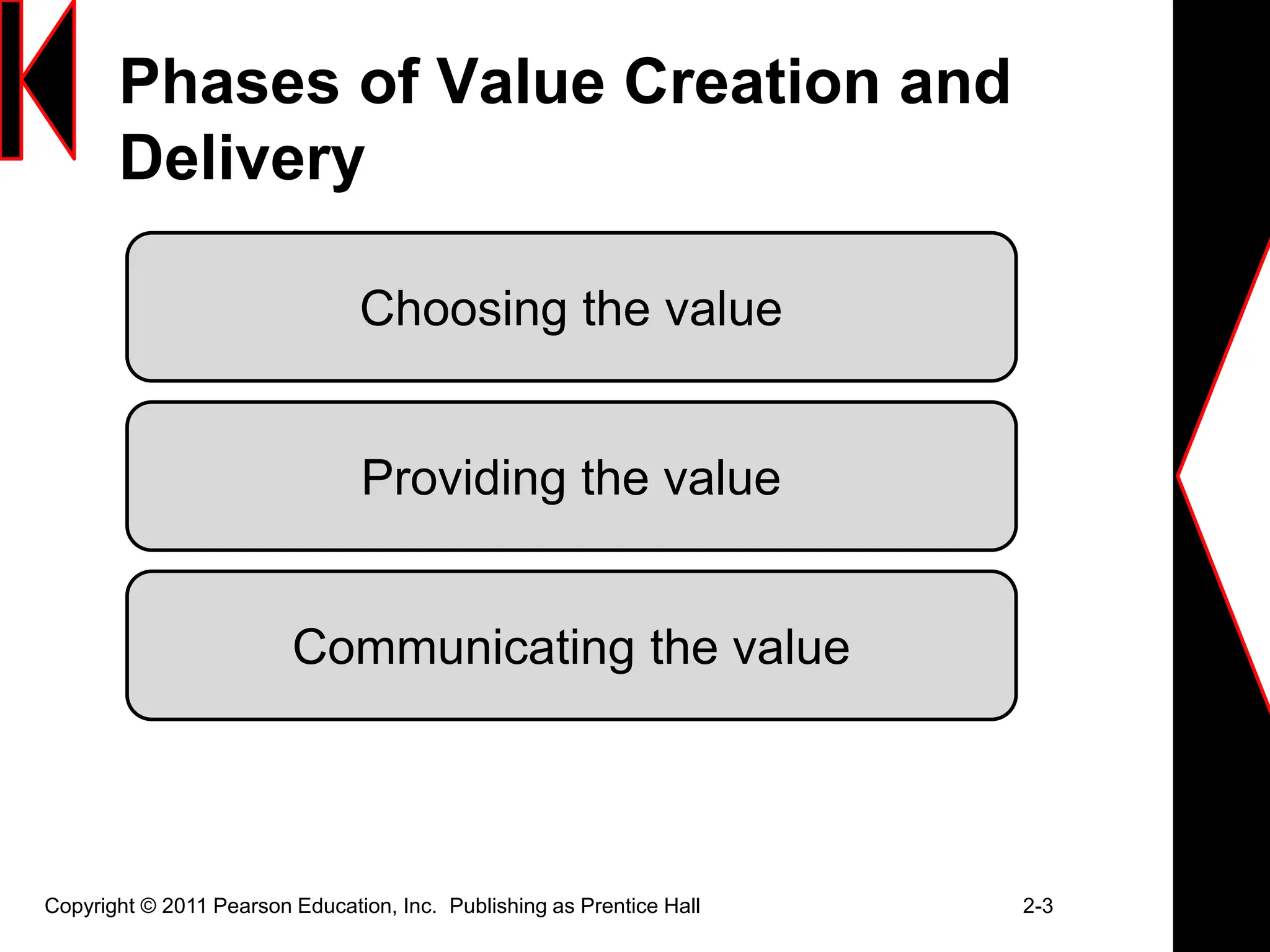
Phases of Value Creation and
Delivery
Copyright © 2011 Pearson Education, Inc. Publishing as Prentice Hall 2-3
Choosing the value
Providing the value
Communicating the value
Copyright © 2011 Pearson Education, Inc. Publishing as Prentice Hall 2-4
What is the Value Chain?
The value chain is a tool for identifying was
to create more customer value because
every firm is a synthesis of primary and
support activities performed to design,
produce, market, deliver, and support its
product.
Core Business Processes
 Market-sensing process
 New-offering realization process
 Customer acquisition process
 Customer relationship management process
 Fulfillment management process
Copyright © 2011 Pearson Education, Inc. Publishing as Prentice Hall 2-5
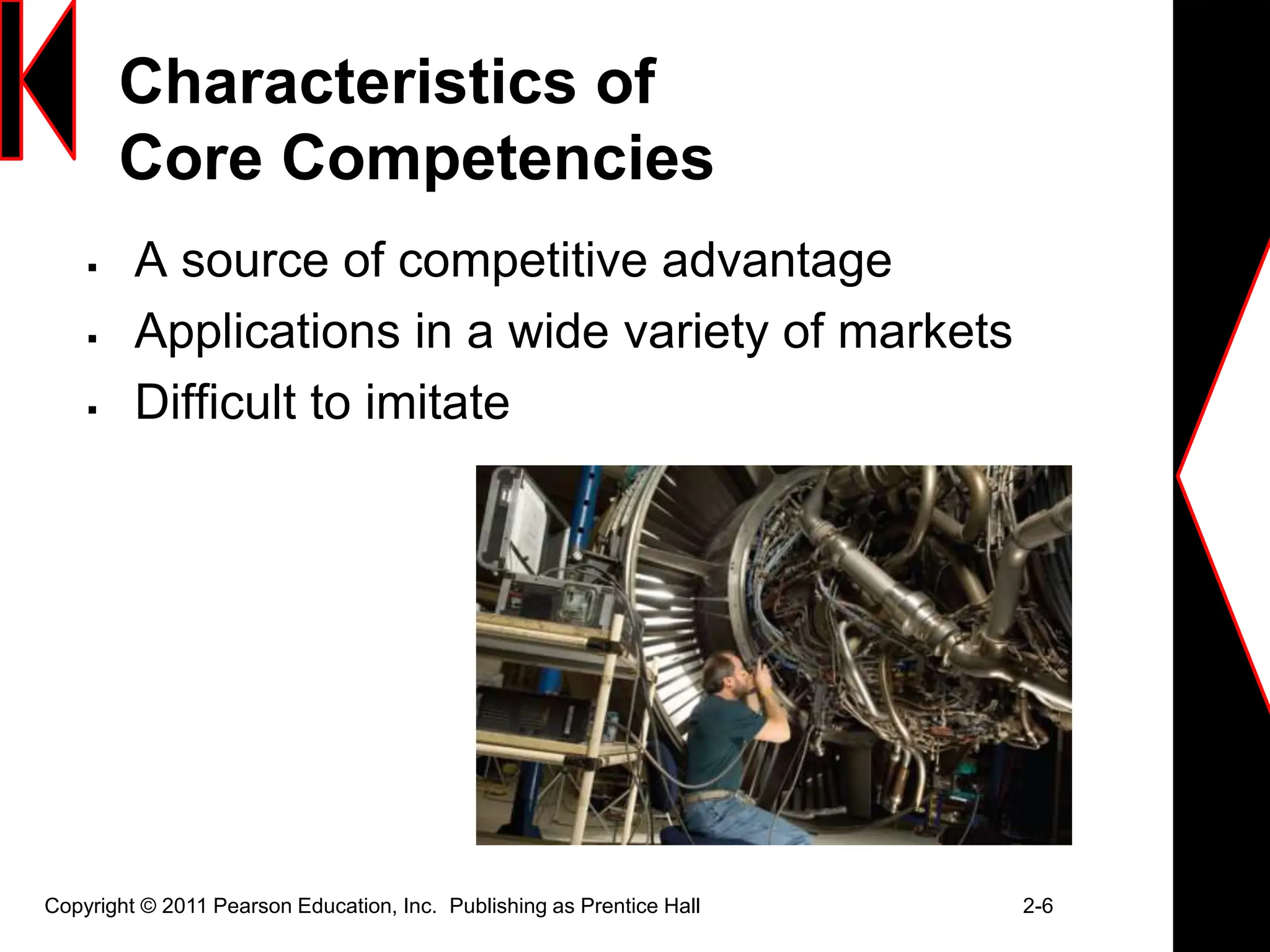
Characteristics of
Core Competencies
 A source of competitive advantage
 Applications in a wide variety of markets
 Difficult to imitate
Copyright © 2011 Pearson Education, Inc. Publishing as Prentice Hall 2-6
Maximizing Core Competencies
 (Re)define the business concept
 (Re)shaping the business scope
 (Re)positioning the company’s brand identity
Copyright © 2011 Pearson Education, Inc. Publishing as Prentice Hall 2-7
Copyright © 2011 Pearson Education, Inc. Publishing as Prentice Hall 2-8
What is Holistic Marketing?
Holistic marketing sees itself as integrating
the value exploration, value creation, and
value delivery activities with the purpose of
building long-term, mutually satisfying
relationships and co-prosperity among key
stakeholders.
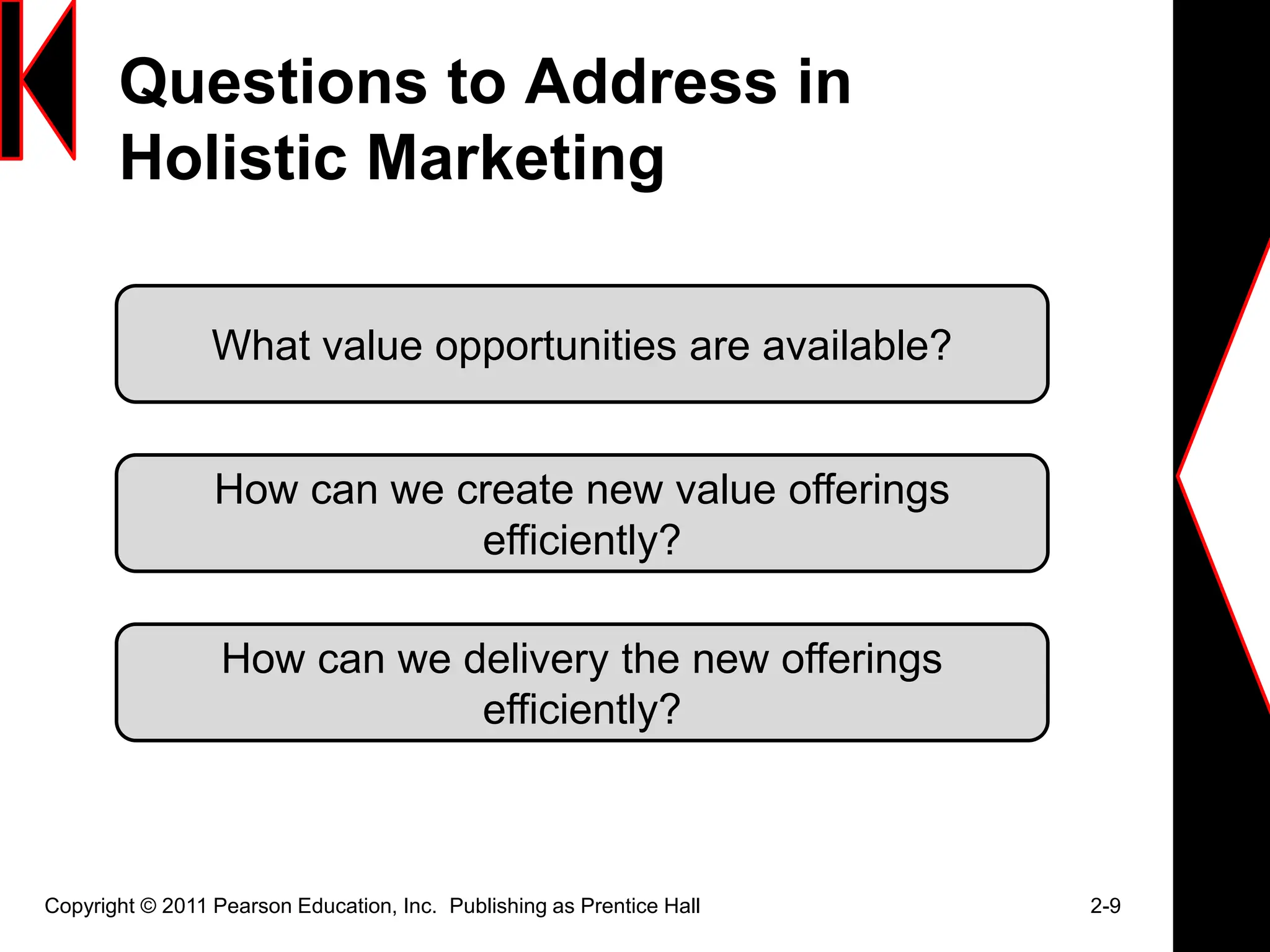
Questions to Address in
Holistic Marketing
Copyright © 2011 Pearson Education, Inc. Publishing as Prentice Hall 2-9
What value opportunities are available?
How can we create new value offerings
efficiently?
How can we delivery the new offerings
efficiently?
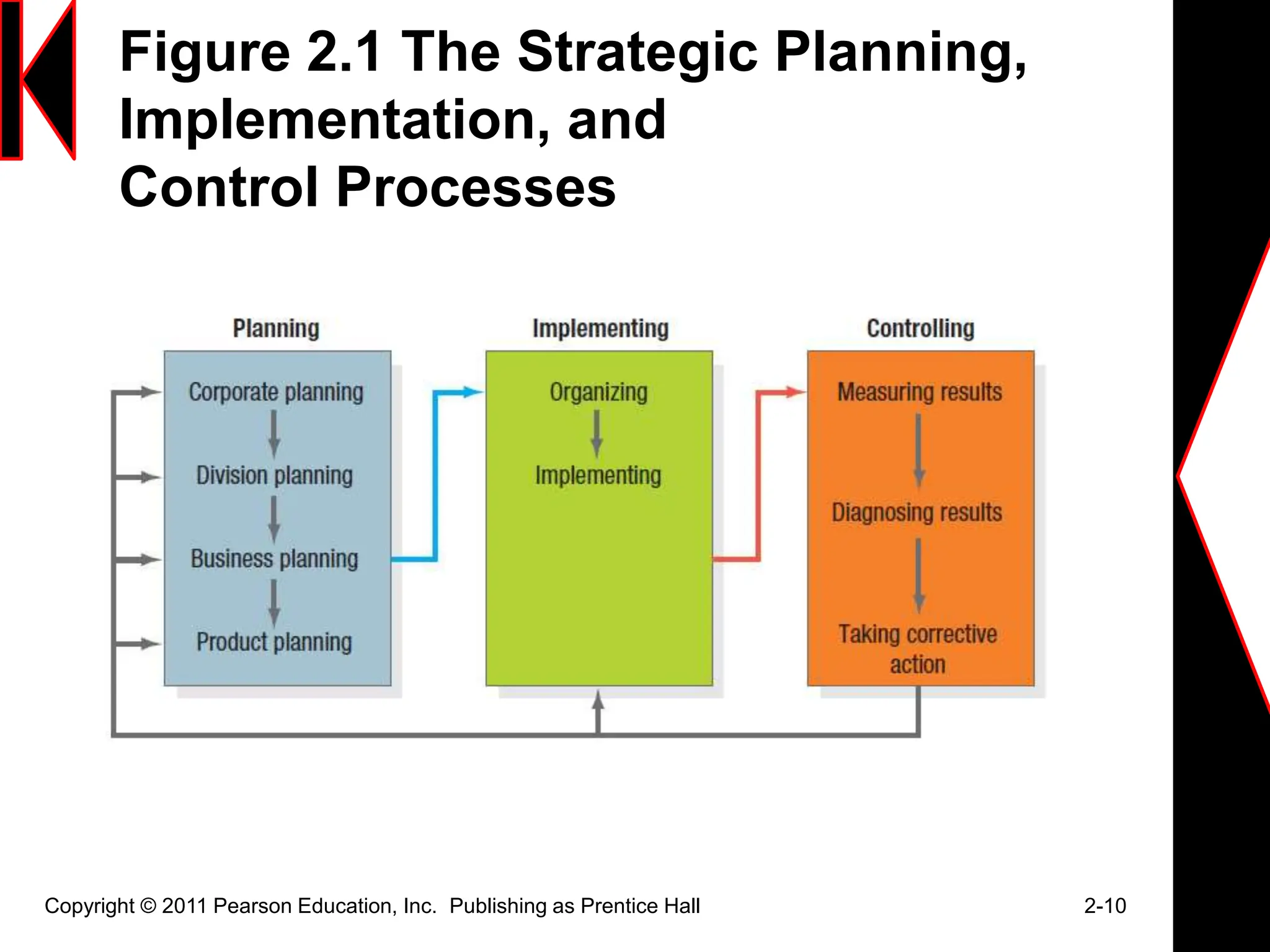
Figure 2.1 The Strategic Planning,
Implementation, and
Control Processes
Copyright © 2011 Pearson Education, Inc. Publishing as Prentice Hall 2-10
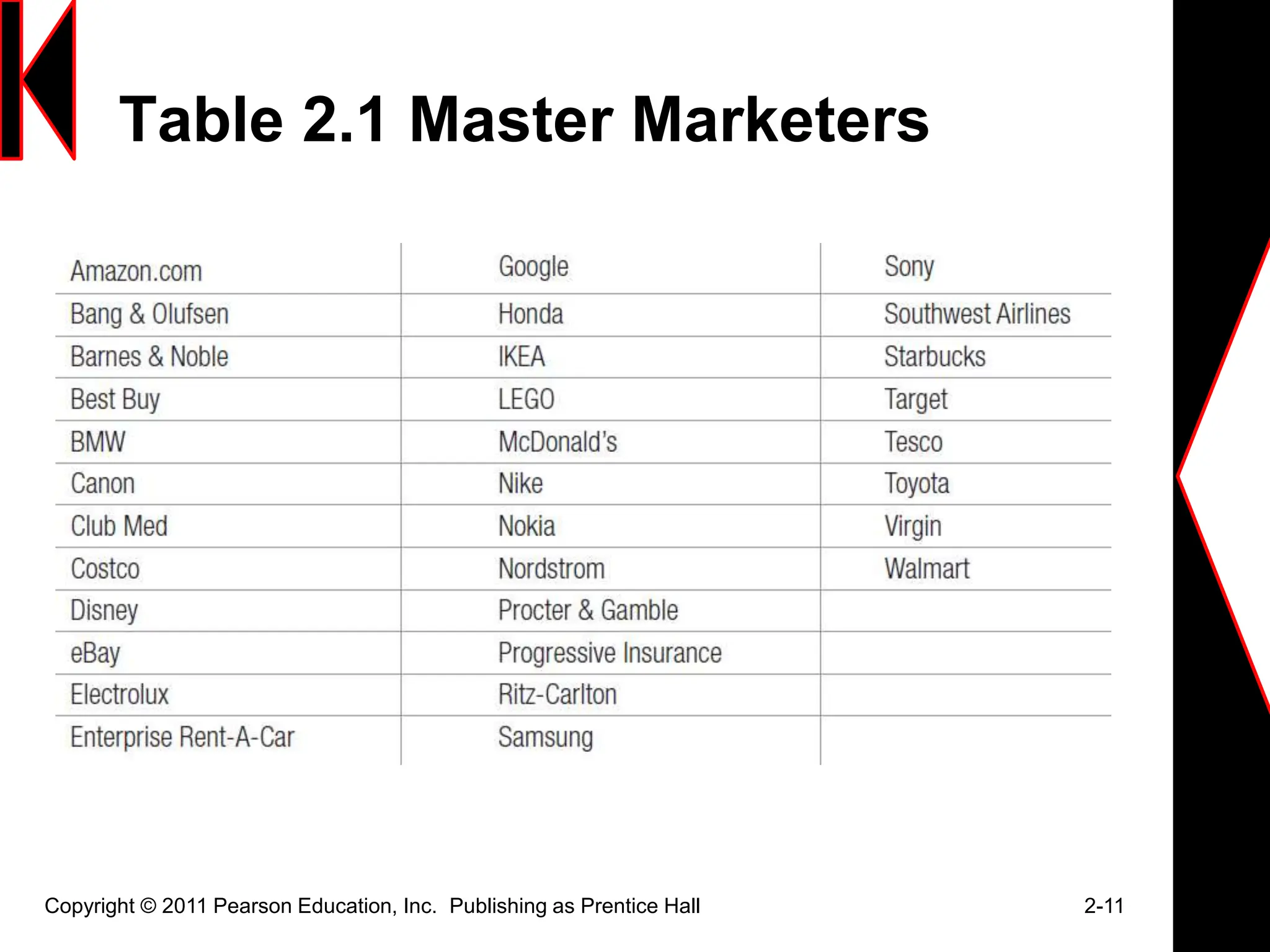
Table 2.1 Master Marketers
Copyright © 2011 Pearson Education, Inc. Publishing as Prentice Hall 2-11
Copyright © 2011 Pearson Education, Inc. Publishing as Prentice Hall 2-12
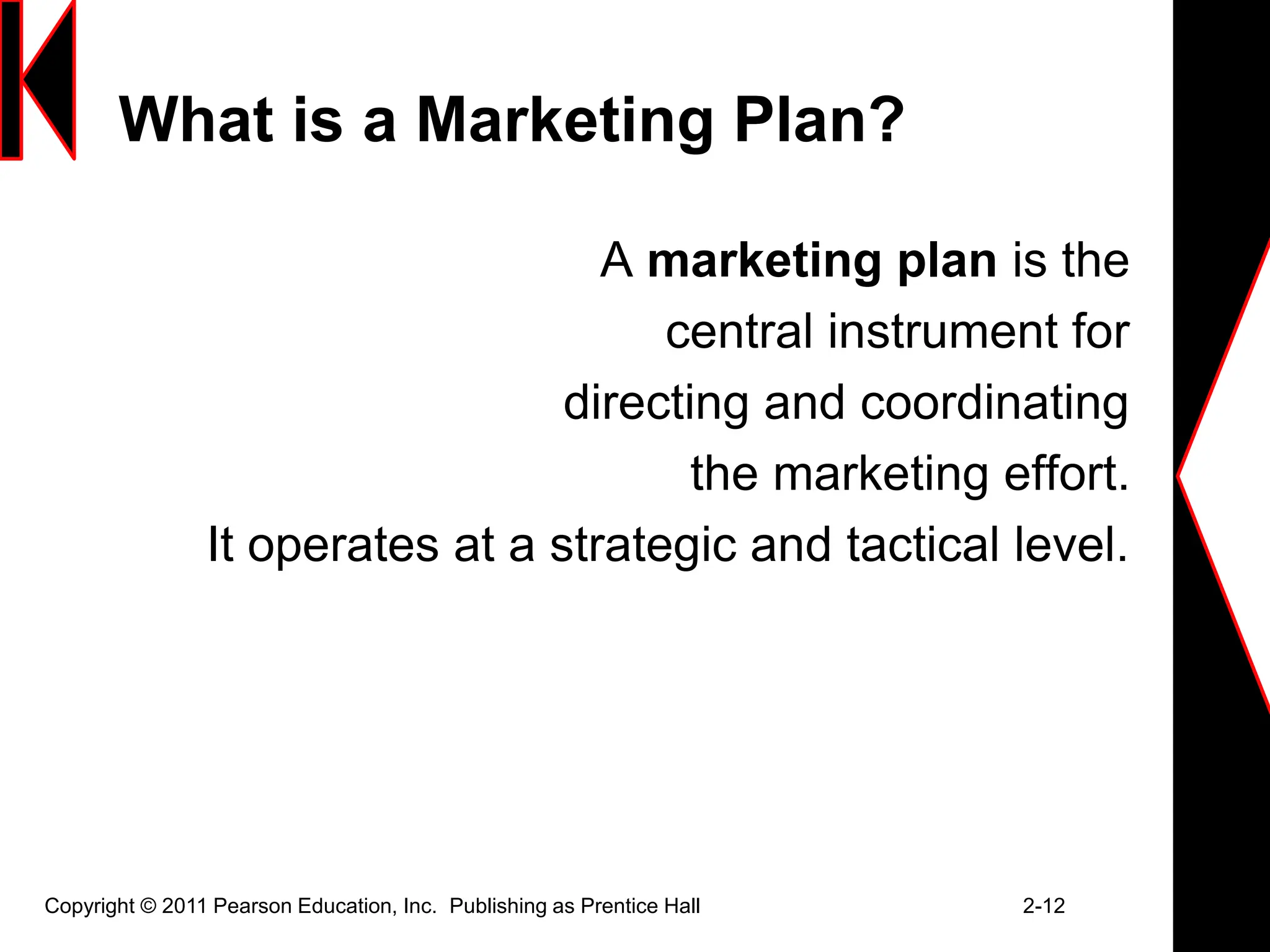
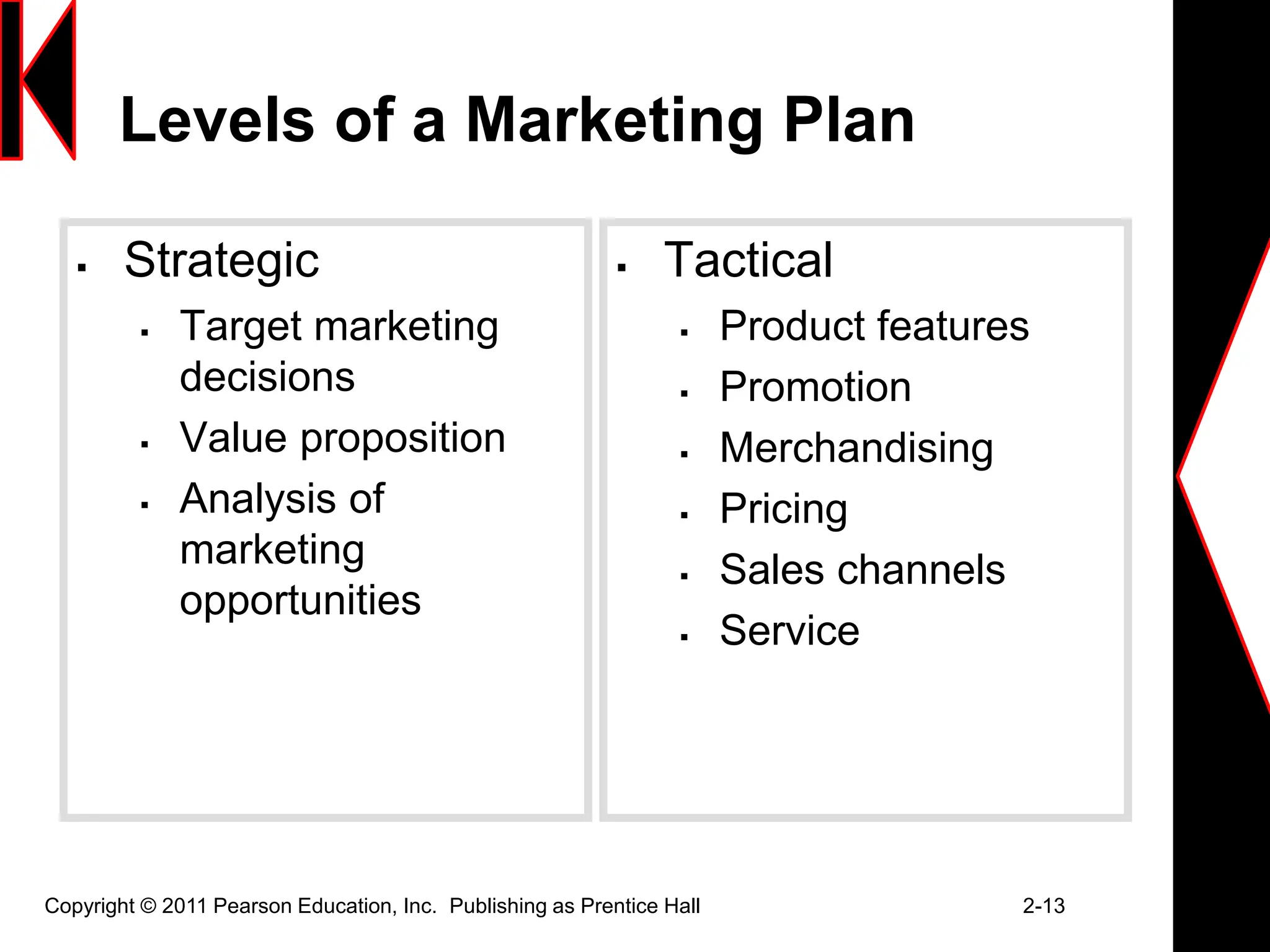
What is a Marketing Plan?
A marketing plan is the
central instrument for
directing and coordinating
the marketing effort.
It operates at a strategic and tactical level.
Copyright © 2011 Pearson Education, Inc. Publishing as Prentice Hall 2-13
Levels of a Marketing Plan
 Strategic
 Target marketing
decisions
 Value proposition
 Analysis of
marketing
opportunities
 Tactical
 Product features
 Promotion
 Merchandising
 Pricing
 Sales channels
 Service
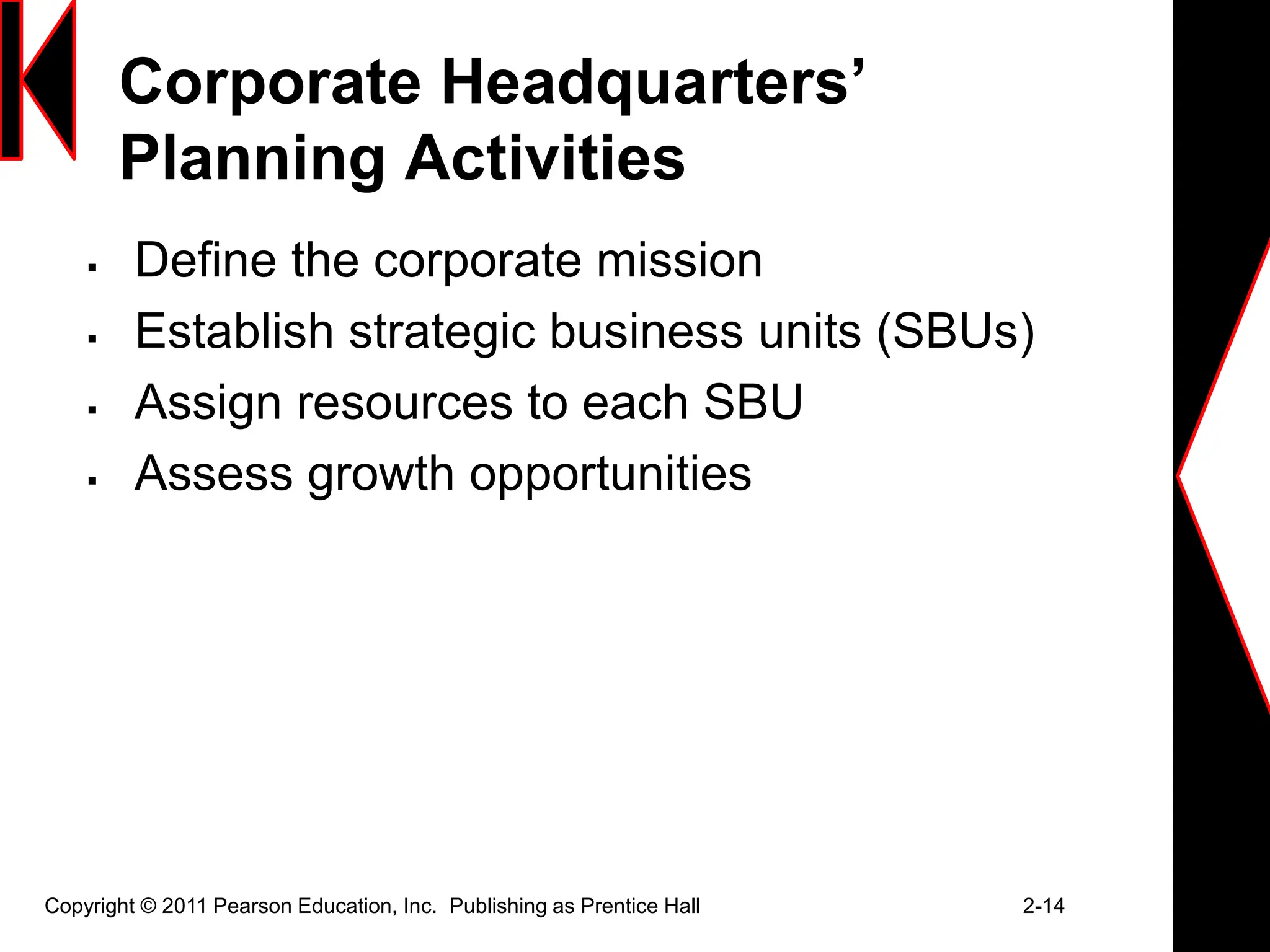
Corporate Headquarters’
Planning Activities
 Define the corporate mission
 Establish strategic business units (SBUs)
 Assign resources to each SBU
 Assess growth opportunities
Copyright © 2011 Pearson Education, Inc. Publishing as Prentice Hall 2-14
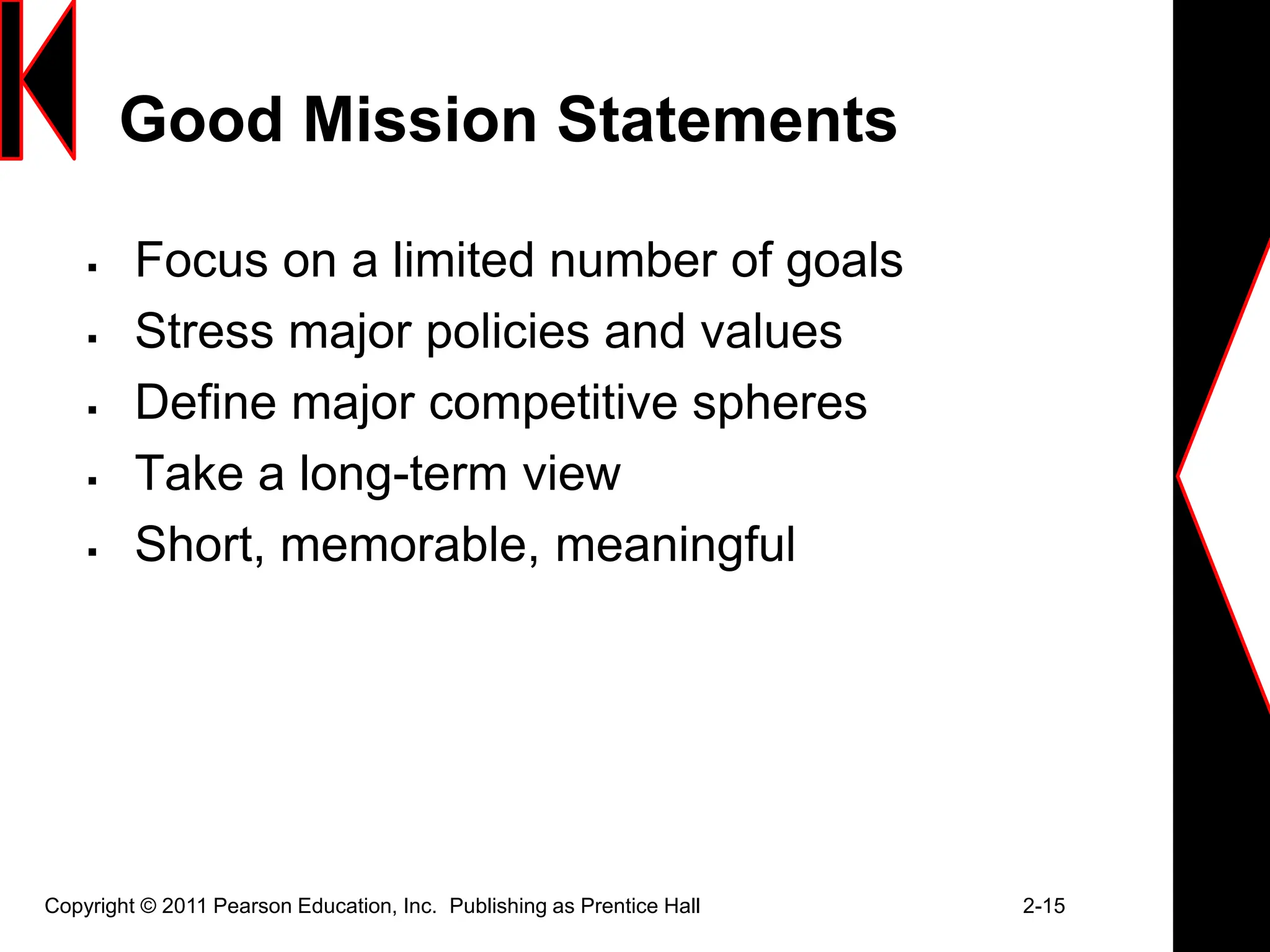
Good Mission Statements
 Focus on a limited number of goals
 Stress major policies and values
 Define major competitive spheres
 Take a long-term view
 Short, memorable, meaningful
Copyright © 2011 Pearson Education, Inc. Publishing as Prentice Hall 2-15
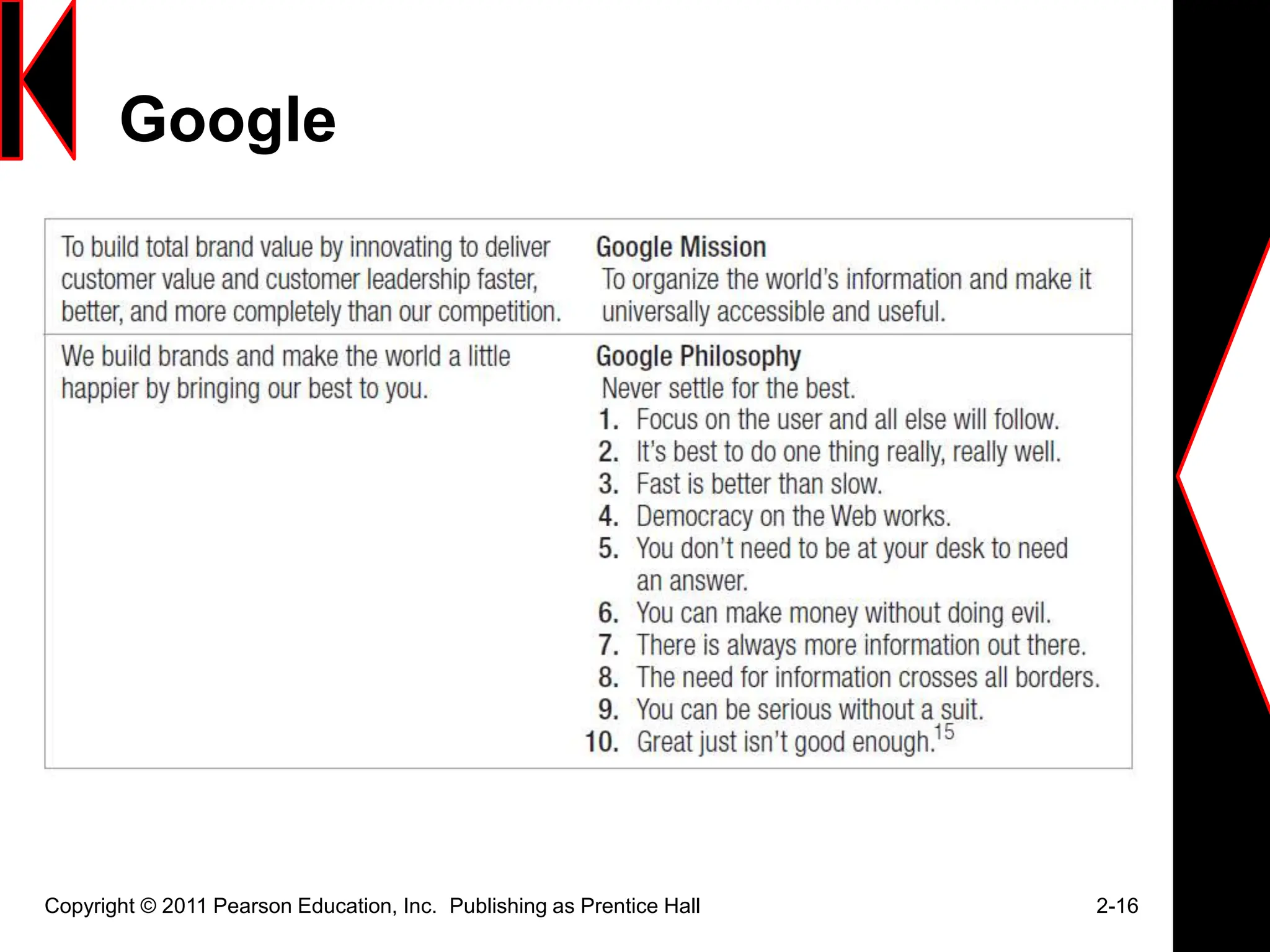
Google
Copyright © 2011 Pearson Education, Inc. Publishing as Prentice Hall 2-16
Table 2.2
Major Competitive Spheres
 Industry
 Products
 Competence
 Market segment
 Vertical channels
 Geographic
Copyright © 2011 Pearson Education, Inc. Publishing as Prentice Hall 2-17
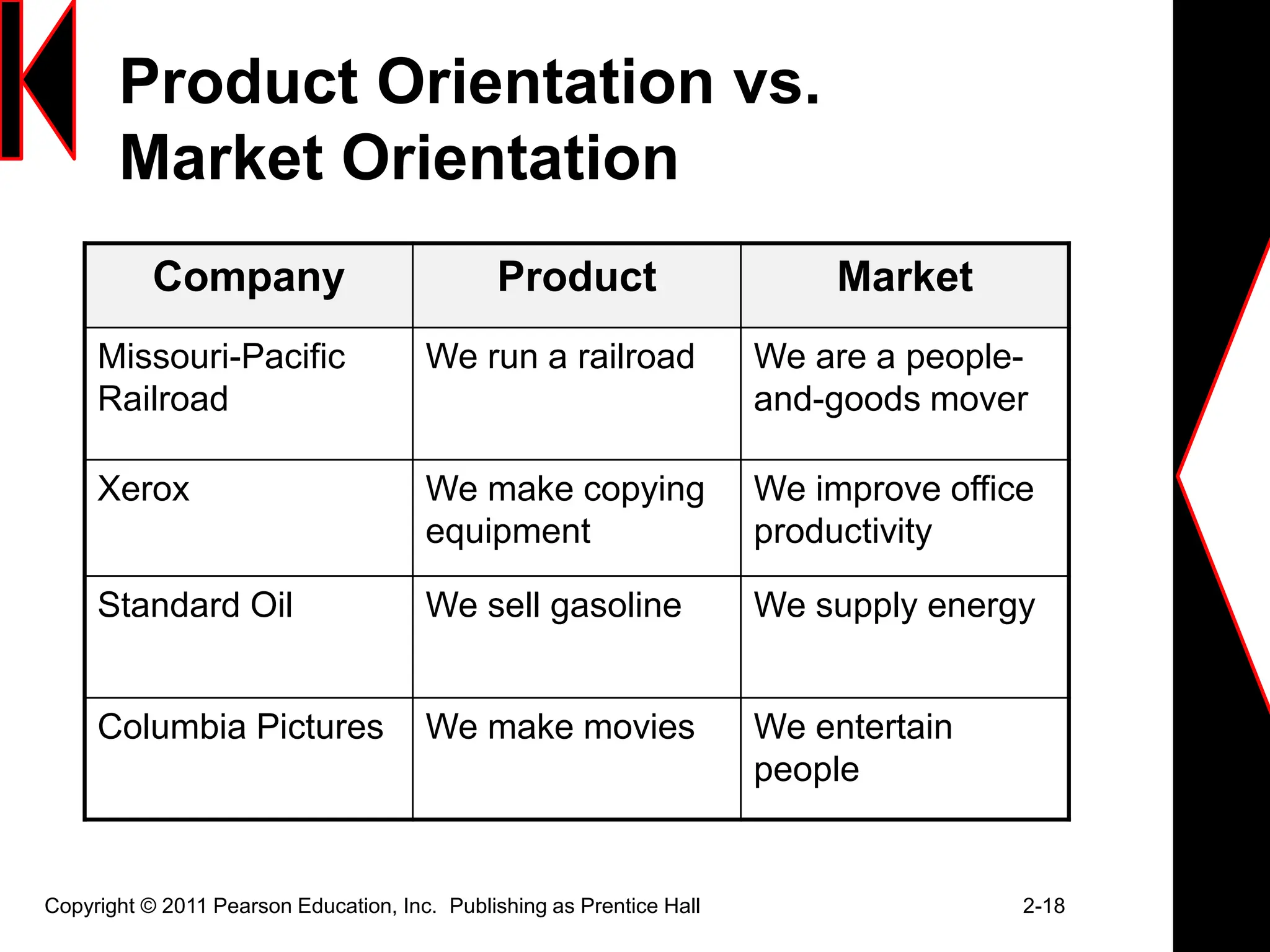
Product Orientation vs.
Market Orientation
Company Product Market
Missouri-Pacific
Railroad
We run a railroad We are a people-
and-goods mover
Xerox We make copying
equipment
We improve office
productivity
Standard Oil We sell gasoline We supply energy
Columbia Pictures We make movies We entertain
people
Copyright © 2011 Pearson Education, Inc. Publishing as Prentice Hall 2-18
Copyright © 2011 Pearson Education, Inc. Publishing as Prentice Hall 2-19
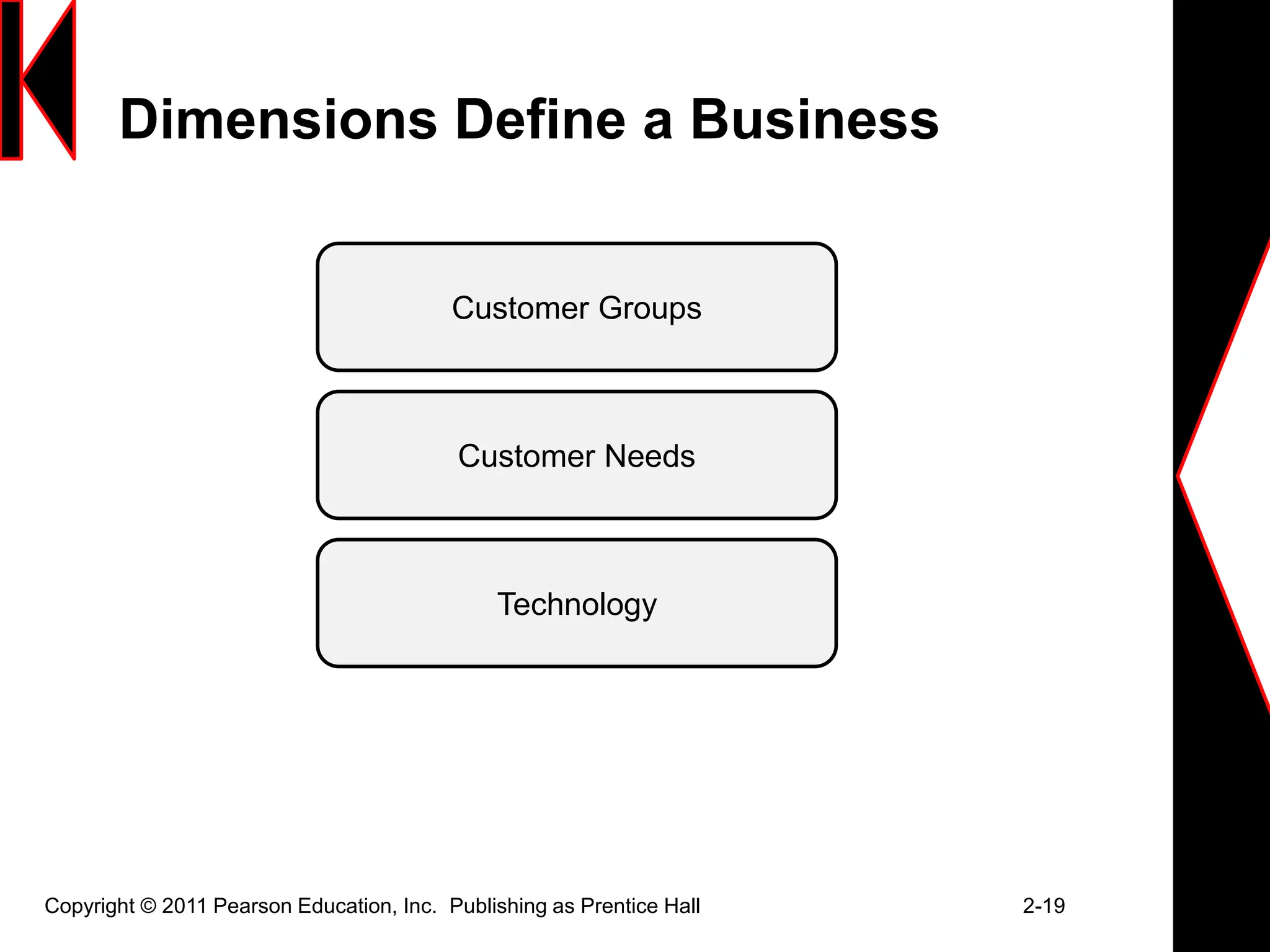
Dimensions Define a Business
Customer Groups
Customer Needs
Technology
Characteristics of SBUs
 It is a single business or collection of related
businesses
 It has its own set of competitors
 It has a leader responsible for strategic
planning and profitability
Copyright © 2011 Pearson Education, Inc. Publishing as Prentice Hall 2-20
Copyright © 2011 Pearson Education, Inc. Publishing as Prentice Hall 2-21
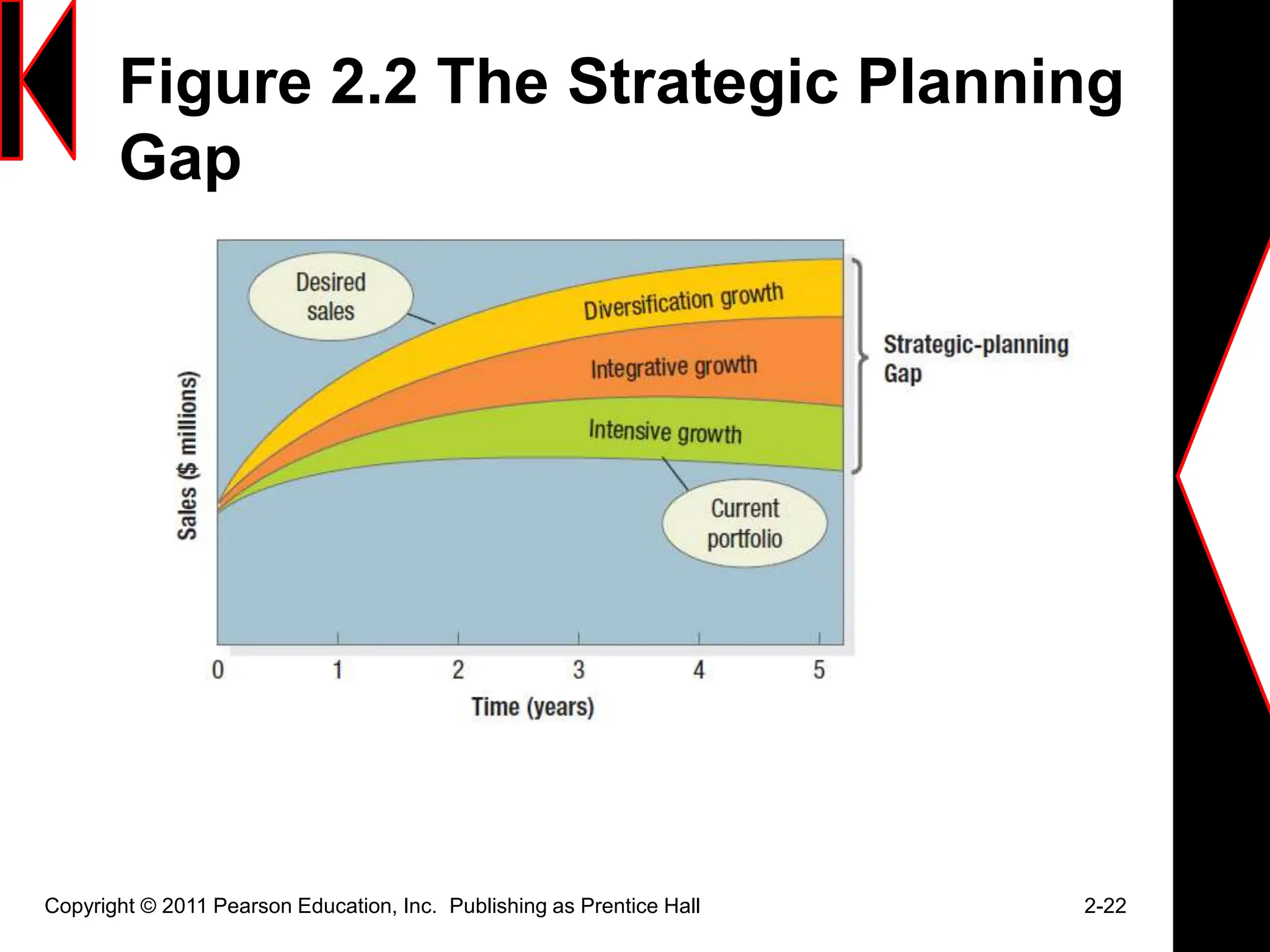
Figure 2.2 The Strategic Planning
Gap
Copyright © 2011 Pearson Education, Inc. Publishing as Prentice Hall 2-22
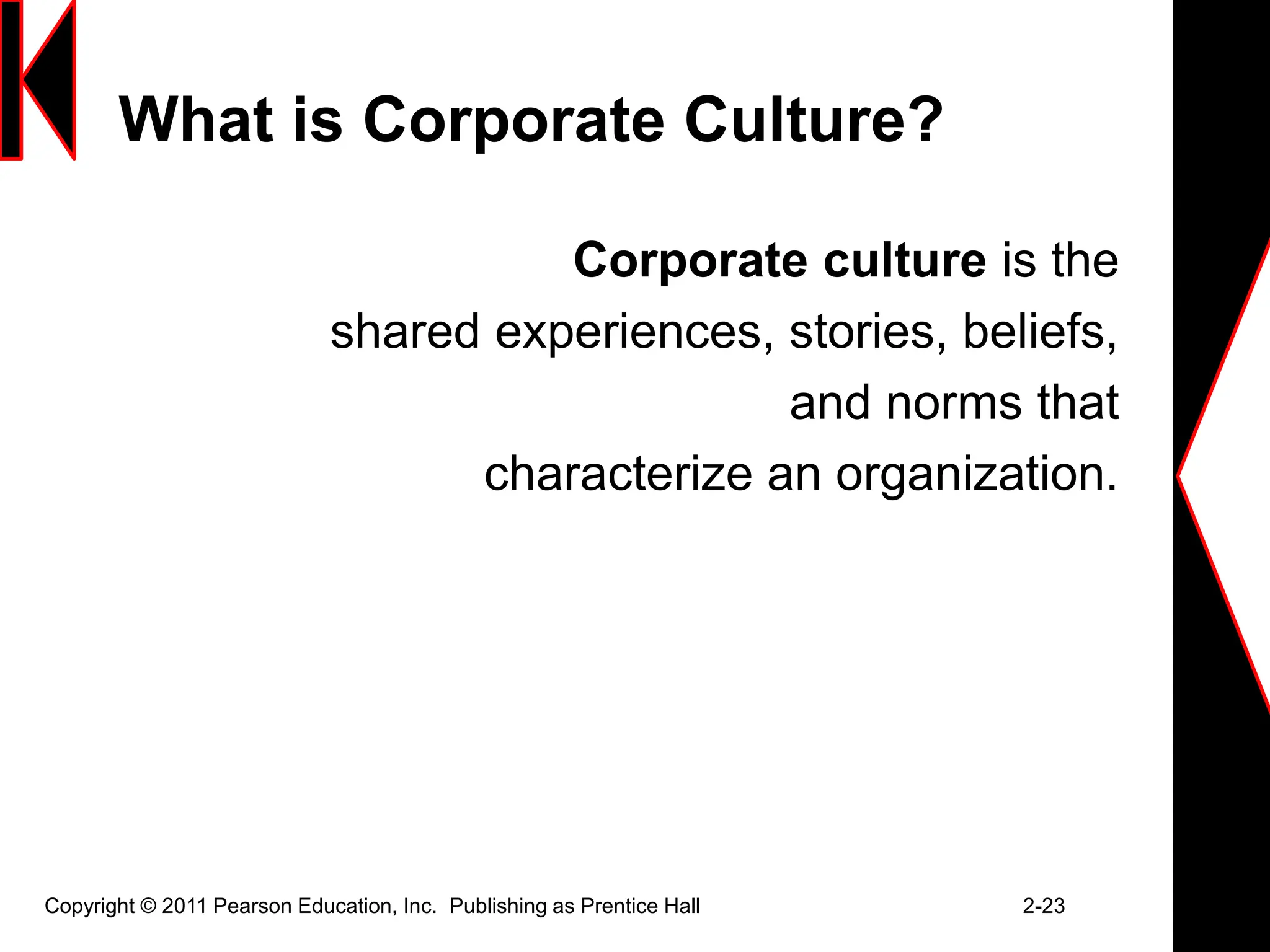
What is Corporate Culture?
Corporate culture is the
shared experiences, stories, beliefs,
and norms that
characterize an organization.
Copyright © 2011 Pearson Education, Inc. Publishing as Prentice Hall 2-23
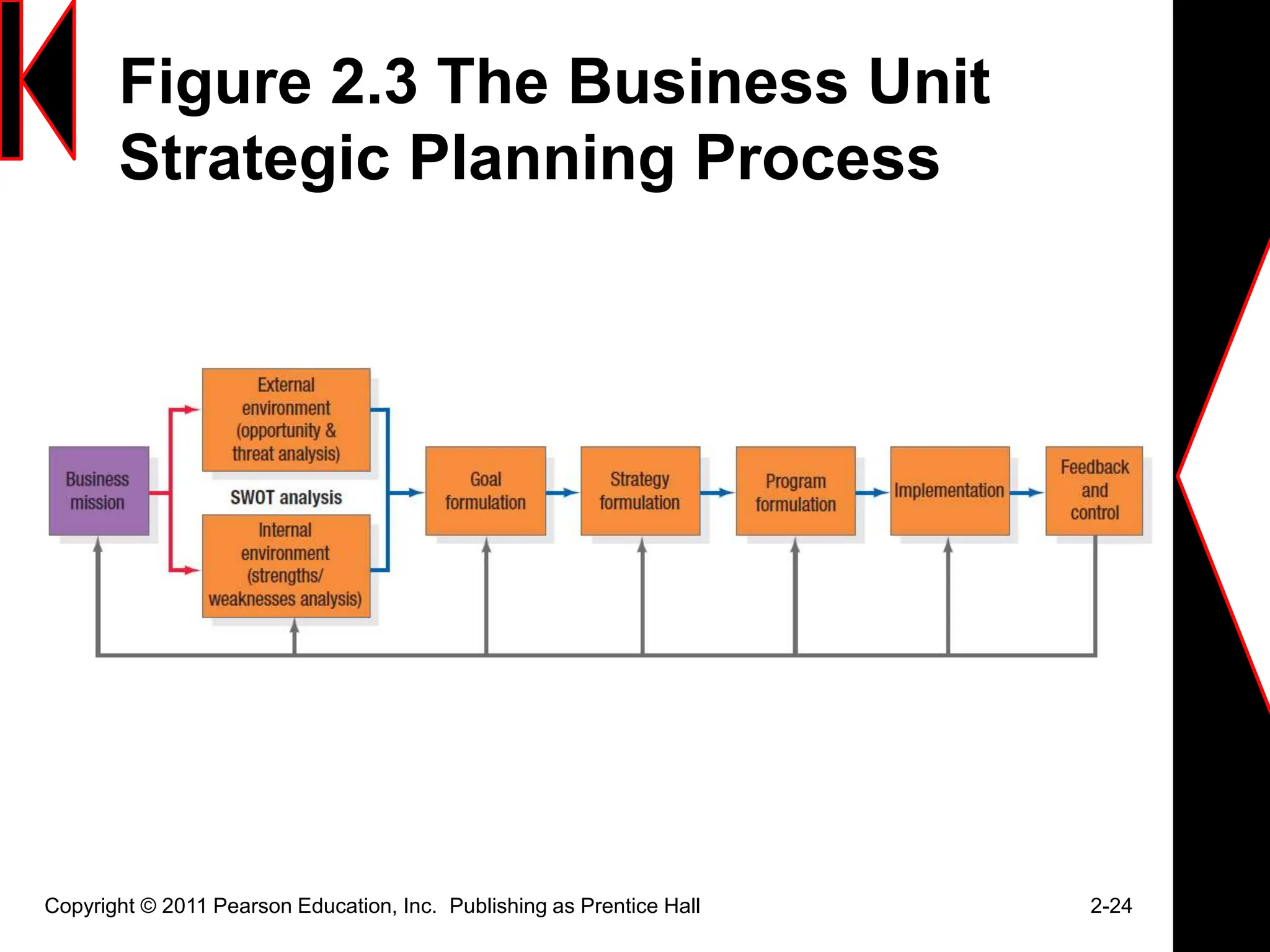
Figure 2.3 The Business Unit
Strategic Planning Process
Copyright © 2011 Pearson Education, Inc. Publishing as Prentice Hall 2-24
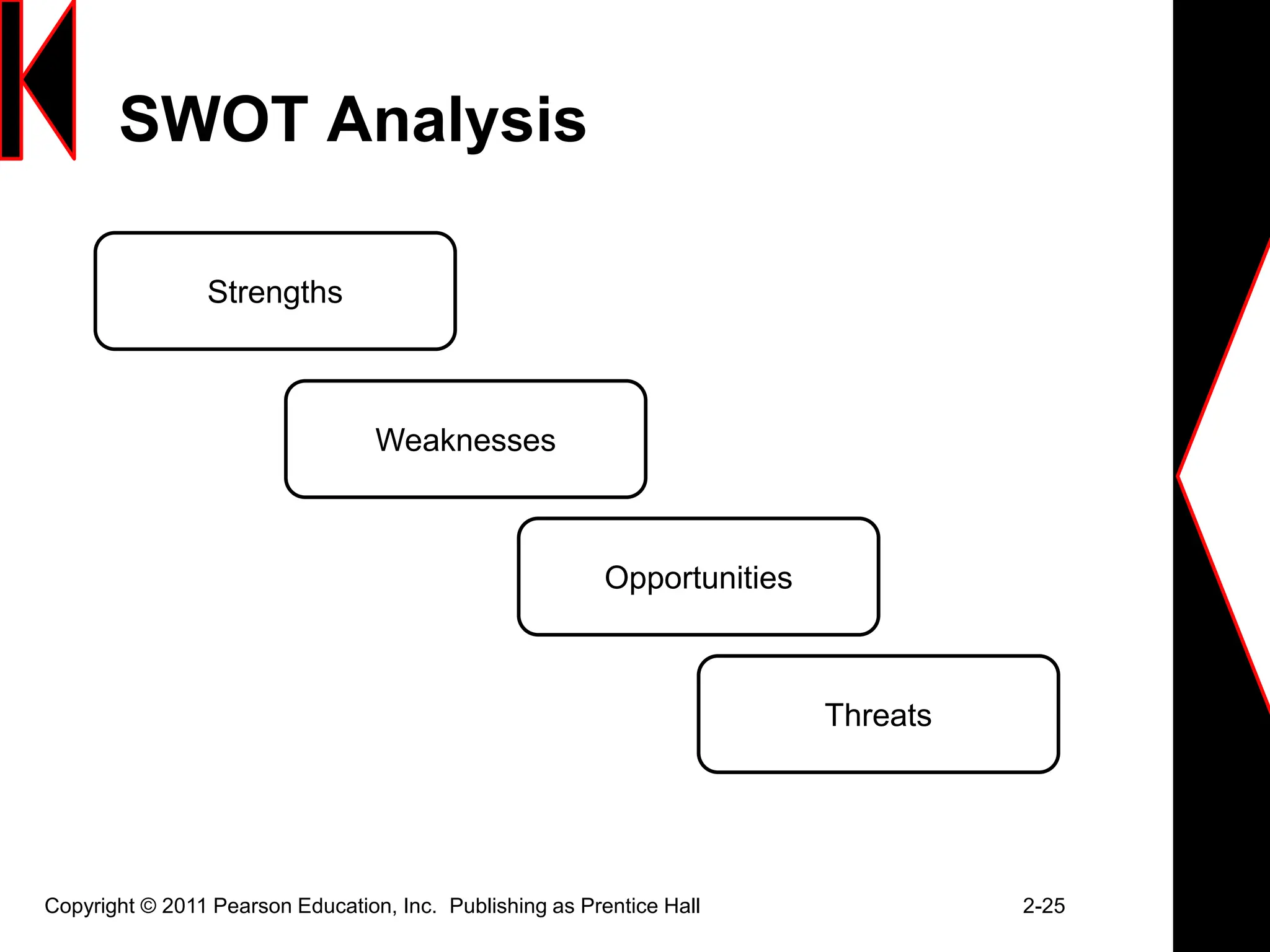
SWOT Analysis
Copyright © 2011 Pearson Education, Inc. Publishing as Prentice Hall 2-25
Strengths
Weaknesses
Opportunities
Threats
Market Opportunity Analysis
(MOA)
 Can the benefits involved in the opportunity
be articulated convincingly to a defined
target market?
 Can the target market be located and
reached with cost-effective media and trade
channels?
 Does the company possess or have access
to the critical capabilities and resources
needed to deliver the customer benefits?
Copyright © 2011 Pearson Education, Inc. Publishing as Prentice Hall 2-26
Market Opportunity Analysis
(MOA)
 Can the company deliver the benefits better
than any actual or potential competitors?
 Will the financial rate of return meet or exceed
the company’s required threshold for
investment?
Copyright © 2011 Pearson Education, Inc. Publishing as Prentice Hall 2-27
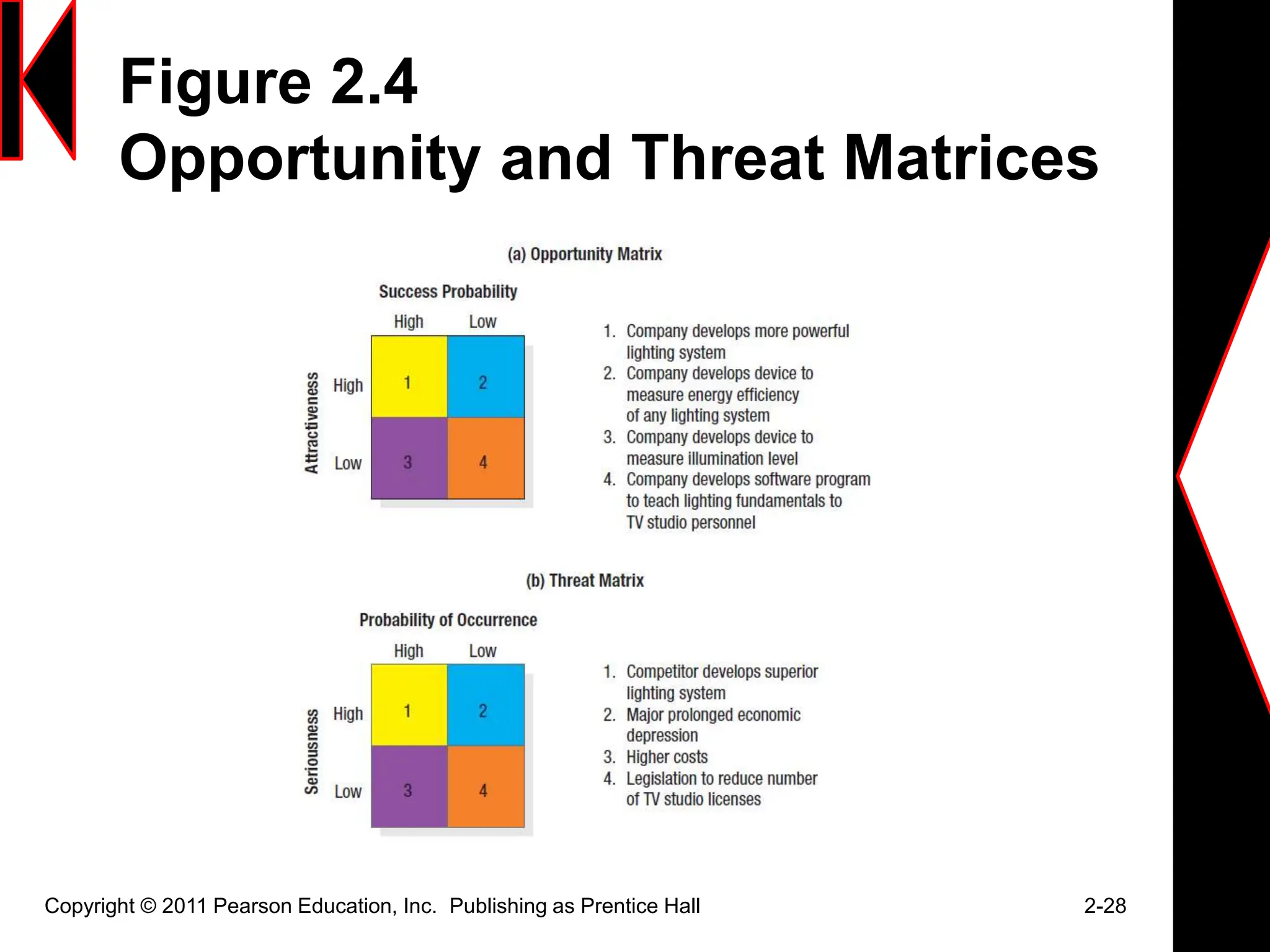
Figure 2.4
Opportunity and Threat Matrices
Copyright © 2011 Pearson Education, Inc. Publishing as Prentice Hall 2-28
Goal Formulation and MBO
 Unit’s objectives must be hierarchical
 Objectives should be quantitative
 Goals should be realistic
 Objectives must be consistent
Copyright © 2011 Pearson Education, Inc. Publishing as Prentice Hall 2-29
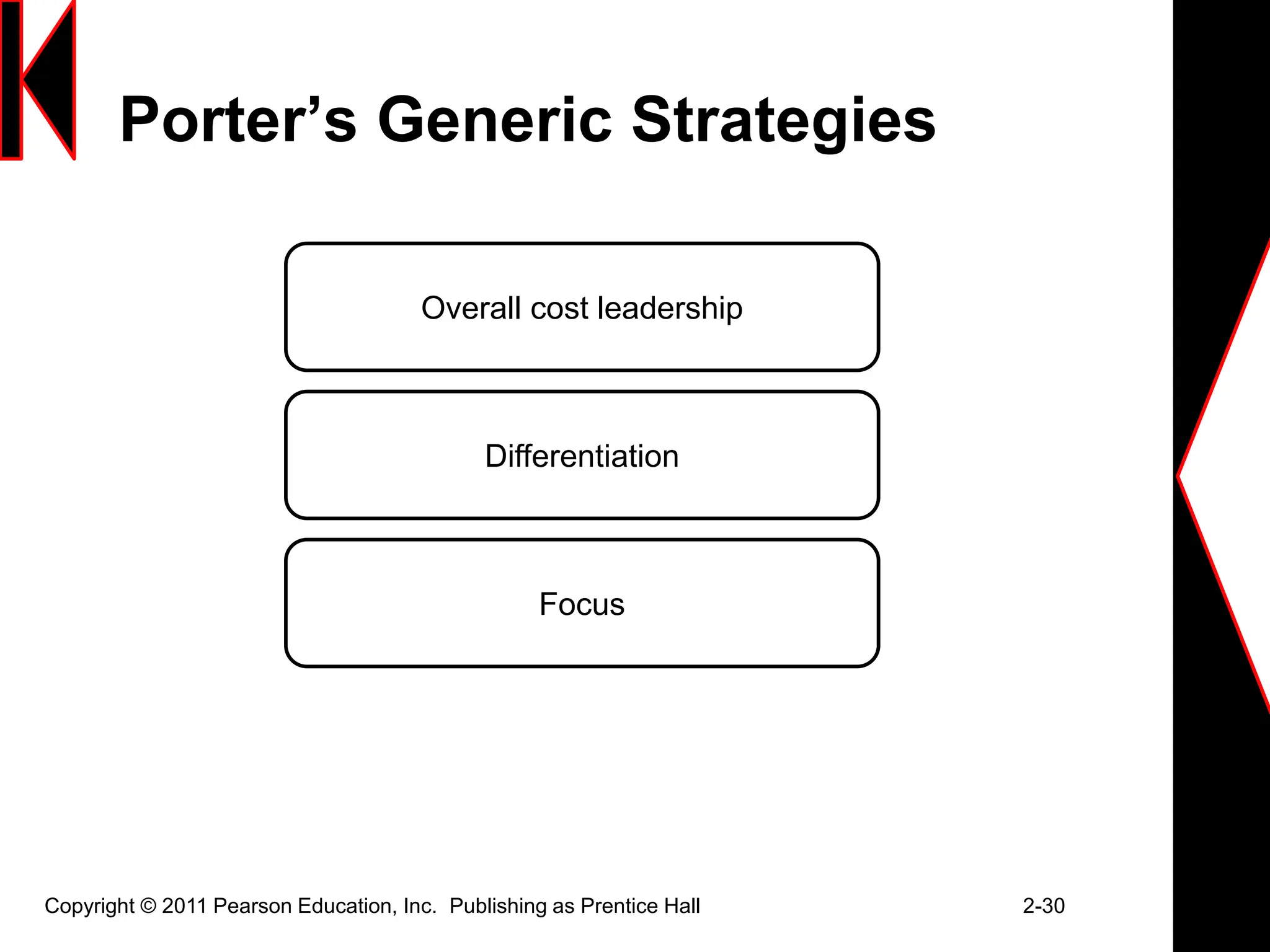
Porter’s Generic Strategies
Copyright © 2011 Pearson Education, Inc. Publishing as Prentice Hall 2-30
Overall cost leadership
Differentiation
Focus
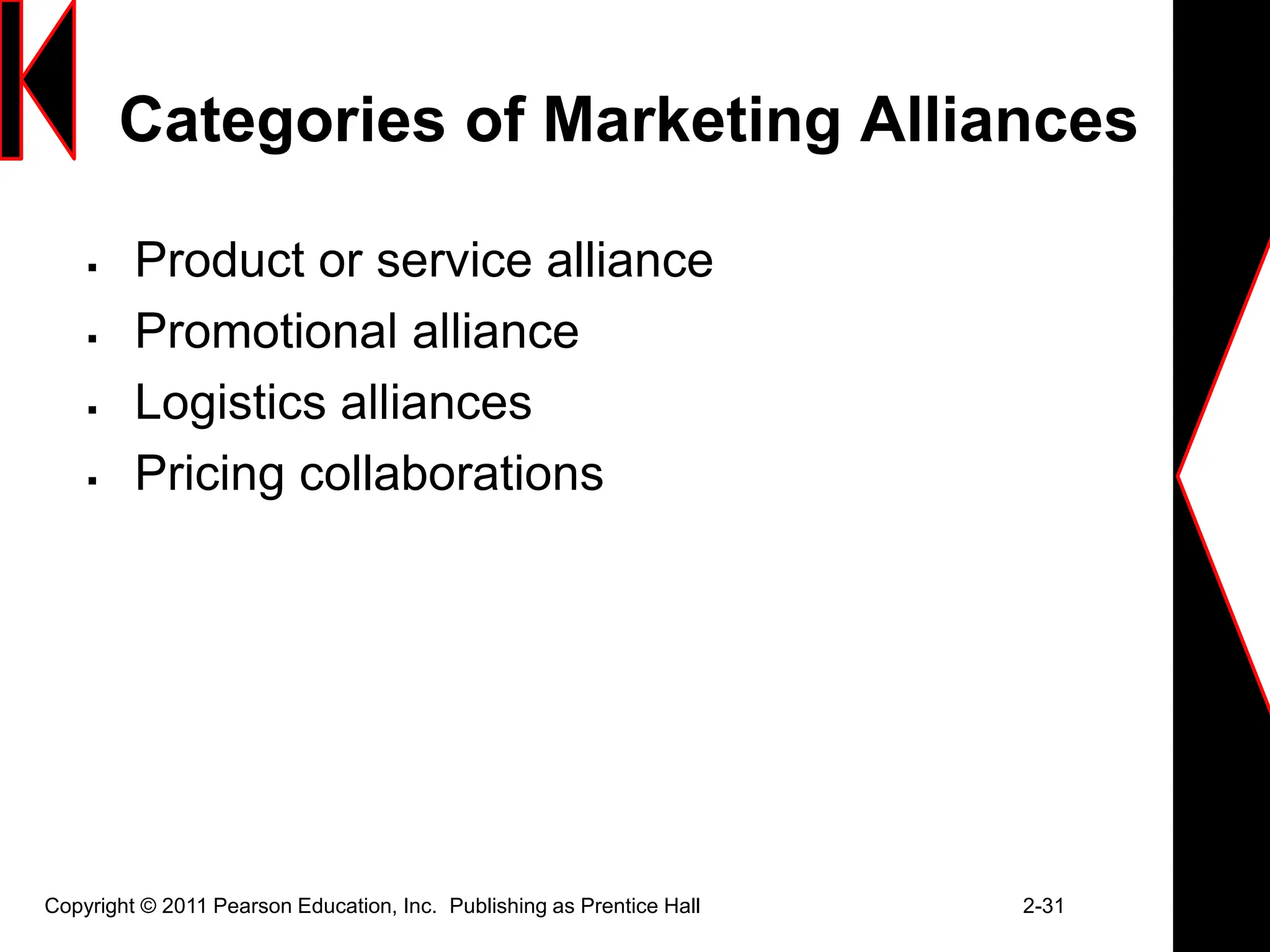
Categories of Marketing Alliances
 Product or service alliance
 Promotional alliance
 Logistics alliances
 Pricing collaborations
Copyright © 2011 Pearson Education, Inc. Publishing as Prentice Hall 2-31
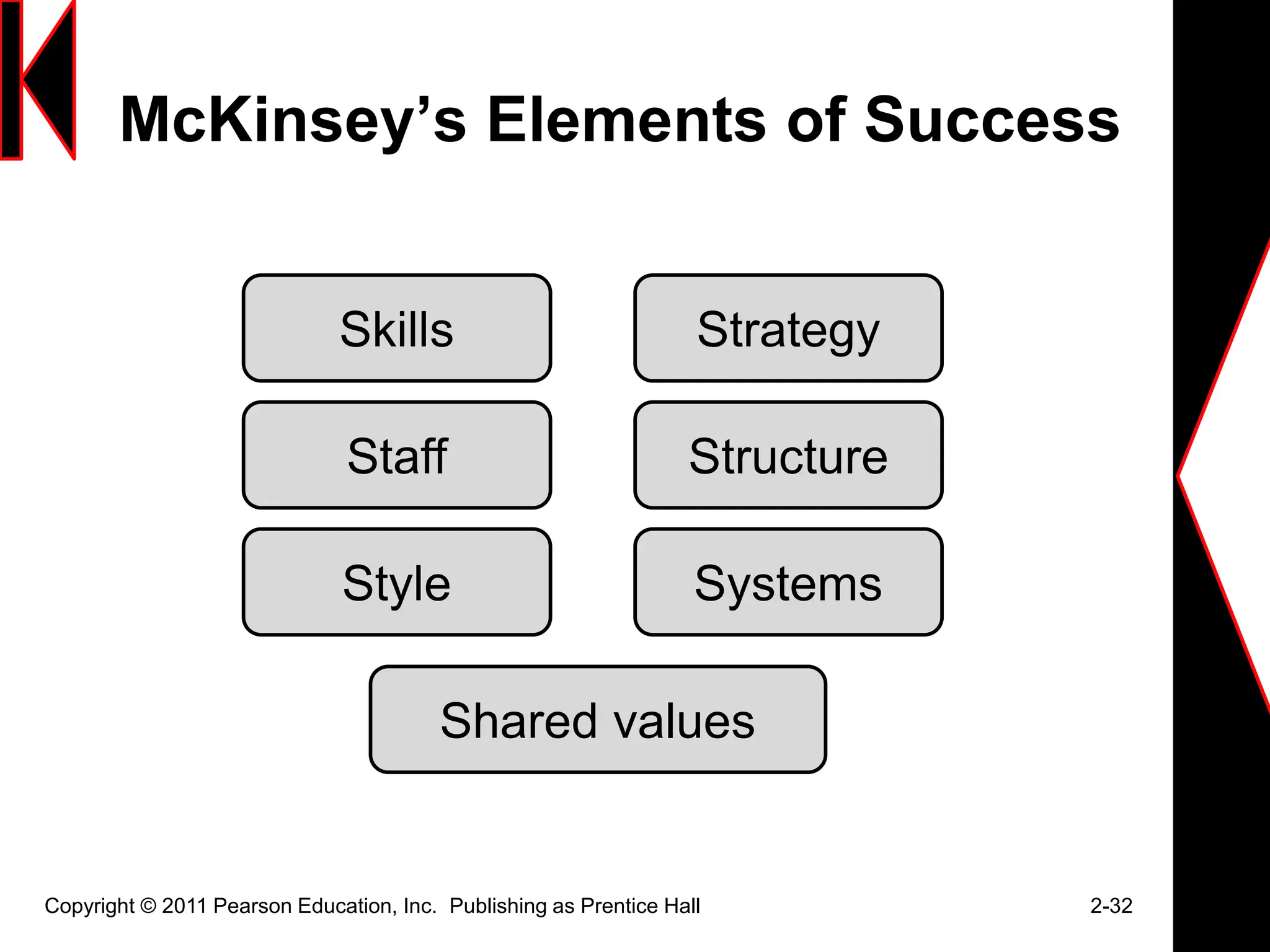
McKinsey’s Elements of Success
Copyright © 2011 Pearson Education, Inc. Publishing as Prentice Hall 2-32
Strategy
Structure
Systems
Style
Shared values
Staff
Skills
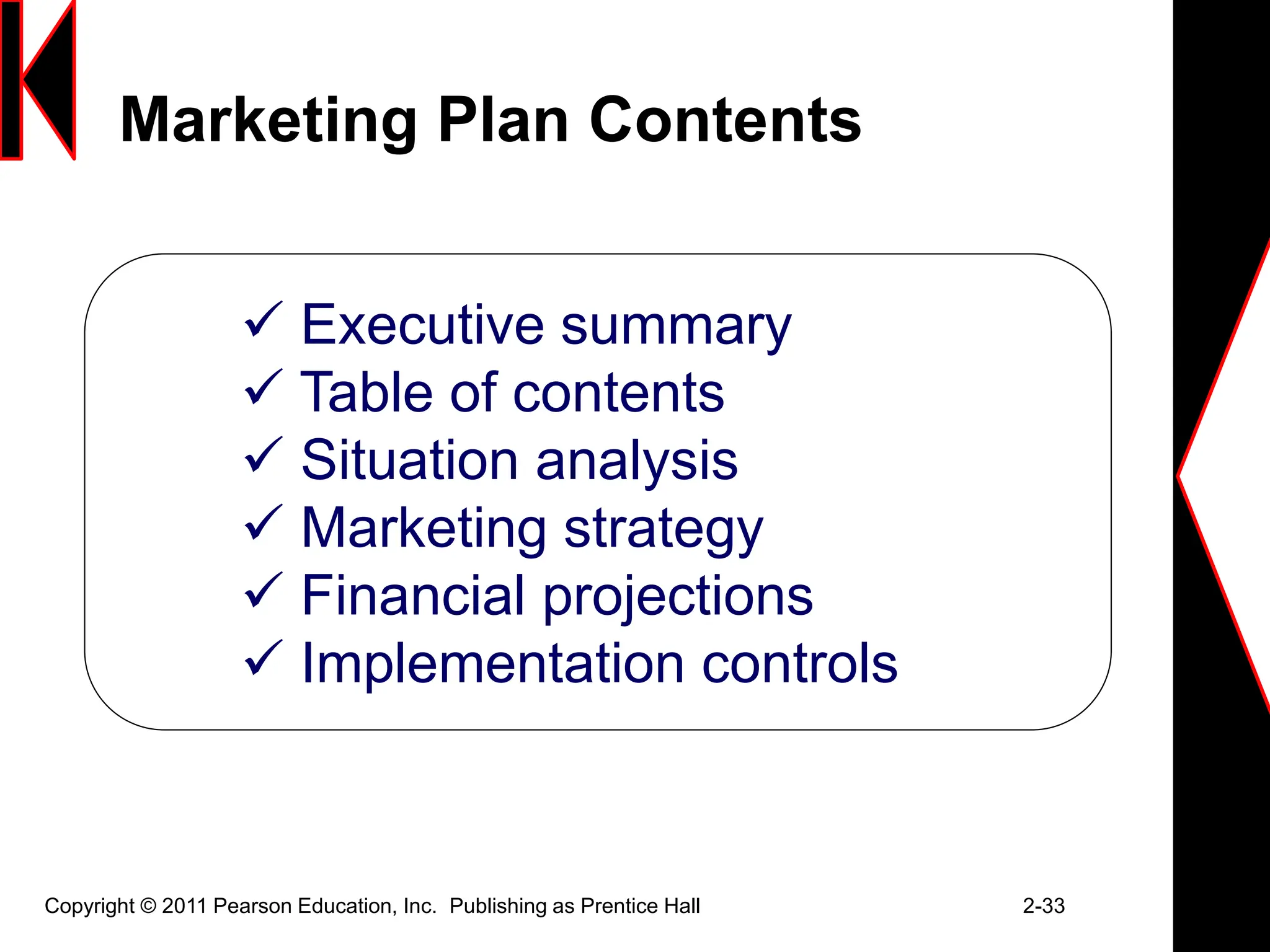
Marketing Plan Contents
Copyright © 2011 Pearson Education, Inc. Publishing as Prentice Hall 2-33
 Executive summary
 Table of contents
 Situation analysis
 Marketing strategy
 Financial projections
 Implementation controls
Copyright © 2011 Pearson Education, Inc. Publishing as Prentice Hall 2-34
Evaluating a Marketing Plan
 Is the plan simple?
 Is the plan specific?
 Is the plan realistic?
 Is the plan complete?
For Review
 How does marketing affect customer value?
 How is strategic planning carried out at
different levels of the organization?
 What does a marketing plan include?
Copyright © 2011 Pearson Education, Inc. Publishing as Prentice Hall 2-35

CHAPTER 2 Developing Marketing Strategies and Plans.ppt

  • 1.
  • 2.
    Chapter Questions  Howdoes marketing affect customer value?  How is strategic planning carried out at different levels of the organization?  What does a marketing plan include? Copyright © 2011 Pearson Education, Inc. Publishing as Prentice Hall 2-2
  • 3.
    Phases of ValueCreation and Delivery Copyright © 2011 Pearson Education, Inc. Publishing as Prentice Hall 2-3 Choosing the value Providing the value Communicating the value
  • 4.
    Copyright © 2011Pearson Education, Inc. Publishing as Prentice Hall 2-4 What is the Value Chain? The value chain is a tool for identifying was to create more customer value because every firm is a synthesis of primary and support activities performed to design, produce, market, deliver, and support its product.
  • 5.
    Core Business Processes Market-sensing process  New-offering realization process  Customer acquisition process  Customer relationship management process  Fulfillment management process Copyright © 2011 Pearson Education, Inc. Publishing as Prentice Hall 2-5
  • 6.
    Characteristics of Core Competencies A source of competitive advantage  Applications in a wide variety of markets  Difficult to imitate Copyright © 2011 Pearson Education, Inc. Publishing as Prentice Hall 2-6
  • 7.
    Maximizing Core Competencies (Re)define the business concept  (Re)shaping the business scope  (Re)positioning the company’s brand identity Copyright © 2011 Pearson Education, Inc. Publishing as Prentice Hall 2-7
  • 8.
    Copyright © 2011Pearson Education, Inc. Publishing as Prentice Hall 2-8 What is Holistic Marketing? Holistic marketing sees itself as integrating the value exploration, value creation, and value delivery activities with the purpose of building long-term, mutually satisfying relationships and co-prosperity among key stakeholders.
  • 9.
    Questions to Addressin Holistic Marketing Copyright © 2011 Pearson Education, Inc. Publishing as Prentice Hall 2-9 What value opportunities are available? How can we create new value offerings efficiently? How can we delivery the new offerings efficiently?
  • 10.
    Figure 2.1 TheStrategic Planning, Implementation, and Control Processes Copyright © 2011 Pearson Education, Inc. Publishing as Prentice Hall 2-10
  • 11.
    Table 2.1 MasterMarketers Copyright © 2011 Pearson Education, Inc. Publishing as Prentice Hall 2-11
  • 12.
    Copyright © 2011Pearson Education, Inc. Publishing as Prentice Hall 2-12 What is a Marketing Plan? A marketing plan is the central instrument for directing and coordinating the marketing effort. It operates at a strategic and tactical level.
  • 13.
    Copyright © 2011Pearson Education, Inc. Publishing as Prentice Hall 2-13 Levels of a Marketing Plan  Strategic  Target marketing decisions  Value proposition  Analysis of marketing opportunities  Tactical  Product features  Promotion  Merchandising  Pricing  Sales channels  Service
  • 14.
    Corporate Headquarters’ Planning Activities Define the corporate mission  Establish strategic business units (SBUs)  Assign resources to each SBU  Assess growth opportunities Copyright © 2011 Pearson Education, Inc. Publishing as Prentice Hall 2-14
  • 15.
    Good Mission Statements Focus on a limited number of goals  Stress major policies and values  Define major competitive spheres  Take a long-term view  Short, memorable, meaningful Copyright © 2011 Pearson Education, Inc. Publishing as Prentice Hall 2-15
  • 16.
    Google Copyright © 2011Pearson Education, Inc. Publishing as Prentice Hall 2-16
  • 17.
    Table 2.2 Major CompetitiveSpheres  Industry  Products  Competence  Market segment  Vertical channels  Geographic Copyright © 2011 Pearson Education, Inc. Publishing as Prentice Hall 2-17
  • 18.
    Product Orientation vs. MarketOrientation Company Product Market Missouri-Pacific Railroad We run a railroad We are a people- and-goods mover Xerox We make copying equipment We improve office productivity Standard Oil We sell gasoline We supply energy Columbia Pictures We make movies We entertain people Copyright © 2011 Pearson Education, Inc. Publishing as Prentice Hall 2-18
  • 19.
    Copyright © 2011Pearson Education, Inc. Publishing as Prentice Hall 2-19 Dimensions Define a Business Customer Groups Customer Needs Technology
  • 20.
    Characteristics of SBUs It is a single business or collection of related businesses  It has its own set of competitors  It has a leader responsible for strategic planning and profitability Copyright © 2011 Pearson Education, Inc. Publishing as Prentice Hall 2-20
  • 21.
    Copyright © 2011Pearson Education, Inc. Publishing as Prentice Hall 2-21
  • 22.
    Figure 2.2 TheStrategic Planning Gap Copyright © 2011 Pearson Education, Inc. Publishing as Prentice Hall 2-22
  • 23.
    What is CorporateCulture? Corporate culture is the shared experiences, stories, beliefs, and norms that characterize an organization. Copyright © 2011 Pearson Education, Inc. Publishing as Prentice Hall 2-23
  • 24.
    Figure 2.3 TheBusiness Unit Strategic Planning Process Copyright © 2011 Pearson Education, Inc. Publishing as Prentice Hall 2-24
  • 25.
    SWOT Analysis Copyright ©2011 Pearson Education, Inc. Publishing as Prentice Hall 2-25 Strengths Weaknesses Opportunities Threats
  • 26.
    Market Opportunity Analysis (MOA) Can the benefits involved in the opportunity be articulated convincingly to a defined target market?  Can the target market be located and reached with cost-effective media and trade channels?  Does the company possess or have access to the critical capabilities and resources needed to deliver the customer benefits? Copyright © 2011 Pearson Education, Inc. Publishing as Prentice Hall 2-26
  • 27.
    Market Opportunity Analysis (MOA) Can the company deliver the benefits better than any actual or potential competitors?  Will the financial rate of return meet or exceed the company’s required threshold for investment? Copyright © 2011 Pearson Education, Inc. Publishing as Prentice Hall 2-27
  • 28.
    Figure 2.4 Opportunity andThreat Matrices Copyright © 2011 Pearson Education, Inc. Publishing as Prentice Hall 2-28
  • 29.
    Goal Formulation andMBO  Unit’s objectives must be hierarchical  Objectives should be quantitative  Goals should be realistic  Objectives must be consistent Copyright © 2011 Pearson Education, Inc. Publishing as Prentice Hall 2-29
  • 30.
    Porter’s Generic Strategies Copyright© 2011 Pearson Education, Inc. Publishing as Prentice Hall 2-30 Overall cost leadership Differentiation Focus
  • 31.
    Categories of MarketingAlliances  Product or service alliance  Promotional alliance  Logistics alliances  Pricing collaborations Copyright © 2011 Pearson Education, Inc. Publishing as Prentice Hall 2-31
  • 32.
    McKinsey’s Elements ofSuccess Copyright © 2011 Pearson Education, Inc. Publishing as Prentice Hall 2-32 Strategy Structure Systems Style Shared values Staff Skills
  • 33.
    Marketing Plan Contents Copyright© 2011 Pearson Education, Inc. Publishing as Prentice Hall 2-33  Executive summary  Table of contents  Situation analysis  Marketing strategy  Financial projections  Implementation controls
  • 34.
    Copyright © 2011Pearson Education, Inc. Publishing as Prentice Hall 2-34 Evaluating a Marketing Plan  Is the plan simple?  Is the plan specific?  Is the plan realistic?  Is the plan complete?
  • 35.
    For Review  Howdoes marketing affect customer value?  How is strategic planning carried out at different levels of the organization?  What does a marketing plan include? Copyright © 2011 Pearson Education, Inc. Publishing as Prentice Hall 2-35