> > > > > > > >
Promotion and
Pricing Strategies
Chapter 14
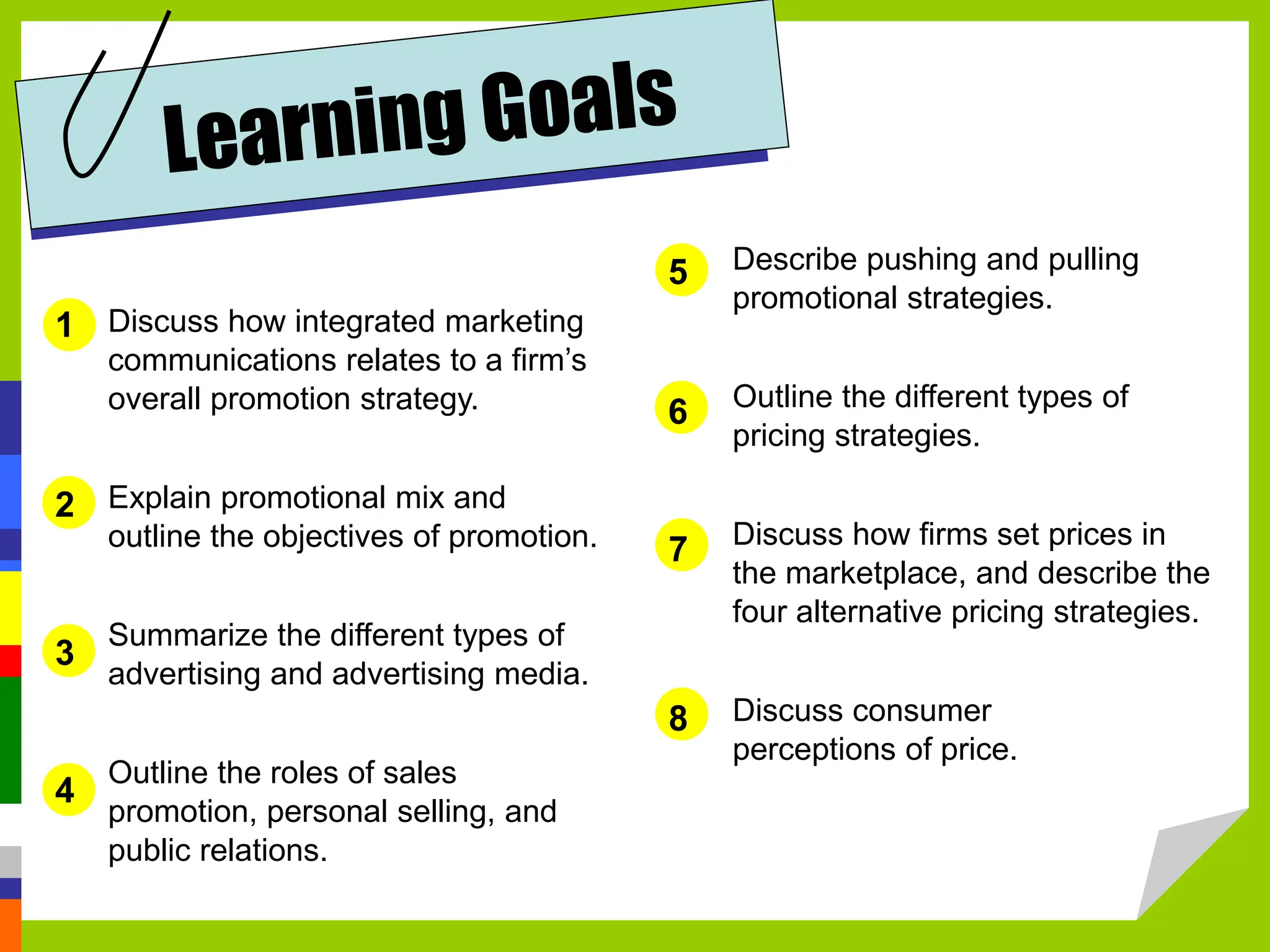
Discuss how integrated marketing
communications relates to a firm’s
overall promotion strategy.
Explain promotional mix and
outline the objectives of promotion.
Summarize the different types of
advertising and advertising media.
Outline the roles of sales
promotion, personal selling, and
public relations.
Describe pushing and pulling
promotional strategies.
Outline the different types of
pricing strategies.
Discuss how firms set prices in
the marketplace, and describe the
four alternative pricing strategies.
Discuss consumer
perceptions of price.
1
2
3
4
5
6
7
8
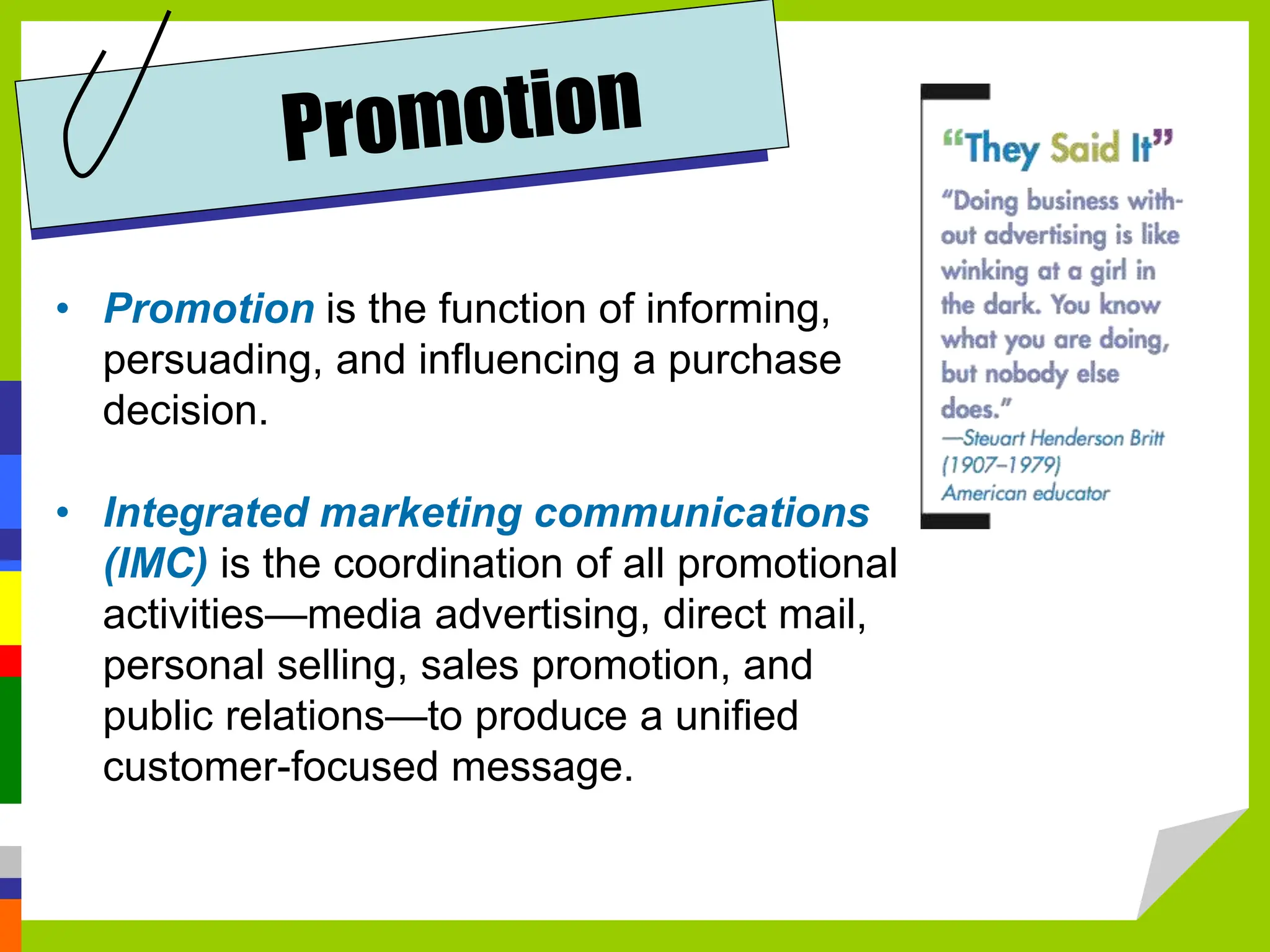
• Promotion is the function of informing,
persuading, and influencing a purchase
decision.
• Integrated marketing communications
(IMC) is the coordination of all promotional
activities—media advertising, direct mail,
personal selling, sales promotion, and
public relations—to produce a unified
customer-focused message.
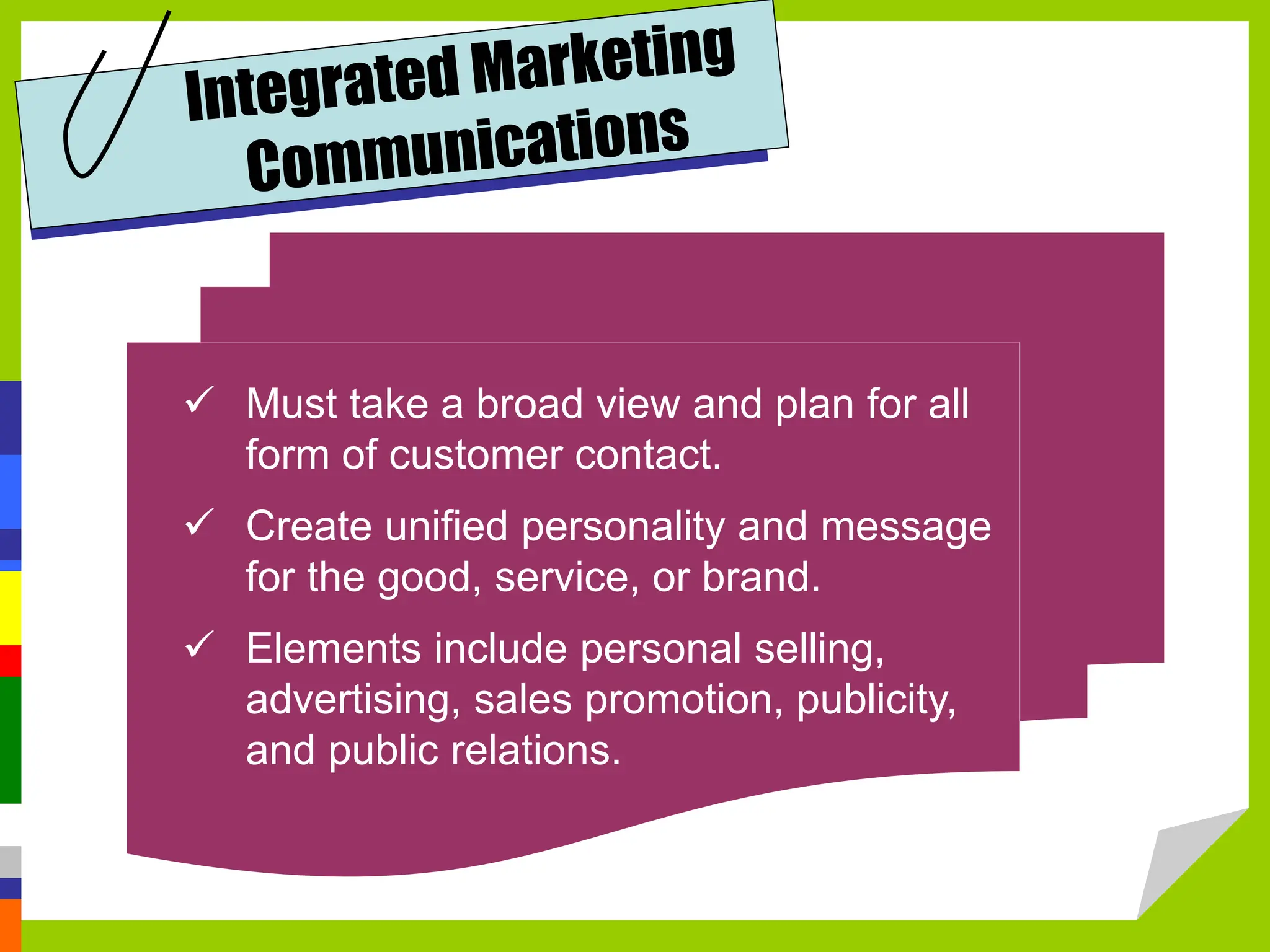
 Must take a broad view and plan for all
form of customer contact.
 Create unified personality and message
for the good, service, or brand.
 Elements include personal selling,
advertising, sales promotion, publicity,
and public relations.
• Promotional mix - combination of personal and
nonpersonal selling techniques designed to achieve
promotional objectives.
• Personal selling - interpersonal promotional process
involving a seller’s face-to-face presentation to a
prospective buyer.
• Nonpersonal selling - advertising, sales promotion,
direct marketing, and public relations.
• Product placement - marketers pay placement fees
to have their products showcased in various media,
ranging from newspapers and magazines to television
and movies.
• Guerilla marketing - innovative, low-cost marketing
efforts designed to get consumers’ attention in
unusual ways.
• Advertising - paid nonpersonal communication
delivered through various media and designed
to inform, persuade, or remind members of a
particular audience.
• Consumers receive 5,000 marketing
messages each day.
• Firms need to be more and more creative and
efficient at getting consumers’ attention.
• Product advertising - messages designed to sell a
particular good or service.
• Institutional advertising - messages that promote
concepts, ideas, philosophies, or goodwill for
industries, companies, organizations, or government
entities.
• Cause advertising - institutional messaging that
promotes a specific viewpoint on a public issue as a
way to influence public opinion and the legislative
process.
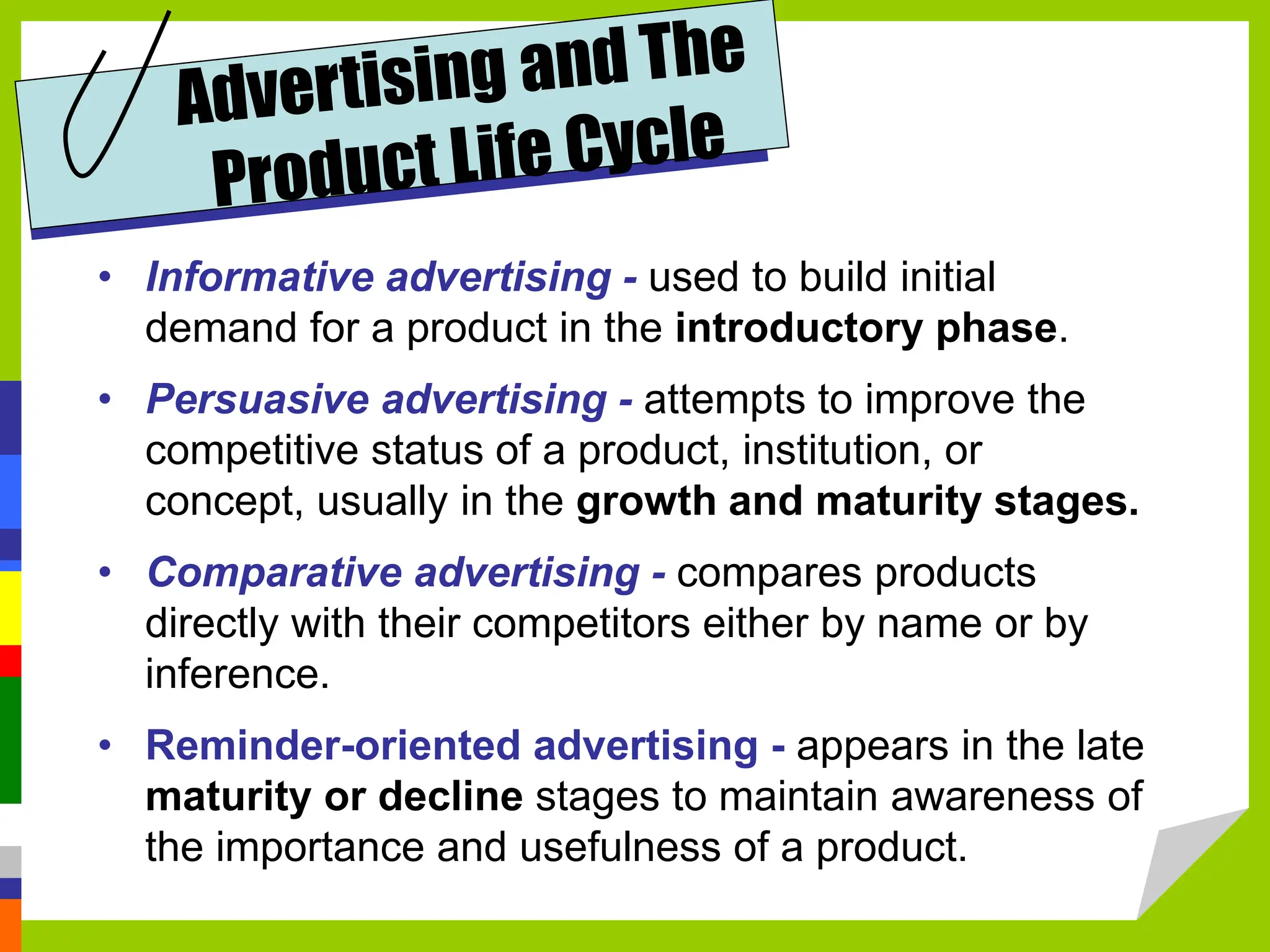
• Informative advertising - used to build initial
demand for a product in the introductory phase.
• Persuasive advertising - attempts to improve the
competitive status of a product, institution, or
concept, usually in the growth and maturity stages.
• Comparative advertising - compares products
directly with their competitors either by name or by
inference.
• Reminder-oriented advertising - appears in the late
maturity or decline stages to maintain awareness of
the importance and usefulness of a product.
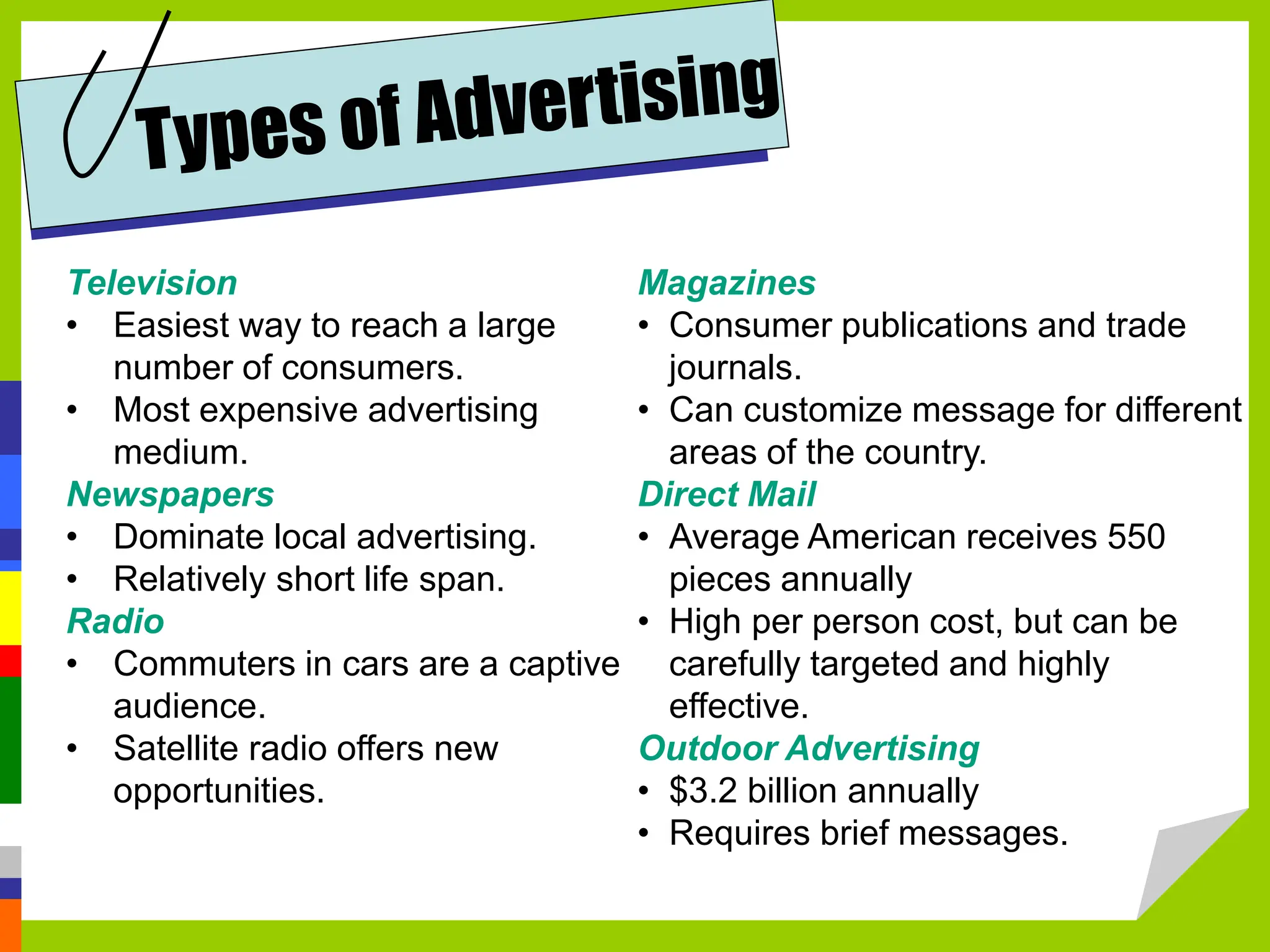
Television
• Easiest way to reach a large
number of consumers.
• Most expensive advertising
medium.
Newspapers
• Dominate local advertising.
• Relatively short life span.
Radio
• Commuters in cars are a captive
audience.
• Satellite radio offers new
opportunities.
Magazines
• Consumer publications and trade
journals.
• Can customize message for different
areas of the country.
Direct Mail
• Average American receives 550
pieces annually
• High per person cost, but can be
carefully targeted and highly
effective.
Outdoor Advertising
• $3.2 billion annually
• Requires brief messages.
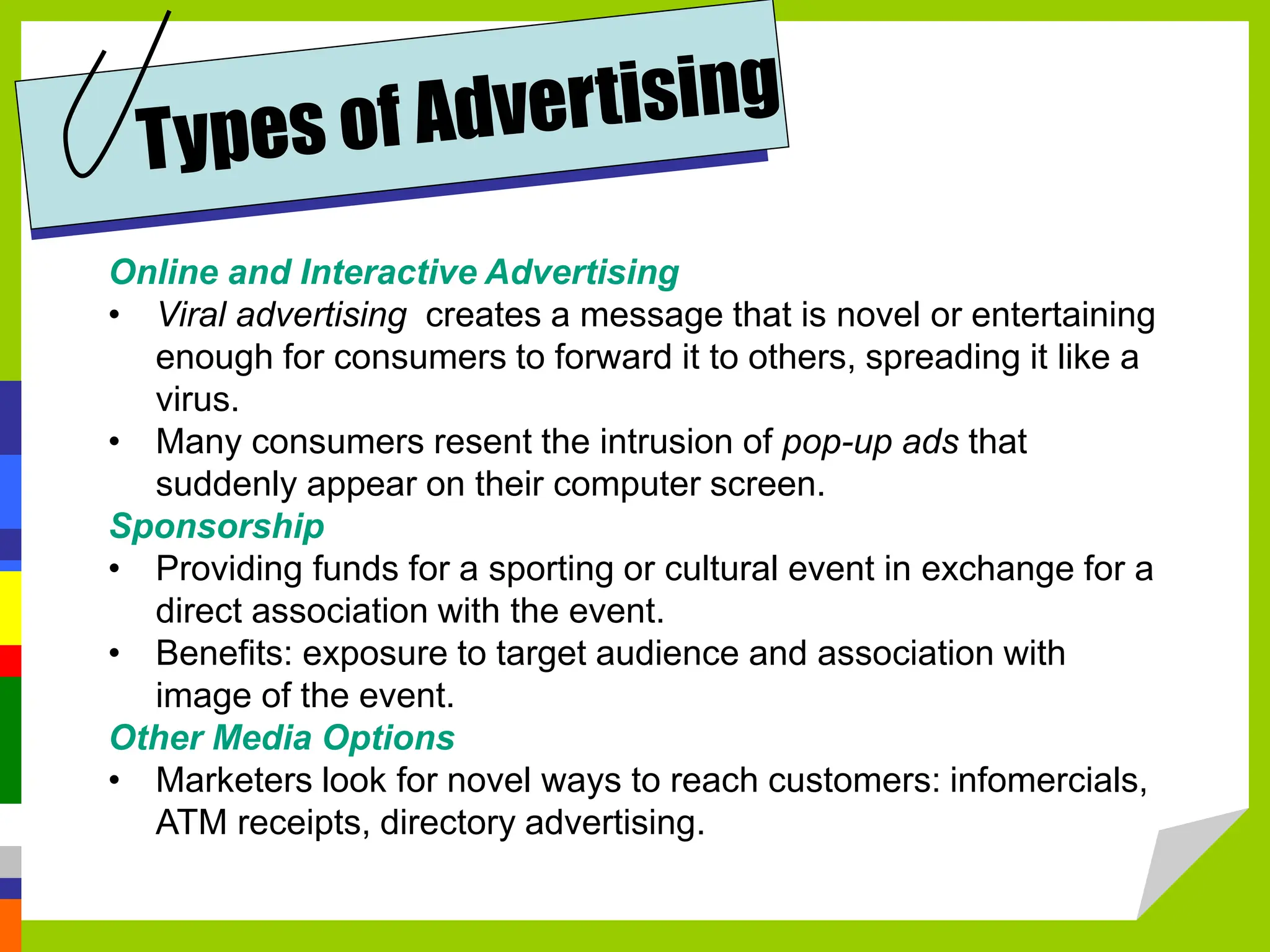
Online and Interactive Advertising
• Viral advertising creates a message that is novel or entertaining
enough for consumers to forward it to others, spreading it like a
virus.
• Many consumers resent the intrusion of pop-up ads that
suddenly appear on their computer screen.
Sponsorship
• Providing funds for a sporting or cultural event in exchange for a
direct association with the event.
• Benefits: exposure to target audience and association with
image of the event.
Other Media Options
• Marketers look for novel ways to reach customers: infomercials,
ATM receipts, directory advertising.
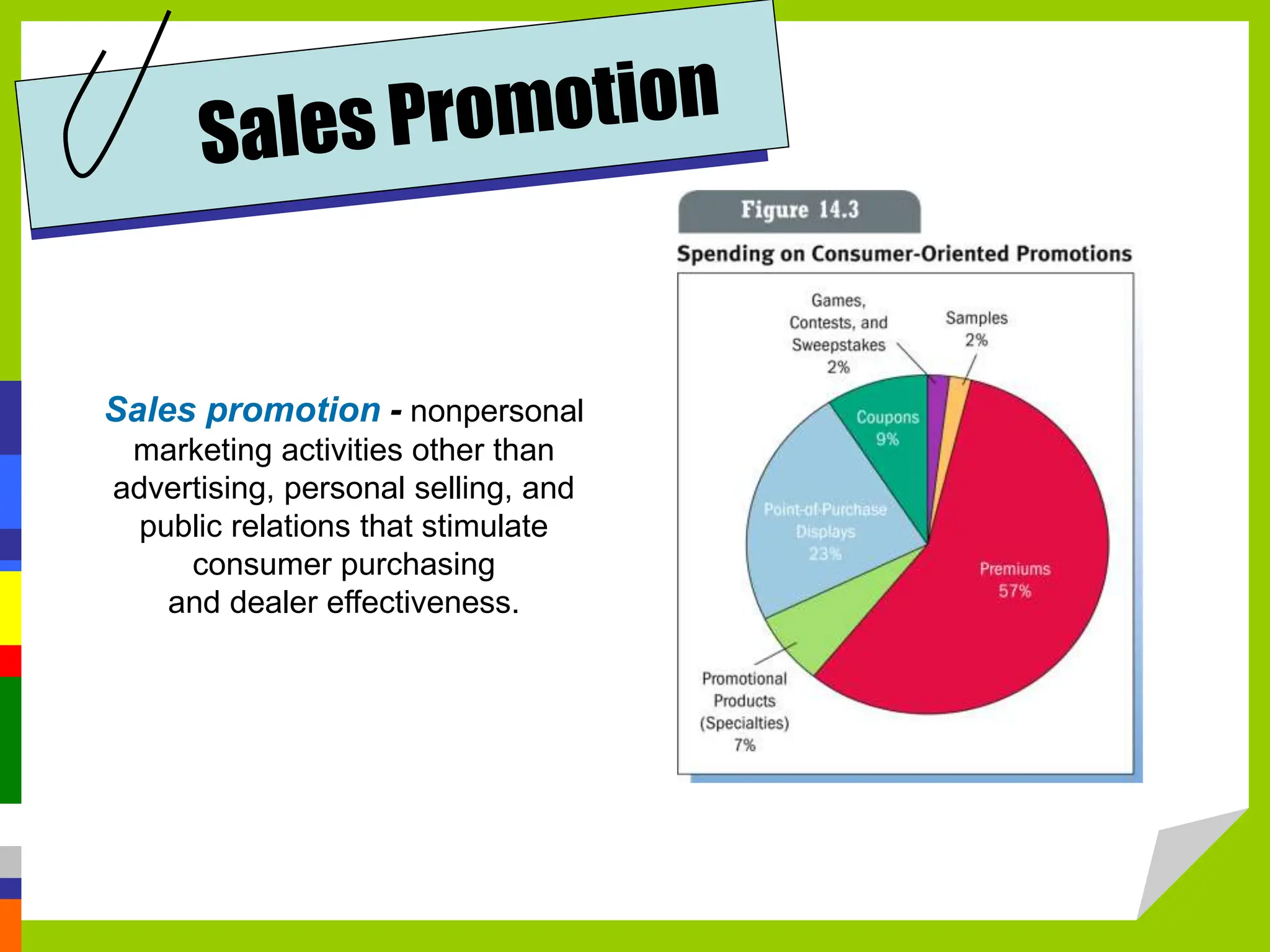
Sales promotion - nonpersonal
marketing activities other than
advertising, personal selling, and
public relations that stimulate
consumer purchasing
and dealer effectiveness.
Premiums, Coupons, Rebates, Samples
• Coupons attract new customers but focus on price rather than
brand loyalty.
• Rebates increase purchase rates, promote multiple purchases,
and reward product users.
• Three of every four consumers who receive a sample will try it.
Games, Contests, and Sweepstakes
• Introduction of new products.
• Subject to legal restrictions.
Specialty Advertising
• Gift of useful merchandise carrying the name, logo, or slogan
of an organization.
• A person-to-person promotional presentation to a
potential buyer.
– Customers are relatively few in number and
geographically concentrated.
– The product is technically complex, involves trade-
ins, and requires special handling.
– The product carries a relatively high price.
– It moves through direct-distribution channels.
• Example: Selling to the government or
military.
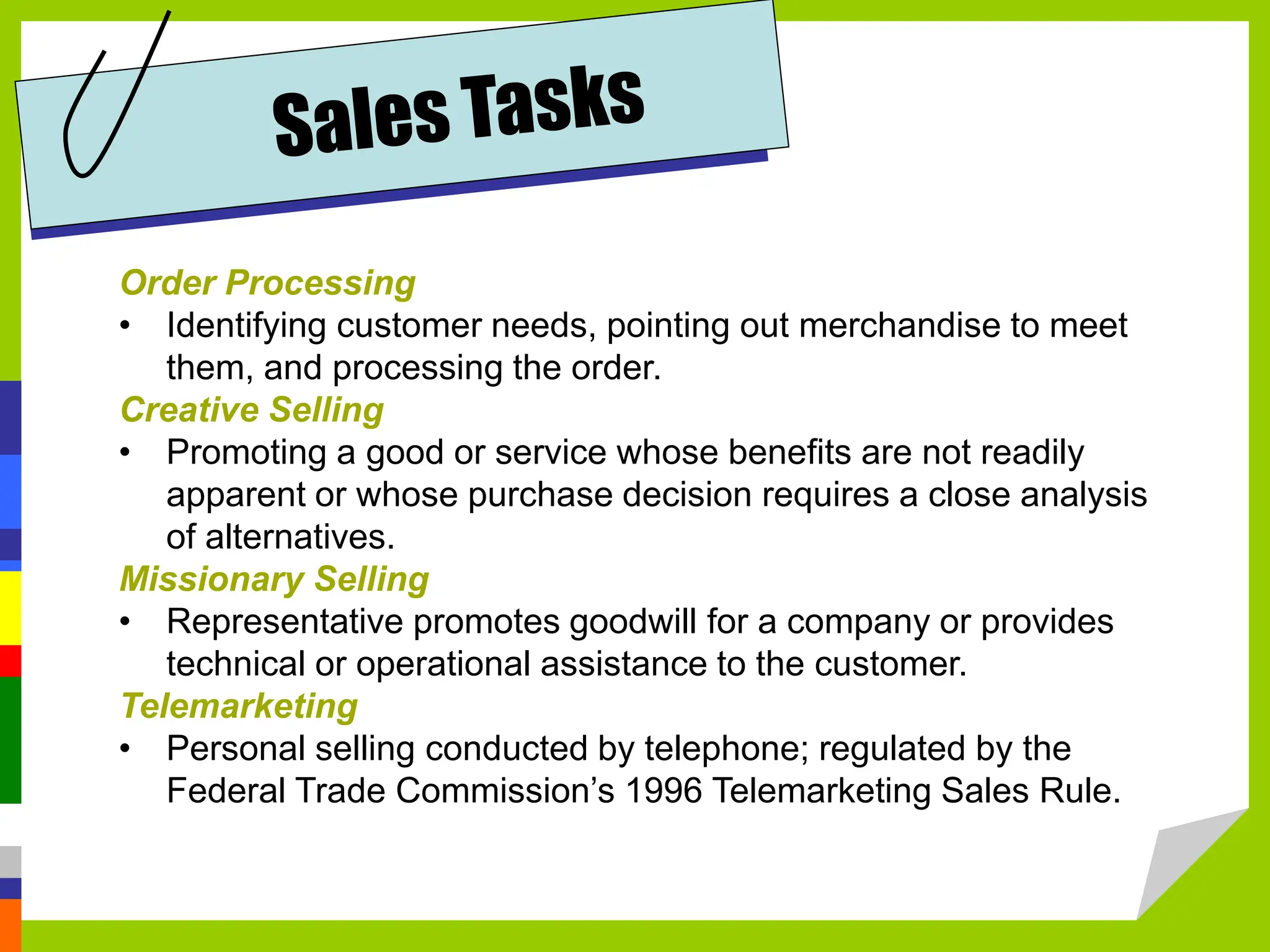
Order Processing
• Identifying customer needs, pointing out merchandise to meet
them, and processing the order.
Creative Selling
• Promoting a good or service whose benefits are not readily
apparent or whose purchase decision requires a close analysis
of alternatives.
Missionary Selling
• Representative promotes goodwill for a company or provides
technical or operational assistance to the customer.
Telemarketing
• Personal selling conducted by telephone; regulated by the
Federal Trade Commission’s 1996 Telemarketing Sales Rule.
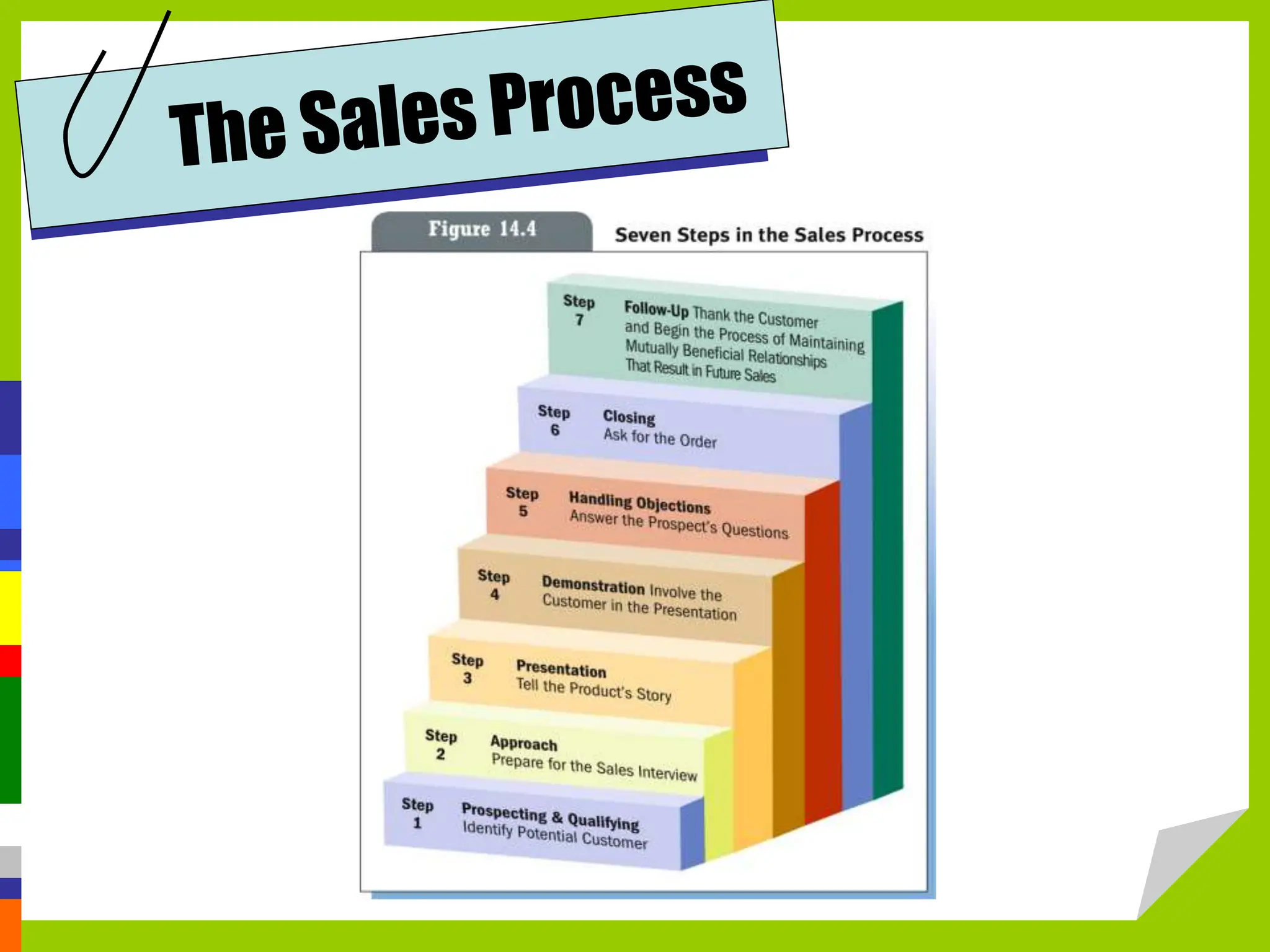
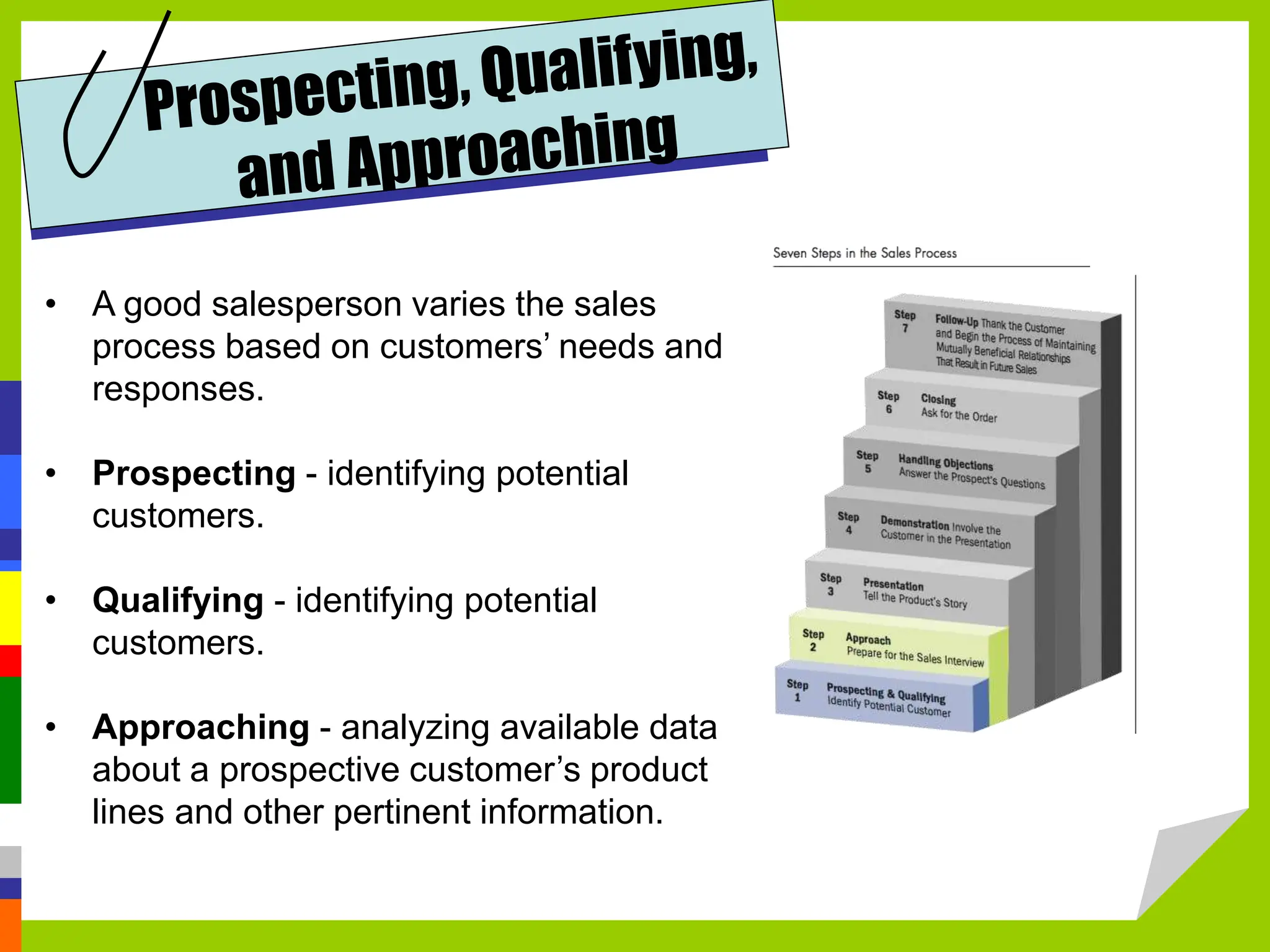
• A good salesperson varies the sales
process based on customers’ needs and
responses.
• Prospecting - identifying potential
customers.
• Qualifying - identifying potential
customers.
• Approaching - analyzing available data
about a prospective customer’s product
lines and other pertinent information.
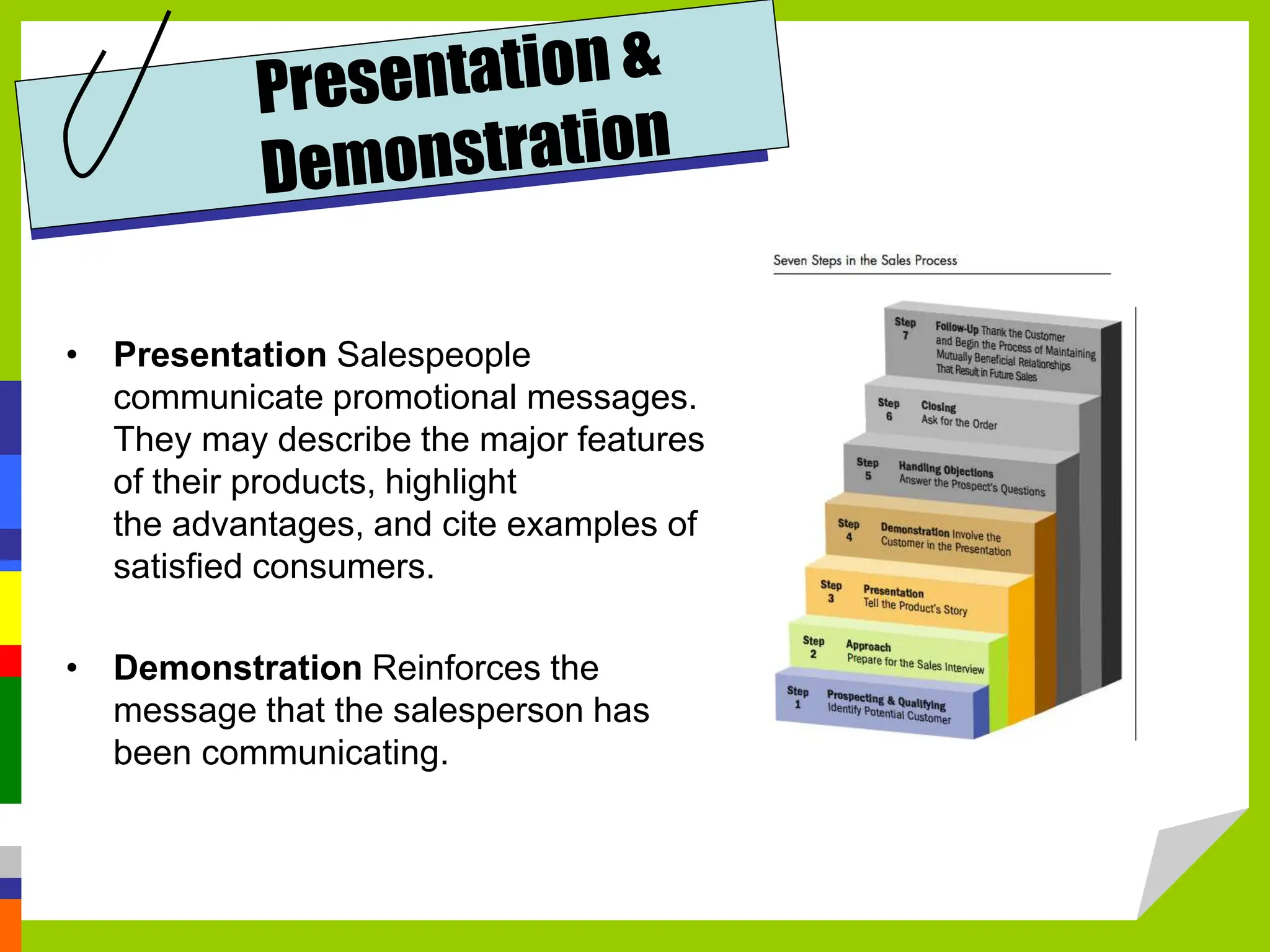
• Presentation Salespeople
communicate promotional messages.
They may describe the major features
of their products, highlight
the advantages, and cite examples of
satisfied consumers.
• Demonstration Reinforces the
message that the salesperson has
been communicating.
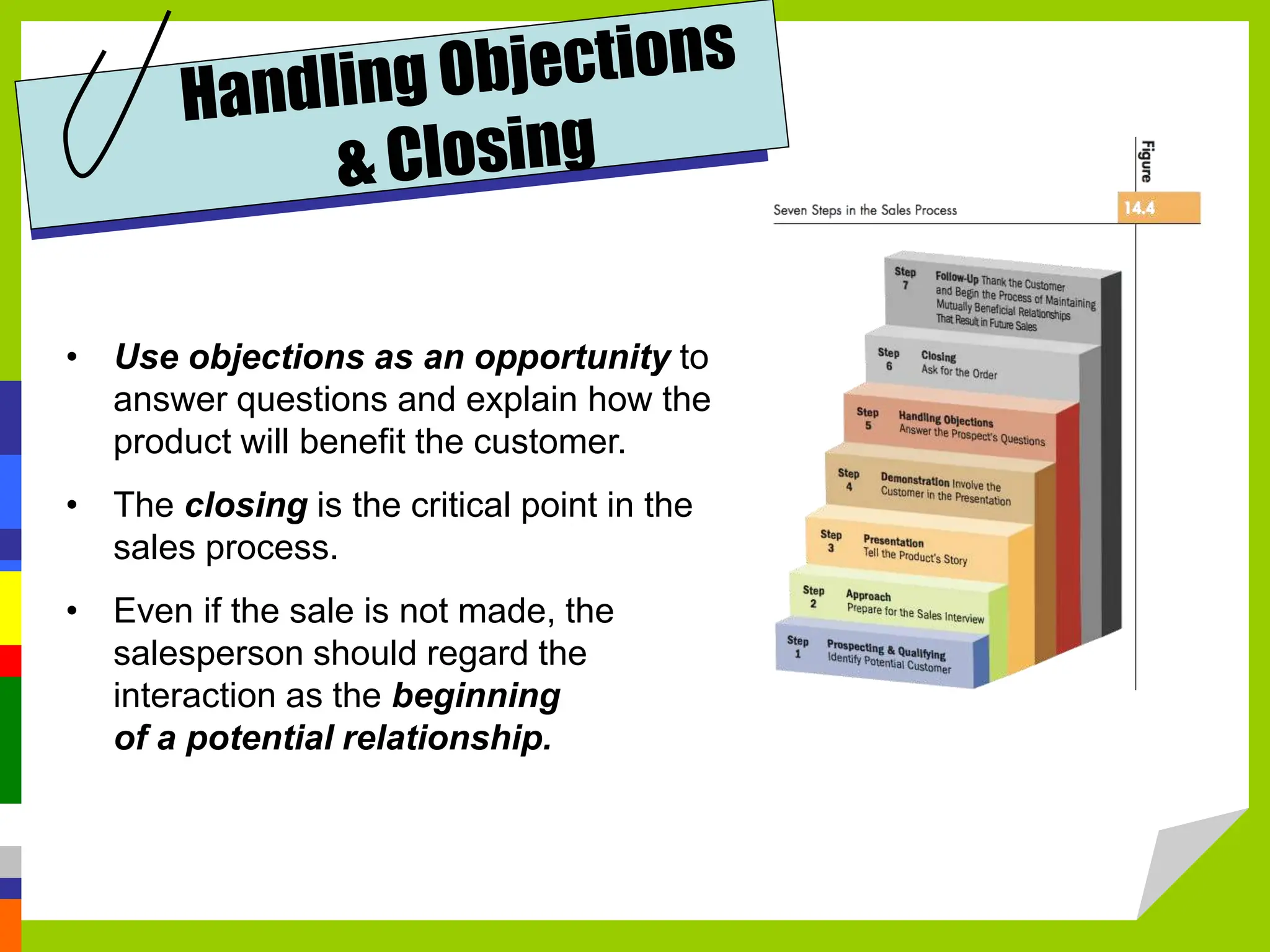
• Use objections as an opportunity to
answer questions and explain how the
product will benefit the customer.
• The closing is the critical point in the
sales process.
• Even if the sale is not made, the
salesperson should regard the
interaction as the beginning
of a potential relationship.
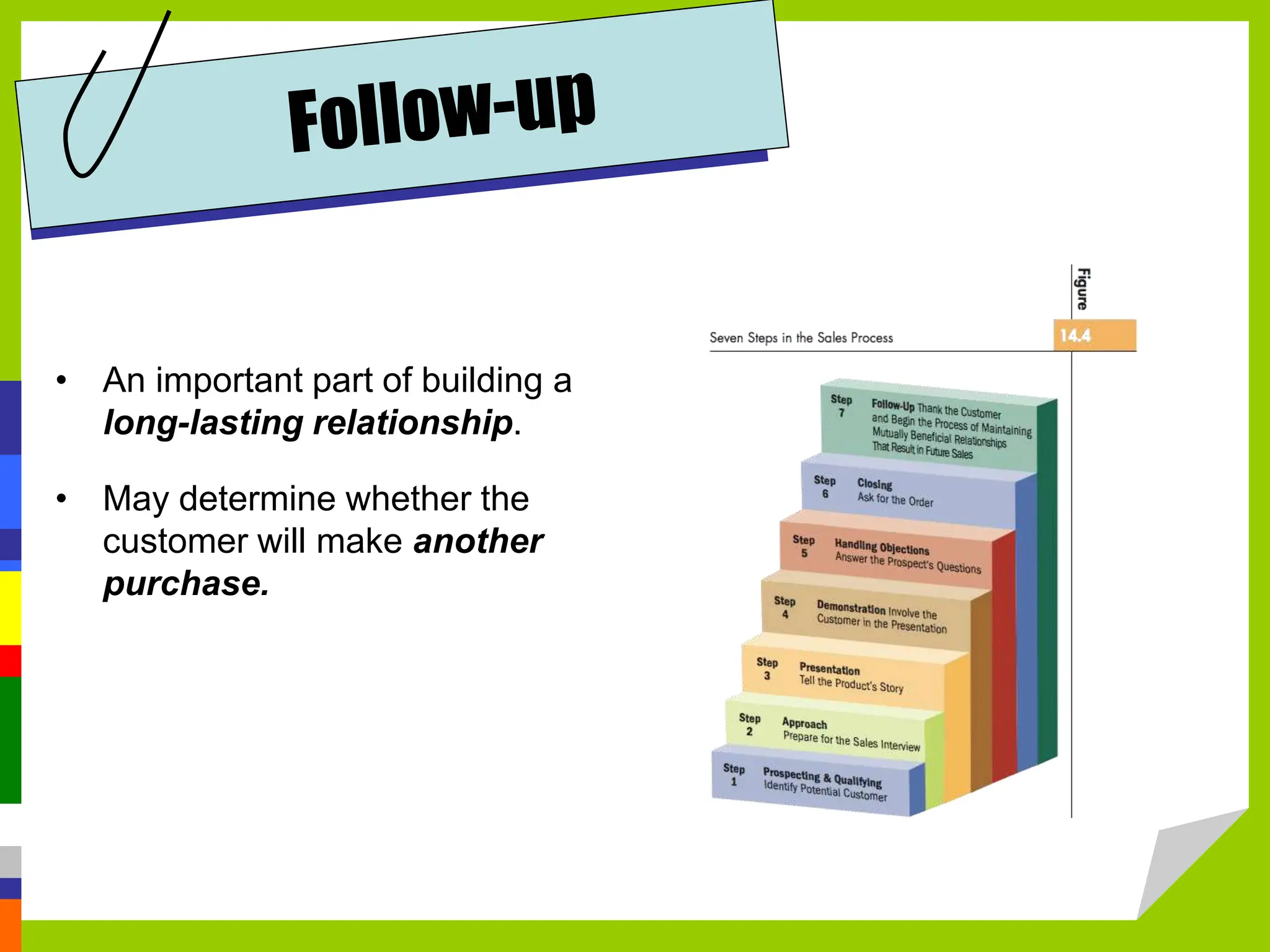
• An important part of building a
long-lasting relationship.
• May determine whether the
customer will make another
purchase.
• Public relations - a public organization’s
communications and relationships with its various
audiences.
– Helps a firm establish awareness of goods and services and
builds a positive image of them.
• Publicity - stimulation of demand for a good,
service, place, idea, person, or organization by
disseminating news or obtaining favorable unpaid
media presentations.
– Good publicity can promote a firm’s positive image.
– Negative publicity can cause problems.
• Pushing strategy - relies on personal selling to market an item
to wholesalers and retailers in a company’s distribution
channels.
– Companies promote the product to members of the marketing
channel, not to end users.
• Pulling strategy - promote a product by generating consumer
demand for it, primarily through advertising and sales promotion
appeals.
– Potential buyers will request that their suppliers—retailers or local
distributors—carry the product, thereby pulling it through the
distribution channel.
• Most marketing situations require combinations of push
and pull strategies
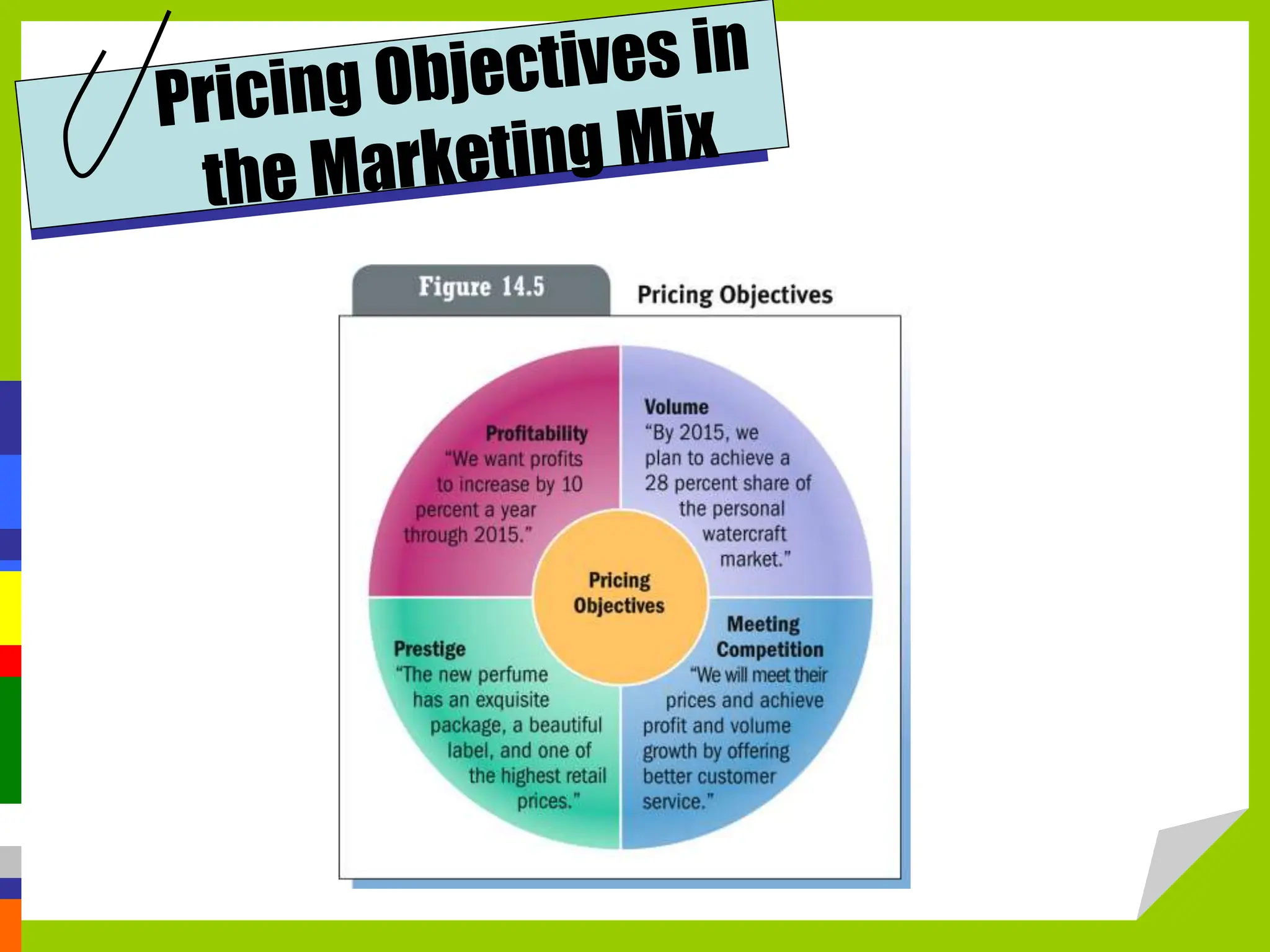
Profitability Objectives
• Maximize profits by reducing costs.
• Maintain price while reducing package size.
Volume Objectives
• Base pricing decisions on market share goals.
Pricing to Meet Competition
• Meeting competitors’ price.
• Competitors cannot legally work together to set prices.
• Competition can result in a price war.
Prestige Objectives
• Establishing a relatively high price
to develop and maintain an image
of quality and exclusiveness.
• Recognition of the role of price in
communicating an overall image
for the firm and its products.
• Pricing is influenced by people in
different areas of a company.
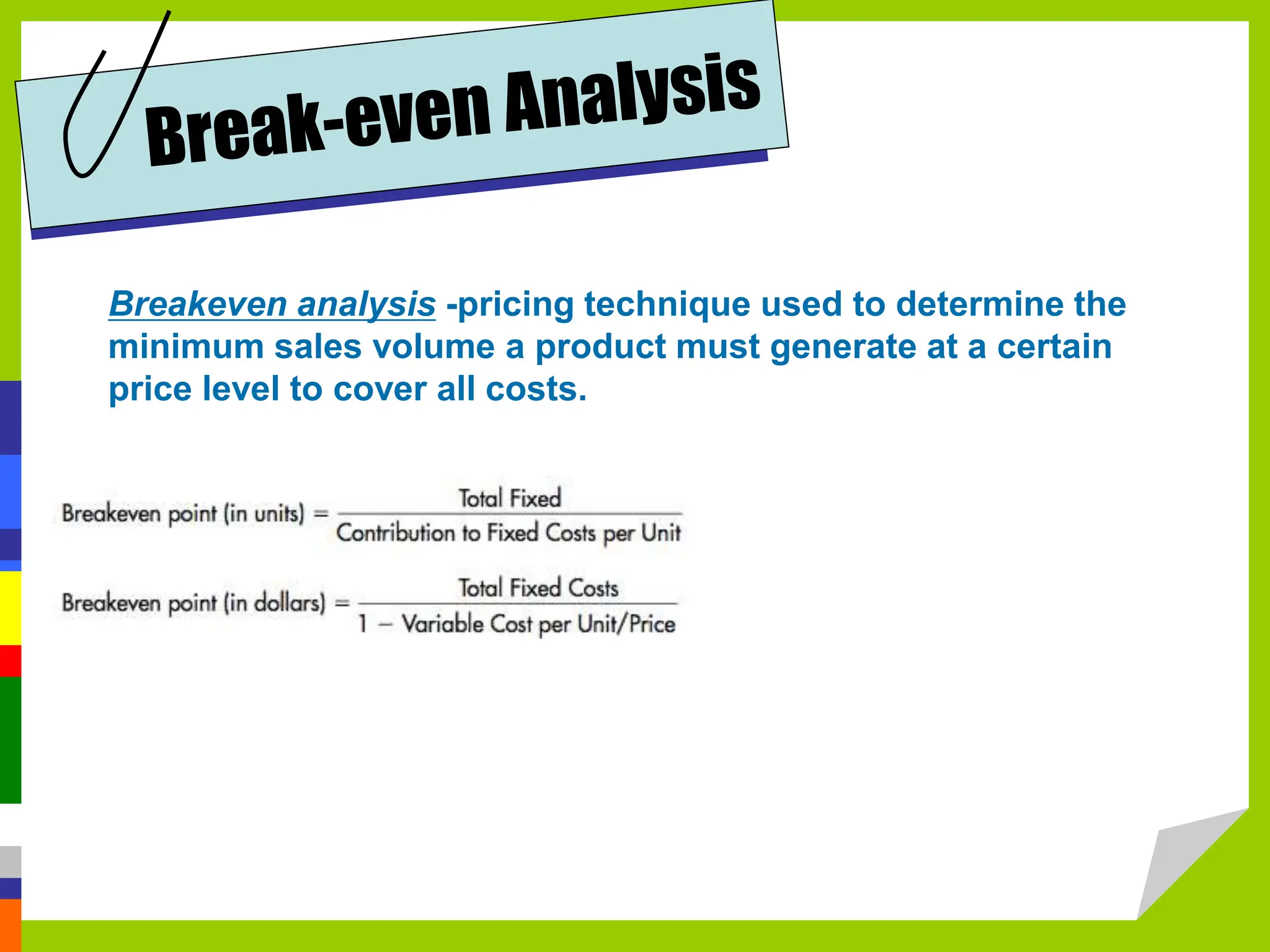
Breakeven analysis -pricing technique used to determine the
minimum sales volume a product must generate at a certain
price level to cover all costs.
Skimming Pricing
• Setting an intentionally high price relative to the prices of competing products.
• Helps marketers set a price that distinguishes a firm’s high-end product from
those of competitors.
Penetration Pricing
• Setting a low price as a major marketing weapon.
• Often used with new products.
Everyday Low Pricing and Discount Pricing
• Maintaining continuous low prices.
• Discount pricing - attracting customers by dropping prices for a set period of time.
Competitive Pricing
• Reducing the emphasis on price competition by matching other firms’ prices.
• Concentrating marketing efforts on the product, distribution, and promotional
elements of the marketing mix.
Price-Quality Relationships
• Consumers’ perceptions of quality closely
tied to price.
• High price = prestige and higher quality.
• Low price = less prestige and lower quality.
Odd Pricing
• Setting prices in uneven amounts or
amounts that sound less than they really
are.
– Example: $1.99 or $299.

ch14 PROMOTION AND PRICING in marketing management

  • 1.
    > > >> > > > > Promotion and Pricing Strategies Chapter 14
  • 2.
    Discuss how integratedmarketing communications relates to a firm’s overall promotion strategy. Explain promotional mix and outline the objectives of promotion. Summarize the different types of advertising and advertising media. Outline the roles of sales promotion, personal selling, and public relations. Describe pushing and pulling promotional strategies. Outline the different types of pricing strategies. Discuss how firms set prices in the marketplace, and describe the four alternative pricing strategies. Discuss consumer perceptions of price. 1 2 3 4 5 6 7 8
  • 3.
    • Promotion isthe function of informing, persuading, and influencing a purchase decision. • Integrated marketing communications (IMC) is the coordination of all promotional activities—media advertising, direct mail, personal selling, sales promotion, and public relations—to produce a unified customer-focused message.
  • 4.
     Must takea broad view and plan for all form of customer contact.  Create unified personality and message for the good, service, or brand.  Elements include personal selling, advertising, sales promotion, publicity, and public relations.
  • 5.
    • Promotional mix- combination of personal and nonpersonal selling techniques designed to achieve promotional objectives. • Personal selling - interpersonal promotional process involving a seller’s face-to-face presentation to a prospective buyer. • Nonpersonal selling - advertising, sales promotion, direct marketing, and public relations.
  • 8.
    • Product placement- marketers pay placement fees to have their products showcased in various media, ranging from newspapers and magazines to television and movies. • Guerilla marketing - innovative, low-cost marketing efforts designed to get consumers’ attention in unusual ways.
  • 9.
    • Advertising -paid nonpersonal communication delivered through various media and designed to inform, persuade, or remind members of a particular audience. • Consumers receive 5,000 marketing messages each day. • Firms need to be more and more creative and efficient at getting consumers’ attention.
  • 10.
    • Product advertising- messages designed to sell a particular good or service. • Institutional advertising - messages that promote concepts, ideas, philosophies, or goodwill for industries, companies, organizations, or government entities. • Cause advertising - institutional messaging that promotes a specific viewpoint on a public issue as a way to influence public opinion and the legislative process.
  • 11.
    • Informative advertising- used to build initial demand for a product in the introductory phase. • Persuasive advertising - attempts to improve the competitive status of a product, institution, or concept, usually in the growth and maturity stages. • Comparative advertising - compares products directly with their competitors either by name or by inference. • Reminder-oriented advertising - appears in the late maturity or decline stages to maintain awareness of the importance and usefulness of a product.
  • 13.
    Television • Easiest wayto reach a large number of consumers. • Most expensive advertising medium. Newspapers • Dominate local advertising. • Relatively short life span. Radio • Commuters in cars are a captive audience. • Satellite radio offers new opportunities. Magazines • Consumer publications and trade journals. • Can customize message for different areas of the country. Direct Mail • Average American receives 550 pieces annually • High per person cost, but can be carefully targeted and highly effective. Outdoor Advertising • $3.2 billion annually • Requires brief messages.
  • 14.
    Online and InteractiveAdvertising • Viral advertising creates a message that is novel or entertaining enough for consumers to forward it to others, spreading it like a virus. • Many consumers resent the intrusion of pop-up ads that suddenly appear on their computer screen. Sponsorship • Providing funds for a sporting or cultural event in exchange for a direct association with the event. • Benefits: exposure to target audience and association with image of the event. Other Media Options • Marketers look for novel ways to reach customers: infomercials, ATM receipts, directory advertising.
  • 15.
    Sales promotion -nonpersonal marketing activities other than advertising, personal selling, and public relations that stimulate consumer purchasing and dealer effectiveness.
  • 16.
    Premiums, Coupons, Rebates,Samples • Coupons attract new customers but focus on price rather than brand loyalty. • Rebates increase purchase rates, promote multiple purchases, and reward product users. • Three of every four consumers who receive a sample will try it. Games, Contests, and Sweepstakes • Introduction of new products. • Subject to legal restrictions. Specialty Advertising • Gift of useful merchandise carrying the name, logo, or slogan of an organization.
  • 18.
    • A person-to-personpromotional presentation to a potential buyer. – Customers are relatively few in number and geographically concentrated. – The product is technically complex, involves trade- ins, and requires special handling. – The product carries a relatively high price. – It moves through direct-distribution channels. • Example: Selling to the government or military.
  • 19.
    Order Processing • Identifyingcustomer needs, pointing out merchandise to meet them, and processing the order. Creative Selling • Promoting a good or service whose benefits are not readily apparent or whose purchase decision requires a close analysis of alternatives. Missionary Selling • Representative promotes goodwill for a company or provides technical or operational assistance to the customer. Telemarketing • Personal selling conducted by telephone; regulated by the Federal Trade Commission’s 1996 Telemarketing Sales Rule.
  • 21.
    • A goodsalesperson varies the sales process based on customers’ needs and responses. • Prospecting - identifying potential customers. • Qualifying - identifying potential customers. • Approaching - analyzing available data about a prospective customer’s product lines and other pertinent information.
  • 22.
    • Presentation Salespeople communicatepromotional messages. They may describe the major features of their products, highlight the advantages, and cite examples of satisfied consumers. • Demonstration Reinforces the message that the salesperson has been communicating.
  • 23.
    • Use objectionsas an opportunity to answer questions and explain how the product will benefit the customer. • The closing is the critical point in the sales process. • Even if the sale is not made, the salesperson should regard the interaction as the beginning of a potential relationship.
  • 24.
    • An importantpart of building a long-lasting relationship. • May determine whether the customer will make another purchase.
  • 25.
    • Public relations- a public organization’s communications and relationships with its various audiences. – Helps a firm establish awareness of goods and services and builds a positive image of them. • Publicity - stimulation of demand for a good, service, place, idea, person, or organization by disseminating news or obtaining favorable unpaid media presentations. – Good publicity can promote a firm’s positive image. – Negative publicity can cause problems.
  • 26.
    • Pushing strategy- relies on personal selling to market an item to wholesalers and retailers in a company’s distribution channels. – Companies promote the product to members of the marketing channel, not to end users. • Pulling strategy - promote a product by generating consumer demand for it, primarily through advertising and sales promotion appeals. – Potential buyers will request that their suppliers—retailers or local distributors—carry the product, thereby pulling it through the distribution channel. • Most marketing situations require combinations of push and pull strategies
  • 28.
    Profitability Objectives • Maximizeprofits by reducing costs. • Maintain price while reducing package size. Volume Objectives • Base pricing decisions on market share goals. Pricing to Meet Competition • Meeting competitors’ price. • Competitors cannot legally work together to set prices. • Competition can result in a price war.
  • 29.
    Prestige Objectives • Establishinga relatively high price to develop and maintain an image of quality and exclusiveness. • Recognition of the role of price in communicating an overall image for the firm and its products. • Pricing is influenced by people in different areas of a company.
  • 30.
    Breakeven analysis -pricingtechnique used to determine the minimum sales volume a product must generate at a certain price level to cover all costs.
  • 32.
    Skimming Pricing • Settingan intentionally high price relative to the prices of competing products. • Helps marketers set a price that distinguishes a firm’s high-end product from those of competitors. Penetration Pricing • Setting a low price as a major marketing weapon. • Often used with new products. Everyday Low Pricing and Discount Pricing • Maintaining continuous low prices. • Discount pricing - attracting customers by dropping prices for a set period of time. Competitive Pricing • Reducing the emphasis on price competition by matching other firms’ prices. • Concentrating marketing efforts on the product, distribution, and promotional elements of the marketing mix.
  • 33.
    Price-Quality Relationships • Consumers’perceptions of quality closely tied to price. • High price = prestige and higher quality. • Low price = less prestige and lower quality. Odd Pricing • Setting prices in uneven amounts or amounts that sound less than they really are. – Example: $1.99 or $299.