Breakdown in LiquidDielectics
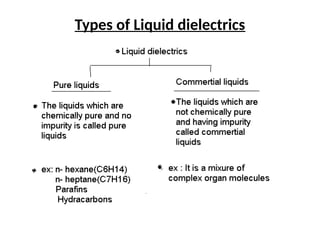
• Liquid dielectrics :
• a) 1000 times high dielectric strength ( 10 times than air) i.e 107
v/cm
• b) good heat conduction
• c) Cheapest & Commonly used
[Note : Most commonly used oil is transformer oil it is a mixture of
hydrocarbons includes (T= 95o
C) ]
• Paraffin's ,
• Iso –paraffin's,
• Naphthalene etc.
• Liquid dielectrics electrical properties:
• a) High permittivity
• b) High Resistivity
• c) Low dissipation factor
• d) Ability to withstand high electric stress …
–
Breakdown in PureLiquid Dielectics
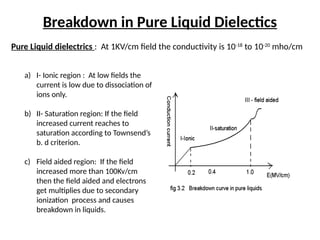
a) I- Ionic region : At low fields the
current is low due to dissociation of
ions only.
b) II- Saturation region: If the field
increased current reaches to
saturation according to Townsend’s
b. d criterion.
c) Field aided region: If the field
increased more than 100Kv/cm
then the field aided and electrons
get multiplies due to secondary
ionization process and causes
breakdown in liquids.
Pure Liquid dielectrics : At 1KV/cm field the conductivity is 10-18
to 10-20
mho/cm
6.
Breakdown in CommercialLiquid Dielectics
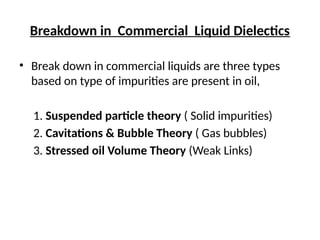
• Break down in commercial liquids are three types
based on type of impurities are present in oil,
1. Suspended particle theory ( Solid impurities)
2. Cavitations & Bubble Theory ( Gas bubbles)
3. Stressed oil Volume Theory (Weak Links)
7.
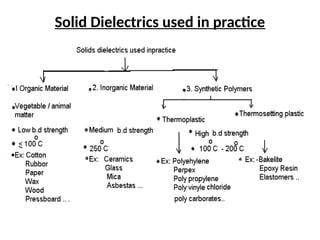
Breakdown in SolidDielectics
• Electrical Properties:
1. High resistivity
2. Low Dielectric loss ( Tan(delta))
3. High mechanical strength
4. Free from moisture contents
5. No chemical reaction
6. High thermal stability
7. Free from gaseous inclusions
8.
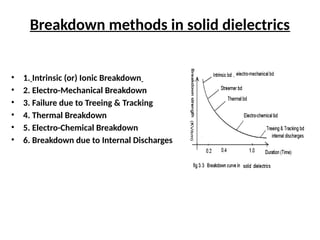
Breakdown methods insolid dielectrics
• 1. Intrinsic (or) Ionic Breakdown
• 2. Electro-Mechanical Breakdown
• 3. Failure due to Treeing & Tracking
• 4. Thermal Breakdown
• 5. Electro-Chemical Breakdown
• 6. Breakdown due to Internal Discharges
9.
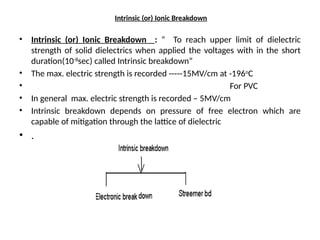
Intrinsic (or) IonicBreakdown
• Intrinsic (or) Ionic Breakdown : “ To reach upper limit of dielectric
strength of solid dielectrics when applied the voltages with in the short
duration(10-8
sec) called Intrinsic breakdown”
• The max. electric strength is recorded -----15MV/cm at -196o
C
• For PVC
• In general max. electric strength is recorded – 5MV/cm
• Intrinsic breakdown depends on pressure of free electron which are
capable of mitigation through the lattice of dielectric
• .
10.
Electro-Mechanical Breakdown
• “Principle:When solid dielectrics are subjected to high
electric field fields stresses, failure occurs when electro-static
compressive forces which are exceeds the electromechanical
compressive strength”
• Electrostatic compressive forces = εo εr (V2
/2d2
)
• Electro- mechanical compressive forces = γ ln(do/d)
Equilibrium condition : εo εr (V2
/2d2
) = γ ln(do/d)
V2 =
d2
[2γ /εo εr] ln (do/d)
Mechanical instability occurs, d / do = 0.6 (or) = do / d = 1.67
Max. stress before breakdown,
Emax = V/do = 0.6 [γ / εo εr]1/2
11.
Thermal Breakdown
• “Principle:When solid dielectrics are subjected to high electric
field fields stresses, failure occurs when it will under goes high
temperature due to heat generated init ”
• Heat generated in specimen = Heat dissipated
• Heat generated (Wdc) = σ E2
W/m3
• (Wac) = E2
f εr tan δ / 1.8x 10¹²
W/m3
• Heat dissipated WT = Cv dT/dt + div[K. grad(T)]
• Cv- Specific heat
• T – Temperature
• K – Thermal Conductivity
• δ – loss angle
12.
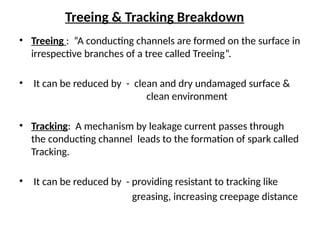
Treeing & TrackingBreakdown
• Treeing : “A conducting channels are formed on the surface in
irrespective branches of a tree called Treeing”.
• It can be reduced by - clean and dry undamaged surface &
clean environment
• Tracking: A mechanism by leakage current passes through
the conducting channel leads to the formation of spark called
Tracking.
• It can be reduced by - providing resistant to tracking like
greasing, increasing creepage distance
13.
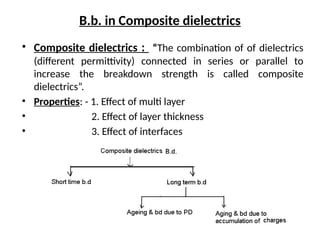
B.b. in Compositedielectrics
• Composite dielectrics : “The combination of of dielectrics
(different permittivity) connected in series or parallel to
increase the breakdown strength is called composite
dielectrics”.
• Properties: - 1. Effect of multi layer
• 2. Effect of layer thickness
• 3. Effect of interfaces

![Breakdown in Liquid Dielectics
• Liquid dielectrics :
• a) 1000 times high dielectric strength ( 10 times than air) i.e 107
v/cm
• b) good heat conduction
• c) Cheapest & Commonly used
[Note : Most commonly used oil is transformer oil it is a mixture of
hydrocarbons includes (T= 95o
C) ]
• Paraffin's ,
• Iso –paraffin's,
• Naphthalene etc.
• Liquid dielectrics electrical properties:
• a) High permittivity
• b) High Resistivity
• c) Low dissipation factor
• d) Ability to withstand high electric stress …
–](https://image.slidesharecdn.com/bbb65f6d2c2a5397ee5f20ec42465df7-250315084302-958ff094/85/bbb65f6d2c2a5397eefgxfxfg5f20ec42465df7-pptx-2-320.jpg)
![Electro-Mechanical Breakdown
• “Principle: When solid dielectrics are subjected to high
electric field fields stresses, failure occurs when electro-static
compressive forces which are exceeds the electromechanical
compressive strength”
• Electrostatic compressive forces = εo εr (V2
/2d2
)
• Electro- mechanical compressive forces = γ ln(do/d)
Equilibrium condition : εo εr (V2
/2d2
) = γ ln(do/d)
V2 =
d2
[2γ /εo εr] ln (do/d)
Mechanical instability occurs, d / do = 0.6 (or) = do / d = 1.67
Max. stress before breakdown,
Emax = V/do = 0.6 [γ / εo εr]1/2](https://image.slidesharecdn.com/bbb65f6d2c2a5397ee5f20ec42465df7-250315084302-958ff094/85/bbb65f6d2c2a5397eefgxfxfg5f20ec42465df7-pptx-10-320.jpg)
![Thermal Breakdown
• “Principle: When solid dielectrics are subjected to high electric
field fields stresses, failure occurs when it will under goes high
temperature due to heat generated init ”
• Heat generated in specimen = Heat dissipated
• Heat generated (Wdc) = σ E2
W/m3
• (Wac) = E2
f εr tan δ / 1.8x 10¹²
W/m3
• Heat dissipated WT = Cv dT/dt + div[K. grad(T)]
• Cv- Specific heat
• T – Temperature
• K – Thermal Conductivity
• δ – loss angle](https://image.slidesharecdn.com/bbb65f6d2c2a5397ee5f20ec42465df7-250315084302-958ff094/85/bbb65f6d2c2a5397eefgxfxfg5f20ec42465df7-pptx-11-320.jpg)