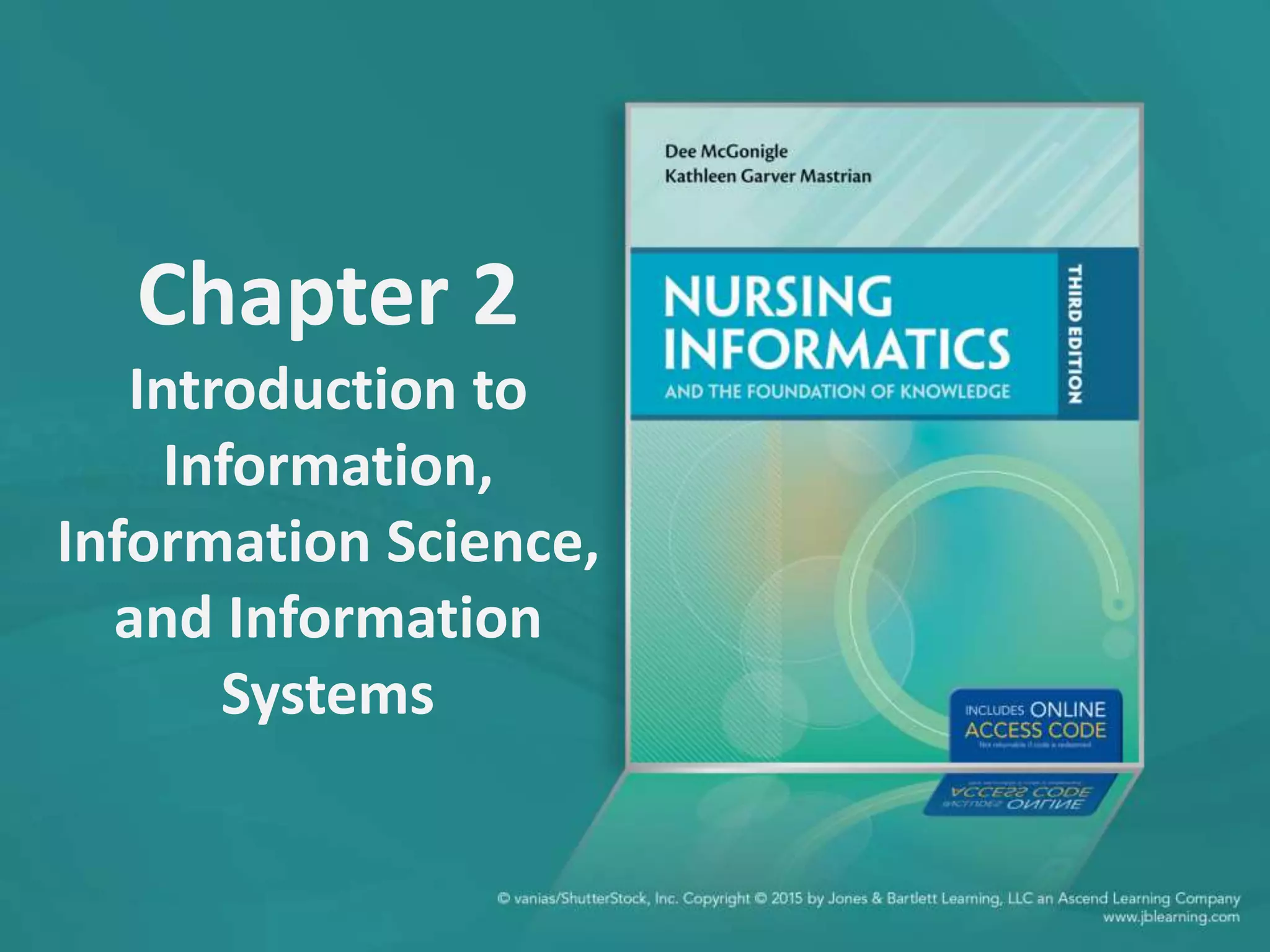
Chapter 2
Introduction to
Information,
Information Science,
and Information
Systems
Data
• Raw facts
Information
• Processed data that has meaning
• Information is data that is processed using
knowledge. In order for information to be
valuable or meaningful, it must be accessible,
accurate, timely, complete, cost effective, flexible,
reliable, relevant, simple, verifiable, and secure
Data Integrity
• Refers to whole, complete, correct, and
consistent data
• Can be compromised through human
error, viruses, worms, other bugs,
hardware failures or crashes,
transmission errors, and/or hackers
entering the system
High Quality Data
• Data that are relevant and accurately
represent their corresponding concepts.
• Data are dirty when there are errors in the
database such as duplicate, incomplete, or
outdated records
The data that we process
into information must be of
high quality and integrity to
create meaning to inform
our assessments and
decision making.
Quality of Information
• Necessary for it to be valuable and
meaningful.
• Characteristics of valuable, quality information
– accessibility, security, timeliness, accuracy,
relevancy, completeness, flexibility, reliability,
objectivity, utility, transparency, verifiability, and
reproducibility
Information Science
• Science of information, studying the
application and usage of information and
knowledge in organizations and the
interfacings or interaction between people,
organizations, and information systems
• Information science enables the processing of
information
Information Science
• is a multidisciplinary science that involves aspects from
computer science, cognitive science, social science,
communication science, and library science to deal
with obtaining, gathering, organizing, manipulating,
managing, storing, retrieving, recapturing, disposing of,
distributing, or broadcasting information. Information
science studies everything that deals with information
and can be defined as the study of information
systems. This science originated as a subdiscipline of
computer science, in an attempt to understand and
rationalize the management of technology within
organizations.
Information Processing
• Is the conversion of latent information into
manifest information.
• Latent information is that which is not yet
realized or apparent
• Manifest information is obvious or clearly
apparent.
• Information science and computational tools are
extremely important in enabling the processing
of data, information, and knowledge in health
care.
Information System (IS)
• Combinations of hardware, software and
telecommunications networks that people
build and use to collect, create, and distribute
useful data, typically in organizational settings
• Can be manually based, but for the purposes
of this text, the term refers to computer-based
information systems (CBISs)
• Designed for specific purposes within
organizations
IS
• Acquires data or inputs; processes data that
consists of the retrieval, analysis, and/or
synthesis of data; disseminates or outputs in
the form of reports, documents, summaries,
alerts, prompts, and/or outcomes; and
provides for responses or feedback
IS
• Capability to disseminate, provide feedback,
and adjust the data and information based on
these dynamic processes are what sets them
apart
• should be a user-friendly entity that provides
the right information at the right time and in
the right place.
Summary
• Organizations are recognizing that their most
precious asset is their information,
represented in their employees, experience,
competence or know-how, and innovative or
novel approaches, all of which are dependent
on a robust information network that
encompasses the information technology
infrastructure.

Chapter 2

  • 1.
  • 2.
    Data • Raw facts Information •Processed data that has meaning • Information is data that is processed using knowledge. In order for information to be valuable or meaningful, it must be accessible, accurate, timely, complete, cost effective, flexible, reliable, relevant, simple, verifiable, and secure
  • 3.
    Data Integrity • Refersto whole, complete, correct, and consistent data • Can be compromised through human error, viruses, worms, other bugs, hardware failures or crashes, transmission errors, and/or hackers entering the system
  • 4.
    High Quality Data •Data that are relevant and accurately represent their corresponding concepts. • Data are dirty when there are errors in the database such as duplicate, incomplete, or outdated records
  • 5.
    The data thatwe process into information must be of high quality and integrity to create meaning to inform our assessments and decision making.
  • 6.
    Quality of Information •Necessary for it to be valuable and meaningful. • Characteristics of valuable, quality information – accessibility, security, timeliness, accuracy, relevancy, completeness, flexibility, reliability, objectivity, utility, transparency, verifiability, and reproducibility
  • 7.
    Information Science • Scienceof information, studying the application and usage of information and knowledge in organizations and the interfacings or interaction between people, organizations, and information systems • Information science enables the processing of information
  • 8.
    Information Science • isa multidisciplinary science that involves aspects from computer science, cognitive science, social science, communication science, and library science to deal with obtaining, gathering, organizing, manipulating, managing, storing, retrieving, recapturing, disposing of, distributing, or broadcasting information. Information science studies everything that deals with information and can be defined as the study of information systems. This science originated as a subdiscipline of computer science, in an attempt to understand and rationalize the management of technology within organizations.
  • 9.
    Information Processing • Isthe conversion of latent information into manifest information. • Latent information is that which is not yet realized or apparent • Manifest information is obvious or clearly apparent. • Information science and computational tools are extremely important in enabling the processing of data, information, and knowledge in health care.
  • 10.
    Information System (IS) •Combinations of hardware, software and telecommunications networks that people build and use to collect, create, and distribute useful data, typically in organizational settings • Can be manually based, but for the purposes of this text, the term refers to computer-based information systems (CBISs) • Designed for specific purposes within organizations
  • 11.
    IS • Acquires dataor inputs; processes data that consists of the retrieval, analysis, and/or synthesis of data; disseminates or outputs in the form of reports, documents, summaries, alerts, prompts, and/or outcomes; and provides for responses or feedback
  • 12.
    IS • Capability todisseminate, provide feedback, and adjust the data and information based on these dynamic processes are what sets them apart • should be a user-friendly entity that provides the right information at the right time and in the right place.
  • 13.
    Summary • Organizations arerecognizing that their most precious asset is their information, represented in their employees, experience, competence or know-how, and innovative or novel approaches, all of which are dependent on a robust information network that encompasses the information technology infrastructure.