Historical Perspectives
of Nursing
and the Computer
Submitted by:
Onda, Jessica Nadine S.
BSN III-1
 A computer generally means a programmable
machine.
 The computer help transform the nursing
profession prior to the new century. It
includes the transformation of paper-based
records to computer-based records. It is
use to manage information in patient’s
care, monitor the quality of care and
evaluate the outcomes of care. It can be
used for communication and enhancing the
nursing education and support nursing
research.
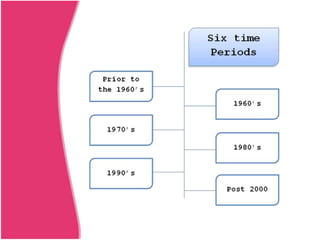
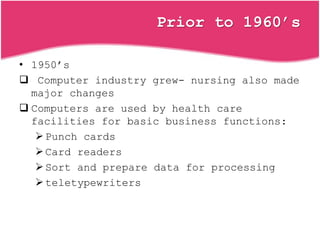
Prior to 1960’s
• 1950’s
 Computer industry grew- nursing also made
major changes
 Computers are used by health care
facilities for basic business functions:
Punch cards
Card readers
Sort and prepare data for processing
teletypewriters
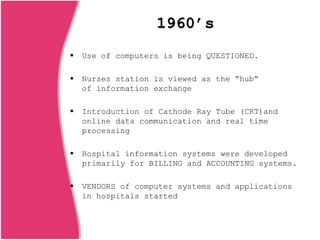
1960’s
 Use of computers is being QUESTIONED.
 Nurses station is viewed as the “hub”
of information exchange
 Introduction of Cathode Ray Tube (CRT)and
online data communication and real time
processing
 Hospital information systems were developed
primarily for BILLING and ACCOUNTING systems.
 VENDORS of computer systems and applications
in hospitals started
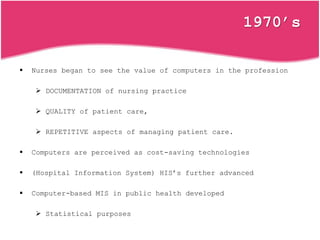
1970’s
 Nurses began to see the value of computers in the profession
 DOCUMENTATION of nursing practice
 QUALITY of patient care,
 REPETITIVE aspects of managing patient care.
 Computers are perceived as cost-saving technologies
 (Hospital Information System) HIS’s further advanced
 Computer-based MIS in public health developed
 Statistical purposes
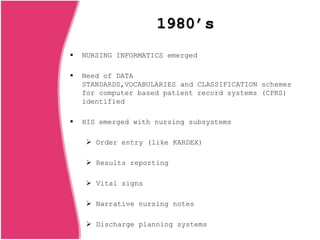
1980’s
 NURSING INFORMATICS emerged
 Need of DATA
STANDARDS,VOCABULARIES and CLASSIFICATION schemes
for computer based patient record systems (CPRS)
identified
 HIS emerged with nursing subsystems
 Order entry (like KARDEX)
 Results reporting
 Vital signs
 Narrative nursing notes
 Discharge planning systems
1980’s
 Microcomputer / Personal Computer emerged
Has brought computing power to
workplace, especially the POINT-of-CARE.
Served as stand-alone
systems(workstations)
User-friendly and allowed nurses to
create their own applications
1990’s
 Computer technology became an integral
part of health care settings, nursing
practice, and the profession.
 Nursing Informatics was approved in1992
by ANA as a new nursing specialty
 Demand for NI expertise increased greatly
 Use of innovative technologies for all
levels and types of nursing and patient
education demanded
1990’s
 Laptops and Notebooks were utilized at bedside and
all point-of-care settings.
 Local area networks (LANs) were developed in
hospitals.
 Wide area networks (WANs) were developed for
linking care across healthcare facilities
 INTERNET is widely used and helped information and
knowledge databases to be integrated into bedside
systems.
1990’s
 1995 – internet was brought to the
social milieu
E-mail
File transfer
protocol(upload/download)
Telnet
www protocols (The Web)
1990’s
 The internet was used to exchange data
between CPRS, while the Web became the
means to communicating online services
(browsing the internet)and resources to
the nursing community.
Post-2000
 Development of wireless Point-of-care systems
with focus on OPEN SOURCE solutions
 Clinical information systems (CIS)became
individualized in the Electronic Patient
Record (EPR) and patient specific systems
considered for the lifelong longitudinal
record or the Electronic Health Record (EHR)
 Mobile Technology Advances
 Wireless tablet computers
 Personal digital assistants (PDAs)
 Smart cellular telephones (Smartphones)
 Voice over internet protocol (VOIP)
 Health smartcards
Post-2000
 TELENURSING became popular
 Remote monitoring of ICU patient, community patients
 LEGISLATION (US-based)
made an impact on the practice - The Health
Insurance Portability and Accountability Act of 1996
(HIPAA)
– 1. enacted to streamline health care transactions
– 2. reduce cost
– 3. reimbursements
– 4. security, privacy, and confidentiality
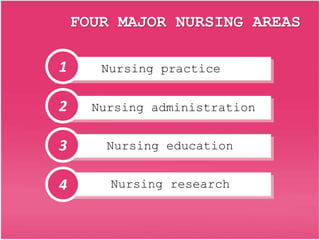
FOUR MAJOR NURSING AREAS
Nursing practice
Nursing administration
Nursing education
Nursing research
1
2
3
4
Nursing Practice
 Has evolved and changed radically.
 It has become an integral part of the
HER.
 Computer system with nursing and patient
care data, nursing care plans are no
longer separate subsystems of the
computerized HISs, but rather integrated
into one interdisciplinary patient health
record in the EHR.
 Emerged with the introduction of several
nursing terminologies that were
recognized by the ANA.
Nursing Administration
 Most policy and procedure manuals are
accessed and retrieve by computer.
 Has also changed with the introduction of
the computers that links nursing
department together.
 Internet is being used by nurses to access
digital libraries, online resources, and
research protocols at the bedside.
Nursing Education
 Most universities and schools of nursing
offer computer in enhancing courses,
online courses and or distance education.
 Live classroom lectures via digital
telephone lines arise.
 Campus-wide computer systems are
available
 Web and E-mail are used to enhance
teachings.
Nursing Research
 Provides the impetus to used the computer for
analyzing nursing data.
 Computer technology data bases supporting nursing
research emerged.
 Software programs are made available for processing
both quantitative and qualitative research data.
 Databases support nursing research for online
searching and retrieving information.
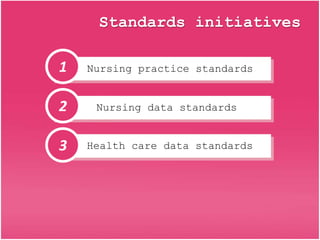
Standards initiatives
Nursing practice standards
Nursing data standards
Health care data standards
1
2
3
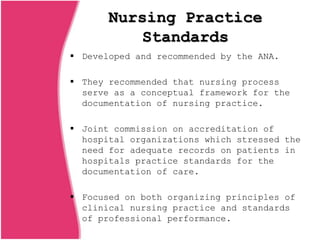
Nursing Practice
Standards
 Developed and recommended by the ANA.
 They recommended that nursing process
serve as a conceptual framework for the
documentation of nursing practice.
 Joint commission on accreditation of
hospital organizations which stressed the
need for adequate records on patients in
hospitals practice standards for the
documentation of care.
 Focused on both organizing principles of
clinical nursing practice and standards
of professional performance.
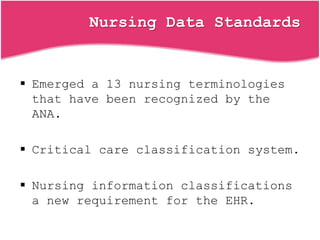
Nursing Data Standards
 Emerged a 13 nursing terminologies
that have been recognized by the
ANA.
 Critical care classification system.
 Nursing information classifications
a new requirement for the EHR.
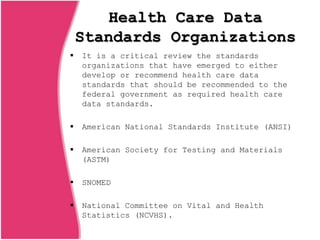
Health Care Data
Standards Organizations
 It is a critical review the standards
organizations that have emerged to either
develop or recommend health care data
standards that should be recommended to the
federal government as required health care
data standards.
 American National Standards Institute (ANSI)
 American Society for Testing and Materials
(ASTM)
 SNOMED
 National Committee on Vital and Health
Statistics (NCVHS).
Early Computer –Based
Nursing Applications
 Developed before the mid-1970’s as a part
of HISs.
 Different nursing applications focused on
documentation of nursing practice and
management of patient care.
 Designs for hospitals, ambulatory care
settings, and community health agencies.
Landmark Events in
Nursing and Computers
 Computers were introduced into the
nursing profession over 35 years
ago.
 Major milestones of nursing are
interwoven with the advancement of
computer and information
technologies, the increase need
for nursing data, development of
nursing applications, and changes
making the nursing profession an
autonomous discipline.
Landmark Events in Nursing
and Computers
 The landmark events were described by the
following categories:
(a)early conferences, meetings
(b)early academic initiatives
(c)initial ANA initiatives
(d)Initial National League for
Nursing initiatives
(e)early international initiatives
(f)initial educational resources
(g)significant collaborative events
Thank You !!!

Nursing Informatics

  • 1.
    Historical Perspectives of Nursing andthe Computer Submitted by: Onda, Jessica Nadine S. BSN III-1
  • 2.
     A computergenerally means a programmable machine.  The computer help transform the nursing profession prior to the new century. It includes the transformation of paper-based records to computer-based records. It is use to manage information in patient’s care, monitor the quality of care and evaluate the outcomes of care. It can be used for communication and enhancing the nursing education and support nursing research.
  • 4.
    Prior to 1960’s •1950’s  Computer industry grew- nursing also made major changes  Computers are used by health care facilities for basic business functions: Punch cards Card readers Sort and prepare data for processing teletypewriters
  • 5.
    1960’s  Use ofcomputers is being QUESTIONED.  Nurses station is viewed as the “hub” of information exchange  Introduction of Cathode Ray Tube (CRT)and online data communication and real time processing  Hospital information systems were developed primarily for BILLING and ACCOUNTING systems.  VENDORS of computer systems and applications in hospitals started
  • 6.
    1970’s  Nurses beganto see the value of computers in the profession  DOCUMENTATION of nursing practice  QUALITY of patient care,  REPETITIVE aspects of managing patient care.  Computers are perceived as cost-saving technologies  (Hospital Information System) HIS’s further advanced  Computer-based MIS in public health developed  Statistical purposes
  • 7.
    1980’s  NURSING INFORMATICSemerged  Need of DATA STANDARDS,VOCABULARIES and CLASSIFICATION schemes for computer based patient record systems (CPRS) identified  HIS emerged with nursing subsystems  Order entry (like KARDEX)  Results reporting  Vital signs  Narrative nursing notes  Discharge planning systems
  • 8.
    1980’s  Microcomputer /Personal Computer emerged Has brought computing power to workplace, especially the POINT-of-CARE. Served as stand-alone systems(workstations) User-friendly and allowed nurses to create their own applications
  • 9.
    1990’s  Computer technologybecame an integral part of health care settings, nursing practice, and the profession.  Nursing Informatics was approved in1992 by ANA as a new nursing specialty  Demand for NI expertise increased greatly  Use of innovative technologies for all levels and types of nursing and patient education demanded
  • 10.
    1990’s  Laptops andNotebooks were utilized at bedside and all point-of-care settings.  Local area networks (LANs) were developed in hospitals.  Wide area networks (WANs) were developed for linking care across healthcare facilities  INTERNET is widely used and helped information and knowledge databases to be integrated into bedside systems.
  • 11.
    1990’s  1995 –internet was brought to the social milieu E-mail File transfer protocol(upload/download) Telnet www protocols (The Web)
  • 12.
    1990’s  The internetwas used to exchange data between CPRS, while the Web became the means to communicating online services (browsing the internet)and resources to the nursing community.
  • 13.
    Post-2000  Development ofwireless Point-of-care systems with focus on OPEN SOURCE solutions  Clinical information systems (CIS)became individualized in the Electronic Patient Record (EPR) and patient specific systems considered for the lifelong longitudinal record or the Electronic Health Record (EHR)  Mobile Technology Advances  Wireless tablet computers  Personal digital assistants (PDAs)  Smart cellular telephones (Smartphones)  Voice over internet protocol (VOIP)  Health smartcards
  • 14.
    Post-2000  TELENURSING becamepopular  Remote monitoring of ICU patient, community patients  LEGISLATION (US-based) made an impact on the practice - The Health Insurance Portability and Accountability Act of 1996 (HIPAA) – 1. enacted to streamline health care transactions – 2. reduce cost – 3. reimbursements – 4. security, privacy, and confidentiality
  • 15.
    FOUR MAJOR NURSINGAREAS Nursing practice Nursing administration Nursing education Nursing research 1 2 3 4
  • 16.
    Nursing Practice  Hasevolved and changed radically.  It has become an integral part of the HER.  Computer system with nursing and patient care data, nursing care plans are no longer separate subsystems of the computerized HISs, but rather integrated into one interdisciplinary patient health record in the EHR.  Emerged with the introduction of several nursing terminologies that were recognized by the ANA.
  • 17.
    Nursing Administration  Mostpolicy and procedure manuals are accessed and retrieve by computer.  Has also changed with the introduction of the computers that links nursing department together.  Internet is being used by nurses to access digital libraries, online resources, and research protocols at the bedside.
  • 18.
    Nursing Education  Mostuniversities and schools of nursing offer computer in enhancing courses, online courses and or distance education.  Live classroom lectures via digital telephone lines arise.  Campus-wide computer systems are available  Web and E-mail are used to enhance teachings.
  • 19.
    Nursing Research  Providesthe impetus to used the computer for analyzing nursing data.  Computer technology data bases supporting nursing research emerged.  Software programs are made available for processing both quantitative and qualitative research data.  Databases support nursing research for online searching and retrieving information.
  • 20.
    Standards initiatives Nursing practicestandards Nursing data standards Health care data standards 1 2 3
  • 21.
    Nursing Practice Standards  Developedand recommended by the ANA.  They recommended that nursing process serve as a conceptual framework for the documentation of nursing practice.  Joint commission on accreditation of hospital organizations which stressed the need for adequate records on patients in hospitals practice standards for the documentation of care.  Focused on both organizing principles of clinical nursing practice and standards of professional performance.
  • 22.
    Nursing Data Standards Emerged a 13 nursing terminologies that have been recognized by the ANA.  Critical care classification system.  Nursing information classifications a new requirement for the EHR.
  • 23.
    Health Care Data StandardsOrganizations  It is a critical review the standards organizations that have emerged to either develop or recommend health care data standards that should be recommended to the federal government as required health care data standards.  American National Standards Institute (ANSI)  American Society for Testing and Materials (ASTM)  SNOMED  National Committee on Vital and Health Statistics (NCVHS).
  • 24.
    Early Computer –Based NursingApplications  Developed before the mid-1970’s as a part of HISs.  Different nursing applications focused on documentation of nursing practice and management of patient care.  Designs for hospitals, ambulatory care settings, and community health agencies.
  • 25.
    Landmark Events in Nursingand Computers  Computers were introduced into the nursing profession over 35 years ago.  Major milestones of nursing are interwoven with the advancement of computer and information technologies, the increase need for nursing data, development of nursing applications, and changes making the nursing profession an autonomous discipline.
  • 26.
    Landmark Events inNursing and Computers  The landmark events were described by the following categories: (a)early conferences, meetings (b)early academic initiatives (c)initial ANA initiatives (d)Initial National League for Nursing initiatives (e)early international initiatives (f)initial educational resources (g)significant collaborative events
  • 27.