Steve VarelaProfessor of International Business© 2009 – All Rights ReservedEffective Negotiations
WELCOME!!!!!!         “Tell me and I'll forget; show me and I may remember; involve me and I'll understand.” 					-Chinese Proverb
Business English NegotiationsWelcomeInstructorIndex Card:   Number   +   English_Name    +     EmailPersonal Info, work experience, academic focus, goals for this course, travel/overseas experience, sales and/or negotiation experience.Individual Student IntroductionsToday’s Agenda: Preview of CoursePair’s and Group’sQuestion of the dayChapter 1Textbook: Effective Negotiations by Jeremy Comfort,Oxford University Press , 2007
Syllabus
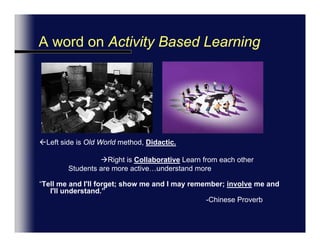
A word on Activity Based LearningLeft side is Old World method, Didactic.Right is CollaborativeLearn from each other 		Students are more active…understand more“Tell me and I'll forget; show me and I may remember; involve me and I'll understand.” 					                         -Chinese Proverb
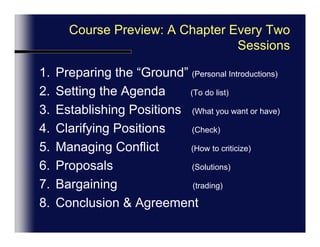
Course Preview: A Chapter Every Two SessionsPreparing the “Ground”     (Introductions, goals, place)Setting the Agenda            (Negotiate what you will 						    negotiate)Establishing Positions        (What you want or have)Clarifying Positions 	           (Check understanding)Managing Conflict              (How to criticize)Proposals                           (Creating solutions)Bargaining                          (Exerting pressure)Conclusion& Agreement   (Follow-up, implementation)
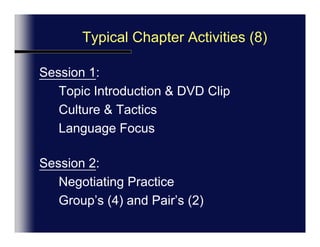
Typical Chapter Activities (8)Session 1:	Topic Introduction & DVD Clip	International Culture & Tactics	Language FocusSession 2:	Negotiating Practice 	Group’s (4) and Pair’s (2)
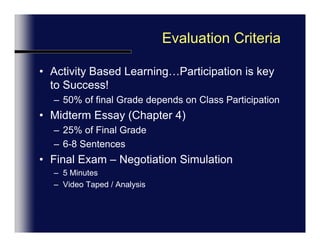
Evaluation CriteriaActivity Based Learning…Participation is key to Success!34% of final Grade depends on Class ParticipationMidterm Essay or Simulation (Chapter 4)33% of Final Grade6-8 Sentences or 5 minutesFinal Exam – Negotiation Simulation5 Minutes Video Taped / Analysis33%
Question of the Day (Graded Exercise)At the start of each chapter, one group answers the first two communication skills questions at the start of the class.List question on blackboard & present your answer to the class.  5 Minute Limit.Have ready before the class begins.i.e. Chapter 1 = Group 1, Chapter 2 = Group 2…
Questions???
*****Session 2****
Chapter Introduction QuestionGroup 1	Present the Answer/Commentary to the First 2 questions of Chapter1.					… Group1.
Preparing the GroundA negotiation is a meeting in which both parties need each other’s agreement to reach a specific objective.Various Types of NegotiationsInternal / ExternalLong / ShortFormal / InformalWhat is your Goal?
Video Negotiating Context:  Preparing the GroundOkus ITAndrew is the Export Sales Manager, He made the initial contact and knows SeanKaren is the project manager. She made the contract specifications and this is her first international negotiation.  She is anxious.LevienFrancoise is the IT Manager, she is ready to be promoted to Logistics Head. She is Keen that her team (employees) are protected.Sean: from Levin’s Chicago office.  He was sent to Brussels to develop Levin’s procurement policySituation: Andrew and Karen have arrived at Levin’s Brussels office to meet Françoise and Sean
Preparing the GroundVersion 1:	Watch their body language with no sound?	What problems do you expect?Version 2:	Body language…	Introduction differences?EN Chapter 1 Version 1.aviEN Chapter 1 Version 2.avi
Preparing for a Business Negotiation (p.68)Objectives: best, worst, bottom lineStrategies: main areas, sticking points, best order for discussion, concessionsRoles: who is responsible, skills of team members, the other teamCommunication: maintain positive communication, note taking, who asks questions?  Who is the Chair?
Chapter 1: Preparing the “Ground”Culture and TacticsWork in Pair’sRead “Task Oriented” or “People Oriented” Present a Summary to your partner (pair)15 Minutes….
Chapter 1: How Do You See Yourself?iI start my day with a list (to do)ii  I start my day with a chat (talk)iI don’t let personal feelings influence decisionsii  I Consider human angle firsti Friendship not important if good job at workii Important to like people I work with
How Do You See Yourself? (p.2)i Meetings only purpose is to get things doneii Meetings are opportunities to develop relationshipsiI fell end of day frustration if my list not finishedii Feel “low” (sad) if have not got on with colleaguesScoring: 2 Points for every i		  0 Points for every ii,                 1 Point for every neither
What’s your score?6-10 Points =  Task-Oriented4-5 Points =    Balanced0-3 Points =    People – OrientedNeither is betterLets us know who we are and what to plan for.
Language FocusFormal	WelcomingOn behalf of…I’m very glad to welcome youIt’s a pleasure to see you hereIntroductionsThis is…He’s in Charge of…              He’s responsible for...He is our President/Director       In-FormalWelcome toThank you for comingIt’s nice to be hereLet me introduce you to…Have you met…?
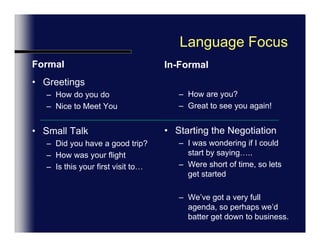
Language Focus, (p.11)FormalIn-FormalHow are you?Great to see you again!Starting the NegotiationI was wondering if I could start by saying…..Were short of time, so lets get startedWe’ve got a very full agenda, so perhaps we’d batter get down to business.GreetingsHow do you doNice to Meet YouSmall TalkDid you have a good trip?How was your flightIs this your first visit to…
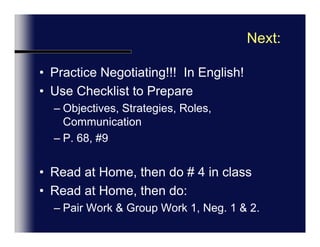
Next Session:Practice Negotiating!!!Use Checklist P. 68, #9  to prepare the following:ObjectivesStrategiesRolesCommunicationSpeaking Practice #4 in class, p.12Pair Work & Group Work 1, Neg. 1 & 2, p.13
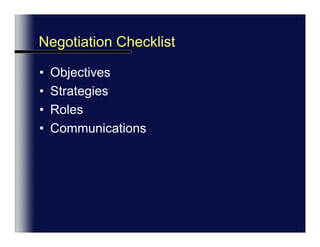
Negotiation ChecklistObjectivesStrategiesRolesCommunications
Questions???Prepare for Negotiation #1…
Negotiation #1 (p.13)Group up…work in pairs (2)Use checklist to prepare and then negotiate the sale/purchase of the car15 minutes.
Group Work 1: Negotiation 1Two want a ban on smokingTwo want free smokingUse Checklist and NegotiateBe prepared to discuss what happened to the class.15 minutes.
For next Session…Chapter 2:  Setting the AgendaRead: pages 16-20.Read: Video Transcripts Unit 2 (version 1 & 2)Do Questions:7 & 1on p. 17, 2 p. 18, 3 p. 19, 4 p. 20Review: Negotiating Practice, Negotiation #1, p.22Group 2 does Q1 “Chapter Introduction Chapter”
FeedbackAny questions????Visit my office anytime:#M615B OR email.
Welcome Back!Chapter 2: Setting the Agenda
Question of the ChapterChapter2	Present the Answer/Commentary to the First question of the Chapter (2).					…Group2.
Setting the AgendaSome basic negotiations have only one point of discussionOthers are more complex…But all need a sense of direction, a clear understanding of the objectives and a plan…often, the Host is responsible for Chairing or controlling the negotiation.
Video Negotiating Context:  AgendaOkus ITAndrew ready to present opening presentationKaren expects Francoise to set the agendaLevienFrancoise worried about protecting her staff’s jobsSean: wants to establish a clear and strong negotiating positionMain Issues (aspects): Who is in control,who is Chairing here???
Video: Roles of Chairperson, Agenda & ProcedureVersion 1What do you expect to happen in the first stage of the negotiation?EN_Chapter_2_Version_1a.aviWhat went wrong?Now, half focus on Levien side other half on Okus sideEN_Chapter_2_Version_1a.aviVersion 2EN_Chapter_2_Version_2.aviHow about Francois’s new performance?Now, lets identify the checklist steps…EN_Chapter_2_Version_2.avi
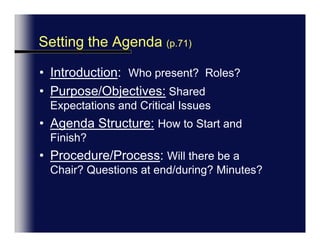
Setting the Agenda (p.71)Introduction:  Who present?  Roles?Purpose/Objectives: Shared Expectations and Critical IssuesAgenda Structure:How to Start and Finish the meeting?Procedure/Process: Will there be a Chair? Questions at end/during? Minutes?
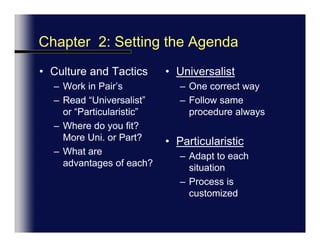
Chapter  2: Setting the AgendaCulture and TacticsWork in Pair’sRead “Universalist” or “Particularistic” Where do you fit?  More Univ. or Part.?What are advantages of each?UniversalisticOne correct wayFollow same procedure alwaysParticularisticAdapt to each situationProcess is customized
What are the Advantages and Disadvantages of each?ParticularisticUniversalistic
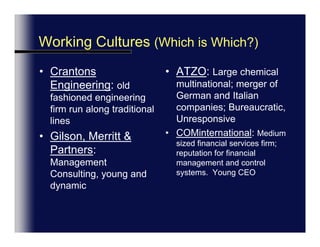
Identifying Working Cultures (Which is Which?)Crantons Engineering: old fashioned engineering firm run along traditional linesGilson, Merritt & Partners: Management Consulting, young and dynamicATZO: Large chemical multinational; merger of German and Italian companies; Bureaucratic, UnresponsiveCOMinternational: Medium sized financial services firm;  reputation for financial management and control systems.  Young CEO
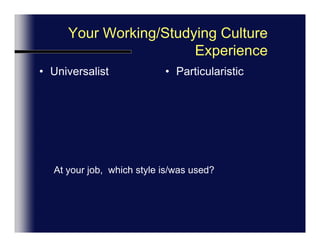
Your Working/Studying Culture ExperienceUniversalisticAt your job/school,  which style is commonly used?Examples???Particularistic
Break …
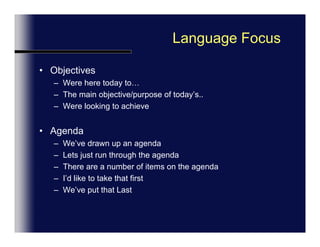
Language FocusObjectivesWere here today to…The main objective/purpose of today’s..Were looking to achieveAgendaWe’ve drawn up an agendaLets just run through the agendaThere are a number of items on the agendaI’d like to take that firstWe’ve put that Last
TimingThat gives us two hoursIt will take two hoursIt won’t be longI need to be away by…Roles …is going to sit in…is going to take the minutes…would like to say a few words…you’re going to give us a presentationProcedureWe’ll deal with that ….last/first/tomorrowWe’ll go round the tableWe’ll have a question and answer at the endWe can table that for discussion later
Speaking Practice (#4, p.20)Group up!Do the following in your groups…Present your introduction to the class (2 minute introductions)Use the Negotiation Checklist (p.71) to organize your introduction and agenda talkUse tips from Language Focus for your vocabulary15 Minutes to prepare.
Speaking PracticeImportant: Use a structured introductionAct as a Chairman, Chairwoman.Show Leadership.Practice in your group…Afterwards,  we will present to class ---with Gusto!
Presentations….Group 1-X2 Minute maximum time  Introduction only
For next session…Chapter 2:  Negotiation PracticeRe-Read pages 16-20.Review Language Focus examplesReview: Negotiating Practice, Negotiation #1 & 2 p.22Be prepared to present to classyour2 minute Introductions onlyto No’s. 1 & 2.                              * Not a full negotiation- just introduction.
FeedbackAny questions????Visit my office anytime or email:#M615BOffice Hours:  Monday       13:10 – 15:20Wednesday 15:20 – 17:10
Session 4Setting the Agenda II
Session AgendaVocabulary exercise: P. 19 No. 3Complete Speaking Practice Session 2Negotiation Practice, P.22, No.1 or 2.Everybody Participates!
Negotiation SimulationNegotiating Practice, P. 22, Negotiation # 12 Buyers: Toy manufacturer2 Sellers: Training consultantsBe prepared to present your introduction to class with Gusto!2 minute maximum		*Only the introduction, not a full negotiation
*****Break*****
Introduction SimulationNegotiating Practice, Page 22, # 1 or 22 Buyers2 SellersNegotiate in Pairs for 30 MinutesTake notes as to what happened and whenBe prepared to present your results to classEx.Introduction Structure	Names	Purpose	Roles	Logistics	Timing	Proposal	Issue Resolution
Negotiation Introduction No. 1Groups X-1Saroyan-Arttech: Toy Manufacturer seeks management training programConsultancy: Sent materials and was invited to make a presentation on your training services.
Negotiation Introduction #1, p. 22Group N – 1…Buyers (2)Sellers (2)3 Minute Maximum NegotiationSimulationFocus on: Introduction Structure.
Negotiation Introduction  #2Futura:  Large Manufacturing needs packaging materialsDTX Packaging, Vendor of packaging material.Groups 1-X, 3 minutes, alternate speakers
For next session…Chapter 3:  Establishing PositionsRead: Pages 24, 25, 27, 28& 29Read: Unit 3 Video TranscriptsReview Culture and Tactics StylesIndividualist & CollectivistDo p. 25-26-27 #’s 1, 2 &3Review/Practice Language FocusGroup 3: Present your Chapter Question before class starts
Establishing Positions
Today’s Agenda: Establishing PositionsDilemma of PositionsPositive and Open vs. Room to Bargain laterHold Backpermits a discussion ( & creativity)Goal: Find out what they think about your offerThrough Effective Feedback & listeningCulture and Tactics: Direct vs. IndirectLanguage Focus: Vocabulary tips
Video Negotiating ContextOkus ITAndrew presents key aspectsKaren AssistsLevienFrancoise expects key aspectsSean: Chicago waiting for staffing info.Main Issues (aspects): Staffing levels:  Take all Levin IT Staff?Support levelsLevel A:  Full Support and New ProjectsLevel B:  Full Support, Projects Cost Extra
ClipVersion 1: No SoundEN Chapter 3 Version 1.aviwatch body language		both presenter and audienceVersion 1: SoundEN Chapter 3 Version 1.avi		What should Andrew do?		Start/stopVersion 2:  No SoundEN Chapter 3 Version 2.avi		watch changes		note style		Pauses to check for  	audience agreement, 	confirmationAndrew’s Presentation Style…How to Improve?
Language Focus…Asking for and giving feedback(p.27)Group Up.Each Group pick a section and write on a piece of paper, add missing words or put each phrase in a short two sentence dialogue.Each person should do only one phraseWrite you Name & Answers on paper, give to instructor – we will review a few in class.15 Minutes.
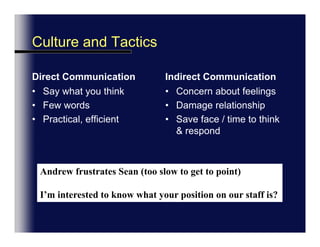
Culture and TacticsDirect CommunicationSay what you thinkFew wordsPractical, efficientIndirect CommunicationConcern about feelingsDamage relationshipSave face / time to think & respondAndrew frustrates Sean (too slow to get tothe point)“I’m interested to know what your position on our staff is?”
Direct versus IndirectWhich style (direct or indirect) is yours?Which style do you like?Which is more effective?  Why?
Group Exercise: Culture and TacticsWhat is the more direct question or statement behind these sentences?  (Page 25, #1)Change sentences to Direct StyleDo A, C, E Indirectness is achieved by making questions and statements vague and not specific. (Page 26, #2)Change sentences to Indirect StyleDo B & DWrite you Name & Answers on paper, give to instructor – we will review a few in class.15 Minutes.
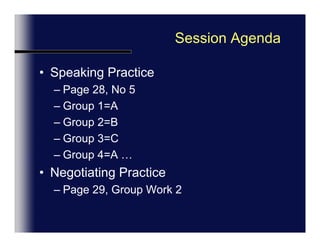
For next session…Speaking Practice, p.28 #5, G1=a, G2=b, G3=c…Work in Groups (2+2)Create brief introductions for situation ( 2 mins.)Invite feedback oftenPractice and then change rolesNegotiating Practice, p.29  Group Work 2Groups choose a topicPrepare presentation to sell your product  (5 mins.)Invite feedback from other group membersClass asks questions
Feedback	Was anything unclear?  Fuzzy?Stop by my office:   M615B  orEmail:  svarela@thu.edu.twOr, Write it down and leave it at the desk…    …I will address it next time we meet.						Thank you.
Establishing Positions IISession 6
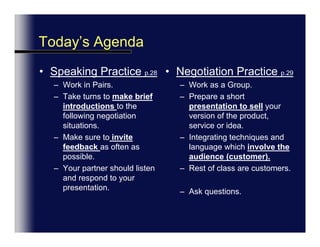
SessionAgendaSpeaking Practice p.28Work in Pairs.Take turns to make brief introductions to the following negotiation situations.Make sure to invite feedback as often as possible.Your partner should listen and respond to your presentation.  Negotiation Practice p.29Work as a Group.Prepare a short presentation to sell your version of the product, service or idea.Integrating techniques and language which involve the audience (customer).Rest of class are customers. Ask questions.
Next Session: Clarifying Positions (Ch.4)Read Carefully “Video Negotiating Context” p.30Video Transcript Unit 4 p. 92Study pages 30-34Do Questions:P.31 #8P.32 #1 & 2
Questions?Stop by officeEmailOffice Hours: Monday 	 1:10 – 3:20 PMOffice Hours: Thursday      3:00 – 5:00 PM
Clarifying Positions
Clarifying Your Position’sLast session:Focus was Presenting your position and Interactive Communication using QuestionsThis session:Focus is on Clarifying: making sure we really  understand each otherSkills to understand are:Good ListeningEffective Questioning
The ProblemMost of us do not communicate very well…We start with our own ideasWe wait for time to tell our ideasWe usually have already made up our minds, disagree or ignore the other side.We should be actively listening.An open mind to understand the other party better,Develop practical and beneficial solutions,Earn respect from the other team.
Video Negotiating ContextOkus ITKaren clarifies the details of Okus’ offerAndrew assistsLevienFrancoise is worried about extra project fee’sSean: Concerned about level of support from Okus.Main Issue (aspect): Support levelsLevel A:  Full Support Packageincludes New Projects (ala Club Med All Inclusive Vacation)Level B:  Cheaper, Monthly Invoice include regular support but no new project work; Projects cost extra
Clarifying PositionsMeeting Order?Everyone following their own Ideas…Karen is not happy; she can’t get her message across.What does she need to do?
Culture: Individualist vs. CollectivistGroup up!Decide weather our group is more Individualist or Collectivist10 Minutes…Then, Group X will give feedback to the class.
Language KnowledgeGeneral QuestionsI’d be interested to know more about…Could you tell me something aboutWhat exactly do you mean by…Could you be more specificConfirming  phrasesSo you are sayingIf I understand you correctly…Is that clear?Does that explain it?
Read “Between the Lines” ask a supportive or reflective questionPage 34, number 5.
Next: Speaking Practice (p.35)BUYERNegotiate a Contract for  the Catering and Entertainment for a Corporate  Office PartyExplain the details (above) and then listen to the offer that Celebration Nights makes.SELLERYou represent  Celebration Nights, a party planner for corporationsYou have been contacted  by Buyer who wants to arrange (hold) an office partyYou must listen to Buyer’s plans and then clarify all points, and then present what your company can offerPractice using Active Listening and a variety of question types to show interest and get full details and understanding.  Pairs 5 min. each.
Corporate Office Party (5 Minute Maximum)Buyer (Corporate Planner)Give details of Office Party Idea -Listen to optionsClarify your understanding Agreement.Seller (Celebration Nights)Introduce & Listen to customers needs.Understand, Summarize &Clarify IdeasProvide alternatives & Pricing.
For next session: Negotiating PracticePair Work, p. 36Form pairs from your groups (2 people only)If 5 in a group, 2+2+2=one person does two roles)Each student choose one of the 4 situationsEach student should present initially and the other student should listen, understand, clarify, and then summarize.2.5 Minutes each, 5 minutes per pair – In class.Change Roles.  GRADED Exercise.
For next session:Midterm ReviewConcepts from Chapter’s 3 & 4What is a positionBest way to get feedbackEffective questioningActive ListeningEstablishing your position10 Questions, Multiple Choice1 Essay question: What is the purpose of a Negotiation Introduction?5-8 Sentences.
Feedback	Was anything unclear?  Fuzzy?Office Hours: Monday       1:00-3:00PM                     Thursday     3:00 – 5:00 PMStop by my office:   M615B  orEmailOr, write it down and leave it at the desk…                …I will address it next time we meet.
Clarifying Positions, Part II
AgendaSpeaking Practice: Page 35Negotiating Practice: Page 36Midterm Review (time permitting)
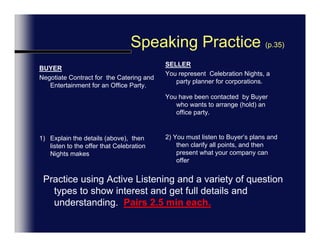
Speaking Practice (p.35)SELLERYou represent  Celebration Nights, a party planner for corporations.You have been contacted  by Buyer who wants to arrange (hold) an office party.You must listen to Buyer’s plans and then clarify all points, and then present what your company can offerConfirm throughout your talkBUYERNegotiate Contract for  the Catering and Entertainment for an Office Party.Explain the details (above),  then listen to the offer that Celebration Nights makesCheck for understanding throughoutPractice using Active Listening and a variety of question types to show interest and get full details and understanding.  Pairs 2.5 min each.
***Break***
Negotiating PracticeTwo People (Pair Work, P. 36)Each student should present initially and the other student should (1) listen, (2) understand, (3) clarify, and then (4) summarizeYou are graded on the number of clarifications youmake2.5 Minutes each, 5 minutes per pair – In class.No exceptions.
Next Session: Midterm Review (Ch. 1-4)Review Carefully Opening “Objectives” for each ChapterPrepare questions on any terms you don’t understandReview: Negotiation Introduction: ”Setting the Agenda” Ch 2 & Page 71.Fully understand why we  have this structure (organization)Review: Establishing PositionsUnderstand what your position is and your opponentsEffective questions and active listening:  How to learn your opponents position.Review: Clarifying Positions Understand how this helps define the specifics and also push’s your opponent to reveal their important issues & Positions
Midterm ReviewWhat is a position?Your opening and later changing offers (price, delivery, specifications, preferences, work hours, location, benefits, etc).Holdback:  The difference between your opening position and your bottom line. Gives you room to negotiate. (p. 24, No. 1)Best way to get feedback on your position?  Say what you want, and also ask questions to get verbal and non verbal signals from customer or opponent (p.27, No. 3)Effective Listening: increase your understanding of the other sides needs, wants or capabilities (features, benefits, budget)
Review (Continued)Essay Question:What is the purpose of an introduction?Reduce Stress (everyone knows what will happen and when)Maintain order, structure (avoid Karen’s problem)Provide a good setting to cooperate and find good solutions.10 Questions, Multiple Choice
Feedback	Was anything unclear?  Fuzzy?Office Hours: Monday       1:00-3:00PMWednesday 3:00 – 5:00 PMStop by my office:   M615B  orEmailOr, write it down and leave it at the desk…                …I will address it next time we meet.
Chapter 5: Managing ConflictAfter the mid-term ExamReview Video ContextReview Video Transcripts Unit 5For the next class meeting:Plan for Negotiating Practice No. 1Plan for Speaking Practice No. 6
Managing Conflict*****Session 10****
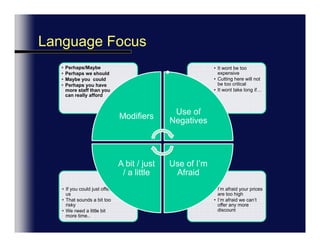
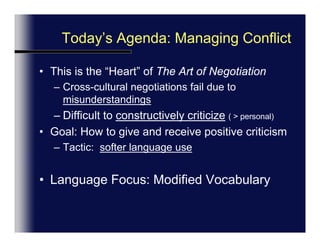
Today’s Agenda: Managing ConflictThis is the “Heart” of The Art of NegotiationCross-cultural negotiations fail due to misunderstandingsDue to our Inability to constructively criticize( > less personal)Goal: How to give and receive positive criticismOne Tactic:  softer language useLanguage Focus: Modified Vocabulary
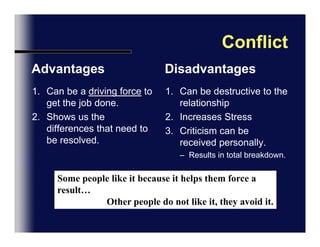
ConflictAdvantagesCan be a driving force to get the job done.Shows us the differences that need to be resolved.DisadvantagesCan be destructive to the relationshipIncreases StressCriticism can be received personally.Results in total breakdown.Some people like it because it helps them force a result…Other people do not like it, they avoid it.
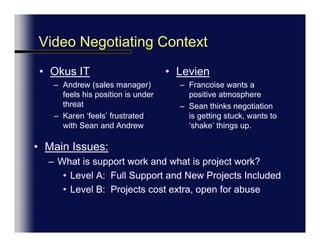
Video Negotiating ContextOkus ITAndrew (sales manager) thinks his position is under threatKaren ‘feels’ frustrated with Sean and AndrewLevienFrancoise wants a positive atmosphereSean thinks negotiation is getting stuck, wants to ‘shake’ things up.Main Issues: What is support work and what is project work?Level A:  Full Support and New Projects IncludedLevel B:  Projects cost extra, open for abuse
 - Version 1: EN Chapter 5 Version 1.avi	- issue: logging or support work	- inexperience remark causes offense	- Sean and Francois not working as a teamVersion 2: EN Chapter 5 Version 2.avi
Sean adapts, downtones his remarks but,
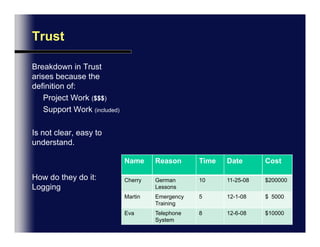
Confronts the issue, does not avoid sticky issues.Okus, Levin & TrustBreakdown in Trust arises because the definition of:     Project Work ($$$)     Support Work (included)Is not clear, easy to understand.How do they do it: Logging  -
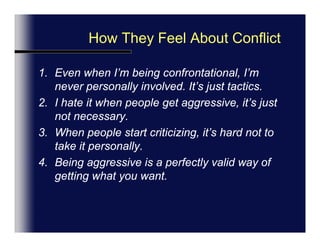
How We Feel About ConflictAGREE   --------------------------------------DISAGREEEven when I’m being confrontational, I’m never personally involved. It’s just tactics.I hate it when people get aggressive, it’s just not necessary.When people start criticizing, it’s hard not to take it personally.Being aggressive is a perfectly valid way of getting what you want.
Culture and Tactics, P. 40Discuss the four individuals negotiating styleCompare them to the people in your groupLater, tell the class which of those negotiators you most identify with and why? (which one’s are more like your group).
Language Focus: “creating options”
Modify the following remarks… p. 42We must cut the advertising budgetWe could perhaps cut the advertising budgetYou need to analyze your costs in more detailYou might check your costs in a bit more detailLook at page 32 of the documentMay I suggest you take a look at page 32?Intonation:  Pitch up, cooperative   Down = serious/negative
Modify the following…This is the worst food I’ve ever tastedThis is not the best food I’ve ever tastedDon’t be so late for classCould you be early for class?Your quotation is much too expensiveYour quotation is a bit too expensiveYour quotation is not as we hopedIntonation:  Pitch up, cooperative,   Down = serious/negative
Next Session: Speaking Practice #5 (p.43)Work in your groups (2 pairs each)Modify the following dialogue (conversation):Write your changes on paperSpecial attention to intonation (how you sound).Then either:Record your new dialogue on Mp3 orRole-play in classBring to class next session, we will all listen or watch.
And, Conflict Negotiation : Speaking Practice #6 (p.43)Student AManager: ProductionHave large quantity of extra components (parts) to make your productWhy are you paying for storage you don’t need?Customer cancelled and you don’t need these extra partsStudent BManager: PurchasingYou order parts based on production scheduleYou always order extra because there are problems with delivery and it takes a long time to arrive“Down-tone”  the language to be more positive
Next Session:We review your two exercises.Remember you must work outside of classWrite your answers down and either:Record your voice for #5  orRole-play live in classSee me if you have any questions.
Managing ConflictDowntoningYour Language
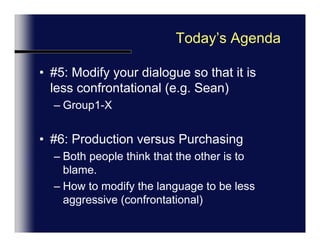
Today’s Agenda#5: Modify your dialogue so that it is less confrontational (e.g. Sean)Group1-X#6: Production versus PurchasingBoth people think that the other is to blame.How to modify the language to be less aggressive (confrontational)
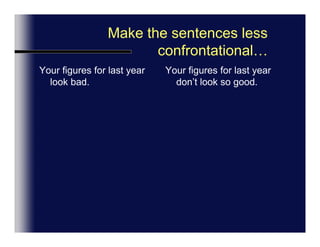
Make the sentences less confrontational… #5Your figures for last year look bad.Mp3 recordings  orRoleplayYour figures for last year don’t look so good.Group X->1
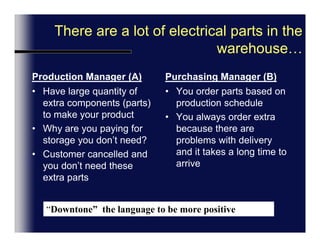
There are a lot of electrical parts in the warehouse…#6Production Manager (A)Have large quantity of extra components (parts) to make your productWhy are you paying for storage you don’t need?Customer cancelled and you don’t need these extra partsPurchasing Manager (B)You order parts based on production scheduleYou always order extra because there are problems with delivery and it takes a long time to arrive“Downtone”  the language to be more positive
Production ManagerPurchasing Manager
Internal Negotiation – Personnel ProblemRoles:Commercial DirectorMarketing ManagerHuman Resources DirectorSales ManagerPublic Relations ManagerFemale staffer is complaining that she was discriminated against for a department promotion.Goal: Avoid legal suit, decide on alternative solution to make everybody happyP. 44, group work (5 people)
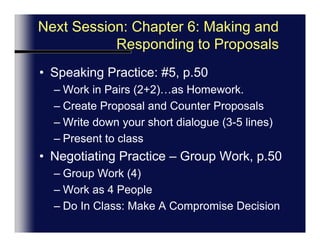
Next Session:Chapter 6: Making and Responding to ProposalsRead pages: 46, 47, 49Read carefully: “Video Negotiating Context”Read carefully: Video Transcript Unit 6Do: Pair Work,  #7, p. 47, 3  minute limit
Remember: Participation is 34%Any questions????Visit my office anytime:#M615BemailOffice Hours:  Monday       13:10 – 15:20Thursday	 15:20 – 17:10
Business NegotiationsMaking and Responding to Proposals
Proposals & CounterproposalsLast session:Focus was Down-toning Language, Constructive Criticism (managing conflict positively)This session:Reduce the gap between your position and the other side’s positionHow: by making proposals and counter proposalsSkills to learn are:Persuasive proposalsAsserting pressure 
Problem:  Levin and Okus are Stuck!Level A and Level B Support OffersLevin does not like either optionWhich side should now make a new proposal?Normally the supplier (seller) does this.The buyer has the advantage since they do not have to reveal anything about their position.However, the team that starts the next step sets the direction and range of possibilities.
Video Negotiating ContextLevienFrancoise looking for a solution to the ‘logging’ problemSean: Not happy about ‘logging’. Wants Okus to offer a better solution.Okus ITKaren makes a new proposal to break the deadlock.Andrew assistsCurrent Issue (Deadlocked Negotiations): Support levelsLevel A:  Full Support Package (Complete) includes New Projects – Expensive but easy to ManageLevel B:  Cheaper, Monthly Invoice includes regular support but no new project work; Projects logged and billed extra …”An open bar tab”
Proposals“Win-Loose Style of Sean”EN Chapter 6 Version 1.aviDoes Sean let Okus explain their proposal?EN Chapter 6 Version 2.aviFocus on exchange between Francois and Karen – solution oriented
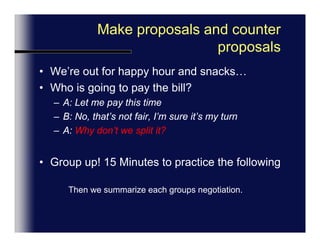
Make proposals and counter proposalsWe’re out for happy hour and snacks…Who is going to pay the bill?A: Let me pay this timeB: No, that’s not fair, I’m sure it’s my turnA: Why don’t we split it?Group up! 15 Minutes to practice the following		Then we summarize each groups negotiation.
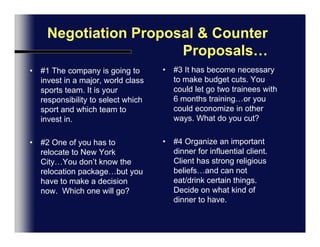
Negotiation Proposal & Counter Proposals…(p.47)#3 It has become necessary to make budget cuts. You could let go two trainees with 6 months training…or you could economize in other ways. What do you cut?#4 Organize an important dinner for influential client. Client has strong religious beliefs…and can not eat/drink certain things. Decide on what kind of dinner to have.#1 The company is going to invest in a major, world class sports team. It is your responsibility to select which sport and which team to invest in.#2 One of you has to relocate to New York City…You don’t know the relocation package…but you have to make a decision now.  Which one will go?Follow the problem solving model of Karen & Francois, p. 93 transcript.
***Break***..\..\VA - Cafe Brazillia - The Cream Of Latino Lounge (\102 - Panaphonic - Sambastique.mp3
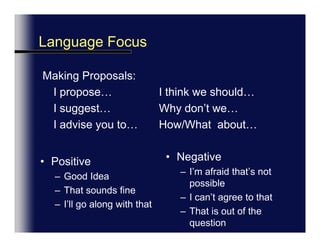
Language FocusMaking Proposals:	I propose…		I think we should…	I suggest…		Why don’t we…	I advise you to…   	How/What  about…NegativeI’m afraid that’s not possibleI can’t agree to thatThat is out of the questionPositiveGood IdeaThat sounds fineI’ll go along with that
Roleplay
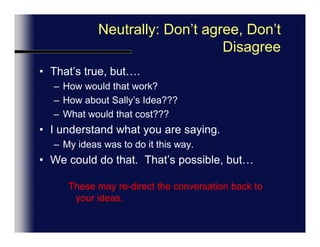
Neutrally: Don’t agree, Don’t DisagreeThat’s true, but….How would that work?How about Sally’s Idea???What would that cost???I understand what you are saying….My idea was to do it this way.We could do that.  That’s possible, but…These may re-direct the conversation back to your ideas.
Next Session:Chapter 7: BargainingRead pages: 52, 53, 54, 56Do p. 56 #4 & p. 57 # 5.Read carefully: “Video Negotiating Context”Read carefully: Video Transcript Unit 7  Role-play:  Group Work (4) Page 50-51    (All Groups)  5 Minute Time LimitFull Cumulative Grading (Chapter’s 1-6)
Now, we start to Think in English…Any questions????Visit my office anytime:#M615BOffice Hours:  Monday       13:10 – 15:20             Thursday     15:20 – 17:10
Business NegotiationsBARGAINING
BargainingLast session:Focus was Proposals & Counter Proposals to reduce the gap between positions…This session:Keep a positive communication style while finalizing remaining differences.How: Keep the Big Picture in Mind (Objective)Skills to learn are:Conditional language:  “If you do something…. then…”Hypothetical language: “ We would  be able to give a discount if…”
Problem:  Levin is Worried about People!Levin does not want to fire employeesCultural Styles are DifferentSean & Andrew, for example. Think Sharon & ThorAn open mind helps to think positively, accepting new ideas in order to reach an agreement  versus:  No.Outsourcing:  The contractor (Okus) might be the new employer of the staff that work at the customers offices(Levin)
Video Negotiating ContextLevienFrancoise wants to save her staff’s jobs…Sean: Worried about the Works Council (Employee Union)Okus ITAndrew thinks he is giving up to muchKaren originally planned to only hire two of Levin’s staff.Current Issue:Staffing Okus offers to hire only two of Levin’s Staff: Manager & EngineerRemaining work projects would be done by Okus UK Staff
Bargaining“NO!”What is the focus under pressure:     What they can do..or     What they cannot do?What should they do?Version1: EN Chapter 7 Version 1.aviVersion2: EN Chapter 7 Version 2.avi
Example Bargaining IssuesDiscount: 2% in 10 Days, 0% 30days.Delivery Time: Now, Fast, Late, Specific DateDelivery Location:  Your office, other place,  customer paysPayment Method:  Credit card, Wire, CashQuality: defect rate, failure rate, customer complaints
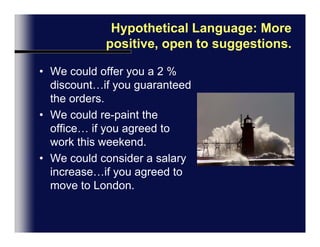
Hypothetical Language: More positive, open to suggestions.We could offer you a 2 % discount…if you guaranteed the orders.We could re-paint the office… if you agreed to work this weekend.We could consider a salary increase…if you agreed to move to London.
ConditionalPressure:  If…Then.(I’m afraid) we will have to cancel the contract…unless you reduce your fees.We will have to choose another supplier…if you can’t make us a better offer.That looks like the end of the negotiation…unless you can make a concession
ExercisesP. 56, No 4Use the ideas to make offers and attach conditions.Offer;  Extend the contract     Condition: 1% DiscountWe could extend your contract as long as you offered us a 1% discount.P. 57, No 5Complete the dialogue using expressions from Language Focus (p. 56).We seem to have reached a stalemate. Were not going to  progress _________ you can make us a better offer.
Negotiation Practice: BargainingRoleplay:  Group Work (4) Page 50-51 (All Groups)  5 Minute Time Limit
City CouncilCommunity Group
For Final Exam:  Negotiation Practice, p.59Training Company  negotiating with a large company for sales and management training.Customer wants a discount for volume.     Two Suppliers    &   Two Customers5 minute negotiation, prepare written outline only – give to professor prior to role-playMeasurement: Use of Structure &# of times you correctly use Language Focus phrases from all chapters
Next Session:  Ch. 8 ConclusionRead: Video Negotiating ContextLanguage Focus Speaking iPractice: #6 p. 65DO:  Prepare your Negotiation Outline for the Final Exam & Submit draft to instructor.
Now, we start to use short outlinesAny questions????Visit my office anytime:OrEmailOffice Hours:  Monday       13:10 – 15:20   Thursday     15:20 – 17:10
Business NegotiationsNegotiation Conclusion
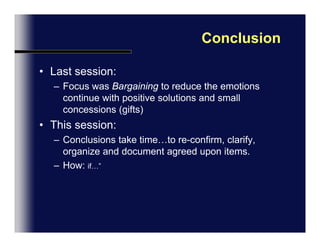
Conclusion Last session:Focus was Bargaining to add some pressure, continue with positive solutions and offer small concessions (gifts)This session:Conclusions take time…to re-confirm, clarify, organize and document agreed upon items.Think about the future (this is only the beginning)
Challenge:  The Ending Sets the RelationshipThe Progress we made duringthe difficult negotiations are still at risk until the contract is signed.Summarizing is Critical to:Re-Confirm Agreed-upon ItemsClarify all open issues (& set at time to resolve)Suggest a pleasant (positive, memorable)  departureNote: Culture often sets negotiation styleWin-Win Objectives: everybody benefitsWin-Loose still exists due to competition for resources, profits, politics, cultural preference, etc.
Video Negotiating ContextLevienFrancoise has a dinner engagement, needs to goSean feels he has a great deal, does not see any more critical decisions/issues to solveOkus ITAndrew Keen on getting homeKaren feels there are more issues to solveFinal Issue:Staffing has been decided, but…Their remain questions about exactly which staff will be hired and…What is the amount of the special “Contingency Fund” to be used for special projects
ConclusionEN Chapter 8 Version 1.avi#1 Focus on Francois, whatdoesshe do? Worry about?#2  Focus on Karen and Andrew, are theyworking as a team?EN Chapter 8 Version 2.avi#1 Focus on Francois: Make a list of the wayssheendsdifferently.#2 Videostop’sreview.Summarizes » So we have agreed an initial 1 yrcontractAgrees on Action: Wewillmeetagainhere to interviewApologizes for having to leavequickly“Leaving without a good understanding….”How will this affect the long term relationship?What should they do?
Language focus exercises.Complete the concluding phrases…(p. 64)Let me just_____ the main points.I think that just about ____ it.It ___ say how much we appreciate your contribution.Does that accurately  ____  what we agreed during the meeting?Could you  _____me a written proposal before the next meeting?I ____we meet later in the week.As ____ payment ___, there are still some _____ issues to resolve.
Language focus exercises.Discuss the following tactics Which do you agree with and why? What other advice would you give…(p. 62)Never negotiate a single issue.Always bargain from a position of strength.Don’t let your negotiation partners feel too comfortable.Identify and reinforce the weak points in their argument.Never show  your real feelings.Keep your strongest cards up your sleeves.
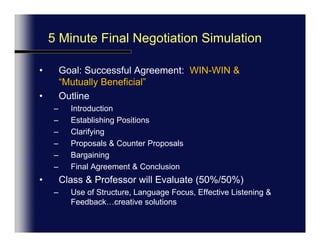
Final Exam Preview:5 Minute Final Negotiation SimulationGoal: Successful Agreement:  WIN-WIN &  “Mutually Beneficial”StructureIntroductionEstablishing PositionsClarifyingProposals & Counter ProposalsBargainingFinal Agreement & ConclusionClass & Professor will Evaluate (50%/50%)Use of Structure, Language Focus, Effective Listening & Feedback…creative solutions
Negotiation OutlineChapter 1Preparation (p.68)Objectives of the negotiationBest & Worst Case, Bottom LineStrategies: Best order to discuss issuesLikely “Stick Points (problems)”Concessions (advance preparation)What do we know about the other teamIntroduction (p.69)Names, Roles, Titles  (special knowledge/skills)Purpose of Meeting/NegotiationChair of the meeting, Minute (note) takerQuestions (how to manage)
OutlineAgenda (p.71)How to Start/FinishHow long to meet?Meal arrangements (lunch and/or dinner)Travel needs (hotel, airline confirmation, taxi)Agenda itemsTopic  1Topic 2…www.slideshare.netTunghai Negotiation Checklist
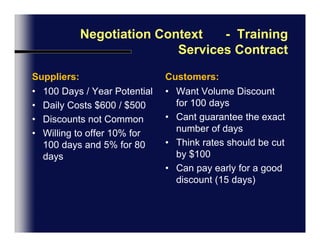
Chapter 7 – Page 59:  Training Services AgreementSuppliers:100 Days / Year PotentialDaily Costs $600 / $500Discounts not CommonWilling to offer 10% for 100 days and 5% for 80 daysCustomers: Want Volume Discount for 100 daysCant guarantee the exact number of daysThink rates should be cut by $100Can pay early for a good discount (15 days)
Resources:  Everything is in Your TextLanguage FocusVocabularyExamplesStructure & Outline is KeyVideo TranscriptsSpecific PhrasesCulturally SensitiveUnderstand context & Meaning
Ending…At the end of a meeting we often make a remark about the meeting…(p. 64)“That was a very positive start.  I look forward to our next meeting”This meeting was extremely fruitful…Today’s negotiation was very useful…So to end our class….Today’s class________ (stimulant).Todays class ________ (help)
FeedbackAny questions????Visit my office anytime:#M615BemailOffice Hours:  Monday       13:10 – 15:20		   Thursday    15:20 – 17:10
Questions?
Business Negotiations(FinalExam)Negotiation Simulation
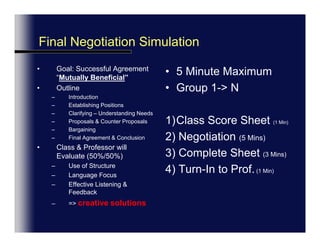
Final Negotiation Simulation	Goal: Successful Agreement “Mutually Beneficial”OutlineIntroductionEstablishing PositionsClarifying – Understanding NeedsProposals & Counter ProposalsBargainingFinal Agreement & ConclusionClass & Professor will Evaluate (50%/50%)Use of StructureLanguage FocusEffective Listening & Feedback=>creativesolutions5 Minute MaximumGroup X-> N1)	Class Score Sheet (1 Min)2) Negotiation (5 Mins)3) Complete Sheet (3 Mins)4) Turn-In to Prof. (1 Min)

Effective Negotiations [BE II Course Lecture]

  • 1.
    Steve VarelaProfessor ofInternational Business© 2009 – All Rights ReservedEffective Negotiations
  • 2.
    WELCOME!!!!!!      “Tell me and I'll forget; show me and I may remember; involve me and I'll understand.” -Chinese Proverb
  • 3.
    Business English NegotiationsWelcomeInstructorIndexCard: Number + English_Name + EmailPersonal Info, work experience, academic focus, goals for this course, travel/overseas experience, sales and/or negotiation experience.Individual Student IntroductionsToday’s Agenda: Preview of CoursePair’s and Group’sQuestion of the dayChapter 1Textbook: Effective Negotiations by Jeremy Comfort,Oxford University Press , 2007
  • 4.
  • 5.
    A word onActivity Based LearningLeft side is Old World method, Didactic.Right is CollaborativeLearn from each other Students are more active…understand more“Tell me and I'll forget; show me and I may remember; involve me and I'll understand.” -Chinese Proverb
  • 6.
    Course Preview: AChapter Every Two SessionsPreparing the “Ground” (Introductions, goals, place)Setting the Agenda (Negotiate what you will negotiate)Establishing Positions (What you want or have)Clarifying Positions (Check understanding)Managing Conflict (How to criticize)Proposals (Creating solutions)Bargaining (Exerting pressure)Conclusion& Agreement (Follow-up, implementation)
  • 7.
    Typical Chapter Activities(8)Session 1: Topic Introduction & DVD Clip International Culture & Tactics Language FocusSession 2: Negotiating Practice Group’s (4) and Pair’s (2)
  • 8.
    Evaluation CriteriaActivity BasedLearning…Participation is key to Success!34% of final Grade depends on Class ParticipationMidterm Essay or Simulation (Chapter 4)33% of Final Grade6-8 Sentences or 5 minutesFinal Exam – Negotiation Simulation5 Minutes Video Taped / Analysis33%
  • 9.
    Question of theDay (Graded Exercise)At the start of each chapter, one group answers the first two communication skills questions at the start of the class.List question on blackboard & present your answer to the class. 5 Minute Limit.Have ready before the class begins.i.e. Chapter 1 = Group 1, Chapter 2 = Group 2…
  • 10.
  • 11.
  • 12.
    Chapter Introduction QuestionGroup1 Present the Answer/Commentary to the First 2 questions of Chapter1. … Group1.
  • 13.
    Preparing the GroundAnegotiation is a meeting in which both parties need each other’s agreement to reach a specific objective.Various Types of NegotiationsInternal / ExternalLong / ShortFormal / InformalWhat is your Goal?
  • 14.
    Video Negotiating Context: Preparing the GroundOkus ITAndrew is the Export Sales Manager, He made the initial contact and knows SeanKaren is the project manager. She made the contract specifications and this is her first international negotiation. She is anxious.LevienFrancoise is the IT Manager, she is ready to be promoted to Logistics Head. She is Keen that her team (employees) are protected.Sean: from Levin’s Chicago office. He was sent to Brussels to develop Levin’s procurement policySituation: Andrew and Karen have arrived at Levin’s Brussels office to meet Françoise and Sean
  • 15.
    Preparing the GroundVersion1: Watch their body language with no sound? What problems do you expect?Version 2: Body language… Introduction differences?EN Chapter 1 Version 1.aviEN Chapter 1 Version 2.avi
  • 16.
    Preparing for aBusiness Negotiation (p.68)Objectives: best, worst, bottom lineStrategies: main areas, sticking points, best order for discussion, concessionsRoles: who is responsible, skills of team members, the other teamCommunication: maintain positive communication, note taking, who asks questions? Who is the Chair?
  • 17.
    Chapter 1: Preparingthe “Ground”Culture and TacticsWork in Pair’sRead “Task Oriented” or “People Oriented” Present a Summary to your partner (pair)15 Minutes….
  • 18.
    Chapter 1: HowDo You See Yourself?iI start my day with a list (to do)ii I start my day with a chat (talk)iI don’t let personal feelings influence decisionsii I Consider human angle firsti Friendship not important if good job at workii Important to like people I work with
  • 19.
    How Do YouSee Yourself? (p.2)i Meetings only purpose is to get things doneii Meetings are opportunities to develop relationshipsiI fell end of day frustration if my list not finishedii Feel “low” (sad) if have not got on with colleaguesScoring: 2 Points for every i 0 Points for every ii, 1 Point for every neither
  • 20.
    What’s your score?6-10Points = Task-Oriented4-5 Points = Balanced0-3 Points = People – OrientedNeither is betterLets us know who we are and what to plan for.
  • 21.
    Language FocusFormal WelcomingOn behalfof…I’m very glad to welcome youIt’s a pleasure to see you hereIntroductionsThis is…He’s in Charge of… He’s responsible for...He is our President/Director In-FormalWelcome toThank you for comingIt’s nice to be hereLet me introduce you to…Have you met…?
  • 22.
    Language Focus, (p.11)FormalIn-FormalHoware you?Great to see you again!Starting the NegotiationI was wondering if I could start by saying…..Were short of time, so lets get startedWe’ve got a very full agenda, so perhaps we’d batter get down to business.GreetingsHow do you doNice to Meet YouSmall TalkDid you have a good trip?How was your flightIs this your first visit to…
  • 23.
    Next Session:Practice Negotiating!!!UseChecklist P. 68, #9 to prepare the following:ObjectivesStrategiesRolesCommunicationSpeaking Practice #4 in class, p.12Pair Work & Group Work 1, Neg. 1 & 2, p.13
  • 24.
  • 25.
  • 26.
    Negotiation #1 (p.13)Groupup…work in pairs (2)Use checklist to prepare and then negotiate the sale/purchase of the car15 minutes.
  • 27.
    Group Work 1:Negotiation 1Two want a ban on smokingTwo want free smokingUse Checklist and NegotiateBe prepared to discuss what happened to the class.15 minutes.
  • 28.
    For next Session…Chapter2: Setting the AgendaRead: pages 16-20.Read: Video Transcripts Unit 2 (version 1 & 2)Do Questions:7 & 1on p. 17, 2 p. 18, 3 p. 19, 4 p. 20Review: Negotiating Practice, Negotiation #1, p.22Group 2 does Q1 “Chapter Introduction Chapter”
  • 29.
    FeedbackAny questions????Visit myoffice anytime:#M615B OR email.
  • 30.
    Welcome Back!Chapter 2:Setting the Agenda
  • 31.
    Question of theChapterChapter2 Present the Answer/Commentary to the First question of the Chapter (2). …Group2.
  • 32.
    Setting the AgendaSomebasic negotiations have only one point of discussionOthers are more complex…But all need a sense of direction, a clear understanding of the objectives and a plan…often, the Host is responsible for Chairing or controlling the negotiation.
  • 33.
    Video Negotiating Context: AgendaOkus ITAndrew ready to present opening presentationKaren expects Francoise to set the agendaLevienFrancoise worried about protecting her staff’s jobsSean: wants to establish a clear and strong negotiating positionMain Issues (aspects): Who is in control,who is Chairing here???
  • 34.
    Video: Roles ofChairperson, Agenda & ProcedureVersion 1What do you expect to happen in the first stage of the negotiation?EN_Chapter_2_Version_1a.aviWhat went wrong?Now, half focus on Levien side other half on Okus sideEN_Chapter_2_Version_1a.aviVersion 2EN_Chapter_2_Version_2.aviHow about Francois’s new performance?Now, lets identify the checklist steps…EN_Chapter_2_Version_2.avi
  • 35.
    Setting the Agenda(p.71)Introduction: Who present? Roles?Purpose/Objectives: Shared Expectations and Critical IssuesAgenda Structure:How to Start and Finish the meeting?Procedure/Process: Will there be a Chair? Questions at end/during? Minutes?
  • 36.
    Chapter 2:Setting the AgendaCulture and TacticsWork in Pair’sRead “Universalist” or “Particularistic” Where do you fit? More Univ. or Part.?What are advantages of each?UniversalisticOne correct wayFollow same procedure alwaysParticularisticAdapt to each situationProcess is customized
  • 37.
    What are theAdvantages and Disadvantages of each?ParticularisticUniversalistic
  • 38.
    Identifying Working Cultures(Which is Which?)Crantons Engineering: old fashioned engineering firm run along traditional linesGilson, Merritt & Partners: Management Consulting, young and dynamicATZO: Large chemical multinational; merger of German and Italian companies; Bureaucratic, UnresponsiveCOMinternational: Medium sized financial services firm; reputation for financial management and control systems. Young CEO
  • 39.
    Your Working/Studying CultureExperienceUniversalisticAt your job/school, which style is commonly used?Examples???Particularistic
  • 40.
  • 41.
    Language FocusObjectivesWere heretoday to…The main objective/purpose of today’s..Were looking to achieveAgendaWe’ve drawn up an agendaLets just run through the agendaThere are a number of items on the agendaI’d like to take that firstWe’ve put that Last
  • 42.
    TimingThat gives ustwo hoursIt will take two hoursIt won’t be longI need to be away by…Roles …is going to sit in…is going to take the minutes…would like to say a few words…you’re going to give us a presentationProcedureWe’ll deal with that ….last/first/tomorrowWe’ll go round the tableWe’ll have a question and answer at the endWe can table that for discussion later
  • 43.
    Speaking Practice (#4,p.20)Group up!Do the following in your groups…Present your introduction to the class (2 minute introductions)Use the Negotiation Checklist (p.71) to organize your introduction and agenda talkUse tips from Language Focus for your vocabulary15 Minutes to prepare.
  • 44.
    Speaking PracticeImportant: Usea structured introductionAct as a Chairman, Chairwoman.Show Leadership.Practice in your group…Afterwards, we will present to class ---with Gusto!
  • 45.
    Presentations….Group 1-X2 Minutemaximum time Introduction only
  • 46.
    For next session…Chapter2: Negotiation PracticeRe-Read pages 16-20.Review Language Focus examplesReview: Negotiating Practice, Negotiation #1 & 2 p.22Be prepared to present to classyour2 minute Introductions onlyto No’s. 1 & 2. * Not a full negotiation- just introduction.
  • 47.
    FeedbackAny questions????Visit myoffice anytime or email:#M615BOffice Hours: Monday 13:10 – 15:20Wednesday 15:20 – 17:10
  • 48.
  • 49.
    Session AgendaVocabulary exercise:P. 19 No. 3Complete Speaking Practice Session 2Negotiation Practice, P.22, No.1 or 2.Everybody Participates!
  • 50.
    Negotiation SimulationNegotiating Practice,P. 22, Negotiation # 12 Buyers: Toy manufacturer2 Sellers: Training consultantsBe prepared to present your introduction to class with Gusto!2 minute maximum *Only the introduction, not a full negotiation
  • 51.
  • 52.
    Introduction SimulationNegotiating Practice,Page 22, # 1 or 22 Buyers2 SellersNegotiate in Pairs for 30 MinutesTake notes as to what happened and whenBe prepared to present your results to classEx.Introduction Structure Names Purpose Roles Logistics Timing Proposal Issue Resolution
  • 53.
    Negotiation Introduction No.1Groups X-1Saroyan-Arttech: Toy Manufacturer seeks management training programConsultancy: Sent materials and was invited to make a presentation on your training services.
  • 54.
    Negotiation Introduction #1,p. 22Group N – 1…Buyers (2)Sellers (2)3 Minute Maximum NegotiationSimulationFocus on: Introduction Structure.
  • 55.
    Negotiation Introduction #2Futura: Large Manufacturing needs packaging materialsDTX Packaging, Vendor of packaging material.Groups 1-X, 3 minutes, alternate speakers
  • 56.
    For next session…Chapter3: Establishing PositionsRead: Pages 24, 25, 27, 28& 29Read: Unit 3 Video TranscriptsReview Culture and Tactics StylesIndividualist & CollectivistDo p. 25-26-27 #’s 1, 2 &3Review/Practice Language FocusGroup 3: Present your Chapter Question before class starts
  • 57.
  • 58.
    Today’s Agenda: EstablishingPositionsDilemma of PositionsPositive and Open vs. Room to Bargain laterHold Backpermits a discussion ( & creativity)Goal: Find out what they think about your offerThrough Effective Feedback & listeningCulture and Tactics: Direct vs. IndirectLanguage Focus: Vocabulary tips
  • 59.
    Video Negotiating ContextOkusITAndrew presents key aspectsKaren AssistsLevienFrancoise expects key aspectsSean: Chicago waiting for staffing info.Main Issues (aspects): Staffing levels: Take all Levin IT Staff?Support levelsLevel A: Full Support and New ProjectsLevel B: Full Support, Projects Cost Extra
  • 60.
    ClipVersion 1: NoSoundEN Chapter 3 Version 1.aviwatch body language both presenter and audienceVersion 1: SoundEN Chapter 3 Version 1.avi What should Andrew do? Start/stopVersion 2: No SoundEN Chapter 3 Version 2.avi watch changes note style Pauses to check for audience agreement, confirmationAndrew’s Presentation Style…How to Improve?
  • 61.
    Language Focus…Asking forand giving feedback(p.27)Group Up.Each Group pick a section and write on a piece of paper, add missing words or put each phrase in a short two sentence dialogue.Each person should do only one phraseWrite you Name & Answers on paper, give to instructor – we will review a few in class.15 Minutes.
  • 62.
    Culture and TacticsDirectCommunicationSay what you thinkFew wordsPractical, efficientIndirect CommunicationConcern about feelingsDamage relationshipSave face / time to think & respondAndrew frustrates Sean (too slow to get tothe point)“I’m interested to know what your position on our staff is?”
  • 63.
    Direct versus IndirectWhichstyle (direct or indirect) is yours?Which style do you like?Which is more effective? Why?
  • 64.
    Group Exercise: Cultureand TacticsWhat is the more direct question or statement behind these sentences? (Page 25, #1)Change sentences to Direct StyleDo A, C, E Indirectness is achieved by making questions and statements vague and not specific. (Page 26, #2)Change sentences to Indirect StyleDo B & DWrite you Name & Answers on paper, give to instructor – we will review a few in class.15 Minutes.
  • 65.
    For next session…SpeakingPractice, p.28 #5, G1=a, G2=b, G3=c…Work in Groups (2+2)Create brief introductions for situation ( 2 mins.)Invite feedback oftenPractice and then change rolesNegotiating Practice, p.29 Group Work 2Groups choose a topicPrepare presentation to sell your product (5 mins.)Invite feedback from other group membersClass asks questions
  • 66.
    Feedback Was anything unclear? Fuzzy?Stop by my office: M615B orEmail: svarela@thu.edu.twOr, Write it down and leave it at the desk… …I will address it next time we meet. Thank you.
  • 67.
  • 68.
    SessionAgendaSpeaking Practice p.28Workin Pairs.Take turns to make brief introductions to the following negotiation situations.Make sure to invite feedback as often as possible.Your partner should listen and respond to your presentation. Negotiation Practice p.29Work as a Group.Prepare a short presentation to sell your version of the product, service or idea.Integrating techniques and language which involve the audience (customer).Rest of class are customers. Ask questions.
  • 69.
    Next Session: ClarifyingPositions (Ch.4)Read Carefully “Video Negotiating Context” p.30Video Transcript Unit 4 p. 92Study pages 30-34Do Questions:P.31 #8P.32 #1 & 2
  • 70.
    Questions?Stop by officeEmailOfficeHours: Monday 1:10 – 3:20 PMOffice Hours: Thursday 3:00 – 5:00 PM
  • 71.
  • 72.
    Clarifying Your Position’sLastsession:Focus was Presenting your position and Interactive Communication using QuestionsThis session:Focus is on Clarifying: making sure we really understand each otherSkills to understand are:Good ListeningEffective Questioning
  • 73.
    The ProblemMost ofus do not communicate very well…We start with our own ideasWe wait for time to tell our ideasWe usually have already made up our minds, disagree or ignore the other side.We should be actively listening.An open mind to understand the other party better,Develop practical and beneficial solutions,Earn respect from the other team.
  • 74.
    Video Negotiating ContextOkusITKaren clarifies the details of Okus’ offerAndrew assistsLevienFrancoise is worried about extra project fee’sSean: Concerned about level of support from Okus.Main Issue (aspect): Support levelsLevel A: Full Support Packageincludes New Projects (ala Club Med All Inclusive Vacation)Level B: Cheaper, Monthly Invoice include regular support but no new project work; Projects cost extra
  • 75.
    Clarifying PositionsMeeting Order?Everyonefollowing their own Ideas…Karen is not happy; she can’t get her message across.What does she need to do?
  • 76.
    Culture: Individualist vs.CollectivistGroup up!Decide weather our group is more Individualist or Collectivist10 Minutes…Then, Group X will give feedback to the class.
  • 77.
    Language KnowledgeGeneral QuestionsI’dbe interested to know more about…Could you tell me something aboutWhat exactly do you mean by…Could you be more specificConfirming phrasesSo you are sayingIf I understand you correctly…Is that clear?Does that explain it?
  • 78.
    Read “Between theLines” ask a supportive or reflective questionPage 34, number 5.
  • 79.
    Next: Speaking Practice(p.35)BUYERNegotiate a Contract for the Catering and Entertainment for a Corporate Office PartyExplain the details (above) and then listen to the offer that Celebration Nights makes.SELLERYou represent Celebration Nights, a party planner for corporationsYou have been contacted by Buyer who wants to arrange (hold) an office partyYou must listen to Buyer’s plans and then clarify all points, and then present what your company can offerPractice using Active Listening and a variety of question types to show interest and get full details and understanding. Pairs 5 min. each.
  • 80.
    Corporate Office Party(5 Minute Maximum)Buyer (Corporate Planner)Give details of Office Party Idea -Listen to optionsClarify your understanding Agreement.Seller (Celebration Nights)Introduce & Listen to customers needs.Understand, Summarize &Clarify IdeasProvide alternatives & Pricing.
  • 81.
    For next session:Negotiating PracticePair Work, p. 36Form pairs from your groups (2 people only)If 5 in a group, 2+2+2=one person does two roles)Each student choose one of the 4 situationsEach student should present initially and the other student should listen, understand, clarify, and then summarize.2.5 Minutes each, 5 minutes per pair – In class.Change Roles. GRADED Exercise.
  • 82.
    For next session:MidtermReviewConcepts from Chapter’s 3 & 4What is a positionBest way to get feedbackEffective questioningActive ListeningEstablishing your position10 Questions, Multiple Choice1 Essay question: What is the purpose of a Negotiation Introduction?5-8 Sentences.
  • 83.
    Feedback Was anything unclear? Fuzzy?Office Hours: Monday 1:00-3:00PM Thursday 3:00 – 5:00 PMStop by my office: M615B orEmailOr, write it down and leave it at the desk… …I will address it next time we meet.
  • 84.
  • 85.
    AgendaSpeaking Practice: Page35Negotiating Practice: Page 36Midterm Review (time permitting)
  • 86.
    Speaking Practice (p.35)SELLERYourepresent Celebration Nights, a party planner for corporations.You have been contacted by Buyer who wants to arrange (hold) an office party.You must listen to Buyer’s plans and then clarify all points, and then present what your company can offerConfirm throughout your talkBUYERNegotiate Contract for the Catering and Entertainment for an Office Party.Explain the details (above), then listen to the offer that Celebration Nights makesCheck for understanding throughoutPractice using Active Listening and a variety of question types to show interest and get full details and understanding. Pairs 2.5 min each.
  • 87.
  • 88.
    Negotiating PracticeTwo People(Pair Work, P. 36)Each student should present initially and the other student should (1) listen, (2) understand, (3) clarify, and then (4) summarizeYou are graded on the number of clarifications youmake2.5 Minutes each, 5 minutes per pair – In class.No exceptions.
  • 89.
    Next Session: MidtermReview (Ch. 1-4)Review Carefully Opening “Objectives” for each ChapterPrepare questions on any terms you don’t understandReview: Negotiation Introduction: ”Setting the Agenda” Ch 2 & Page 71.Fully understand why we have this structure (organization)Review: Establishing PositionsUnderstand what your position is and your opponentsEffective questions and active listening: How to learn your opponents position.Review: Clarifying Positions Understand how this helps define the specifics and also push’s your opponent to reveal their important issues & Positions
  • 90.
    Midterm ReviewWhat isa position?Your opening and later changing offers (price, delivery, specifications, preferences, work hours, location, benefits, etc).Holdback: The difference between your opening position and your bottom line. Gives you room to negotiate. (p. 24, No. 1)Best way to get feedback on your position? Say what you want, and also ask questions to get verbal and non verbal signals from customer or opponent (p.27, No. 3)Effective Listening: increase your understanding of the other sides needs, wants or capabilities (features, benefits, budget)
  • 91.
    Review (Continued)Essay Question:Whatis the purpose of an introduction?Reduce Stress (everyone knows what will happen and when)Maintain order, structure (avoid Karen’s problem)Provide a good setting to cooperate and find good solutions.10 Questions, Multiple Choice
  • 92.
    Feedback Was anything unclear? Fuzzy?Office Hours: Monday 1:00-3:00PMWednesday 3:00 – 5:00 PMStop by my office: M615B orEmailOr, write it down and leave it at the desk… …I will address it next time we meet.
  • 93.
    Chapter 5: ManagingConflictAfter the mid-term ExamReview Video ContextReview Video Transcripts Unit 5For the next class meeting:Plan for Negotiating Practice No. 1Plan for Speaking Practice No. 6
  • 94.
  • 95.
    Today’s Agenda: ManagingConflictThis is the “Heart” of The Art of NegotiationCross-cultural negotiations fail due to misunderstandingsDue to our Inability to constructively criticize( > less personal)Goal: How to give and receive positive criticismOne Tactic: softer language useLanguage Focus: Modified Vocabulary
  • 96.
    ConflictAdvantagesCan be adriving force to get the job done.Shows us the differences that need to be resolved.DisadvantagesCan be destructive to the relationshipIncreases StressCriticism can be received personally.Results in total breakdown.Some people like it because it helps them force a result…Other people do not like it, they avoid it.
  • 97.
    Video Negotiating ContextOkusITAndrew (sales manager) thinks his position is under threatKaren ‘feels’ frustrated with Sean and AndrewLevienFrancoise wants a positive atmosphereSean thinks negotiation is getting stuck, wants to ‘shake’ things up.Main Issues: What is support work and what is project work?Level A: Full Support and New Projects IncludedLevel B: Projects cost extra, open for abuse
  • 98.
    - Version1: EN Chapter 5 Version 1.avi - issue: logging or support work - inexperience remark causes offense - Sean and Francois not working as a teamVersion 2: EN Chapter 5 Version 2.avi
  • 99.
    Sean adapts, downtoneshis remarks but,
  • 100.
    Confronts the issue,does not avoid sticky issues.Okus, Levin & TrustBreakdown in Trust arises because the definition of: Project Work ($$$) Support Work (included)Is not clear, easy to understand.How do they do it: Logging -
  • 101.
    How We FeelAbout ConflictAGREE --------------------------------------DISAGREEEven when I’m being confrontational, I’m never personally involved. It’s just tactics.I hate it when people get aggressive, it’s just not necessary.When people start criticizing, it’s hard not to take it personally.Being aggressive is a perfectly valid way of getting what you want.
  • 102.
    Culture and Tactics,P. 40Discuss the four individuals negotiating styleCompare them to the people in your groupLater, tell the class which of those negotiators you most identify with and why? (which one’s are more like your group).
  • 103.
  • 104.
    Modify the followingremarks… p. 42We must cut the advertising budgetWe could perhaps cut the advertising budgetYou need to analyze your costs in more detailYou might check your costs in a bit more detailLook at page 32 of the documentMay I suggest you take a look at page 32?Intonation: Pitch up, cooperative Down = serious/negative
  • 105.
    Modify the following…Thisis the worst food I’ve ever tastedThis is not the best food I’ve ever tastedDon’t be so late for classCould you be early for class?Your quotation is much too expensiveYour quotation is a bit too expensiveYour quotation is not as we hopedIntonation: Pitch up, cooperative, Down = serious/negative
  • 106.
    Next Session: SpeakingPractice #5 (p.43)Work in your groups (2 pairs each)Modify the following dialogue (conversation):Write your changes on paperSpecial attention to intonation (how you sound).Then either:Record your new dialogue on Mp3 orRole-play in classBring to class next session, we will all listen or watch.
  • 107.
    And, Conflict Negotiation: Speaking Practice #6 (p.43)Student AManager: ProductionHave large quantity of extra components (parts) to make your productWhy are you paying for storage you don’t need?Customer cancelled and you don’t need these extra partsStudent BManager: PurchasingYou order parts based on production scheduleYou always order extra because there are problems with delivery and it takes a long time to arrive“Down-tone” the language to be more positive
  • 108.
    Next Session:We reviewyour two exercises.Remember you must work outside of classWrite your answers down and either:Record your voice for #5 orRole-play live in classSee me if you have any questions.
  • 109.
  • 110.
    Today’s Agenda#5: Modifyyour dialogue so that it is less confrontational (e.g. Sean)Group1-X#6: Production versus PurchasingBoth people think that the other is to blame.How to modify the language to be less aggressive (confrontational)
  • 111.
    Make the sentencesless confrontational… #5Your figures for last year look bad.Mp3 recordings orRoleplayYour figures for last year don’t look so good.Group X->1
  • 112.
    There are alot of electrical parts in the warehouse…#6Production Manager (A)Have large quantity of extra components (parts) to make your productWhy are you paying for storage you don’t need?Customer cancelled and you don’t need these extra partsPurchasing Manager (B)You order parts based on production scheduleYou always order extra because there are problems with delivery and it takes a long time to arrive“Downtone” the language to be more positive
  • 113.
  • 114.
    Internal Negotiation –Personnel ProblemRoles:Commercial DirectorMarketing ManagerHuman Resources DirectorSales ManagerPublic Relations ManagerFemale staffer is complaining that she was discriminated against for a department promotion.Goal: Avoid legal suit, decide on alternative solution to make everybody happyP. 44, group work (5 people)
  • 115.
    Next Session:Chapter 6:Making and Responding to ProposalsRead pages: 46, 47, 49Read carefully: “Video Negotiating Context”Read carefully: Video Transcript Unit 6Do: Pair Work, #7, p. 47, 3 minute limit
  • 116.
    Remember: Participation is34%Any questions????Visit my office anytime:#M615BemailOffice Hours: Monday 13:10 – 15:20Thursday 15:20 – 17:10
  • 117.
    Business NegotiationsMaking andResponding to Proposals
  • 118.
    Proposals & CounterproposalsLastsession:Focus was Down-toning Language, Constructive Criticism (managing conflict positively)This session:Reduce the gap between your position and the other side’s positionHow: by making proposals and counter proposalsSkills to learn are:Persuasive proposalsAsserting pressure 
  • 119.
    Problem: Levinand Okus are Stuck!Level A and Level B Support OffersLevin does not like either optionWhich side should now make a new proposal?Normally the supplier (seller) does this.The buyer has the advantage since they do not have to reveal anything about their position.However, the team that starts the next step sets the direction and range of possibilities.
  • 120.
    Video Negotiating ContextLevienFrancoiselooking for a solution to the ‘logging’ problemSean: Not happy about ‘logging’. Wants Okus to offer a better solution.Okus ITKaren makes a new proposal to break the deadlock.Andrew assistsCurrent Issue (Deadlocked Negotiations): Support levelsLevel A: Full Support Package (Complete) includes New Projects – Expensive but easy to ManageLevel B: Cheaper, Monthly Invoice includes regular support but no new project work; Projects logged and billed extra …”An open bar tab”
  • 121.
    Proposals“Win-Loose Style ofSean”EN Chapter 6 Version 1.aviDoes Sean let Okus explain their proposal?EN Chapter 6 Version 2.aviFocus on exchange between Francois and Karen – solution oriented
  • 122.
    Make proposals andcounter proposalsWe’re out for happy hour and snacks…Who is going to pay the bill?A: Let me pay this timeB: No, that’s not fair, I’m sure it’s my turnA: Why don’t we split it?Group up! 15 Minutes to practice the following Then we summarize each groups negotiation.
  • 123.
    Negotiation Proposal &Counter Proposals…(p.47)#3 It has become necessary to make budget cuts. You could let go two trainees with 6 months training…or you could economize in other ways. What do you cut?#4 Organize an important dinner for influential client. Client has strong religious beliefs…and can not eat/drink certain things. Decide on what kind of dinner to have.#1 The company is going to invest in a major, world class sports team. It is your responsibility to select which sport and which team to invest in.#2 One of you has to relocate to New York City…You don’t know the relocation package…but you have to make a decision now. Which one will go?Follow the problem solving model of Karen & Francois, p. 93 transcript.
  • 124.
    ***Break***..\..\VA - CafeBrazillia - The Cream Of Latino Lounge (\102 - Panaphonic - Sambastique.mp3
  • 125.
    Language FocusMaking Proposals: Ipropose… I think we should… I suggest… Why don’t we… I advise you to… How/What about…NegativeI’m afraid that’s not possibleI can’t agree to thatThat is out of the questionPositiveGood IdeaThat sounds fineI’ll go along with that
  • 126.
  • 127.
    Neutrally: Don’t agree,Don’t DisagreeThat’s true, but….How would that work?How about Sally’s Idea???What would that cost???I understand what you are saying….My idea was to do it this way.We could do that. That’s possible, but…These may re-direct the conversation back to your ideas.
  • 128.
    Next Session:Chapter 7:BargainingRead pages: 52, 53, 54, 56Do p. 56 #4 & p. 57 # 5.Read carefully: “Video Negotiating Context”Read carefully: Video Transcript Unit 7 Role-play: Group Work (4) Page 50-51 (All Groups) 5 Minute Time LimitFull Cumulative Grading (Chapter’s 1-6)
  • 129.
    Now, we startto Think in English…Any questions????Visit my office anytime:#M615BOffice Hours: Monday 13:10 – 15:20 Thursday 15:20 – 17:10
  • 130.
  • 131.
    BargainingLast session:Focus wasProposals & Counter Proposals to reduce the gap between positions…This session:Keep a positive communication style while finalizing remaining differences.How: Keep the Big Picture in Mind (Objective)Skills to learn are:Conditional language: “If you do something…. then…”Hypothetical language: “ We would be able to give a discount if…”
  • 132.
    Problem: Levinis Worried about People!Levin does not want to fire employeesCultural Styles are DifferentSean & Andrew, for example. Think Sharon & ThorAn open mind helps to think positively, accepting new ideas in order to reach an agreement versus: No.Outsourcing: The contractor (Okus) might be the new employer of the staff that work at the customers offices(Levin)
  • 133.
    Video Negotiating ContextLevienFrancoisewants to save her staff’s jobs…Sean: Worried about the Works Council (Employee Union)Okus ITAndrew thinks he is giving up to muchKaren originally planned to only hire two of Levin’s staff.Current Issue:Staffing Okus offers to hire only two of Levin’s Staff: Manager & EngineerRemaining work projects would be done by Okus UK Staff
  • 134.
    Bargaining“NO!”What is thefocus under pressure: What they can do..or What they cannot do?What should they do?Version1: EN Chapter 7 Version 1.aviVersion2: EN Chapter 7 Version 2.avi
  • 135.
    Example Bargaining IssuesDiscount:2% in 10 Days, 0% 30days.Delivery Time: Now, Fast, Late, Specific DateDelivery Location: Your office, other place, customer paysPayment Method: Credit card, Wire, CashQuality: defect rate, failure rate, customer complaints
  • 136.
    Hypothetical Language: Morepositive, open to suggestions.We could offer you a 2 % discount…if you guaranteed the orders.We could re-paint the office… if you agreed to work this weekend.We could consider a salary increase…if you agreed to move to London.
  • 137.
    ConditionalPressure: If…Then.(I’mafraid) we will have to cancel the contract…unless you reduce your fees.We will have to choose another supplier…if you can’t make us a better offer.That looks like the end of the negotiation…unless you can make a concession
  • 138.
    ExercisesP. 56, No4Use the ideas to make offers and attach conditions.Offer; Extend the contract Condition: 1% DiscountWe could extend your contract as long as you offered us a 1% discount.P. 57, No 5Complete the dialogue using expressions from Language Focus (p. 56).We seem to have reached a stalemate. Were not going to progress _________ you can make us a better offer.
  • 139.
    Negotiation Practice: BargainingRoleplay: Group Work (4) Page 50-51 (All Groups) 5 Minute Time Limit
  • 141.
  • 142.
    For Final Exam: Negotiation Practice, p.59Training Company negotiating with a large company for sales and management training.Customer wants a discount for volume. Two Suppliers & Two Customers5 minute negotiation, prepare written outline only – give to professor prior to role-playMeasurement: Use of Structure &# of times you correctly use Language Focus phrases from all chapters
  • 143.
    Next Session: Ch. 8 ConclusionRead: Video Negotiating ContextLanguage Focus Speaking iPractice: #6 p. 65DO: Prepare your Negotiation Outline for the Final Exam & Submit draft to instructor.
  • 144.
    Now, we startto use short outlinesAny questions????Visit my office anytime:OrEmailOffice Hours: Monday 13:10 – 15:20 Thursday 15:20 – 17:10
  • 145.
  • 146.
    Conclusion Last session:Focuswas Bargaining to add some pressure, continue with positive solutions and offer small concessions (gifts)This session:Conclusions take time…to re-confirm, clarify, organize and document agreed upon items.Think about the future (this is only the beginning)
  • 147.
    Challenge: TheEnding Sets the RelationshipThe Progress we made duringthe difficult negotiations are still at risk until the contract is signed.Summarizing is Critical to:Re-Confirm Agreed-upon ItemsClarify all open issues (& set at time to resolve)Suggest a pleasant (positive, memorable) departureNote: Culture often sets negotiation styleWin-Win Objectives: everybody benefitsWin-Loose still exists due to competition for resources, profits, politics, cultural preference, etc.
  • 148.
    Video Negotiating ContextLevienFrancoisehas a dinner engagement, needs to goSean feels he has a great deal, does not see any more critical decisions/issues to solveOkus ITAndrew Keen on getting homeKaren feels there are more issues to solveFinal Issue:Staffing has been decided, but…Their remain questions about exactly which staff will be hired and…What is the amount of the special “Contingency Fund” to be used for special projects
  • 149.
    ConclusionEN Chapter 8Version 1.avi#1 Focus on Francois, whatdoesshe do? Worry about?#2 Focus on Karen and Andrew, are theyworking as a team?EN Chapter 8 Version 2.avi#1 Focus on Francois: Make a list of the wayssheendsdifferently.#2 Videostop’sreview.Summarizes » So we have agreed an initial 1 yrcontractAgrees on Action: Wewillmeetagainhere to interviewApologizes for having to leavequickly“Leaving without a good understanding….”How will this affect the long term relationship?What should they do?
  • 150.
    Language focus exercises.Completethe concluding phrases…(p. 64)Let me just_____ the main points.I think that just about ____ it.It ___ say how much we appreciate your contribution.Does that accurately ____ what we agreed during the meeting?Could you _____me a written proposal before the next meeting?I ____we meet later in the week.As ____ payment ___, there are still some _____ issues to resolve.
  • 151.
    Language focus exercises.Discussthe following tactics Which do you agree with and why? What other advice would you give…(p. 62)Never negotiate a single issue.Always bargain from a position of strength.Don’t let your negotiation partners feel too comfortable.Identify and reinforce the weak points in their argument.Never show your real feelings.Keep your strongest cards up your sleeves.
  • 152.
    Final Exam Preview:5Minute Final Negotiation SimulationGoal: Successful Agreement: WIN-WIN & “Mutually Beneficial”StructureIntroductionEstablishing PositionsClarifyingProposals & Counter ProposalsBargainingFinal Agreement & ConclusionClass & Professor will Evaluate (50%/50%)Use of Structure, Language Focus, Effective Listening & Feedback…creative solutions
  • 153.
    Negotiation OutlineChapter 1Preparation(p.68)Objectives of the negotiationBest & Worst Case, Bottom LineStrategies: Best order to discuss issuesLikely “Stick Points (problems)”Concessions (advance preparation)What do we know about the other teamIntroduction (p.69)Names, Roles, Titles (special knowledge/skills)Purpose of Meeting/NegotiationChair of the meeting, Minute (note) takerQuestions (how to manage)
  • 154.
    OutlineAgenda (p.71)How toStart/FinishHow long to meet?Meal arrangements (lunch and/or dinner)Travel needs (hotel, airline confirmation, taxi)Agenda itemsTopic 1Topic 2…www.slideshare.netTunghai Negotiation Checklist
  • 155.
    Chapter 7 –Page 59: Training Services AgreementSuppliers:100 Days / Year PotentialDaily Costs $600 / $500Discounts not CommonWilling to offer 10% for 100 days and 5% for 80 daysCustomers: Want Volume Discount for 100 daysCant guarantee the exact number of daysThink rates should be cut by $100Can pay early for a good discount (15 days)
  • 156.
    Resources: Everythingis in Your TextLanguage FocusVocabularyExamplesStructure & Outline is KeyVideo TranscriptsSpecific PhrasesCulturally SensitiveUnderstand context & Meaning
  • 158.
    Ending…At the endof a meeting we often make a remark about the meeting…(p. 64)“That was a very positive start. I look forward to our next meeting”This meeting was extremely fruitful…Today’s negotiation was very useful…So to end our class….Today’s class________ (stimulant).Todays class ________ (help)
  • 159.
    FeedbackAny questions????Visit myoffice anytime:#M615BemailOffice Hours: Monday 13:10 – 15:20 Thursday 15:20 – 17:10
  • 160.
  • 161.
  • 162.
    Final Negotiation Simulation Goal:Successful Agreement “Mutually Beneficial”OutlineIntroductionEstablishing PositionsClarifying – Understanding NeedsProposals & Counter ProposalsBargainingFinal Agreement & ConclusionClass & Professor will Evaluate (50%/50%)Use of StructureLanguage FocusEffective Listening & Feedback=>creativesolutions5 Minute MaximumGroup X-> N1) Class Score Sheet (1 Min)2) Negotiation (5 Mins)3) Complete Sheet (3 Mins)4) Turn-In to Prof. (1 Min)

Editor's Notes

  • #16 Closed body posturesTurn back on partner, Andrew.Shows inadequate preparation; each have different agenda’s and priorities.Host should typically make introductions but don’t.Version 2: Closer, shows teamwork, preparation as they work well together.Franqoise involves everyone in the introduction.Aready talked about strategy
  • #61 Version I: Andrew lack of eye contact, overreliance on equipment, lack of flexibility Audience is also restless, anxious.
  • #64 Military commandersFiremanAirplane pilots: were running a little low on fuel….Avianca prior to crashing in new york.Indirect, political, time of grieving, age, status.
  • #76 Version 2Francois questions are more reflective (thinking)Shows that she is genuinely listening to KarenReflective questions help to clarify for everyone what is being said.Helps to find “Common Ground”…a solution.
  • #100 Take class survey, point out differences even within our little world.
  • #113 Optional exercise for small classes that finish the first two – advanced.
  • #120 Collaboration versus already made up minds.