Chapter 19Political Reform & the Progressive Era
Section 1The Gilded Age & Progressive Reform
Reform in the Gilded AgeGilded AgePeriod after Civil WarLasted from 1870s through 1890sAge of serious problems hiding under shiny surfacePolitical ConcernsAmericans feared industrialists & wealthy men were enriching themselves at expense of publicCorruption/Dishonesty in governmentBribery & voter fraud appeared widespread
Taming the Spoils SystemSource of corruption was Spoils SystemPractice of rewarding political supporters w/ gov’t jobsW/ election of new President, people swarmed to Washington looking for jobs in rewards for their political support1881James Garfield elected President4 months later was shot by disappointed office seekerSparked efforts to end spoils systemVice President Chester A. Arthur became PresidentOwed his rise to spoils system1883Pendleton Act signedCreated Civil Service CommissionA system that includes most gov’t jobs, except elected positions, the judiciary, & the militaryAim was to fill jobs on basis of meritJobs went  to those who scored highest on civil services examinations
Controlling Big BusinessLate 1800sBig business influenced politics, often  w/ briberyAmericans demanded limiting power of railroads & monopoliesCongressUnder Constitution has power to regulate interstate commerce1887President Grover Cleveland signed Interstate Commerce ActForbade practices such as rebates & set up Interstate Commerce Commission to oversee railroads
1890President Benjamin Harrison signed Sherman Antitrust ActProhibited businesses from trying to limit or destroy competitionDifficult to enforceJudges often ruled in favor of trusts & the Sherman Act was used to limit the power of labor unions (strikers blocked free trade & threatened competition)
Corruption in the CitiesExpansion of cities led to expansion of sewers, garbage collection, & roadsCity politicians often excepted money to award jobs to friendsPowerful politicians (bosses) controlled work done locally & wanted payoffs from businessesPopular w/ poorGave turkeys & coal Poor voted for them in return
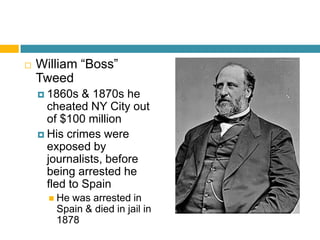
William “Boss” Tweed1860s & 1870s he cheated NY City out of $100 millionHis crimes were exposed by journalists, before being arrested he fled to SpainHe was arrested in Spain & died in jail in 1878
Progressives & Political ReformProgressive MovementCorruption led to riseProgressives: diverse group of reformers united by a belief in the public interestNot sacrificed to greed of huge trusts & city bossesWisconsin idea1st to adopt Progressive reformsGovernor Robert La Follette “Battling Bob”Opposed political bossesAppointed commissions of experts to solve problemsRailroad commission recommended lowering railroad rates; as rates decreased, rail traffic increased1903 Wisconsin was 1st state to adopt a primary run by state gov’t officials1917 all but 4 states joined
More Power to VotersRecallA process by which people may vote to remove an elected official from officeEasier to remove corrupt officialsInitiativeProcess that allows voters to put a bill before a state legislatureVoters must collect a certain # of signatures on a petitionReferendum: way for people to vote directly on a proposed new law
Two Constitutional AmendmentsProgressive ReformersBacked graduated income tax (method of taxation that taxes people at different rates depending on income)Wealthy pay higher taxes than poorSupreme Court ruled this was unconstitutional16th Amendment (gives Congress the power to pass an income tax) was ratified in 19131789U.S. senators were elected by state legislaturesBribery was a problemProgressives wanted people to vote for senators191317th Amendment was ratified to require the direct election of senators
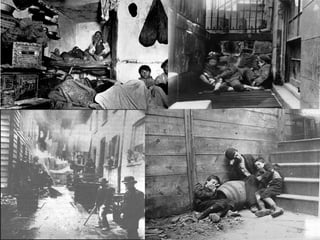
The MuckrakersPress play important role in exposing corruptionPresident Theodore Roosevelt Compared these reporters to men who raked up dirt/muck in stablesMuckraker became a term for a crusading journalistIda TarbellTargeted big businessWork led to demands for more controls on trustsAccused oil baron John D. Rockefeller of unfair business methodsOther reporters described how corruption had led to inadequate fire, police, & sanitation servicesJacob Riis
Jacob Riis Photographs
1906Upton Sinclair’s novel The Jungle Grisly details about the meatpacking industryDescribed how packers used meat from sick animals & how rats often got group up in the meat
Section 2The Progressive President
The First Progressive PresidentSeptember 6, 1901President William McKinley assassinated by unemployed anarchist @ the world’s fair in Buffalo, NYVice President Theodore Roosevelt became President42 years oldYoungest President to take officeSupporter of Progressive goals
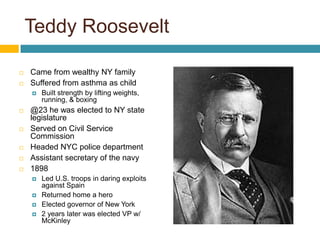
Teddy RooseveltCame from wealthy NY familySuffered from asthma as childBuilt strength by lifting weights, running, & boxing@23 he was elected to NY state legislatureServed on Civil Service CommissionHeaded NYC police departmentAssistant secretary of the navy1898Led U.S. troops in daring exploits against SpainReturned home a heroElected governor of New York2 years later was elected VP w/ McKinley
TR & Big BusinessTR won reputation as trustbuster (a person working to destroy monopolies & trusts)Was not against big business, saw difference between “good” & “bad” trustsGood trusts: were efficient & fair & should be left aloneBad trusts: took advantage of workers & cheated the public by eliminating competition.  Gov’t must control or break them up1902Gov’t brought lawsuit against Northern Securities Company (was formed to control competition among railroads)TR said NSC used unfair business practices1904Supreme Court ruling: NSC violated Sherman Antitrust ActOrder: trust to be broken up1st time Sherman Antitrust Act used to break up trusts, not unionsMore suits followedAgainst: Standard Oil & American Tobacco CompanyWere later broke up because they attempted to limit free trade
A Boost for Organized LaborTR also clashed w/ mine owners1902PA coal miners strikeWanted: better pay & short workdayOwners: refused to negotiate w/ miners’ unionw/ winter approaching schools & hospitals ran out of coalTR threatened to send troops to run minesMine owners negotiated w/ miners union & reached agreementTR 1st President to side w/ strikers
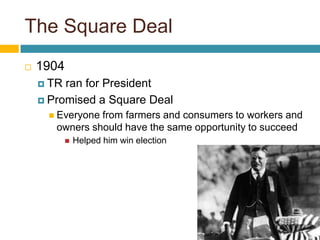
The Square Deal1904TR ran for PresidentPromised a Square DealEveryone from farmers and consumers to workers and owners should have the same opportunity to succeedHelped him win election
Conserving Natural ResourcesTR took action to protect wilderness areasLumber companies were cutting down entire forests & miners were removing iron & coal, while leaving gaping holes in the earth to keep up w/ industrial growthTR loved the wilderness & pressed for conservationNot against using resources, but believed they had to be used wisely, w/ an eye toward the future1905U.S. Forest Service was formedThousands of acres of land set aside for national parks
Protecting ConsumersSinclair’s novel The Jungle shocked TRHe made public a report exposing unhealthy meatpacking plant conditions1906Congress passed a law allowing closer inspection of meatpacking housesMuckrakersExposed drug companies for making false claims about medicines & adding harmful chemicals to canned foodCongress passed Pure Food & Drug Act(required food & drug makers to list all ingredients on packages
Taft & Wilson1908TR did not run for reelectionSupported William Howard TaftTrouble For TaftTaft: quite & cautious Was wary of powerSupported Progressive causesBroke up more trusts, favored graduated income tax, approved safety rules for mines, created federal office to control child labor, & signed laws giving gov’t workers 8 hour workday
1909Lost Progressive supportSigned a bill to raise tariffsProgressives argued this raised prices for consumersModified conservation policiesProgressives accused him of blocking conservaton
Election of 1912TR broke away from Taft & ran against him for Republican nominationTR was loved by people, but Taft controlled party leadershipTaft nominated by Republican PartyTR & supporters formed new partyProgressive Party, later known as the Bull Moose PartyDemocrats chose Woodrow WilsonProgressive candidatePresident of Princeton University & governor of New JerseyBrilliant scholar & cautious reformerKnown as begin rigid & unwilling to compromiseTR & Taft gained more votes than Wilson, but spilt Republican vote allowing Wilson to win the election of 1912
Wilson & the New FreedomWanted to restore free competitionProgram called New FreedomPersuaded Congress to create Federal Trade CommissionPower to investigate companies & order them to stop using unfair practices to destroy competitors1914Clayton Antitrust Act signedBanned some business practices that limited competitionStopped antitrust laws from being used against unionsFederal Reserve ActRegulated bankingSet up a system of federal banks and gave government the power to raise or lower interest rates & control the money supply
Chapter 19Section 3
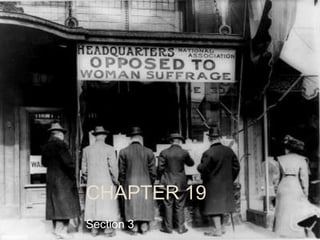
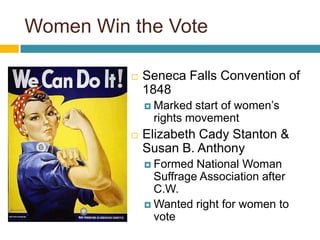
Women Win the VoteSeneca Falls Convention of 1848Marked start of women’s rights movementElizabeth Cady Stanton & Susan B. AnthonyFormed National Woman Suffrage Association after C.W.Wanted right for women to vote
Women Vote in the WestLate 1800sWyoming, Utah, Colorado, & Idaho  allowed women to voteRecognized women’s contributions made to build farms & cities by allowing them to vote1890Wyoming applied for statehoodCongress wanted to bar women from votingWyoming lawmakers stood firm & was admitted with women being able to vote
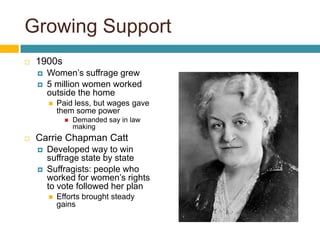
Growing Support1900sWomen’s suffrage grew5 million women worked outside the homePaid less, but wages gave them some power Demanded say in law makingCarrie Chapman CattDeveloped way to win suffrage state by stateSuffragists: people who worked for women’s rights to vote followed her planEfforts brought steady gains
The Nineteenth AmendmentWomen right to voteIn some states it did not apply to federal electionsCall for federal amendment to allow women to vote in all electionsAlice PaulMet with President Wilson in 1913Explained suffragists were committed to achieving a federal amendmentWilson pledged support191919th Amendment passed Guaranteed women right to voteAugust 1920¾ of states ratified the amendment19th AmendmentDoubled # of eligible voters
New Opportunities for WomenWomen also struggled to gain access to jobs & educationWere refused licenses to practice law or medicineHigher EducationA few women managed to get higher education to enter a profession1877Boston University granted first Ph.D. to w woman19001,000 women lawyers & 7,000 doctors
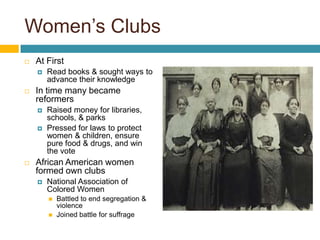
Women’s ClubsAt FirstRead books & sought ways to advance their knowledgeIn time many became reformersRaised money for libraries, schools, & parksPressed for laws to protect women & children, ensure pure food & drugs, and win the voteAfrican American women formed own clubsNational Association of Colored WomenBattled to end segregation & violenceJoined battle for suffrage
Women ReformersProgressive EraSome women committed themselves to reformBecame social workers to help the poorFlorence KelleyInvestigated sweatshop conditionsBecame chief factory inspector in IllinoisMain concern was child laborOrganized boycott of goods produced  in factories employed by young children
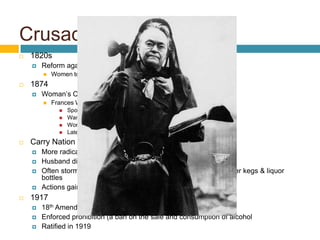
Crusade Against Alcohol1820sReform against alcohol abuseWomen took leading role1874Woman’s Christian Temperance UnionFrances Willard became presidentSpoke about evils of alcoholWanted state laws to ban sale of liquorWorked to close saloonsLater joined suffrage movement w/ other WCTU membersCarry NationMore radical temperance crusaderHusband died from heavy drinkingOften stormed into saloons swinging a hatchet & smashed beer kegs & liquor bottlesActions gained publicity, but embarrassed WCTU191718th Amendment passed by CongressEnforced prohibition (a ban on the sale and consumption of alcoholRatified in 1919
Section 4Struggles for Justice
Discriminated against in North & SouthLandlords refused to rent homes in white areasRestricted to worst housing & poorest jobsAfrican Americans
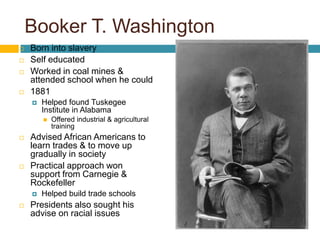
Born into slaverySelf educatedWorked in coal mines & attended school when he could1881Helped found Tuskegee Institute in AlabamaOffered industrial & agricultural trainingAdvised African Americans to learn trades & to move up gradually in societyPractical approach won support from Carnegie & RockefellerHelped build trade schools Presidents also sought his advise on racial issuesBooker T. Washington
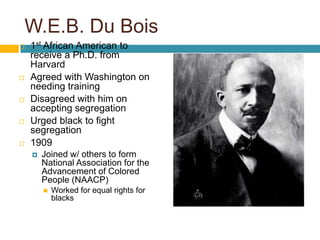
1st African American to receive a Ph.D. from HarvardAgreed with Washington on needing trainingDisagreed with him on accepting segregationUrged black to fight segregation1909Joined w/ others to form National Association for the Advancement of Colored People (NAACP)Worked for equal rights for blacksW.E.B. Du Bois
Campaign Against LynchingMore than 1000 African Americans in the south were victims of lynching: murdered by a mobafter the depression of 1893 violence worsenedIda B. Wells an African American journalist talked about free speech in her articles urged African Americans to protest against lynchingalso called for a boycott of segregated streetcars and white-owned stores
Setbacks and SuccessPresident Wilson supported segregation and thought of it as a benefit
Despite challenges, some African Americans  prospered
George Washington Carver
Discovered hundreds of new uses for peanuts and other crops in the South
Sarah Walker
Created line of hair products for African American women
Was the 1st American women to earn more than $1 million
Black owned insurance companies, banks, and other businesses server African Americans
Black colleges trained young people
Churches became training ground for generations of African American leaders

Chapter 19 blog notes

  • 1.
    Chapter 19Political Reform& the Progressive Era
  • 2.
    Section 1The GildedAge & Progressive Reform
  • 3.
    Reform in theGilded AgeGilded AgePeriod after Civil WarLasted from 1870s through 1890sAge of serious problems hiding under shiny surfacePolitical ConcernsAmericans feared industrialists & wealthy men were enriching themselves at expense of publicCorruption/Dishonesty in governmentBribery & voter fraud appeared widespread
  • 4.
    Taming the SpoilsSystemSource of corruption was Spoils SystemPractice of rewarding political supporters w/ gov’t jobsW/ election of new President, people swarmed to Washington looking for jobs in rewards for their political support1881James Garfield elected President4 months later was shot by disappointed office seekerSparked efforts to end spoils systemVice President Chester A. Arthur became PresidentOwed his rise to spoils system1883Pendleton Act signedCreated Civil Service CommissionA system that includes most gov’t jobs, except elected positions, the judiciary, & the militaryAim was to fill jobs on basis of meritJobs went to those who scored highest on civil services examinations
  • 5.
    Controlling Big BusinessLate1800sBig business influenced politics, often w/ briberyAmericans demanded limiting power of railroads & monopoliesCongressUnder Constitution has power to regulate interstate commerce1887President Grover Cleveland signed Interstate Commerce ActForbade practices such as rebates & set up Interstate Commerce Commission to oversee railroads
  • 6.
    1890President Benjamin Harrisonsigned Sherman Antitrust ActProhibited businesses from trying to limit or destroy competitionDifficult to enforceJudges often ruled in favor of trusts & the Sherman Act was used to limit the power of labor unions (strikers blocked free trade & threatened competition)
  • 7.
    Corruption in theCitiesExpansion of cities led to expansion of sewers, garbage collection, & roadsCity politicians often excepted money to award jobs to friendsPowerful politicians (bosses) controlled work done locally & wanted payoffs from businessesPopular w/ poorGave turkeys & coal Poor voted for them in return
  • 8.
    William “Boss” Tweed1860s& 1870s he cheated NY City out of $100 millionHis crimes were exposed by journalists, before being arrested he fled to SpainHe was arrested in Spain & died in jail in 1878
  • 9.
    Progressives & PoliticalReformProgressive MovementCorruption led to riseProgressives: diverse group of reformers united by a belief in the public interestNot sacrificed to greed of huge trusts & city bossesWisconsin idea1st to adopt Progressive reformsGovernor Robert La Follette “Battling Bob”Opposed political bossesAppointed commissions of experts to solve problemsRailroad commission recommended lowering railroad rates; as rates decreased, rail traffic increased1903 Wisconsin was 1st state to adopt a primary run by state gov’t officials1917 all but 4 states joined
  • 10.
    More Power toVotersRecallA process by which people may vote to remove an elected official from officeEasier to remove corrupt officialsInitiativeProcess that allows voters to put a bill before a state legislatureVoters must collect a certain # of signatures on a petitionReferendum: way for people to vote directly on a proposed new law
  • 11.
    Two Constitutional AmendmentsProgressiveReformersBacked graduated income tax (method of taxation that taxes people at different rates depending on income)Wealthy pay higher taxes than poorSupreme Court ruled this was unconstitutional16th Amendment (gives Congress the power to pass an income tax) was ratified in 19131789U.S. senators were elected by state legislaturesBribery was a problemProgressives wanted people to vote for senators191317th Amendment was ratified to require the direct election of senators
  • 12.
    The MuckrakersPress playimportant role in exposing corruptionPresident Theodore Roosevelt Compared these reporters to men who raked up dirt/muck in stablesMuckraker became a term for a crusading journalistIda TarbellTargeted big businessWork led to demands for more controls on trustsAccused oil baron John D. Rockefeller of unfair business methodsOther reporters described how corruption had led to inadequate fire, police, & sanitation servicesJacob Riis
  • 13.
  • 14.
    1906Upton Sinclair’s novelThe Jungle Grisly details about the meatpacking industryDescribed how packers used meat from sick animals & how rats often got group up in the meat
  • 15.
  • 16.
    The First ProgressivePresidentSeptember 6, 1901President William McKinley assassinated by unemployed anarchist @ the world’s fair in Buffalo, NYVice President Theodore Roosevelt became President42 years oldYoungest President to take officeSupporter of Progressive goals
  • 17.
    Teddy RooseveltCame fromwealthy NY familySuffered from asthma as childBuilt strength by lifting weights, running, & boxing@23 he was elected to NY state legislatureServed on Civil Service CommissionHeaded NYC police departmentAssistant secretary of the navy1898Led U.S. troops in daring exploits against SpainReturned home a heroElected governor of New York2 years later was elected VP w/ McKinley
  • 18.
    TR & BigBusinessTR won reputation as trustbuster (a person working to destroy monopolies & trusts)Was not against big business, saw difference between “good” & “bad” trustsGood trusts: were efficient & fair & should be left aloneBad trusts: took advantage of workers & cheated the public by eliminating competition. Gov’t must control or break them up1902Gov’t brought lawsuit against Northern Securities Company (was formed to control competition among railroads)TR said NSC used unfair business practices1904Supreme Court ruling: NSC violated Sherman Antitrust ActOrder: trust to be broken up1st time Sherman Antitrust Act used to break up trusts, not unionsMore suits followedAgainst: Standard Oil & American Tobacco CompanyWere later broke up because they attempted to limit free trade
  • 19.
    A Boost forOrganized LaborTR also clashed w/ mine owners1902PA coal miners strikeWanted: better pay & short workdayOwners: refused to negotiate w/ miners’ unionw/ winter approaching schools & hospitals ran out of coalTR threatened to send troops to run minesMine owners negotiated w/ miners union & reached agreementTR 1st President to side w/ strikers
  • 20.
    The Square Deal1904TRran for PresidentPromised a Square DealEveryone from farmers and consumers to workers and owners should have the same opportunity to succeedHelped him win election
  • 21.
    Conserving Natural ResourcesTRtook action to protect wilderness areasLumber companies were cutting down entire forests & miners were removing iron & coal, while leaving gaping holes in the earth to keep up w/ industrial growthTR loved the wilderness & pressed for conservationNot against using resources, but believed they had to be used wisely, w/ an eye toward the future1905U.S. Forest Service was formedThousands of acres of land set aside for national parks
  • 22.
    Protecting ConsumersSinclair’s novelThe Jungle shocked TRHe made public a report exposing unhealthy meatpacking plant conditions1906Congress passed a law allowing closer inspection of meatpacking housesMuckrakersExposed drug companies for making false claims about medicines & adding harmful chemicals to canned foodCongress passed Pure Food & Drug Act(required food & drug makers to list all ingredients on packages
  • 23.
    Taft & Wilson1908TRdid not run for reelectionSupported William Howard TaftTrouble For TaftTaft: quite & cautious Was wary of powerSupported Progressive causesBroke up more trusts, favored graduated income tax, approved safety rules for mines, created federal office to control child labor, & signed laws giving gov’t workers 8 hour workday
  • 24.
    1909Lost Progressive supportSigneda bill to raise tariffsProgressives argued this raised prices for consumersModified conservation policiesProgressives accused him of blocking conservaton
  • 25.
    Election of 1912TRbroke away from Taft & ran against him for Republican nominationTR was loved by people, but Taft controlled party leadershipTaft nominated by Republican PartyTR & supporters formed new partyProgressive Party, later known as the Bull Moose PartyDemocrats chose Woodrow WilsonProgressive candidatePresident of Princeton University & governor of New JerseyBrilliant scholar & cautious reformerKnown as begin rigid & unwilling to compromiseTR & Taft gained more votes than Wilson, but spilt Republican vote allowing Wilson to win the election of 1912
  • 26.
    Wilson & theNew FreedomWanted to restore free competitionProgram called New FreedomPersuaded Congress to create Federal Trade CommissionPower to investigate companies & order them to stop using unfair practices to destroy competitors1914Clayton Antitrust Act signedBanned some business practices that limited competitionStopped antitrust laws from being used against unionsFederal Reserve ActRegulated bankingSet up a system of federal banks and gave government the power to raise or lower interest rates & control the money supply
  • 27.
  • 28.
    Women Win theVoteSeneca Falls Convention of 1848Marked start of women’s rights movementElizabeth Cady Stanton & Susan B. AnthonyFormed National Woman Suffrage Association after C.W.Wanted right for women to vote
  • 29.
    Women Vote inthe WestLate 1800sWyoming, Utah, Colorado, & Idaho allowed women to voteRecognized women’s contributions made to build farms & cities by allowing them to vote1890Wyoming applied for statehoodCongress wanted to bar women from votingWyoming lawmakers stood firm & was admitted with women being able to vote
  • 30.
    Growing Support1900sWomen’s suffragegrew5 million women worked outside the homePaid less, but wages gave them some power Demanded say in law makingCarrie Chapman CattDeveloped way to win suffrage state by stateSuffragists: people who worked for women’s rights to vote followed her planEfforts brought steady gains
  • 31.
    The Nineteenth AmendmentWomenright to voteIn some states it did not apply to federal electionsCall for federal amendment to allow women to vote in all electionsAlice PaulMet with President Wilson in 1913Explained suffragists were committed to achieving a federal amendmentWilson pledged support191919th Amendment passed Guaranteed women right to voteAugust 1920¾ of states ratified the amendment19th AmendmentDoubled # of eligible voters
  • 32.
    New Opportunities forWomenWomen also struggled to gain access to jobs & educationWere refused licenses to practice law or medicineHigher EducationA few women managed to get higher education to enter a profession1877Boston University granted first Ph.D. to w woman19001,000 women lawyers & 7,000 doctors
  • 33.
    Women’s ClubsAt FirstReadbooks & sought ways to advance their knowledgeIn time many became reformersRaised money for libraries, schools, & parksPressed for laws to protect women & children, ensure pure food & drugs, and win the voteAfrican American women formed own clubsNational Association of Colored WomenBattled to end segregation & violenceJoined battle for suffrage
  • 34.
    Women ReformersProgressive EraSomewomen committed themselves to reformBecame social workers to help the poorFlorence KelleyInvestigated sweatshop conditionsBecame chief factory inspector in IllinoisMain concern was child laborOrganized boycott of goods produced in factories employed by young children
  • 35.
    Crusade Against Alcohol1820sReformagainst alcohol abuseWomen took leading role1874Woman’s Christian Temperance UnionFrances Willard became presidentSpoke about evils of alcoholWanted state laws to ban sale of liquorWorked to close saloonsLater joined suffrage movement w/ other WCTU membersCarry NationMore radical temperance crusaderHusband died from heavy drinkingOften stormed into saloons swinging a hatchet & smashed beer kegs & liquor bottlesActions gained publicity, but embarrassed WCTU191718th Amendment passed by CongressEnforced prohibition (a ban on the sale and consumption of alcoholRatified in 1919
  • 36.
  • 37.
    Discriminated against inNorth & SouthLandlords refused to rent homes in white areasRestricted to worst housing & poorest jobsAfrican Americans
  • 38.
    Born into slaverySelfeducatedWorked in coal mines & attended school when he could1881Helped found Tuskegee Institute in AlabamaOffered industrial & agricultural trainingAdvised African Americans to learn trades & to move up gradually in societyPractical approach won support from Carnegie & RockefellerHelped build trade schools Presidents also sought his advise on racial issuesBooker T. Washington
  • 39.
    1st African Americanto receive a Ph.D. from HarvardAgreed with Washington on needing trainingDisagreed with him on accepting segregationUrged black to fight segregation1909Joined w/ others to form National Association for the Advancement of Colored People (NAACP)Worked for equal rights for blacksW.E.B. Du Bois
  • 40.
    Campaign Against LynchingMorethan 1000 African Americans in the south were victims of lynching: murdered by a mobafter the depression of 1893 violence worsenedIda B. Wells an African American journalist talked about free speech in her articles urged African Americans to protest against lynchingalso called for a boycott of segregated streetcars and white-owned stores
  • 41.
    Setbacks and SuccessPresidentWilson supported segregation and thought of it as a benefit
  • 42.
    Despite challenges, someAfrican Americans prospered
  • 43.
  • 44.
    Discovered hundreds ofnew uses for peanuts and other crops in the South
  • 45.
  • 46.
    Created line ofhair products for African American women
  • 47.
    Was the 1stAmerican women to earn more than $1 million
  • 48.
    Black owned insurancecompanies, banks, and other businesses server African Americans
  • 49.
  • 50.
    Churches became trainingground for generations of African American leaders