Chapter 22 East Africa
 
The Land East Africa is a land of high plains & plateaus North: deserts & dry grasslands Southwest: large lakes dot the plateaus East: sandy beaches and coral reefs run along the coast Rifts: most striking feature Long, deep valleys with mountains or plateaus on either side
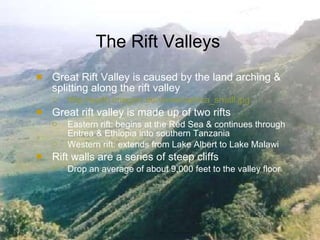
The Rift Valleys Great Rift Valley is caused by the land arching & splitting along the rift valley http://earth.imagico.de/views/eafrica_small.jpg Great rift valley is made up of two rifts Eastern rift: begins at the Red Sea & continues through Eritrea & Ethiopia into southern Tanzania Western rift: extends from Lake Albert to Lake Malawi Rift walls are a series of steep cliffs Drop an average of about 9,000 feet to the valley floor
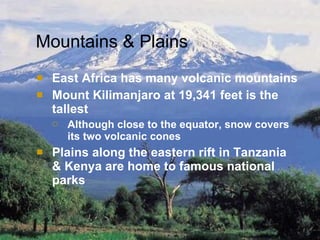
Mountains & Plains East Africa has many volcanic mountains Mount Kilimanjaro at 19,341 feet is the tallest Although close to the equator, snow covers its two volcanic cones Plains along the eastern rift in Tanzania & Kenya are home to famous national parks
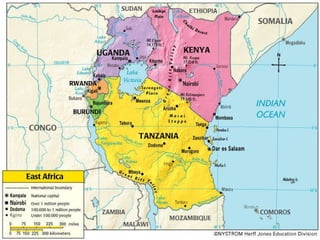
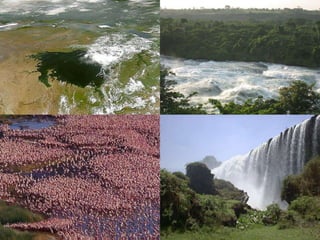
Rivers & Lakes East Africa has a number of rivers & large lakes The Nile being the largest Water from small streams collects in Lake Victoria, the source of the White Nile Water from Ethiopia’s highlands form the Blue Nile Two rivers meet at Khartoum, Sudan to form the Nile Lake Victoria is Africa’s largest lake, but it is shallow Along the western rift is a chain of great lakes Along the eastern rift lakes are heated from the earth’s interior and make them too hot to swim in Lake Nakuru is too salty for most fish, but algae found here provides food for more than a million flamingos
 
Climate & Resources Northern Sudan & northeast coast has desert & steppe climates Changes to a tropical climate as you travel south At rift valleys, floors are dry, grasslands with little rain while the plateaus and mountains have a humid highland climate and dense forests, with rainfall Most East Africans are farmers or herders Resources: coal, copper, diamonds, gold, iron ore, & lead
http://www.altrec.com/includes/published/crownofafrica/intro.html
History & Culture Section 2
Christianity & Islam Christian missionaries from Egypt introduced Christianity A.D. 300 A.D. 500 Christianity spread into Nubia, now part of Egypt & Sudan Arab armies conquered Egypt  & North Africa by A.D. 700 Islam brought in with Arabs
The Slave Trade Dates back 1,000 years Most slaves went to Islamic countries in Africa & Asia Portuguese began setting up forts & settlements on the East African coast by early 1500s By 1700s the island of Zanzibar became an international slave trading center Plantations were later set up here to grow sugarcane
European Influence & Conflict 1800s Slavery ends Focus shifts to trading gold, ivory, & rubber To get goods Europeans needed to dominate the region Est. colonies to expand empires Britain & other European countries divided up most of Africa Drew boundaries that separated ethnic groups Used imperialism in their colonies (a practice that tries to dominate other countries’ gov’t, trade, & culture African deputies were used to control colonies & these chiefs were loyal to their own ethnic people which often caused rivalries
Today Gov’t trying to strengthen national id., but ethnic conflicts continue 1960s Time when most East African countries gained independence Ethiopia was never colonized Mountains provided protection and people resisted colonization
Culture Greatest diversity of people & ways of life of all of Africa Many different languages & religions
Language European influences French & English spoken Swahili is most widely spoken African language
Religion Important aspect of culture Religions vary, but same importance placed on honoring ancestors Animists Natural world contains spirits Christianity practiced Islam practiced
Section 3 East Africa Today
Tanzania & Kenya Economies based on tourism & agriculture among poorest countries in the world Economy & Resources Tourism important Go on safari of numerous national parks Tanzania rich in gold & diamonds Mainly subsistence farmers Poor soil & limited technology restrict productivity Kenya land set aside as national parkland People would like to farm land, but it would affect wildlife & hurt tourism industry Agriculture on slope of Mt. Kilimanjaro Produce coffee & tea Geothermal energy also part of economy
Cities Similar to cities in U.S. Businesspeople hurrying to work, outdoor markets, soaring skyscrapers, parks Terrorist attacks have taken place in cities in Kenya & Tanzania
Rwanda & Burundi Two ethnic groups Tutsi & Hutu Violence between the groups  1990s genocide (intentional destruction of a people) Densely populated countries Bother former German colonies Lack resources & rely on coffee & tea
Sudan & Uganda Sudan Is Largest African country Mainly an agricultural country, but also developing some of its mineral resources Arab Muslims make up 40% of population & have political power Religious conflicts between Muslims & Christians Recently Genocide in Darfur (10 of thousands of black Sudanese are being killed by an Arab militia group, millions more have fled the region) Uganda Recovering from decades of military dictatorship Site of an ancient empire Economic progress has been slow Rely on agriculture
The Horn of Africa Ethiopia Never under foreign rule Due to mts. Volcanic mts. have very fertile soil Agriculture main part of economy Many herd sheep & cattle Serious droughts over last 30 years Christians live in highland regions while Muslims live in lowlands
Eritrea Once Italian colony & then Ethiopian province 1993 after years of war Eritrea broke away Located on the Red Sea Economy has slowly improved Tourists visit coral reefs of region People are mostly farmers & herders Export mainly cotton
Somalia Land of deserts & dry savannas Most are nomadic herders Less diverse Most are members of single ethnic group Most are Muslim Livestock & bananas are main exports Troubled by civil war Often had no central gov’t Clans have fought over grazing rights & control over cities
Djibouti Small desert country Lies on the Bab al-Mandab Narrow strait that connects the Red Sea & Indian Ocean Lies along major shipping route, which has helped this countries economy 1860s came under French control 1977 gained independence French still contribute economic & military support Port serves as a major source of income People include the Issa & Afar Issa tied to the people of Somalia Afar are related to the people of Ethiopia Both groups are Muslim 1990s civil broke out between two groups 2001 peace treaty signed

Chapter 22 Sections 1-3

  • 1.
  • 2.
  • 3.
    The Land EastAfrica is a land of high plains & plateaus North: deserts & dry grasslands Southwest: large lakes dot the plateaus East: sandy beaches and coral reefs run along the coast Rifts: most striking feature Long, deep valleys with mountains or plateaus on either side
  • 4.
    The Rift ValleysGreat Rift Valley is caused by the land arching & splitting along the rift valley http://earth.imagico.de/views/eafrica_small.jpg Great rift valley is made up of two rifts Eastern rift: begins at the Red Sea & continues through Eritrea & Ethiopia into southern Tanzania Western rift: extends from Lake Albert to Lake Malawi Rift walls are a series of steep cliffs Drop an average of about 9,000 feet to the valley floor
  • 5.
    Mountains & PlainsEast Africa has many volcanic mountains Mount Kilimanjaro at 19,341 feet is the tallest Although close to the equator, snow covers its two volcanic cones Plains along the eastern rift in Tanzania & Kenya are home to famous national parks
  • 6.
    Rivers & LakesEast Africa has a number of rivers & large lakes The Nile being the largest Water from small streams collects in Lake Victoria, the source of the White Nile Water from Ethiopia’s highlands form the Blue Nile Two rivers meet at Khartoum, Sudan to form the Nile Lake Victoria is Africa’s largest lake, but it is shallow Along the western rift is a chain of great lakes Along the eastern rift lakes are heated from the earth’s interior and make them too hot to swim in Lake Nakuru is too salty for most fish, but algae found here provides food for more than a million flamingos
  • 7.
  • 8.
    Climate & ResourcesNorthern Sudan & northeast coast has desert & steppe climates Changes to a tropical climate as you travel south At rift valleys, floors are dry, grasslands with little rain while the plateaus and mountains have a humid highland climate and dense forests, with rainfall Most East Africans are farmers or herders Resources: coal, copper, diamonds, gold, iron ore, & lead
  • 9.
  • 10.
  • 11.
    Christianity & IslamChristian missionaries from Egypt introduced Christianity A.D. 300 A.D. 500 Christianity spread into Nubia, now part of Egypt & Sudan Arab armies conquered Egypt & North Africa by A.D. 700 Islam brought in with Arabs
  • 12.
    The Slave TradeDates back 1,000 years Most slaves went to Islamic countries in Africa & Asia Portuguese began setting up forts & settlements on the East African coast by early 1500s By 1700s the island of Zanzibar became an international slave trading center Plantations were later set up here to grow sugarcane
  • 13.
    European Influence &Conflict 1800s Slavery ends Focus shifts to trading gold, ivory, & rubber To get goods Europeans needed to dominate the region Est. colonies to expand empires Britain & other European countries divided up most of Africa Drew boundaries that separated ethnic groups Used imperialism in their colonies (a practice that tries to dominate other countries’ gov’t, trade, & culture African deputies were used to control colonies & these chiefs were loyal to their own ethnic people which often caused rivalries
  • 14.
    Today Gov’t tryingto strengthen national id., but ethnic conflicts continue 1960s Time when most East African countries gained independence Ethiopia was never colonized Mountains provided protection and people resisted colonization
  • 15.
    Culture Greatest diversityof people & ways of life of all of Africa Many different languages & religions
  • 16.
    Language European influencesFrench & English spoken Swahili is most widely spoken African language
  • 17.
    Religion Important aspectof culture Religions vary, but same importance placed on honoring ancestors Animists Natural world contains spirits Christianity practiced Islam practiced
  • 18.
    Section 3 EastAfrica Today
  • 19.
    Tanzania & KenyaEconomies based on tourism & agriculture among poorest countries in the world Economy & Resources Tourism important Go on safari of numerous national parks Tanzania rich in gold & diamonds Mainly subsistence farmers Poor soil & limited technology restrict productivity Kenya land set aside as national parkland People would like to farm land, but it would affect wildlife & hurt tourism industry Agriculture on slope of Mt. Kilimanjaro Produce coffee & tea Geothermal energy also part of economy
  • 20.
    Cities Similar tocities in U.S. Businesspeople hurrying to work, outdoor markets, soaring skyscrapers, parks Terrorist attacks have taken place in cities in Kenya & Tanzania
  • 21.
    Rwanda & BurundiTwo ethnic groups Tutsi & Hutu Violence between the groups 1990s genocide (intentional destruction of a people) Densely populated countries Bother former German colonies Lack resources & rely on coffee & tea
  • 22.
    Sudan & UgandaSudan Is Largest African country Mainly an agricultural country, but also developing some of its mineral resources Arab Muslims make up 40% of population & have political power Religious conflicts between Muslims & Christians Recently Genocide in Darfur (10 of thousands of black Sudanese are being killed by an Arab militia group, millions more have fled the region) Uganda Recovering from decades of military dictatorship Site of an ancient empire Economic progress has been slow Rely on agriculture
  • 23.
    The Horn ofAfrica Ethiopia Never under foreign rule Due to mts. Volcanic mts. have very fertile soil Agriculture main part of economy Many herd sheep & cattle Serious droughts over last 30 years Christians live in highland regions while Muslims live in lowlands
  • 24.
    Eritrea Once Italiancolony & then Ethiopian province 1993 after years of war Eritrea broke away Located on the Red Sea Economy has slowly improved Tourists visit coral reefs of region People are mostly farmers & herders Export mainly cotton
  • 25.
    Somalia Land ofdeserts & dry savannas Most are nomadic herders Less diverse Most are members of single ethnic group Most are Muslim Livestock & bananas are main exports Troubled by civil war Often had no central gov’t Clans have fought over grazing rights & control over cities
  • 26.
    Djibouti Small desertcountry Lies on the Bab al-Mandab Narrow strait that connects the Red Sea & Indian Ocean Lies along major shipping route, which has helped this countries economy 1860s came under French control 1977 gained independence French still contribute economic & military support Port serves as a major source of income People include the Issa & Afar Issa tied to the people of Somalia Afar are related to the people of Ethiopia Both groups are Muslim 1990s civil broke out between two groups 2001 peace treaty signed