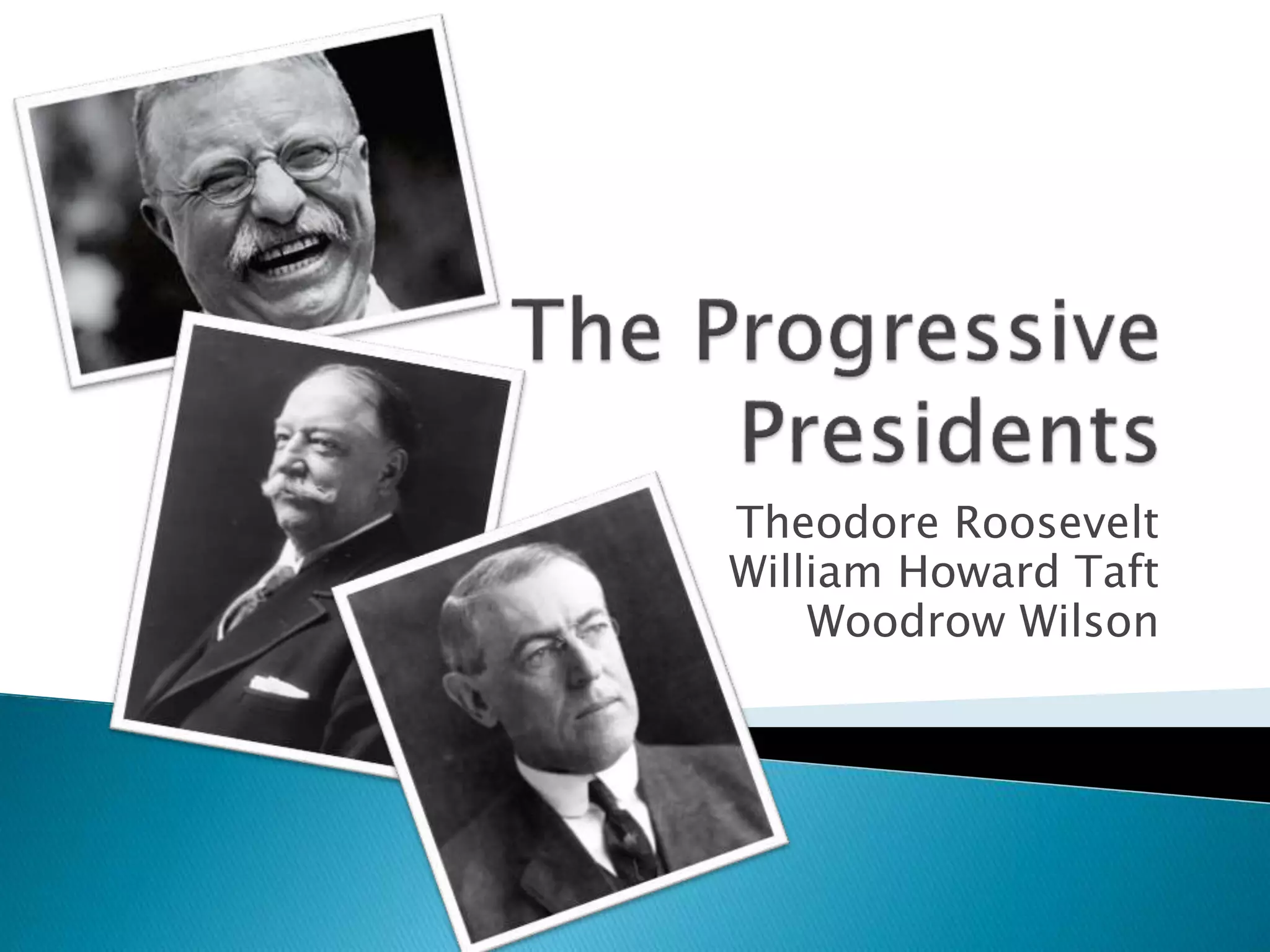
Theodore Roosevelt
William Howard Taft
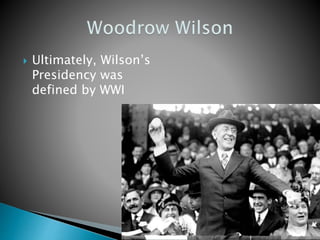
Woodrow Wilson
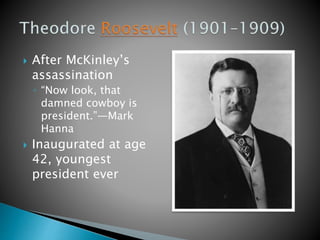
 After McKinley’s
assassination
◦ “Now look, that
damned cowboy is
president.”—Mark
Hanna
 Inaugurated at age
42, youngest
president ever
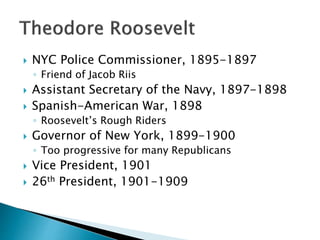
 NYC Police Commissioner, 1895-1897
◦ Friend of Jacob Riis
 Assistant Secretary of the Navy, 1897-1898
 Spanish-American War, 1898
◦ Roosevelt’s Rough Riders
 Governor of New York, 1899-1900
◦ Too progressive for many Republicans
 Vice President, 1901
 26th President, 1901-1909
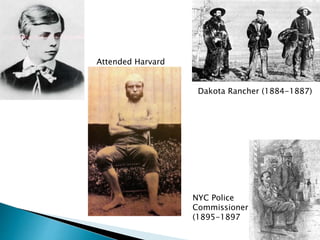
Attended Harvard
Dakota Rancher (1884-1887)
NYC Police
Commissioner
(1895-1897
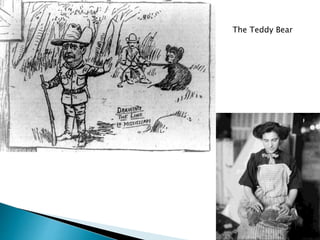
The Teddy Bear
 Regarded the president as “the steward of
public welfare”
 He moved aggressively to set a progressive
political agenda
◦ Delivered a 20K word address to Congress asking it
to curb the power of big corporations
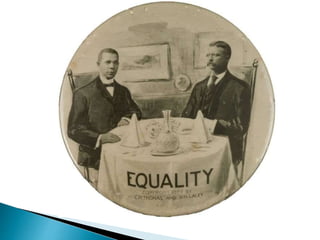
◦ One month into office he invited Booker T.
Washington to dinner at the White House
 1st time an African American had been invited to the
WH for a meal
 Outraged some white southerners
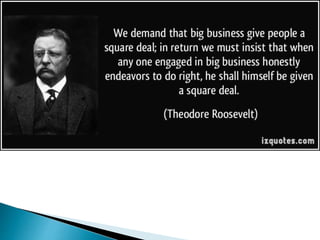
 Phrase used as early as 1902; became slogan
for re-election in 1904
 Domestic program, 3 basic ideas:
◦ 1. Conservation of natural resources
◦ 2. Control of corporations
◦ 3. Consumer protection
*The Three C’s*
 Under Roosevelt conservation became a
concerted federal policy
 He worked closely w/ the head of the Forestry
Service, Gifford Pinchot
 Set aside 200+ millions of acres:
◦ 5 national parks
◦ 18 monuments
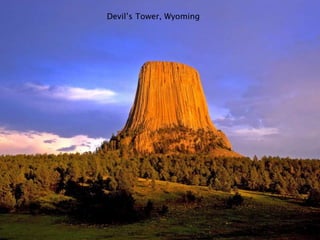
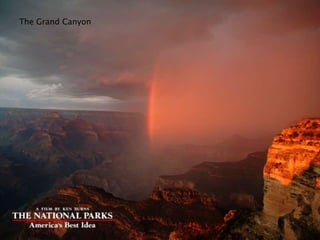
 Devil’s Tower (1906) & Grand Canyon (1908)
◦ 4 game preserves,
◦ 51 bird preserves
◦ 150 national forests
Devil’s Tower, Wyoming
The Grand Canyon
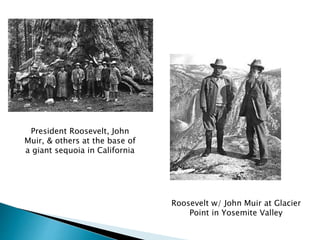
Roosevelt w/ John Muir at Glacier
Point in Yosemite Valley
President Roosevelt, John
Muir, & others at the base of
a giant sequoia in California
 “In the Grand Canyon, Arizona has a natural
wonder…Keep this great wonder of nature as it
is. You can not improve it. The ages have been at
work on it and man can only mar it.”—1903
 “All the great natural resources which are vital to
the welfare of the whole people should be kept
either in the hands or under the control of the
whole people.”—1912
 “There can be no greater issue than that of
conservation in this country.”--1912
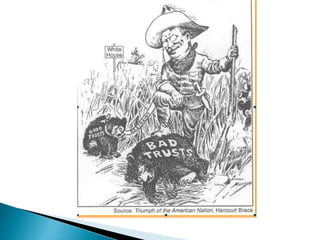
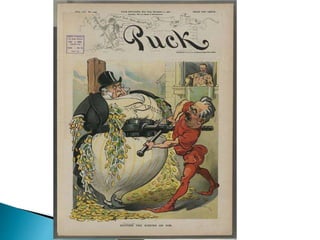
 TR distinguished between “good” & “bad”
corporations
◦ He considered bad corporations to be run by greedy
financiers interested only in profit
 He shocked the corporate world by prosecuting the
Northern Securities Co. under the Sherman Antitrust
Act
◦ NSC was created by JP Morgan
◦ The holding company owned the stock & directed the affairs
of 3 western RRs
 It had a monopoly on transportation between the Great Lakes &
the Pacific
◦ By 1904 it was dissolved
 One newspaper: “Wall Street is paralyzed at the thought that a
President of the United States should sink to enforce the law.”
◦ Major victory of the antitrust movement
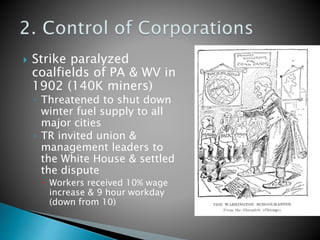
 Strike paralyzed
coalfields of PA & WV in
1902 (140K miners)
◦ Threatened to shut down
winter fuel supply to all
major cities
◦ TR invited union &
management leaders to
the White House & settled
the dispute
 Workers received 10% wage
increase & 9 hour workday
(down from 10)
 Strengthened the ICC
 Now could examine RRs’ business records &
set reasonable rates
 Congress, w/ urging from TR, created the
Dept. of Commerce & Labor in 1903
 Monitored corporations, ensured they had fair
business practices
 Later split into two depts.
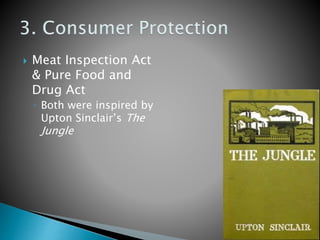
 Meat Inspection Act
& Pure Food and
Drug Act
◦ Both were inspired by
Upton Sinclair’s The
Jungle
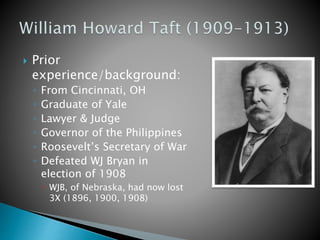
 Prior
experience/background:
◦ From Cincinnati, OH
◦ Graduate of Yale
◦ Lawyer & Judge
◦ Governor of the Philippines
◦ Roosevelt’s Secretary of War
◦ Defeated WJ Bryan in
election of 1908
 WJB, of Nebraska, had now lost
3X (1896, 1900, 1908)
 Hand-picked successor to TR
◦ Seemingly would follow in his footsteps
 In the end, he was more conservative than TR
 From his inaugural address:
◦ “The scope of a modern government has been
widened far beyond the principles laid down by the
old ‘laissez-fair’ school of political writers.”
 Taft pursued anti-trust policy more
aggressively than Roosevelt
◦ In 1911 he persuaded the Supreme Court to declare
Rockefeller’s Standard Oil Co. in violation of the
Sherman Antitrust Act
 Had to be broken up into separate marketing,
producing, & refining companies
 Taft supported this Amendment
 It authorized Congress to enact a graduated
income tax
◦ It was ratified shortly before he left office
◦ It provided a new source of revenue for a
government whose powers, responsibilities, &
expenditures were growing rapidly
 Passive personality
◦ More easily pushed around by Congress
 Some thought he lacked the physical &
mental stamina necessary to be president
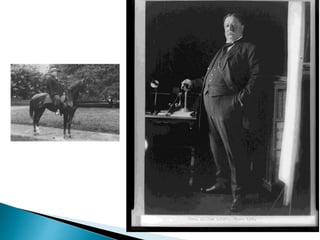
◦ He weighed 350+ pounds
 Payne-Aldrich Tariff:
◦ Reduced tariff rates, but nearly as much as
reformers had hoped
 Taft called it the “best bill the Republican Party ever
passed”
 Taft was a conservationist, however…
 Gifford Pinchot, head of Forestry service, &
close friend to TR attacked Sec. of Interior,
Richard Ballinger
◦ Ballinger had opened up federal lands in WY, MT, &
AK for private use
 This angered many Progressives, including Pinchot
◦ To stop the negativity, Taft fired Pinchot for
insubordination
 This infuriated the public & also TR
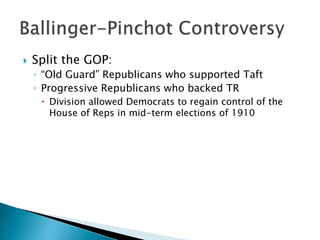
 Split the GOP:
◦ “Old Guard” Republicans who supported Taft
◦ Progressive Republicans who backed TR
 Division allowed Democrats to regain control of the
House of Reps in mid-term elections of 1910
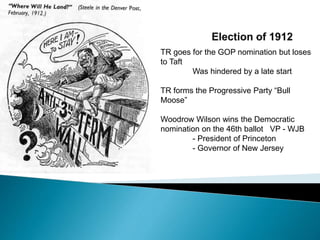
TR goes for the GOP nomination but loses
to Taft
Was hindered by a late start
TR forms the Progressive Party “Bull
Moose”
Woodrow Wilson wins the Democratic
nomination on the 46th ballot VP - WJB
- President of Princeton
- Governor of New Jersey

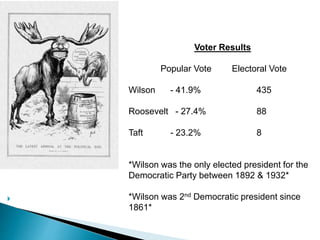
Voter Results
Popular Vote Electoral Vote
Wilson - 41.9% 435
Roosevelt - 27.4% 88
Taft - 23.2% 8
*Wilson was the only elected president for the
Democratic Party between 1892 & 1932*
*Wilson was 2nd Democratic president since
1861*
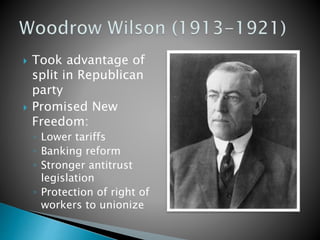
 Took advantage of
split in Republican
party
 Promised New
Freedom:
◦ Lower tariffs
◦ Banking reform
◦ Stronger antitrust
legislation
◦ Protection of right of
workers to unionize
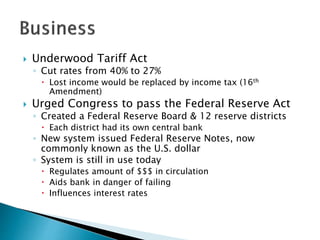
 Underwood Tariff Act
◦ Cut rates from 40% to 27%
 Lost income would be replaced by income tax (16th
Amendment)
 Urged Congress to pass the Federal Reserve Act
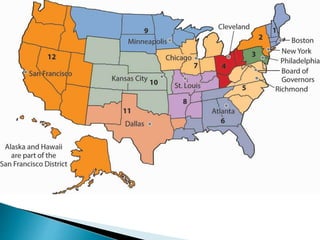
◦ Created a Federal Reserve Board & 12 reserve districts
 Each district had its own central bank
◦ New system issued Federal Reserve Notes, now
commonly known as the U.S. dollar
◦ System is still in use today
 Regulates amount of $$$ in circulation
 Aids bank in danger of failing
 Influences interest rates
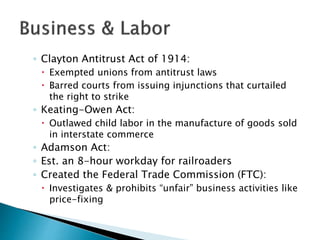
◦ Clayton Antitrust Act of 1914:
 Exempted unions from antitrust laws
 Barred courts from issuing injunctions that curtailed
the right to strike
◦ Keating-Owen Act:
 Outlawed child labor in the manufacture of goods sold
in interstate commerce
◦ Adamson Act:
◦ Est. an 8-hour workday for railroaders
◦ Created the Federal Trade Commission (FTC):
 Investigates & prohibits “unfair” business activities like
price-fixing
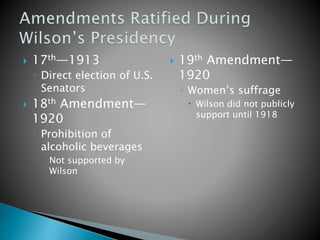
 17th—1913
◦ Direct election of U.S.
Senators
 18th Amendment—
1920
◦ Prohibition of
alcoholic beverages
 Not supported by
Wilson
 19th Amendment—
1920
◦ Women’s suffrage
 Wilson did not publicly
support until 1918
 Ultimately, Wilson’s
Presidency was
defined by WWI

Progressive Presidents

  • 1.
  • 2.
     After McKinley’s assassination ◦“Now look, that damned cowboy is president.”—Mark Hanna  Inaugurated at age 42, youngest president ever
  • 3.
     NYC PoliceCommissioner, 1895-1897 ◦ Friend of Jacob Riis  Assistant Secretary of the Navy, 1897-1898  Spanish-American War, 1898 ◦ Roosevelt’s Rough Riders  Governor of New York, 1899-1900 ◦ Too progressive for many Republicans  Vice President, 1901  26th President, 1901-1909
  • 4.
    Attended Harvard Dakota Rancher(1884-1887) NYC Police Commissioner (1895-1897
  • 6.
  • 7.
     Regarded thepresident as “the steward of public welfare”  He moved aggressively to set a progressive political agenda ◦ Delivered a 20K word address to Congress asking it to curb the power of big corporations ◦ One month into office he invited Booker T. Washington to dinner at the White House  1st time an African American had been invited to the WH for a meal  Outraged some white southerners
  • 9.
     Phrase usedas early as 1902; became slogan for re-election in 1904  Domestic program, 3 basic ideas: ◦ 1. Conservation of natural resources ◦ 2. Control of corporations ◦ 3. Consumer protection *The Three C’s*
  • 11.
     Under Rooseveltconservation became a concerted federal policy  He worked closely w/ the head of the Forestry Service, Gifford Pinchot  Set aside 200+ millions of acres: ◦ 5 national parks ◦ 18 monuments  Devil’s Tower (1906) & Grand Canyon (1908) ◦ 4 game preserves, ◦ 51 bird preserves ◦ 150 national forests
  • 12.
  • 13.
  • 14.
    Roosevelt w/ JohnMuir at Glacier Point in Yosemite Valley President Roosevelt, John Muir, & others at the base of a giant sequoia in California
  • 15.
     “In theGrand Canyon, Arizona has a natural wonder…Keep this great wonder of nature as it is. You can not improve it. The ages have been at work on it and man can only mar it.”—1903  “All the great natural resources which are vital to the welfare of the whole people should be kept either in the hands or under the control of the whole people.”—1912  “There can be no greater issue than that of conservation in this country.”--1912
  • 16.
     TR distinguishedbetween “good” & “bad” corporations ◦ He considered bad corporations to be run by greedy financiers interested only in profit  He shocked the corporate world by prosecuting the Northern Securities Co. under the Sherman Antitrust Act ◦ NSC was created by JP Morgan ◦ The holding company owned the stock & directed the affairs of 3 western RRs  It had a monopoly on transportation between the Great Lakes & the Pacific ◦ By 1904 it was dissolved  One newspaper: “Wall Street is paralyzed at the thought that a President of the United States should sink to enforce the law.” ◦ Major victory of the antitrust movement
  • 19.
     Strike paralyzed coalfieldsof PA & WV in 1902 (140K miners) ◦ Threatened to shut down winter fuel supply to all major cities ◦ TR invited union & management leaders to the White House & settled the dispute  Workers received 10% wage increase & 9 hour workday (down from 10)
  • 20.
     Strengthened theICC  Now could examine RRs’ business records & set reasonable rates  Congress, w/ urging from TR, created the Dept. of Commerce & Labor in 1903  Monitored corporations, ensured they had fair business practices  Later split into two depts.
  • 21.
     Meat InspectionAct & Pure Food and Drug Act ◦ Both were inspired by Upton Sinclair’s The Jungle
  • 22.
     Prior experience/background: ◦ FromCincinnati, OH ◦ Graduate of Yale ◦ Lawyer & Judge ◦ Governor of the Philippines ◦ Roosevelt’s Secretary of War ◦ Defeated WJ Bryan in election of 1908  WJB, of Nebraska, had now lost 3X (1896, 1900, 1908)
  • 23.
     Hand-picked successorto TR ◦ Seemingly would follow in his footsteps  In the end, he was more conservative than TR  From his inaugural address: ◦ “The scope of a modern government has been widened far beyond the principles laid down by the old ‘laissez-fair’ school of political writers.”
  • 24.
     Taft pursuedanti-trust policy more aggressively than Roosevelt ◦ In 1911 he persuaded the Supreme Court to declare Rockefeller’s Standard Oil Co. in violation of the Sherman Antitrust Act  Had to be broken up into separate marketing, producing, & refining companies
  • 25.
     Taft supportedthis Amendment  It authorized Congress to enact a graduated income tax ◦ It was ratified shortly before he left office ◦ It provided a new source of revenue for a government whose powers, responsibilities, & expenditures were growing rapidly
  • 26.
     Passive personality ◦More easily pushed around by Congress  Some thought he lacked the physical & mental stamina necessary to be president ◦ He weighed 350+ pounds  Payne-Aldrich Tariff: ◦ Reduced tariff rates, but nearly as much as reformers had hoped  Taft called it the “best bill the Republican Party ever passed”
  • 28.
     Taft wasa conservationist, however…  Gifford Pinchot, head of Forestry service, & close friend to TR attacked Sec. of Interior, Richard Ballinger ◦ Ballinger had opened up federal lands in WY, MT, & AK for private use  This angered many Progressives, including Pinchot ◦ To stop the negativity, Taft fired Pinchot for insubordination  This infuriated the public & also TR
  • 29.
     Split theGOP: ◦ “Old Guard” Republicans who supported Taft ◦ Progressive Republicans who backed TR  Division allowed Democrats to regain control of the House of Reps in mid-term elections of 1910
  • 30.
    TR goes forthe GOP nomination but loses to Taft Was hindered by a late start TR forms the Progressive Party “Bull Moose” Woodrow Wilson wins the Democratic nomination on the 46th ballot VP - WJB - President of Princeton - Governor of New Jersey
  • 31.
     Voter Results Popular VoteElectoral Vote Wilson - 41.9% 435 Roosevelt - 27.4% 88 Taft - 23.2% 8 *Wilson was the only elected president for the Democratic Party between 1892 & 1932* *Wilson was 2nd Democratic president since 1861*
  • 32.
     Took advantageof split in Republican party  Promised New Freedom: ◦ Lower tariffs ◦ Banking reform ◦ Stronger antitrust legislation ◦ Protection of right of workers to unionize
  • 33.
     Underwood TariffAct ◦ Cut rates from 40% to 27%  Lost income would be replaced by income tax (16th Amendment)  Urged Congress to pass the Federal Reserve Act ◦ Created a Federal Reserve Board & 12 reserve districts  Each district had its own central bank ◦ New system issued Federal Reserve Notes, now commonly known as the U.S. dollar ◦ System is still in use today  Regulates amount of $$$ in circulation  Aids bank in danger of failing  Influences interest rates
  • 35.
    ◦ Clayton AntitrustAct of 1914:  Exempted unions from antitrust laws  Barred courts from issuing injunctions that curtailed the right to strike ◦ Keating-Owen Act:  Outlawed child labor in the manufacture of goods sold in interstate commerce ◦ Adamson Act: ◦ Est. an 8-hour workday for railroaders ◦ Created the Federal Trade Commission (FTC):  Investigates & prohibits “unfair” business activities like price-fixing
  • 36.
     17th—1913 ◦ Directelection of U.S. Senators  18th Amendment— 1920 ◦ Prohibition of alcoholic beverages  Not supported by Wilson  19th Amendment— 1920 ◦ Women’s suffrage  Wilson did not publicly support until 1918
  • 37.