CHAPTER 19
Political Reform & the Progressive Era
SECTION 1
The Gilded Age & Progressive Reform
Reform in the Gilded Age
   Gilded Age
     Period after Civil War
     Lasted from 1870s through 1890s

     Age of serious problems hiding under shiny
      surface
   Political Concerns
     Americans  feared industrialists & wealthy men
      were enriching themselves at expense of public
     Corruption/Dishonesty in government
       Bribery   & voter fraud appeared widespread
Taming the Spoils System
   Source of corruption was Spoils System
       Practice of rewarding political supporters w/ gov’t jobs
   W/ election of new President, people swarmed to Washington
    looking for jobs in rewards for their political support
   1881
       James Garfield elected President
       4 months later was shot by disappointed office seeker
           Sparked efforts to end spoils system
       Vice President Chester A. Arthur became President
           Owed his rise to spoils system
   1883
       Pendleton Act signed
       Created Civil Service Commission
           A system that includes most gov’t jobs, except elected positions, the
            judiciary, & the military
           Aim was to fill jobs on basis of merit
                 Jobs went to those who scored highest on civil services examinations
Controlling Big Business
   Late 1800s
     Bigbusiness influenced politics, often w/ bribery
     Americans demanded limiting power of railroads
      & monopolies
   Congress
     Under  Constitution has power to regulate
      interstate commerce
     1887
       President
              Grover Cleveland signed Interstate
       Commerce Act
               Forbade practices such as rebates & set up Interstate
                Commerce Commission to oversee railroads
   1890
     President Benjamin Harrison signed Sherman
     Antitrust Act
       Prohibited
                 businesses from trying to limit or destroy
       competition
              Difficult to enforce
              Judges often ruled in favor of trusts & the Sherman Act
               was used to limit the power of labor unions (strikers
               blocked free trade & threatened competition)
Corruption in the Cities
   Expansion of cities led to expansion of sewers,
    garbage collection, & roads
     Citypoliticians often excepted money to award
     jobs to friends
   Powerful politicians (bosses) controlled work
    done locally & wanted payoffs from businesses
     Popular   w/ poor
       Gave  turkeys & coal
       Poor voted for them in return
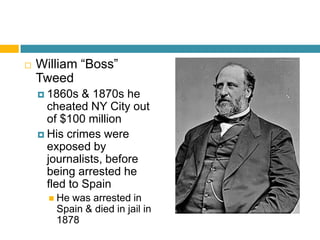
   William “Boss”
    Tweed
     1860s   & 1870s he
      cheated NY City out
      of $100 million
     His crimes were
      exposed by
      journalists, before
      being arrested he
      fled to Spain
       Hewas arrested in
       Spain & died in jail in
       1878
Progressives & Political Reform
   Progressive Movement
       Corruption led to rise
       Progressives: diverse group of reformers united by a belief
        in the public interest
           Not sacrificed to greed of huge trusts & city bosses
   Wisconsin idea
       1st to adopt Progressive reforms
       Governor Robert La Follette “Battling Bob”
           Opposed political bosses
           Appointed commissions of experts to solve problems
                 Railroad commission recommended lowering railroad rates; as rates
                  decreased, rail traffic increased
           1903 Wisconsin was 1st state to adopt a primary run by state
            gov’t officials
                 1917 all but 4 states joined
More Power to Voters
   Recall
    A  process by which people may vote to remove
      an elected official from office
       Easier   to remove corrupt officials
   Initiative
     Process  that allows voters to put a bill before a
      state legislature
       Voters   must collect a certain # of signatures on a
         petition
     Referendum: way for people to vote directly on a
      proposed new law
Two Constitutional
Amendments
   Progressive Reformers
       Backed graduated income tax (method of taxation that taxes
        people at different rates depending on income)
           Wealthy pay higher taxes than poor
       Supreme Court ruled this was unconstitutional
       16th Amendment (gives Congress the power to pass an income
        tax) was ratified in 1913
   1789
       U.S. senators were elected by state legislatures
           Bribery was a problem
           Progressives wanted people to vote for senators
   1913
       17th Amendment was ratified to require the direct election of
        senators
The Muckrakers
   Press play important role in exposing corruption
   President Theodore Roosevelt
       Compared these reporters to men who raked up dirt/muck
        in stables
       Muckraker became a term for a crusading journalist
   Ida Tarbell
       Targeted big business
       Work led to demands for more controls on trusts
       Accused oil baron John D. Rockefeller of unfair business
        methods
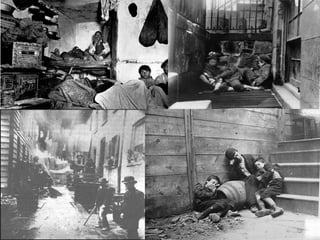
   Other reporters described how corruption had led to
    inadequate fire, police, & sanitation services
       Jacob Riis
Jacob Riis Photographs
   1906
     Upton      Sinclair’s novel The Jungle
      Grisly     details about the meatpacking industry
              Described how packers used meat from sick animals &
               how rats often got group up in the meat
SECTION 2
The Progressive President
The First Progressive President
   September 6, 1901
     President William McKinley assassinated by
      unemployed anarchist @ the world’s fair in
      Buffalo, NY
     Vice President Theodore Roosevelt became
      President
       42years old
       Youngest President to take office
       Supporter of Progressive goals
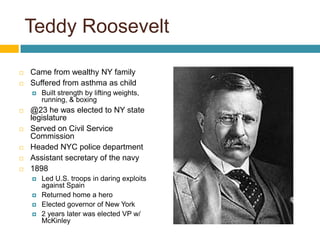
Teddy Roosevelt

   Came from wealthy NY family
   Suffered from asthma as child
       Built strength by lifting weights,
        running, & boxing
   @23 he was elected to NY state
    legislature
   Served on Civil Service
    Commission
   Headed NYC police department
   Assistant secretary of the navy
   1898
       Led U.S. troops in daring exploits
        against Spain
       Returned home a hero
       Elected governor of New York
       2 years later was elected VP w/
        McKinley
TR & Big Business

   TR won reputation as trustbuster (a person working to destroy
    monopolies & trusts)
       Was not against big business, saw difference between “good” & “bad”
        trusts
           Good trusts: were efficient & fair & should be left alone
           Bad trusts: took advantage of workers & cheated the public by eliminating
            competition. Gov’t must control or break them up
   1902
       Gov’t brought lawsuit against Northern Securities Company (was formed
        to control competition among railroads)
           TR said NSC used unfair business practices
   1904
       Supreme Court ruling: NSC violated Sherman Antitrust Act
           Order: trust to be broken up
           1st time Sherman Antitrust Act used to break up trusts, not unions
   More suits followed
       Against: Standard Oil & American Tobacco Company
           Were later broke up because they attempted to limit free trade
A Boost for Organized Labor
   TR also clashed w/ mine owners
   1902
       PA coal miners strike
         Wanted: better pay & short workday
         Owners: refused to negotiate w/ miners’ union

     w/ winter approaching schools & hospitals ran out of
      coal
     TR threatened to send troops to run mines

     Mine owners negotiated w/ miners union & reached
      agreement
     TR 1st President to side w/ strikers
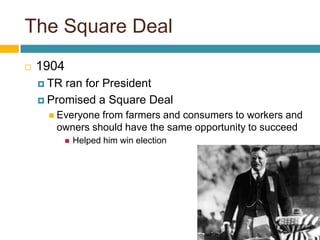
The Square Deal
   1904
     TR ran for President
     Promised a Square Deal
      Everyone from farmers and consumers to workers and
       owners should have the same opportunity to succeed
              Helped him win election
Conserving Natural Resources
   TR took action to protect wilderness areas
     Lumber   companies were cutting down entire
      forests & miners were removing iron & coal,
      while leaving gaping holes in the earth to keep
      up w/ industrial growth
   TR loved the wilderness & pressed for conservation
     Not against using resources, but believed
      they had to be used wisely, w/ an eye toward
      the future
   1905
     U.S.Forest Service was formed
     Thousands of acres of land set aside for
Protecting Consumers
   Sinclair’s novel The Jungle shocked TR
   He made public a report exposing unhealthy
    meatpacking plant conditions
   1906
       Congress passed a law allowing closer inspection of
        meatpacking houses
   Muckrakers
       Exposed drug companies for making false claims
        about medicines & adding harmful chemicals to
        canned food
           Congress passed Pure Food & Drug Act (required food &
            drug makers to list all ingredients on packages
Taft & Wilson
   1908
     TR did not run for reelection
     Supported William Howard Taft

   Trouble For Taft
     Taft:
          quite & cautious
     Was wary of power
     Supported Progressive causes
       Broke  up more trusts, favored graduated income tax,
        approved safety rules for mines, created federal office
        to control child labor, & signed laws giving gov’t
        workers 8 hour workday
   1909
     LostProgressive support
     Signed a bill to raise tariffs
       Progressives   argued this raised prices for consumers
     Modified   conservation policies
       Progressives   accused him of blocking conservaton
Election of 1912
   TR broke away from Taft & ran against him for Republican
    nomination
       TR was loved by people, but Taft controlled party leadership
       Taft nominated by Republican Party
   TR & supporters formed new party
       Progressive Party, later known as the Bull Moose Party
   Democrats chose Woodrow Wilson
       Progressive candidate
       President of Princeton University & governor of New Jersey
       Brilliant scholar & cautious reformer
       Known as begin rigid & unwilling to compromise
   TR & Taft gained more votes than Wilson, but spilt
    Republican vote allowing Wilson to win the election of 1912
Wilson & the New Freedom
   Wanted to restore free competition
   Program called New Freedom
   Persuaded Congress to create Federal Trade Commission
       Power to investigate companies & order them to stop using
        unfair practices to destroy competitors
   1914
       Clayton Antitrust Act signed
           Banned some business practices that limited competition
           Stopped antitrust laws from being used against unions
   Federal Reserve Act
       Regulated banking
       Set up a system of federal banks and gave government the
        power to raise or lower interest rates & control the money supply
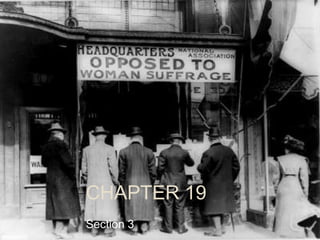
CHAPTER 19
Section 3
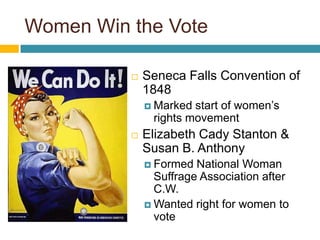
Women Win the Vote

             Seneca Falls Convention of
              1848
               Marked start of women’s
               rights movement
             Elizabeth Cady Stanton &
              Susan B. Anthony
               Formed  National Woman
                Suffrage Association after
                C.W.
               Wanted right for women to
                vote
Women Vote in the West
   Late 1800s
     Wyoming,Utah, Colorado, & Idaho allowed
     women to vote
       Recognized  women’s contributions made to build
       farms & cities by allowing them to vote
   1890
     Wyoming  applied for statehood
     Congress wanted to bar women from voting
     Wyoming lawmakers stood firm & was admitted
      with women being able to vote
Growing Support
   1900s
       Women’s suffrage grew
       5 million women worked
        outside the home
           Paid less, but wages gave
            them some power
                 Demanded say in law
                  making
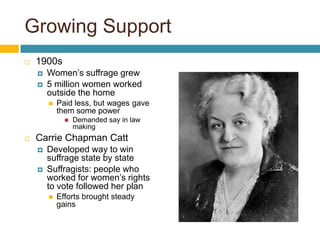
   Carrie Chapman Catt
       Developed way to win
        suffrage state by state
       Suffragists: people who
        worked for women’s rights
        to vote followed her plan
           Efforts brought steady
            gains
The Nineteenth Amendment
   Women right to vote
       In some states it did not apply to federal elections
       Call for federal amendment to allow women to vote in all elections
   Alice Paul
       Met with President Wilson in 1913
       Explained suffragists were committed to achieving a federal amendment
           Wilson pledged support
   1919
       19th Amendment passed
           Guaranteed women right to vote
   August 1920
       ¾ of states ratified the amendment
   19th Amendment
       Doubled # of eligible voters
New Opportunities for Women
   Women also struggled to gain access to jobs &
    education
   Were refused licenses to practice law or
    medicine
   Higher Education
    A  few women managed to get higher education to
      enter a profession
     1877
       Boston   University granted first Ph.D. to w woman
     1900
       1,000   women lawyers & 7,000 doctors
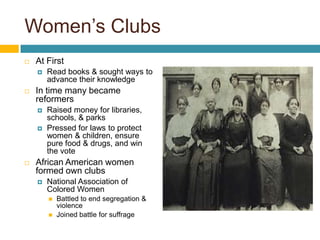
Women’s Clubs
   At First
       Read books & sought ways to
        advance their knowledge
   In time many became
    reformers
       Raised money for libraries,
        schools, & parks
       Pressed for laws to protect
        women & children, ensure
        pure food & drugs, and win
        the vote
   African American women
    formed own clubs
       National Association of
        Colored Women
           Battled to end segregation &
            violence
           Joined battle for suffrage
Women Reformers
   Progressive Era
     Some     women committed themselves to reform
       Became   social workers to help the poor
   Florence Kelley
     Investigated
                 sweatshop conditions
     Became chief factory inspector in Illinois
       Mainconcern was child labor
       Organized boycott of goods produced in factories
        employed by young children
Crusade Against Alcohol
   1820s
       Reform against alcohol abuse
           Women took leading role
   1874
       Woman’s Christian Temperance Union
           Frances Willard became president
                 Spoke about evils of alcohol
                 Wanted state laws to ban sale of liquor
                 Worked to close saloons
                 Later joined suffrage movement w/ other WCTU members
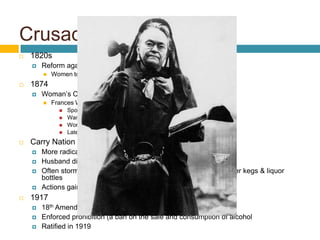
   Carry Nation
       More radical temperance crusader
       Husband died from heavy drinking
       Often stormed into saloons swinging a hatchet & smashed beer kegs & liquor
        bottles
       Actions gained publicity, but embarrassed WCTU
   1917
       18th Amendment passed by Congress
       Enforced prohibition (a ban on the sale and consumption of alcohol
       Ratified in 1919
SECTION 4
Struggles for Justice
African Americans
   Discriminated against in North & South
     Landlords  refused to rent homes in white areas
     Restricted to worst housing & poorest jobs
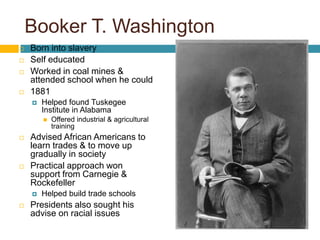
Booker T. Washington
   Born into slavery
   Self educated
   Worked in coal mines &
    attended school when he could
   1881
       Helped found Tuskegee
        Institute in Alabama
           Offered industrial & agricultural
            training
   Advised African Americans to
    learn trades & to move up
    gradually in society
   Practical approach won
    support from Carnegie &
    Rockefeller
       Helped build trade schools
   Presidents also sought his
    advise on racial issues
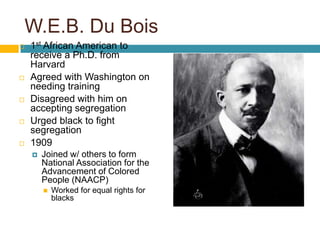
W.E.B. Du Bois
   1st African American to
    receive a Ph.D. from
    Harvard
   Agreed with Washington on
    needing training
   Disagreed with him on
    accepting segregation
   Urged black to fight
    segregation
   1909
       Joined w/ others to form
        National Association for the
        Advancement of Colored
        People (NAACP)
           Worked for equal rights for
            blacks
Campaign Against Lynching
 More than 1000 African Americans in the
south were victims of lynching: murdered
                 by a mob
  after the depression of 1893 violence
                worsened
               Ida B. Wells
          an African American journalist
     talked about free speech in her articles
    urged African Americans to protest against
                     lynching
Setbacks and Success
• President Wilson supported segregation and thought of it
  as a benefit
• Despite challenges, some African Americans prospered
   – George Washington Carver
       • Discovered hundreds of new uses for peanuts and other crops in
         the South
   – Sarah Walker
       • Created line of hair products for African American women
       • Was the 1st American women to earn more than $1 million
   – Black owned insurance companies, banks, and other
     businesses server African Americans
   – Black colleges trained young people
   – Churches became training ground for generations of African
     American leaders
       • African Methodist Episcopal Church
Mexican Americans
• 1900
   – ½ a million Mexican Americans lived in U.S.
      • Faced legal segregation like African Americans
• 1910
   – San Angelo, Texas
      • Built new schools for Anglo (of English ancestry)
        children
      • Mexican children forced to attend separate, inferior
        schools
      • When Mexican children tried to attend one of the new
        schools, officials would not let them
Increased Immigration
• 1910
  – Revolution and famine swept through Mexico
  – Thousands fled to the U.S.
    • All levels of Mexican society - poor farmers, middle
      class, and upper class
  – 90% of Mexican Immigrants lived in the
    southwest at first
    • Migration later spread Mexican Americans to other
      parts of the country to find work
Daily Life
• Mexican immigrants as farmhands, built roads, or dug
  irrigation ditches
   – Some lived near R.R.’s they helped build
• Other Mexican Americans worked in factories under harsh
  conditions
   – Paid less than Americans
   – Denied skilled jobs
• Sought to preserve culture & language
• Created barrios (ethnic Mexican American neighborhoods)
   – LA home to nation’s largest barrio
• Within Barrios Mexican immigrants & Mexican Americans
  helped each other
   – Some formed mutualistas (mutual aid groups)
       • Pooled money to pay for insurance and legal advise
       • Collected money for the sick and needy
Asian Americans
• The Chinese exclusion act of 1882 led
  to employers on the west coast in
  Hawaii to hire people from Asian
  countries, mostly from Japan and the
  Philippines.
Japanese Immigrants
• More than 100,000 Japanese immigrants
  traveled to the U.S in the early 1900’s
• Some went to Hawaii to work on sugar
  plantations
• When the U.S. annexed Hawaii in 1898,
  Japanese sought a better life in the
  mainland.
   ∙ most became farmers that settled on
  dry              barren land that the
  Americans didn’t want.
• Japanese built up their farms and began
A Gentlemen's Agreement
• Asians were out casted.
• In the 1900’s, san Francisco forced all Asian
  students even children to attend different
  schools than white students.
• When Japan protested the issue, it threatened
  to cause an international crisis.
• Unions pressured Theodore Roosevelt to limit
  the immigration from Japan.
• He refused and tried to hush the turmoil
  between Japanese and Americans.
• He proposed the idea that if san Francisco
  ended there segregation he would limit the
  Japanese immigrants
• In 1907 Roosevelt created a
  gentleman's agreement with Japan.
• Japan agreed to stop workers from
  going to the U.S and the U.S
  agreed to allow Japanese women
  to join their husbands and family
  already in the U.S.
• The anti-Japanese feeling
  remained high.
• In 1913 California banned Asians
  who were not American citizens
Religious Minorities
• Religious minorities faced deep prejudice
• Roman Catholics and Jews were included in the immigration
  boom.
• Nativist groups such as the Anti-Catholic American Protective
  Association (ACAPA) worked to restrict immigration.
• Jews and Catholics who were not immigrants face
  discrimination in jobs and housing.
• A feeling of Anti-Catholicism was common in schools.
• Some teachers lectured against the Pope, and textbooks with
  references to “decitful catholics”
• American Catholics set up parochial schools, or schools
  sponsored by a church.
• 1913
• Anti-Semitism, or prejudice against Jews, took place in
  Georgia.
   He was falsely accused of murdering a young
    girl.
   Despite lack of evidence, he was sentenced to
    death.
   Although the Governor of Georgia reduced his
    sentence.
   A mob took him form prison, and lynched him.
   In response to the lynching, and Anti-Semitism,
    American Jews founded Anti-Defamation
    League.
   The League worked to promote understanding

Chapter 19 blog notes

  • 1.
    CHAPTER 19 Political Reform& the Progressive Era
  • 2.
    SECTION 1 The GildedAge & Progressive Reform
  • 3.
    Reform in theGilded Age  Gilded Age  Period after Civil War  Lasted from 1870s through 1890s  Age of serious problems hiding under shiny surface  Political Concerns  Americans feared industrialists & wealthy men were enriching themselves at expense of public  Corruption/Dishonesty in government  Bribery & voter fraud appeared widespread
  • 4.
    Taming the SpoilsSystem  Source of corruption was Spoils System  Practice of rewarding political supporters w/ gov’t jobs  W/ election of new President, people swarmed to Washington looking for jobs in rewards for their political support  1881  James Garfield elected President  4 months later was shot by disappointed office seeker  Sparked efforts to end spoils system  Vice President Chester A. Arthur became President  Owed his rise to spoils system  1883  Pendleton Act signed  Created Civil Service Commission  A system that includes most gov’t jobs, except elected positions, the judiciary, & the military  Aim was to fill jobs on basis of merit  Jobs went to those who scored highest on civil services examinations
  • 5.
    Controlling Big Business  Late 1800s  Bigbusiness influenced politics, often w/ bribery  Americans demanded limiting power of railroads & monopolies  Congress  Under Constitution has power to regulate interstate commerce  1887  President Grover Cleveland signed Interstate Commerce Act  Forbade practices such as rebates & set up Interstate Commerce Commission to oversee railroads
  • 6.
    1890  President Benjamin Harrison signed Sherman Antitrust Act  Prohibited businesses from trying to limit or destroy competition  Difficult to enforce  Judges often ruled in favor of trusts & the Sherman Act was used to limit the power of labor unions (strikers blocked free trade & threatened competition)
  • 7.
    Corruption in theCities  Expansion of cities led to expansion of sewers, garbage collection, & roads  Citypoliticians often excepted money to award jobs to friends  Powerful politicians (bosses) controlled work done locally & wanted payoffs from businesses  Popular w/ poor  Gave turkeys & coal  Poor voted for them in return
  • 8.
    William “Boss” Tweed  1860s & 1870s he cheated NY City out of $100 million  His crimes were exposed by journalists, before being arrested he fled to Spain  Hewas arrested in Spain & died in jail in 1878
  • 9.
    Progressives & PoliticalReform  Progressive Movement  Corruption led to rise  Progressives: diverse group of reformers united by a belief in the public interest  Not sacrificed to greed of huge trusts & city bosses  Wisconsin idea  1st to adopt Progressive reforms  Governor Robert La Follette “Battling Bob”  Opposed political bosses  Appointed commissions of experts to solve problems  Railroad commission recommended lowering railroad rates; as rates decreased, rail traffic increased  1903 Wisconsin was 1st state to adopt a primary run by state gov’t officials  1917 all but 4 states joined
  • 10.
    More Power toVoters  Recall A process by which people may vote to remove an elected official from office  Easier to remove corrupt officials  Initiative  Process that allows voters to put a bill before a state legislature  Voters must collect a certain # of signatures on a petition  Referendum: way for people to vote directly on a proposed new law
  • 11.
    Two Constitutional Amendments  Progressive Reformers  Backed graduated income tax (method of taxation that taxes people at different rates depending on income)  Wealthy pay higher taxes than poor  Supreme Court ruled this was unconstitutional  16th Amendment (gives Congress the power to pass an income tax) was ratified in 1913  1789  U.S. senators were elected by state legislatures  Bribery was a problem  Progressives wanted people to vote for senators  1913  17th Amendment was ratified to require the direct election of senators
  • 12.
    The Muckrakers  Press play important role in exposing corruption  President Theodore Roosevelt  Compared these reporters to men who raked up dirt/muck in stables  Muckraker became a term for a crusading journalist  Ida Tarbell  Targeted big business  Work led to demands for more controls on trusts  Accused oil baron John D. Rockefeller of unfair business methods  Other reporters described how corruption had led to inadequate fire, police, & sanitation services  Jacob Riis
  • 13.
  • 14.
    1906  Upton Sinclair’s novel The Jungle  Grisly details about the meatpacking industry  Described how packers used meat from sick animals & how rats often got group up in the meat
  • 15.
  • 16.
    The First ProgressivePresident  September 6, 1901  President William McKinley assassinated by unemployed anarchist @ the world’s fair in Buffalo, NY  Vice President Theodore Roosevelt became President  42years old  Youngest President to take office  Supporter of Progressive goals
  • 17.
    Teddy Roosevelt  Came from wealthy NY family  Suffered from asthma as child  Built strength by lifting weights, running, & boxing  @23 he was elected to NY state legislature  Served on Civil Service Commission  Headed NYC police department  Assistant secretary of the navy  1898  Led U.S. troops in daring exploits against Spain  Returned home a hero  Elected governor of New York  2 years later was elected VP w/ McKinley
  • 18.
    TR & BigBusiness  TR won reputation as trustbuster (a person working to destroy monopolies & trusts)  Was not against big business, saw difference between “good” & “bad” trusts  Good trusts: were efficient & fair & should be left alone  Bad trusts: took advantage of workers & cheated the public by eliminating competition. Gov’t must control or break them up  1902  Gov’t brought lawsuit against Northern Securities Company (was formed to control competition among railroads)  TR said NSC used unfair business practices  1904  Supreme Court ruling: NSC violated Sherman Antitrust Act  Order: trust to be broken up  1st time Sherman Antitrust Act used to break up trusts, not unions  More suits followed  Against: Standard Oil & American Tobacco Company  Were later broke up because they attempted to limit free trade
  • 19.
    A Boost forOrganized Labor  TR also clashed w/ mine owners  1902  PA coal miners strike  Wanted: better pay & short workday  Owners: refused to negotiate w/ miners’ union  w/ winter approaching schools & hospitals ran out of coal  TR threatened to send troops to run mines  Mine owners negotiated w/ miners union & reached agreement  TR 1st President to side w/ strikers
  • 20.
    The Square Deal  1904  TR ran for President  Promised a Square Deal  Everyone from farmers and consumers to workers and owners should have the same opportunity to succeed  Helped him win election
  • 21.
    Conserving Natural Resources  TR took action to protect wilderness areas  Lumber companies were cutting down entire forests & miners were removing iron & coal, while leaving gaping holes in the earth to keep up w/ industrial growth  TR loved the wilderness & pressed for conservation  Not against using resources, but believed they had to be used wisely, w/ an eye toward the future  1905  U.S.Forest Service was formed  Thousands of acres of land set aside for
  • 22.
    Protecting Consumers  Sinclair’s novel The Jungle shocked TR  He made public a report exposing unhealthy meatpacking plant conditions  1906  Congress passed a law allowing closer inspection of meatpacking houses  Muckrakers  Exposed drug companies for making false claims about medicines & adding harmful chemicals to canned food  Congress passed Pure Food & Drug Act (required food & drug makers to list all ingredients on packages
  • 23.
    Taft & Wilson  1908  TR did not run for reelection  Supported William Howard Taft  Trouble For Taft  Taft: quite & cautious  Was wary of power  Supported Progressive causes  Broke up more trusts, favored graduated income tax, approved safety rules for mines, created federal office to control child labor, & signed laws giving gov’t workers 8 hour workday
  • 24.
    1909  LostProgressive support  Signed a bill to raise tariffs  Progressives argued this raised prices for consumers  Modified conservation policies  Progressives accused him of blocking conservaton
  • 25.
    Election of 1912  TR broke away from Taft & ran against him for Republican nomination  TR was loved by people, but Taft controlled party leadership  Taft nominated by Republican Party  TR & supporters formed new party  Progressive Party, later known as the Bull Moose Party  Democrats chose Woodrow Wilson  Progressive candidate  President of Princeton University & governor of New Jersey  Brilliant scholar & cautious reformer  Known as begin rigid & unwilling to compromise  TR & Taft gained more votes than Wilson, but spilt Republican vote allowing Wilson to win the election of 1912
  • 26.
    Wilson & theNew Freedom  Wanted to restore free competition  Program called New Freedom  Persuaded Congress to create Federal Trade Commission  Power to investigate companies & order them to stop using unfair practices to destroy competitors  1914  Clayton Antitrust Act signed  Banned some business practices that limited competition  Stopped antitrust laws from being used against unions  Federal Reserve Act  Regulated banking  Set up a system of federal banks and gave government the power to raise or lower interest rates & control the money supply
  • 27.
  • 28.
    Women Win theVote  Seneca Falls Convention of 1848  Marked start of women’s rights movement  Elizabeth Cady Stanton & Susan B. Anthony  Formed National Woman Suffrage Association after C.W.  Wanted right for women to vote
  • 29.
    Women Vote inthe West  Late 1800s  Wyoming,Utah, Colorado, & Idaho allowed women to vote  Recognized women’s contributions made to build farms & cities by allowing them to vote  1890  Wyoming applied for statehood  Congress wanted to bar women from voting  Wyoming lawmakers stood firm & was admitted with women being able to vote
  • 30.
    Growing Support  1900s  Women’s suffrage grew  5 million women worked outside the home  Paid less, but wages gave them some power  Demanded say in law making  Carrie Chapman Catt  Developed way to win suffrage state by state  Suffragists: people who worked for women’s rights to vote followed her plan  Efforts brought steady gains
  • 31.
    The Nineteenth Amendment  Women right to vote  In some states it did not apply to federal elections  Call for federal amendment to allow women to vote in all elections  Alice Paul  Met with President Wilson in 1913  Explained suffragists were committed to achieving a federal amendment  Wilson pledged support  1919  19th Amendment passed  Guaranteed women right to vote  August 1920  ¾ of states ratified the amendment  19th Amendment  Doubled # of eligible voters
  • 32.
    New Opportunities forWomen  Women also struggled to gain access to jobs & education  Were refused licenses to practice law or medicine  Higher Education A few women managed to get higher education to enter a profession  1877  Boston University granted first Ph.D. to w woman  1900  1,000 women lawyers & 7,000 doctors
  • 33.
    Women’s Clubs  At First  Read books & sought ways to advance their knowledge  In time many became reformers  Raised money for libraries, schools, & parks  Pressed for laws to protect women & children, ensure pure food & drugs, and win the vote  African American women formed own clubs  National Association of Colored Women  Battled to end segregation & violence  Joined battle for suffrage
  • 34.
    Women Reformers  Progressive Era  Some women committed themselves to reform  Became social workers to help the poor  Florence Kelley  Investigated sweatshop conditions  Became chief factory inspector in Illinois  Mainconcern was child labor  Organized boycott of goods produced in factories employed by young children
  • 35.
    Crusade Against Alcohol  1820s  Reform against alcohol abuse  Women took leading role  1874  Woman’s Christian Temperance Union  Frances Willard became president  Spoke about evils of alcohol  Wanted state laws to ban sale of liquor  Worked to close saloons  Later joined suffrage movement w/ other WCTU members  Carry Nation  More radical temperance crusader  Husband died from heavy drinking  Often stormed into saloons swinging a hatchet & smashed beer kegs & liquor bottles  Actions gained publicity, but embarrassed WCTU  1917  18th Amendment passed by Congress  Enforced prohibition (a ban on the sale and consumption of alcohol  Ratified in 1919
  • 36.
  • 37.
    African Americans  Discriminated against in North & South  Landlords refused to rent homes in white areas  Restricted to worst housing & poorest jobs
  • 38.
    Booker T. Washington  Born into slavery  Self educated  Worked in coal mines & attended school when he could  1881  Helped found Tuskegee Institute in Alabama  Offered industrial & agricultural training  Advised African Americans to learn trades & to move up gradually in society  Practical approach won support from Carnegie & Rockefeller  Helped build trade schools  Presidents also sought his advise on racial issues
  • 39.
    W.E.B. Du Bois  1st African American to receive a Ph.D. from Harvard  Agreed with Washington on needing training  Disagreed with him on accepting segregation  Urged black to fight segregation  1909  Joined w/ others to form National Association for the Advancement of Colored People (NAACP)  Worked for equal rights for blacks
  • 40.
    Campaign Against Lynching More than 1000 African Americans in the south were victims of lynching: murdered by a mob after the depression of 1893 violence worsened Ida B. Wells an African American journalist talked about free speech in her articles urged African Americans to protest against lynching
  • 41.
    Setbacks and Success •President Wilson supported segregation and thought of it as a benefit • Despite challenges, some African Americans prospered – George Washington Carver • Discovered hundreds of new uses for peanuts and other crops in the South – Sarah Walker • Created line of hair products for African American women • Was the 1st American women to earn more than $1 million – Black owned insurance companies, banks, and other businesses server African Americans – Black colleges trained young people – Churches became training ground for generations of African American leaders • African Methodist Episcopal Church
  • 42.
    Mexican Americans • 1900 – ½ a million Mexican Americans lived in U.S. • Faced legal segregation like African Americans • 1910 – San Angelo, Texas • Built new schools for Anglo (of English ancestry) children • Mexican children forced to attend separate, inferior schools • When Mexican children tried to attend one of the new schools, officials would not let them
  • 43.
    Increased Immigration • 1910 – Revolution and famine swept through Mexico – Thousands fled to the U.S. • All levels of Mexican society - poor farmers, middle class, and upper class – 90% of Mexican Immigrants lived in the southwest at first • Migration later spread Mexican Americans to other parts of the country to find work
  • 44.
    Daily Life • Mexicanimmigrants as farmhands, built roads, or dug irrigation ditches – Some lived near R.R.’s they helped build • Other Mexican Americans worked in factories under harsh conditions – Paid less than Americans – Denied skilled jobs • Sought to preserve culture & language • Created barrios (ethnic Mexican American neighborhoods) – LA home to nation’s largest barrio • Within Barrios Mexican immigrants & Mexican Americans helped each other – Some formed mutualistas (mutual aid groups) • Pooled money to pay for insurance and legal advise • Collected money for the sick and needy
  • 45.
    Asian Americans • TheChinese exclusion act of 1882 led to employers on the west coast in Hawaii to hire people from Asian countries, mostly from Japan and the Philippines.
  • 46.
    Japanese Immigrants • Morethan 100,000 Japanese immigrants traveled to the U.S in the early 1900’s • Some went to Hawaii to work on sugar plantations • When the U.S. annexed Hawaii in 1898, Japanese sought a better life in the mainland. ∙ most became farmers that settled on dry barren land that the Americans didn’t want. • Japanese built up their farms and began
  • 47.
    A Gentlemen's Agreement •Asians were out casted. • In the 1900’s, san Francisco forced all Asian students even children to attend different schools than white students. • When Japan protested the issue, it threatened to cause an international crisis. • Unions pressured Theodore Roosevelt to limit the immigration from Japan. • He refused and tried to hush the turmoil between Japanese and Americans. • He proposed the idea that if san Francisco ended there segregation he would limit the Japanese immigrants
  • 48.
    • In 1907Roosevelt created a gentleman's agreement with Japan. • Japan agreed to stop workers from going to the U.S and the U.S agreed to allow Japanese women to join their husbands and family already in the U.S. • The anti-Japanese feeling remained high. • In 1913 California banned Asians who were not American citizens
  • 49.
    Religious Minorities • Religiousminorities faced deep prejudice • Roman Catholics and Jews were included in the immigration boom. • Nativist groups such as the Anti-Catholic American Protective Association (ACAPA) worked to restrict immigration. • Jews and Catholics who were not immigrants face discrimination in jobs and housing. • A feeling of Anti-Catholicism was common in schools. • Some teachers lectured against the Pope, and textbooks with references to “decitful catholics” • American Catholics set up parochial schools, or schools sponsored by a church. • 1913 • Anti-Semitism, or prejudice against Jews, took place in Georgia.
  • 50.
    He was falsely accused of murdering a young girl.  Despite lack of evidence, he was sentenced to death.  Although the Governor of Georgia reduced his sentence.  A mob took him form prison, and lynched him.  In response to the lynching, and Anti-Semitism, American Jews founded Anti-Defamation League.  The League worked to promote understanding