Mapping, Researching and
Documenting Hate Speech
22nd November 2023
Skills for Civil Society
Organisations
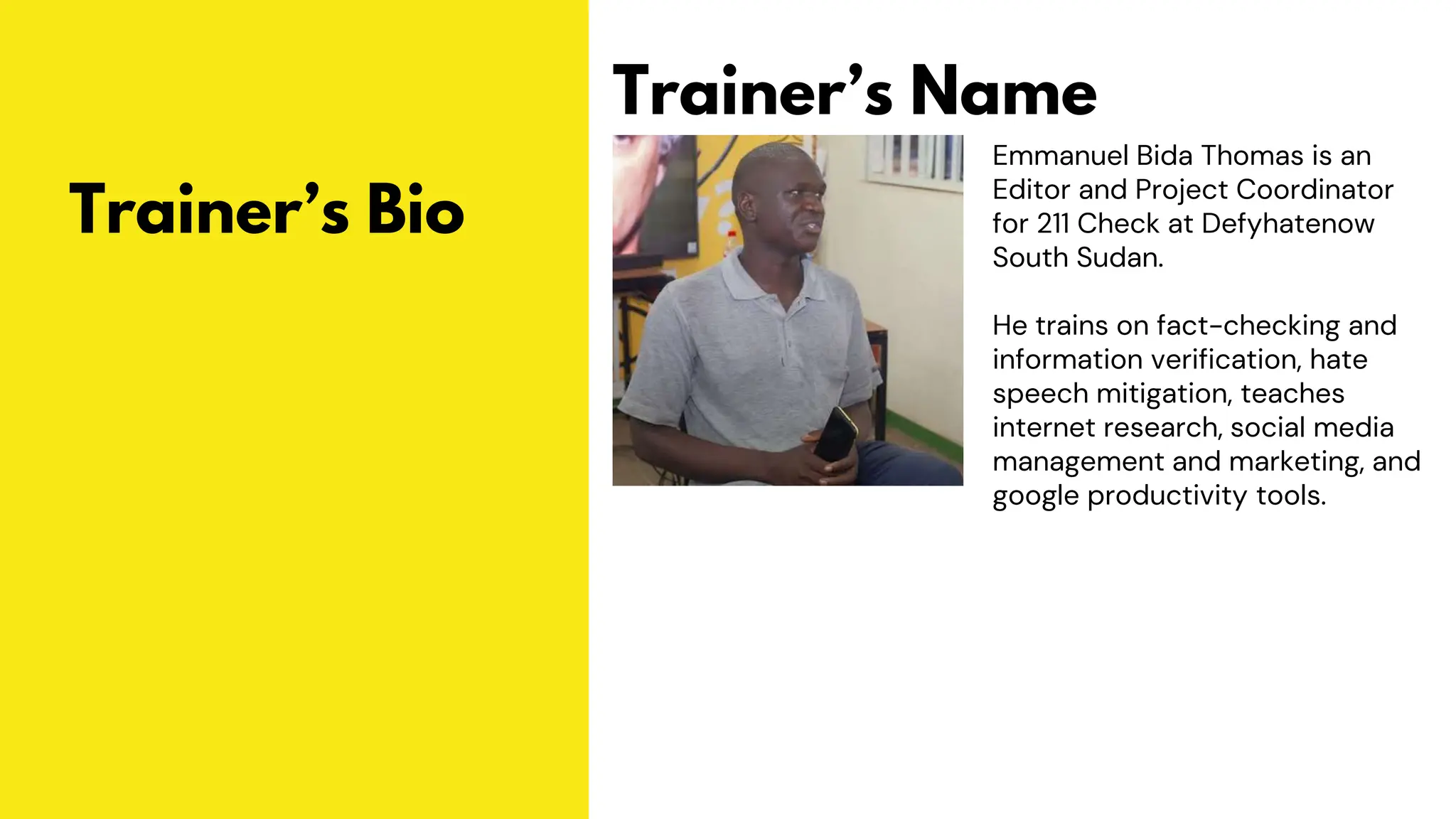
Trainer’s Bio
Emmanuel Bida Thomas is an
Editor and Project Coordinator
for 211 Check at Defyhatenow
South Sudan.
He trains on fact-checking and
information verification, hate
speech mitigation, teaches
internet research, social media
management and marketing, and
google productivity tools.
Trainer’s Name
Training
Content
Outline
• Hate Speech Mitigation
• Importance of Research
and Documentation
• Mapping Systems and
Structures
Training
Objectives
Equip participants with the knowledge and skills to
identify hate speech and differentiate it from
freedom of expression, fostering critical thinking and
media literacy.
Equip
Educate participants on the importance of
documenting offline and online hate speech
incidents and guide effective reporting mechanisms.
Educate
Inspire participants to actively counter hate speech
by promoting dialogue, engaging in counter-
narratives, advocating for legislative measures, and
fostering inclusive and respectful communities.
Inspire
Definition of Hate Speech
It is important to note that hate speech is not protected
by freedom of speech, as it infringes upon the rights and
well-being of others.
Hate speech refers to any form of communication, be it
spoken, written, or symbolic, that promotes or incites
violence, discrimination, prejudice, or hostility against
individuals or groups based on attributes such as race,
ethnicity, religion, gender, sexual orientation, or disability.
Hate Speech Attributes
Hate speech often emerges from an “us vs. them” conceptual framework, in which
individuals differentiate the group they believe they belong to, or the “in-group,”
from the “out-group.”
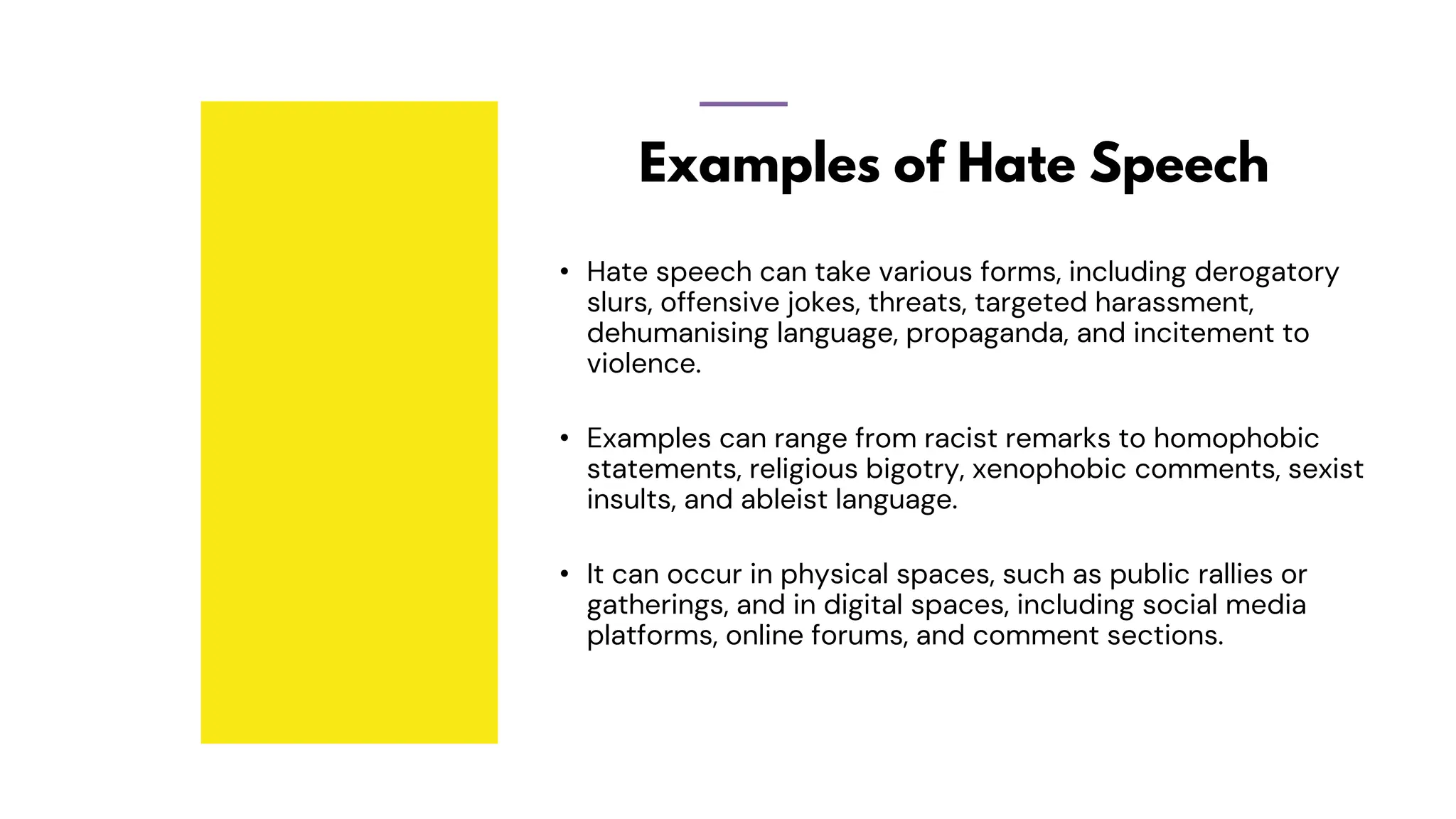
Hate speech can be conveyed through any form of expression, including
images, cartoons, memes, objects, gestures and symbols and it can be
disseminated offline or online.
Hate speech is “discriminatory” (biased, bigoted or intolerant) or “pejorative”
(prejudiced, contemptuous or demeaning) of an individual or group.
Hate speech calls out real or perceived “identity factors” of an individual or a
group, including: “religion, ethnicity, nationality, race, colour, descent, gender,”
but also characteristics such as language, economic or social origin, disability,
health status, or sexual orientation, among many others.
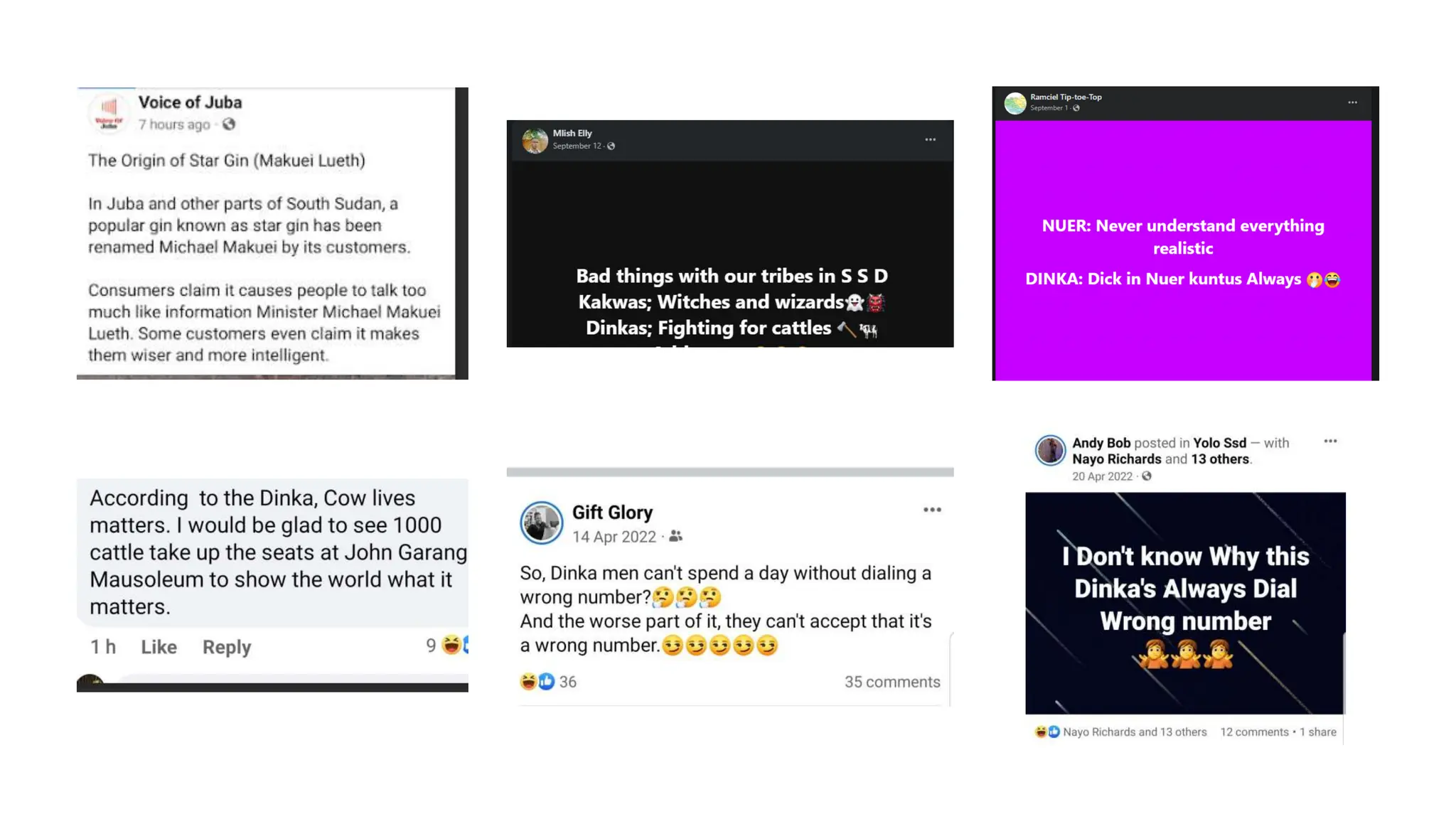
Examples of Hate Speech
• Hate speech can take various forms, including derogatory
slurs, offensive jokes, threats, targeted harassment,
dehumanising language, propaganda, and incitement to
violence.
• Examples can range from racist remarks to homophobic
statements, religious bigotry, xenophobic comments, sexist
insults, and ableist language.
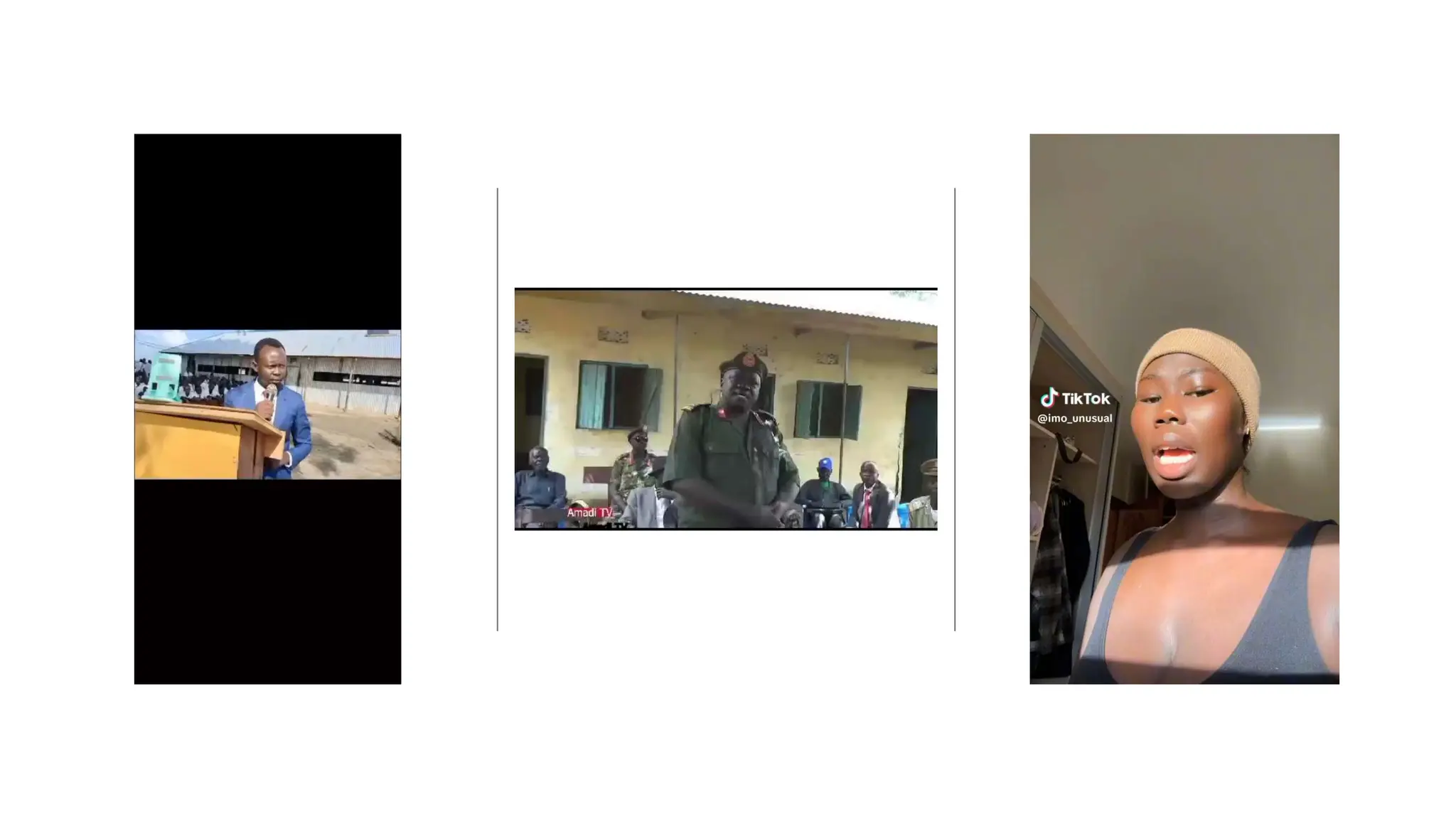
• It can occur in physical spaces, such as public rallies or
gatherings, and in digital spaces, including social media
platforms, online forums, and comment sections.
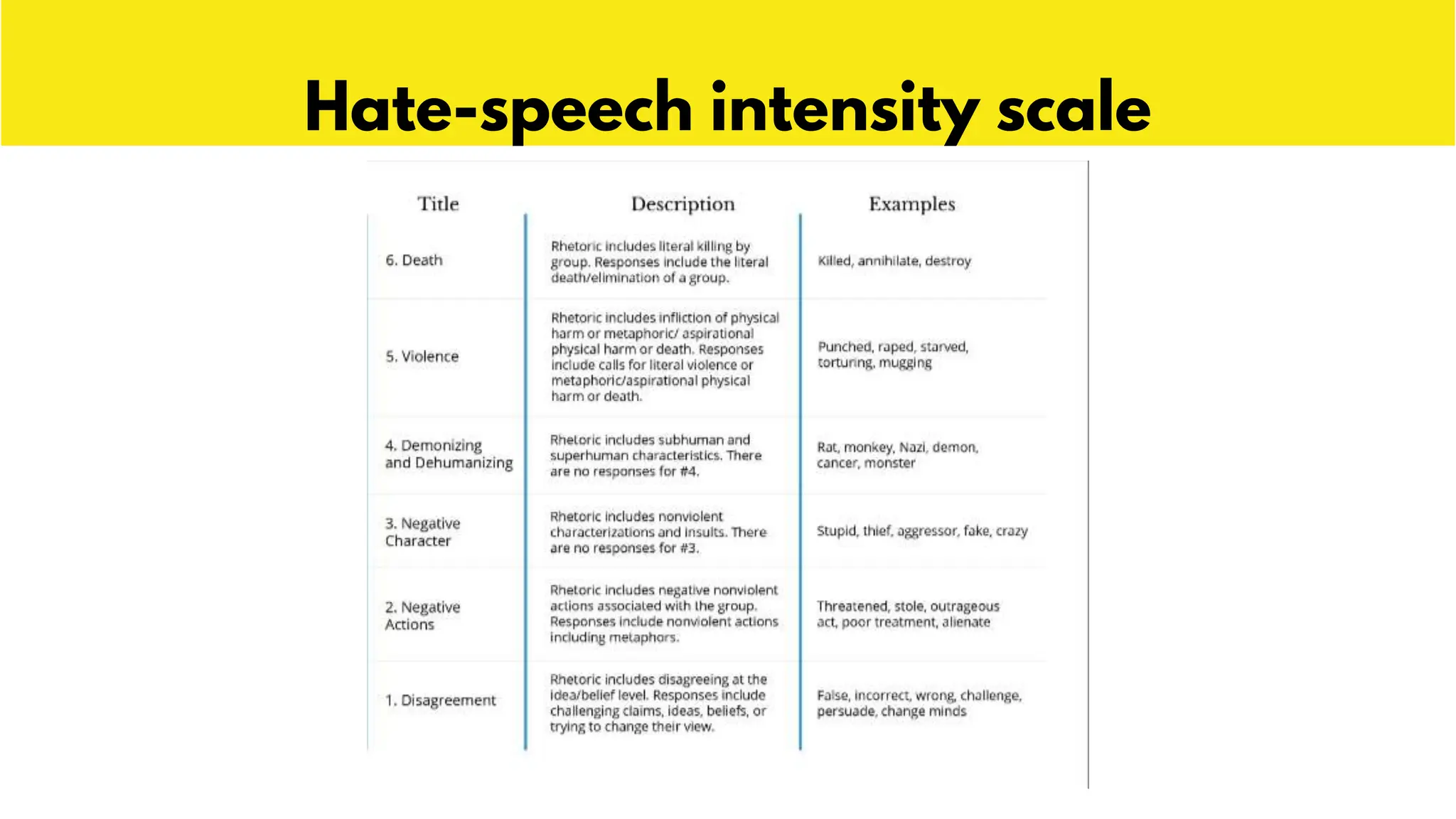
Hate-speech intensity scale
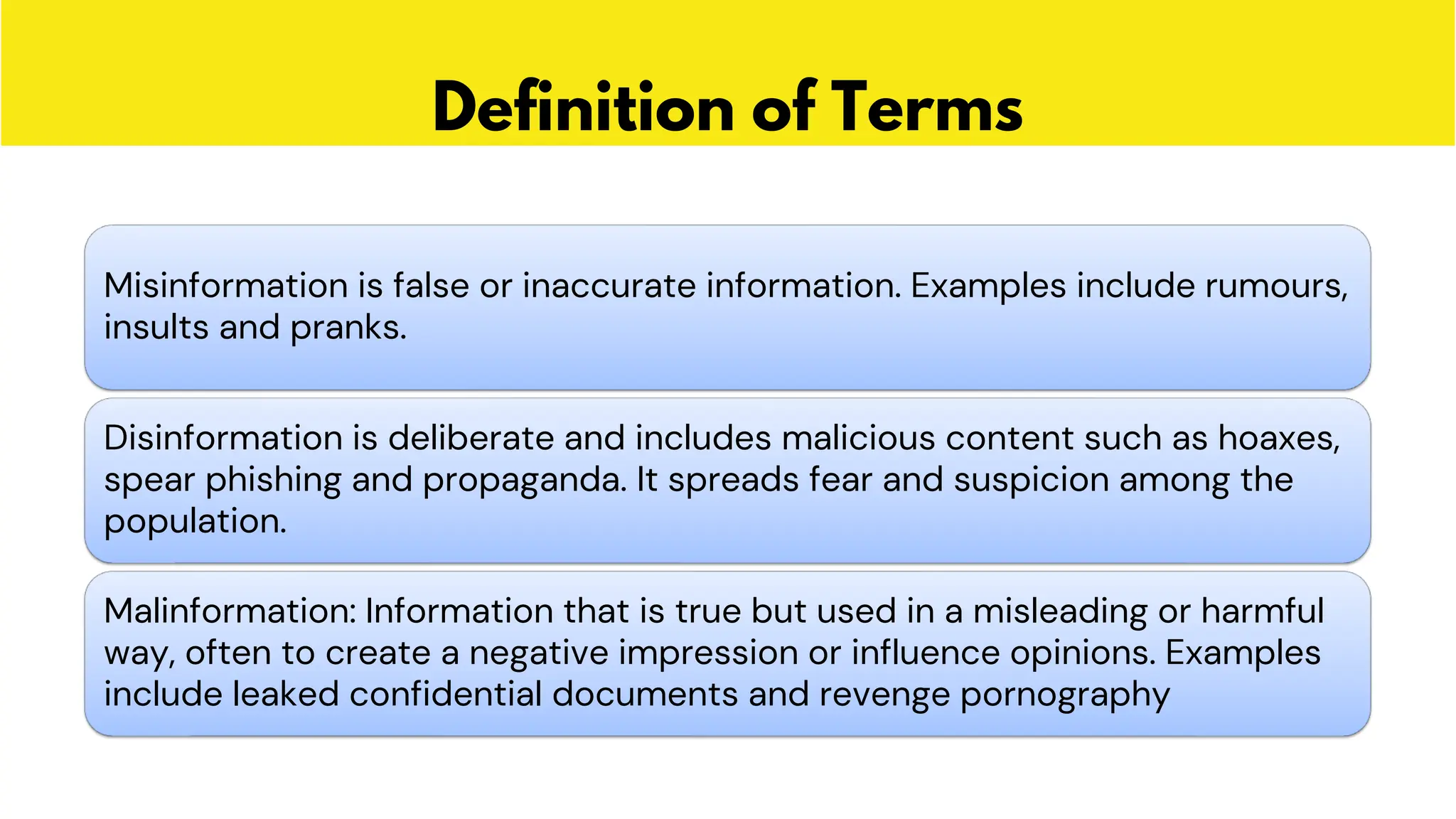
Definition of Terms
Misinformation is false or inaccurate information. Examples include rumours,
insults and pranks.
Disinformation is deliberate and includes malicious content such as hoaxes,
spear phishing and propaganda. It spreads fear and suspicion among the
population.
Malinformation: Information that is true but used in a misleading or harmful
way, often to create a negative impression or influence opinions. Examples
include leaked confidential documents and revenge pornography
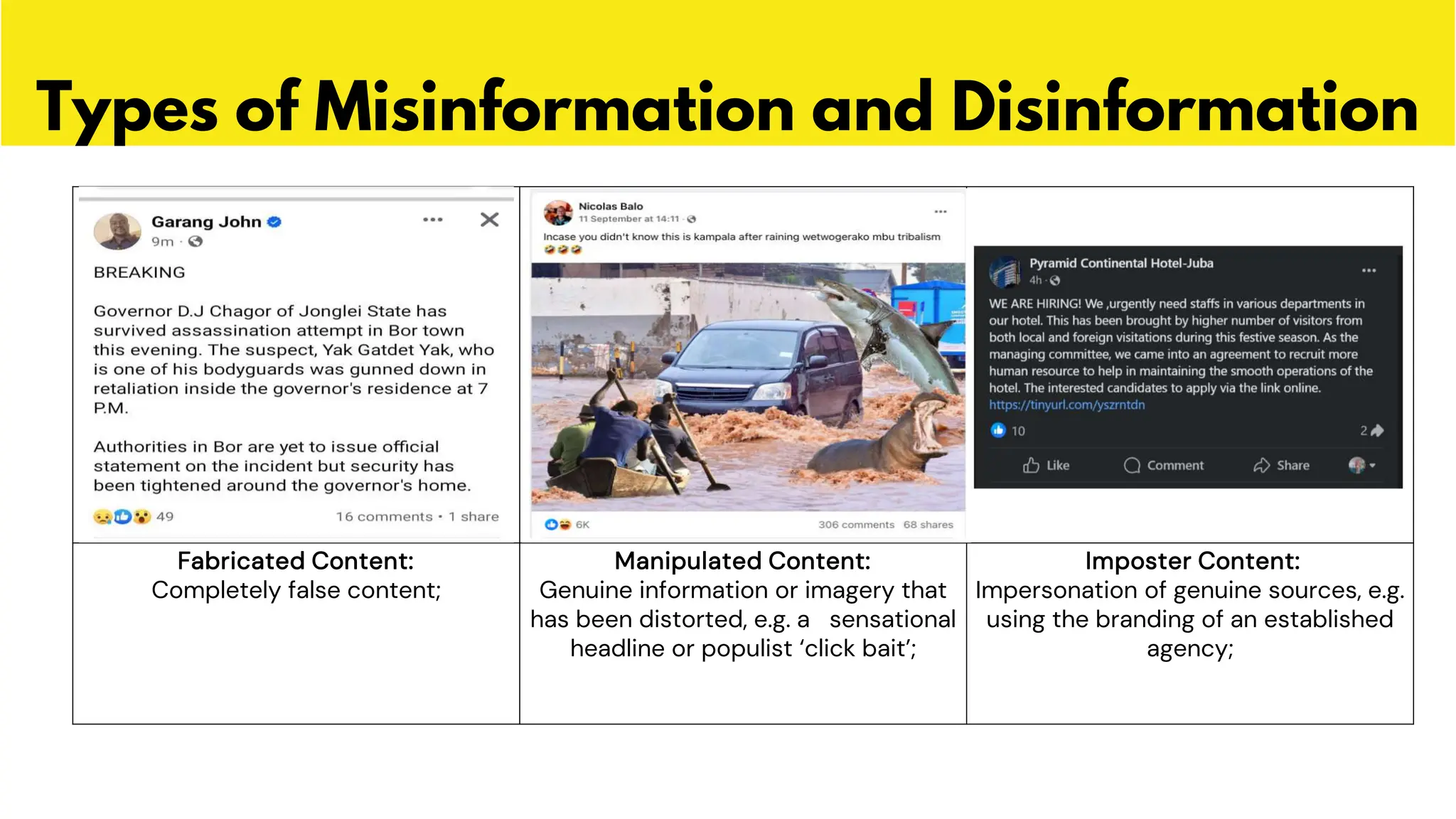
Types of Misinformation and Disinformation
Fabricated Content:
Completely false content;
Manipulated Content:
Genuine information or imagery that
has been distorted, e.g. a sensational
headline or populist ‘click bait’;
Imposter Content:
Impersonation of genuine sources, e.g.
using the branding of an established
agency;
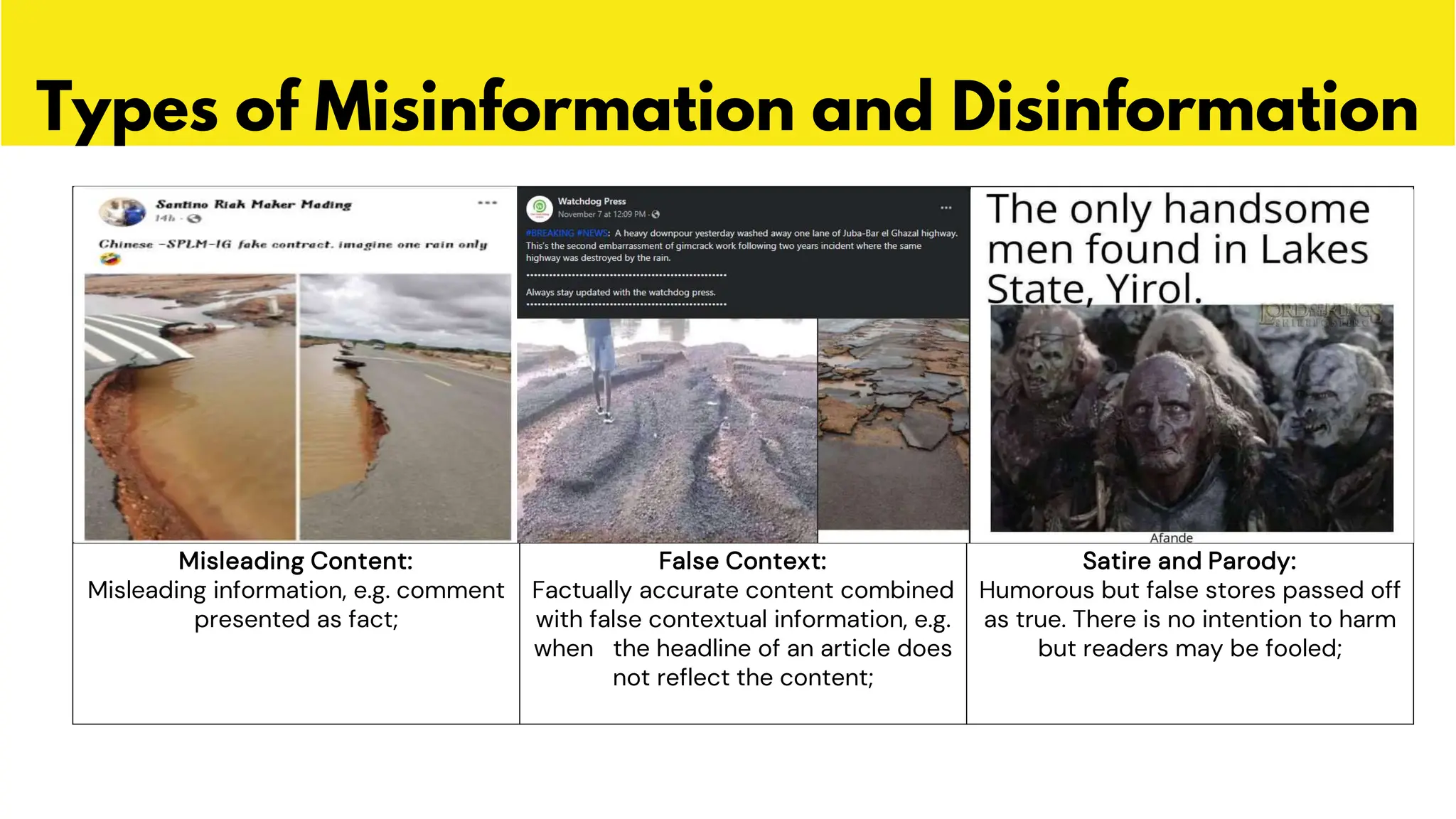
Types of Misinformation and Disinformation
Misleading Content:
Misleading information, e.g. comment
presented as fact;
False Context:
Factually accurate content combined
with false contextual information, e.g.
when the headline of an article does
not reflect the content;
Satire and Parody:
Humorous but false stores passed off
as true. There is no intention to harm
but readers may be fooled;
Types of Misinformation and Disinformation
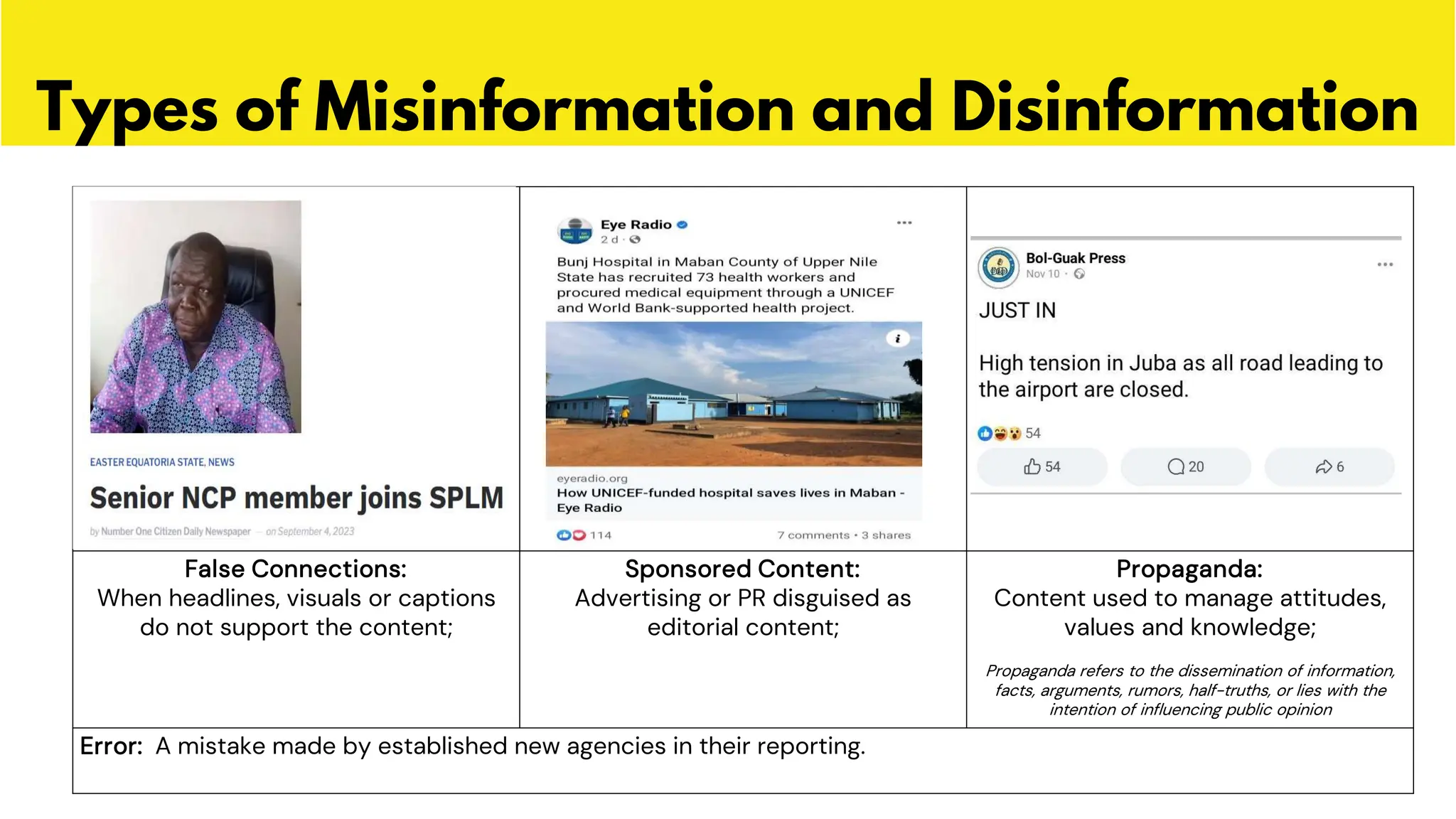
False Connections:
When headlines, visuals or captions
do not support the content;
Sponsored Content:
Advertising or PR disguised as
editorial content;
Propaganda:
Content used to manage attitudes,
values and knowledge;
Propaganda refers to the dissemination of information,
facts, arguments, rumors, half-truths, or lies with the
intention of influencing public opinion
Error: A mistake made by established new agencies in their reporting.
BRIEF BREAK & REFLECTION…
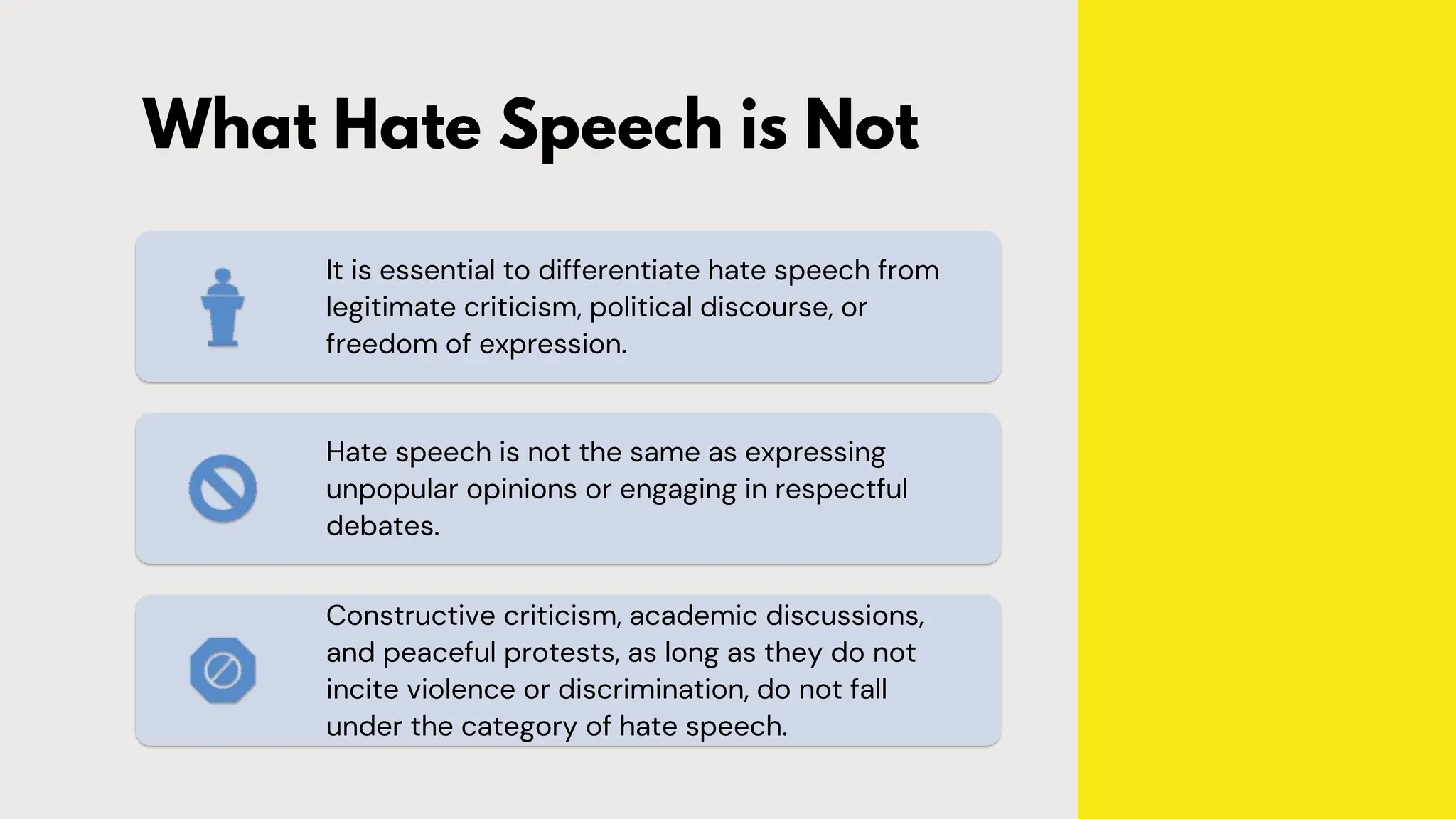
What Hate Speech is Not
It is essential to differentiate hate speech from
legitimate criticism, political discourse, or
freedom of expression.
Hate speech is not the same as expressing
unpopular opinions or engaging in respectful
debates.
Constructive criticism, academic discussions,
and peaceful protests, as long as they do not
incite violence or discrimination, do not fall
under the category of hate speech.
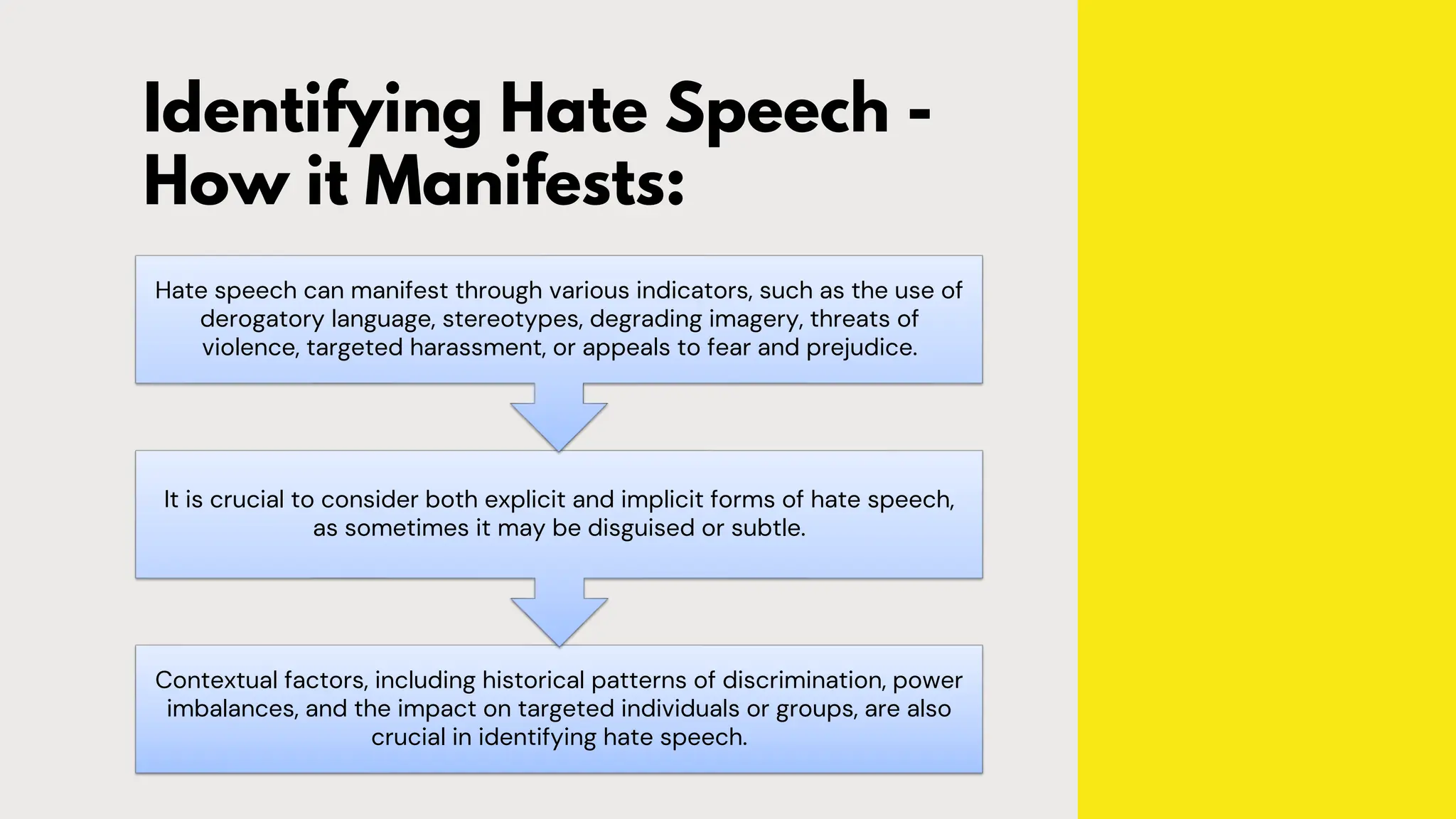
Identifying Hate Speech -
How it Manifests:
Contextual factors, including historical patterns of discrimination, power
imbalances, and the impact on targeted individuals or groups, are also
crucial in identifying hate speech.
It is crucial to consider both explicit and implicit forms of hate speech,
as sometimes it may be disguised or subtle.
Hate speech can manifest through various indicators, such as the use of
derogatory language, stereotypes, degrading imagery, threats of
violence, targeted harassment, or appeals to fear and prejudice.
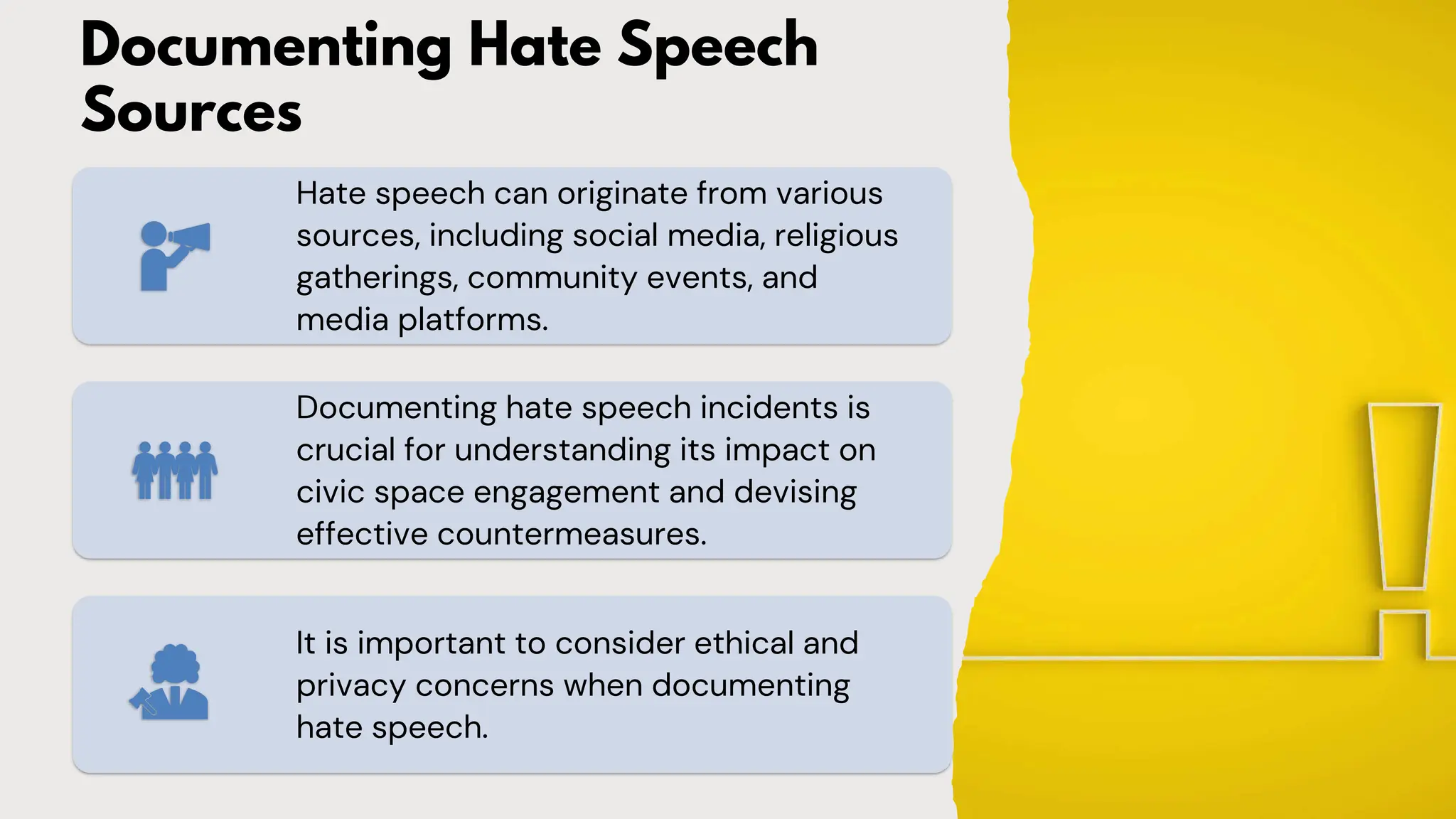
Documenting Hate Speech
Sources
Hate speech can originate from various
sources, including social media, religious
gatherings, community events, and
media platforms.
Documenting hate speech incidents is
crucial for understanding its impact on
civic space engagement and devising
effective countermeasures.
It is important to consider ethical and
privacy concerns when documenting
hate speech.
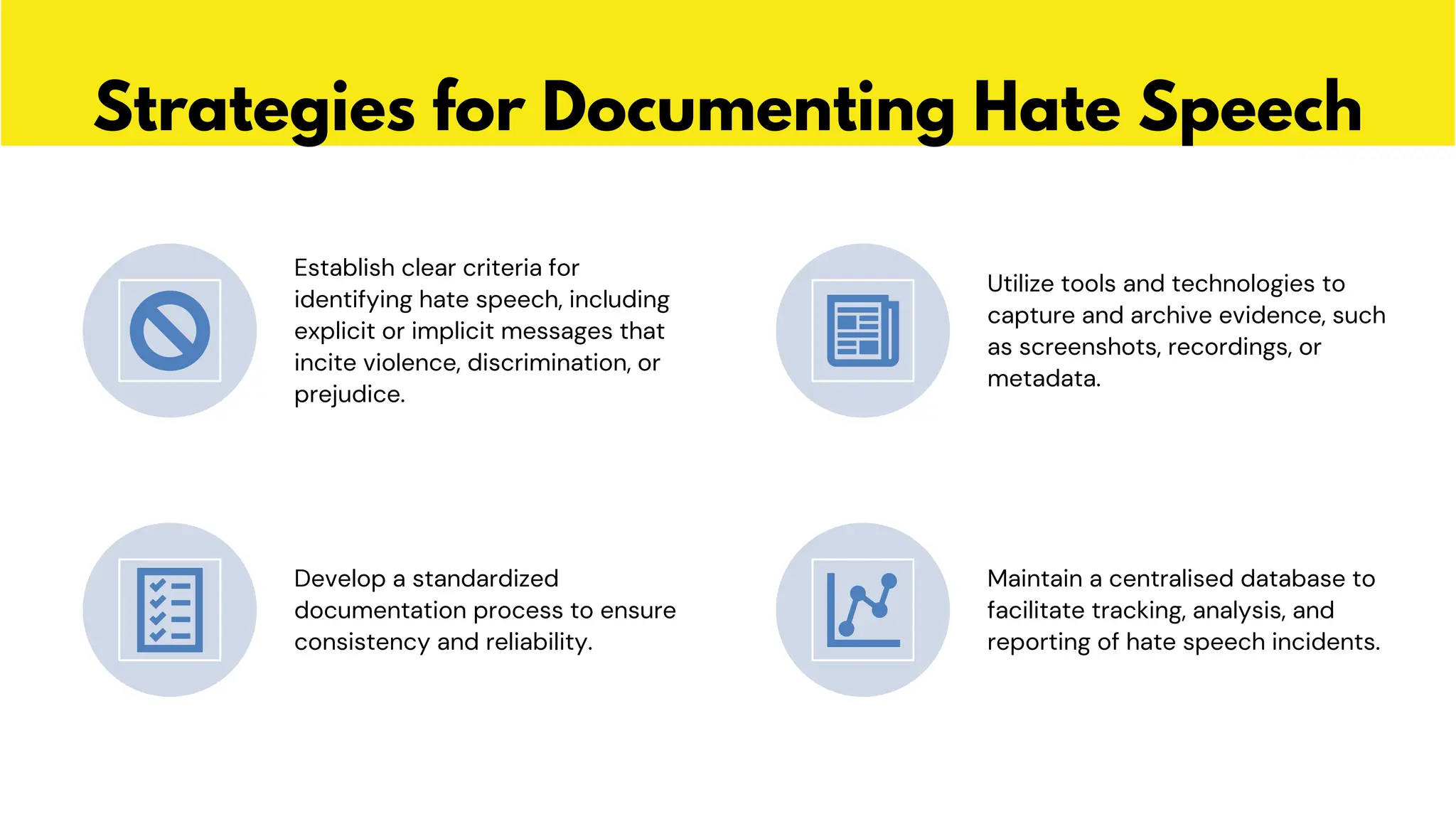
Establish clear criteria for
identifying hate speech, including
explicit or implicit messages that
incite violence, discrimination, or
prejudice.
Utilize tools and technologies to
capture and archive evidence, such
as screenshots, recordings, or
metadata.
Develop a standardized
documentation process to ensure
consistency and reliability.
Maintain a centralised database to
facilitate tracking, analysis, and
reporting of hate speech incidents.
Strategies for Documenting Hate Speech
How to Document Hate Speech
- Offline/Online
Offline: Documenting hate speech incidents in physical
spaces can involve collecting eyewitness accounts, audio or
video recordings, photographs, and written testimonials.
Online: Documenting hate speech on digital platforms can
include capturing screenshots, archiving web pages,
recording video or audio content, and preserving metadata.
Both offline and online documentation should include
relevant details such as dates, locations, individuals involved,
and the specific content of the hate speech.
Countering Hate Speech
• Education and Awareness: Promote education and awareness
campaigns to help individuals understand the consequences of
hate speech and foster empathy and tolerance.
• Media Literacy: Enhance media literacy programs to develop
critical thinking skills and equip individuals to identify and
challenge hate speech.
• Reporting Mechanisms: Establish accessible reporting
mechanisms for hate speech incidents, ensuring swift and
effective responses to address and mitigate harm.
• Dialogue and Counter-Narratives: Encourage dialogue and
constructive discussions that counter hate speech with respect,
inclusivity, and understanding messages.
• Legislative Measures: Advocate for robust legal frameworks and
policies that hold perpetrators accountable for hate speech
while safeguarding the right to freedom of expression.
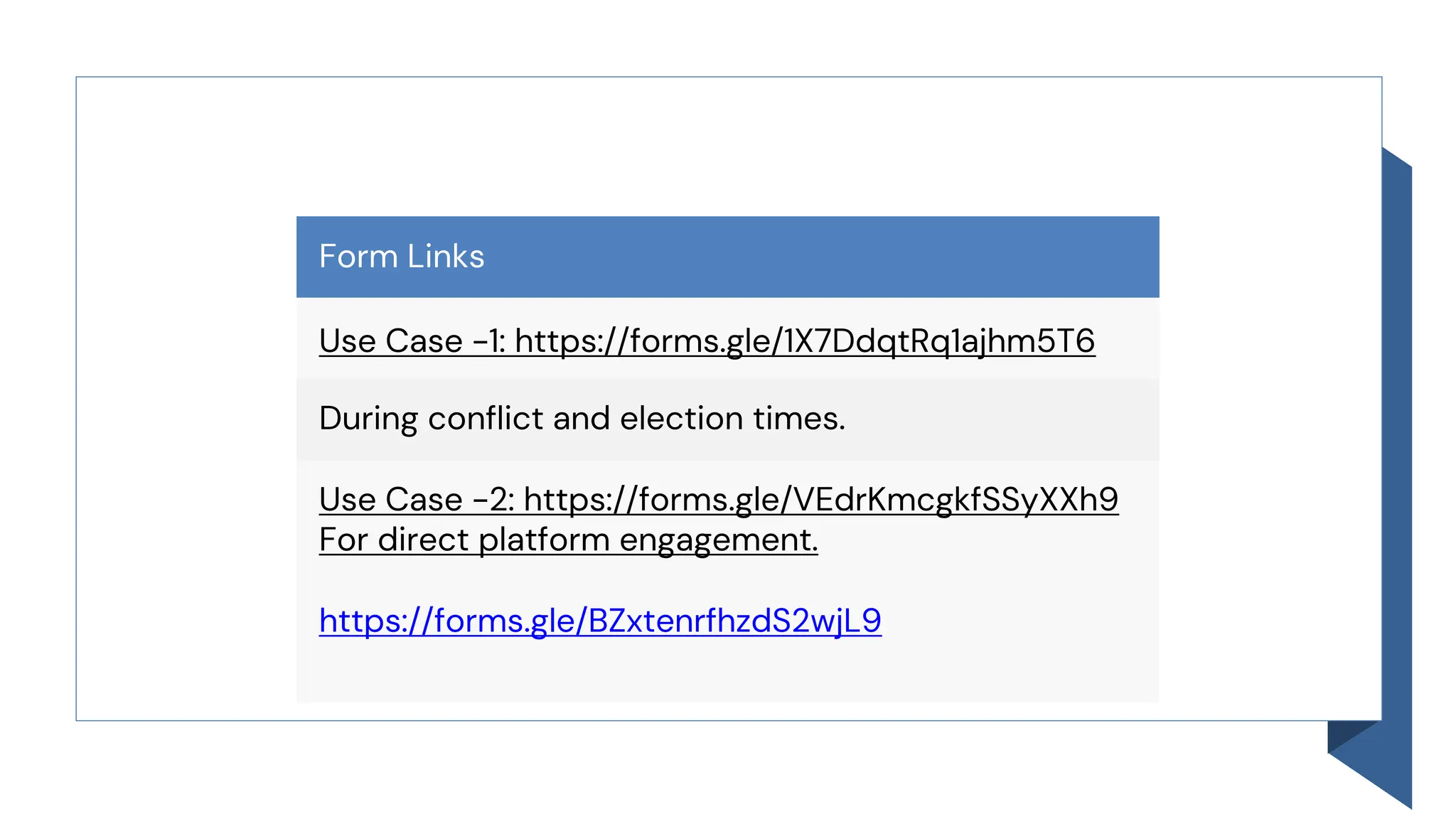
Form Links
Use Case -1: https://forms.gle/1X7DdqtRq1ajhm5T6
During conflict and election times.
Use Case -2: https://forms.gle/VEdrKmcgkfSSyXXh9
For direct platform engagement.
https://forms.gle/BZxtenrfhzdS2wjL9
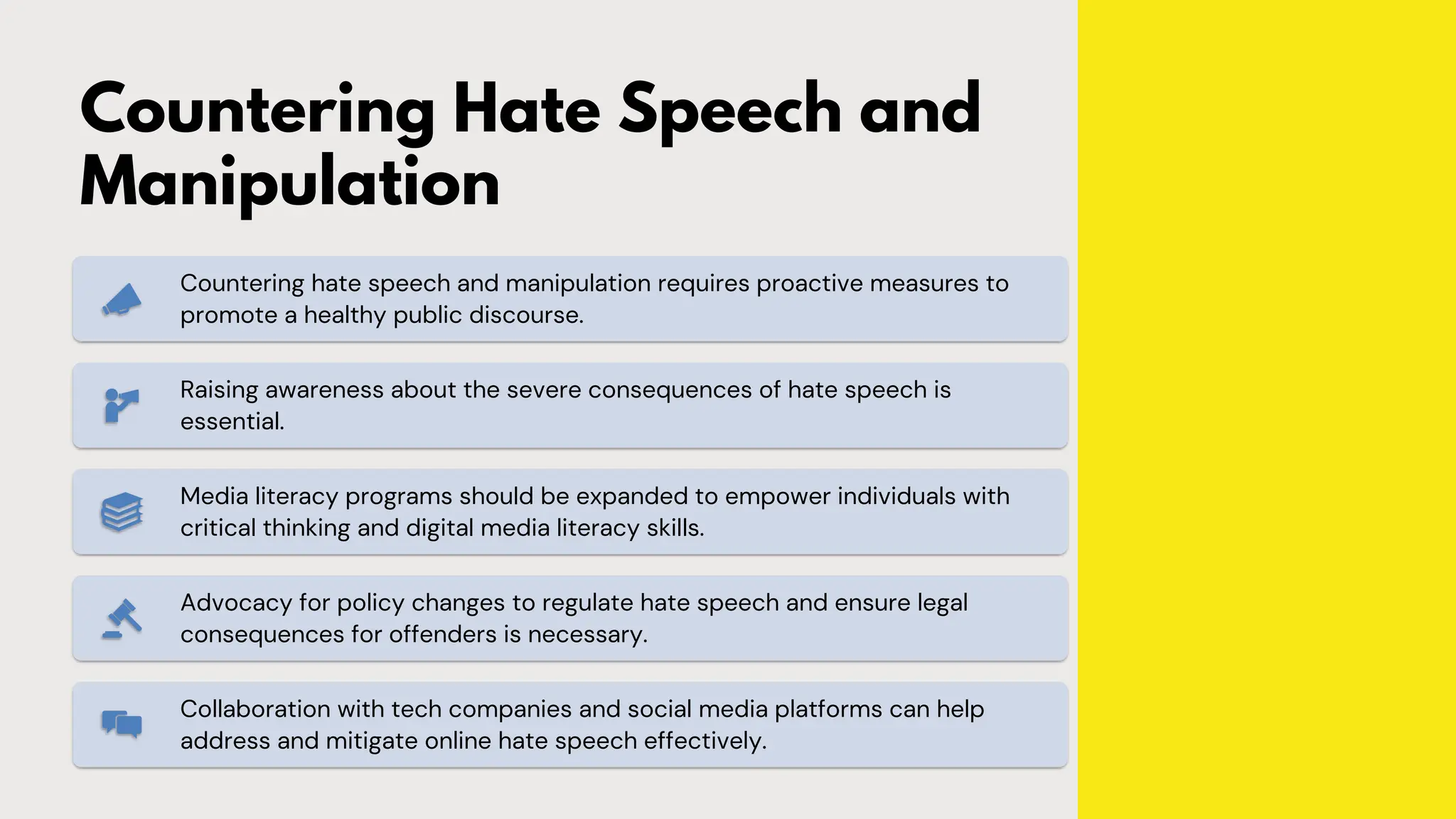
Countering Hate Speech and
Manipulation
Countering hate speech and manipulation requires proactive measures to
promote a healthy public discourse.
Raising awareness about the severe consequences of hate speech is
essential.
Media literacy programs should be expanded to empower individuals with
critical thinking and digital media literacy skills.
Advocacy for policy changes to regulate hate speech and ensure legal
consequences for offenders is necessary.
Collaboration with tech companies and social media platforms can help
address and mitigate online hate speech effectively.
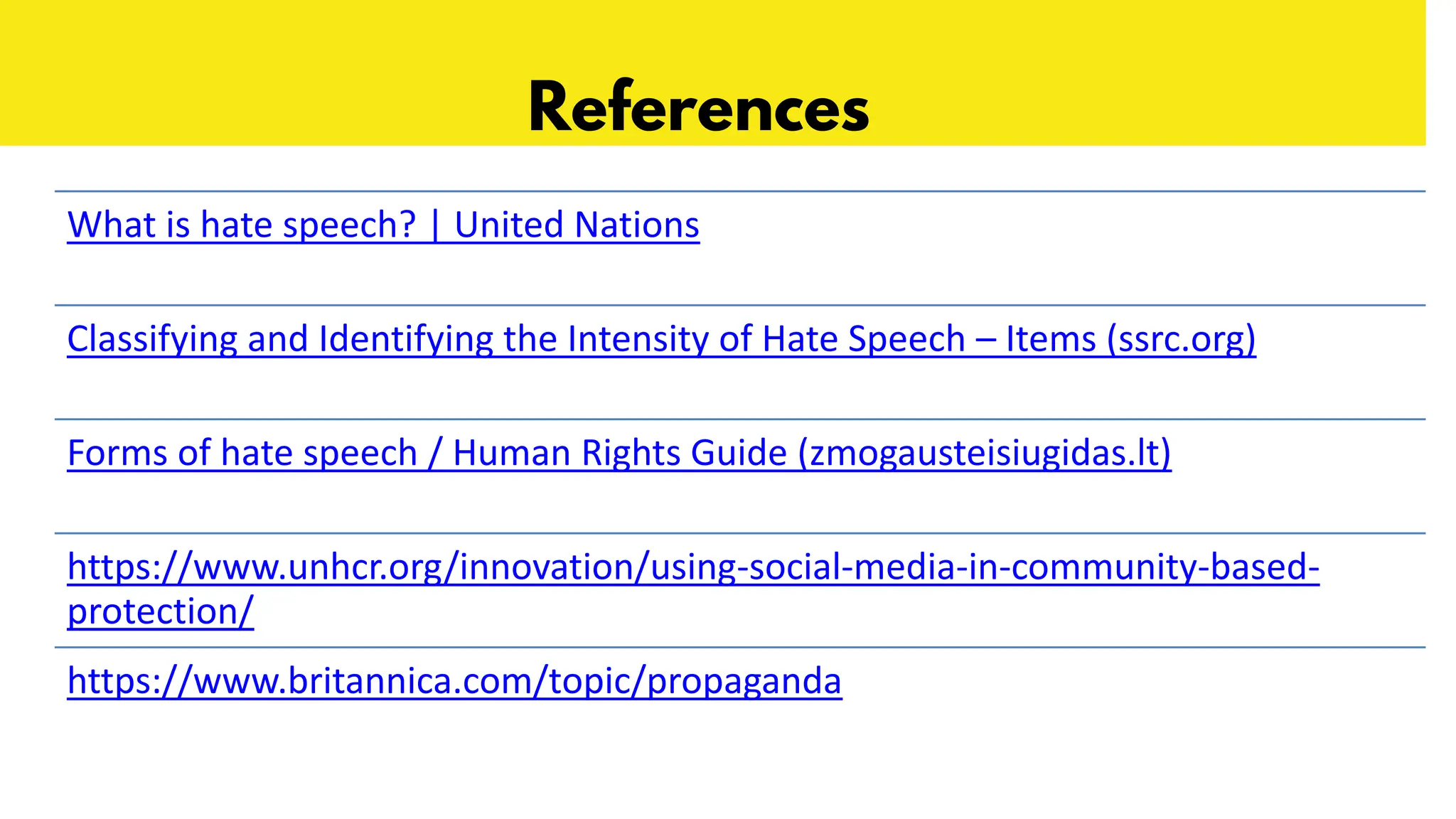
References
What is hate speech? | United Nations
Classifying and Identifying the Intensity of Hate Speech – Items (ssrc.org)
Forms of hate speech / Human Rights Guide (zmogausteisiugidas.lt)
https://www.unhcr.org/innovation/using-social-media-in-community-based-
protection/
https://www.britannica.com/topic/propaganda
THANK YOU!
SEIZING DIGITAL SPACES FOR PEACEBUILDING
info@211check.org | +211917298255
2023

Mapping, Researching and Documenting Hate Speech_Skills for Civil Society Organisations

  • 1.
    Mapping, Researching and DocumentingHate Speech 22nd November 2023 Skills for Civil Society Organisations
  • 2.
    Trainer’s Bio Emmanuel BidaThomas is an Editor and Project Coordinator for 211 Check at Defyhatenow South Sudan. He trains on fact-checking and information verification, hate speech mitigation, teaches internet research, social media management and marketing, and google productivity tools. Trainer’s Name
  • 3.
    Training Content Outline • Hate SpeechMitigation • Importance of Research and Documentation • Mapping Systems and Structures
  • 4.
    Training Objectives Equip participants withthe knowledge and skills to identify hate speech and differentiate it from freedom of expression, fostering critical thinking and media literacy. Equip Educate participants on the importance of documenting offline and online hate speech incidents and guide effective reporting mechanisms. Educate Inspire participants to actively counter hate speech by promoting dialogue, engaging in counter- narratives, advocating for legislative measures, and fostering inclusive and respectful communities. Inspire
  • 5.
    Definition of HateSpeech It is important to note that hate speech is not protected by freedom of speech, as it infringes upon the rights and well-being of others. Hate speech refers to any form of communication, be it spoken, written, or symbolic, that promotes or incites violence, discrimination, prejudice, or hostility against individuals or groups based on attributes such as race, ethnicity, religion, gender, sexual orientation, or disability.
  • 6.
    Hate Speech Attributes Hatespeech often emerges from an “us vs. them” conceptual framework, in which individuals differentiate the group they believe they belong to, or the “in-group,” from the “out-group.” Hate speech can be conveyed through any form of expression, including images, cartoons, memes, objects, gestures and symbols and it can be disseminated offline or online. Hate speech is “discriminatory” (biased, bigoted or intolerant) or “pejorative” (prejudiced, contemptuous or demeaning) of an individual or group. Hate speech calls out real or perceived “identity factors” of an individual or a group, including: “religion, ethnicity, nationality, race, colour, descent, gender,” but also characteristics such as language, economic or social origin, disability, health status, or sexual orientation, among many others.
  • 7.
    Examples of HateSpeech • Hate speech can take various forms, including derogatory slurs, offensive jokes, threats, targeted harassment, dehumanising language, propaganda, and incitement to violence. • Examples can range from racist remarks to homophobic statements, religious bigotry, xenophobic comments, sexist insults, and ableist language. • It can occur in physical spaces, such as public rallies or gatherings, and in digital spaces, including social media platforms, online forums, and comment sections.
  • 10.
  • 11.
    Definition of Terms Misinformationis false or inaccurate information. Examples include rumours, insults and pranks. Disinformation is deliberate and includes malicious content such as hoaxes, spear phishing and propaganda. It spreads fear and suspicion among the population. Malinformation: Information that is true but used in a misleading or harmful way, often to create a negative impression or influence opinions. Examples include leaked confidential documents and revenge pornography
  • 12.
    Types of Misinformationand Disinformation Fabricated Content: Completely false content; Manipulated Content: Genuine information or imagery that has been distorted, e.g. a sensational headline or populist ‘click bait’; Imposter Content: Impersonation of genuine sources, e.g. using the branding of an established agency;
  • 13.
    Types of Misinformationand Disinformation Misleading Content: Misleading information, e.g. comment presented as fact; False Context: Factually accurate content combined with false contextual information, e.g. when the headline of an article does not reflect the content; Satire and Parody: Humorous but false stores passed off as true. There is no intention to harm but readers may be fooled;
  • 14.
    Types of Misinformationand Disinformation False Connections: When headlines, visuals or captions do not support the content; Sponsored Content: Advertising or PR disguised as editorial content; Propaganda: Content used to manage attitudes, values and knowledge; Propaganda refers to the dissemination of information, facts, arguments, rumors, half-truths, or lies with the intention of influencing public opinion Error: A mistake made by established new agencies in their reporting.
  • 15.
    BRIEF BREAK &REFLECTION…
  • 16.
    What Hate Speechis Not It is essential to differentiate hate speech from legitimate criticism, political discourse, or freedom of expression. Hate speech is not the same as expressing unpopular opinions or engaging in respectful debates. Constructive criticism, academic discussions, and peaceful protests, as long as they do not incite violence or discrimination, do not fall under the category of hate speech.
  • 17.
    Identifying Hate Speech- How it Manifests: Contextual factors, including historical patterns of discrimination, power imbalances, and the impact on targeted individuals or groups, are also crucial in identifying hate speech. It is crucial to consider both explicit and implicit forms of hate speech, as sometimes it may be disguised or subtle. Hate speech can manifest through various indicators, such as the use of derogatory language, stereotypes, degrading imagery, threats of violence, targeted harassment, or appeals to fear and prejudice.
  • 18.
    Documenting Hate Speech Sources Hatespeech can originate from various sources, including social media, religious gatherings, community events, and media platforms. Documenting hate speech incidents is crucial for understanding its impact on civic space engagement and devising effective countermeasures. It is important to consider ethical and privacy concerns when documenting hate speech.
  • 19.
    Establish clear criteriafor identifying hate speech, including explicit or implicit messages that incite violence, discrimination, or prejudice. Utilize tools and technologies to capture and archive evidence, such as screenshots, recordings, or metadata. Develop a standardized documentation process to ensure consistency and reliability. Maintain a centralised database to facilitate tracking, analysis, and reporting of hate speech incidents. Strategies for Documenting Hate Speech
  • 20.
    How to DocumentHate Speech - Offline/Online Offline: Documenting hate speech incidents in physical spaces can involve collecting eyewitness accounts, audio or video recordings, photographs, and written testimonials. Online: Documenting hate speech on digital platforms can include capturing screenshots, archiving web pages, recording video or audio content, and preserving metadata. Both offline and online documentation should include relevant details such as dates, locations, individuals involved, and the specific content of the hate speech.
  • 21.
    Countering Hate Speech •Education and Awareness: Promote education and awareness campaigns to help individuals understand the consequences of hate speech and foster empathy and tolerance. • Media Literacy: Enhance media literacy programs to develop critical thinking skills and equip individuals to identify and challenge hate speech. • Reporting Mechanisms: Establish accessible reporting mechanisms for hate speech incidents, ensuring swift and effective responses to address and mitigate harm. • Dialogue and Counter-Narratives: Encourage dialogue and constructive discussions that counter hate speech with respect, inclusivity, and understanding messages. • Legislative Measures: Advocate for robust legal frameworks and policies that hold perpetrators accountable for hate speech while safeguarding the right to freedom of expression.
  • 22.
    Form Links Use Case-1: https://forms.gle/1X7DdqtRq1ajhm5T6 During conflict and election times. Use Case -2: https://forms.gle/VEdrKmcgkfSSyXXh9 For direct platform engagement. https://forms.gle/BZxtenrfhzdS2wjL9
  • 23.
    Countering Hate Speechand Manipulation Countering hate speech and manipulation requires proactive measures to promote a healthy public discourse. Raising awareness about the severe consequences of hate speech is essential. Media literacy programs should be expanded to empower individuals with critical thinking and digital media literacy skills. Advocacy for policy changes to regulate hate speech and ensure legal consequences for offenders is necessary. Collaboration with tech companies and social media platforms can help address and mitigate online hate speech effectively.
  • 24.
    References What is hatespeech? | United Nations Classifying and Identifying the Intensity of Hate Speech – Items (ssrc.org) Forms of hate speech / Human Rights Guide (zmogausteisiugidas.lt) https://www.unhcr.org/innovation/using-social-media-in-community-based- protection/ https://www.britannica.com/topic/propaganda
  • 25.
    THANK YOU! SEIZING DIGITALSPACES FOR PEACEBUILDING info@211check.org | +211917298255 2023