The Diversity Of
American Colonial
Societies 1530-1770
By Teonna Butler
pd. 7
The Columbian Exchange
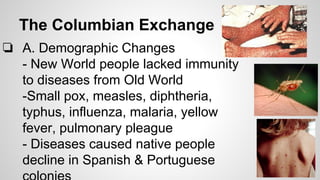
❏ A. Demographic Changes
- New World people lacked immunity
to diseases from Old World
-Small pox, measles, diphtheria,
typhus, influenza, malaria, yellow
fever, pulmonary pleague
- Diseases caused native people
decline in Spanish & Portuguese
The Columbian Exchange
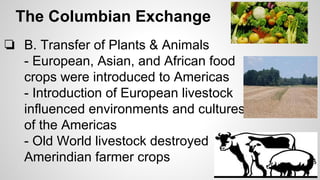
❏ B. Transfer of Plants & Animals
- European, Asian, and African food
crops were introduced to Americas
- Introduction of European livestock
influenced environments and cultures
of the Americas
- Old World livestock destroyed
Amerindian farmer crops
Spanish America & Brazil
❏ A. State and Church
- Spanish crown tried to exert control over
Amerindian colonies
- Years of neglect and mismanagement
Portuguese appointed viceroy to Brazil
- Governmental institutions established
developed bureaucracies that thwarted
economic initiative and political
experimentation
Spanish America & Brazil
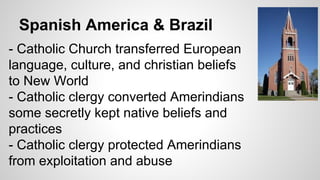
- Catholic Church transferred European
language, culture, and christian beliefs
to New World
- Catholic clergy converted Amerindians
some secretly kept native beliefs and
practices
- Catholic clergy protected Amerindians
from exploitation and abuse
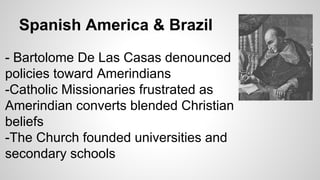
Spanish America & Brazil
- Bartolome De Las Casas denounced
policies toward Amerindians
-Catholic Missionaries frustrated as
Amerindian converts blended Christian
beliefs
-The Church founded universities and
secondary schools
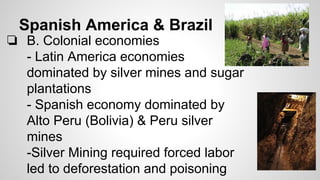
Spanish America & Brazil

❏ B. Colonial economies
- Latin America economies
dominated by silver mines and sugar
plantations
- Spanish economy dominated by
Alto Peru (Bolivia) & Peru silver
mines
-Silver Mining required forced labor
led to deforestation and poisoning
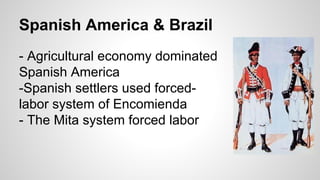
Spanish America & Brazil
- Agricultural economy dominated
Spanish America
-Spanish settlers used forcedlabor system of Encomienda
- The Mita system forced labor
Spanish America & Brazil
- Portuguese developed African slave- labor
sugar plantation system
-Brazilian plantation used Amerindian slaves
-Silver and sugar integrated American colonial
economies to World trade
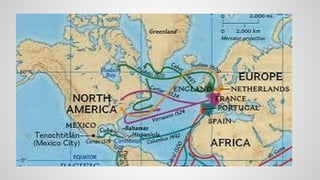
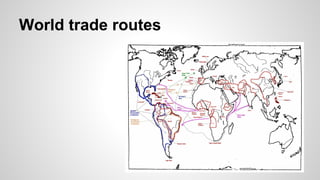
World trade routes
Spanish America & Brazil

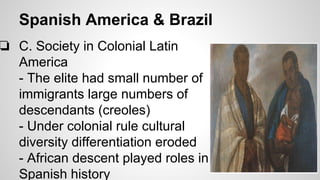
❏ C. Society in Colonial Latin
America
- The elite had small number of
immigrants large numbers of
descendants (creoles)
- Under colonial rule cultural
diversity differentiation eroded
- African descent played roles in
Spanish history
Spanish America & Brazil
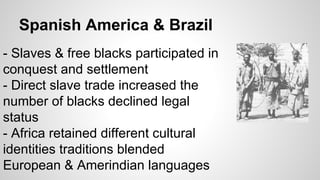
- Slaves & free blacks participated in
conquest and settlement
- Direct slave trade increased the
number of blacks declined legal
status
- Africa retained different cultural
identities traditions blended
European & Amerindian languages
Spanish America & Brazil
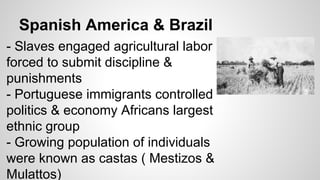
- Slaves engaged agricultural labor
forced to submit discipline &
punishments
- Portuguese immigrants controlled
politics & economy Africans largest
ethnic group
- Growing population of individuals
were known as castas ( Mestizos &
Mulattos)
English & French Colonies in North
America
❏ A. Early English Experiments
-Attempts to establish colonies in Americas
ended in failure
- In 17th century hope colonies proved
profitable investments successfully colonized
Ireland
- Led to new wave of interest in establishing
colonies in the New World
English & French Colonies in North
America
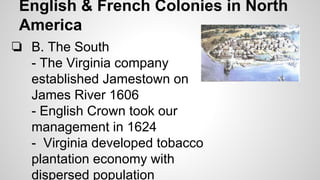
❏ B. The South
- The Virginia company
established Jamestown on
James River 1606
- English Crown took our
management in 1624
- Virginia developed tobacco
plantation economy with
dispersed population
English & French Colonies in North
America
- Plantations in Chesapeake Bay area relied on
servants for labor
- Planters prefer to invest in slaves: Slaves
population increased in 1660
-Virginia administered governor by
representatives in House of Burgesse
English & French Colonies in North
America
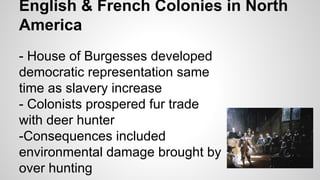
- House of Burgesses developed
democratic representation same
time as slavery increase
- Colonists prospered fur trade
with deer hunter
-Consequences included
environmental damage brought by
over hunting
English & French Colonies in North
America
- dependency on goods caused fighting over
hunting grounds
- unsuccessful Amerindian attacks on English
colonists in early 1700’s
- Southern part of Carolinas - settled by
planters
English & French Colonies in North
America
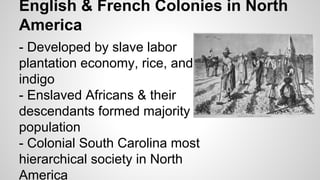
- Developed by slave labor
plantation economy, rice, and
indigo
- Enslaved Africans & their
descendants formed majority
population
- Colonial South Carolina most
hierarchical society in North
America
English & French Colonies in North
America
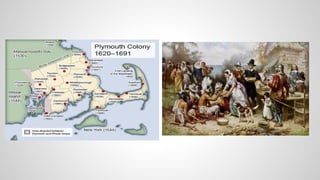
❏ C. New England
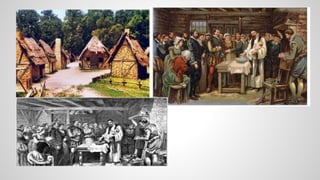
- Pilgrims wanted to break from
Church of England established
Plymouth colony
- Puritans wanted to reform joint stock
company (Massachusetts Bay Colony)
- Massachusetts Bay Colony : normal
gender balance increased population,
homogeneous, hierarchical
English & French Colonies in North
America
- Political institutions derived of charter: elected
governor lower legislative house
- Massachusetts economy: dependence on fur,
forest products, fish, commerce shipping.
- Merchants engaged diversified trade made
Boston largest city in America
English & French Colonies in North
America
❏ D. Middle Atlantic Region
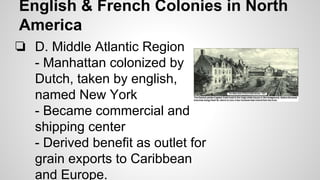
- Manhattan colonized by
Dutch, taken by english,
named New York
- Became commercial and
shipping center
- Derived benefit as outlet for
grain exports to Caribbean
and Europe.
English & French Colonies in North
America
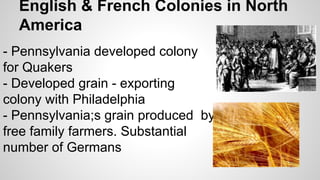
- Pennsylvania developed colony
for Quakers
- Developed grain - exporting
colony with Philadelphia
- Pennsylvania;s grain produced by
free family farmers. Substantial
number of Germans
English & French Colonies in North
America
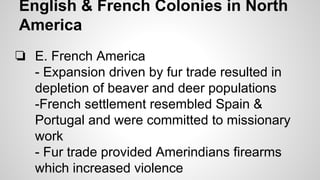
❏ E. French America
- Expansion driven by fur trade resulted in
depletion of beaver and deer populations
-French settlement resembled Spain &
Portugal and were committed to missionary
work
- Fur trade provided Amerindians firearms
which increased violence
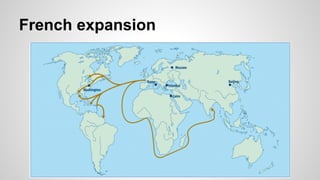
French expansion
English & French Colonies in North
America
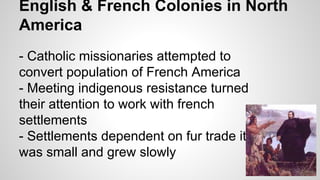
- Catholic missionaries attempted to
convert population of French America
- Meeting indigenous resistance turned
their attention to work with french
settlements
- Settlements dependent on fur trade it
was small and grew slowly
English & French Colonies in North
America
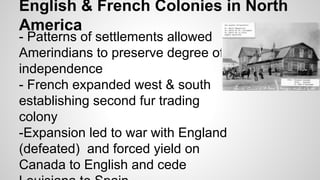
- Patterns of settlements allowed
Amerindians to preserve degree of
independence
- French expanded west & south
establishing second fur trading
colony
-Expansion led to war with England
(defeated) and forced yield on
Canada to English and cede
Colonial Expansion and Conflict

❏ A. Imperial reform in Spanish and Brazil
- Spain's new Bourbon dynasty undertook
administrative reforms
- Threatened by Jesuits influences
monarchs were expelled from American
colonies
- Bourbon policies were detrimental to
interests of grazing and agricultural export
economies
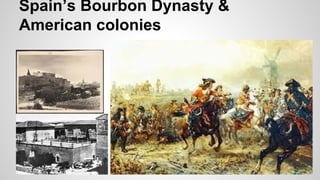
Spain’s Bourbon Dynasty &
American colonies
Colonial Expansion and Conflict
- New monopolies aroused opposition from
creole elites whose only gain from reforms
were militia leaders
- Bourbon policy's factor in Amerindian
uprisings included uprisings led by Jose Gabriel
Condorcanqui
- Rebellion suppressed after two years and cost
Spanish colonies over 100,00 lives and
Colonial Expansion and Conflict
- Brazil underwent economic expansion and
administrative reform in 1700s
- Economic expansion fueled by fold,
diamonds, coffee, and cotton
- The Pombal reforms paid for importation of
nearly 2 million African slaves and underwrote
British imports.
Colonial Expansion and Conflict
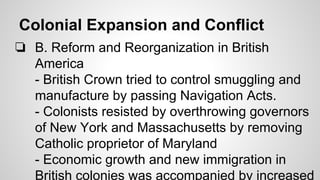
❏ B. Reform and Reorganization in British
America
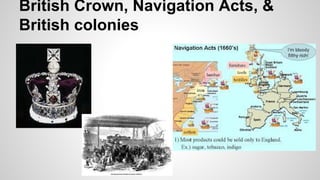
- British Crown tried to control smuggling and
manufacture by passing Navigation Acts.
- Colonists resisted by overthrowing governors
of New York and Massachusetts by removing
Catholic proprietor of Maryland
- Economic growth and new immigration in
British colonies was accompanied by increased
British Crown, Navigation Acts, &
British colonies
CONCLUSION
❏ A. Political & Economic Comparisons
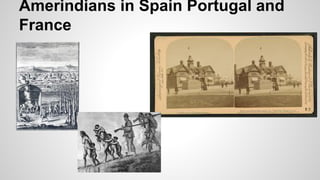
- Amerindians in Spain, Portugal, france, and
England experienced European Subjugation
-Catholic powers gained the most wealth
and developed centralized control
- British colonial governments were likely to
develop colonial governments
Amerindians in Spain Portugal and
France
CONCLUSION
❏ B. Environment & Cultural Comparisons
- Environments underwent change from
introduction of European technology animals,
and plants. Lost natural resources to European
markets
- Catholic nations forced cultural uniformity more
religiously and ethnically
- British colonies welcomed Larger influx
European migrants than other new World
Catholic Nations, Plants, & Animals
(European)

Chapter 17 world history

  • 1.
    The Diversity Of AmericanColonial Societies 1530-1770 By Teonna Butler pd. 7
  • 2.
    The Columbian Exchange ❏A. Demographic Changes - New World people lacked immunity to diseases from Old World -Small pox, measles, diphtheria, typhus, influenza, malaria, yellow fever, pulmonary pleague - Diseases caused native people decline in Spanish & Portuguese
  • 3.
    The Columbian Exchange ❏B. Transfer of Plants & Animals - European, Asian, and African food crops were introduced to Americas - Introduction of European livestock influenced environments and cultures of the Americas - Old World livestock destroyed Amerindian farmer crops
  • 5.
    Spanish America &Brazil ❏ A. State and Church - Spanish crown tried to exert control over Amerindian colonies - Years of neglect and mismanagement Portuguese appointed viceroy to Brazil - Governmental institutions established developed bureaucracies that thwarted economic initiative and political experimentation
  • 6.
    Spanish America &Brazil - Catholic Church transferred European language, culture, and christian beliefs to New World - Catholic clergy converted Amerindians some secretly kept native beliefs and practices - Catholic clergy protected Amerindians from exploitation and abuse
  • 7.
    Spanish America &Brazil - Bartolome De Las Casas denounced policies toward Amerindians -Catholic Missionaries frustrated as Amerindian converts blended Christian beliefs -The Church founded universities and secondary schools
  • 8.
    Spanish America &Brazil ❏ B. Colonial economies - Latin America economies dominated by silver mines and sugar plantations - Spanish economy dominated by Alto Peru (Bolivia) & Peru silver mines -Silver Mining required forced labor led to deforestation and poisoning
  • 9.
    Spanish America &Brazil - Agricultural economy dominated Spanish America -Spanish settlers used forcedlabor system of Encomienda - The Mita system forced labor
  • 10.
    Spanish America &Brazil - Portuguese developed African slave- labor sugar plantation system -Brazilian plantation used Amerindian slaves -Silver and sugar integrated American colonial economies to World trade
  • 11.
  • 12.
    Spanish America &Brazil ❏ C. Society in Colonial Latin America - The elite had small number of immigrants large numbers of descendants (creoles) - Under colonial rule cultural diversity differentiation eroded - African descent played roles in Spanish history
  • 13.
    Spanish America &Brazil - Slaves & free blacks participated in conquest and settlement - Direct slave trade increased the number of blacks declined legal status - Africa retained different cultural identities traditions blended European & Amerindian languages
  • 14.
    Spanish America &Brazil - Slaves engaged agricultural labor forced to submit discipline & punishments - Portuguese immigrants controlled politics & economy Africans largest ethnic group - Growing population of individuals were known as castas ( Mestizos & Mulattos)
  • 15.
    English & FrenchColonies in North America ❏ A. Early English Experiments -Attempts to establish colonies in Americas ended in failure - In 17th century hope colonies proved profitable investments successfully colonized Ireland - Led to new wave of interest in establishing colonies in the New World
  • 17.
    English & FrenchColonies in North America ❏ B. The South - The Virginia company established Jamestown on James River 1606 - English Crown took our management in 1624 - Virginia developed tobacco plantation economy with dispersed population
  • 18.
    English & FrenchColonies in North America - Plantations in Chesapeake Bay area relied on servants for labor - Planters prefer to invest in slaves: Slaves population increased in 1660 -Virginia administered governor by representatives in House of Burgesse
  • 19.
    English & FrenchColonies in North America - House of Burgesses developed democratic representation same time as slavery increase - Colonists prospered fur trade with deer hunter -Consequences included environmental damage brought by over hunting
  • 20.
    English & FrenchColonies in North America - dependency on goods caused fighting over hunting grounds - unsuccessful Amerindian attacks on English colonists in early 1700’s - Southern part of Carolinas - settled by planters
  • 21.
    English & FrenchColonies in North America - Developed by slave labor plantation economy, rice, and indigo - Enslaved Africans & their descendants formed majority population - Colonial South Carolina most hierarchical society in North America
  • 22.
    English & FrenchColonies in North America ❏ C. New England - Pilgrims wanted to break from Church of England established Plymouth colony - Puritans wanted to reform joint stock company (Massachusetts Bay Colony) - Massachusetts Bay Colony : normal gender balance increased population, homogeneous, hierarchical
  • 24.
    English & FrenchColonies in North America - Political institutions derived of charter: elected governor lower legislative house - Massachusetts economy: dependence on fur, forest products, fish, commerce shipping. - Merchants engaged diversified trade made Boston largest city in America
  • 25.
    English & FrenchColonies in North America ❏ D. Middle Atlantic Region - Manhattan colonized by Dutch, taken by english, named New York - Became commercial and shipping center - Derived benefit as outlet for grain exports to Caribbean and Europe.
  • 26.
    English & FrenchColonies in North America - Pennsylvania developed colony for Quakers - Developed grain - exporting colony with Philadelphia - Pennsylvania;s grain produced by free family farmers. Substantial number of Germans
  • 27.
    English & FrenchColonies in North America ❏ E. French America - Expansion driven by fur trade resulted in depletion of beaver and deer populations -French settlement resembled Spain & Portugal and were committed to missionary work - Fur trade provided Amerindians firearms which increased violence
  • 28.
  • 29.
    English & FrenchColonies in North America - Catholic missionaries attempted to convert population of French America - Meeting indigenous resistance turned their attention to work with french settlements - Settlements dependent on fur trade it was small and grew slowly
  • 30.
    English & FrenchColonies in North America - Patterns of settlements allowed Amerindians to preserve degree of independence - French expanded west & south establishing second fur trading colony -Expansion led to war with England (defeated) and forced yield on Canada to English and cede
  • 31.
    Colonial Expansion andConflict ❏ A. Imperial reform in Spanish and Brazil - Spain's new Bourbon dynasty undertook administrative reforms - Threatened by Jesuits influences monarchs were expelled from American colonies - Bourbon policies were detrimental to interests of grazing and agricultural export economies
  • 32.
    Spain’s Bourbon Dynasty& American colonies
  • 33.
    Colonial Expansion andConflict - New monopolies aroused opposition from creole elites whose only gain from reforms were militia leaders - Bourbon policy's factor in Amerindian uprisings included uprisings led by Jose Gabriel Condorcanqui - Rebellion suppressed after two years and cost Spanish colonies over 100,00 lives and
  • 34.
    Colonial Expansion andConflict - Brazil underwent economic expansion and administrative reform in 1700s - Economic expansion fueled by fold, diamonds, coffee, and cotton - The Pombal reforms paid for importation of nearly 2 million African slaves and underwrote British imports.
  • 35.
    Colonial Expansion andConflict ❏ B. Reform and Reorganization in British America - British Crown tried to control smuggling and manufacture by passing Navigation Acts. - Colonists resisted by overthrowing governors of New York and Massachusetts by removing Catholic proprietor of Maryland - Economic growth and new immigration in British colonies was accompanied by increased
  • 36.
    British Crown, NavigationActs, & British colonies
  • 37.
    CONCLUSION ❏ A. Political& Economic Comparisons - Amerindians in Spain, Portugal, france, and England experienced European Subjugation -Catholic powers gained the most wealth and developed centralized control - British colonial governments were likely to develop colonial governments
  • 38.
    Amerindians in SpainPortugal and France
  • 39.
    CONCLUSION ❏ B. Environment& Cultural Comparisons - Environments underwent change from introduction of European technology animals, and plants. Lost natural resources to European markets - Catholic nations forced cultural uniformity more religiously and ethnically - British colonies welcomed Larger influx European migrants than other new World
  • 40.
    Catholic Nations, Plants,& Animals (European)