The Organization of
International
Business
Learning Objectives
LO 14-1 Explain what is meant by organizational architecture.
LO 14-2 Describe the different organizational architecture choices that can be
made in an international business.
LO 14-3 Explain how the organizational architecture can be matched to global
strategy to improve performance.
LO 14-4 Discuss what is required for an international business to change its
organizational architecture so that it better matches its global strategy.
2
Introduction
Organizational Architecture
▪ Three conditions for superior enterprise profitability
▫ Different elements of a firm’s organizational architecture
must be internally consistent
▫ Organizational architecture must match or fit the strategy of
the firm—strategy and architecture must be consistent
▫ Strategy and architecture of the firm must not only be
consistent with each other but also make sense given the
competitive conditions prevailing in the firm’s markets—
strategy, architecture, and competitive environment must all
be consistent
3
Organizational Architecture 1 of 2
Learning Objective 14-1 Explain what is meant by organizational
architecture.
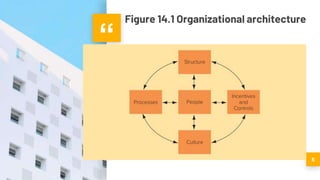
Organizational Architecture
● Organizational structure
● The formal division of the organization
● The location of decision-making responsibilities
● The establishment of integrating mechanisms
“
Figure 14.1 Organizational architecture
5
Organizational Architecture 2 of 2
Organizational Architecture continued
▪ Control Systems
▪ Incentives
▪ Processes
▪ Organizational Culture
▫ Organizations are societies of individuals who come
together to perform collective tasks
▫ Distinct patterns of culture and subculture
▪ People include employees and strategies to recruit, compensate
and retain them
6
Organizational Structure 1 of 13
Learning Objective 14-2 Describe the different organizational architecture choices that
can be made in an international business.
Three dimensions
▪ Vertical differentiation
▪ Horizontal differentiation
▪ Integrating mechanisms
7
Organizational Structure 2 of 13
8
Vertical Differentiation: Centralization and
Decentralization
● Arguments for centralization
1. Facilitates coordination and integration of operations
2. Helps ensure that decisions are consistent with organizational
objectives
3. Gives top-level managers the means to bring change
4. Avoids the duplication of activities that occurs when similar
activities are carried on by various subunits
Organizational Structure 3 of 13
Vertical Differentiation: Centralization and Decentralization continued
▪ Arguments for decentralization
1. Gives top management time to focus on critical issues by
delegating more routine issues to lower-level managers
2. Motivational research favors decentralization
3. Permits greater flexibility
4. Can result in better decisions
5. Can increase control
9
Organizational Structure 4 of
13
10
Vertical Differentiation:
Centralization and
Decentralization continued
● Global strategy and centralization
○ Typically centralized: overall
firm strategy, major financial
expenditures, financial
objectives, and legal issues
○ May be decentralized: operating
decisions, such as those relating
to production, marketing, R&D,
and human resource
management
11
Organizational
Structure 5 of 13
Vertical Differentiation: Centralization and
Decentralization continued
● Global strategy and centralization continued
○ Global standardization strategy
○ Localization strategy
○ International strategy
○ Transnational strategy
Organizational Structure 6 of 13
12
Horizontal Differentiation: The Design of Structure
● The Structure of Domestic Firms
○ Functional structure - functions reflecting the firm’s
value creation activities (e.g., production, marketing,
R&D, sales)
○ Product divisional structure - each division is responsible
for a distinct product line (business area)
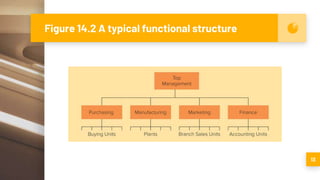
Figure 14.2 A typical functional structure
13
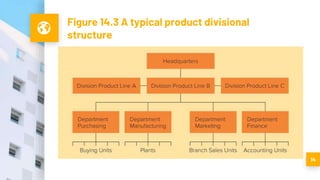
Figure 14.3 A typical product divisional
structure
14
Organizational Structure 7 of 13
15
Horizontal Differentiation: The Design of
Structure continued
● The international division
○ Tends to be organized by geography
○ Typically replicates the structure in the home
market
○ Dual structure can create conflict and
coordination problems
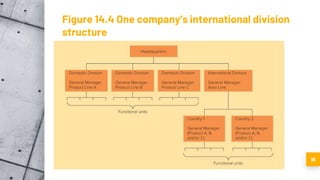
Figure 14.4 One company’s international division
structure
16
Organizational Structure 8 of 13
17
Horizontal Differentiation: The Design of Structure
continued
● Worldwide area structure
○ Favored by firms with a low degree of diversification and a
domestic structure based on functions
○ Geographic divisions
● Worldwide product divisional structure
○ Favored by firms that are reasonably diversified and
originally had domestic structures based on product
divisions
○ Helps overcome coordination problems
Organizational Structure 9 of 13
Horizontal Differentiation: The Design of Structure
continued
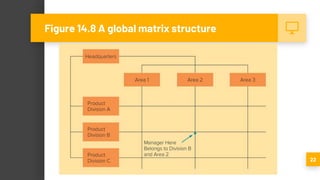
▪ Global matrix structure
▫ Horizontal differentiation proceeds along two dimensions:
product division and geographic area
▫ Dual decision making
▫ Often clumsy and bureaucratic
18
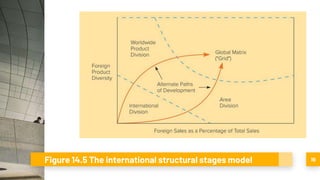
Figure 14.5 The international structural stages model 19
20
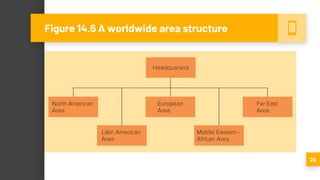
Figure 14.6 A worldwide area structure
21
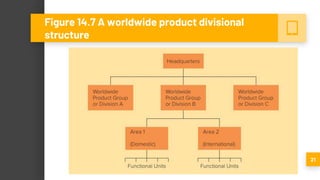
Figure 14.7 A worldwide product divisional
structure
22
Figure 14.8 A global matrix structure
23
Organizational Structure 10 of 13
Integrating Mechanisms
▪ Strategy and coordination in the international business
▫ Need for coordination is lowest in firms pursuing a
localization strategy, is higher in international companies,
higher still in global companies, and highest of all in
transnational companies
Organizational Structure 11 of 13
Integrating Mechanisms continued
▪ Impediments to coordination
▫ Managers have different orientations (production,
marketing) and goals
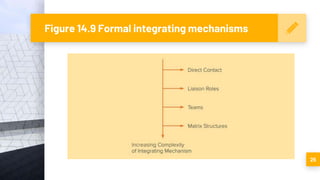
▪ Formal integrating mechanisms
▫ The greater the need for coordination, the more complex the
formal integrating mechanisms need to be. From low to
high:
▫ Direct contact
▫ Liaison roles
▫ Teams
24
Figure 14.9 Formal integrating mechanisms
25
Organizational Structure 12 of 13
Integrating Mechanisms continued
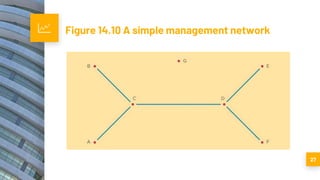
▪ Informal integrating mechanism: knowledge networks
▫ Can be used as a nonbureaucratic conduit for knowledge
flows within a multinational enterprise
▫ Make use of distributed computer and telecommunications
information systems
▫ Managers must share a strong commitment to the same
goals, norms and values
26
Figure 14.10 A simple management network
27
Integrating Mechanisms continued
▪ Integrating Mechanisms Summary
▫ Multinationals need integration—particularly if they are
pursuing global standardization, international, or
transnational strategies
▫ Can be difficult to achieve due to the impediments to
coordination
▫ Formal integrating mechanisms do not always work
▫ Establish an informal knowledge network
▫ Build a common culture
28
Organizational Structure 13 of 13
Control Systems and Incentives 1 of 6
29
Types of Control Systems
● Personal control
○ Most widely used in small firms
○ Structures the relationships between managers at
different levels in multinational enterprises
● Bureaucratic controls
○ Most important bureaucratic controls in subunits within
multinational firms are budgets and capital spending rules
Control Systems and Incentives 2 of 6
30
Types of Control Systems continued
● Output controls
○ Relatively objective performance metrics such as
profitability, productivity, growth, market share, and quality
○ Managers judged by their ability to achieve these goals
○ Goals are normally established through negotiation
between subunits and headquarters
Control Systems and Incentives 3 of 6
Types of Control Systems continued
▪ Cultural controls
▫ Employees “buy into” the norms and value systems of the
firm and control their own behavior
▫ Can reduce the need for other control systems
31
Incentive Systems
▪ Devices used to reward appropriate employee behavior
▪ Usually closely tied to performance metrics used for output
controls
▫ The type of incentive varies depending on
employees/tasks
▫ Requires significant cooperation between managers in
different subunits
▫ Often adjusted to account for national differences in
institutions and culture
▫ Can have unintended consequences
Control Systems and Incentives 4 of 6
32
Control Systems and Incentives 5 of 6
33
Control Systems, Incentives, and Strategy in the
International Business
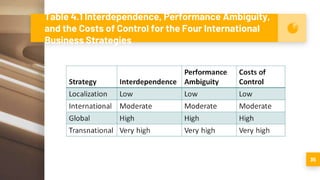
● Performance ambiguity
○ Tends to occur when there is a high degree of
interdependence between subunits within the organization
● Strategy, interdependence, and ambiguity
○ Localization strategy: performance ambiguity is low
○ International strategy: higher level, integration is necessary
○ Global standardization strategy: higher still, many activities
are interdependent
○ Transnational: Highest level of performance ambiguity, high
degree of joint decision making
Control Systems and Incentives 6 of 6 34
Control Systems, Incentives, and Strategy in the
International Business continued
● Implications for control and incentives
○ Costs defined as amount of time top management
devotes to monitoring and evaluating subunits’
performance
○ Costs are greater when performance ambiguity is
greater
Table 4.1 Interdependence, Performance Ambiguity,
and the Costs of Control for the Four International
Business Strategies
35
Formulating strategy
Allocating resources
Evaluating new-product ideas
Handling customer inquiries and complaints
Improving product quality
Evaluating employee performance
And so on
▪ Efficient and effective processes can lower the costs of value
creation and add additional value to a product
36
Processes 1 of 2
Processes 2 of 2
37
Managing Processes in an International Business
● Many processes cut not only across organizational
boundaries, embracing several different subunits, but also
across national boundaries
● A multinational enterprise should recognize that valuable
new processes that might lead to a competitive advantage
can be developed anywhere within the organization’s global
network of operations
Organizational Culture 1 of 3
38
● Culture is a system of values and norms that are shared among
people
● Creating and Maintaining Organizational Culture
○ Founders or leaders have a profound impact
○ The broader social culture of the nation
○ The history of the enterprise
Creating and Maintaining Organizational Culture continued
▪ Culture is maintained by
▫ Hiring and promotional practices of the organization
▫ Reward strategies
▫ Socialization processes – formal or informal
▫ Communication strategy – corporate mission statements
39
Organizational Culture 2 of 3
Organizational Culture 3 of 3
Organizational Culture and Performance in the
International Business
▪ Strong cultures
▫ All managers share a consistent set of values and norms
that have a clear impact on work performance
▫ Strong doesn’t necessarily mean good
▪ Adaptive cultures
▫ Most managers care deeply about and value customers,
stockholders, and employees
40
Synthesis: Strategy and Architecture 1 of 5
41
Learning Objective 14-3 Explain how the organizational architecture can be matched
to global strategy to improve performance.
Localization Strategy
● Focus on local responsiveness
● Operating decisions are decentralized to functionally self-
contained country subsidiaries
● Need for coordination or integrating mechanisms is low
Synthesis: Strategy and Architecture 2 of 5 42
International Strategy
● Firms attempt to create value by transferring core
competencies from home to foreign subsidiaries
● Headquarters maintains centralized control over firm’s core
competency, other decisions are decentralized
● Moderate need for coordination
Synthesis: Strategy and Architecture 3 of 5
43
Global Standardization Strategy
● Firms focus on the realization of location and experience curve
economies
● Headquarters typically maintains ultimate control over most
operating decisions
● The need for integration is high
● Need a strong organizational culture
● Incentive systems are typically linked to performance metrics at
the corporate level
Synthesis: Strategy and Architecture 4 of 5
Transnational Strategy
▪ Focus is on the simultaneous attainment of location and
experience curve economies, local responsiveness, and global
learning
▪ Some operating decisions are centralized (production, R&D)
▪ Need for coordination is high
▪ Need a strong culture and incentives to promote cooperation
44
Synthesis: Strategy and Architecture 5 of 5 45
Environment, Strategy, Architecture, and
Performance
1. The firm’s strategy must be consistent with the environment
in which the firm operates
2. The firm’s organizational architecture must be consistent
with its strategy
Organizational Change 1 of 2
46
Learning Objective 14-4 Discuss what is required for an international business to
change its organizational architecture so that it better matches its global strategy.
Organizational Inertia
● May be caused by
○ Existing distribution of power and influence within an
organization
○ Existing culture expressed in norms and value systems
○ Senior managers’ preconceptions about the appropriate
business model or paradigm
○ Institutional constraints
Organizational Change 2 of 2
47
Implementing Organizational Change
● Unfreezing the organization
● Moving to the new state
● Refreezing the organization
Appendix of
Image Long
Descriptions
48
At the top of the chart is Top Management, below that is a second row
that includes Purchasing, Manufacturing, Marketing, and Finance.
Below this is the bottom row that includes Buying Units under
Purchasing, Plants under Manufacturing, Branch Sales Units under
Marketing, and Accounting Units under Finance.
49
Appendix 1 Figure 14.2 A typical functional
structure
Appendix 2 Figure 14.3 A typical product divisional
structure
50
The top level of the chart has a box labeled Headquarters.
The level below this includes Division Product Line A, B, and C in
separate boxes.
The next level includes Department Purchasing, Department
Manufacturing, Department Marketing, and Department Finance,
all under Division product line B.
The final, bottom level includes buying units under Purchasing,
plants under Manufacturing, branch sales units under marketing,
and accounting units under finance.
Appendix 3 Figure 14.4 One company’s
international division structure
51
At the top of the chart is a box labeled Headquarters.
The next level includes Domestic division, general manager
Product line A; Domestic division, general manager Product line
B; Domestic division, general manager product line C; and
international division. general manager area line.
All three domestic division boxes are labeled “functional units.”
Beneath the international division box are country 1, general
manager (product A, B, and C); and country 2, general manager
(product A, B, and C). These two boxes are labeled “functional
units.”
Appendix 4 Figure 14.5 The international structural
stages model
52
A graph shows foreign sales as a percentage of sales
along the x axis, and foreign product diversity along
the y axis. A line begins in the lower left corner and
extends upward, curving to the right, through
sections named international division, worldwide
product division, and ending in global matrix (grid). A
second line begins at the bottom left corner also, but
extends upward curving to the left, passing through
the same sections and ending in the same place. The
area between these lines is labeled alternate paths of
development.
Appendix 5 Figure 14.6 A worldwide area structure
A box labeled Headquarters is at the top, connected to a second level
that includes North American Area, Latin America Area, European
area, Middle-Eastern African area, and Far East area.
53
At the top of the chart is a box labeled Headquarters. Beneath this box
are three connected boxes labeled Worldwide Product Group or
Division A, Worldwide Product Group or Division B, and Worldwide
Product Group or Division C. Two boxes are connected below
Worldwide Product Group or Division B, labeled Area 1 domestic and
Area 2 international. Each of these has several functional units
connected to it.
54
Appendix 6 Figure 14.7 A worldwide product
divisional structure
Appendix 7 Figure 14.8 A global matrix structure
55
At the top of the chart is a box labeled Headquarters. It is
connected by lines to Product Division A, B, and C. It is also
connected by lines to Area 1, 2, and 3. Intersecting lines extend
from all product division boxes and all area boxes.
A dot is placed on one of the intersections and is labeled Manager
here belongs to division B and to area 2.

Chapter 14.pdf

  • 1.
  • 2.
    Learning Objectives LO 14-1Explain what is meant by organizational architecture. LO 14-2 Describe the different organizational architecture choices that can be made in an international business. LO 14-3 Explain how the organizational architecture can be matched to global strategy to improve performance. LO 14-4 Discuss what is required for an international business to change its organizational architecture so that it better matches its global strategy. 2
  • 3.
    Introduction Organizational Architecture ▪ Threeconditions for superior enterprise profitability ▫ Different elements of a firm’s organizational architecture must be internally consistent ▫ Organizational architecture must match or fit the strategy of the firm—strategy and architecture must be consistent ▫ Strategy and architecture of the firm must not only be consistent with each other but also make sense given the competitive conditions prevailing in the firm’s markets— strategy, architecture, and competitive environment must all be consistent 3
  • 4.
    Organizational Architecture 1of 2 Learning Objective 14-1 Explain what is meant by organizational architecture. Organizational Architecture ● Organizational structure ● The formal division of the organization ● The location of decision-making responsibilities ● The establishment of integrating mechanisms
  • 5.
  • 6.
    Organizational Architecture 2of 2 Organizational Architecture continued ▪ Control Systems ▪ Incentives ▪ Processes ▪ Organizational Culture ▫ Organizations are societies of individuals who come together to perform collective tasks ▫ Distinct patterns of culture and subculture ▪ People include employees and strategies to recruit, compensate and retain them 6
  • 7.
    Organizational Structure 1of 13 Learning Objective 14-2 Describe the different organizational architecture choices that can be made in an international business. Three dimensions ▪ Vertical differentiation ▪ Horizontal differentiation ▪ Integrating mechanisms 7
  • 8.
    Organizational Structure 2of 13 8 Vertical Differentiation: Centralization and Decentralization ● Arguments for centralization 1. Facilitates coordination and integration of operations 2. Helps ensure that decisions are consistent with organizational objectives 3. Gives top-level managers the means to bring change 4. Avoids the duplication of activities that occurs when similar activities are carried on by various subunits
  • 9.
    Organizational Structure 3of 13 Vertical Differentiation: Centralization and Decentralization continued ▪ Arguments for decentralization 1. Gives top management time to focus on critical issues by delegating more routine issues to lower-level managers 2. Motivational research favors decentralization 3. Permits greater flexibility 4. Can result in better decisions 5. Can increase control 9
  • 10.
    Organizational Structure 4of 13 10 Vertical Differentiation: Centralization and Decentralization continued ● Global strategy and centralization ○ Typically centralized: overall firm strategy, major financial expenditures, financial objectives, and legal issues ○ May be decentralized: operating decisions, such as those relating to production, marketing, R&D, and human resource management
  • 11.
    11 Organizational Structure 5 of13 Vertical Differentiation: Centralization and Decentralization continued ● Global strategy and centralization continued ○ Global standardization strategy ○ Localization strategy ○ International strategy ○ Transnational strategy
  • 12.
    Organizational Structure 6of 13 12 Horizontal Differentiation: The Design of Structure ● The Structure of Domestic Firms ○ Functional structure - functions reflecting the firm’s value creation activities (e.g., production, marketing, R&D, sales) ○ Product divisional structure - each division is responsible for a distinct product line (business area)
  • 13.
    Figure 14.2 Atypical functional structure 13
  • 14.
    Figure 14.3 Atypical product divisional structure 14
  • 15.
    Organizational Structure 7of 13 15 Horizontal Differentiation: The Design of Structure continued ● The international division ○ Tends to be organized by geography ○ Typically replicates the structure in the home market ○ Dual structure can create conflict and coordination problems
  • 16.
    Figure 14.4 Onecompany’s international division structure 16
  • 17.
    Organizational Structure 8of 13 17 Horizontal Differentiation: The Design of Structure continued ● Worldwide area structure ○ Favored by firms with a low degree of diversification and a domestic structure based on functions ○ Geographic divisions ● Worldwide product divisional structure ○ Favored by firms that are reasonably diversified and originally had domestic structures based on product divisions ○ Helps overcome coordination problems
  • 18.
    Organizational Structure 9of 13 Horizontal Differentiation: The Design of Structure continued ▪ Global matrix structure ▫ Horizontal differentiation proceeds along two dimensions: product division and geographic area ▫ Dual decision making ▫ Often clumsy and bureaucratic 18
  • 19.
    Figure 14.5 Theinternational structural stages model 19
  • 20.
    20 Figure 14.6 Aworldwide area structure
  • 21.
    21 Figure 14.7 Aworldwide product divisional structure
  • 22.
    22 Figure 14.8 Aglobal matrix structure
  • 23.
    23 Organizational Structure 10of 13 Integrating Mechanisms ▪ Strategy and coordination in the international business ▫ Need for coordination is lowest in firms pursuing a localization strategy, is higher in international companies, higher still in global companies, and highest of all in transnational companies
  • 24.
    Organizational Structure 11of 13 Integrating Mechanisms continued ▪ Impediments to coordination ▫ Managers have different orientations (production, marketing) and goals ▪ Formal integrating mechanisms ▫ The greater the need for coordination, the more complex the formal integrating mechanisms need to be. From low to high: ▫ Direct contact ▫ Liaison roles ▫ Teams 24
  • 25.
    Figure 14.9 Formalintegrating mechanisms 25
  • 26.
    Organizational Structure 12of 13 Integrating Mechanisms continued ▪ Informal integrating mechanism: knowledge networks ▫ Can be used as a nonbureaucratic conduit for knowledge flows within a multinational enterprise ▫ Make use of distributed computer and telecommunications information systems ▫ Managers must share a strong commitment to the same goals, norms and values 26
  • 27.
    Figure 14.10 Asimple management network 27
  • 28.
    Integrating Mechanisms continued ▪Integrating Mechanisms Summary ▫ Multinationals need integration—particularly if they are pursuing global standardization, international, or transnational strategies ▫ Can be difficult to achieve due to the impediments to coordination ▫ Formal integrating mechanisms do not always work ▫ Establish an informal knowledge network ▫ Build a common culture 28 Organizational Structure 13 of 13
  • 29.
    Control Systems andIncentives 1 of 6 29 Types of Control Systems ● Personal control ○ Most widely used in small firms ○ Structures the relationships between managers at different levels in multinational enterprises ● Bureaucratic controls ○ Most important bureaucratic controls in subunits within multinational firms are budgets and capital spending rules
  • 30.
    Control Systems andIncentives 2 of 6 30 Types of Control Systems continued ● Output controls ○ Relatively objective performance metrics such as profitability, productivity, growth, market share, and quality ○ Managers judged by their ability to achieve these goals ○ Goals are normally established through negotiation between subunits and headquarters
  • 31.
    Control Systems andIncentives 3 of 6 Types of Control Systems continued ▪ Cultural controls ▫ Employees “buy into” the norms and value systems of the firm and control their own behavior ▫ Can reduce the need for other control systems 31
  • 32.
    Incentive Systems ▪ Devicesused to reward appropriate employee behavior ▪ Usually closely tied to performance metrics used for output controls ▫ The type of incentive varies depending on employees/tasks ▫ Requires significant cooperation between managers in different subunits ▫ Often adjusted to account for national differences in institutions and culture ▫ Can have unintended consequences Control Systems and Incentives 4 of 6 32
  • 33.
    Control Systems andIncentives 5 of 6 33 Control Systems, Incentives, and Strategy in the International Business ● Performance ambiguity ○ Tends to occur when there is a high degree of interdependence between subunits within the organization ● Strategy, interdependence, and ambiguity ○ Localization strategy: performance ambiguity is low ○ International strategy: higher level, integration is necessary ○ Global standardization strategy: higher still, many activities are interdependent ○ Transnational: Highest level of performance ambiguity, high degree of joint decision making
  • 34.
    Control Systems andIncentives 6 of 6 34 Control Systems, Incentives, and Strategy in the International Business continued ● Implications for control and incentives ○ Costs defined as amount of time top management devotes to monitoring and evaluating subunits’ performance ○ Costs are greater when performance ambiguity is greater
  • 35.
    Table 4.1 Interdependence,Performance Ambiguity, and the Costs of Control for the Four International Business Strategies 35
  • 36.
    Formulating strategy Allocating resources Evaluatingnew-product ideas Handling customer inquiries and complaints Improving product quality Evaluating employee performance And so on ▪ Efficient and effective processes can lower the costs of value creation and add additional value to a product 36 Processes 1 of 2
  • 37.
    Processes 2 of2 37 Managing Processes in an International Business ● Many processes cut not only across organizational boundaries, embracing several different subunits, but also across national boundaries ● A multinational enterprise should recognize that valuable new processes that might lead to a competitive advantage can be developed anywhere within the organization’s global network of operations
  • 38.
    Organizational Culture 1of 3 38 ● Culture is a system of values and norms that are shared among people ● Creating and Maintaining Organizational Culture ○ Founders or leaders have a profound impact ○ The broader social culture of the nation ○ The history of the enterprise
  • 39.
    Creating and MaintainingOrganizational Culture continued ▪ Culture is maintained by ▫ Hiring and promotional practices of the organization ▫ Reward strategies ▫ Socialization processes – formal or informal ▫ Communication strategy – corporate mission statements 39 Organizational Culture 2 of 3
  • 40.
    Organizational Culture 3of 3 Organizational Culture and Performance in the International Business ▪ Strong cultures ▫ All managers share a consistent set of values and norms that have a clear impact on work performance ▫ Strong doesn’t necessarily mean good ▪ Adaptive cultures ▫ Most managers care deeply about and value customers, stockholders, and employees 40
  • 41.
    Synthesis: Strategy andArchitecture 1 of 5 41 Learning Objective 14-3 Explain how the organizational architecture can be matched to global strategy to improve performance. Localization Strategy ● Focus on local responsiveness ● Operating decisions are decentralized to functionally self- contained country subsidiaries ● Need for coordination or integrating mechanisms is low
  • 42.
    Synthesis: Strategy andArchitecture 2 of 5 42 International Strategy ● Firms attempt to create value by transferring core competencies from home to foreign subsidiaries ● Headquarters maintains centralized control over firm’s core competency, other decisions are decentralized ● Moderate need for coordination
  • 43.
    Synthesis: Strategy andArchitecture 3 of 5 43 Global Standardization Strategy ● Firms focus on the realization of location and experience curve economies ● Headquarters typically maintains ultimate control over most operating decisions ● The need for integration is high ● Need a strong organizational culture ● Incentive systems are typically linked to performance metrics at the corporate level
  • 44.
    Synthesis: Strategy andArchitecture 4 of 5 Transnational Strategy ▪ Focus is on the simultaneous attainment of location and experience curve economies, local responsiveness, and global learning ▪ Some operating decisions are centralized (production, R&D) ▪ Need for coordination is high ▪ Need a strong culture and incentives to promote cooperation 44
  • 45.
    Synthesis: Strategy andArchitecture 5 of 5 45 Environment, Strategy, Architecture, and Performance 1. The firm’s strategy must be consistent with the environment in which the firm operates 2. The firm’s organizational architecture must be consistent with its strategy
  • 46.
    Organizational Change 1of 2 46 Learning Objective 14-4 Discuss what is required for an international business to change its organizational architecture so that it better matches its global strategy. Organizational Inertia ● May be caused by ○ Existing distribution of power and influence within an organization ○ Existing culture expressed in norms and value systems ○ Senior managers’ preconceptions about the appropriate business model or paradigm ○ Institutional constraints
  • 47.
    Organizational Change 2of 2 47 Implementing Organizational Change ● Unfreezing the organization ● Moving to the new state ● Refreezing the organization
  • 48.
  • 49.
    At the topof the chart is Top Management, below that is a second row that includes Purchasing, Manufacturing, Marketing, and Finance. Below this is the bottom row that includes Buying Units under Purchasing, Plants under Manufacturing, Branch Sales Units under Marketing, and Accounting Units under Finance. 49 Appendix 1 Figure 14.2 A typical functional structure
  • 50.
    Appendix 2 Figure14.3 A typical product divisional structure 50 The top level of the chart has a box labeled Headquarters. The level below this includes Division Product Line A, B, and C in separate boxes. The next level includes Department Purchasing, Department Manufacturing, Department Marketing, and Department Finance, all under Division product line B. The final, bottom level includes buying units under Purchasing, plants under Manufacturing, branch sales units under marketing, and accounting units under finance.
  • 51.
    Appendix 3 Figure14.4 One company’s international division structure 51 At the top of the chart is a box labeled Headquarters. The next level includes Domestic division, general manager Product line A; Domestic division, general manager Product line B; Domestic division, general manager product line C; and international division. general manager area line. All three domestic division boxes are labeled “functional units.” Beneath the international division box are country 1, general manager (product A, B, and C); and country 2, general manager (product A, B, and C). These two boxes are labeled “functional units.”
  • 52.
    Appendix 4 Figure14.5 The international structural stages model 52 A graph shows foreign sales as a percentage of sales along the x axis, and foreign product diversity along the y axis. A line begins in the lower left corner and extends upward, curving to the right, through sections named international division, worldwide product division, and ending in global matrix (grid). A second line begins at the bottom left corner also, but extends upward curving to the left, passing through the same sections and ending in the same place. The area between these lines is labeled alternate paths of development.
  • 53.
    Appendix 5 Figure14.6 A worldwide area structure A box labeled Headquarters is at the top, connected to a second level that includes North American Area, Latin America Area, European area, Middle-Eastern African area, and Far East area. 53
  • 54.
    At the topof the chart is a box labeled Headquarters. Beneath this box are three connected boxes labeled Worldwide Product Group or Division A, Worldwide Product Group or Division B, and Worldwide Product Group or Division C. Two boxes are connected below Worldwide Product Group or Division B, labeled Area 1 domestic and Area 2 international. Each of these has several functional units connected to it. 54 Appendix 6 Figure 14.7 A worldwide product divisional structure
  • 55.
    Appendix 7 Figure14.8 A global matrix structure 55 At the top of the chart is a box labeled Headquarters. It is connected by lines to Product Division A, B, and C. It is also connected by lines to Area 1, 2, and 3. Intersecting lines extend from all product division boxes and all area boxes. A dot is placed on one of the intersections and is labeled Manager here belongs to division B and to area 2.