International Business
9e
By Charles W.L. Hill
McGraw-Hill/Irwin Copyright © 2013 by The McGraw-Hill Companies, Inc. All rights reserved.
Chapter 9
Regional Economic
Integration
9-3
What Is Regional
Economic Integration?
 Regional economic integration - agreements
between countries in a geographic region to
reduce tariff and non-tariff barriers to the free
flow of goods, services, and factors of
production between each other
 Question: Do regional trade agreements
promote free trade?
In theory, yes, but the world may be moving toward a
situation in which a number of regional trade blocks
compete against each other
9-4
What Are The Levels Of
Regional Economic Integration?
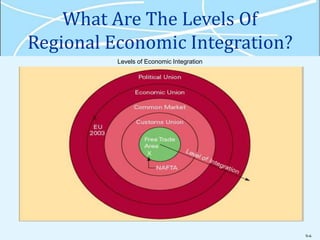
1. A free trade area eliminates all barriers to
the trade of goods and services among
members
2. A customs union eliminates trade
barriers between members and adopts a
common external trade policy
3. A common market has no trade barriers
between members, a common external
trade policy, and the free movement of
the factors of production
9-5
What Are The Levels Of
Regional Economic Integration?
4. An economic union has the free flow of
products and factors of production between
members, a common external trade policy, a
common currency, a harmonized tax rate, and
a common monetary and fiscal policy
5. A political union involves a central political
apparatus that coordinates the economic,
social, and foreign policy of member states
9-6
What Are The Levels Of
Regional Economic Integration?
Levels of Economic Integration
9-7
Why Should Countries
Integrate Their Economies?
All countries gain from free trade and
investment - regional economic integration
is an attempt to exploit the gains from free
trade and investment
Linking countries together, making them
more dependent on each other
creates incentives for political cooperation
and reduces the likelihood of violent conflict
gives countries greater political clout when
dealing with other nations
9-8
What Limits Efforts
At Integration?
 Economic integration can be difficult because
while a nation as a whole may benefit from a regional
free trade agreement, certain groups may lose
it implies a loss of national sovereignty
 Regional economic integration is only beneficial
if the amount of trade it creates exceeds the
amount it diverts
trade creation occurs when low cost producers within
the free trade area replace high cost domestic
producers
trade diversion occurs when higher cost suppliers
within the free trade area replace lower cost external
suppliers
9-9
What Is The Status Of Regional
Economic Integration In Europe?
 Europe has two trade blocs
1. The European Union (EU) with 27
members
2. The European Free Trade Area (EFTA)
with 4 members
 The EU is seen as the world’s next
economic and political superpower
9-10
What Is The Status Of Regional
Economic Integration In Europe?
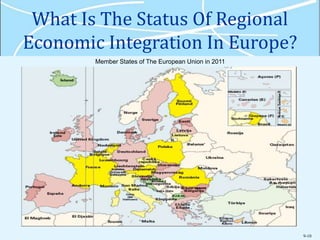
Member States of The European Union in 2011
9-11
What Is The European Union?
 The devastation of two world wars on Western Europe
prompted the formation of the European Union (EU)
 members wanted lasting peace and to hold their own on the
world’s political and economic stage
 The Single European Act (1987) committed the countries
to work toward establishment of a single market by
December 31, 1992
 The main institutions in the EU include:
1. The European Council
2. The European Commission
3. The European Parliament
4. The Court of Justice
9-12
What Is The European Union?
The Maastricht Treaty committed the EU
to adopt a single currency
created the second largest currency zone in
the world after that of the U.S. dollar
used by 17 of the 27 member states
Many countries have applied for EU
membership
Turkey has been denied full membership
because of concerns over human rights
9-13
What Is The Status Of Economic
Integration In The Americas?
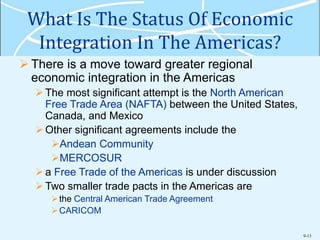
 There is a move toward greater regional
economic integration in the Americas
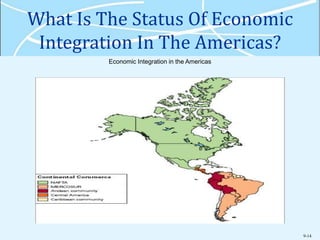
The most significant attempt is the North American
Free Trade Area (NAFTA) between the United States,
Canada, and Mexico
Other significant agreements include the
Andean Community
MERCOSUR
a Free Trade of the Americas is under discussion
Two smaller trade pacts in the Americas are
the Central American Trade Agreement
CARICOM
9-14
What Is The Status Of Economic
Integration In The Americas?
Economic Integration in the Americas
9-15
What Is The Status Of
Economic Integration In Asia?
Various efforts at integration have been
attempted in Asia, but most exist in name
only
Association of Southeast Asian Nations
(ASEAN)
Asia-Pacific Economic Cooperation (APEC)
9-16
What Is The Status Of
Economic Integration In Africa?
Many countries are members of more than
one of the nine blocs in the region
But, since many countries support the use
of trade barriers to protect their economies
from foreign competition, meaningful
progress is slow
East African Community (EAC)
9-17
What Does Economic
Integration Mean For Managers?
 Regional economic integration
opens new markets
allows firms to realize cost economies by centralizing
production in those locations where the mix of factor
costs and skills is optimal
 But
within each grouping, the business environment
becomes competitive
there is a risk of being shut out of the single market by
the creation of a “trade fortress”

Chapter 009.ppt

  • 1.
    International Business 9e By CharlesW.L. Hill McGraw-Hill/Irwin Copyright © 2013 by The McGraw-Hill Companies, Inc. All rights reserved.
  • 2.
  • 3.
    9-3 What Is Regional EconomicIntegration?  Regional economic integration - agreements between countries in a geographic region to reduce tariff and non-tariff barriers to the free flow of goods, services, and factors of production between each other  Question: Do regional trade agreements promote free trade? In theory, yes, but the world may be moving toward a situation in which a number of regional trade blocks compete against each other
  • 4.
    9-4 What Are TheLevels Of Regional Economic Integration? 1. A free trade area eliminates all barriers to the trade of goods and services among members 2. A customs union eliminates trade barriers between members and adopts a common external trade policy 3. A common market has no trade barriers between members, a common external trade policy, and the free movement of the factors of production
  • 5.
    9-5 What Are TheLevels Of Regional Economic Integration? 4. An economic union has the free flow of products and factors of production between members, a common external trade policy, a common currency, a harmonized tax rate, and a common monetary and fiscal policy 5. A political union involves a central political apparatus that coordinates the economic, social, and foreign policy of member states
  • 6.
    9-6 What Are TheLevels Of Regional Economic Integration? Levels of Economic Integration
  • 7.
    9-7 Why Should Countries IntegrateTheir Economies? All countries gain from free trade and investment - regional economic integration is an attempt to exploit the gains from free trade and investment Linking countries together, making them more dependent on each other creates incentives for political cooperation and reduces the likelihood of violent conflict gives countries greater political clout when dealing with other nations
  • 8.
    9-8 What Limits Efforts AtIntegration?  Economic integration can be difficult because while a nation as a whole may benefit from a regional free trade agreement, certain groups may lose it implies a loss of national sovereignty  Regional economic integration is only beneficial if the amount of trade it creates exceeds the amount it diverts trade creation occurs when low cost producers within the free trade area replace high cost domestic producers trade diversion occurs when higher cost suppliers within the free trade area replace lower cost external suppliers
  • 9.
    9-9 What Is TheStatus Of Regional Economic Integration In Europe?  Europe has two trade blocs 1. The European Union (EU) with 27 members 2. The European Free Trade Area (EFTA) with 4 members  The EU is seen as the world’s next economic and political superpower
  • 10.
    9-10 What Is TheStatus Of Regional Economic Integration In Europe? Member States of The European Union in 2011
  • 11.
    9-11 What Is TheEuropean Union?  The devastation of two world wars on Western Europe prompted the formation of the European Union (EU)  members wanted lasting peace and to hold their own on the world’s political and economic stage  The Single European Act (1987) committed the countries to work toward establishment of a single market by December 31, 1992  The main institutions in the EU include: 1. The European Council 2. The European Commission 3. The European Parliament 4. The Court of Justice
  • 12.
    9-12 What Is TheEuropean Union? The Maastricht Treaty committed the EU to adopt a single currency created the second largest currency zone in the world after that of the U.S. dollar used by 17 of the 27 member states Many countries have applied for EU membership Turkey has been denied full membership because of concerns over human rights
  • 13.
    9-13 What Is TheStatus Of Economic Integration In The Americas?  There is a move toward greater regional economic integration in the Americas The most significant attempt is the North American Free Trade Area (NAFTA) between the United States, Canada, and Mexico Other significant agreements include the Andean Community MERCOSUR a Free Trade of the Americas is under discussion Two smaller trade pacts in the Americas are the Central American Trade Agreement CARICOM
  • 14.
    9-14 What Is TheStatus Of Economic Integration In The Americas? Economic Integration in the Americas
  • 15.
    9-15 What Is TheStatus Of Economic Integration In Asia? Various efforts at integration have been attempted in Asia, but most exist in name only Association of Southeast Asian Nations (ASEAN) Asia-Pacific Economic Cooperation (APEC)
  • 16.
    9-16 What Is TheStatus Of Economic Integration In Africa? Many countries are members of more than one of the nine blocs in the region But, since many countries support the use of trade barriers to protect their economies from foreign competition, meaningful progress is slow East African Community (EAC)
  • 17.
    9-17 What Does Economic IntegrationMean For Managers?  Regional economic integration opens new markets allows firms to realize cost economies by centralizing production in those locations where the mix of factor costs and skills is optimal  But within each grouping, the business environment becomes competitive there is a risk of being shut out of the single market by the creation of a “trade fortress”