International Business
9e
By Charles W.L. Hill
McGraw-Hill/Irwin Copyright © 2013 by The McGraw-Hill Companies, Inc. All rights reserved.
Chapter 13
The Strategy of International
Business
13-3
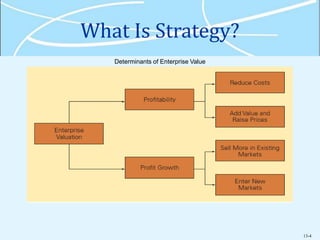
What Is Strategy?
 A firm’s strategy refers to the actions that
managers take to attain the goals of the firm
 Firms need to pursue strategies that increase
profitability and profit growth
 Firms can
add value
lower costs
sell more in existing markets
expand internationally
13-4
What Is Strategy?
Determinants of Enterprise Value
13-5
How Is Value Created?
 The firm’s value creation is the difference between V and
C
a firm has high profits when it creates more value for
its customers and does so at a lower cost
 Profits can be increased by
1.Using a differentiation strategy
2.Using a low cost strategy
 To maximize long run return on invested capital firms
pick a viable position on the efficiency frontier, configure
internal operations to support that position, have the right
organization structure in place to execute the strategy
13-6
How Is Value Created?
Value Creation
13-7
How Are A Firm’s
Operations Configured?
 A firm’s operations are like a value chain
composed of distinct value creation activities
 Primary activities
 R&D
 production
 marketing and sales
 customer service
 Support activities
 information systems
 logistics
 human resources
13-8
How Are A Firm’s
Operations Configured?
The Value Chain
13-9
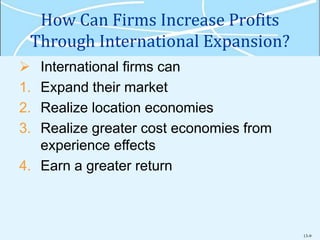
How Can Firms Increase Profits
Through International Expansion?
 International firms can
1. Expand their market
2. Realize location economies
3. Realize greater cost economies from
experience effects
4. Earn a greater return
13-10
How Can Firms Leverage Their
Products And Competencies?
The success of firms that expand
internationally depends on
the goods or services sold
the firm’s core competencies
Core competencies allow firms to reduce
the costs of value creation and/or to create
perceived value so that premium pricing is
possible
13-11
Why Are Location
Economies Important?
By achieving location economies, firms
can
lower the costs of value creation and achieve
a low cost position
differentiate their product offering
Firms that take advantage of location
economies in different parts of the world,
create a global web of value creation
activities
13-12
Why Are Experience
Effects Important?
 The experience curve - the systematic
reductions in production costs that occur over
the life of a product
by moving down the experience curve, firms reduce
the cost of creating value
 Learning effects - cost savings that come from
learning by doing
 Economies of scale - the reductions in unit cost
achieved by producing a large volume of a
product
13-13
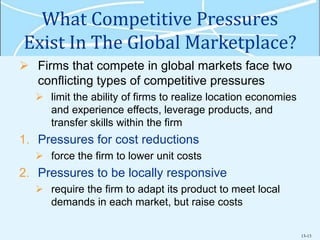
What Competitive Pressures
Exist In The Global Marketplace?
 Firms that compete in global markets face two
conflicting types of competitive pressures
 limit the ability of firms to realize location economies
and experience effects, leverage products, and
transfer skills within the firm
1. Pressures for cost reductions
 force the firm to lower unit costs
2. Pressures to be locally responsive
 require the firm to adapt its product to meet local
demands in each market, but raise costs
13-14
When Are Pressures Greatest?
 Pressures for cost reductions are greatest
1. For firms producing products that fill universal needs
2. When major competitors are in low cost locations
3. Where there is persistent excess capacity
4. Where consumers are powerful and face low
switching costs
 Pressures for local responsiveness arise from
1. Differences in consumer tastes and preferences
2. Differences in traditional practices and infrastructure
3. Differences in distribution channels
4. Host government demands
13-15
Which Strategy
Should A Firm Choose?
 There are four basic strategies to
compete in international markets
 the appropriateness of each strategy
depends on the pressures for cost reduction
and local responsiveness in the industry
1. Global standardization
2. Localization
3. Transnational
4. International
13-16
How Does Strategy Evolve?
 An international strategy may not be viable in the
long term
to survive, firms may need to shift to a global
standardization strategy or a transnational strategy in
advance of competitors
 Localization may give a firm a competitive edge,
but if the firm is simultaneously facing
aggressive competitors, the company will also
have to reduce its cost structures
would require a shift toward a transnational strategy
13-17
How Does Strategy Evolve?
Changes in Strategy over Time

Chapter number 13 international business

  • 1.
    International Business 9e By CharlesW.L. Hill McGraw-Hill/Irwin Copyright © 2013 by The McGraw-Hill Companies, Inc. All rights reserved.
  • 2.
    Chapter 13 The Strategyof International Business
  • 3.
    13-3 What Is Strategy? A firm’s strategy refers to the actions that managers take to attain the goals of the firm  Firms need to pursue strategies that increase profitability and profit growth  Firms can add value lower costs sell more in existing markets expand internationally
  • 4.
  • 5.
    13-5 How Is ValueCreated?  The firm’s value creation is the difference between V and C a firm has high profits when it creates more value for its customers and does so at a lower cost  Profits can be increased by 1.Using a differentiation strategy 2.Using a low cost strategy  To maximize long run return on invested capital firms pick a viable position on the efficiency frontier, configure internal operations to support that position, have the right organization structure in place to execute the strategy
  • 6.
    13-6 How Is ValueCreated? Value Creation
  • 7.
    13-7 How Are AFirm’s Operations Configured?  A firm’s operations are like a value chain composed of distinct value creation activities  Primary activities  R&D  production  marketing and sales  customer service  Support activities  information systems  logistics  human resources
  • 8.
    13-8 How Are AFirm’s Operations Configured? The Value Chain
  • 9.
    13-9 How Can FirmsIncrease Profits Through International Expansion?  International firms can 1. Expand their market 2. Realize location economies 3. Realize greater cost economies from experience effects 4. Earn a greater return
  • 10.
    13-10 How Can FirmsLeverage Their Products And Competencies? The success of firms that expand internationally depends on the goods or services sold the firm’s core competencies Core competencies allow firms to reduce the costs of value creation and/or to create perceived value so that premium pricing is possible
  • 11.
    13-11 Why Are Location EconomiesImportant? By achieving location economies, firms can lower the costs of value creation and achieve a low cost position differentiate their product offering Firms that take advantage of location economies in different parts of the world, create a global web of value creation activities
  • 12.
    13-12 Why Are Experience EffectsImportant?  The experience curve - the systematic reductions in production costs that occur over the life of a product by moving down the experience curve, firms reduce the cost of creating value  Learning effects - cost savings that come from learning by doing  Economies of scale - the reductions in unit cost achieved by producing a large volume of a product
  • 13.
    13-13 What Competitive Pressures ExistIn The Global Marketplace?  Firms that compete in global markets face two conflicting types of competitive pressures  limit the ability of firms to realize location economies and experience effects, leverage products, and transfer skills within the firm 1. Pressures for cost reductions  force the firm to lower unit costs 2. Pressures to be locally responsive  require the firm to adapt its product to meet local demands in each market, but raise costs
  • 14.
    13-14 When Are PressuresGreatest?  Pressures for cost reductions are greatest 1. For firms producing products that fill universal needs 2. When major competitors are in low cost locations 3. Where there is persistent excess capacity 4. Where consumers are powerful and face low switching costs  Pressures for local responsiveness arise from 1. Differences in consumer tastes and preferences 2. Differences in traditional practices and infrastructure 3. Differences in distribution channels 4. Host government demands
  • 15.
    13-15 Which Strategy Should AFirm Choose?  There are four basic strategies to compete in international markets  the appropriateness of each strategy depends on the pressures for cost reduction and local responsiveness in the industry 1. Global standardization 2. Localization 3. Transnational 4. International
  • 16.
    13-16 How Does StrategyEvolve?  An international strategy may not be viable in the long term to survive, firms may need to shift to a global standardization strategy or a transnational strategy in advance of competitors  Localization may give a firm a competitive edge, but if the firm is simultaneously facing aggressive competitors, the company will also have to reduce its cost structures would require a shift toward a transnational strategy
  • 17.
    13-17 How Does StrategyEvolve? Changes in Strategy over Time