The Strategy of
International
Business
Learning Objectives
LO 13-1 Explain the concept of global strategy.
LO 13-2 Recognize how firms can profit by expanding globally.
LO 13-3 Understand how pressures for cost reductions and local responsiveness
influence strategic choice.
LO 13-4 Identify and choose the different global strategies for competing in the
global marketplace.
2
Introduction
Shift from macro environment to the firm itself
▪ Actions managers take to compete more effectively
▪ How organizations can increase revenue (and profitability) by
expanding their operations in foreign markets
▫ Value creation
3
Strategy and the Firm 1 of 7
Learning Objective 13-1 Explain the concept of global strategy.
Basic Principles of Strategy
● Goal is to maximize the value of the firm for owners and shareholders
○ Profitability
○ Profit growth
“
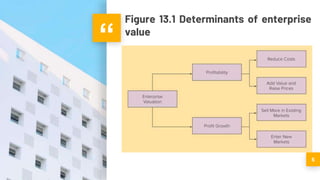
Figure 13.1 Determinants of enterprise
value
5
Strategy and the Firm 2 of 7
Value Creation
▪ Measured by the difference between a firm’s costs of production
and the quality that consumers perceive in its products
▪ The more value customers place on a firm’s products, the higher
the price the firm can charge for those products.
▪ Measured by the difference between V (value) and C (cost)
▪ Two strategies: low cost and differentiation
6
Strategy and the Firm 3 of 7
Strategic Positioning
▪ Porter
▫ A firm should be explicit about its choice of strategic
emphasis with regard to value creation (differentiation) and
low cost.
▫ A firm should configure its internal operations to support
that strategic emphasis.
▫ Efficiency frontier
▫ Diminishing returns
7
Strategy and the Firm 4 of 7
8
Strategic Positioningcontinued
● To maximize profitability, a firm must:
1. Pick a position on the efficiency frontier that is viable in the
sense that there is enough demand to support that choice
2. Configure its internal operations, such as manufacturing,
marketing, logistics, information systems, human
resources, and so on, so that they support that position
3. Make sure that the firm has the right organization structure
in place to execute its strategy
● The strategy, operations, and organization of the firm must all
be consistent with each other if it is to attain a competitive
advantage and garner superior profitability
Strategy and the Firm 5 of 7
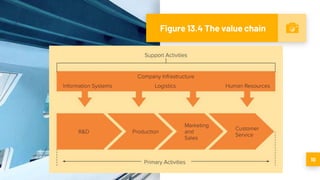
The Firm as a Value Chain
▪ Value creation activities
▫ Production
▫ Marketing and sales
▫ Materials management
▫ R&D
▫ Human resources
▫ Information systems
▫ Infrastructure
9
Figure 13.4 The value chain
10
11
Strategy and the
Firm 6 of 7
The Firm as a Value Chain continued
● Primary activities
○ Design, creation, and delivery of the product
○ Marketing, support, and after-sale service
○ R&D is concerned with the design and production
processes.
○ Production is concerned with the creation of a
good or service.
○ Marketing and sales can increase the perceived
value of a product and discover customer needs.
○ Service activity provides after-sale service and
support.
Strategy and the Firm 7 of 7
12
The Firm as a Value Chain continued
● Support activities
○ Provide inputs that allow the primary activities to occur
○ Information systems can alter the efficiency and effectiveness with
which a firm manages its other value creation activities.
○ Logistics controls the transmission of physical materials through the
value chain.
○ Human resources ensures that the company has the right mix of skilled
people and ensures training, motivation, and compensation.
○ Infrastructure includes the organization structure, control systems, and
culture of the firm.
Global Expansion, Profitability, and Profit
Growth 1 of 6
13
Learning Objective 13-2 Recognize how firms can profit by expanding globally.
Expanding the Market: Leveraging Products and
Competencies
● Core competence
○ Bedrock of a firm’s competitive advantage
Global Expansion, Profitability, and Profit
Growth 2 of 6
14
Location Economies
● Can lower the costs of value creation and help the firm
achieve a low-cost position
● Can enable a firm to differentiate its product offering
from those of competitors
Global Expansion, Profitability, and Profit Growth 3
of 6
15
Location Economies
● Creating a global web
○ Should create a competitive advantage vis-à-vis a firm
that bases all of its value creation activities at a single
location
○ Should be able to better differentiate its product
offering (thereby raising perceived value, V) and lower
its cost structure (C) than its single-location competitor
● Caveats
○ Transportation costs and trade barriers
Global Expansion, Profitability, and Profit Growth 4
of 6
Experience Effects
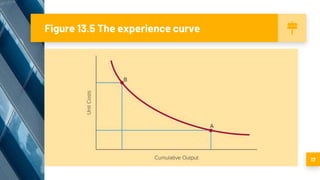
▪ Experience curve
▫ Costs decline by some quantity about each time cumulative
output doubles
▪ Learning effects
▪ Economies of scale
▪ Strategic significance
▫ Moving down the experience curve allows a firm to reduce
its cost of creating value and increase its profitability.
16
Figure 13.5 The experience curve
17
Global Expansion, Profitability, and Profit
Growth 5 of 6
Leveraging Subsidiary Skills
▪ Development of valuable skills can occur in foreign subsidiaries.
▪ Leveraging the skills created within subsidiaries and applying
them to other operations within the firm’s global network may
create value.
18
Global Expansion, Profitability, and Profit Growth 6
of 6
19
Leveraging Subsidiary Skills continued
● Managers must:
○ Recognize that valuable skills that lead to
competencies can arise anywhere within the firm’s
global network, not just at the corporate center
○ Establish an incentive system that encourages local
employees to acquire new skills
○ Have a process for identifying when valuable new
skills have been created in a subsidiary
○ Act as facilitators, helping transfer valuable skills
within the firm
Learning Objective 13-3 Understand how pressures for cost reductions and local
responsiveness influence strategic choice.
Pressures for Cost Reductions
▪ Require a firm to try to lower the costs of value creation
▪ Greater in industries producing commodity-type products
▫ Universal needs
▪ Also in industries where major competitors are based in low-cost
locations, where there is persistent excess capacity, and where
consumers are powerful and face low switching costs
20
Cost Pressures and Pressures for Local
Responsiveness 1 of 4
Pressures for Local Responsiveness
▪ Differences in customer tastes and preferences
▫ Customer demands for local customization are on the
decline worldwide in some markets, but not others.
▪ Differences in infrastructure and traditional practices
▫ May require the delegation of manufacturing and production
functions to foreign subsidiaries
21
Cost Pressures and Pressures for Local
Responsiveness 2 of 4
Pressures for Local Responsiveness continued
▪ Differences in distribution channels
▫ May necessitate delegation of marketing functions to
national subsidiaries
▪ Host-government demands
▫ Economic and political
▫ Threats of protectionism, economic nationalism, and local
content rules dictate that international businesses
manufacture locally.
22
Cost Pressures and Pressures for Local
Responsiveness 3 of 4
23
Cost Pressures and Pressures for Local
Responsiveness 4 of 4
Pressures for Local Responsiveness continued
▪ Rise of regionalism
▫ Tendency toward the convergence of tastes, preferences,
infrastructure, distribution channels, and host-government
demands with a broader region that is composed of two or
more nations
▫ Examples: EU, North America, Latin America
Choosing a Strategy 1 of 6
Learning Objective 13-4 Identify and choose the different global strategies for competing
in the global marketplace.
The need to customize the product to local conditions
may work against the implementation of a global
standardization strategy.
▪ Concessions may need to be made to local conditions.
24
Choosing a Strategy 2 of 6
25
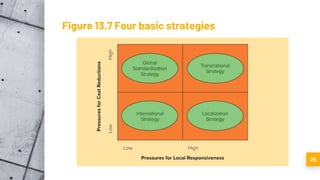
Four International Strategies
● Global standardization
● Localization strategy
● Transnational strategy
● International strategy
Figure 13.7 Four basic strategies
26
Choosing a Strategy 3 of 6
27
Global Standardization Strategy
● Goal is to pursue low-cost strategy on global scale
● Production, marketing, R&D, and supply chain
activities are concentrated in a few favorable
locations.
● Avoids customization
● Makes the most sense when there are strong
pressures for cost reductions and demands for local
responsiveness are minimal
Localization Strategy
▪ Most appropriate when:
▫ There are substantial differences across nations with regard
to consumer tastes and preferences
▫ Cost pressures are not too intense
▪ Customization limits the ability of the firm to capture the cost
reductions associated with mass-producing a standardized
product for global consumption.
28
Choosing a Strategy 4 of 6
Choosing a Strategy 5 of 6
29
Transnational Strategy
● Makes most sense when demands for local responsiveness are
high but cost pressures are moderate or low
● Must focus on leveraging subsidiary skills
● Places conflicting demands on the company
○ Differentiating the product to respond to local demands in
different geographic markets raises costs, which runs
counter to the goal of reducing costs.
Choosing a Strategy 6 of 6
30
International Strategy
● For firms with low cost pressures and low pressures for local
responsiveness
● Involves taking products first produced for their domestic
market and selling them internationally with only minimal local
customization
● Tend to centralize product development functions such as R&D
at home, but establish manufacturing and marketing functions
in each major country or geographic region in which they do
business
Appendix of
Image Long
Descriptions
31
Enterprise valuation involves increasing profitability by reducing
costs, adding value, and raising prices. Enterprise valuation also
involves profit growth by selling more in existing markets and
entering new markets.
Appendix 1 Figure 13.1 Determinants of
enterprise value
32
Appendix 2 Figure 13.4 The value chain
33
Support activities include information systems, company
infrastructure logistics, and human resources.
Primary activities include R&D, production, marketing and sales,
and customer service.
Appendix 3 Figure 13.7 Four basic strategies 34
Global standardization strategy is high in pressures
for cost reductions and low in pressures for local
responsiveness.
Transnational strategy is high in pressures for cost
reductions and high in pressures for local
responsiveness.
International strategy is low in pressures for cost
reductions and low in pressures for local
responsiveness.
Localization strategy is low in pressures for cost
reductions and high in pressures for local
responsiveness.

Chapter 13.pdf

  • 1.
  • 2.
    Learning Objectives LO 13-1Explain the concept of global strategy. LO 13-2 Recognize how firms can profit by expanding globally. LO 13-3 Understand how pressures for cost reductions and local responsiveness influence strategic choice. LO 13-4 Identify and choose the different global strategies for competing in the global marketplace. 2
  • 3.
    Introduction Shift from macroenvironment to the firm itself ▪ Actions managers take to compete more effectively ▪ How organizations can increase revenue (and profitability) by expanding their operations in foreign markets ▫ Value creation 3
  • 4.
    Strategy and theFirm 1 of 7 Learning Objective 13-1 Explain the concept of global strategy. Basic Principles of Strategy ● Goal is to maximize the value of the firm for owners and shareholders ○ Profitability ○ Profit growth
  • 5.
    “ Figure 13.1 Determinantsof enterprise value 5
  • 6.
    Strategy and theFirm 2 of 7 Value Creation ▪ Measured by the difference between a firm’s costs of production and the quality that consumers perceive in its products ▪ The more value customers place on a firm’s products, the higher the price the firm can charge for those products. ▪ Measured by the difference between V (value) and C (cost) ▪ Two strategies: low cost and differentiation 6
  • 7.
    Strategy and theFirm 3 of 7 Strategic Positioning ▪ Porter ▫ A firm should be explicit about its choice of strategic emphasis with regard to value creation (differentiation) and low cost. ▫ A firm should configure its internal operations to support that strategic emphasis. ▫ Efficiency frontier ▫ Diminishing returns 7
  • 8.
    Strategy and theFirm 4 of 7 8 Strategic Positioningcontinued ● To maximize profitability, a firm must: 1. Pick a position on the efficiency frontier that is viable in the sense that there is enough demand to support that choice 2. Configure its internal operations, such as manufacturing, marketing, logistics, information systems, human resources, and so on, so that they support that position 3. Make sure that the firm has the right organization structure in place to execute its strategy ● The strategy, operations, and organization of the firm must all be consistent with each other if it is to attain a competitive advantage and garner superior profitability
  • 9.
    Strategy and theFirm 5 of 7 The Firm as a Value Chain ▪ Value creation activities ▫ Production ▫ Marketing and sales ▫ Materials management ▫ R&D ▫ Human resources ▫ Information systems ▫ Infrastructure 9
  • 10.
    Figure 13.4 Thevalue chain 10
  • 11.
    11 Strategy and the Firm6 of 7 The Firm as a Value Chain continued ● Primary activities ○ Design, creation, and delivery of the product ○ Marketing, support, and after-sale service ○ R&D is concerned with the design and production processes. ○ Production is concerned with the creation of a good or service. ○ Marketing and sales can increase the perceived value of a product and discover customer needs. ○ Service activity provides after-sale service and support.
  • 12.
    Strategy and theFirm 7 of 7 12 The Firm as a Value Chain continued ● Support activities ○ Provide inputs that allow the primary activities to occur ○ Information systems can alter the efficiency and effectiveness with which a firm manages its other value creation activities. ○ Logistics controls the transmission of physical materials through the value chain. ○ Human resources ensures that the company has the right mix of skilled people and ensures training, motivation, and compensation. ○ Infrastructure includes the organization structure, control systems, and culture of the firm.
  • 13.
    Global Expansion, Profitability,and Profit Growth 1 of 6 13 Learning Objective 13-2 Recognize how firms can profit by expanding globally. Expanding the Market: Leveraging Products and Competencies ● Core competence ○ Bedrock of a firm’s competitive advantage
  • 14.
    Global Expansion, Profitability,and Profit Growth 2 of 6 14 Location Economies ● Can lower the costs of value creation and help the firm achieve a low-cost position ● Can enable a firm to differentiate its product offering from those of competitors
  • 15.
    Global Expansion, Profitability,and Profit Growth 3 of 6 15 Location Economies ● Creating a global web ○ Should create a competitive advantage vis-à-vis a firm that bases all of its value creation activities at a single location ○ Should be able to better differentiate its product offering (thereby raising perceived value, V) and lower its cost structure (C) than its single-location competitor ● Caveats ○ Transportation costs and trade barriers
  • 16.
    Global Expansion, Profitability,and Profit Growth 4 of 6 Experience Effects ▪ Experience curve ▫ Costs decline by some quantity about each time cumulative output doubles ▪ Learning effects ▪ Economies of scale ▪ Strategic significance ▫ Moving down the experience curve allows a firm to reduce its cost of creating value and increase its profitability. 16
  • 17.
    Figure 13.5 Theexperience curve 17
  • 18.
    Global Expansion, Profitability,and Profit Growth 5 of 6 Leveraging Subsidiary Skills ▪ Development of valuable skills can occur in foreign subsidiaries. ▪ Leveraging the skills created within subsidiaries and applying them to other operations within the firm’s global network may create value. 18
  • 19.
    Global Expansion, Profitability,and Profit Growth 6 of 6 19 Leveraging Subsidiary Skills continued ● Managers must: ○ Recognize that valuable skills that lead to competencies can arise anywhere within the firm’s global network, not just at the corporate center ○ Establish an incentive system that encourages local employees to acquire new skills ○ Have a process for identifying when valuable new skills have been created in a subsidiary ○ Act as facilitators, helping transfer valuable skills within the firm
  • 20.
    Learning Objective 13-3Understand how pressures for cost reductions and local responsiveness influence strategic choice. Pressures for Cost Reductions ▪ Require a firm to try to lower the costs of value creation ▪ Greater in industries producing commodity-type products ▫ Universal needs ▪ Also in industries where major competitors are based in low-cost locations, where there is persistent excess capacity, and where consumers are powerful and face low switching costs 20 Cost Pressures and Pressures for Local Responsiveness 1 of 4
  • 21.
    Pressures for LocalResponsiveness ▪ Differences in customer tastes and preferences ▫ Customer demands for local customization are on the decline worldwide in some markets, but not others. ▪ Differences in infrastructure and traditional practices ▫ May require the delegation of manufacturing and production functions to foreign subsidiaries 21 Cost Pressures and Pressures for Local Responsiveness 2 of 4
  • 22.
    Pressures for LocalResponsiveness continued ▪ Differences in distribution channels ▫ May necessitate delegation of marketing functions to national subsidiaries ▪ Host-government demands ▫ Economic and political ▫ Threats of protectionism, economic nationalism, and local content rules dictate that international businesses manufacture locally. 22 Cost Pressures and Pressures for Local Responsiveness 3 of 4
  • 23.
    23 Cost Pressures andPressures for Local Responsiveness 4 of 4 Pressures for Local Responsiveness continued ▪ Rise of regionalism ▫ Tendency toward the convergence of tastes, preferences, infrastructure, distribution channels, and host-government demands with a broader region that is composed of two or more nations ▫ Examples: EU, North America, Latin America
  • 24.
    Choosing a Strategy1 of 6 Learning Objective 13-4 Identify and choose the different global strategies for competing in the global marketplace. The need to customize the product to local conditions may work against the implementation of a global standardization strategy. ▪ Concessions may need to be made to local conditions. 24
  • 25.
    Choosing a Strategy2 of 6 25 Four International Strategies ● Global standardization ● Localization strategy ● Transnational strategy ● International strategy
  • 26.
    Figure 13.7 Fourbasic strategies 26
  • 27.
    Choosing a Strategy3 of 6 27 Global Standardization Strategy ● Goal is to pursue low-cost strategy on global scale ● Production, marketing, R&D, and supply chain activities are concentrated in a few favorable locations. ● Avoids customization ● Makes the most sense when there are strong pressures for cost reductions and demands for local responsiveness are minimal
  • 28.
    Localization Strategy ▪ Mostappropriate when: ▫ There are substantial differences across nations with regard to consumer tastes and preferences ▫ Cost pressures are not too intense ▪ Customization limits the ability of the firm to capture the cost reductions associated with mass-producing a standardized product for global consumption. 28 Choosing a Strategy 4 of 6
  • 29.
    Choosing a Strategy5 of 6 29 Transnational Strategy ● Makes most sense when demands for local responsiveness are high but cost pressures are moderate or low ● Must focus on leveraging subsidiary skills ● Places conflicting demands on the company ○ Differentiating the product to respond to local demands in different geographic markets raises costs, which runs counter to the goal of reducing costs.
  • 30.
    Choosing a Strategy6 of 6 30 International Strategy ● For firms with low cost pressures and low pressures for local responsiveness ● Involves taking products first produced for their domestic market and selling them internationally with only minimal local customization ● Tend to centralize product development functions such as R&D at home, but establish manufacturing and marketing functions in each major country or geographic region in which they do business
  • 31.
  • 32.
    Enterprise valuation involvesincreasing profitability by reducing costs, adding value, and raising prices. Enterprise valuation also involves profit growth by selling more in existing markets and entering new markets. Appendix 1 Figure 13.1 Determinants of enterprise value 32
  • 33.
    Appendix 2 Figure13.4 The value chain 33 Support activities include information systems, company infrastructure logistics, and human resources. Primary activities include R&D, production, marketing and sales, and customer service.
  • 34.
    Appendix 3 Figure13.7 Four basic strategies 34 Global standardization strategy is high in pressures for cost reductions and low in pressures for local responsiveness. Transnational strategy is high in pressures for cost reductions and high in pressures for local responsiveness. International strategy is low in pressures for cost reductions and low in pressures for local responsiveness. Localization strategy is low in pressures for cost reductions and high in pressures for local responsiveness.