More Related Content

PPT

PPT

PPT
Monetary system in Macro Economics 
PPT

PPT
International Financial Markets 
PDF

PPTX

PPT
What's hot

PPT
An introduction to Da AFghanistan bank and its monetary policy By Taj Mohamma... 
PPT
International financial system 
PDF

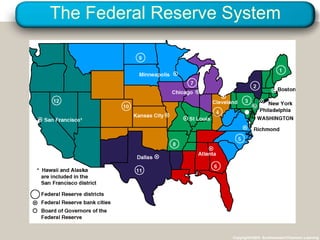
PPTX
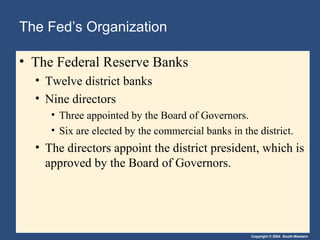
The Role of IMF on the Global Monetary Systems 
PPTX
International Financial System 
PPTX

PPTX

PPT
Chapter 07_Central Banking and the Conduct of Monetary Policy 
PPTX
SDR- Special Drawing Rights, IMF 
PPTX

PPTX
International Financial Market & International Monetary System 
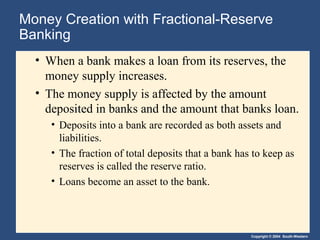
PPTX
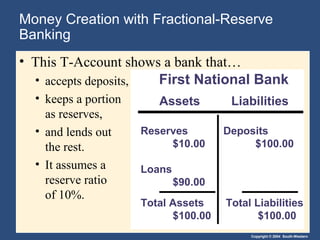
The international monetary fund 
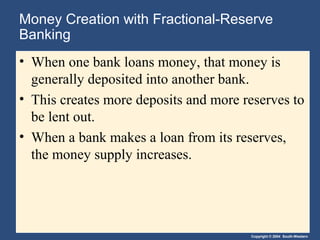
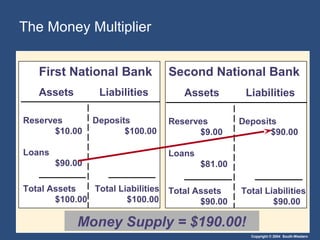
PPTX
INTERATIONAL FINANCIAL SYSTEM 
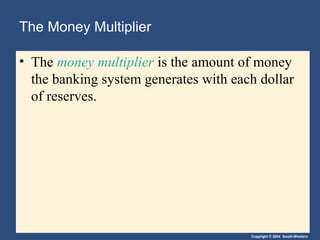
PPTX
Special drawing rights (SDR) and Optimum currency area (OCA) 
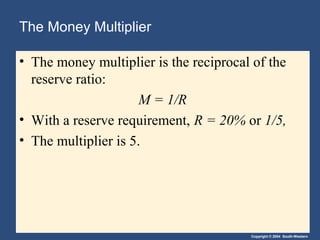
PPTX

PPTX

PPT
The-financial-environment 
PPT

PPTX

PPT
Similar to monetary system

PPT

PPT
29_4E - The Monetary System.ppt 
PPTX
Econ201-Chapter34-2023Fall.pptx 
PPTX
Unit 6 The Mdddddddddonetary System.pptx 
PPTX

PPT

PPT

PPTX
Fed and Monetary Policy Notes111111.pptx 
PPT

PPTX
The FED and its influence on Money and Credit 
PPT

PPT
10 money and the federal reserve 
DOCX

PPTX

PPTX

PPT
Unit 6 finance academic FSAEU6 
PPT
![Lesson 13---banking-fed-monetary[1]](https://cdn.slidesharecdn.com/ss_thumbnails/lesson-13-banking-fed-monetary1-130409195938-phpapp01-thumbnail.jpg?width=640&height=640&fit=bounds)
PPTX
Lesson 13---banking-fed-monetary[1] 
PPT

PPT
monetary system
- 1.
- 2.
- 3.
THE MEANING OFMONEY
• Money is the set of assets in an economy that
people regularly use to buy goods and services
from other people.
Copyright © 2004 South-Western
- 4.
The Functions ofMoney
• Money has three functions in the economy:
• Medium of exchange
• Unit of account
• Store of value
Copyright © 2004 South-Western
- 5.
The Functions ofMoney
• Medium of Exchange
• A medium of exchange is an item that buyers give
to sellers when they want to purchase goods and
services.
• A medium of exchange is anything that is readily
acceptable as payment.
Copyright © 2004 South-Western
- 6.
The Functions ofMoney
• Unit of Account
• A unit of account is the yardstick people use to post
prices and record debts.
• Store of Value
• A store of value is an item that people can use to
transfer purchasing power from the present to the
future.
Copyright © 2004 South-Western
- 7.
The Functions ofMoney
• Liquidity
• Liquidity is the ease with which an asset can be
converted into the economy’s medium of exchange.
Copyright © 2004 South-Western
- 8.
The Kinds ofMoney
• Commodity money takes the form of a
commodity with intrinsic value.
• Examples: Gold, silver, cigarettes.
• Fiat money is used as money because of
government decree.
• It does not have intrinsic value.
• Examples: Coins, currency, check deposits.
Copyright © 2004 South-Western
- 9.
Money in theU.S. Economy
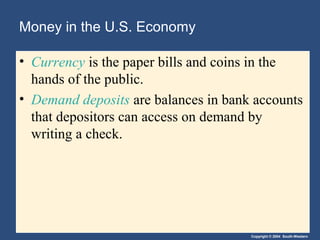
• Currency is the paper bills and coins in the
hands of the public.
• Demand deposits are balances in bank accounts
that depositors can access on demand by
writing a check.
Copyright © 2004 South-Western
- 10.
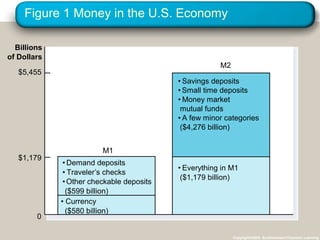
Figure 1 Moneyin the U.S. Economy
Billions
of Dollars
M2
$5,455
• Savings deposits
• Small time deposits
• Money market
mutual funds
• A few minor categories
($4,276 billion)
M1
$1,179
• Demand deposits
• Everything in M1
• Traveler’s checks
($1,179 billion)
• Other checkable deposits
($599 billion)
• Currency
($580 billion)
0
Copyright©2003 Southwestern/Thomson Learning
- 11.
CASE STUDY: WhereIs All The Currency?
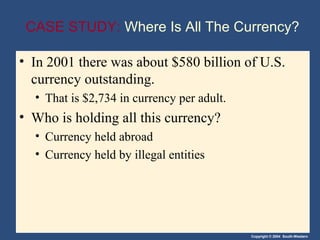
• In 2001 there was about $580 billion of U.S.
currency outstanding.
• That is $2,734 in currency per adult.
• Who is holding all this currency?
• Currency held abroad
• Currency held by illegal entities
Copyright © 2004 South-Western
- 12.
THE FEDERAL RESERVE
SYSTEM
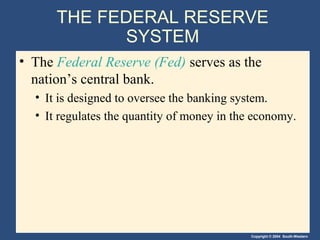
• The Federal Reserve (Fed) serves as the
nation’s central bank.
• It is designed to oversee the banking system.
• It regulates the quantity of money in the economy.
Copyright © 2004 South-Western
- 13.
THE FEDERAL RESERVE
SYSTEM
• The Fed was created in 1914 after a series of
bank failures convinced Congress that the
United States needed a central bank to ensure
the health of the nation’s banking system.
Copyright © 2004 South-Western
- 14.
THE FEDERAL RESERVE
SYSTEM
• The Structure of the Federal Reserve System:
• The primary elements in the Federal Reserve
System are:
• 1) The Board of Governors
• 2) The Regional Federal Reserve Banks
• 3) The Federal Open Market Committee
Copyright © 2004 South-Western
- 15.
The Fed’s Organization
•The Fed is run by a Board of Governors, which
has seven members appointed by the president
and confirmed by the Senate.
• Among the seven members, the most important
is the chairman.
• The chairman directs the Fed staff, presides over
board meetings, and testifies about Fed policy in
front of Congressional Committees.
Copyright © 2004 South-Western
- 16.
The Fed’s Organization
•The Board of Governors
• Seven members
• Appointed by the president
• Confirmed by the Senate
• Serve staggered 14-year terms so that one comes
vacant every two years.
• President appoints a member as chairman to serve a
four-year term.
Copyright © 2004 South-Western
- 17.
The Fed’s Organization
•The Federal Reserve System is made up of the
Federal Reserve Board in Washington, D.C.,
and twelve regional Federal Reserve Banks.
Copyright © 2004 South-Western
- 18.
The Fed’s Organization
•The Federal Reserve Banks
• Twelve district banks
• Nine directors
• Three appointed by the Board of Governors.
• Six are elected by the commercial banks in the district.
• The directors appoint the district president, which is
approved by the Board of Governors.
Copyright © 2004 South-Western
- 19.
- 20.
The Fed’s Organization
•The Federal Reserve Banks
• The New York Fed implements some of the Fed’s
most important policy decisions.
Copyright © 2004 South-Western
- 21.
The Fed’s Organization
•The Federal Open Market Committee (FOMC)
• Serves as the main policy-making organ of the
Federal Reserve System.
• Meets approximately every six weeks to review the
economy.
Copyright © 2004 South-Western
- 22.
The Fed’s Organization
•The Federal Open Market Committee (FOMC)
is made up of the following voting members:
• The chairman and the other six members of the
Board of Governors.
• The president of the Federal Reserve Bank of New
York.
• The presidents of the other regional Federal Reserve
banks (four vote on a yearly rotating basis).
Copyright © 2004 South-Western
- 23.
The Fed’s Organization
•Monetary policy is conducted by the Federal
Open Market Committee.
• Monetary policy is the setting of the money supply
by policymakers in the central bank
• The money supply refers to the quantity of money
available in the economy.
Copyright © 2004 South-Western
- 24.
The Federal OpenMarket Committee
• Three Primary Functions of the Fed
• Regulates banks to ensure they follow federal laws
intended to promote safe and sound banking
practices.
• Acts as a banker’s bank, making loans to banks and
as a lender of last resort.
• Conducts monetary policy by controlling the money
supply.
Copyright © 2004 South-Western
- 25.
The Federal OpenMarket Committee
• Open-Market Operations
• The money supply is the quantity of money
available in the economy.
• The primary way in which the Fed changes the
money supply is through open-market operations.
• The Fed purchases and sells U.S. government bonds.
Copyright © 2004 South-Western
- 26.
The Federal OpenMarket Committee
• Open-Market Operations
• To increase the money supply, the Fed buys
government bonds from the public.
• To decrease the money supply, the Fed sells
government bonds to the public.
Copyright © 2004 South-Western
- 27.
BANKS AND THEMONEY
SUPPLY
• Banks can influence the quantity of demand
deposits in the economy and the money supply.
Copyright © 2004 South-Western
- 28.
BANKS AND THEMONEY
SUPPLY
• Reserves are deposits that banks have received
but have not loaned out.
• In a fractional-reserve banking system, banks
hold a fraction of the money deposited as
reserves and lend out the rest.
Copyright © 2004 South-Western
- 29.
BANKS AND THEMONEY
SUPPLY
• Reserve Ratio
• The reserve ratio is the fraction of deposits that
banks hold as reserves.
Copyright © 2004 South-Western
- 30.
Money Creation withFractional-Reserve
Banking
• When a bank makes a loan from its reserves, the
money supply increases.
• The money supply is affected by the amount
deposited in banks and the amount that banks loan.
• Deposits into a bank are recorded as both assets and
liabilities.
• The fraction of total deposits that a bank has to keep as
reserves is called the reserve ratio.
• Loans become an asset to the bank.
Copyright © 2004 South-Western
- 31.
Money Creation withFractional-Reserve
Banking
• This T-Account shows a bank that…
• accepts deposits, First National Bank
• keeps a portion Assets Liabilities
as reserves,
• and lends out Reserves Deposits
the rest. $10.00 $100.00
• It assumes a Loans
reserve ratio $90.00
of 10%.
Total Assets Total Liabilities
$100.00 $100.00
Copyright © 2004 South-Western
- 32.
Money Creation withFractional-Reserve
Banking
• When one bank loans money, that money is
generally deposited into another bank.
• This creates more deposits and more reserves to
be lent out.
• When a bank makes a loan from its reserves,
the money supply increases.
Copyright © 2004 South-Western
- 33.
- 34.
The Money Multiplier
•The money multiplier is the amount of money
the banking system generates with each dollar
of reserves.
Copyright © 2004 South-Western
- 35.
The Money Multiplier
First National Bank Second National Bank
Assets Liabilities Assets Liabilities
Reserves Deposits Reserves Deposits
$10.00 $100.00 $9.00 $90.00
Loans Loans
$90.00 $81.00
Total Assets Total Liabilities Total Assets Total Liabilities
$100.00 $100.00 $90.00 $90.00
Money Supply = $190.00!
Copyright © 2004 South-Western
- 36.
The Money Multiplier
•The money multiplier is the reciprocal of the
reserve ratio:
M = 1/R
• With a reserve requirement, R = 20% or 1/5,
• The multiplier is 5.
Copyright © 2004 South-Western
- 37.
The Fed’s Toolsof Monetary Control
• The Fed has three tools in its monetary toolbox:
• Open-market operations
• Changing the reserve requirement
• Changing the discount rate
Copyright © 2004 South-Western
- 38.
The Fed’s Toolsof Monetary Control
• Open-Market Operations
• The Fed conducts open-market operations when it
buys government bonds from or sells government
bonds to the public:
• When the Fed buys government bonds, the money supply
increases.
• The money supply decreases when the Fed sells
government bonds.
Copyright © 2004 South-Western
- 39.
The Fed’s Toolsof Monetary Control
• Reserve Requirements
• The Fed also influences the money supply with
reserve requirements.
• Reserve requirements are regulations on the
minimum amount of reserves that banks must hold
against deposits.
Copyright © 2004 South-Western
- 40.
The Fed’s Toolsof Monetary Control
• Changing the Reserve Requirement
• The reserve requirement is the amount (%) of a
bank’s total reserves that may not be loaned out.
• Increasing the reserve requirement decreases the money
supply.
• Decreasing the reserve requirement increases the money
supply.
Copyright © 2004 South-Western
- 41.
The Fed’s Toolsof Monetary Control
• Changing the Discount Rate
• The discount rate is the interest rate the Fed charges
banks for loans.
• Increasing the discount rate decreases the money supply.
• Decreasing the discount rate increases the money supply.
Copyright © 2004 South-Western
- 42.
Problems in Controllingthe Money Supply
• The Fed’s control of the money supply is not
precise.
• The Fed must wrestle with two problems that
arise due to fractional-reserve banking.
• The Fed does not control the amount of money that
households choose to hold as deposits in banks.
• The Fed does not control the amount of money that
bankers choose to lend.
Copyright © 2004 South-Western
- 43.
Summary
• The termmoney refers to assets that people
regularly use to buy goods and services.
• Money serves three functions in an economy:
as a medium of exchange, a unit of account,
and a store of value.
• Commodity money is money that has intrinsic
value.
• Fiat money is money without intrinsic value.
Copyright © 2004 South-Western
- 44.
Summary
• The FederalReserve, the central bank of the
United States, regulates the U.S. monetary
system.
• It controls the money supply through open-
market operations or by changing reserve
requirements or the discount rate.
Copyright © 2004 South-Western
- 45.
Summary
• When banksloan out their deposits, they
increase the quantity of money in the economy.
• Because the Fed cannot control the amount
bankers choose to lend or the amount
households choose to deposit in banks, the
Fed’s control of the money supply is imperfect.
Copyright © 2004 South-Western