Options
Real Options
• Managers have options to adapt and revise
decisions.
• Flexibility is valuable.
• Value of flexibility should be accounted for.
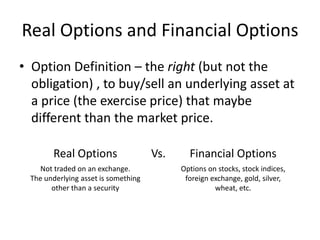
Real Options and Financial Options
• Option Definition – the right (but not the
obligation) , to buy/sell an underlying asset at
a price (the exercise price) that maybe
different than the market price.
Real Options Vs. Financial Options
Not traded on an exchange.
The underlying asset is something
other than a security
Options on stocks, stock indices,
foreign exchange, gold, silver,
wheat, etc.
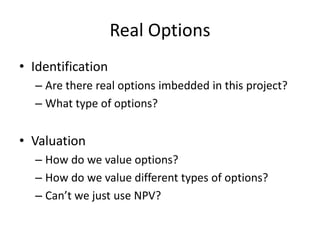
Real Options
• Identification
– Are there real options imbedded in this project?
– What type of options?
• Valuation
– How do we value options?
– How do we value different types of options?
– Can’t we just use NPV?
Identifying Real Options
• Value
• Almost always exist
• Art:
– Identify options that are “significant”
– Ignore options that are not
• Identifying real options takes practice, and
some times “vision”.
Identifying Real Options
• 4 types
1. Growth
2. Abandon
3. Investment Timing
4. Switch
• Key elements
– Information will arrive in the future
– Decisions can be made after the information
Options vs. DCF
• DCF method:
– “expected scenario” of cash flows
– Discount the expected cash flows
• DCF is fine – as long as –
– Expected cash flows are estimated properly
– Discount rates are estimated properly
• Complex options make it difficult to estimate
Start with “Static” DCF Analysis
• Begin by valuing project with no options
– Pretend the investment decision must be taken
immediately.
• This benchmark constitutes a lower bound for
the project’s value.
– NPV < 0 – Does not mean:
•
– NPV > 0 – Does not mean:
•
•
Growth Option (1)
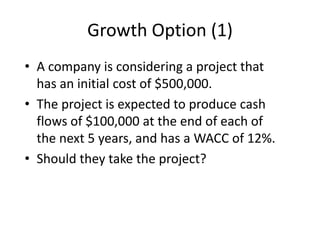
• A company is considering a project that
has an initial cost of $500,000.
• The project is expected to produce cash
flows of $100,000 at the end of each of
the next 5 years, and has a WACC of 12%.
• Should they take the project?
Growth Option (1)
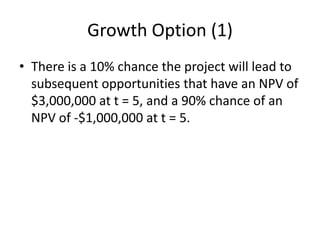
• There is a 10% chance the project will lead to
subsequent opportunities that have an NPV of
$3,000,000 at t = 5, and a 90% chance of an
NPV of -$1,000,000 at t = 5.
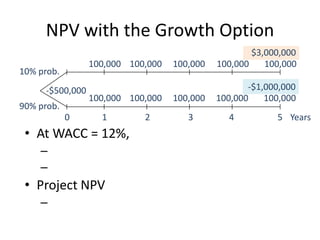
NPV with the Growth Option
• At WACC = 12%,
–
–
• Project NPV
–
100,000 100,000 100,000 100,000 100,000
-$500,000
10% prob.
90% prob.
1 2 3 4 5 Years0
100,000 100,000 100,000 100,000 100,000
-$1,000,000
$3,000,000
Growth Option (2)
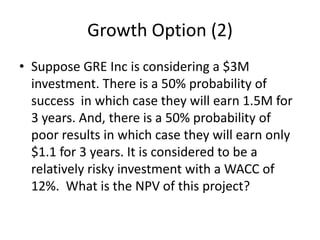
• Suppose GRE Inc is considering a $3M
investment. There is a 50% probability of
success in which case they will earn 1.5M for
3 years. And, there is a 50% probability of
poor results in which case they will earn only
$1.1 for 3 years. It is considered to be a
relatively risky investment with a WACC of
12%. What is the NPV of this project?
Growth Option (2)
• However, if the plan is successful at the end of
the first year, then GRE Inc could invest
another $1M at the end of the first year. This
additional investment is expected to yield an
additional cash flow of $5 the following year.
What is the value of the growth option?
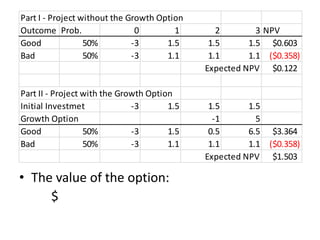
Part I - Project without the Growth Option
Outcome Prob. 0 1 2 3 NPV
Good 50% -3 1.5 1.5 1.5 $0.603
Bad 50% -3 1.1 1.1 1.1 ($0.358)
Expected NPV $0.122
Part II - Project with the Growth Option
Initial Investmet -3 1.5 1.5 1.5
Growth Option -1 5
Good 50% -3 1.5 0.5 6.5 $3.364
Bad 50% -3 1.1 1.1 1.1 ($0.358)
Expected NPV $1.503
• The value of the option:
$
Abandonment Option
• A project has an initial, up-front cost of
$200,000. The project is expected to
produce cash flows of $80,000 for the next
three years.
• At a 10% WACC, should we take the
project?
– The NPV is -1051.84.
– No, don’t take the project.
Abandonment Option
• The project’s cash flows depend critically
upon customer acceptance of the product.
• There is a 60% probability that the product
will be wildly successful and produce CFs
of $150,000, and a 40% chance it will
produce annual CFs of $25,000.
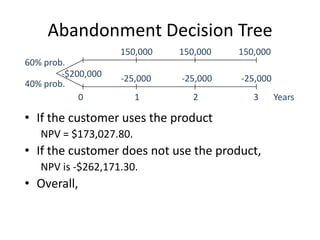
Abandonment Decision Tree
• If the customer uses the product
NPV = $173,027.80.
• If the customer does not use the product,
NPV is -$262,171.30.
• Overall,
-$200,000
60% prob.
40% prob.
1 2 3 Years0
150,000 150,000 150,000
-25,000 -25,000 -25,000
Issues with Abandonment Options
• The company does not have the option to
delay the project.
• The company may abandon the project
after a year, if the customer has not
adopted the product.
• If the project is abandoned, there will be
no operating costs incurred nor cash
inflows received after the first year.
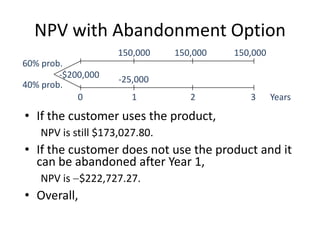
NPV with Abandonment Option
• If the customer uses the product,
NPV is still $173,027.80.
• If the customer does not use the product and it
can be abandoned after Year 1,
NPV is $222,727.27.
• Overall,
-$200,000
60% prob.
40% prob.
1 2 3 Years0
150,000 150,000 150,000
-25,000
Should an abandonment option affect a
project’s WACC?
Investment Timing Option
• A company is considering a project that
has an up-front cost of $100,000. The
project is expected to produce cash flows
of $33,500 at the end of each of the next
four years. The project has a WACC = 10%.
• Should they take the project now?
• However, if the company waits a year they
will find out more information.
Investment Timing Option
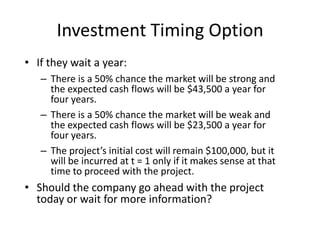
• If they wait a year:
– There is a 50% chance the market will be strong and
the expected cash flows will be $43,500 a year for
four years.
– There is a 50% chance the market will be weak and
the expected cash flows will be $23,500 a year for
four years.
– The project’s initial cost will remain $100,000, but it
will be incurred at t = 1 only if it makes sense at that
time to proceed with the project.
• Should the company go ahead with the project
today or wait for more information?
Investment Timing Decision Tree
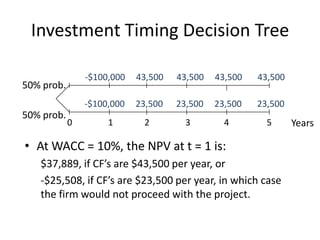
• At WACC = 10%, the NPV at t = 1 is:
$37,889, if CF’s are $43,500 per year, or
-$25,508, if CF’s are $23,500 per year, in which case
the firm would not proceed with the project.
50% prob.
50% prob.
0 1 2 3 4 5 Years
-$100,000 43,500 43,500 43,500 43,500
-$100,000 23,500 23,500 23,500 23,500
Should we wait or proceed?
Factors to Consider In Decision of
When to Invest
• Delaying the project means that cash flows
come later rather than sooner.
• It might make sense to proceed today if
there are important advantages to being
the first competitor to enter a market.
• Waiting may allow you to take advantage
of changing conditions.

Chapter 13 real options - student version

  • 1.
  • 2.
    Real Options • Managershave options to adapt and revise decisions. • Flexibility is valuable. • Value of flexibility should be accounted for.
  • 3.
    Real Options andFinancial Options • Option Definition – the right (but not the obligation) , to buy/sell an underlying asset at a price (the exercise price) that maybe different than the market price. Real Options Vs. Financial Options Not traded on an exchange. The underlying asset is something other than a security Options on stocks, stock indices, foreign exchange, gold, silver, wheat, etc.
  • 4.
    Real Options • Identification –Are there real options imbedded in this project? – What type of options? • Valuation – How do we value options? – How do we value different types of options? – Can’t we just use NPV?
  • 5.
    Identifying Real Options •Value • Almost always exist • Art: – Identify options that are “significant” – Ignore options that are not • Identifying real options takes practice, and some times “vision”.
  • 6.
    Identifying Real Options •4 types 1. Growth 2. Abandon 3. Investment Timing 4. Switch • Key elements – Information will arrive in the future – Decisions can be made after the information
  • 7.
    Options vs. DCF •DCF method: – “expected scenario” of cash flows – Discount the expected cash flows • DCF is fine – as long as – – Expected cash flows are estimated properly – Discount rates are estimated properly • Complex options make it difficult to estimate
  • 8.
    Start with “Static”DCF Analysis • Begin by valuing project with no options – Pretend the investment decision must be taken immediately. • This benchmark constitutes a lower bound for the project’s value. – NPV < 0 – Does not mean: • – NPV > 0 – Does not mean: • •
  • 9.
    Growth Option (1) •A company is considering a project that has an initial cost of $500,000. • The project is expected to produce cash flows of $100,000 at the end of each of the next 5 years, and has a WACC of 12%. • Should they take the project?
  • 10.
    Growth Option (1) •There is a 10% chance the project will lead to subsequent opportunities that have an NPV of $3,000,000 at t = 5, and a 90% chance of an NPV of -$1,000,000 at t = 5.
  • 11.
    NPV with theGrowth Option • At WACC = 12%, – – • Project NPV – 100,000 100,000 100,000 100,000 100,000 -$500,000 10% prob. 90% prob. 1 2 3 4 5 Years0 100,000 100,000 100,000 100,000 100,000 -$1,000,000 $3,000,000
  • 12.
    Growth Option (2) •Suppose GRE Inc is considering a $3M investment. There is a 50% probability of success in which case they will earn 1.5M for 3 years. And, there is a 50% probability of poor results in which case they will earn only $1.1 for 3 years. It is considered to be a relatively risky investment with a WACC of 12%. What is the NPV of this project?
  • 13.
    Growth Option (2) •However, if the plan is successful at the end of the first year, then GRE Inc could invest another $1M at the end of the first year. This additional investment is expected to yield an additional cash flow of $5 the following year. What is the value of the growth option?
  • 14.
    Part I -Project without the Growth Option Outcome Prob. 0 1 2 3 NPV Good 50% -3 1.5 1.5 1.5 $0.603 Bad 50% -3 1.1 1.1 1.1 ($0.358) Expected NPV $0.122 Part II - Project with the Growth Option Initial Investmet -3 1.5 1.5 1.5 Growth Option -1 5 Good 50% -3 1.5 0.5 6.5 $3.364 Bad 50% -3 1.1 1.1 1.1 ($0.358) Expected NPV $1.503 • The value of the option: $
  • 15.
    Abandonment Option • Aproject has an initial, up-front cost of $200,000. The project is expected to produce cash flows of $80,000 for the next three years. • At a 10% WACC, should we take the project? – The NPV is -1051.84. – No, don’t take the project.
  • 16.
    Abandonment Option • Theproject’s cash flows depend critically upon customer acceptance of the product. • There is a 60% probability that the product will be wildly successful and produce CFs of $150,000, and a 40% chance it will produce annual CFs of $25,000.
  • 17.
    Abandonment Decision Tree •If the customer uses the product NPV = $173,027.80. • If the customer does not use the product, NPV is -$262,171.30. • Overall, -$200,000 60% prob. 40% prob. 1 2 3 Years0 150,000 150,000 150,000 -25,000 -25,000 -25,000
  • 18.
    Issues with AbandonmentOptions • The company does not have the option to delay the project. • The company may abandon the project after a year, if the customer has not adopted the product. • If the project is abandoned, there will be no operating costs incurred nor cash inflows received after the first year.
  • 19.
    NPV with AbandonmentOption • If the customer uses the product, NPV is still $173,027.80. • If the customer does not use the product and it can be abandoned after Year 1, NPV is $222,727.27. • Overall, -$200,000 60% prob. 40% prob. 1 2 3 Years0 150,000 150,000 150,000 -25,000
  • 20.
    Should an abandonmentoption affect a project’s WACC?
  • 21.
    Investment Timing Option •A company is considering a project that has an up-front cost of $100,000. The project is expected to produce cash flows of $33,500 at the end of each of the next four years. The project has a WACC = 10%. • Should they take the project now? • However, if the company waits a year they will find out more information.
  • 22.
    Investment Timing Option •If they wait a year: – There is a 50% chance the market will be strong and the expected cash flows will be $43,500 a year for four years. – There is a 50% chance the market will be weak and the expected cash flows will be $23,500 a year for four years. – The project’s initial cost will remain $100,000, but it will be incurred at t = 1 only if it makes sense at that time to proceed with the project. • Should the company go ahead with the project today or wait for more information?
  • 23.
    Investment Timing DecisionTree • At WACC = 10%, the NPV at t = 1 is: $37,889, if CF’s are $43,500 per year, or -$25,508, if CF’s are $23,500 per year, in which case the firm would not proceed with the project. 50% prob. 50% prob. 0 1 2 3 4 5 Years -$100,000 43,500 43,500 43,500 43,500 -$100,000 23,500 23,500 23,500 23,500
  • 24.
    Should we waitor proceed?
  • 25.
    Factors to ConsiderIn Decision of When to Invest • Delaying the project means that cash flows come later rather than sooner. • It might make sense to proceed today if there are important advantages to being the first competitor to enter a market. • Waiting may allow you to take advantage of changing conditions.