A visit to  America   Creative Rupture  The 1960s  Introduction to American Art and Visual Culture – Lecture 6
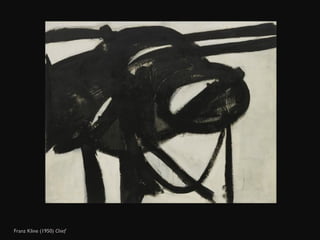
Franz Kline (1950)  Chief
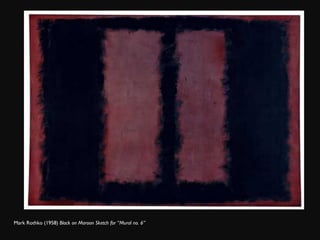
Mark Rothko (1958)  Black on Maroon Sketch for “Mural no. 6”
 
1960s      The nation was in accelerated cultural, social, and political transition.  Painting moved from the deeply personal (last week) to the impersonal Issues of “High versus Low” were raised. Multiple voices clamored for equalities and freedoms: women, blacks, etc.
Artists: Ad Reinhardt Ellsworth Kelly Morris Louis Cy Twombly Agnes Martin Robert Rauschenberg Claes Oldenberg Andy Warhol
Non Compositional Strategies
Ad Reinhardt         ” Art is Art. Everything else is everything else”
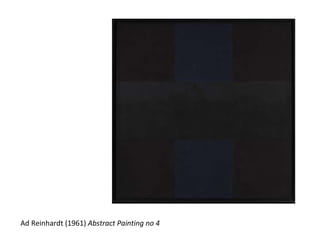
Ad Reinhardt (1961)  Abstract Painting no 4
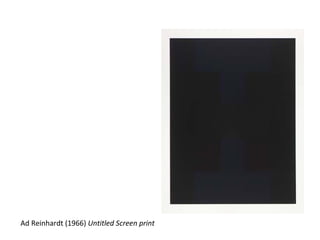
Ad Reinhardt (1966)  Untitled Screen print
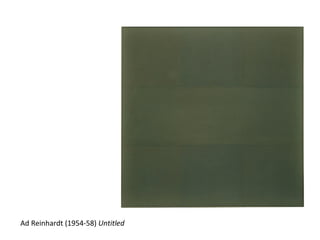
Ad Reinhardt (1954-58)  Untitled
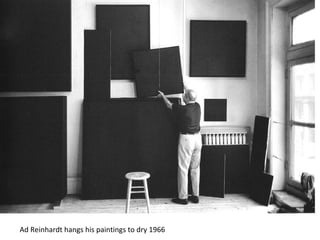
Ad Reinhardt hangs his paintings to dry 1966
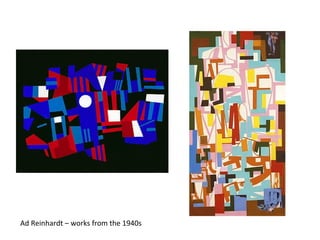
Ad Reinhardt – works from the 1940s
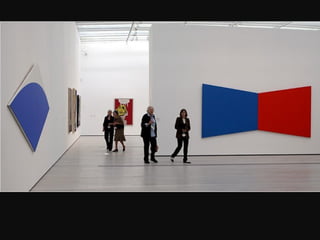
Ellsworth Kelly       Take a look at MoMA’s Mp3 description of the artist’s work:http://www.moma.org/audio_file/audio_file/794/ColorChart_601.mp3
    
Ellsworth Kelly
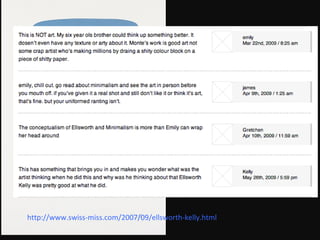
http://www.swiss-miss.com/2007/09/ellsworth-kelly.html
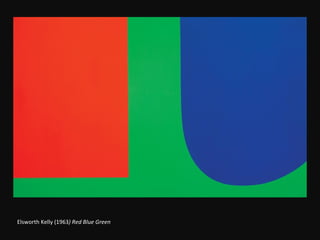
Elsworth Kelly (1963 ) Red Blue Green
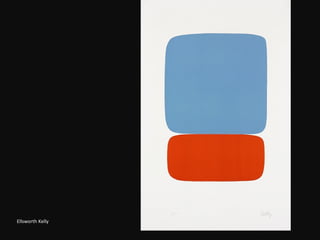
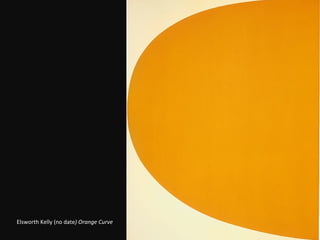
Elsworth Kelly (no date ) Orange Curve
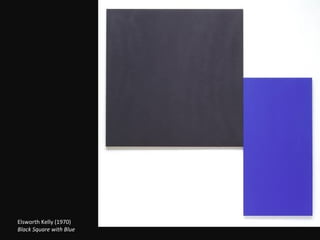
Elsworth Kelly (1970) Black Square with Blue
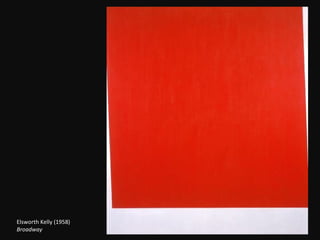
Elsworth Kelly (1958) Broadway
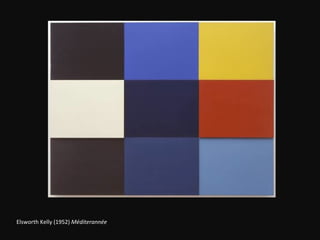
Elsworth Kelly (1952)  Méditerannée
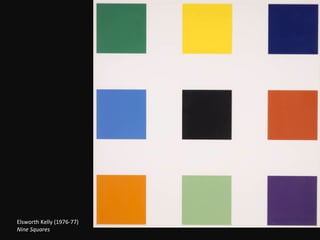
Elsworth Kelly (1976-77) Nine Squares
Stains and Graffiti  Legacy of Color and Gesture Forefathers
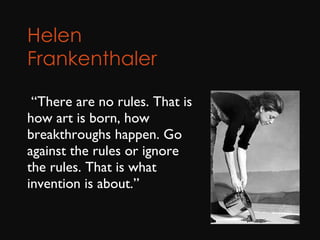
Helen Frankenthaler        “ There are no rules. That is how art is born, how breakthroughs happen. Go against the rules or ignore the rules. That is what invention is about.”
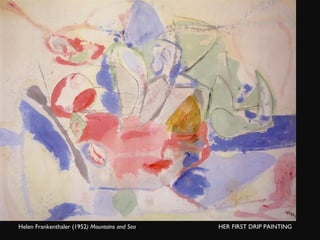
Helen  Helen Frankenthaler (1952 ) Mountains and Sea  HER FIRST DRIP PAINTING
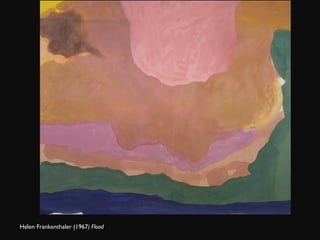
Helen  Helen Frankenthaler (1967 ) Flood
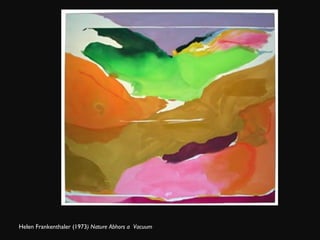
Helen  Helen Frankenthaler (1973 ) Nature Abhors a  Vacuum
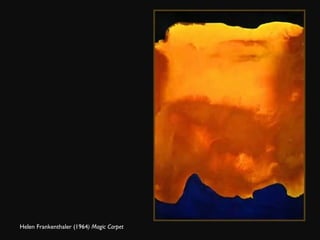
Helen  Helen Frankenthaler (1964 ) Magic Carpet
Morris Louis        “ He owes his reputation to the critic Clement Greenberg, who was also his coach. It is not really true, as has often been said, that Greenberg told Louis what to paint, though he probably had more influence over this lonely, gifted and insecure man than any American critic has had over any other artist.”  - Critic Robert Hughes Read more:  http://www.time.com/time/magazine/article/0,9171,962782,00.html#ixzz0YwAjOkQF
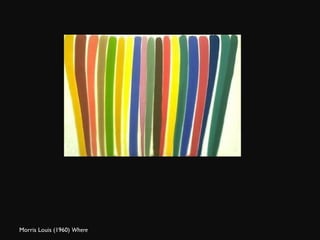
Morris Louis (1960)  Where
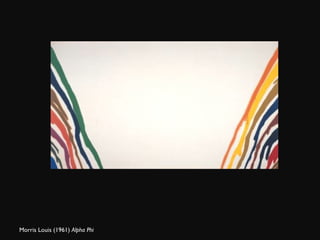
Morris Louis (1961)  Alpha Phi
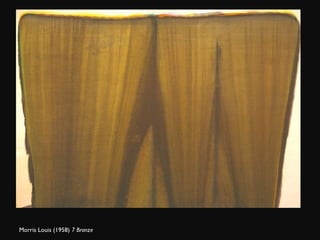
Morris Louis (1958)  7 Bronze
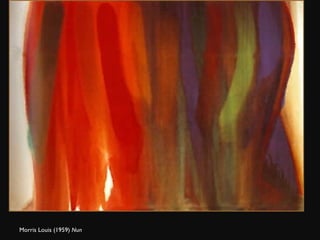
Morris Louis (1959)  Nun
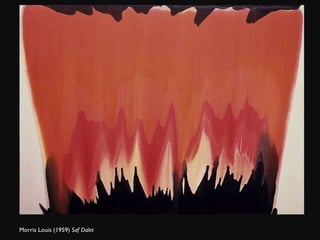
Morris Louis (1959)  Saf Dalet
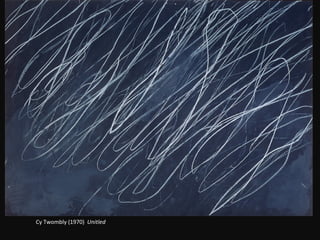
Cy Twombly         On graffiti-- 
”Graffiti is linear and it's done with a pencil, and it's like writing on walls. But [in my paintings] it's more lyrical. In those beautiful early paintings like Academy, it's graffiti but it's something else, too. I don't know how people ­react, but the feeling is more complicated, more elaborate. Graffiti is usually a protest - ink on walls - or has a reason for ­being naughty or aggressive.” Read a rare interview of this artist: http://www.guardian.co.uk/artanddesign/2008/jun/03/art1
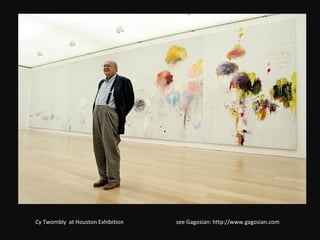
Cy Twombly  at Houston Exhibition  see Gagosian: http://www.gagosian.com
Cy Twombly (1970)  Unitled
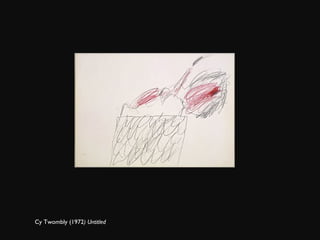
Cy Twombly (1972 ) Untitled
Read the entire interview: http://www.guardian.co.uk/artanddesign/2008/jun/03/art1 The Ferragosto paintings 
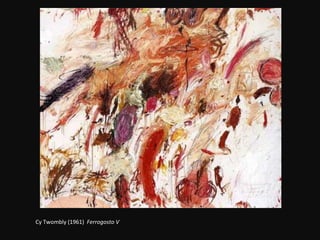
They were done in Rome, when I had to stay there in August. I was completely crazy, out of my mind with [the] heat.Paint is something that I use with my hands and do all those tactile things. I really don't like oil because you can't get back into it, or you make a mess. It's not my favourite thing - pencil is more my medium than wet paint. I did by mistake paint on a picture in Lexington and then quickly put an image on top. And I got into the wet. I had the background painted, worked into it and then merged the background and surfaces. Before, I always had a dry background and painted on. Now, I have someone paint the background that I have already figured out. I used to change things in my early paintings to get the nuance or feeling I wanted, but now I plan everything in my head ­before I do it. Also the scale of the things - they are big and I can't get on the ladder all the time, it hurts. So they are more thought out. I have drawn little sketches of things.
Cy Twombly (1961)  Ferrogosto V
Read the entire interview: http://www.guardian.co.uk/artanddesign/2008/jun/03/art1 Coronation of Sesostris series 
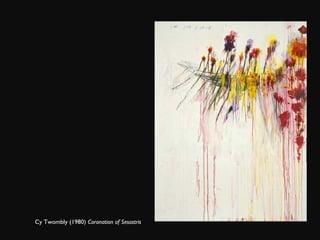
When I work, I work very fast, but preparing to work can take any length of time. It can even be a year. These were started in ­Bassano and hung upstairs for years. I like the sun disc because I managed to do very childlike painting, very immediate. Then I took them to Virginia and finished them - wound up at the end with a detail of Degas's  The Cotton Exchange in New ­Orleans.  How it got in there, I don't know, but it's one of my favorite sets.
Cy Twombly (1980)  Coronation of Sesostris
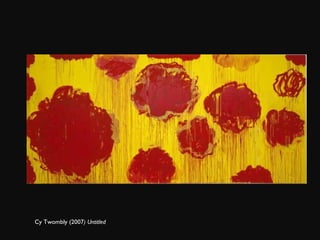
Read the entire interview: http://www.guardian.co.uk/artanddesign/2008/jun/03/art1 A Scattering of Blossoms series
 I work in waves, because I'm impatient. Because of a certain physicality, of lack of breath from standing. It has to be done and I do take liberties I wouldn't have taken before. I got all kinds of wonderful effects that I never achieved before. Sometimes it's simplistic. It's hot, so I do some cool paintings. Lots of times I like to enjoy myself. I think I'm in a good point of working.
Cy Twombly (2007 ) Untitled
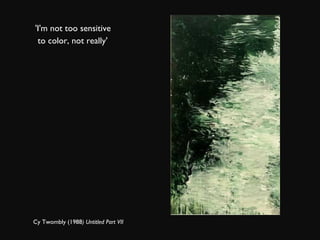
'I'm not too sensitive to color, not really' Cy Twombly (1988 ) Untitled Part VII
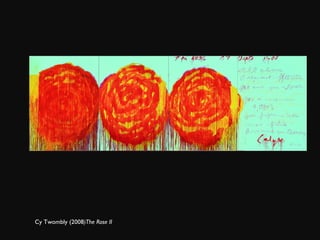
Cy Twombly (2008 )The Rose II
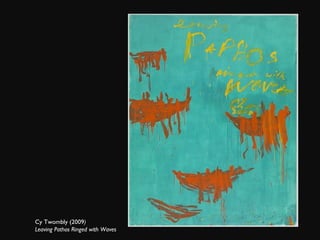
Cy Twombly (2009 ) Leaving Pathos Ringed with Waves
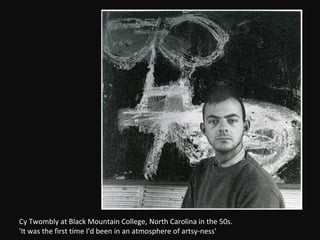
Cy Twombly at Black Mountain College, North Carolina in the 50s.  'It was the first time I'd been in an atmosphere of artsy-ness'
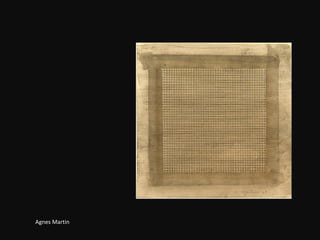
Agnes Martin         “ Art is the concrete representation of our most subtle feelings.” Eight minute Interview of this artist: http://www.youtube.com/watch?v=_-JfYjmo5OA
Agnes Martin
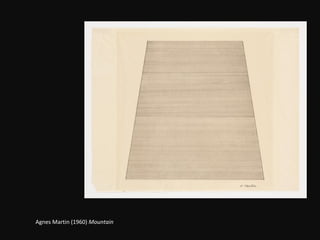
Agnes Martin (1960)  Mountain
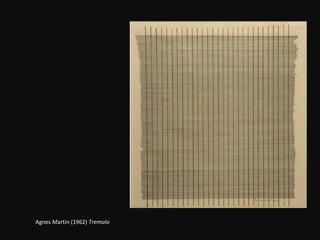
Agnes Martin (1962)  Tremolo
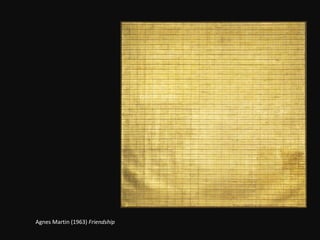
Agnes Martin (1963)  Friendship
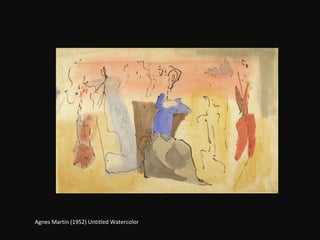
Agnes Martin (1952) Untitled Watercolor
 
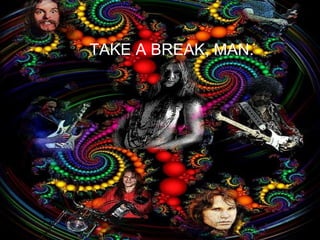
Creedence Clearwater Revival (1967 ) I Heard it Through the Grapevine TAKE A BREAK, MAN.
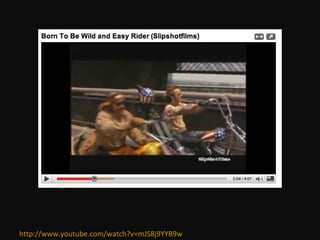
http://www.youtube.com/watch?v=mJS8j9YYB9w
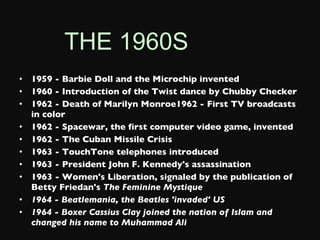
1959 - Barbie Doll and the Microchip invented 1960 - Introduction of the Twist dance by Chubby Checker 1962 - Death of Marilyn Monroe1962 - First TV broadcasts in color 1962 - Spacewar, the first computer video game, invented 1962 - The Cuban Missile Crisis 1963 - TouchTone telephones introduced 1963 - President John F. Kennedy's assassination 1963 - Women's Liberation, signaled by the publication of Betty Friedan's  The Feminine Mystique 1964 - Beatlemania, the Beatles 'invaded' US 1964 - Boxer Cassius Clay joined the nation of Islam and changed his name to Muhammad Ali THE 1960S
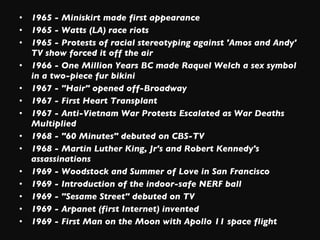
1965 - Miniskirt made first appearance 1965 - Watts (LA) race riots 1965 - Protests of racial stereotyping against 'Amos and Andy' TV show forced it off the air 1966 - One Million Years BC made Raquel Welch a sex symbol in a two-piece fur bikini 1967 - "Hair" opened off-Broadway 1967 - First Heart Transplant 1967 - Anti-Vietnam War Protests Escalated as War Deaths Multiplied 1968 - "60 Minutes" debuted on CBS-TV 1968 - Martin Luther King, Jr's and Robert Kennedy's assassinations 1969 - Woodstock and Summer of Love in San Francisco 1969 - Introduction of the indoor-safe NERF ball 1969 - "Sesame Street" debuted on TV 1969 - Arpanet (first Internet) invented 1969 - First Man on the Moon with Apollo 11 space flight
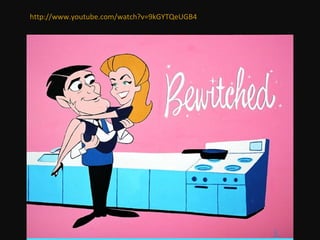
http://www.youtube.com/watch?v=9kGYTQeUGB4
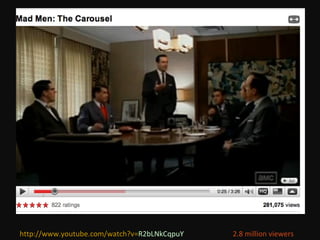
http://www.youtube.com/watch?v= R2bLNkCqpuY   2.8 million viewers
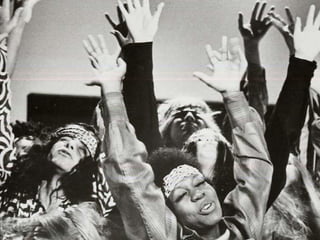
The sixties were the age of youth, as
70 million children from the post-war baby boom became teenagers and young adults.  The movement away from the conservative fifties continued and eventually resulted in revolutionary ways of thinking and real change in the cultural fabric of American life. 
http://www.youtube.com/watch?v=-7JVxE2SYxo
Pop Art
Andy Warhol       “ They say that time changes things, but you actually have to change them yourself”
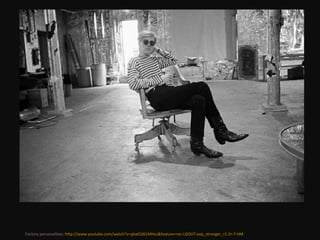
Factory personalities:  http://www.youtube.com/watch?v=qkwD261MHsc&feature=rec-LGOUT-exp_stronger_r2-2r-7-HM
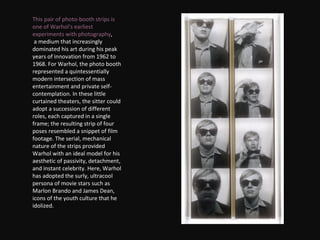
This pair of photo-booth strips is one of Warhol's earliest experiments with photography , a medium that increasingly dominated his art during his peak years of innovation from 1962 to 1968. For Warhol, the photo booth represented a quintessentially modern intersection of mass entertainment and private self-contemplation. In these little curtained theaters, the sitter could adopt a succession of different roles, each captured in a single frame; the resulting strip of four poses resembled a snippet of film footage. The serial, mechanical nature of the strips provided Warhol with an ideal model for his aesthetic of passivity, detachment, and instant celebrity. Here, Warhol has adopted the surly, ultracool persona of movie stars such as Marlon Brando and James Dean, icons of the youth culture that he idolized.
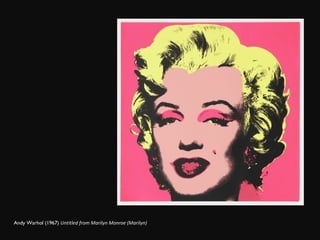
Andy Warhol (1967)  Untitled from Marilyn Monroe (Marilyn)
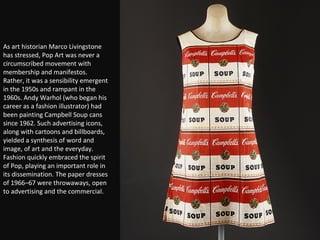
As art historian Marco Livingstone has stressed, Pop Art was never a circumscribed movement with membership and manifestos. Rather, it was a sensibility emergent in the 1950s and rampant in the 1960s. Andy Warhol (who began his career as a fashion illustrator) had been painting Campbell Soup cans since 1962. Such advertising icons, along with cartoons and billboards, yielded a synthesis of word and image, of art and the everyday. Fashion quickly embraced the spirit of Pop, playing an important role in its dissemination. The paper dresses of 1966–67 were throwaways, open to advertising and the commercial.
http://www.youtube.com/watch?v=_cT10g9U9cU&feature=related
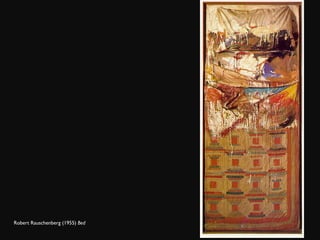
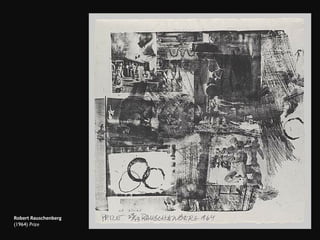
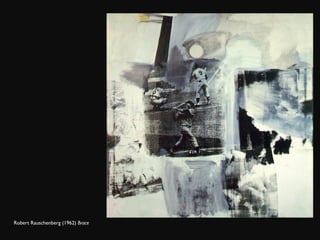
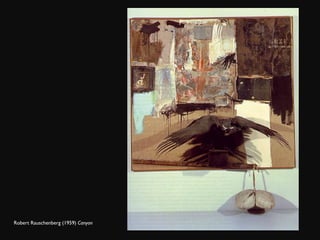
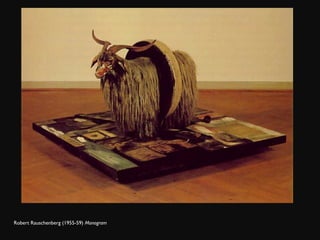
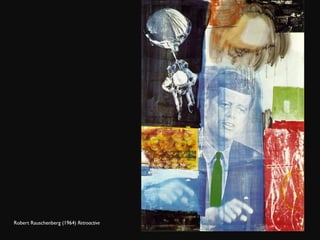
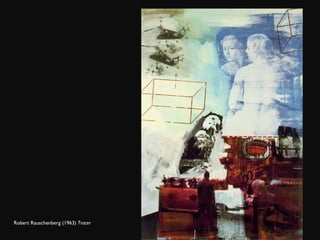
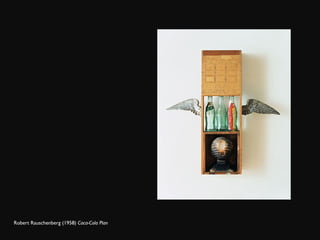
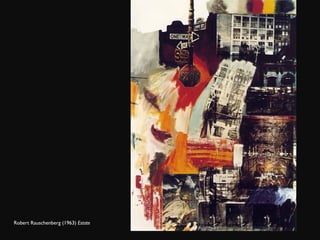
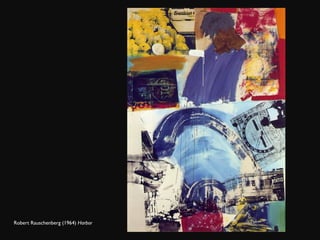
Rauschenberg: At the same time that Abstract Expressionism began to wane…a disparate group of artists began to explore some of the overlooked implications of action painting—its gestural freedom, chance effects, and urban themes—giving birth to a wide array of strategies epitomized by Robert Rauschenberg's oft-quoted statement that he wanted to act in the gap between art and life. Rauschenberg himself had been making Combines—found objects covered with slashing strokes of paint that blurred the boundaries between high and low—since the mid-1950s, and in the early '60s began transferring photographic images from newspapers directly onto his canvases (via the process of silkscreening) in rebus-like arrangements. In this neo-avant-garde work, artists such as Rauschenberg adapted the shock tactics of World War I-era Dada collagists such as Kurt Schwitters to the new postwar context of American hegemonic power.
http://www.youtube.com/watch?v=tpCWh3IFtDQ
Robert Rauschenberg (1955)  Bed
Robert Rauschenberg (1964)  Prize
Robert Rauschenberg (1962)  Brace
Robert Rauschenberg (1959)  Canyon
Robert Rauschenberg (1963)  Estate
Robert Rauschenberg (1964)  Harbor
Robert Rauschenberg (1955-59)  Monogram
Robert Rauschenberg (1964)  Retroactive
Robert Rauschenberg (1963)  Tracer
Robert Rauschenberg (1958)  Caca-Cola Plan
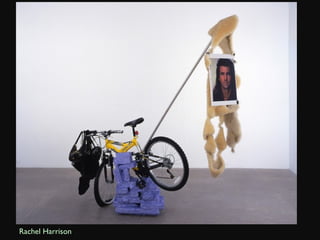
Rachel Harrison
Claes Oldenburg: Best known for his oversized soft sculptures of food and consumer objects of the Pop art period, Claes Oldenburg began his career staging avant-garde performances, constructing environments, publishing writings, and generally embracing the commerce of everyday life. Printed work has always played a central role in his art, beginning with commercially produced announcements and ephemera for his Happenings, and continuing with traditional printmaking.
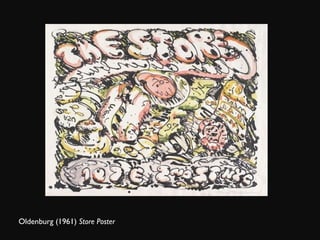
Oldenburg (1961)  Store Poster
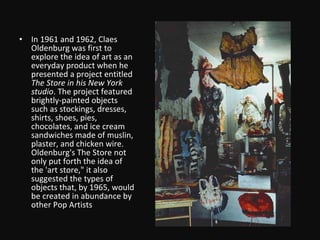
In 1961 and 1962, Claes Oldenburg was first to explore the idea of art as an everyday product when he presented a project entitled  The Store in his New York studio . The project featured brightly-painted objects such as stockings, dresses, shirts, shoes, pies, chocolates, and ice cream sandwiches made of muslin, plaster, and chicken wire. Oldenburg's The Store not only put forth the idea of the 'art store," it also suggested the types of objects that, by 1965, would be created in abundance by other Pop Artists
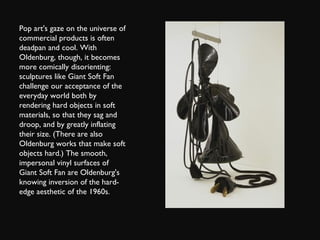
Pop art's gaze on the universe of commercial products is often deadpan and cool. With Oldenburg, though, it becomes more comically disorienting: sculptures like Giant Soft Fan challenge our acceptance of the everyday world both by rendering hard objects in soft materials, so that they sag and droop, and by greatly inflating their size. (There are also Oldenburg works that make soft objects hard.) The smooth, impersonal vinyl surfaces of Giant Soft Fan are Oldenburg's knowing inversion of the hard-edge aesthetic of the 1960s.
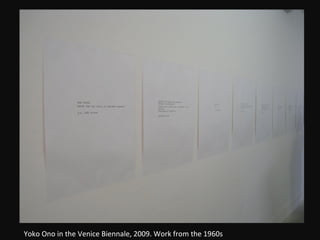
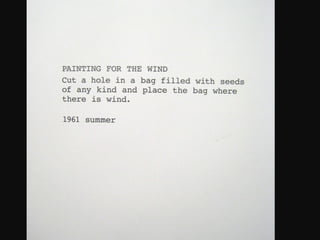
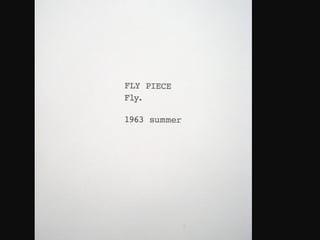
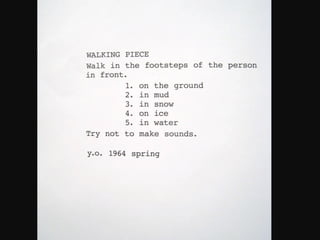
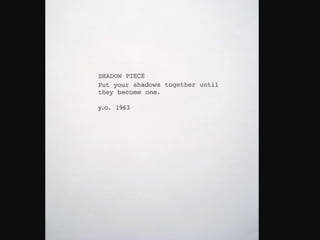
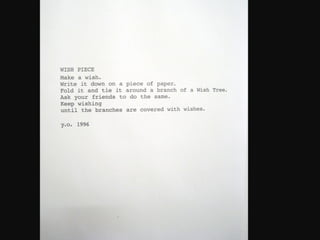
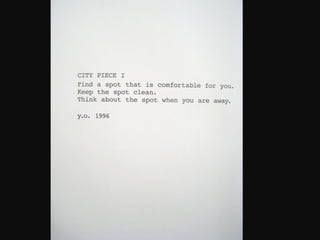
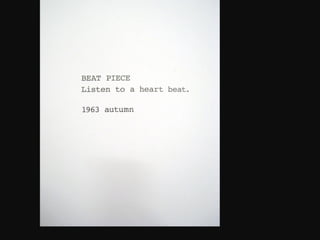
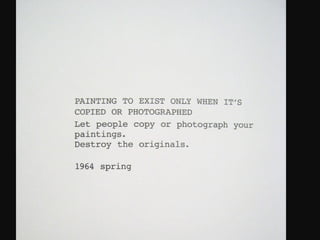
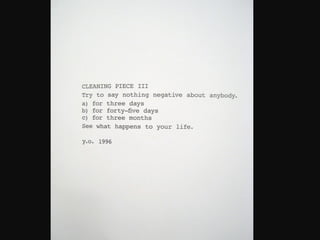
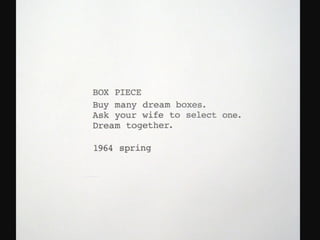
Yoko Ono        “ The 1960s were about releasing ourselves from conventional society and freeing ourselves.”
Yoko Ono in the Venice Biennale, 2009. Work from the 1960s


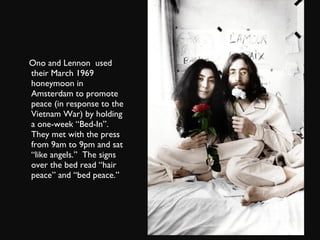
Ono and Lennon  used their March 1969 honeymoon in Amsterdam to promote peace (in response to the Vietnam War) by holding a one-week “Bed-In”.  They met with the press from 9am to 9pm and sat “like angels.”  The signs over the bed read “hair peace” and “bed peace.”
Next Week? Roy Lichtenstein James Rosenquist Jim Dine Larry Rivers Wayne Triebaud Tom Wesselmann Lucas Samaras James Rosenquist George Segal Ed Ruscha Carolee Schneeman Kenneth Noland Robert Morris And more….

ASP 6 AAVC - Creative Rupture 1960s

  • 1.
    Avisit to America Creative Rupture The 1960s Introduction to American Art and Visual Culture – Lecture 6
  • 2.
  • 3.
    Mark Rothko (1958) Black on Maroon Sketch for “Mural no. 6”
  • 4.
  • 5.
    1960s     The nation was in accelerated cultural, social, and political transition. Painting moved from the deeply personal (last week) to the impersonal Issues of “High versus Low” were raised. Multiple voices clamored for equalities and freedoms: women, blacks, etc.
  • 6.
    Artists: Ad ReinhardtEllsworth Kelly Morris Louis Cy Twombly Agnes Martin Robert Rauschenberg Claes Oldenberg Andy Warhol
  • 7.
  • 8.
    Ad Reinhardt       ” Art is Art. Everything else is everything else”
  • 9.
    Ad Reinhardt (1961) Abstract Painting no 4
  • 10.
    Ad Reinhardt (1966) Untitled Screen print
  • 11.
  • 12.
    Ad Reinhardt hangshis paintings to dry 1966
  • 13.
    Ad Reinhardt –works from the 1940s
  • 14.
    Ellsworth Kelly     Take a look at MoMA’s Mp3 description of the artist’s work:http://www.moma.org/audio_file/audio_file/794/ColorChart_601.mp3
  • 15.
  • 16.
  • 17.
  • 18.
    Elsworth Kelly (1963) Red Blue Green
  • 19.
    Elsworth Kelly (nodate ) Orange Curve
  • 20.
    Elsworth Kelly (1970)Black Square with Blue
  • 21.
  • 22.
    Elsworth Kelly (1952) Méditerannée
  • 23.
  • 24.
    Stains and Graffiti Legacy of Color and Gesture Forefathers
  • 25.
    Helen Frankenthaler      “ There are no rules. That is how art is born, how breakthroughs happen. Go against the rules or ignore the rules. That is what invention is about.”
  • 26.
    Helen HelenFrankenthaler (1952 ) Mountains and Sea HER FIRST DRIP PAINTING
  • 27.
    Helen HelenFrankenthaler (1967 ) Flood
  • 28.
    Helen HelenFrankenthaler (1973 ) Nature Abhors a Vacuum
  • 29.
    Helen HelenFrankenthaler (1964 ) Magic Carpet
  • 30.
    Morris Louis      “ He owes his reputation to the critic Clement Greenberg, who was also his coach. It is not really true, as has often been said, that Greenberg told Louis what to paint, though he probably had more influence over this lonely, gifted and insecure man than any American critic has had over any other artist.” - Critic Robert Hughes Read more: http://www.time.com/time/magazine/article/0,9171,962782,00.html#ixzz0YwAjOkQF
  • 31.
  • 32.
  • 33.
  • 34.
  • 35.
  • 36.
    Cy Twombly       On graffiti-- 
”Graffiti is linear and it's done with a pencil, and it's like writing on walls. But [in my paintings] it's more lyrical. In those beautiful early paintings like Academy, it's graffiti but it's something else, too. I don't know how people ­react, but the feeling is more complicated, more elaborate. Graffiti is usually a protest - ink on walls - or has a reason for ­being naughty or aggressive.” Read a rare interview of this artist: http://www.guardian.co.uk/artanddesign/2008/jun/03/art1
  • 37.
    Cy Twombly at Houston Exhibition see Gagosian: http://www.gagosian.com
  • 38.
  • 39.
    Cy Twombly (1972) Untitled
  • 40.
    Read the entireinterview: http://www.guardian.co.uk/artanddesign/2008/jun/03/art1 The Ferragosto paintings 
They were done in Rome, when I had to stay there in August. I was completely crazy, out of my mind with [the] heat.Paint is something that I use with my hands and do all those tactile things. I really don't like oil because you can't get back into it, or you make a mess. It's not my favourite thing - pencil is more my medium than wet paint. I did by mistake paint on a picture in Lexington and then quickly put an image on top. And I got into the wet. I had the background painted, worked into it and then merged the background and surfaces. Before, I always had a dry background and painted on. Now, I have someone paint the background that I have already figured out. I used to change things in my early paintings to get the nuance or feeling I wanted, but now I plan everything in my head ­before I do it. Also the scale of the things - they are big and I can't get on the ladder all the time, it hurts. So they are more thought out. I have drawn little sketches of things.
  • 41.
    Cy Twombly (1961) Ferrogosto V
  • 42.
    Read the entireinterview: http://www.guardian.co.uk/artanddesign/2008/jun/03/art1 Coronation of Sesostris series 
When I work, I work very fast, but preparing to work can take any length of time. It can even be a year. These were started in ­Bassano and hung upstairs for years. I like the sun disc because I managed to do very childlike painting, very immediate. Then I took them to Virginia and finished them - wound up at the end with a detail of Degas's The Cotton Exchange in New ­Orleans. How it got in there, I don't know, but it's one of my favorite sets.
  • 43.
    Cy Twombly (1980) Coronation of Sesostris
  • 44.
    Read the entireinterview: http://www.guardian.co.uk/artanddesign/2008/jun/03/art1 A Scattering of Blossoms series
 I work in waves, because I'm impatient. Because of a certain physicality, of lack of breath from standing. It has to be done and I do take liberties I wouldn't have taken before. I got all kinds of wonderful effects that I never achieved before. Sometimes it's simplistic. It's hot, so I do some cool paintings. Lots of times I like to enjoy myself. I think I'm in a good point of working.
  • 45.
    Cy Twombly (2007) Untitled
  • 46.
    'I'm not toosensitive to color, not really' Cy Twombly (1988 ) Untitled Part VII
  • 47.
    Cy Twombly (2008)The Rose II
  • 48.
    Cy Twombly (2009) Leaving Pathos Ringed with Waves
  • 49.
    Cy Twombly atBlack Mountain College, North Carolina in the 50s. 'It was the first time I'd been in an atmosphere of artsy-ness'
  • 50.
    Agnes Martin       “ Art is the concrete representation of our most subtle feelings.” Eight minute Interview of this artist: http://www.youtube.com/watch?v=_-JfYjmo5OA
  • 51.
  • 52.
  • 53.
  • 54.
  • 55.
    Agnes Martin (1952)Untitled Watercolor
  • 56.
  • 57.
    Creedence Clearwater Revival(1967 ) I Heard it Through the Grapevine TAKE A BREAK, MAN.
  • 58.
  • 59.
    1959 - BarbieDoll and the Microchip invented 1960 - Introduction of the Twist dance by Chubby Checker 1962 - Death of Marilyn Monroe1962 - First TV broadcasts in color 1962 - Spacewar, the first computer video game, invented 1962 - The Cuban Missile Crisis 1963 - TouchTone telephones introduced 1963 - President John F. Kennedy's assassination 1963 - Women's Liberation, signaled by the publication of Betty Friedan's The Feminine Mystique 1964 - Beatlemania, the Beatles 'invaded' US 1964 - Boxer Cassius Clay joined the nation of Islam and changed his name to Muhammad Ali THE 1960S
  • 60.
    1965 - Miniskirtmade first appearance 1965 - Watts (LA) race riots 1965 - Protests of racial stereotyping against 'Amos and Andy' TV show forced it off the air 1966 - One Million Years BC made Raquel Welch a sex symbol in a two-piece fur bikini 1967 - "Hair" opened off-Broadway 1967 - First Heart Transplant 1967 - Anti-Vietnam War Protests Escalated as War Deaths Multiplied 1968 - "60 Minutes" debuted on CBS-TV 1968 - Martin Luther King, Jr's and Robert Kennedy's assassinations 1969 - Woodstock and Summer of Love in San Francisco 1969 - Introduction of the indoor-safe NERF ball 1969 - "Sesame Street" debuted on TV 1969 - Arpanet (first Internet) invented 1969 - First Man on the Moon with Apollo 11 space flight
  • 61.
  • 62.
  • 63.
    The sixties werethe age of youth, as
70 million children from the post-war baby boom became teenagers and young adults.  The movement away from the conservative fifties continued and eventually resulted in revolutionary ways of thinking and real change in the cultural fabric of American life. 
  • 64.
  • 65.
  • 66.
    Andy Warhol      “ They say that time changes things, but you actually have to change them yourself”
  • 67.
    Factory personalities: http://www.youtube.com/watch?v=qkwD261MHsc&feature=rec-LGOUT-exp_stronger_r2-2r-7-HM
  • 68.
    This pair ofphoto-booth strips is one of Warhol's earliest experiments with photography , a medium that increasingly dominated his art during his peak years of innovation from 1962 to 1968. For Warhol, the photo booth represented a quintessentially modern intersection of mass entertainment and private self-contemplation. In these little curtained theaters, the sitter could adopt a succession of different roles, each captured in a single frame; the resulting strip of four poses resembled a snippet of film footage. The serial, mechanical nature of the strips provided Warhol with an ideal model for his aesthetic of passivity, detachment, and instant celebrity. Here, Warhol has adopted the surly, ultracool persona of movie stars such as Marlon Brando and James Dean, icons of the youth culture that he idolized.
  • 69.
    Andy Warhol (1967) Untitled from Marilyn Monroe (Marilyn)
  • 70.
    As art historianMarco Livingstone has stressed, Pop Art was never a circumscribed movement with membership and manifestos. Rather, it was a sensibility emergent in the 1950s and rampant in the 1960s. Andy Warhol (who began his career as a fashion illustrator) had been painting Campbell Soup cans since 1962. Such advertising icons, along with cartoons and billboards, yielded a synthesis of word and image, of art and the everyday. Fashion quickly embraced the spirit of Pop, playing an important role in its dissemination. The paper dresses of 1966–67 were throwaways, open to advertising and the commercial.
  • 71.
  • 72.
    Rauschenberg: At thesame time that Abstract Expressionism began to wane…a disparate group of artists began to explore some of the overlooked implications of action painting—its gestural freedom, chance effects, and urban themes—giving birth to a wide array of strategies epitomized by Robert Rauschenberg's oft-quoted statement that he wanted to act in the gap between art and life. Rauschenberg himself had been making Combines—found objects covered with slashing strokes of paint that blurred the boundaries between high and low—since the mid-1950s, and in the early '60s began transferring photographic images from newspapers directly onto his canvases (via the process of silkscreening) in rebus-like arrangements. In this neo-avant-garde work, artists such as Rauschenberg adapted the shock tactics of World War I-era Dada collagists such as Kurt Schwitters to the new postwar context of American hegemonic power.
  • 73.
  • 74.
  • 75.
  • 76.
  • 77.
  • 78.
  • 79.
  • 80.
  • 81.
  • 82.
  • 83.
  • 84.
  • 85.
    Claes Oldenburg: Bestknown for his oversized soft sculptures of food and consumer objects of the Pop art period, Claes Oldenburg began his career staging avant-garde performances, constructing environments, publishing writings, and generally embracing the commerce of everyday life. Printed work has always played a central role in his art, beginning with commercially produced announcements and ephemera for his Happenings, and continuing with traditional printmaking.
  • 86.
    Oldenburg (1961) Store Poster
  • 87.
    In 1961 and1962, Claes Oldenburg was first to explore the idea of art as an everyday product when he presented a project entitled The Store in his New York studio . The project featured brightly-painted objects such as stockings, dresses, shirts, shoes, pies, chocolates, and ice cream sandwiches made of muslin, plaster, and chicken wire. Oldenburg's The Store not only put forth the idea of the 'art store," it also suggested the types of objects that, by 1965, would be created in abundance by other Pop Artists
  • 88.
    Pop art's gazeon the universe of commercial products is often deadpan and cool. With Oldenburg, though, it becomes more comically disorienting: sculptures like Giant Soft Fan challenge our acceptance of the everyday world both by rendering hard objects in soft materials, so that they sag and droop, and by greatly inflating their size. (There are also Oldenburg works that make soft objects hard.) The smooth, impersonal vinyl surfaces of Giant Soft Fan are Oldenburg's knowing inversion of the hard-edge aesthetic of the 1960s.
  • 89.
    Yoko Ono      “ The 1960s were about releasing ourselves from conventional society and freeing ourselves.”
  • 90.
    Yoko Ono inthe Venice Biennale, 2009. Work from the 1960s
  • 91.
  • 92.
  • 93.
  • 94.
  • 95.
  • 96.
  • 97.
  • 98.
  • 99.
  • 100.
  • 101.
    Ono and Lennon used their March 1969 honeymoon in Amsterdam to promote peace (in response to the Vietnam War) by holding a one-week “Bed-In”. They met with the press from 9am to 9pm and sat “like angels.” The signs over the bed read “hair peace” and “bed peace.”
  • 102.
    Next Week? RoyLichtenstein James Rosenquist Jim Dine Larry Rivers Wayne Triebaud Tom Wesselmann Lucas Samaras James Rosenquist George Segal Ed Ruscha Carolee Schneeman Kenneth Noland Robert Morris And more….

Editor's Notes

  • #14 He studied with Mayer Shapiro
  • #38 orn in 1928 in Lexington, Virginia, Cy Twombly studied art at the School of the Museum of Fine Arts, Boston (1947–49); the Art Students League, New York (1950–51); and Black Mountain College, North Carolina (1951–52). In the mid 1950s, following travels in Europe and Africa, he emerged as a prominent figure among a group of artists working in New York that included Robert Rauschenberg and Jasper Johns.