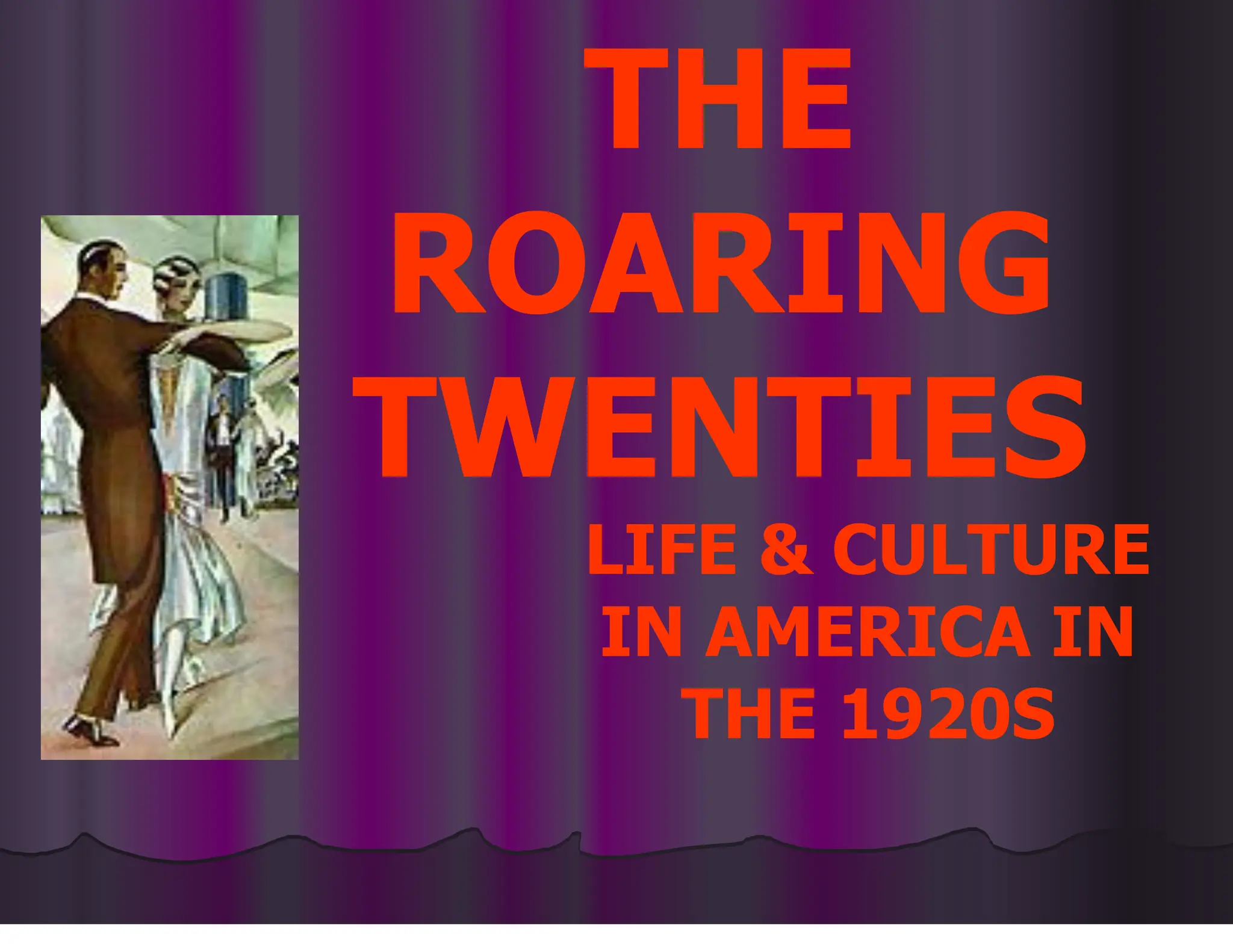
LIFE & CULTURE
IN AMERICA IN
THE 1920S
THE
ROARING
TWENTIES
America at the
Start of the Decade
● Victorious in
World War I
● Treaty of
Versailles
defeated
● Period of
isolationism
● Republican
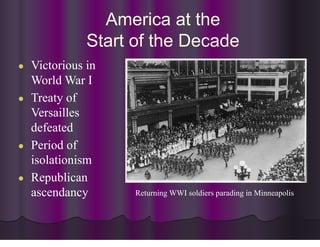
ascendancy Returning WWI soldiers parading in Minneapolis
The Election of 1920
● Republicans nominated
Ohio Sen. Warren G.
Harding
● “Return to Normalcy”
● Democrats ran Ohio Gov.
James M. Cox
● Coolidge as GOP VP
candidate
● FDR as Democratic VP
candidate
● Republican landslide
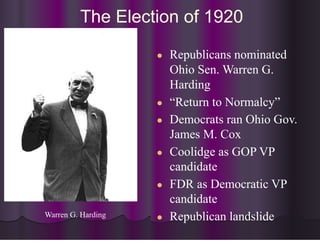
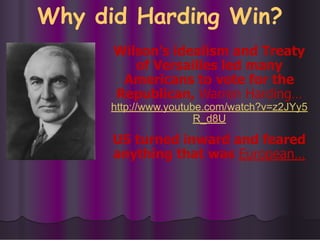
Warren G. Harding
Why did Harding Win?
Wilson’s idealism and Treaty
of Versailles led many
Americans to vote for the
Republican, Warren Harding…
http://www.youtube.com/watch?v=z2JYy5
R_d8U
US turned inward and feared
anything that was European…
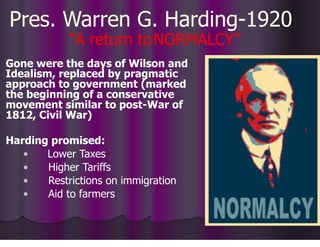
Pres. Warren G. Harding-1920
Gone were the days of Wilson and
Idealism, replaced by pragmatic
approach to government (marked
the beginning of a conservative
movement similar to post-War of
1812, Civil War)
Harding promised:
• Lower Taxes
• Higher Tariffs
• Restrictions on immigration
• Aid to farmers
“A return toNORMALCY”
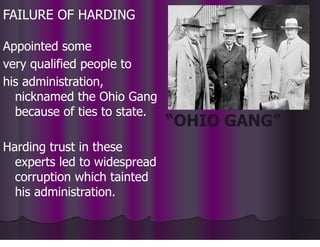
FAILURE OF HARDING
Appointed some
very qualified people to
his administration,
nicknamed the Ohio Gang
because of ties to state.
Harding trust in these
experts led to widespread
corruption which tainted
his administration.
“OHIO GANG”
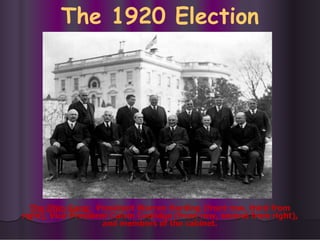
The Ohio Gang: President Warren Harding (front row, third from
right), Vice-President Calvin Coolidge (front row, second from right),
and members of the cabinet.
The 1920 Election
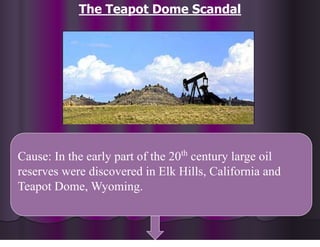
The Teapot Dome Scandal
Cause: In the early part of the 20th
century large oil
reserves were discovered in Elk Hills, California and
Teapot Dome, Wyoming.
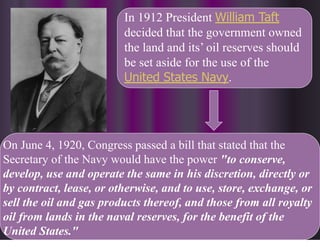
In 1912 President William Taft
decided that the government owned
the land and its’ oil reserves should
be set aside for the use of the
United States Navy.
On June 4, 1920, Congress passed a bill that stated that the
Secretary of the Navy would have the power "to conserve,
develop, use and operate the same in his discretion, directly or
by contract, lease, or otherwise, and to use, store, exchange, or
sell the oil and gas products thereof, and those from all royalty
oil from lands in the naval reserves, for the benefit of the
United States."
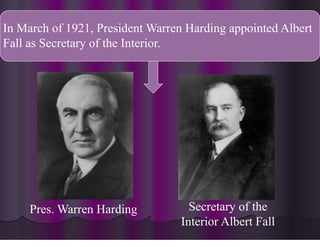
In March of 1921, President Warren Harding appointed Albert
Fall as Secretary of the Interior.
Pres. Warren Harding Secretary of the
Interior Albert Fall
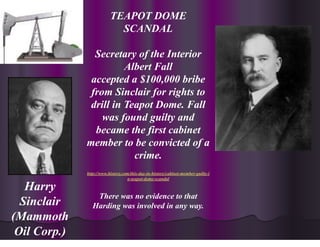
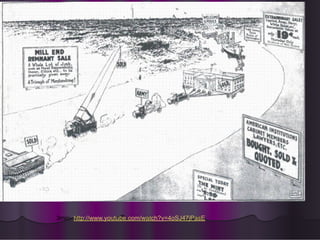
TEAPOT DOME
SCANDAL
Secretary of the Interior
Albert Fall
accepted a $100,000 bribe
from Sinclair for rights to
drill in Teapot Dome. Fall
was found guilty and
became the first cabinet
member to be convicted of a
crime.
http://www.history.com/this-day-in-history/cabinet-member-guilty-i
n-teapot-dome-scandal
There was no evidence to that
Harding was involved in any way.
Harry
Sinclair
(Mammoth
Oil Corp.)
3min- http://www.youtube.com/watch?v=4oSJ47jPasE
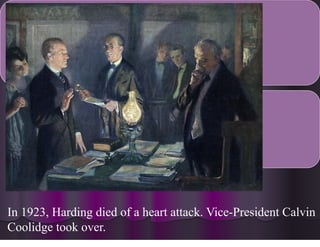
In 1923, Harding died of a heart attack. Vice-President Calvin
Coolidge took over.
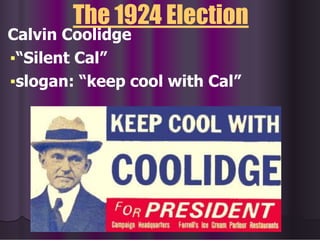
The 1924 Election
Calvin Coolidge
▪“Silent Cal”
▪slogan: “keep cool with Cal”
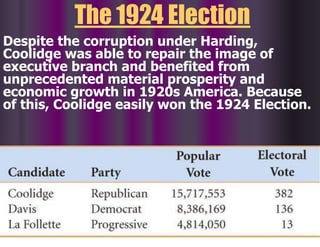
The 1924 Election
Despite the corruption under Harding,
Coolidge was able to repair the image of
executive branch and benefited from
unprecedented material prosperity and
economic growth in 1920s America. Because
of this, Coolidge easily won the 1924 Election.
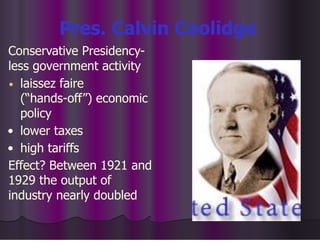
Pres. Calvin Coolidge
Conservative Presidency-
less government activity
• laissez faire
(“hands-off”) economic
policy
• lower taxes
• high tariffs
Effect? Between 1921 and
1929 the output of
industry nearly doubled
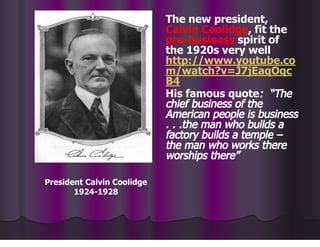
The new president,
Calvin Coolidge, fit the
pro-business spirit of
the 1920s very well
http://www.youtube.co
m/watch?v=J7jEaqOqc
B4
His famous quote: “The
chief business of the
American people is business
. . .the man who builds a
factory builds a temple –
the man who works there
worships there”
President Calvin Coolidge
1924-1928
BUSINESS – FRIENDLY
GOVERNMENT
4min- beliefs on taxation and
govt-start at 2min mark
http://www.youtube.com/watch?v=wwZnExRb8zU
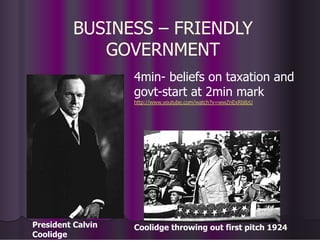
President Calvin
Coolidge
Coolidge throwing out first pitch 1924
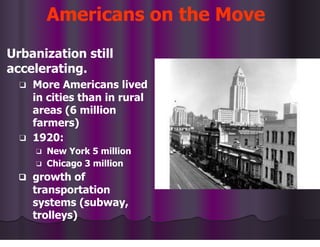
Americans on the Move
Urbanization still
accelerating.
❑ More Americans lived
in cities than in rural
areas (6 million
farmers)
❑ 1920:
❑ New York 5 million
❑ Chicago 3 million
❑ growth of
transportation
systems (subway,
trolleys)
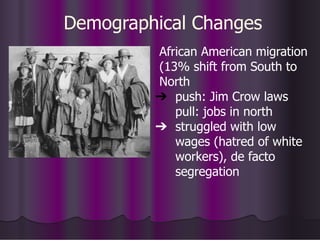
Demographical Changes
African American migration
(13% shift from South to
North
➔ push: Jim Crow laws
pull: jobs in north
➔ struggled with low
wages (hatred of white
workers), de facto
segregation
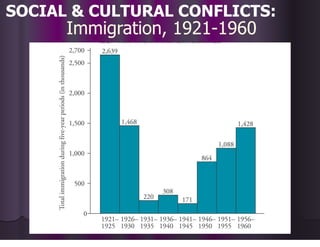
Immigration, 1921-1960
SOCIAL & CULTURAL CONFLICTS:
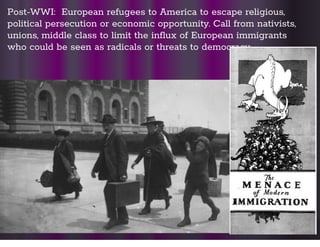
Post-WWI: European refugees to America to escape religious,
political persecution or economic opportunity. Call from nativists,
unions, middle class to limit the influx of European immigrants
who could be seen as radicals or threats to democracy
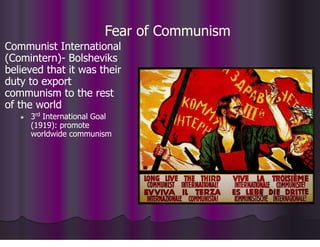
Fear of Communism
Communist International
(Comintern)- Bolsheviks
believed that it was their
duty to export
communism to the rest
of the world
● 3rd
International Goal
(1919): promote
worldwide communism
Fear of Communism-
Red Scare
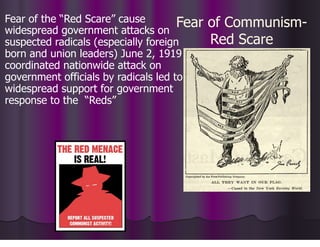
Fear of the “Red Scare” cause
widespread government attacks on
suspected radicals (especially foreign
born and union leaders) June 2, 1919
coordinated nationwide attack on
government officials by radicals led to
widespread support for government
response to the “Reds”
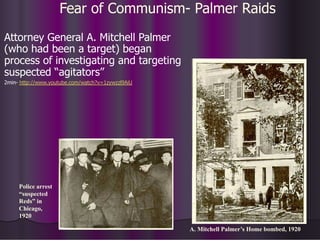
Fear of Communism- Palmer Raids
Attorney General A. Mitchell Palmer
(who had been a target) began
process of investigating and targeting
suspected “agitators”
2min- http://www.youtube.com/watch?v=1zywzzl9AiU
A. Mitchell Palmer’s Home bombed, 1920
Police arrest
“suspected
Reds” in
Chicago,
1920
•
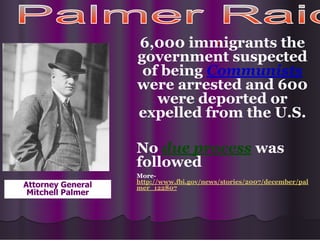
6,000 immigrants the
government suspected
of being Communists
were arrested and 600
were deported or
expelled from the U.S.
No due process was
followed
More-
http://www.fbi.gov/news/stories/2007/december/pal
mer_122807
Attorney General
Mitchell Palmer
Sacco and Vanzetti Case
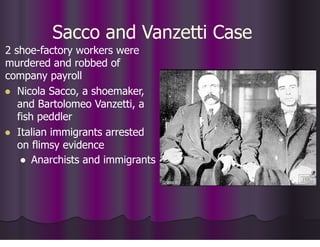
2 shoe-factory workers were
murdered and robbed of
company payroll
● Nicola Sacco, a shoemaker,
and Bartolomeo Vanzetti, a
fish peddler
● Italian immigrants arrested
on flimsy evidence
● Anarchists and immigrants
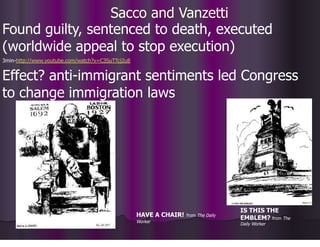
Sacco and Vanzetti
HAVE A CHAIR! from The Daily
Worker
IS THIS THE
EMBLEM? from The
Daily Worker
Found guilty, sentenced to death, executed
(worldwide appeal to stop execution)
3min-http://www.youtube.com/watch?v=C3SuTTcj2u8
Effect? anti-immigrant sentiments led Congress
to change immigration laws
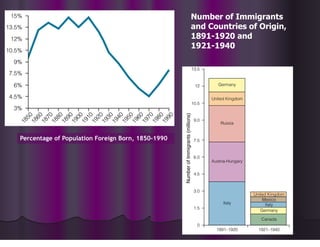
Immigration Backlash
1. Emergency Quota Act - 1921
● 3% of total number people in ethnic group per year
● Based on 1910 census
2. National Origins Act - 1924
● 2% of each nationality living here in 1890
● 1929 limit total immigrants to 150,000/yr with
nationality allotment based on 1920 census
Number of Immigrants
and Countries of Origin,
1891-1920 and
1921-1940
Percentage of Population Foreign Born, 1850-1990
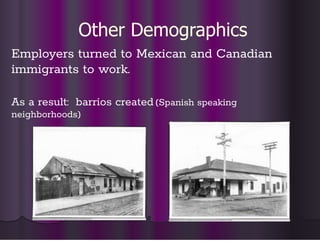
Other Demographics
Employers turned to Mexican and Canadian
immigrants to work.
As a result: barrios created(Spanish speaking
neighborhoods)
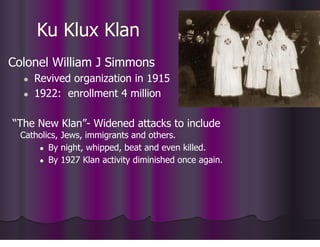
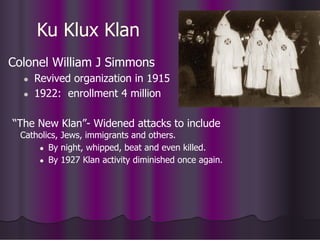
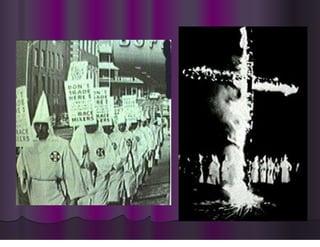
Ku Klux Klan
Colonel William J Simmons
● Revived organization in 1915
● 1922: enrollment 4 million
“The New Klan”- Widened attacks to include
Catholics, Jews, immigrants and others.
● By night, whipped, beat and even killed.
● By 1927 Klan activity diminished once again.
Growth of the KKK
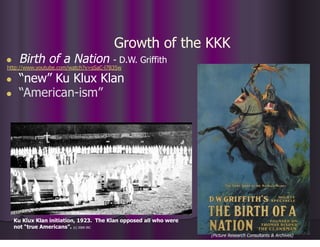
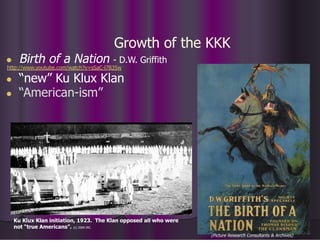
● Birth of a Nation - D.W. Griffith
http://www.youtube.com/watch?v=sSaC-l7B35w
● “new” Ku Klux Klan
● “American-ism”
(Picture Research Consultants & Archives)
Ku Klux Klan initiation, 1923. The Klan opposed all who were
not “true Americans”. (c) 2000 IRC
Ku Klux Klan
Colonel William J Simmons
● Revived organization in 1915
● 1922: enrollment 4 million
“The New Klan”- Widened attacks to include
Catholics, Jews, immigrants and others.
● By night, whipped, beat and even killed.
● By 1927 Klan activity diminished once again.
Growth of the KKK
● Birth of a Nation - D.W. Griffith
http://www.youtube.com/watch?v=sSaC-l7B35w
● “new” Ku Klux Klan
● “American-ism”
(Picture Research Consultants & Archives)
Ku Klux Klan initiation, 1923. The Klan opposed all who were
not “true Americans”. (c) 2000 IRC
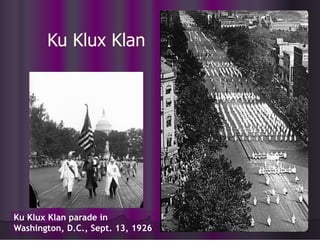
Ku Klux Klan
Ku Klux Klan parade in
Washington, D.C., Sept. 13, 1926
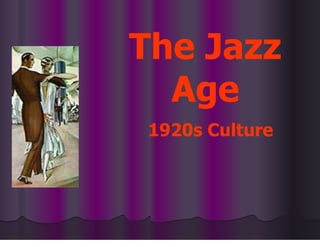
1920s Culture
The Jazz
Age
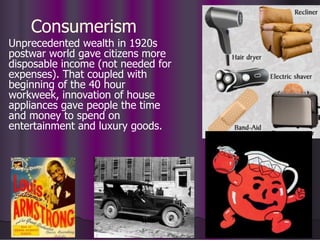
Consumerism
Unprecedented wealth in 1920s
postwar world gave citizens more
disposable income (not needed for
expenses). That coupled with
beginning of the 40 hour
workweek, innovation of house
appliances gave people the time
and money to spend on
entertainment and luxury goods.
Consumerism
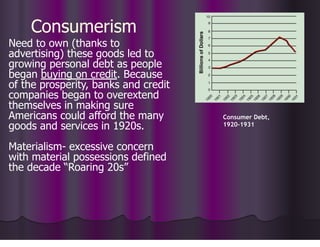
Need to own (thanks to
advertising) these goods led to
growing personal debt as people
began buying on credit. Because
of the prosperity, banks and credit
companies began to overextend
themselves in making sure
Americans could afford the many
goods and services in 1920s.
Materialism- excessive concern
with material possessions defined
the decade “Roaring 20s”
Consumer Debt,
1920–1931
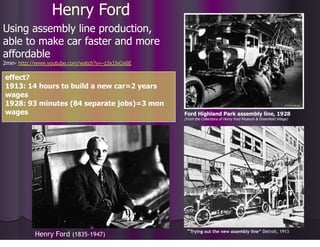
Henry Ford
Using assembly line production,
able to make car faster and more
affordable
2min- http://www.youtube.com/watch?v=-z3xJJxOx6E
Ford Highland Park assembly line, 1928
(From the Collections of Henry Ford Museum & Greenfield Village)
“Trying out the new assembly line“ Detroit, 1913
Henry Ford (1835-1947)
effect?
1913: 14 hours to build a new car=2 years
wages
1928: 93 minutes (84 separate jobs)=3 mon
wages
Automobile
● Replaced the railroad as
the key promoter of
economic growth (steel,
glass, rubber, gasoline, highways)
● Daily life: commuting,
shopping, traveling, “courting”
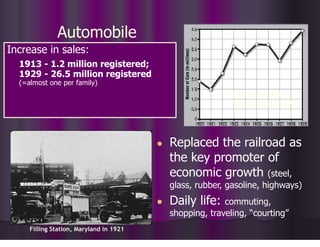
Increase in sales:
1913 - 1.2 million registered;
1929 - 26.5 million registered
(=almost one per family)
Passenger Car
Sales, 1920-1929
Filling Station, Maryland in 1921
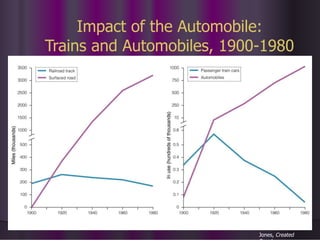
Impact of the Automobile:
Trains and Automobiles, 1900-1980
Jones, Created
Equal
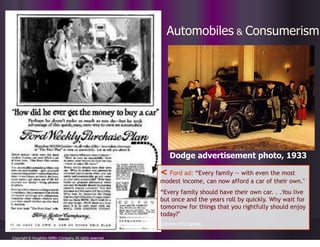
Automobiles & Consumerism
Copyright © Houghton Mifflin Company. All rights reserved
< Ford ad: “Every family -- with even the most
modest income, can now afford a car of their own."
“Every family should have their own car. . .You live
but once and the years roll by quickly. Why wait for
tomorrow for things that you rightfully should enjoy
today?"
(Library of Congress)
Dodge advertisement photo, 1933
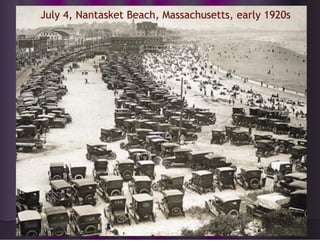
July 4, Nantasket Beach, Massachusetts, early 1920s
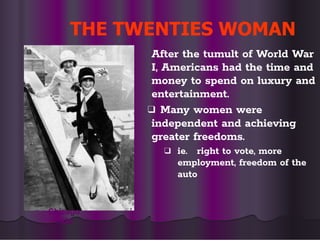
THE TWENTIES WOMAN
After the tumult of World War
I, Americans had the time and
money to spend on luxury and
entertainment.
❑ Many women were
independent and achieving
greater freedoms.
❑ ie. right to vote, more
employment, freedom of the
auto
Chicago
1926
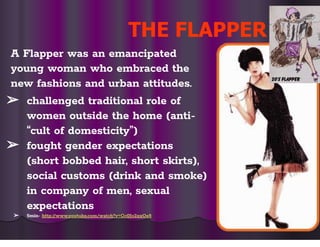
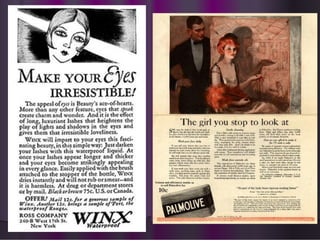
THE FLAPPER
A Flapper was an emancipated
young woman who embraced the
new fashions and urban attitudes.
➢ challenged traditional role of
women outside the home (anti-
“cult of domesticity”)
➢ fought gender expectations
(short bobbed hair, short skirts),
social customs (drink and smoke)
in company of men, sexual
expectations
➢ 5min- http://www.youtube.com/watch?v=Gc0Jo2xxOe8
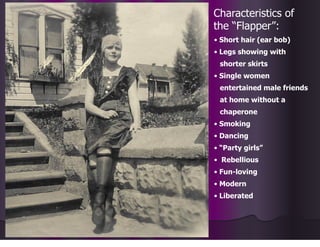
Characteristics of
the “Flapper”:
• Short hair (ear bob)
• Legs showing with
shorter skirts
• Single women
entertained male friends
at home without a
chaperone
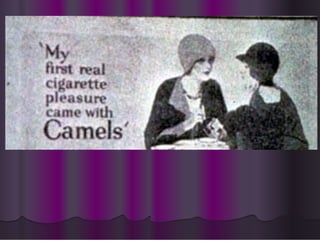
• Smoking
• Dancing
• “Party girls”
• Rebellious
• Fun-loving
• Modern
• Liberated
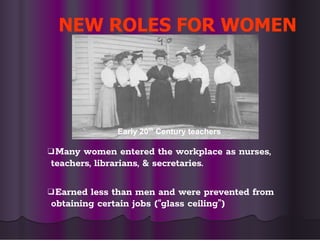
NEW ROLES FOR WOMEN
❑Many women entered the workplace as nurses,
teachers, librarians, & secretaries.
❑Earned less than men and were prevented from
obtaining certain jobs (“glass ceiling”)
Early 20th
Century teachers
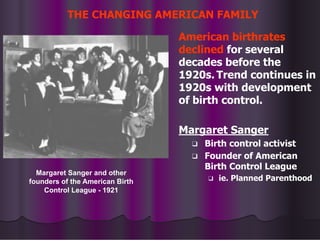
THE CHANGING AMERICAN FAMILY
American birthrates
declined for several
decades before the
1920s. Trend continues in
1920s with development
of birth control.
Margaret Sanger
❑ Birth control activist
❑ Founder of American
Birth Control League
❑ ie. Planned Parenthood
Margaret Sanger and other
founders of the American Birth
Control League - 1921
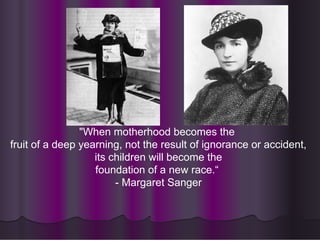
"When motherhood becomes the
fruit of a deep yearning, not the result of ignorance or accident,
its children will become the
foundation of a new race.“
- Margaret Sanger
The Darker Side of Sanger
The birth control movement was largely influenced by the
Eugenics Movement which became popularized during this
time. Sought to eliminate those people who were considered
“undesirable stock” which included mentally handicap,
immigrants (who were having larger families) and rebellious
African Americans.
On blacks, immigrants and indigents:
"...human weeds,' 'reckless breeders,' 'spawning... human beings who never
should have been born." Margaret Sanger, Pivot of Civilization, referring to
immigrants and poor people
On the extermination of blacks:
"We do not want word to go out that we want to exterminate the Negro population,"
she said, "if it ever occurs to any of their more rebellious members."
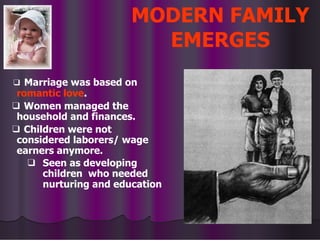
MODERN FAMILY
EMERGES
❑ Marriage was based on
romantic love.
❑ Women managed the
household and finances.
❑ Children were not
considered laborers/ wage
earners anymore.
❑ Seen as developing
children who needed
nurturing and education
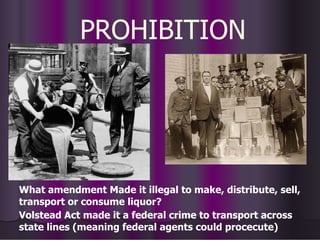
PROHIBITION
What amendment Made it illegal to make, distribute, sell,
transport or consume liquor?
Volstead Act made it a federal crime to transport across
state lines (meaning federal agents could procecute)
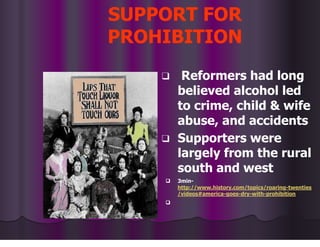
SUPPORT FOR
PROHIBITION
❑ Reformers had long
believed alcohol led
to crime, child & wife
abuse, and accidents
❑ Supporters were
largely from the rural
south and west
❑ 3min-
http://www.history.com/topics/roaring-twenties
/videos#america-goes-dry-with-prohibition
❑
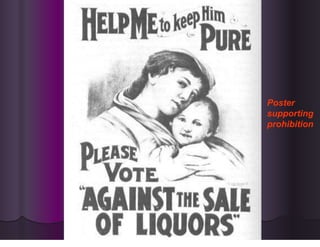
Poster
supporting
prohibition
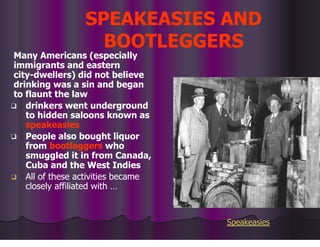
SPEAKEASIES AND
BOOTLEGGERS
Many Americans (especially
immigrants and eastern
city-dwellers) did not believe
drinking was a sin and began
to flaunt the law
❑ drinkers went underground
to hidden saloons known as
speakeasies
❑ People also bought liquor
from bootleggers who
smuggled it in from Canada,
Cuba and the West Indies
❑ All of these activities became
closely affiliated with …
Speakeasies
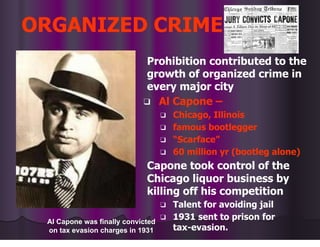
ORGANIZED CRIME
Prohibition contributed to the
growth of organized crime in
every major city
❑ Al Capone –
❑ Chicago, Illinois
❑ famous bootlegger
❑ “Scarface”
❑ 60 million yr (bootleg alone)
Capone took control of the
Chicago liquor business by
killing off his competition
❑ Talent for avoiding jail
❑ 1931 sent to prison for
tax-evasion.
Al Capone was finally convicted
on tax evasion charges in 1931
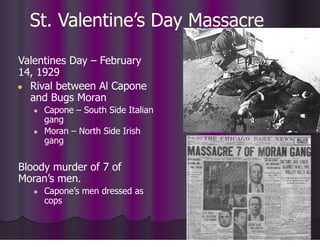
St. Valentine’s Day Massacre
Valentines Day – February
14, 1929
● Rival between Al Capone
and Bugs Moran
● Capone – South Side Italian
gang
● Moran – North Side Irish
gang
Bloody murder of 7 of
Moran’s men.
● Capone’s men dressed as
cops
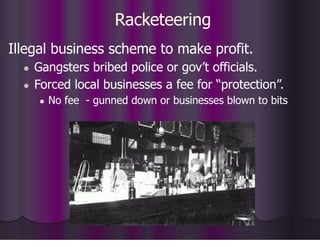
Racketeering
Illegal business scheme to make profit.
● Gangsters bribed police or gov’t officials.
● Forced local businesses a fee for “protection”.
● No fee - gunned down or businesses blown to bits
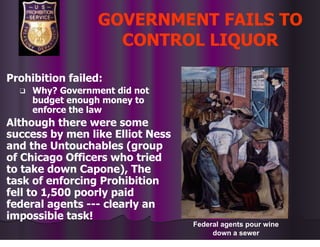
GOVERNMENT FAILS TO
CONTROL LIQUOR
Prohibition failed:
❑ Why? Government did not
budget enough money to
enforce the law
Although there were some
success by men like Elliot Ness
and the Untouchables (group
of Chicago Officers who tried
to take down Capone), The
task of enforcing Prohibition
fell to 1,500 poorly paid
federal agents --- clearly an
impossible task!
Federal agents pour wine
down a sewer
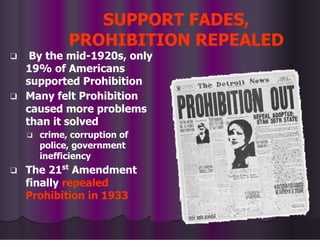
SUPPORT FADES,
PROHIBITION REPEALED
❑ By the mid-1920s, only
19% of Americans
supported Prohibition
❑ Many felt Prohibition
caused more problems
than it solved
❑ crime, corruption of
police, government
inefficiency
❑ The 21st
Amendment
finally repealed
Prohibition in 1933
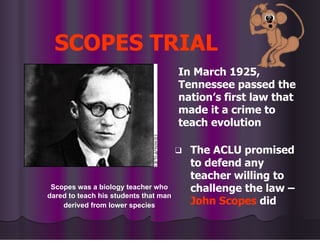
SCOPES TRIAL
In March 1925,
Tennessee passed the
nation’s first law that
made it a crime to
teach evolution
❑ The ACLU promised
to defend any
teacher willing to
challenge the law –
John Scopes did
Scopes was a biology teacher who
dared to teach his students that man
derived from lower species
SCOPES TRIAL
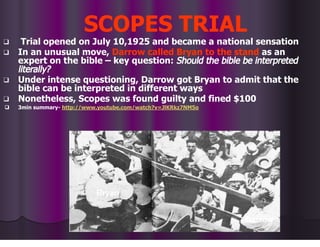
❑ Trial opened on July 10,1925 and became a national sensation
❑ In an unusual move, Darrow called Bryan to the stand as an
expert on the bible – key question: Should the bible be interpreted
literally?
❑ Under intense questioning, Darrow got Bryan to admit that the
bible can be interpreted in different ways
❑ Nonetheless, Scopes was found guilty and fined $100
❑ 3min summary- http://www.youtube.com/watch?v=JlKRkz7NM5o
Bryan
Darrow
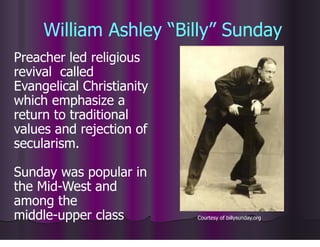
William Ashley “Billy” Sunday
Preacher led religious
revival called
Evangelical Christianity
which emphasize a
return to traditional
values and rejection of
secularism.
Sunday was popular in
the Mid-West and
among the
middle-upper class Courtesy of billysunday.org
EDUCATION AND
POPULAR CULTURE
❑ John Dewey, progressive
educator, argued that
teachers needed to
provide lifelong education
practices.
❑ Enrollment in high schools
quadrupled between 1914
and 1926.
❑ Public schools met the
challenge of educating
millions of immigrants
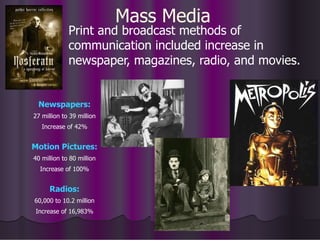
Mass Media
Print and broadcast methods of
communication included increase in
newspaper, magazines, radio, and movies.
Newspapers:
27 million to 39 million
Increase of 42%
Motion Pictures:
40 million to 80 million
Increase of 100%
Radios:
60,000 to 10.2 million
Increase of 16,983%
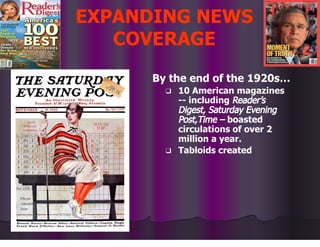
EXPANDING NEWS
COVERAGE
By the end of the 1920s…
❑ 10 American magazines
-- including Reader’s
Digest, Saturday Evening
Post,Time – boasted
circulations of over 2
million a year.
❑ Tabloids created
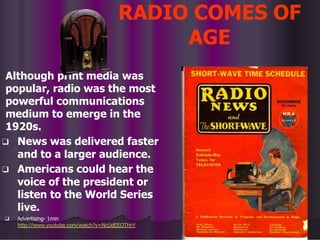
RADIO COMES OF
AGE
Although print media was
popular, radio was the most
powerful communications
medium to emerge in the
1920s.
❑ News was delivered faster
and to a larger audience.
❑ Americans could hear the
voice of the president or
listen to the World Series
live.
❑ Advertising- 1min
http://www.youtube.com/watch?v=NcUdEEOTHrY
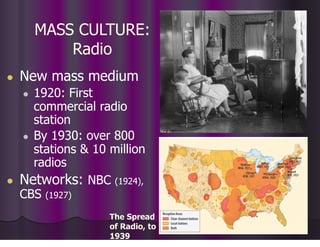
MASS CULTURE:
Radio
● New mass medium
● 1920: First
commercial radio
station
● By 1930: over 800
stations & 10 million
radios
● Networks: NBC (1924),
CBS (1927)
The Spread
of Radio, to
1939
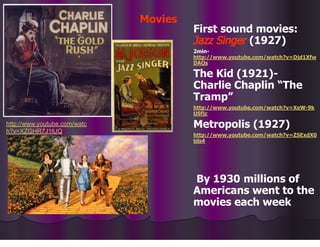
Movies
First sound movies:
Jazz Singer (1927)
2min-
http://www.youtube.com/watch?v=Djd1Xfw
DAQs
The Kid (1921)-
Charlie Chaplin “The
Tramp”
http://www.youtube.com/watch?v=XeW-9k
USfjc
Metropolis (1927)
http://www.youtube.com/watch?v=ZSExdX0
tds4
By 1930 millions of
Americans went to the
movies each week
http://www.youtube.com/watc
h?v=XZGHR7J1lUQ
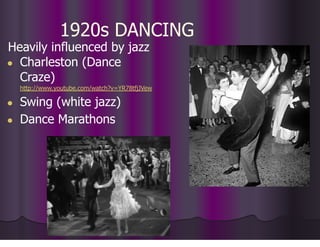
1920s DANCING
Heavily influenced by jazz
● Charleston (Dance
Craze)
http://www.youtube.com/watch?v=YR78tfjJVew
● Swing (white jazz)
● Dance Marathons
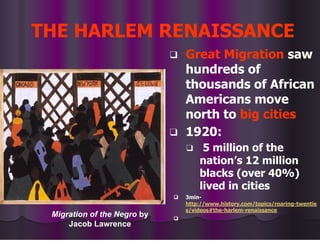
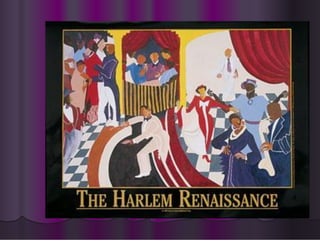
THE HARLEM RENAISSANCE
❑ Great Migration saw
hundreds of
thousands of African
Americans move
north to big cities
❑ 1920:
❑ 5 million of the
nation’s 12 million
blacks (over 40%)
lived in cities
❑ 3min-
http://www.history.com/topics/roaring-twentie
s/videos#the-harlem-renaissance
❑
Migration of the Negro by
Jacob Lawrence
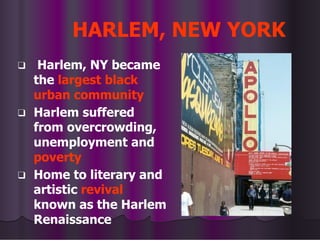
HARLEM, NEW YORK
❑ Harlem, NY became
the largest black
urban community
❑ Harlem suffered
from overcrowding,
unemployment and
poverty
❑ Home to literary and
artistic revival
known as the Harlem
Renaissance
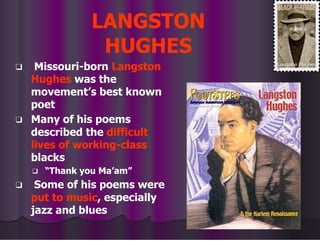
LANGSTON
HUGHES
❑ Missouri-born Langston
Hughes was the
movement’s best known
poet
❑ Many of his poems
described the difficult
lives of working-class
blacks
❑ “Thank you Ma’am”
❑ Some of his poems were
put to music, especially
jazz and blues
A Dream
Deferred
What happens to a dream deferred?
Does it dry up
like a raisin in the sun?
Or fester like a sore--
And then run?
Does it stink like rotten meat?
Or crust and sugar over--
like a syrupy sweet?
Maybe it just sags
like a heavy load.
Or does it explode?
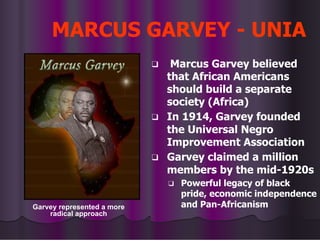
MARCUS GARVEY - UNIA
❑ Marcus Garvey believed
that African Americans
should build a separate
society (Africa)
❑ In 1914, Garvey founded
the Universal Negro
Improvement Association
❑ Garvey claimed a million
members by the mid-1920s
❑ Powerful legacy of black
pride, economic independence
and Pan-Africanism
Garvey represented a more
radical approach
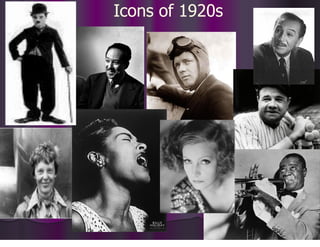
Icons of 1920s
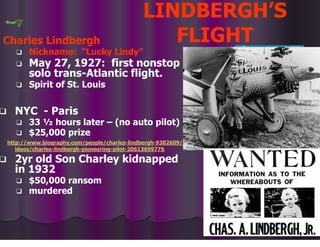
LINDBERGH’S
FLIGHT
Charles Lindbergh
❑ Nickname: “Lucky Lindy”
❑ May 27, 1927: first nonstop
solo trans-Atlantic flight.
❑ Spirit of St. Louis
❑ NYC - Paris
❑ 33 ½ hours later – (no auto pilot)
❑ $25,000 prize
http://www.biography.com/people/charles-lindbergh-9382609/v
ideos/charles-lindbergh-pioneering-pilot-20613699776
❑ 2yr old Son Charley kidnapped
in 1932
❑ $50,000 ransom
❑ murdered
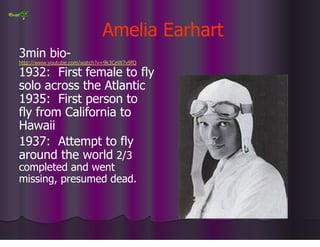
Amelia Earhart
3min bio-
http://www.youtube.com/watch?v=9k3CeW7v9fQ
1932: First female to fly
solo across the Atlantic
1935: First person to
fly from California to
Hawaii
1937: Attempt to fly
around the world; 2/3
completed and went
missing, presumed dead.
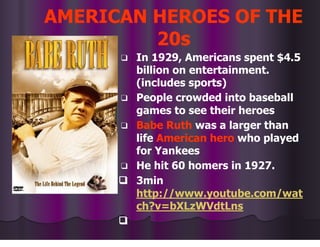
AMERICAN HEROES OF THE
20s
❑ In 1929, Americans spent $4.5
billion on entertainment.
(includes sports)
❑ People crowded into baseball
games to see their heroes
❑ Babe Ruth was a larger than
life American hero who played
for Yankees
❑ He hit 60 homers in 1927.
❑ 3min
http://www.youtube.com/wat
ch?v=bXLzWVdtLns
❑
Jazz
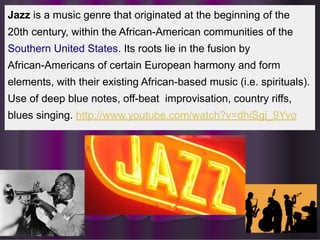
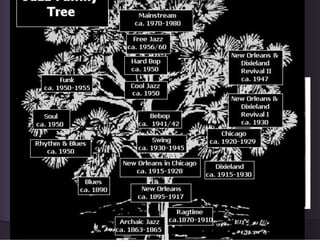
Jazz is a music genre that originated at the beginning of the
20th century, within the African-American communities of the
Southern United States. Its roots lie in the fusion by
African-Americans of certain European harmony and form
elements, with their existing African-based music (i.e. spirituals).
Use of deep blue notes, off-beat improvisation, country riffs,
blues singing. http://www.youtube.com/watch?v=dhiSgi_9Yvo
MUSIC OF THE 1920s
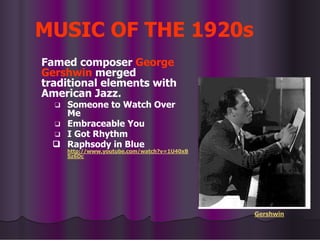
Famed composer George
Gershwin merged
traditional elements with
American Jazz.
❑ Someone to Watch Over
Me
❑ Embraceable You
❑ I Got Rhythm
❑ Raphsody in Blue
http://www.youtube.com/watch?v=1U40xB
Sz6Dc
Gershwin
MUSIC OF THE 1920s
Famed composer George
Gershwin merged
traditional elements with
American Jazz.
❑ Someone to Watch Over
Me
❑ Embraceable You
❑ I Got Rhythm
❑ Raphsody in Blue
http://www.youtube.com/watch?v=1U40xB
Sz6Dc
Gershwin
EDWARD KENNEDY “DUKE”
ELLINGTON
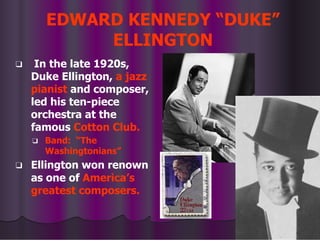
❑ In the late 1920s,
Duke Ellington, a jazz
pianist and composer,
led his ten-piece
orchestra at the
famous Cotton Club.
❑ Band: “The
Washingtonians”
❑ Ellington won renown
as one of America’s
greatest composers.
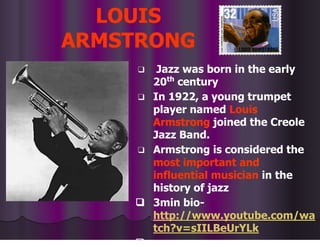
LOUIS
ARMSTRONG
❑ Jazz was born in the early
20th
century
❑ In 1922, a young trumpet
player named Louis
Armstrong joined the Creole
Jazz Band.
❑ Armstrong is considered the
most important and
influential musician in the
history of jazz
❑ 3min bio-
http://www.youtube.com/wa
tch?v=sIILBeUrYLk
❑
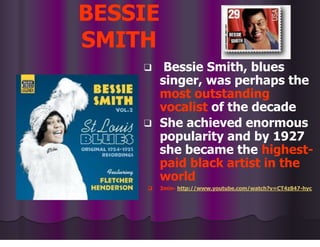
BESSIE
SMITH
❑ Bessie Smith, blues
singer, was perhaps the
most outstanding
vocalist of the decade
❑ She achieved enormous
popularity and by 1927
she became the highest-
paid black artist in the
world
❑ 3min- http://www.youtube.com/watch?v=CT4z847-hyc
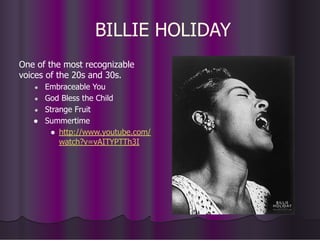
BILLIE HOLIDAY
One of the most recognizable
voices of the 20s and 30s.
● Embraceable You
● God Bless the Child
● Strange Fruit
● Summertime
● http://www.youtube.com/
watch?v=vAITYPTTh3I
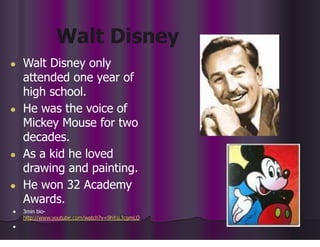
Walt Disney
● Walt Disney only
attended one year of
high school.
● He was the voice of
Mickey Mouse for two
decades.
● As a kid he loved
drawing and painting.
● He won 32 Academy
Awards.
● 3min bio-
http://www.youtube.com/watch?v=9hXsLTcgmLQ
●
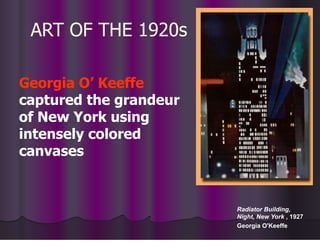
ART OF THE 1920s
Georgia O’ Keeffe
captured the grandeur
of New York using
intensely colored
canvases
Radiator Building,
Night, New York , 1927
Georgia O'Keeffe
WRITERS OF
THE 1920s
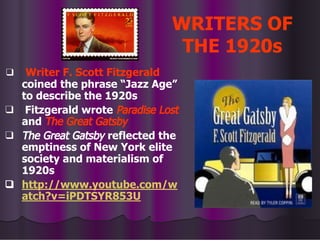
❑ Writer F. Scott Fitzgerald
coined the phrase “Jazz Age”
to describe the 1920s
❑ Fitzgerald wrote Paradise Lost
and The Great Gatsby
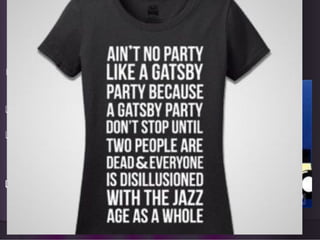
❑ The Great Gatsby reflected the
emptiness of New York elite
society and materialism of
1920s
❑ http://www.youtube.com/w
atch?v=iPDTSYR853U
WRITERS OF
THE 1920s
❑ Writer F. Scott Fitzgerald
coined the phrase “Jazz Age”
to describe the 1920s
❑ Fitzgerald wrote Paradise Lost
and The Great Gatsby
❑ The Great Gatsby reflected the
emptiness of New York elite
society and materialism of
1920s
❑ http://www.youtube.com/w
atch?v=iPDTSYR853U
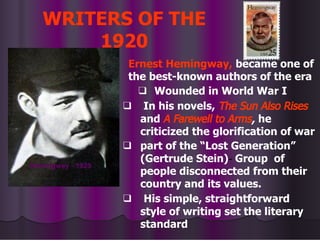
WRITERS OF THE
1920
Ernest Hemingway, became one of
the best-known authors of the era
❑ Wounded in World War I
❑ In his novels, The Sun Also Rises
and A Farewell to Arms, he
criticized the glorification of war
❑ part of the “Lost Generation”
(Gertrude Stein)- Group of
people disconnected from their
country and its values.
❑ His simple, straightforward
style of writing set the literary
standard
Hemingway - 1929

These here slides are about the Roaring 20s

  • 1.
    LIFE & CULTURE INAMERICA IN THE 1920S THE ROARING TWENTIES
  • 2.
    America at the Startof the Decade ● Victorious in World War I ● Treaty of Versailles defeated ● Period of isolationism ● Republican ascendancy Returning WWI soldiers parading in Minneapolis
  • 3.
    The Election of1920 ● Republicans nominated Ohio Sen. Warren G. Harding ● “Return to Normalcy” ● Democrats ran Ohio Gov. James M. Cox ● Coolidge as GOP VP candidate ● FDR as Democratic VP candidate ● Republican landslide Warren G. Harding
  • 4.
    Why did HardingWin? Wilson’s idealism and Treaty of Versailles led many Americans to vote for the Republican, Warren Harding… http://www.youtube.com/watch?v=z2JYy5 R_d8U US turned inward and feared anything that was European…
  • 5.
    Pres. Warren G.Harding-1920 Gone were the days of Wilson and Idealism, replaced by pragmatic approach to government (marked the beginning of a conservative movement similar to post-War of 1812, Civil War) Harding promised: • Lower Taxes • Higher Tariffs • Restrictions on immigration • Aid to farmers “A return toNORMALCY”
  • 6.
    FAILURE OF HARDING Appointedsome very qualified people to his administration, nicknamed the Ohio Gang because of ties to state. Harding trust in these experts led to widespread corruption which tainted his administration. “OHIO GANG”
  • 7.
    The Ohio Gang:President Warren Harding (front row, third from right), Vice-President Calvin Coolidge (front row, second from right), and members of the cabinet. The 1920 Election
  • 8.
    The Teapot DomeScandal Cause: In the early part of the 20th century large oil reserves were discovered in Elk Hills, California and Teapot Dome, Wyoming.
  • 9.
    In 1912 PresidentWilliam Taft decided that the government owned the land and its’ oil reserves should be set aside for the use of the United States Navy. On June 4, 1920, Congress passed a bill that stated that the Secretary of the Navy would have the power "to conserve, develop, use and operate the same in his discretion, directly or by contract, lease, or otherwise, and to use, store, exchange, or sell the oil and gas products thereof, and those from all royalty oil from lands in the naval reserves, for the benefit of the United States."
  • 10.
    In March of1921, President Warren Harding appointed Albert Fall as Secretary of the Interior. Pres. Warren Harding Secretary of the Interior Albert Fall
  • 11.
    TEAPOT DOME SCANDAL Secretary ofthe Interior Albert Fall accepted a $100,000 bribe from Sinclair for rights to drill in Teapot Dome. Fall was found guilty and became the first cabinet member to be convicted of a crime. http://www.history.com/this-day-in-history/cabinet-member-guilty-i n-teapot-dome-scandal There was no evidence to that Harding was involved in any way. Harry Sinclair (Mammoth Oil Corp.)
  • 12.
  • 13.
    In 1923, Hardingdied of a heart attack. Vice-President Calvin Coolidge took over.
  • 14.
    The 1924 Election CalvinCoolidge ▪“Silent Cal” ▪slogan: “keep cool with Cal”
  • 15.
    The 1924 Election Despitethe corruption under Harding, Coolidge was able to repair the image of executive branch and benefited from unprecedented material prosperity and economic growth in 1920s America. Because of this, Coolidge easily won the 1924 Election.
  • 16.
    Pres. Calvin Coolidge ConservativePresidency- less government activity • laissez faire (“hands-off”) economic policy • lower taxes • high tariffs Effect? Between 1921 and 1929 the output of industry nearly doubled
  • 17.
    The new president, CalvinCoolidge, fit the pro-business spirit of the 1920s very well http://www.youtube.co m/watch?v=J7jEaqOqc B4 His famous quote: “The chief business of the American people is business . . .the man who builds a factory builds a temple – the man who works there worships there” President Calvin Coolidge 1924-1928
  • 18.
    BUSINESS – FRIENDLY GOVERNMENT 4min-beliefs on taxation and govt-start at 2min mark http://www.youtube.com/watch?v=wwZnExRb8zU President Calvin Coolidge Coolidge throwing out first pitch 1924
  • 19.
    Americans on theMove Urbanization still accelerating. ❑ More Americans lived in cities than in rural areas (6 million farmers) ❑ 1920: ❑ New York 5 million ❑ Chicago 3 million ❑ growth of transportation systems (subway, trolleys)
  • 20.
    Demographical Changes African Americanmigration (13% shift from South to North ➔ push: Jim Crow laws pull: jobs in north ➔ struggled with low wages (hatred of white workers), de facto segregation
  • 21.
  • 22.
    Post-WWI: European refugeesto America to escape religious, political persecution or economic opportunity. Call from nativists, unions, middle class to limit the influx of European immigrants who could be seen as radicals or threats to democracy
  • 23.
    Fear of Communism CommunistInternational (Comintern)- Bolsheviks believed that it was their duty to export communism to the rest of the world ● 3rd International Goal (1919): promote worldwide communism
  • 24.
    Fear of Communism- RedScare Fear of the “Red Scare” cause widespread government attacks on suspected radicals (especially foreign born and union leaders) June 2, 1919 coordinated nationwide attack on government officials by radicals led to widespread support for government response to the “Reds”
  • 25.
    Fear of Communism-Palmer Raids Attorney General A. Mitchell Palmer (who had been a target) began process of investigating and targeting suspected “agitators” 2min- http://www.youtube.com/watch?v=1zywzzl9AiU A. Mitchell Palmer’s Home bombed, 1920 Police arrest “suspected Reds” in Chicago, 1920
  • 26.
    • 6,000 immigrants the governmentsuspected of being Communists were arrested and 600 were deported or expelled from the U.S. No due process was followed More- http://www.fbi.gov/news/stories/2007/december/pal mer_122807 Attorney General Mitchell Palmer
  • 27.
    Sacco and VanzettiCase 2 shoe-factory workers were murdered and robbed of company payroll ● Nicola Sacco, a shoemaker, and Bartolomeo Vanzetti, a fish peddler ● Italian immigrants arrested on flimsy evidence ● Anarchists and immigrants
  • 28.
    Sacco and Vanzetti HAVEA CHAIR! from The Daily Worker IS THIS THE EMBLEM? from The Daily Worker Found guilty, sentenced to death, executed (worldwide appeal to stop execution) 3min-http://www.youtube.com/watch?v=C3SuTTcj2u8 Effect? anti-immigrant sentiments led Congress to change immigration laws
  • 29.
    Immigration Backlash 1. EmergencyQuota Act - 1921 ● 3% of total number people in ethnic group per year ● Based on 1910 census 2. National Origins Act - 1924 ● 2% of each nationality living here in 1890 ● 1929 limit total immigrants to 150,000/yr with nationality allotment based on 1920 census
  • 30.
    Number of Immigrants andCountries of Origin, 1891-1920 and 1921-1940 Percentage of Population Foreign Born, 1850-1990
  • 31.
    Other Demographics Employers turnedto Mexican and Canadian immigrants to work. As a result: barrios created(Spanish speaking neighborhoods)
  • 32.
    Ku Klux Klan ColonelWilliam J Simmons ● Revived organization in 1915 ● 1922: enrollment 4 million “The New Klan”- Widened attacks to include Catholics, Jews, immigrants and others. ● By night, whipped, beat and even killed. ● By 1927 Klan activity diminished once again.
  • 33.
    Growth of theKKK ● Birth of a Nation - D.W. Griffith http://www.youtube.com/watch?v=sSaC-l7B35w ● “new” Ku Klux Klan ● “American-ism” (Picture Research Consultants & Archives) Ku Klux Klan initiation, 1923. The Klan opposed all who were not “true Americans”. (c) 2000 IRC
  • 34.
    Ku Klux Klan ColonelWilliam J Simmons ● Revived organization in 1915 ● 1922: enrollment 4 million “The New Klan”- Widened attacks to include Catholics, Jews, immigrants and others. ● By night, whipped, beat and even killed. ● By 1927 Klan activity diminished once again.
  • 35.
    Growth of theKKK ● Birth of a Nation - D.W. Griffith http://www.youtube.com/watch?v=sSaC-l7B35w ● “new” Ku Klux Klan ● “American-ism” (Picture Research Consultants & Archives) Ku Klux Klan initiation, 1923. The Klan opposed all who were not “true Americans”. (c) 2000 IRC
  • 36.
    Ku Klux Klan KuKlux Klan parade in Washington, D.C., Sept. 13, 1926
  • 38.
  • 39.
    Consumerism Unprecedented wealth in1920s postwar world gave citizens more disposable income (not needed for expenses). That coupled with beginning of the 40 hour workweek, innovation of house appliances gave people the time and money to spend on entertainment and luxury goods.
  • 40.
    Consumerism Need to own(thanks to advertising) these goods led to growing personal debt as people began buying on credit. Because of the prosperity, banks and credit companies began to overextend themselves in making sure Americans could afford the many goods and services in 1920s. Materialism- excessive concern with material possessions defined the decade “Roaring 20s” Consumer Debt, 1920–1931
  • 41.
    Henry Ford Using assemblyline production, able to make car faster and more affordable 2min- http://www.youtube.com/watch?v=-z3xJJxOx6E Ford Highland Park assembly line, 1928 (From the Collections of Henry Ford Museum & Greenfield Village) “Trying out the new assembly line“ Detroit, 1913 Henry Ford (1835-1947) effect? 1913: 14 hours to build a new car=2 years wages 1928: 93 minutes (84 separate jobs)=3 mon wages
  • 42.
    Automobile ● Replaced therailroad as the key promoter of economic growth (steel, glass, rubber, gasoline, highways) ● Daily life: commuting, shopping, traveling, “courting” Increase in sales: 1913 - 1.2 million registered; 1929 - 26.5 million registered (=almost one per family) Passenger Car Sales, 1920-1929 Filling Station, Maryland in 1921
  • 43.
    Impact of theAutomobile: Trains and Automobiles, 1900-1980 Jones, Created Equal
  • 44.
    Automobiles & Consumerism Copyright© Houghton Mifflin Company. All rights reserved < Ford ad: “Every family -- with even the most modest income, can now afford a car of their own." “Every family should have their own car. . .You live but once and the years roll by quickly. Why wait for tomorrow for things that you rightfully should enjoy today?" (Library of Congress) Dodge advertisement photo, 1933
  • 45.
    July 4, NantasketBeach, Massachusetts, early 1920s
  • 46.
    THE TWENTIES WOMAN Afterthe tumult of World War I, Americans had the time and money to spend on luxury and entertainment. ❑ Many women were independent and achieving greater freedoms. ❑ ie. right to vote, more employment, freedom of the auto Chicago 1926
  • 47.
    THE FLAPPER A Flapperwas an emancipated young woman who embraced the new fashions and urban attitudes. ➢ challenged traditional role of women outside the home (anti- “cult of domesticity”) ➢ fought gender expectations (short bobbed hair, short skirts), social customs (drink and smoke) in company of men, sexual expectations ➢ 5min- http://www.youtube.com/watch?v=Gc0Jo2xxOe8
  • 48.
    Characteristics of the “Flapper”: •Short hair (ear bob) • Legs showing with shorter skirts • Single women entertained male friends at home without a chaperone • Smoking • Dancing • “Party girls” • Rebellious • Fun-loving • Modern • Liberated
  • 51.
    NEW ROLES FORWOMEN ❑Many women entered the workplace as nurses, teachers, librarians, & secretaries. ❑Earned less than men and were prevented from obtaining certain jobs (“glass ceiling”) Early 20th Century teachers
  • 52.
    THE CHANGING AMERICANFAMILY American birthrates declined for several decades before the 1920s. Trend continues in 1920s with development of birth control. Margaret Sanger ❑ Birth control activist ❑ Founder of American Birth Control League ❑ ie. Planned Parenthood Margaret Sanger and other founders of the American Birth Control League - 1921
  • 53.
    "When motherhood becomesthe fruit of a deep yearning, not the result of ignorance or accident, its children will become the foundation of a new race.“ - Margaret Sanger
  • 54.
    The Darker Sideof Sanger The birth control movement was largely influenced by the Eugenics Movement which became popularized during this time. Sought to eliminate those people who were considered “undesirable stock” which included mentally handicap, immigrants (who were having larger families) and rebellious African Americans. On blacks, immigrants and indigents: "...human weeds,' 'reckless breeders,' 'spawning... human beings who never should have been born." Margaret Sanger, Pivot of Civilization, referring to immigrants and poor people On the extermination of blacks: "We do not want word to go out that we want to exterminate the Negro population," she said, "if it ever occurs to any of their more rebellious members."
  • 55.
    MODERN FAMILY EMERGES ❑ Marriagewas based on romantic love. ❑ Women managed the household and finances. ❑ Children were not considered laborers/ wage earners anymore. ❑ Seen as developing children who needed nurturing and education
  • 56.
    PROHIBITION What amendment Madeit illegal to make, distribute, sell, transport or consume liquor? Volstead Act made it a federal crime to transport across state lines (meaning federal agents could procecute)
  • 57.
    SUPPORT FOR PROHIBITION ❑ Reformershad long believed alcohol led to crime, child & wife abuse, and accidents ❑ Supporters were largely from the rural south and west ❑ 3min- http://www.history.com/topics/roaring-twenties /videos#america-goes-dry-with-prohibition ❑
  • 58.
  • 59.
    SPEAKEASIES AND BOOTLEGGERS Many Americans(especially immigrants and eastern city-dwellers) did not believe drinking was a sin and began to flaunt the law ❑ drinkers went underground to hidden saloons known as speakeasies ❑ People also bought liquor from bootleggers who smuggled it in from Canada, Cuba and the West Indies ❑ All of these activities became closely affiliated with … Speakeasies
  • 60.
    ORGANIZED CRIME Prohibition contributedto the growth of organized crime in every major city ❑ Al Capone – ❑ Chicago, Illinois ❑ famous bootlegger ❑ “Scarface” ❑ 60 million yr (bootleg alone) Capone took control of the Chicago liquor business by killing off his competition ❑ Talent for avoiding jail ❑ 1931 sent to prison for tax-evasion. Al Capone was finally convicted on tax evasion charges in 1931
  • 61.
    St. Valentine’s DayMassacre Valentines Day – February 14, 1929 ● Rival between Al Capone and Bugs Moran ● Capone – South Side Italian gang ● Moran – North Side Irish gang Bloody murder of 7 of Moran’s men. ● Capone’s men dressed as cops
  • 62.
    Racketeering Illegal business schemeto make profit. ● Gangsters bribed police or gov’t officials. ● Forced local businesses a fee for “protection”. ● No fee - gunned down or businesses blown to bits
  • 63.
    GOVERNMENT FAILS TO CONTROLLIQUOR Prohibition failed: ❑ Why? Government did not budget enough money to enforce the law Although there were some success by men like Elliot Ness and the Untouchables (group of Chicago Officers who tried to take down Capone), The task of enforcing Prohibition fell to 1,500 poorly paid federal agents --- clearly an impossible task! Federal agents pour wine down a sewer
  • 64.
    SUPPORT FADES, PROHIBITION REPEALED ❑By the mid-1920s, only 19% of Americans supported Prohibition ❑ Many felt Prohibition caused more problems than it solved ❑ crime, corruption of police, government inefficiency ❑ The 21st Amendment finally repealed Prohibition in 1933
  • 65.
    SCOPES TRIAL In March1925, Tennessee passed the nation’s first law that made it a crime to teach evolution ❑ The ACLU promised to defend any teacher willing to challenge the law – John Scopes did Scopes was a biology teacher who dared to teach his students that man derived from lower species
  • 66.
    SCOPES TRIAL ❑ Trialopened on July 10,1925 and became a national sensation ❑ In an unusual move, Darrow called Bryan to the stand as an expert on the bible – key question: Should the bible be interpreted literally? ❑ Under intense questioning, Darrow got Bryan to admit that the bible can be interpreted in different ways ❑ Nonetheless, Scopes was found guilty and fined $100 ❑ 3min summary- http://www.youtube.com/watch?v=JlKRkz7NM5o Bryan Darrow
  • 67.
    William Ashley “Billy”Sunday Preacher led religious revival called Evangelical Christianity which emphasize a return to traditional values and rejection of secularism. Sunday was popular in the Mid-West and among the middle-upper class Courtesy of billysunday.org
  • 68.
    EDUCATION AND POPULAR CULTURE ❑John Dewey, progressive educator, argued that teachers needed to provide lifelong education practices. ❑ Enrollment in high schools quadrupled between 1914 and 1926. ❑ Public schools met the challenge of educating millions of immigrants
  • 69.
    Mass Media Print andbroadcast methods of communication included increase in newspaper, magazines, radio, and movies. Newspapers: 27 million to 39 million Increase of 42% Motion Pictures: 40 million to 80 million Increase of 100% Radios: 60,000 to 10.2 million Increase of 16,983%
  • 70.
    EXPANDING NEWS COVERAGE By theend of the 1920s… ❑ 10 American magazines -- including Reader’s Digest, Saturday Evening Post,Time – boasted circulations of over 2 million a year. ❑ Tabloids created
  • 71.
    RADIO COMES OF AGE Althoughprint media was popular, radio was the most powerful communications medium to emerge in the 1920s. ❑ News was delivered faster and to a larger audience. ❑ Americans could hear the voice of the president or listen to the World Series live. ❑ Advertising- 1min http://www.youtube.com/watch?v=NcUdEEOTHrY
  • 72.
    MASS CULTURE: Radio ● Newmass medium ● 1920: First commercial radio station ● By 1930: over 800 stations & 10 million radios ● Networks: NBC (1924), CBS (1927) The Spread of Radio, to 1939
  • 73.
    Movies First sound movies: JazzSinger (1927) 2min- http://www.youtube.com/watch?v=Djd1Xfw DAQs The Kid (1921)- Charlie Chaplin “The Tramp” http://www.youtube.com/watch?v=XeW-9k USfjc Metropolis (1927) http://www.youtube.com/watch?v=ZSExdX0 tds4 By 1930 millions of Americans went to the movies each week http://www.youtube.com/watc h?v=XZGHR7J1lUQ
  • 74.
    1920s DANCING Heavily influencedby jazz ● Charleston (Dance Craze) http://www.youtube.com/watch?v=YR78tfjJVew ● Swing (white jazz) ● Dance Marathons
  • 75.
    THE HARLEM RENAISSANCE ❑Great Migration saw hundreds of thousands of African Americans move north to big cities ❑ 1920: ❑ 5 million of the nation’s 12 million blacks (over 40%) lived in cities ❑ 3min- http://www.history.com/topics/roaring-twentie s/videos#the-harlem-renaissance ❑ Migration of the Negro by Jacob Lawrence
  • 76.
    HARLEM, NEW YORK ❑Harlem, NY became the largest black urban community ❑ Harlem suffered from overcrowding, unemployment and poverty ❑ Home to literary and artistic revival known as the Harlem Renaissance
  • 77.
    LANGSTON HUGHES ❑ Missouri-born Langston Hugheswas the movement’s best known poet ❑ Many of his poems described the difficult lives of working-class blacks ❑ “Thank you Ma’am” ❑ Some of his poems were put to music, especially jazz and blues
  • 78.
    A Dream Deferred What happensto a dream deferred? Does it dry up like a raisin in the sun? Or fester like a sore-- And then run? Does it stink like rotten meat? Or crust and sugar over-- like a syrupy sweet? Maybe it just sags like a heavy load. Or does it explode?
  • 79.
    MARCUS GARVEY -UNIA ❑ Marcus Garvey believed that African Americans should build a separate society (Africa) ❑ In 1914, Garvey founded the Universal Negro Improvement Association ❑ Garvey claimed a million members by the mid-1920s ❑ Powerful legacy of black pride, economic independence and Pan-Africanism Garvey represented a more radical approach
  • 81.
  • 82.
    LINDBERGH’S FLIGHT Charles Lindbergh ❑ Nickname:“Lucky Lindy” ❑ May 27, 1927: first nonstop solo trans-Atlantic flight. ❑ Spirit of St. Louis ❑ NYC - Paris ❑ 33 ½ hours later – (no auto pilot) ❑ $25,000 prize http://www.biography.com/people/charles-lindbergh-9382609/v ideos/charles-lindbergh-pioneering-pilot-20613699776 ❑ 2yr old Son Charley kidnapped in 1932 ❑ $50,000 ransom ❑ murdered
  • 83.
    Amelia Earhart 3min bio- http://www.youtube.com/watch?v=9k3CeW7v9fQ 1932:First female to fly solo across the Atlantic 1935: First person to fly from California to Hawaii 1937: Attempt to fly around the world; 2/3 completed and went missing, presumed dead.
  • 84.
    AMERICAN HEROES OFTHE 20s ❑ In 1929, Americans spent $4.5 billion on entertainment. (includes sports) ❑ People crowded into baseball games to see their heroes ❑ Babe Ruth was a larger than life American hero who played for Yankees ❑ He hit 60 homers in 1927. ❑ 3min http://www.youtube.com/wat ch?v=bXLzWVdtLns ❑
  • 85.
    Jazz Jazz is amusic genre that originated at the beginning of the 20th century, within the African-American communities of the Southern United States. Its roots lie in the fusion by African-Americans of certain European harmony and form elements, with their existing African-based music (i.e. spirituals). Use of deep blue notes, off-beat improvisation, country riffs, blues singing. http://www.youtube.com/watch?v=dhiSgi_9Yvo
  • 86.
    MUSIC OF THE1920s Famed composer George Gershwin merged traditional elements with American Jazz. ❑ Someone to Watch Over Me ❑ Embraceable You ❑ I Got Rhythm ❑ Raphsody in Blue http://www.youtube.com/watch?v=1U40xB Sz6Dc Gershwin
  • 87.
    MUSIC OF THE1920s Famed composer George Gershwin merged traditional elements with American Jazz. ❑ Someone to Watch Over Me ❑ Embraceable You ❑ I Got Rhythm ❑ Raphsody in Blue http://www.youtube.com/watch?v=1U40xB Sz6Dc Gershwin
  • 88.
    EDWARD KENNEDY “DUKE” ELLINGTON ❑In the late 1920s, Duke Ellington, a jazz pianist and composer, led his ten-piece orchestra at the famous Cotton Club. ❑ Band: “The Washingtonians” ❑ Ellington won renown as one of America’s greatest composers.
  • 89.
    LOUIS ARMSTRONG ❑ Jazz wasborn in the early 20th century ❑ In 1922, a young trumpet player named Louis Armstrong joined the Creole Jazz Band. ❑ Armstrong is considered the most important and influential musician in the history of jazz ❑ 3min bio- http://www.youtube.com/wa tch?v=sIILBeUrYLk ❑
  • 90.
    BESSIE SMITH ❑ Bessie Smith,blues singer, was perhaps the most outstanding vocalist of the decade ❑ She achieved enormous popularity and by 1927 she became the highest- paid black artist in the world ❑ 3min- http://www.youtube.com/watch?v=CT4z847-hyc
  • 91.
    BILLIE HOLIDAY One ofthe most recognizable voices of the 20s and 30s. ● Embraceable You ● God Bless the Child ● Strange Fruit ● Summertime ● http://www.youtube.com/ watch?v=vAITYPTTh3I
  • 92.
    Walt Disney ● WaltDisney only attended one year of high school. ● He was the voice of Mickey Mouse for two decades. ● As a kid he loved drawing and painting. ● He won 32 Academy Awards. ● 3min bio- http://www.youtube.com/watch?v=9hXsLTcgmLQ ●
  • 93.
    ART OF THE1920s Georgia O’ Keeffe captured the grandeur of New York using intensely colored canvases Radiator Building, Night, New York , 1927 Georgia O'Keeffe
  • 94.
    WRITERS OF THE 1920s ❑Writer F. Scott Fitzgerald coined the phrase “Jazz Age” to describe the 1920s ❑ Fitzgerald wrote Paradise Lost and The Great Gatsby ❑ The Great Gatsby reflected the emptiness of New York elite society and materialism of 1920s ❑ http://www.youtube.com/w atch?v=iPDTSYR853U
  • 95.
    WRITERS OF THE 1920s ❑Writer F. Scott Fitzgerald coined the phrase “Jazz Age” to describe the 1920s ❑ Fitzgerald wrote Paradise Lost and The Great Gatsby ❑ The Great Gatsby reflected the emptiness of New York elite society and materialism of 1920s ❑ http://www.youtube.com/w atch?v=iPDTSYR853U
  • 96.
    WRITERS OF THE 1920 ErnestHemingway, became one of the best-known authors of the era ❑ Wounded in World War I ❑ In his novels, The Sun Also Rises and A Farewell to Arms, he criticized the glorification of war ❑ part of the “Lost Generation” (Gertrude Stein)- Group of people disconnected from their country and its values. ❑ His simple, straightforward style of writing set the literary standard Hemingway - 1929