Resource Markets
   As long as the additional revenue from
    employing another worker exceeds the
    additional cost, the firm should hire that
    worker.
   What about capital?
   What about natural resources?
   A producer demands another unit of a
    resource as long as its marginal revenue
    exceeds its marginal cost.
   People supply their resources to the
    highest paying alternative, other things
    held constant.
   In the market for goods and services-
    who is the demander? Who is the
    supplier?
   What about the resource market??
    • Firms-Demanders
    • Households-Suppliers
LO2                     Resource Market for
                            Carpenters
                                                                     S


                         Dollars per hour of labor
Exhibit 1


                                                     W

                                                                         D


                                                     0   E   Hours of labor per period


            The intersection of the upward-sloping supply curve of carpenters with the downward-
            sloping demand curve determines the equilibrium wage, W, and the level of
            employment, E.
   Because the value of any resources
    depends on what it produces, the
    demand for a resources is said to be a
    derived demand, meaning the demand
    arises from the demand of the final
    product.
   The market demand for a particular
    resource is the sum of demands for the
    resource in all its different uses.
   As the price of a resource falls, producers
    are more willing and able to employ that
    resource.
   The market supply curve for a resource
    sums all the individual supply curves for
    that resource.
   As the price increases, resource
    suppliers are more WILLING and ABLE to
    supply the resource.
    • This means that the market supply curve will
     slope UPWARD.
   Resources tend to flow to their highest –
    valued use.
   As long as the nonmonetary benefits of
    supplying resources to alternative uses
    are identical and as long as resources are
    freely mobile, resources adjust across
    uses until they earn the same in different
    uses.
   Adjustment takes time
LO2           Exhibit 2
Market for Carpenters in Alternative Uses
           (a) Home building                              (b) Furniture making
per hour


                                Sh


                                               per hour
Dollars


                                                                       S’f


                                               Dollars
                                  S’h
                                                                             Sf

  $25
   24                                           $24

                                                  20


                                    Dh                                  Df

                                                                       Hours of labor
      0              58 60 Hours of labor      0               10 12
                           per day (thousands)                         per day (thousands)
     The wage differential prompts carpenters to shift from furniture making to home
     building until the wage is identical in the two markets
   Not all resource price differences cause
    reallocation.
    • Example- Land in cities
    • They are explained by:
      1) A lack of resource mobility ( Urban land vs. rural
         land)
      2) Differences in the inherent quality of the resource
         (fertile land vs. non-fertile land)
      3) Differences in the time and money involved in
         developing the necessary skills
      4) Differences in nonmonetary aspects of the job
   Opportunity cost is what that resource
    could earn in its BEST alternative use.
   Economic rent is the amount earned in
    excess of his opportunity cost.
    • The portion of a resource’s earnings that
      exceeds the amount necessary to keep the
      resource in its present use.
    • It’s “pure gravy.”
   The less elastic the resource supply, the
    greater the economic rent as a
    proportion of total earnings.
   The supply of a resource market is
    perfectly inelastic, meaning the resource
    has no alternative use.
   NO opportunity cost.
   ALL earnings are economic rent
   The supply of a resource is perfectly
    elastic supply.
   The market for the resource can earn as
    much in its best alternative use as in its
    present use.
   ALL earnings are opportunity cost.
   There is NO economic rent.
   The supply curve slopes upward, then
    most resource suppliers earn economic
    rent in addition to their opportunity cost.
LO3              Exhibit 3
           Opportunity Cost and Economic Rent
       (a) All earnings are              (b) All earnings are                   (c) Earnings divided
       economic rent                     opportunity cost                       between economic rent and
                                                                                opportunity cost


                                   per unit


                                                                        per unit
per unit
Dollars


                                   Dollars


                                                                        Dollars
                                                                                                       S
                      S


                                                                        $16

  $1                               $10                              S              Economic
                                                                                   rent
           Economic                           Opportunity                   8                              D
           rent                               cost                                     Opportunity
                              D                                 D                       cost

                          Millions of                        Hours of                                  Hours of
       0          10                     0           1,000                   0        5,000   10,000
                          acres                              labor                                     labor
                          per month                          per day                                   per day
   The marginal product: the change in total
    product (output produced) from
    employing one more unit of labor or
    capital.
   The marginal revenue product of labor
    indicates how much total revenue
    changes as more labor is employed.
    • Marginal revenue product (MRP) of a resource is
      the change in the firm’s total revenue resulting
      from employing an additional unit of the
      resource.
    • It is the firm’s “marginal benefit” of hiring a
      resource (a worker or machine).
   What does another unit of labor cost the
    firm?
    • The change in total cost when an additional unit
      of a resource is hired, other things held constant.
    • The firm will hire MORE labor as long as doing
      so adds more to revenue than to costs, meaning
      as long as MRP > MRC
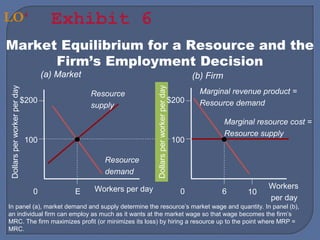
   Marginal revenue product = Marginal
    resource cost
    • This will hold for competitive markets or firms
      with some market power.
    • Profit maximization will occur where labor’s
      marginal revenue product equals the market
      wage.
LO4                                   Exhibit 6
Market Equilibrium for a Resource and the
      Firm’s Employment Decision
                                    (a) Market                                                         (b) Firm


                                                                   Dollars per worker per day
Dollars per worker per day


                                                 Resource                                               Marginal revenue product =
                             $200                                                               $200    Resource demand
                                                 supply

                                                                                                                  Marginal resource cost =
                                                                                                                  Resource supply
                              100                                                                100

                                                    Resource
                                                    demand

                                                 Workers per day                                                              Workers
                                0           E                                                      0          6         10
                                                                                                                              per day
In panel (a), market demand and supply determine the resource’s market wage and quantity. In panel (b),
an individual firm can employ as much as it wants at the market wage so that wage becomes the firm’s
MRC. The firm maximizes profit (or minimizes its loss) by hiring a resource up to the point where MRP =
MRC.
   Two things can change a resource’s
    marginal product:
    1) A change in the amount of other resources
       employed
    2) A change in technology
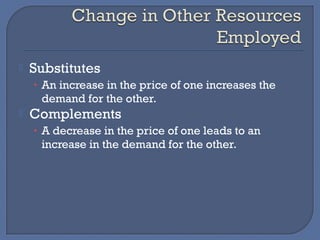
   Substitutes
    • An increase in the price of one increases the
     demand for the other.
   Complements
    • A decrease in the price of one leads to an
     increase in the demand for the other.
   Technological improvements can boost
    the productivity of some resources but
    make other resources obsolete.
    • Computer-controlled machines
   Since the demand for a resource is
    DERIVED from the demand for the final
    output, any change in the demand for
    output affects resource demand.
    • CDs

Chapter 11 resource markets

  • 1.
  • 2.
    As long as the additional revenue from employing another worker exceeds the additional cost, the firm should hire that worker.  What about capital?  What about natural resources?  A producer demands another unit of a resource as long as its marginal revenue exceeds its marginal cost.
  • 3.
    People supply their resources to the highest paying alternative, other things held constant.
  • 4.
    In the market for goods and services- who is the demander? Who is the supplier?  What about the resource market?? • Firms-Demanders • Households-Suppliers
  • 5.
    LO2 Resource Market for Carpenters S Dollars per hour of labor Exhibit 1 W D 0 E Hours of labor per period The intersection of the upward-sloping supply curve of carpenters with the downward- sloping demand curve determines the equilibrium wage, W, and the level of employment, E.
  • 6.
    Because the value of any resources depends on what it produces, the demand for a resources is said to be a derived demand, meaning the demand arises from the demand of the final product.
  • 7.
    The market demand for a particular resource is the sum of demands for the resource in all its different uses.  As the price of a resource falls, producers are more willing and able to employ that resource.
  • 8.
    The market supply curve for a resource sums all the individual supply curves for that resource.  As the price increases, resource suppliers are more WILLING and ABLE to supply the resource. • This means that the market supply curve will slope UPWARD.
  • 9.
    Resources tend to flow to their highest – valued use.  As long as the nonmonetary benefits of supplying resources to alternative uses are identical and as long as resources are freely mobile, resources adjust across uses until they earn the same in different uses.
  • 10.
    Adjustment takes time
  • 11.
    LO2 Exhibit 2 Market for Carpenters in Alternative Uses (a) Home building (b) Furniture making per hour Sh per hour Dollars S’f Dollars S’h Sf $25 24 $24 20 Dh Df Hours of labor 0 58 60 Hours of labor 0 10 12 per day (thousands) per day (thousands) The wage differential prompts carpenters to shift from furniture making to home building until the wage is identical in the two markets
  • 12.
    Not all resource price differences cause reallocation. • Example- Land in cities • They are explained by: 1) A lack of resource mobility ( Urban land vs. rural land) 2) Differences in the inherent quality of the resource (fertile land vs. non-fertile land) 3) Differences in the time and money involved in developing the necessary skills 4) Differences in nonmonetary aspects of the job
  • 13.
    Opportunity cost is what that resource could earn in its BEST alternative use.  Economic rent is the amount earned in excess of his opportunity cost. • The portion of a resource’s earnings that exceeds the amount necessary to keep the resource in its present use. • It’s “pure gravy.”
  • 14.
    The less elastic the resource supply, the greater the economic rent as a proportion of total earnings.
  • 15.
    The supply of a resource market is perfectly inelastic, meaning the resource has no alternative use.  NO opportunity cost.  ALL earnings are economic rent
  • 16.
    The supply of a resource is perfectly elastic supply.  The market for the resource can earn as much in its best alternative use as in its present use.  ALL earnings are opportunity cost.  There is NO economic rent.
  • 17.
    The supply curve slopes upward, then most resource suppliers earn economic rent in addition to their opportunity cost.
  • 18.
    LO3 Exhibit 3 Opportunity Cost and Economic Rent (a) All earnings are (b) All earnings are (c) Earnings divided economic rent opportunity cost between economic rent and opportunity cost per unit per unit per unit Dollars Dollars Dollars S S $16 $1 $10 S Economic rent Economic Opportunity 8 D rent cost Opportunity D D cost Millions of Hours of Hours of 0 10 0 1,000 0 5,000 10,000 acres labor labor per month per day per day
  • 19.
    The marginal product: the change in total product (output produced) from employing one more unit of labor or capital.
  • 21.
    The marginal revenue product of labor indicates how much total revenue changes as more labor is employed. • Marginal revenue product (MRP) of a resource is the change in the firm’s total revenue resulting from employing an additional unit of the resource. • It is the firm’s “marginal benefit” of hiring a resource (a worker or machine).
  • 23.
    What does another unit of labor cost the firm? • The change in total cost when an additional unit of a resource is hired, other things held constant. • The firm will hire MORE labor as long as doing so adds more to revenue than to costs, meaning as long as MRP > MRC
  • 24.
    Marginal revenue product = Marginal resource cost • This will hold for competitive markets or firms with some market power. • Profit maximization will occur where labor’s marginal revenue product equals the market wage.
  • 25.
    LO4 Exhibit 6 Market Equilibrium for a Resource and the Firm’s Employment Decision (a) Market (b) Firm Dollars per worker per day Dollars per worker per day Resource Marginal revenue product = $200 $200 Resource demand supply Marginal resource cost = Resource supply 100 100 Resource demand Workers per day Workers 0 E 0 6 10 per day In panel (a), market demand and supply determine the resource’s market wage and quantity. In panel (b), an individual firm can employ as much as it wants at the market wage so that wage becomes the firm’s MRC. The firm maximizes profit (or minimizes its loss) by hiring a resource up to the point where MRP = MRC.
  • 26.
    Two things can change a resource’s marginal product: 1) A change in the amount of other resources employed 2) A change in technology
  • 27.
    Substitutes • An increase in the price of one increases the demand for the other.  Complements • A decrease in the price of one leads to an increase in the demand for the other.
  • 28.
    Technological improvements can boost the productivity of some resources but make other resources obsolete. • Computer-controlled machines
  • 29.
    Since the demand for a resource is DERIVED from the demand for the final output, any change in the demand for output affects resource demand. • CDs

Editor's Notes

  • #6 Chapter 11 Resource Markets
  • #12 Chapter 11 Resource Markets
  • #19 Chapter 11 Resource Markets
  • #26 Chapter 11 Resource Markets