What Is anEvent Budget?
It is a detailed list of all the expected costs and revenues
associated with the event, including venue rental,
catering, marketing and promotion, transportation,
equipment rental, and any other costs related to the
event.
Creating a comprehensive budget ensures that all
financial aspects of your event are well-managed,
preventing unexpected costs, and helping you allocate
resources effectively.
financial roadmap for your event.
3.
IMPORTANCE OF EVENTBUDGETING
Financial control: A budget helps event planners stay within budget and avoid overspending.
Resource allocation: A budget ensures that each aspect of the event has enough funding.
Risk management: A budget helps event planners identify and mitigate financial risks by considering
potential costs and allocating contingency funds
Informed decisions: A budget helps event planners make informed decisions about various aspects of
the event.
ROI assessment: A budget helps event planners assess the event's ROI and identify areas for
improvement.
Success measurement: A budget helps event planners measure their success by comparing actual
revenue and expenses to projections.
Break-even point: A budget helps event planners identify the minimum income needed to generate to
maintain a balance.
Emergency funds: A budget helps event planners set aside emergency funds to back up their schedule.
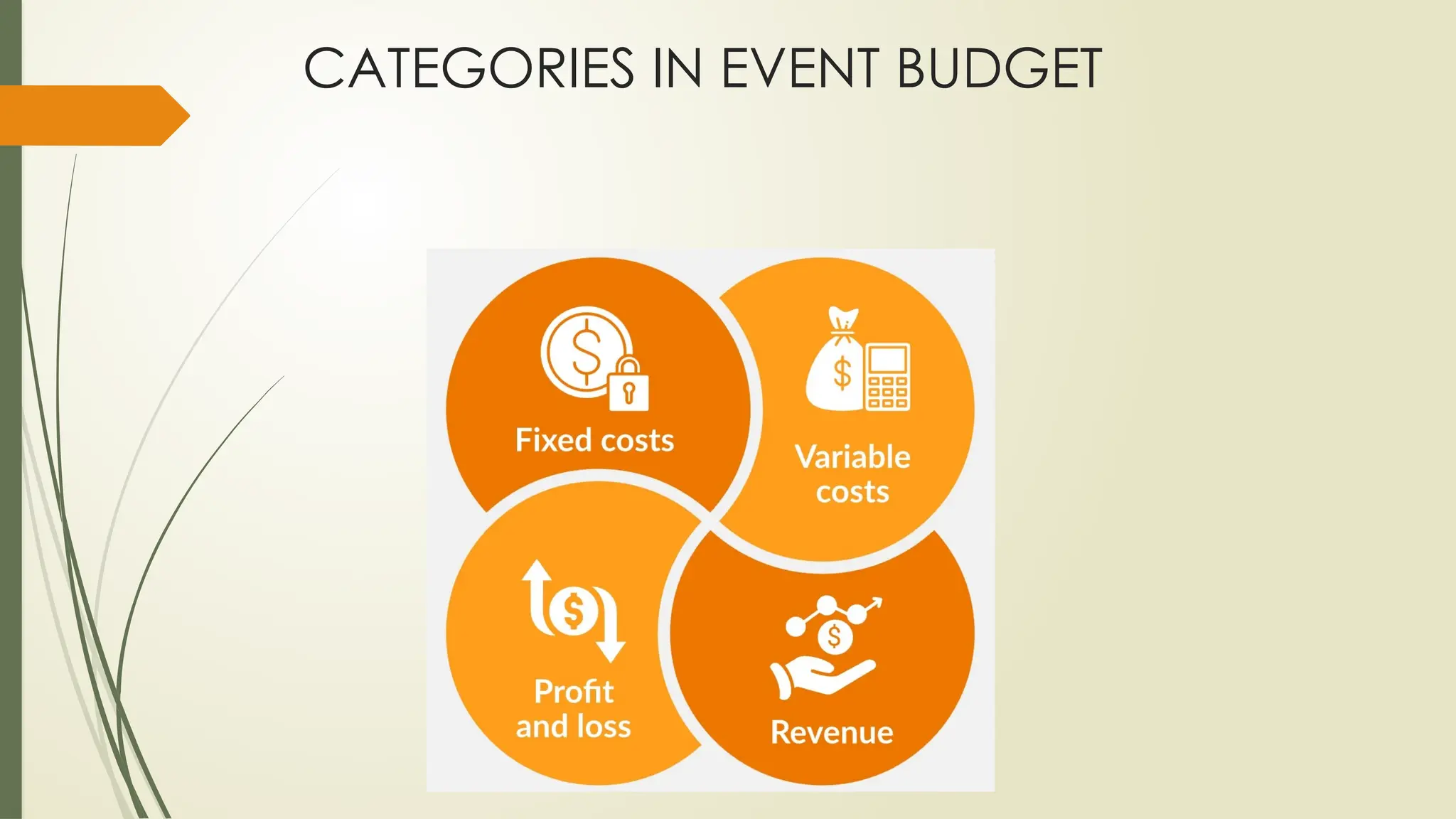
Fixed costs.Fixed costs are expenses that stay the same regardless
of how many attendees join your event. These may include your
venue rental, entertainment, and event registration software fees.
Variable costs. Expenses that vary according to your attendee
count are called variable costs. Examples include food and beverage
and event staff costs.
Revenue. The money you expect to make from your event is your
projected revenue. Common sources of event revenue include ticket
sales, sponsorships, and exhibitor booth fees.
Profit and loss. Taking the above factors into consideration, the
profitability of your event depends on the number of attendees who
show up. To determine how many attendees you’ll need, you may
add a section to your budget that summarizes your projected
expenses and revenue for different potential attendee counts.
Break Even – No profit , No loss.
1. Set financialgoals for your event
One of the first steps for every event planner is preparing
an event profit and loss budget and predicting as
accurately as possible if the event will result in a profit,
loss, or break even. However, determining what financial
success means for your event depends on the type of
event and objectives.
8.
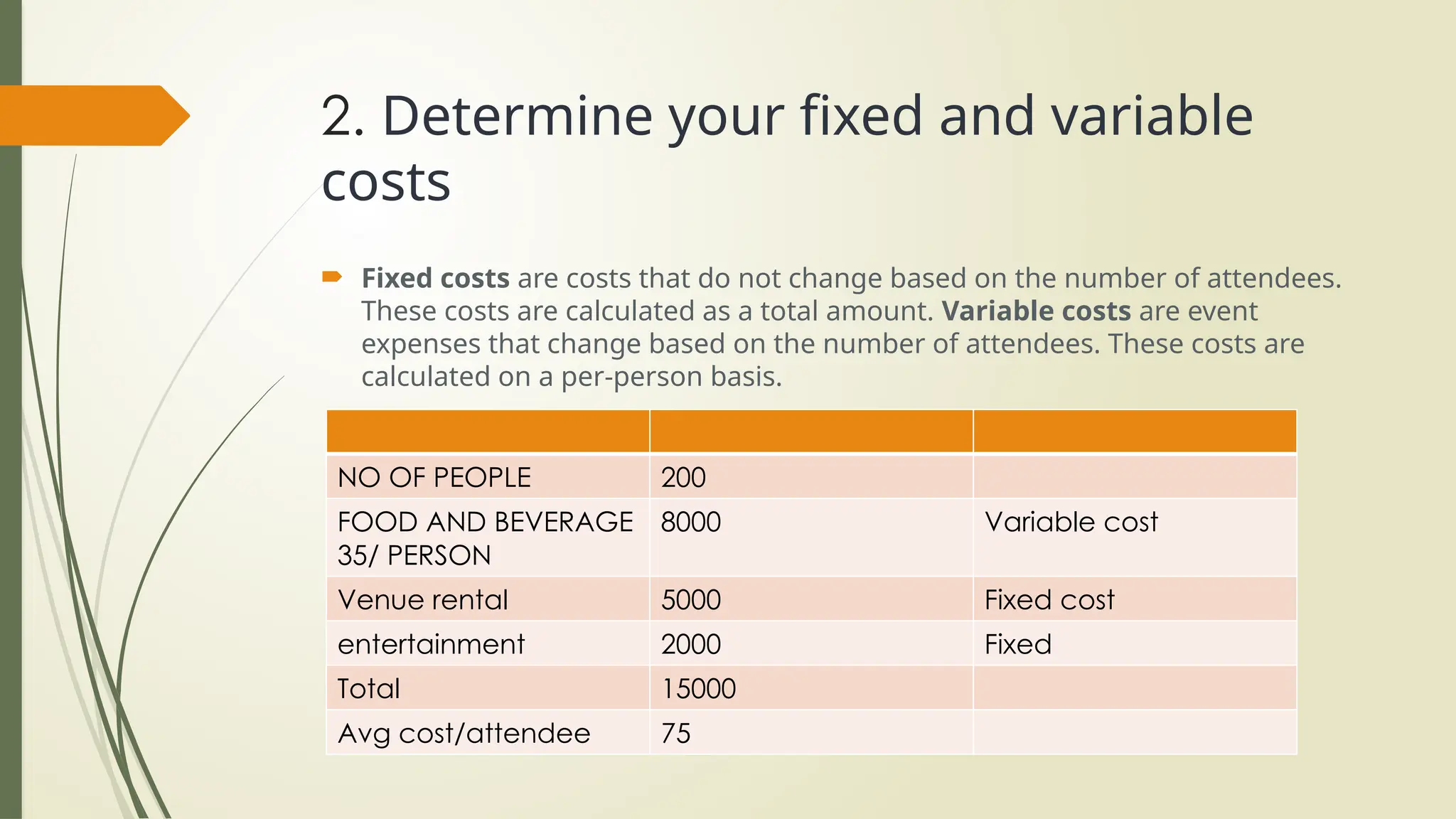
2. Determine yourfixed and variable
costs
Fixed costs are costs that do not change based on the number of attendees.
These costs are calculated as a total amount. Variable costs are event
expenses that change based on the number of attendees. These costs are
calculated on a per-person basis.
NO OF PEOPLE 200
FOOD AND BEVERAGE
35/ PERSON
8000 Variable cost
Venue rental 5000 Fixed cost
entertainment 2000 Fixed
Total 15000
Avg cost/attendee 75
4. Create anevent budget proposal
An event budget proposal is a document or presentation you’ll put together
to convince stakeholders at your business to sign off on.
It could be based on
• The stated purpose and goals of your event
• Data about past events you have hosted
• Information about similar industry events
• Contingency plans for your budget
• Potential overages for your budget
• Information on how you will measure and report ROI on your event
12.
5. Calculate cashflow for your event
To calculate your cash flow, add up all your revenues and
subtract the uncollected accounts receivables (money that
is owed to you for services/work performed). This is your
cash on hand before expenses. If you then subtract all of
your accounts payable (money you owe for services/work
provided to you) from that number, you will have your
cash on hand. If the number is positive, you have a
positive cash flow.
13.
6. Review andtrack your event budget
Not all expenses can be forecasted and your budget will likely change during
the event planning process. This makes it crucial to review and track your
budget as you go.
As demands for your meeting or event might change, it’s also a good idea to
confirm in advance who would have the authority to spend beyond the
approved budget.