BCTA 308:
Administrative Law
Chapters 10, 11 & 12 Administrative Law,
Principles & Advocacy
Advocacy at Tribunals – Procedures During the Hearing
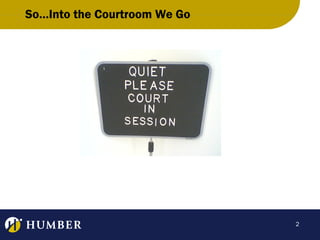
So…Into the Courtroom We Go

2
But Wait…What Type of Hearing?
Different agencies allow different types of
hearings, depending on a number of factors:
• The distance of the parties to the court
• The cost and timeliness of the proceeding
• The format that would allow the most fairness
• The necessity of public access to a hearing
Adjudicators sometimes allow input on the type
of hearing, and will deal with submissions by the
parties in a pre-hearing conference:

3
But Wait…What Type of Hearing?
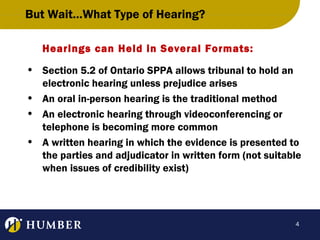
Hearings can Held in Several Formats:
• Section 5.2 of Ontario SPPA allows tribunal to hold an
electronic hearing unless prejudice arises
• An oral in-person hearing is the traditional method
• An electronic hearing through videoconferencing or
telephone is becoming more common
• A written hearing in which the evidence is presented to
the parties and adjudicator in written form (not suitable
when issues of credibility exist)

4
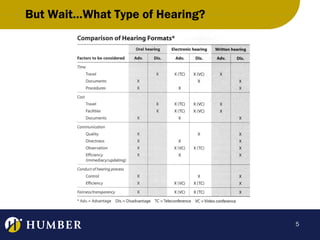
But Wait…What Type of Hearing?

5
But Wait…What Type of Hearing?
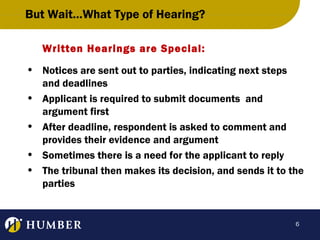
Written Hearings are Special:
• Notices are sent out to parties, indicating next steps
and deadlines
• Applicant is required to submit documents and
argument first
• After deadline, respondent is asked to comment and
provides their evidence and argument
• Sometimes there is a need for the applicant to reply
• The tribunal then makes its decision, and sends it to the
parties

6
Who gets to take part in the proceedings
It’s not all up to you, each Board, Agency,
Tribunal and Commission has its own ways of
doing business.
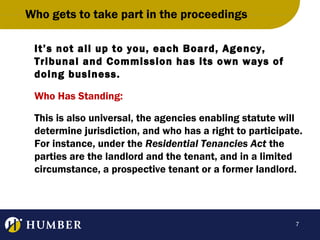
Who Has Standing:
This is also universal, the agencies enabling statute will
determine jurisdiction, and who has a right to participate.
For instance, under the Residential Tenancies Act the
parties are the landlord and the tenant, and in a limited
circumstance, a prospective tenant or a former landlord.

7
Who gets to take part in the proceedings?
It’s not all up to you, each Board, Agency,
Tribunal and Commission has its own ways of
doing business.
Why is Standing Important:
Only parties with standing have a right to:
•
•
•
•
•

Give evidence
Make submission
Cross examine witnesses
Receive a copy of the decision
Review or appeal
8
Agencies have counsel for 2 reasons
Depending on the type of agency, there is
usually counsel for the agency providing one of
two functions, or both:
Functions may include:
1. Presenting a case to the tribunal on behalf of a party
or society in general, in an agency that acts as a
prosecutor. They act for agency, not tribunal.
2. Providing legal advice to the members of the agency

9
Adjudicators have an important role to play
Depending on the type of agency, the
adjudicator has a central role in having the
matter resolved fairly.
Functions may include:
1. Establishing procedures for conduct that are fair and
efficient
2. Listening to evidence, taking notes
3. Listening to argument and examining cases
4. Making a fair, and reasoned decision that applies the
facts to the law and merits of the case
10
Adjudicators have an important role to play
The adjudicator usually follows a process
similar to this:
Functions at the start of the hearing may include:
1. Opening preamble/remarks
2. Calls the case, names the parties and calls them
forward
3. Describes the case. Asks if there are any pre-hearing
submissions
4. Describes the hearing process, giving evidence, cross
examination, closing submissions
11
Adjudicators have an important role to play
The adjudicator usually follows a process similar
to this:
Functions during the hearing may include:
1.
2.
3.
4.
5.
6.

Dealing with any pre-hearing motions
Making evidentiary decisions as issues arise
Reminding the parties what the central issues are
Dealing with conduct issues
Keeping track of exhibits as they are admitted
Questioning witnesses, usually after they have been
examined and cross examined…remember, this is not
just adversarial, it is inquisitorial
12
Adjudicators have an important role to play
The adjudicator usually follows a process
similar to this:
Functions at the end of the hearing may include :
1.
2.
3.
4.

Hearing submissions about costs
Thanking the parties for attending
Advising them when they can expect a decision
Describing the process if a party disagrees with
decision
5. Sometimes, an oral decision will be given, followed
by a written order
13
Adjudicators have an important role to play
The adjudicator usually follows a process
similar to this:
Functions after the hearing may include :
1.
2.
3.
4.
5.

Speaking to tribunal counsel about legal issues
Review the law so it can be applied correctly
Re-convene the hearing if important info is missing
Providing a draft decision for review
Writing a decision with clear reasons

14
The evidence begins
Chapter 11 in the textbook deals with issues of
witness examination and evidence. You should
have dealt with this in advocacy and evidence
law, but you must be familiar with:
1. Rules about evidence, admissibility, weight
2. The order and manner of witness examination,
examination in chief, cross examination and reply
3. Expert witnesses
4. Handling objections
5. Closing submissions

15
The evidence begins

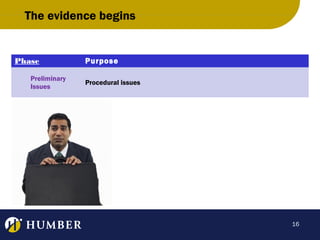
Phase
Preliminary
Issues

Purpose
Procedural issues

16
The evidence begins

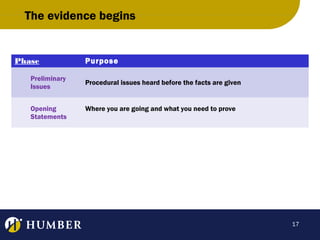
Phase
Preliminary
Issues
Opening
Statements

Purpose
Procedural issues heard before the facts are given

Where you are going and what you need to prove

17
The evidence begins

Phase
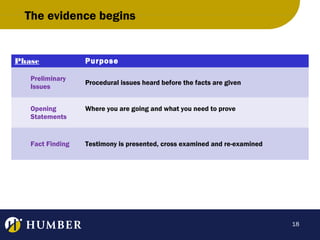
Preliminary
Issues

Purpose
Procedural issues heard before the facts are given

Opening
Statements

Where you are going and what you need to prove

Fact Finding

Testimony is presented, cross examined and re-examined

18
The evidence begins

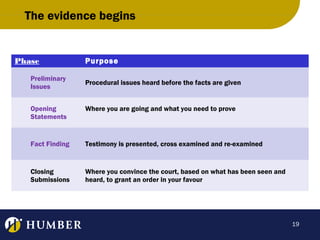
Phase
Preliminary
Issues

Purpose
Procedural issues heard before the facts are given

Opening
Statements

Where you are going and what you need to prove

Fact Finding

Testimony is presented, cross examined and re-examined

Closing
Submissions

Where you convince the court, based on what has been seen and
heard, to grant an order in your favour

19
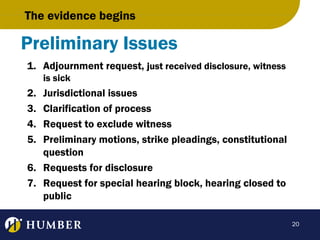
The evidence begins

Preliminary Issues
1. Adjournment request, just received disclosure, witness
is sick

2.
3.
4.
5.

Jurisdictional issues
Clarification of process
Request to exclude witness
Preliminary motions, strike pleadings, constitutional
question
6. Requests for disclosure
7. Request for special hearing block, hearing closed to
public
20
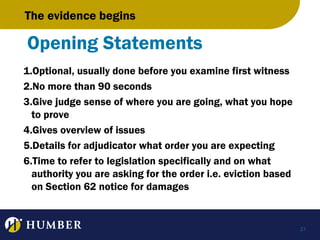
The evidence begins

Opening Statements
1.Optional, usually done before you examine first witness
2.No more than 90 seconds
3.Give judge sense of where you are going, what you hope
to prove
4.Gives overview of issues
5.Details for adjudicator what order you are expecting
6.Time to refer to legislation specifically and on what
authority you are asking for the order i.e. eviction based
on Section 62 notice for damages

21
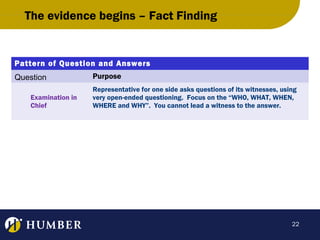
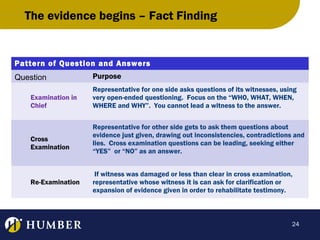
The evidence begins – Fact Finding

Pattern of Question and Answers
Question
Examination in
Chief

Purpose
Representative for one side asks questions of its witnesses, using
very open-ended questioning. Focus on the “WHO, WHAT, WHEN,
WHERE and WHY”. You cannot lead a witness to the answer.

22
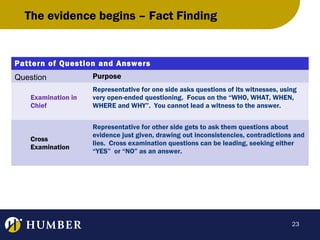
The evidence begins – Fact Finding

Pattern of Question and Answers
Question
Examination in
Chief

Cross
Examination

Purpose
Representative for one side asks questions of its witnesses, using
very open-ended questioning. Focus on the “WHO, WHAT, WHEN,
WHERE and WHY”. You cannot lead a witness to the answer.
Representative for other side gets to ask them questions about
evidence just given, drawing out inconsistencies, contradictions and
lies. Cross examination questions can be leading, seeking either
“YES” or “NO” as an answer.

23
The evidence begins – Fact Finding

Pattern of Question and Answers
Question
Examination in
Chief

Cross
Examination

Re-Examination

Purpose
Representative for one side asks questions of its witnesses, using
very open-ended questioning. Focus on the “WHO, WHAT, WHEN,
WHERE and WHY”. You cannot lead a witness to the answer.
Representative for other side gets to ask them questions about
evidence just given, drawing out inconsistencies, contradictions and
lies. Cross examination questions can be leading, seeking either
“YES” or “NO” as an answer.
If witness was damaged or less than clear in cross examination,
representative whose witness it is can ask for clarification or
expansion of evidence given in order to rehabilitate testimony.

24
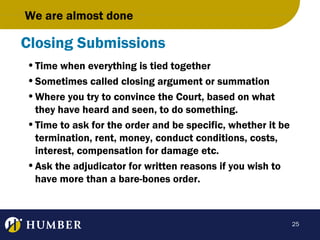
We are almost done

Closing Submissions
• Time when everything is tied together
• Sometimes called closing argument or summation
• Where you try to convince the Court, based on what
they have heard and seen, to do something.
• Time to ask for the order and be specific, whether it be
termination, rent, money, conduct conditions, costs,
interest, compensation for damage etc.
• Ask the adjudicator for written reasons if you wish to
have more than a bare-bones order.

25
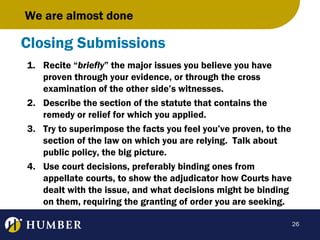
We are almost done

Closing Submissions
1. Recite “briefly” the major issues you believe you have
proven through your evidence, or through the cross
examination of the other side’s witnesses.
2. Describe the section of the statute that contains the
remedy or relief for which you applied.
3. Try to superimpose the facts you feel you’ve proven, to the
section of the law on which you are relying. Talk about
public policy, the big picture.
4. Use court decisions, preferably binding ones from
appellate courts, to show the adjudicator how Courts have
dealt with the issue, and what decisions might be binding
on them, requiring the granting of order you are seeking.
26
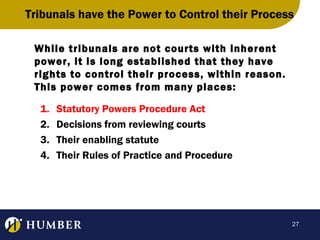
Tribunals have the Power to Control their Process
While tribunals are not courts with inherent
power, it is long established that they have
rights to control their process, within reason.
This power comes from many places:
1.
2.
3.
4.

Statutory Powers Procedure Act
Decisions from reviewing courts
Their enabling statute
Their Rules of Practice and Procedure

27
Tribunals have the Power to Control their Process
Statutory Powers Procedure Act – Name the Section!

1. Power to prevent an abuse of process
2. Power to make inquiries
3. Power to ask a court to commence contempt
proceedings
4. Power to bar an incompetent representative
5. Power to order costs

28
Tribunals have the Power to Control their Process
Statutory Powers Procedure Act – Name the Section!

6. Power to dismiss if frivolous or vexatious
7. Power to issue summonses
8. Power to examine witnesses
9. Power to make rules
10.Power to order disclosure
11.Power to hold closed hearings

29
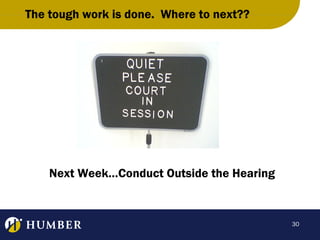
The tough work is done. Where to next??

Next Week…Conduct Outside the Hearing

30

Chapter 10 11_advocacy_during_hearing_abct_week_9

  • 1.
    BCTA 308: Administrative Law Chapters10, 11 & 12 Administrative Law, Principles & Advocacy Advocacy at Tribunals – Procedures During the Hearing
  • 2.
  • 3.
    But Wait…What Typeof Hearing? Different agencies allow different types of hearings, depending on a number of factors: • The distance of the parties to the court • The cost and timeliness of the proceeding • The format that would allow the most fairness • The necessity of public access to a hearing Adjudicators sometimes allow input on the type of hearing, and will deal with submissions by the parties in a pre-hearing conference: 3
  • 4.
    But Wait…What Typeof Hearing? Hearings can Held in Several Formats: • Section 5.2 of Ontario SPPA allows tribunal to hold an electronic hearing unless prejudice arises • An oral in-person hearing is the traditional method • An electronic hearing through videoconferencing or telephone is becoming more common • A written hearing in which the evidence is presented to the parties and adjudicator in written form (not suitable when issues of credibility exist) 4
  • 5.
    But Wait…What Typeof Hearing? 5
  • 6.
    But Wait…What Typeof Hearing? Written Hearings are Special: • Notices are sent out to parties, indicating next steps and deadlines • Applicant is required to submit documents and argument first • After deadline, respondent is asked to comment and provides their evidence and argument • Sometimes there is a need for the applicant to reply • The tribunal then makes its decision, and sends it to the parties 6
  • 7.
    Who gets totake part in the proceedings It’s not all up to you, each Board, Agency, Tribunal and Commission has its own ways of doing business. Who Has Standing: This is also universal, the agencies enabling statute will determine jurisdiction, and who has a right to participate. For instance, under the Residential Tenancies Act the parties are the landlord and the tenant, and in a limited circumstance, a prospective tenant or a former landlord. 7
  • 8.
    Who gets totake part in the proceedings? It’s not all up to you, each Board, Agency, Tribunal and Commission has its own ways of doing business. Why is Standing Important: Only parties with standing have a right to: • • • • • Give evidence Make submission Cross examine witnesses Receive a copy of the decision Review or appeal 8
  • 9.
    Agencies have counselfor 2 reasons Depending on the type of agency, there is usually counsel for the agency providing one of two functions, or both: Functions may include: 1. Presenting a case to the tribunal on behalf of a party or society in general, in an agency that acts as a prosecutor. They act for agency, not tribunal. 2. Providing legal advice to the members of the agency 9
  • 10.
    Adjudicators have animportant role to play Depending on the type of agency, the adjudicator has a central role in having the matter resolved fairly. Functions may include: 1. Establishing procedures for conduct that are fair and efficient 2. Listening to evidence, taking notes 3. Listening to argument and examining cases 4. Making a fair, and reasoned decision that applies the facts to the law and merits of the case 10
  • 11.
    Adjudicators have animportant role to play The adjudicator usually follows a process similar to this: Functions at the start of the hearing may include: 1. Opening preamble/remarks 2. Calls the case, names the parties and calls them forward 3. Describes the case. Asks if there are any pre-hearing submissions 4. Describes the hearing process, giving evidence, cross examination, closing submissions 11
  • 12.
    Adjudicators have animportant role to play The adjudicator usually follows a process similar to this: Functions during the hearing may include: 1. 2. 3. 4. 5. 6. Dealing with any pre-hearing motions Making evidentiary decisions as issues arise Reminding the parties what the central issues are Dealing with conduct issues Keeping track of exhibits as they are admitted Questioning witnesses, usually after they have been examined and cross examined…remember, this is not just adversarial, it is inquisitorial 12
  • 13.
    Adjudicators have animportant role to play The adjudicator usually follows a process similar to this: Functions at the end of the hearing may include : 1. 2. 3. 4. Hearing submissions about costs Thanking the parties for attending Advising them when they can expect a decision Describing the process if a party disagrees with decision 5. Sometimes, an oral decision will be given, followed by a written order 13
  • 14.
    Adjudicators have animportant role to play The adjudicator usually follows a process similar to this: Functions after the hearing may include : 1. 2. 3. 4. 5. Speaking to tribunal counsel about legal issues Review the law so it can be applied correctly Re-convene the hearing if important info is missing Providing a draft decision for review Writing a decision with clear reasons 14
  • 15.
    The evidence begins Chapter11 in the textbook deals with issues of witness examination and evidence. You should have dealt with this in advocacy and evidence law, but you must be familiar with: 1. Rules about evidence, admissibility, weight 2. The order and manner of witness examination, examination in chief, cross examination and reply 3. Expert witnesses 4. Handling objections 5. Closing submissions 15
  • 16.
  • 17.
    The evidence begins Phase Preliminary Issues Opening Statements Purpose Proceduralissues heard before the facts are given Where you are going and what you need to prove 17
  • 18.
    The evidence begins Phase Preliminary Issues Purpose Proceduralissues heard before the facts are given Opening Statements Where you are going and what you need to prove Fact Finding Testimony is presented, cross examined and re-examined 18
  • 19.
    The evidence begins Phase Preliminary Issues Purpose Proceduralissues heard before the facts are given Opening Statements Where you are going and what you need to prove Fact Finding Testimony is presented, cross examined and re-examined Closing Submissions Where you convince the court, based on what has been seen and heard, to grant an order in your favour 19
  • 20.
    The evidence begins PreliminaryIssues 1. Adjournment request, just received disclosure, witness is sick 2. 3. 4. 5. Jurisdictional issues Clarification of process Request to exclude witness Preliminary motions, strike pleadings, constitutional question 6. Requests for disclosure 7. Request for special hearing block, hearing closed to public 20
  • 21.
    The evidence begins OpeningStatements 1.Optional, usually done before you examine first witness 2.No more than 90 seconds 3.Give judge sense of where you are going, what you hope to prove 4.Gives overview of issues 5.Details for adjudicator what order you are expecting 6.Time to refer to legislation specifically and on what authority you are asking for the order i.e. eviction based on Section 62 notice for damages 21
  • 22.
    The evidence begins– Fact Finding Pattern of Question and Answers Question Examination in Chief Purpose Representative for one side asks questions of its witnesses, using very open-ended questioning. Focus on the “WHO, WHAT, WHEN, WHERE and WHY”. You cannot lead a witness to the answer. 22
  • 23.
    The evidence begins– Fact Finding Pattern of Question and Answers Question Examination in Chief Cross Examination Purpose Representative for one side asks questions of its witnesses, using very open-ended questioning. Focus on the “WHO, WHAT, WHEN, WHERE and WHY”. You cannot lead a witness to the answer. Representative for other side gets to ask them questions about evidence just given, drawing out inconsistencies, contradictions and lies. Cross examination questions can be leading, seeking either “YES” or “NO” as an answer. 23
  • 24.
    The evidence begins– Fact Finding Pattern of Question and Answers Question Examination in Chief Cross Examination Re-Examination Purpose Representative for one side asks questions of its witnesses, using very open-ended questioning. Focus on the “WHO, WHAT, WHEN, WHERE and WHY”. You cannot lead a witness to the answer. Representative for other side gets to ask them questions about evidence just given, drawing out inconsistencies, contradictions and lies. Cross examination questions can be leading, seeking either “YES” or “NO” as an answer. If witness was damaged or less than clear in cross examination, representative whose witness it is can ask for clarification or expansion of evidence given in order to rehabilitate testimony. 24
  • 25.
    We are almostdone Closing Submissions • Time when everything is tied together • Sometimes called closing argument or summation • Where you try to convince the Court, based on what they have heard and seen, to do something. • Time to ask for the order and be specific, whether it be termination, rent, money, conduct conditions, costs, interest, compensation for damage etc. • Ask the adjudicator for written reasons if you wish to have more than a bare-bones order. 25
  • 26.
    We are almostdone Closing Submissions 1. Recite “briefly” the major issues you believe you have proven through your evidence, or through the cross examination of the other side’s witnesses. 2. Describe the section of the statute that contains the remedy or relief for which you applied. 3. Try to superimpose the facts you feel you’ve proven, to the section of the law on which you are relying. Talk about public policy, the big picture. 4. Use court decisions, preferably binding ones from appellate courts, to show the adjudicator how Courts have dealt with the issue, and what decisions might be binding on them, requiring the granting of order you are seeking. 26
  • 27.
    Tribunals have thePower to Control their Process While tribunals are not courts with inherent power, it is long established that they have rights to control their process, within reason. This power comes from many places: 1. 2. 3. 4. Statutory Powers Procedure Act Decisions from reviewing courts Their enabling statute Their Rules of Practice and Procedure 27
  • 28.
    Tribunals have thePower to Control their Process Statutory Powers Procedure Act – Name the Section! 1. Power to prevent an abuse of process 2. Power to make inquiries 3. Power to ask a court to commence contempt proceedings 4. Power to bar an incompetent representative 5. Power to order costs 28
  • 29.
    Tribunals have thePower to Control their Process Statutory Powers Procedure Act – Name the Section! 6. Power to dismiss if frivolous or vexatious 7. Power to issue summonses 8. Power to examine witnesses 9. Power to make rules 10.Power to order disclosure 11.Power to hold closed hearings 29
  • 30.
    The tough workis done. Where to next?? Next Week…Conduct Outside the Hearing 30