Contract Law
Course 1: Introduction
1
Today's Agenda
» Introduction of the course
» The background knowledge: common law, examination, and
case briefing
2
Introduction of the Contract Law
Course
» Foundation Course
» Think like a lawyer
» Conducted in English
3
The reasons to take this course
» Contract law rules and principles
» Really lean common law
» Have a written sample ready
» Experiencing (modified) US style teaching
4
What to expect
5
"Case Method"
» The Socratic method utilized in the US law school
» Focus on case law
» Focus on arguments
» Focus on facts
» Key to learning in the Common Law system
» Less time on lecturing the rules
6
Lecture
» Summary of rules (limited)
7
Requirements for students
» Read 3 Principle Cases of the textbook each class
» Write case briefs
» Participate in the course actively
8
Goals
» Familiar with the leading cases in the field of contracts
» Ability to apply the rules to specific cases
» Experiencing US style law teaching
» Ability to write an interoffice memo
» Ability to prepare case briefs
9
Textbook
» Contract Doctrine, Theory & Practice Volume 1-3,
» by J.H. Verkerke. Published by eLangdell Press, 2012.
» available at www.cali.org1
1
http://www.cali.org/book/1l-first-year-lesson-topics/contracts
10
11
Grading
» Class discussion
» Final examination
12
Class discussion
» Students are expected to participate actively in the class
discussion
» Pass or special arrangements made in advance is accepted
13
Final examination
» Final exam will be presented in English.
» The students will have 3 hours to work on the exam.
» Student will have to analyze the issues presented and to
provide an essay as an answer in English.
14
Why case methods?
15
Civilian Jurisdiction
» Law: body of rules enacted by the state to be found in the
codes
» Favor predicability and stability
» To interpret the legislation expansively
16
Common Law
» A huge, chaotic, and inconsistent mass of individual rules and
cases
» Law: uncodified, unlegislated law found in the decisions of the
courts
» Legislation: traditionally regarded with suspicion
» Interpreted narrowly
» Courts have more latitude to interpret the legislation
17
Flexibility and Predicability of the
Common Law
» Each case is considered individually: more flexible
» Predicability is provided by stare decisis
18
Precedent
» Courts do not disturb a settled point
» Similar Cases must must be decided similarly
19
A common law attorney's
research
» Faced with a client's legal problem
» The attorney researches other cases with similar legal
issues and similar facts
» Compare the client's case to the earlier cases
20
Comparison
» If the case has the same legal issues, and is similar in terms of
facts, it will be decided the same way
» If they are substantially different, the decision will be
different
## Requires the lawyer to constantly scrutinize the judicial
decisions to analyze
» Which facts were determinative of the decisions
» What issues was considered
21
Reasoning Compared
» Civilian reasoning: purely deductive
» Begins with general principles–Major premises
» Minor premises
» Concludes whether the principle applies
22
Common law reasoning . . .
» Includes inductive , deductive, and analogical
reasoning
» Inductive: derive general principles from case law
» Deductive: organize the general principles
» Analogical: compares facts of different cases
23
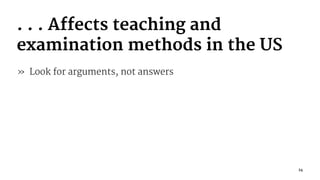
. . . Affects teaching and
examination methods in the US
» Look for arguments, not answers
24
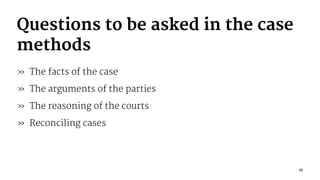
Questions to be asked in the case
methods
» The facts of the case
» The arguments of the parties
» The reasoning of the courts
» Reconciling cases
25
Briefing cases
» In your own words
» Brevity
» one page
» summary of the important elements of a judicial opinion
26
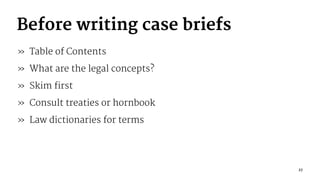
Before writing case briefs
» Table of Contents
» What are the legal concepts?
» Skim first
» Consult treaties or hornbook
» Law dictionaries for terms
27
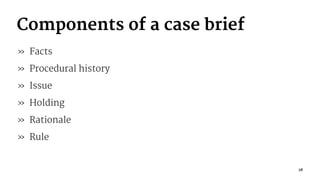
Components of a case brief
» Facts
» Procedural history
» Issue
» Holding
» Rationale
» Rule
28
Facts
» determining the fitness of the case as precedent for later cases
29
Procedural history
» cause of action
» Disposition of the trial court
» Appealing
30
Issue
» Whether the legal rule applies to the facts of the case
» One sentence question incorporating the key facts and the
legal rule that is in controversy
31
Holding or Judgment
» Disposition of the appellate case
» Answers the question asked by the issue
32
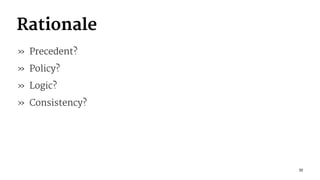
Rationale
» Precedent?
» Policy?
» Logic?
» Consistency?
33
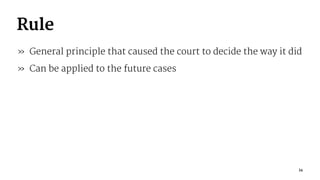
Rule
» General principle that caused the court to decide the way it did
» Can be applied to the future cases
34
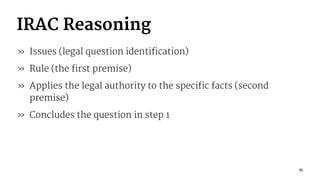
IRAC Reasoning
» Issues (legal question identification)
» Rule (the first premise)
» Applies the legal authority to the specific facts (second
premise)
» Concludes the question in step 1
35
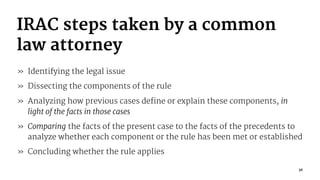
IRAC steps taken by a common
law attorney
» Identifying the legal issue
» Dissecting the components of the rule
» Analyzing how previous cases define or explain these components, in
light of the facts in those cases
» Comparing the facts of the present case to the facts of the precedents to
analyze whether each component or the rule has been met or established
» Concluding whether the rule applies
36
Identification of an issue
» Issue spotting
» Question–phrasing and rephrasing
» Usually understanding of the applicable rule first
37
Analysis of a legal rule
» Reference to appropriate authority
» Needs specific facts of the case
» Needs court's reasoning
38
Types of legal rules
» Elemental or conjunctive Rules (and)
» Disjunctive Rules (*or)
» Exceptions
» Factors and balancing tests
» Totality-of-the-circumstances rules
39
Case law and Rule Analysis
» Each case is limited to the facts of the case
» Examine both the holdings and the material facts
» Determine what types of fact pattern are needed for each
element , factor, or balance
» Consider the policy concerns of each case
40
Fact and policy focused legal
reasoning
» In rule section, need to include
» Facts
» Holding
» Court's reasoning
» Case charts: specify which elements of the rule each case
addresses
41
Weight of authority
» Mandatory vs. Persuasive
» Restatement
» Similarity of the facts
42
Application and conclusion
» How prior case law compares and how the rule applies to the
given facts
» Facts are compared
» Legal implication linked back to each element of the rule
43
Structure of the Memo
» Issue (yes, no, maybe question)
» Short answer
» Facts
» Discussion
» Conclusion
44
Discussion structure
Rule Section (Major premise)
» statement of rule and identification of major components
» Explanation, supported by authority, or components not at
issue
» Explanation of components at issue
» Case 1: component, facts, holding, rationale
» Case 2:
45
Application Section (Minor premise)
» Fact-to-fact comparison of problem facts to Case 2 facts;
conclusion about whether Case 2 component and results apply and
why
» Fact-to-fact comparison of problem facts to Case 1 facts;
conclusion about whether Case 1 component and results apply and
why
» Explanation of how other components or rule apply
» Concluding sentence, incorporating facts and all major components
of rule
46
Examination
47
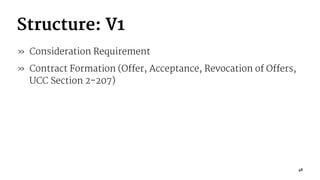
Structure: V1
» Consideration Requirement
» Contract Formation (Offer, Acceptance, Revocation of Offers,
UCC Section 2-207)
48
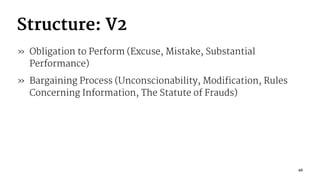
Structure: V2
» Obligation to Perform (Excuse, Mistake, Substantial
Performance)
» Bargaining Process (Unconscionability, Modification, Rules
Concerning Information, The Statute of Frauds)
49
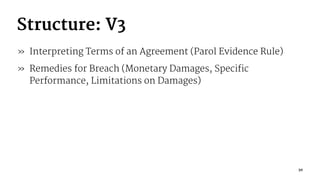
Structure: V3
» Interpreting Terms of an Agreement (Parol Evidence Rule)
» Remedies for Breach (Monetary Damages, Specific
Performance, Limitations on Damages)
50
Week 2 Assignments: V3: 45 -
» Freund v. Washington Square Press
» Klein v. Pepsico
» Sedmak v. Charlie's Chevrolet
51
Conclusion and
questions
52

course slides-contract law-2016-2-Week 1.pdf

  • 1.
    Contract Law Course 1:Introduction 1
  • 2.
    Today's Agenda » Introductionof the course » The background knowledge: common law, examination, and case briefing 2
  • 3.
    Introduction of theContract Law Course » Foundation Course » Think like a lawyer » Conducted in English 3
  • 4.
    The reasons totake this course » Contract law rules and principles » Really lean common law » Have a written sample ready » Experiencing (modified) US style teaching 4
  • 5.
  • 6.
    "Case Method" » TheSocratic method utilized in the US law school » Focus on case law » Focus on arguments » Focus on facts » Key to learning in the Common Law system » Less time on lecturing the rules 6
  • 7.
    Lecture » Summary ofrules (limited) 7
  • 8.
    Requirements for students »Read 3 Principle Cases of the textbook each class » Write case briefs » Participate in the course actively 8
  • 9.
    Goals » Familiar withthe leading cases in the field of contracts » Ability to apply the rules to specific cases » Experiencing US style law teaching » Ability to write an interoffice memo » Ability to prepare case briefs 9
  • 10.
    Textbook » Contract Doctrine,Theory & Practice Volume 1-3, » by J.H. Verkerke. Published by eLangdell Press, 2012. » available at www.cali.org1 1 http://www.cali.org/book/1l-first-year-lesson-topics/contracts 10
  • 11.
  • 12.
    Grading » Class discussion »Final examination 12
  • 13.
    Class discussion » Studentsare expected to participate actively in the class discussion » Pass or special arrangements made in advance is accepted 13
  • 14.
    Final examination » Finalexam will be presented in English. » The students will have 3 hours to work on the exam. » Student will have to analyze the issues presented and to provide an essay as an answer in English. 14
  • 15.
  • 16.
    Civilian Jurisdiction » Law:body of rules enacted by the state to be found in the codes » Favor predicability and stability » To interpret the legislation expansively 16
  • 17.
    Common Law » Ahuge, chaotic, and inconsistent mass of individual rules and cases » Law: uncodified, unlegislated law found in the decisions of the courts » Legislation: traditionally regarded with suspicion » Interpreted narrowly » Courts have more latitude to interpret the legislation 17
  • 18.
    Flexibility and Predicabilityof the Common Law » Each case is considered individually: more flexible » Predicability is provided by stare decisis 18
  • 19.
    Precedent » Courts donot disturb a settled point » Similar Cases must must be decided similarly 19
  • 20.
    A common lawattorney's research » Faced with a client's legal problem » The attorney researches other cases with similar legal issues and similar facts » Compare the client's case to the earlier cases 20
  • 21.
    Comparison » If thecase has the same legal issues, and is similar in terms of facts, it will be decided the same way » If they are substantially different, the decision will be different ## Requires the lawyer to constantly scrutinize the judicial decisions to analyze » Which facts were determinative of the decisions » What issues was considered 21
  • 22.
    Reasoning Compared » Civilianreasoning: purely deductive » Begins with general principles–Major premises » Minor premises » Concludes whether the principle applies 22
  • 23.
    Common law reasoning. . . » Includes inductive , deductive, and analogical reasoning » Inductive: derive general principles from case law » Deductive: organize the general principles » Analogical: compares facts of different cases 23
  • 24.
    . . .Affects teaching and examination methods in the US » Look for arguments, not answers 24
  • 25.
    Questions to beasked in the case methods » The facts of the case » The arguments of the parties » The reasoning of the courts » Reconciling cases 25
  • 26.
    Briefing cases » Inyour own words » Brevity » one page » summary of the important elements of a judicial opinion 26
  • 27.
    Before writing casebriefs » Table of Contents » What are the legal concepts? » Skim first » Consult treaties or hornbook » Law dictionaries for terms 27
  • 28.
    Components of acase brief » Facts » Procedural history » Issue » Holding » Rationale » Rule 28
  • 29.
    Facts » determining thefitness of the case as precedent for later cases 29
  • 30.
    Procedural history » causeof action » Disposition of the trial court » Appealing 30
  • 31.
    Issue » Whether thelegal rule applies to the facts of the case » One sentence question incorporating the key facts and the legal rule that is in controversy 31
  • 32.
    Holding or Judgment »Disposition of the appellate case » Answers the question asked by the issue 32
  • 33.
    Rationale » Precedent? » Policy? »Logic? » Consistency? 33
  • 34.
    Rule » General principlethat caused the court to decide the way it did » Can be applied to the future cases 34
  • 35.
    IRAC Reasoning » Issues(legal question identification) » Rule (the first premise) » Applies the legal authority to the specific facts (second premise) » Concludes the question in step 1 35
  • 36.
    IRAC steps takenby a common law attorney » Identifying the legal issue » Dissecting the components of the rule » Analyzing how previous cases define or explain these components, in light of the facts in those cases » Comparing the facts of the present case to the facts of the precedents to analyze whether each component or the rule has been met or established » Concluding whether the rule applies 36
  • 37.
    Identification of anissue » Issue spotting » Question–phrasing and rephrasing » Usually understanding of the applicable rule first 37
  • 38.
    Analysis of alegal rule » Reference to appropriate authority » Needs specific facts of the case » Needs court's reasoning 38
  • 39.
    Types of legalrules » Elemental or conjunctive Rules (and) » Disjunctive Rules (*or) » Exceptions » Factors and balancing tests » Totality-of-the-circumstances rules 39
  • 40.
    Case law andRule Analysis » Each case is limited to the facts of the case » Examine both the holdings and the material facts » Determine what types of fact pattern are needed for each element , factor, or balance » Consider the policy concerns of each case 40
  • 41.
    Fact and policyfocused legal reasoning » In rule section, need to include » Facts » Holding » Court's reasoning » Case charts: specify which elements of the rule each case addresses 41
  • 42.
    Weight of authority »Mandatory vs. Persuasive » Restatement » Similarity of the facts 42
  • 43.
    Application and conclusion »How prior case law compares and how the rule applies to the given facts » Facts are compared » Legal implication linked back to each element of the rule 43
  • 44.
    Structure of theMemo » Issue (yes, no, maybe question) » Short answer » Facts » Discussion » Conclusion 44
  • 45.
    Discussion structure Rule Section(Major premise) » statement of rule and identification of major components » Explanation, supported by authority, or components not at issue » Explanation of components at issue » Case 1: component, facts, holding, rationale » Case 2: 45
  • 46.
    Application Section (Minorpremise) » Fact-to-fact comparison of problem facts to Case 2 facts; conclusion about whether Case 2 component and results apply and why » Fact-to-fact comparison of problem facts to Case 1 facts; conclusion about whether Case 1 component and results apply and why » Explanation of how other components or rule apply » Concluding sentence, incorporating facts and all major components of rule 46
  • 47.
  • 48.
    Structure: V1 » ConsiderationRequirement » Contract Formation (Offer, Acceptance, Revocation of Offers, UCC Section 2-207) 48
  • 49.
    Structure: V2 » Obligationto Perform (Excuse, Mistake, Substantial Performance) » Bargaining Process (Unconscionability, Modification, Rules Concerning Information, The Statute of Frauds) 49
  • 50.
    Structure: V3 » InterpretingTerms of an Agreement (Parol Evidence Rule) » Remedies for Breach (Monetary Damages, Specific Performance, Limitations on Damages) 50
  • 51.
    Week 2 Assignments:V3: 45 - » Freund v. Washington Square Press » Klein v. Pepsico » Sedmak v. Charlie's Chevrolet 51
  • 52.