Administrative Law

3/5/2014

1
 Barbados AJA s 4; TT JRA s 5(3)
 Public law not about rights per se but rather about

wrongs/misuses of public power (AG St Christopher v
Reynolds: retired inspector of Police detained unlawfully,
no grounds for review)
 Must show:
 Person/body under legal duty to act a certain way
 Decision made was lawful
 Decision not UV
 1) Jurisdiction
 Where do powers come from (discretionary powers
court may second guess)
 Scope of the powers
 Have they acted illegally (UV, irrational, proportionate)
 Additional grounds:
 Deprivation of legitimate expectation
 Absentee of statutory basis
3/5/2014

2
 B. Errors of law: AJA 4(j); JRA 5(3)(j)
 1) Introduction
 JR=legality of decision
 Error in law amounts to:

Purporting a non existent law (Stanislaus v AGTT_
magistrate prescribing a sentence that did not exist in law 5
years instead of 3)
 Misinterpretation of statute
 Legal basis upon which decision was made
 2) Statutory interpretation
 Check what the law is
 Interpret the scope
 Interpret application (Cable Bahamas v PUC: PUC to establish
standard of technology to use not the type)
 3) Service Commissions:
 Subject to review


3/5/2014

3
 4) Fundamental rights and freedoms
 Must consider whether there is an infringement on
rights
 Must distinguish between substantive errors and
procedural for the purposes of due process (Ali v AGTT)
 5) Mistaken view of law
 Error on the face of it court may require
 Error on a complaint or indictment does not amount to an

error in law and is not a ground for JR (Andrews v DPP –
mistaken view of law not a ground for review)

 6) Interim Relief
 Judge makes error in granting relief where an issue exist
(Belize Water services v AG – judge erred in law in holding
that there was an arguable case)
 7) Reasons: will be dealt with later on
 C. Error of fact
 1) Errors of law and facts:
3/5/2014

4
Considers jurisdiction and form as bases of quashing
decision of PA because:
 Misunderstanding of legal terms by the PA in making
decision
 Incorrectly evaluate facts in determining its power
 Re Doyll Insurance Company – registrar interpreted
the law wrongly and there was no causal link between
behaviour and the purported consequential loss.
 2) no evidential basis – error of law/fact
no factual basis for decisions made by the PA (Bovell v
COP –no evidence to support the decisions made
neither in law or reasoning).
 D) Subjectivity
 Manner in which discretion is exercised:
 Did it consider the relevant matters
 Was it reasonable and fair (usually affects areas where
licenses are granted)


3/5/2014

5


Burroughes v Katwaroo: COP having wide discretion to revoke gun
licenses if he thinks fit – must include reasonability)

 E) Non compliance with statutory requirement
 PA did not confer with statute that conferred power equal
unlawful decision
 Cases:
 Arawak trustee Co Ltd v Holden: Bank inspector has
statutory authority to inspect personal and confidential files
to facilitate the performance of his function not for mere
suspicion
 Mossell Ltd v Office of Utilities Regulation: Minister operated
outside the scope of his power when it issued a specific instead
of general direction regarding rates fixing.
F) Mandatory/Directory
Mandatory requirement: non observance leads to invalidity
of the action and result in it being void (directory is the
opposite)
3/5/2014

6
 1) Old approach
 Old approach was rigid and kept in line with the procedure
 Whether the requirement that was not complied with was

mandatory or directory
 Where legislation is not explicit courts decide considering:
 Statutory intention(construction of statute)
 Holding condition ineffective or rigid
 Importance of the condition
 Prejudice of rights, public interest
 Cases:
 Barrow v Hoyte: the effect of statute where a Christian
mission is to hold meetings annually_ deemed
mandatory
 Biggs v COP: minister’s duty to lay SI before
parliament for negative resolution-mandatory
3/5/2014

7
 2) Modern approach:
 Whether the statutory requirements were

mandatory/directory
 Court now exercises discretionary element because
 Statutory requirement not intended to fetter the purpose of
the law.
 Charles v JLC: whether or not adhering to time limits for
disciplinary action fetter the purpose of investigations.
(Wang case was employed-avoid the use of rigid classification
such as mandatory/directory consider whether legislature
intended that the legislation be complied with; if so, did they
intend that a failure to adhere to time to deprive the
legislature from making a decision)
 2) Retention of Discretion
 A) Introduction
 Discretion a legal power not a duty
 Legislation confers the power
3/5/2014

8
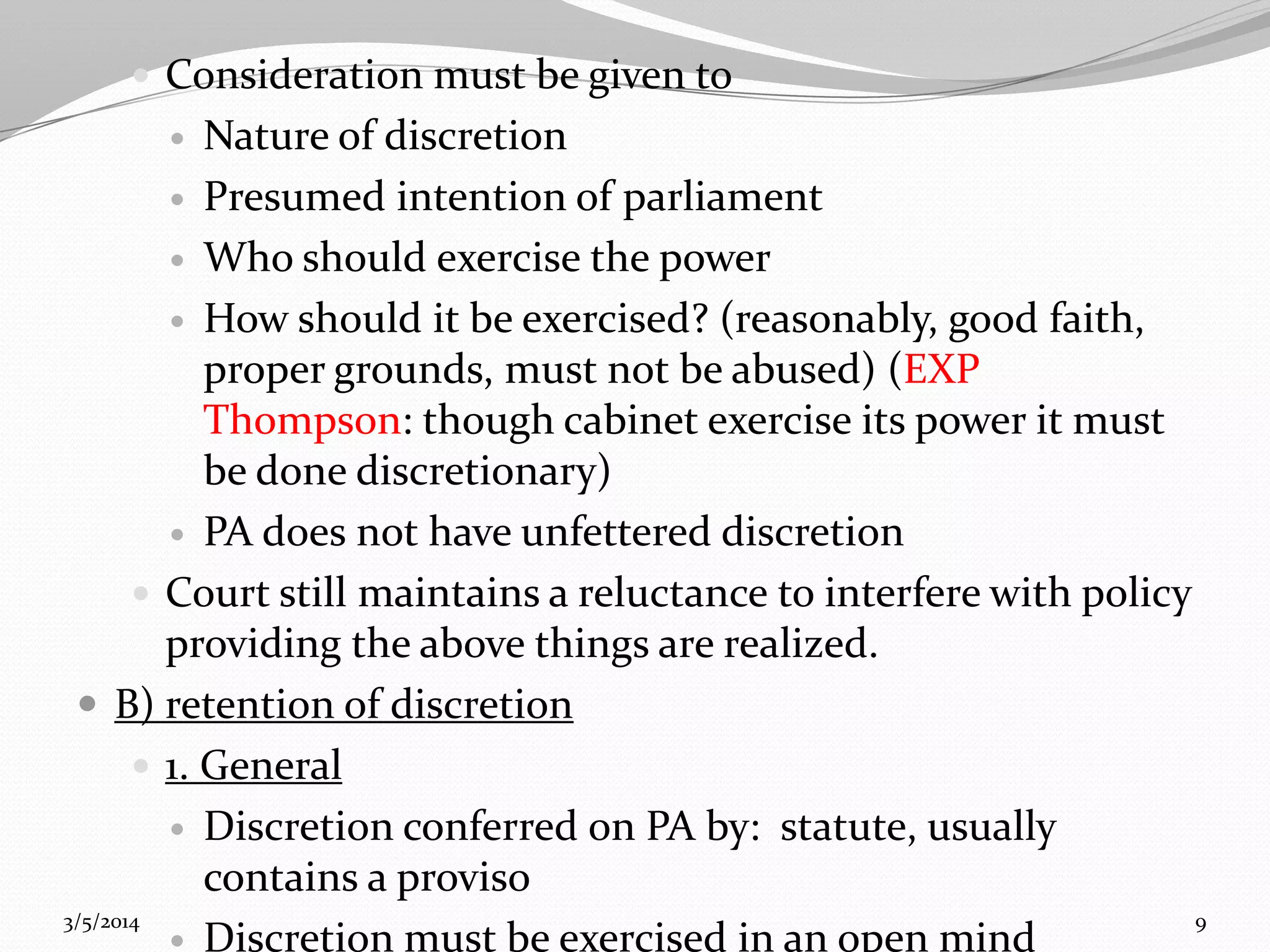
 Consideration must be given to

Nature of discretion
 Presumed intention of parliament
 Who should exercise the power
 How should it be exercised? (reasonably, good faith,
proper grounds, must not be abused) (EXP
Thompson: though cabinet exercise its power it must
be done discretionary)
 PA does not have unfettered discretion
 Court still maintains a reluctance to interfere with policy
providing the above things are realized.
 B) retention of discretion
 1. General
 Discretion conferred on PA by: statute, usually
contains a proviso
3/5/2014
9
 Discretion must be exercised in an open mind

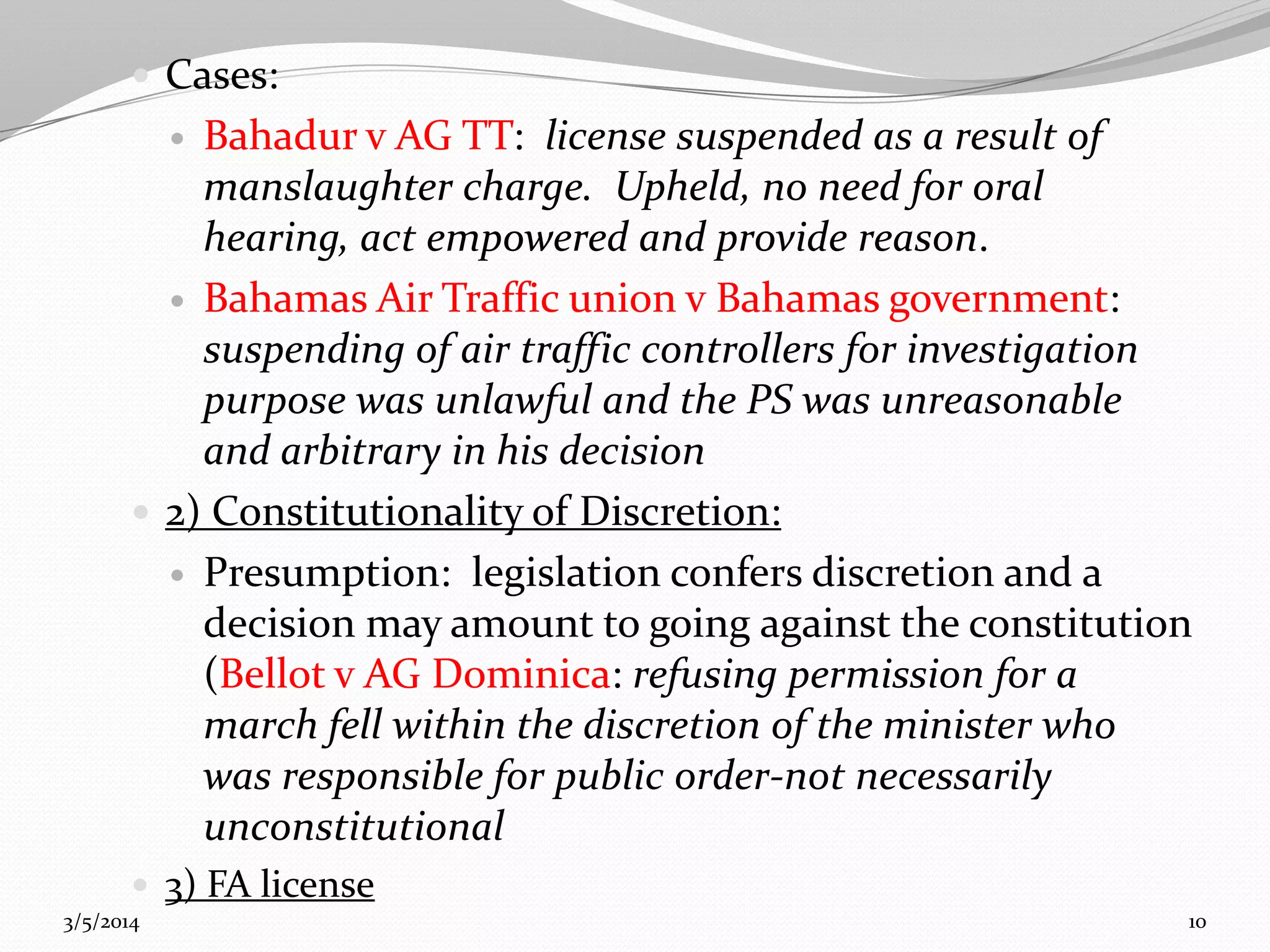
 Cases:

Bahadur v AG TT: license suspended as a result of
manslaughter charge. Upheld, no need for oral
hearing, act empowered and provide reason.
 Bahamas Air Traffic union v Bahamas government:
suspending of air traffic controllers for investigation
purpose was unlawful and the PS was unreasonable
and arbitrary in his decision
 2) Constitutionality of Discretion:
 Presumption: legislation confers discretion and a
decision may amount to going against the constitution
(Bellot v AG Dominica: refusing permission for a
march fell within the discretion of the minister who
was responsible for public order-not necessarily
unconstitutional


 3) FA license
3/5/2014

10




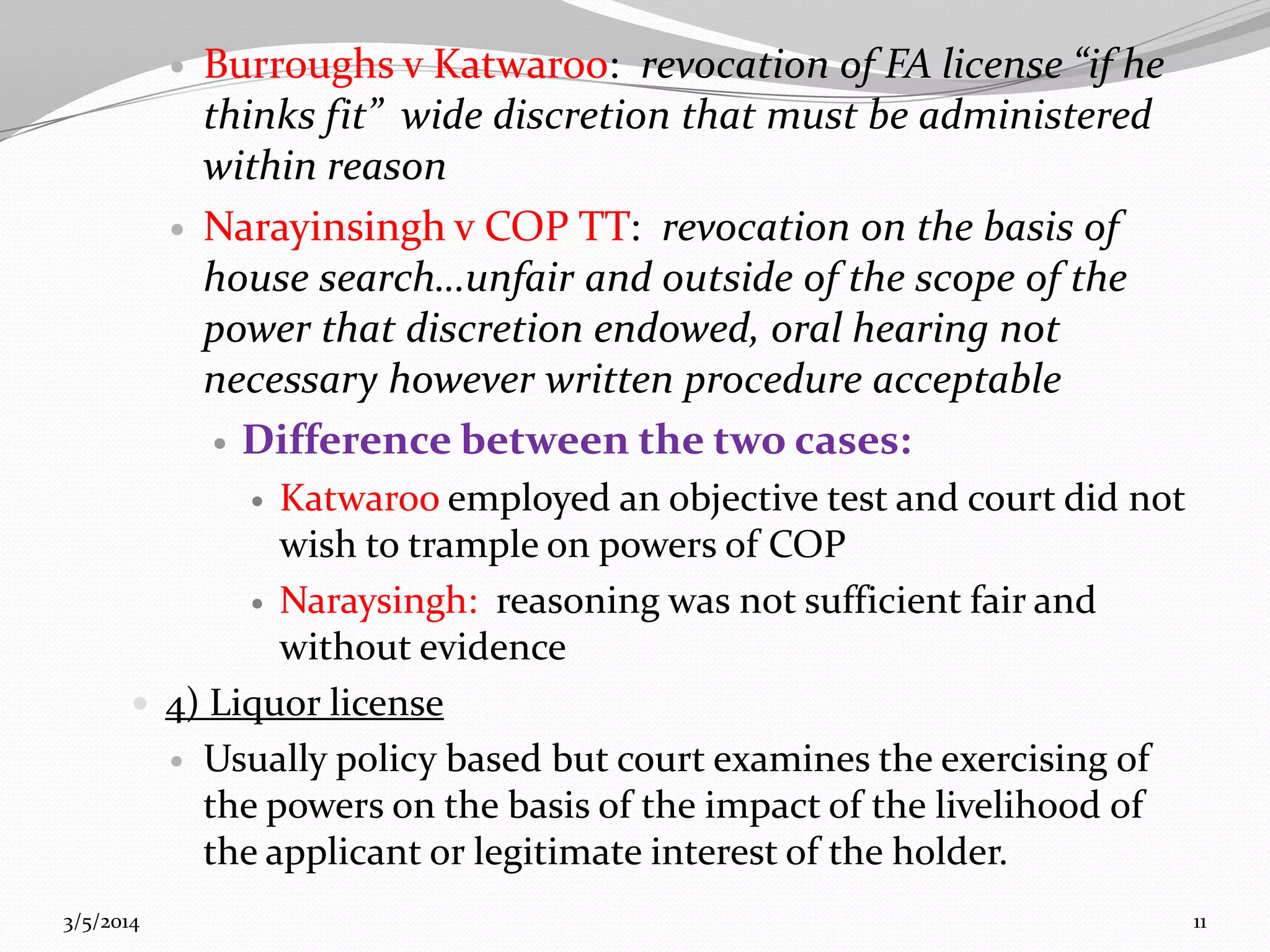
Burroughs v Katwaroo: revocation of FA license “if he
thinks fit” wide discretion that must be administered
within reason
Narayinsingh v COP TT: revocation on the basis of
house search…unfair and outside of the scope of the
power that discretion endowed, oral hearing not
necessary however written procedure acceptable
 Difference between the two cases:

Katwaroo employed an objective test and court did not
wish to trample on powers of COP
 Naraysingh: reasoning was not sufficient fair and
without evidence
 4) Liquor license
 Usually policy based but court examines the exercising of
the powers on the basis of the impact of the livelihood of
the applicant or legitimate interest of the holder.


3/5/2014

11
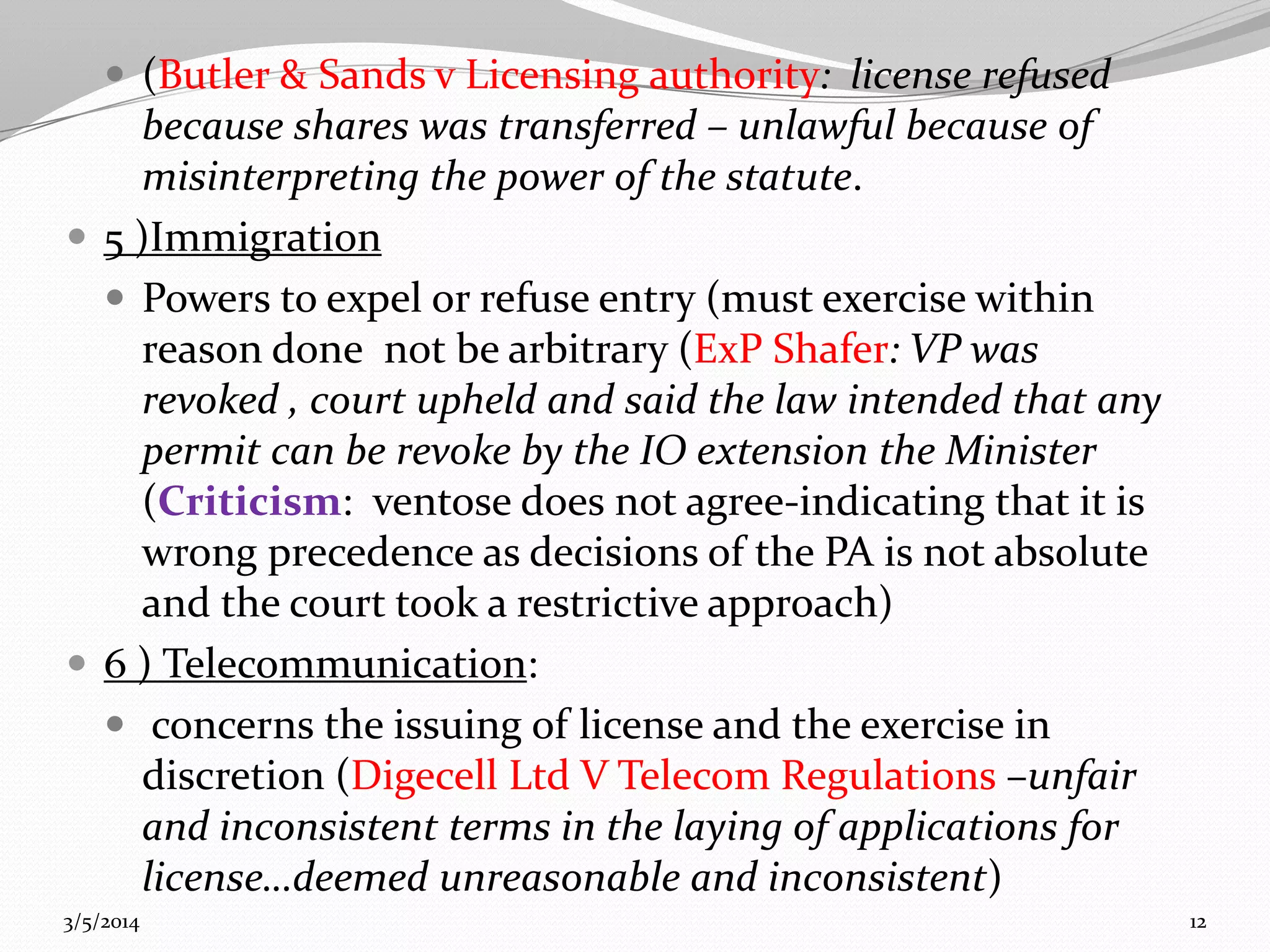
 (Butler & Sands v Licensing authority: license refused

because shares was transferred – unlawful because of
misinterpreting the power of the statute.
 5 )Immigration
 Powers to expel or refuse entry (must exercise within
reason done not be arbitrary (ExP Shafer: VP was
revoked , court upheld and said the law intended that any
permit can be revoke by the IO extension the Minister
(Criticism: ventose does not agree-indicating that it is
wrong precedence as decisions of the PA is not absolute
and the court took a restrictive approach)
 6 ) Telecommunication:
 concerns the issuing of license and the exercise in
discretion (Digecell Ltd V Telecom Regulations –unfair
and inconsistent terms in the laying of applications for
license…deemed unreasonable and inconsistent)
3/5/2014

12
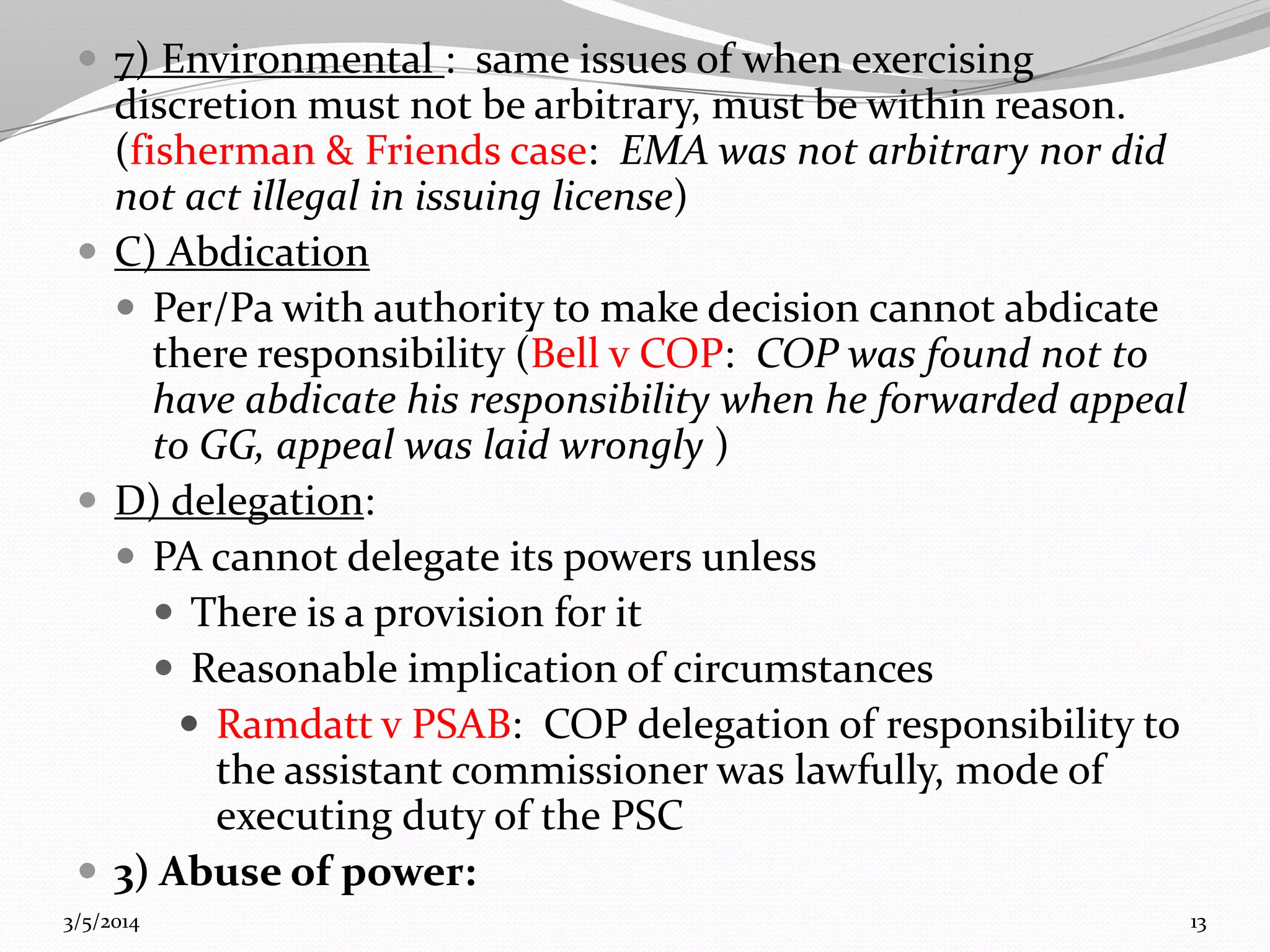
 7) Environmental : same issues of when exercising

discretion must not be arbitrary, must be within reason.
(fisherman & Friends case: EMA was not arbitrary nor did
not act illegal in issuing license)
 C) Abdication
 Per/Pa with authority to make decision cannot abdicate
there responsibility (Bell v COP: COP was found not to
have abdicate his responsibility when he forwarded appeal
to GG, appeal was laid wrongly )
 D) delegation:
 PA cannot delegate its powers unless
 There is a provision for it
 Reasonable implication of circumstances
 Ramdatt v PSAB: COP delegation of responsibility to
the assistant commissioner was lawfully, mode of
executing duty of the PSC
 3) Abuse of power:
3/5/2014

13
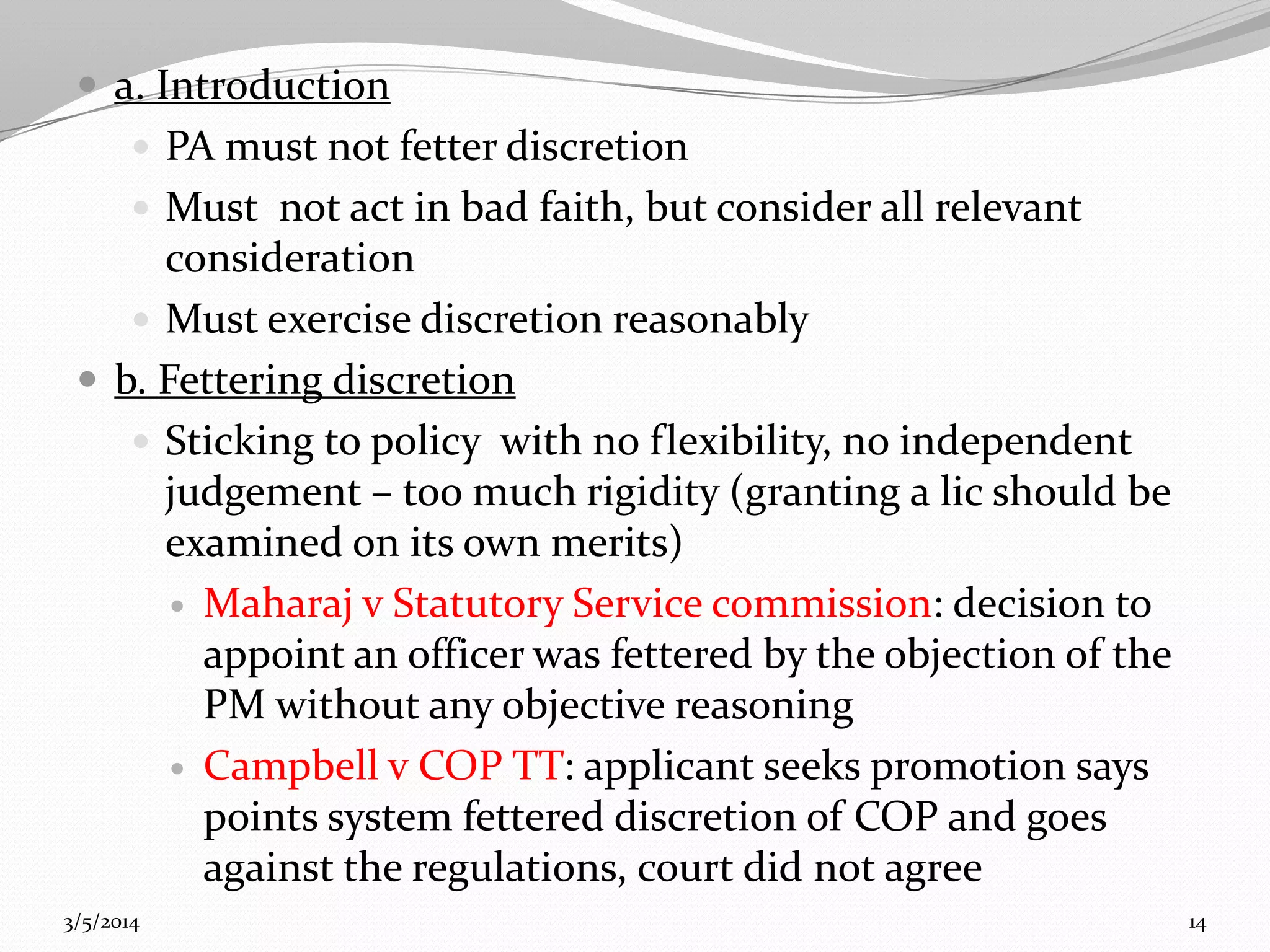
 a. Introduction
 PA must not fetter discretion
 Must not act in bad faith, but consider all relevant

consideration
 Must exercise discretion reasonably
 b. Fettering discretion
 Sticking to policy with no flexibility, no independent
judgement – too much rigidity (granting a lic should be
examined on its own merits)
 Maharaj v Statutory Service commission: decision to
appoint an officer was fettered by the objection of the
PM without any objective reasoning
 Campbell v COP TT: applicant seeks promotion says
points system fettered discretion of COP and goes
against the regulations, court did not agree
3/5/2014

14
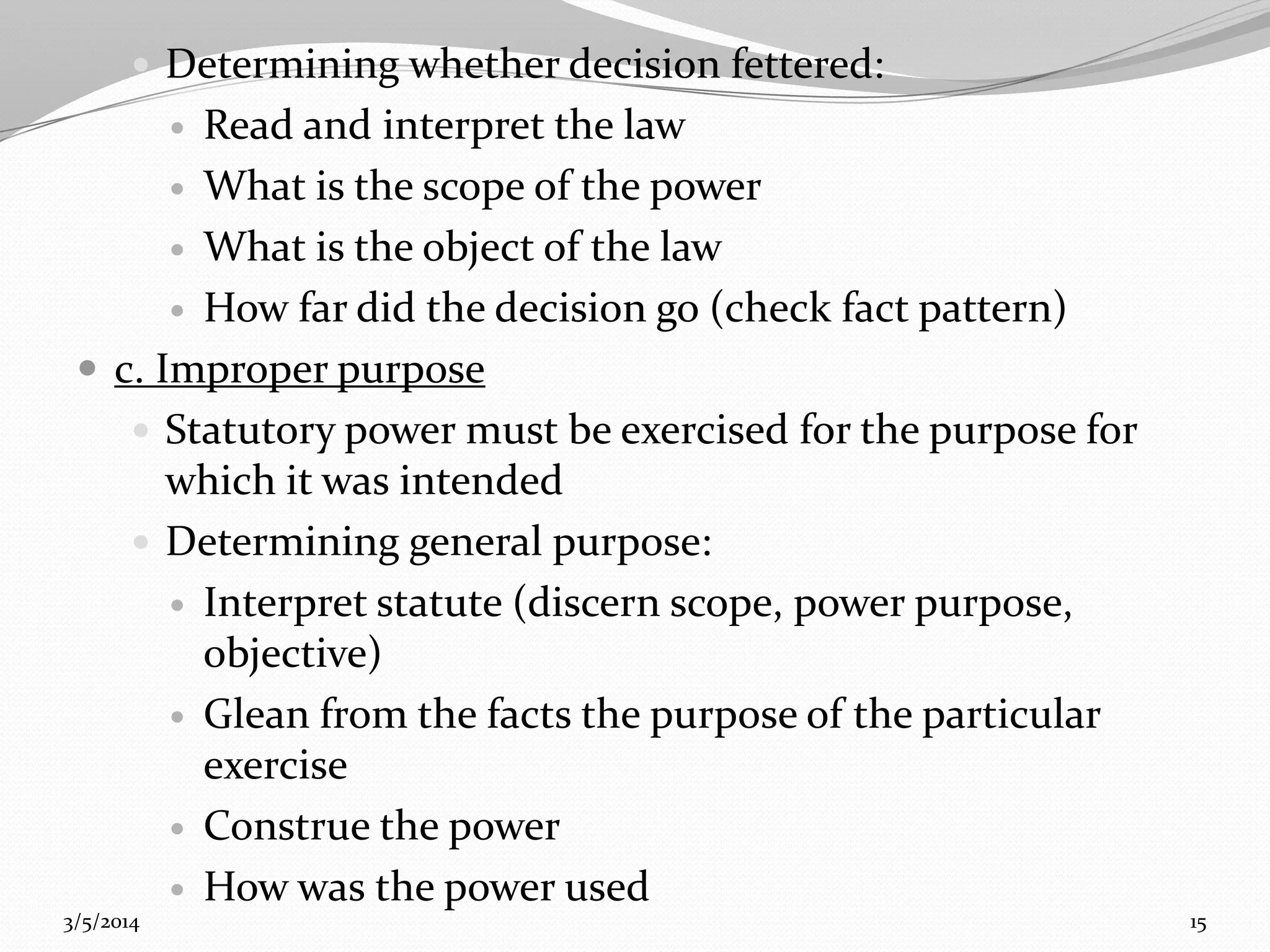
 Determining whether decision fettered:

Read and interpret the law
 What is the scope of the power
 What is the object of the law
 How far did the decision go (check fact pattern)
 c. Improper purpose
 Statutory power must be exercised for the purpose for
which it was intended
 Determining general purpose:
 Interpret statute (discern scope, power purpose,
objective)
 Glean from the facts the purpose of the particular
exercise
 Construe the power
 How was the power used


3/5/2014

15
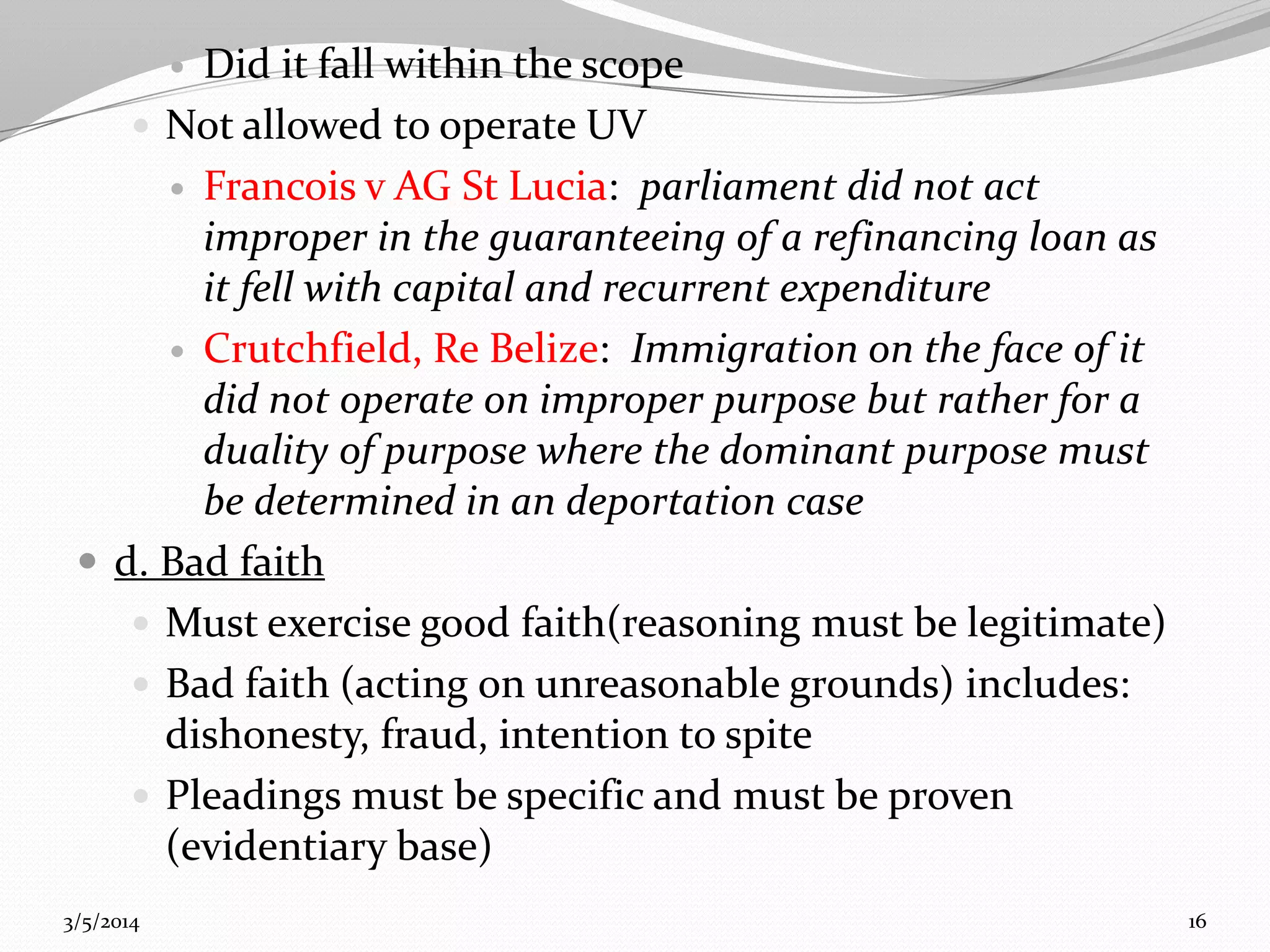
Did it fall within the scope
 Not allowed to operate UV
 Francois v AG St Lucia: parliament did not act
improper in the guaranteeing of a refinancing loan as
it fell with capital and recurrent expenditure
 Crutchfield, Re Belize: Immigration on the face of it
did not operate on improper purpose but rather for a
duality of purpose where the dominant purpose must
be determined in an deportation case
 d. Bad faith
 Must exercise good faith(reasoning must be legitimate)
 Bad faith (acting on unreasonable grounds) includes:
dishonesty, fraud, intention to spite
 Pleadings must be specific and must be proven
(evidentiary base)


3/5/2014

16
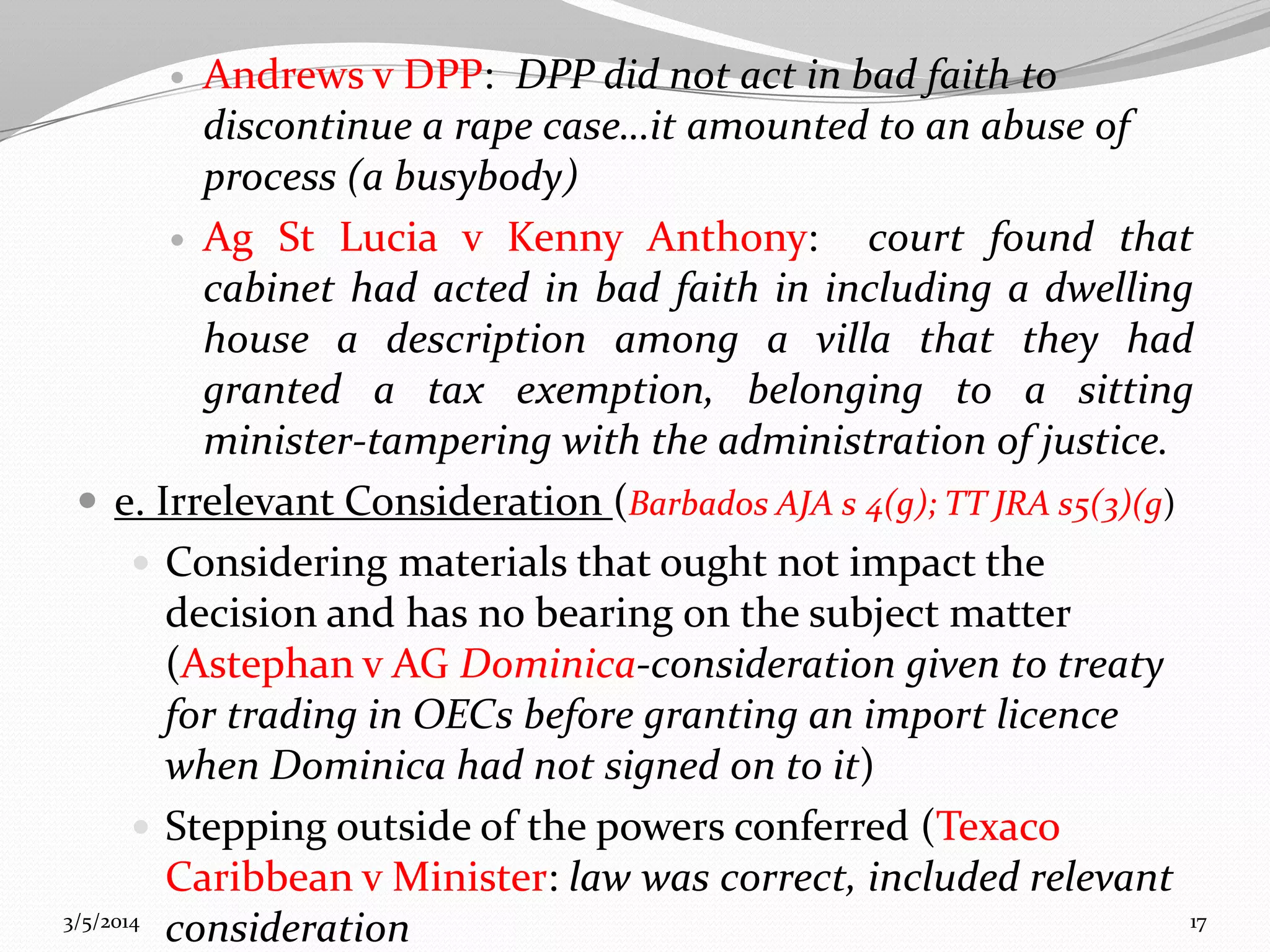
Andrews v DPP: DPP did not act in bad faith to
discontinue a rape case…it amounted to an abuse of
process (a busybody)
 Ag St Lucia v Kenny Anthony:
court found that
cabinet had acted in bad faith in including a dwelling
house a description among a villa that they had
granted a tax exemption, belonging to a sitting
minister-tampering with the administration of justice.
 e. Irrelevant Consideration (Barbados AJA s 4(g); TT JRA s5(3)(g)
 Considering materials that ought not impact the
decision and has no bearing on the subject matter
(Astephan v AG Dominica-consideration given to treaty
for trading in OECs before granting an import licence
when Dominica had not signed on to it)
 Stepping outside of the powers conferred (Texaco
Caribbean v Minister: law was correct, included relevant
3/5/2014
17
consideration

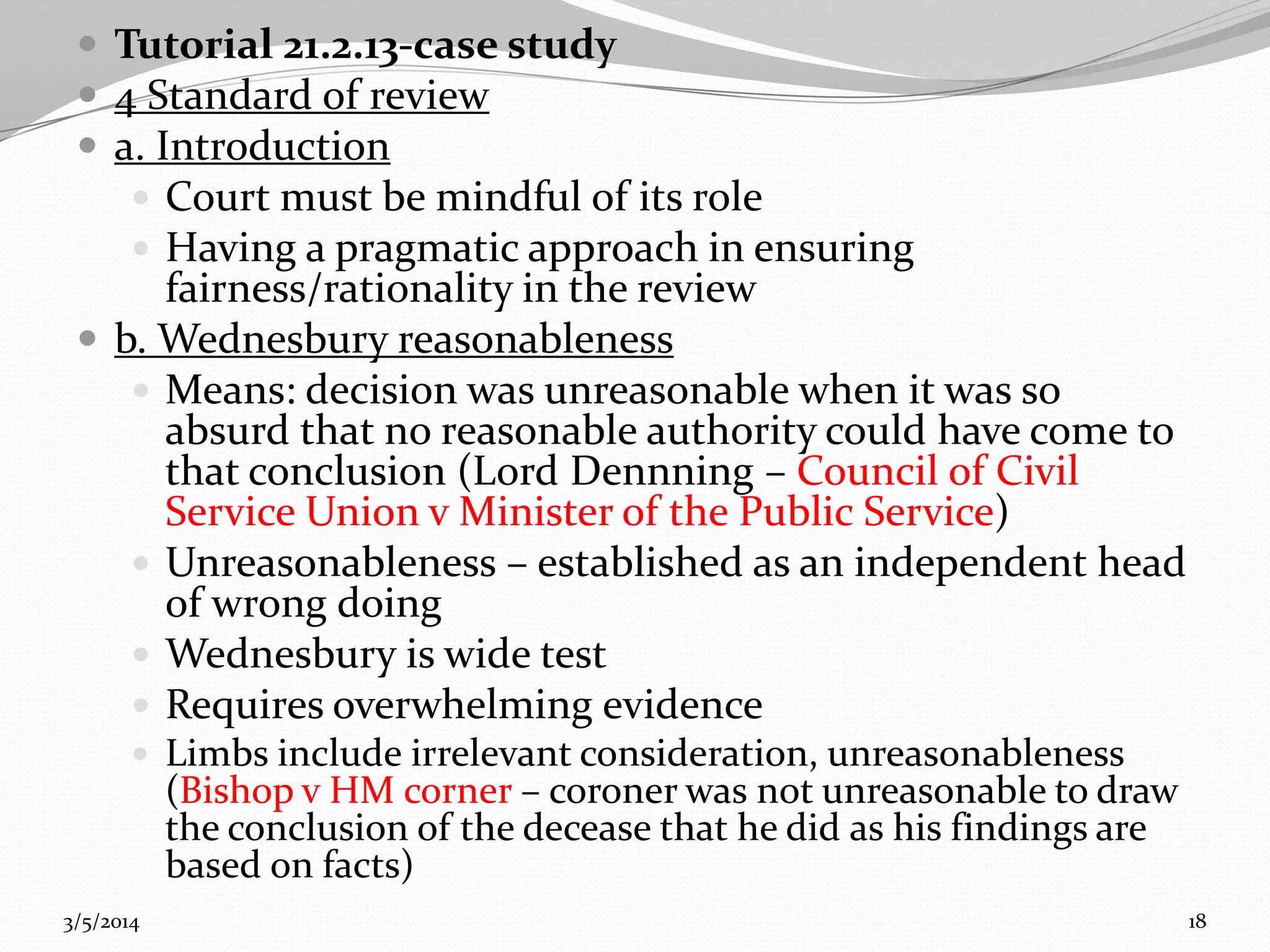
 Tutorial 21.2.13-case study
 4 Standard of review
 a. Introduction
 Court must be mindful of its role
 Having a pragmatic approach in ensuring

fairness/rationality in the review
 b. Wednesbury reasonableness
 Means: decision was unreasonable when it was so
absurd that no reasonable authority could have come to
that conclusion (Lord Dennning – Council of Civil
Service Union v Minister of the Public Service)
 Unreasonableness – established as an independent head
of wrong doing
 Wednesbury is wide test
 Requires overwhelming evidence
 Limbs include irrelevant consideration, unreasonableness

(Bishop v HM corner – coroner was not unreasonable to draw
the conclusion of the decease that he did as his findings are
based on facts)

3/5/2014

18
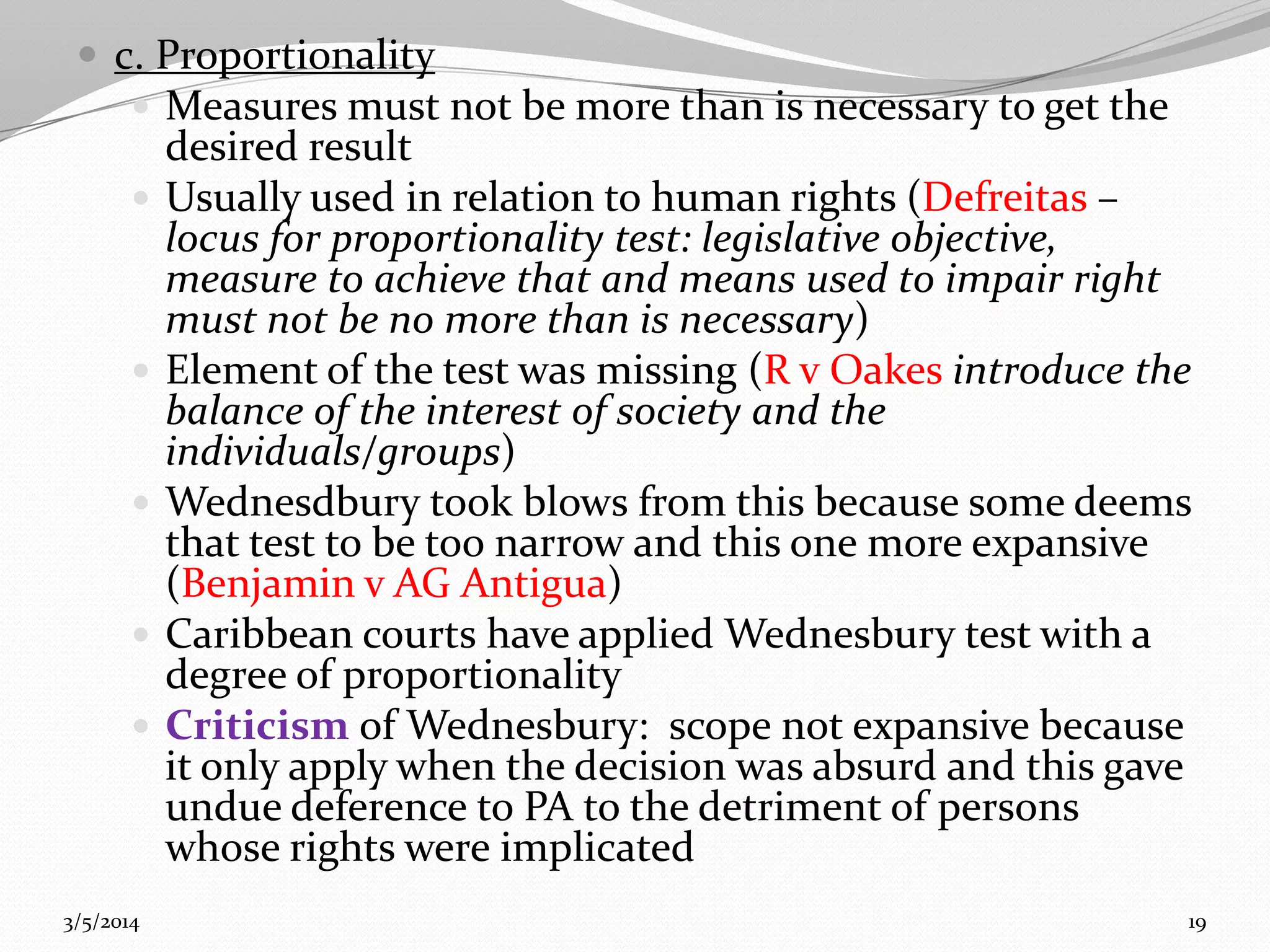
 c. Proportionality
 Measures must not be more than is necessary to get the









3/5/2014

desired result
Usually used in relation to human rights (Defreitas –
locus for proportionality test: legislative objective,
measure to achieve that and means used to impair right
must not be no more than is necessary)
Element of the test was missing (R v Oakes introduce the
balance of the interest of society and the
individuals/groups)
Wednesdbury took blows from this because some deems
that test to be too narrow and this one more expansive
(Benjamin v AG Antigua)
Caribbean courts have applied Wednesbury test with a
degree of proportionality
Criticism of Wednesbury: scope not expansive because
it only apply when the decision was absurd and this gave
undue deference to PA to the detriment of persons
whose rights were implicated
19
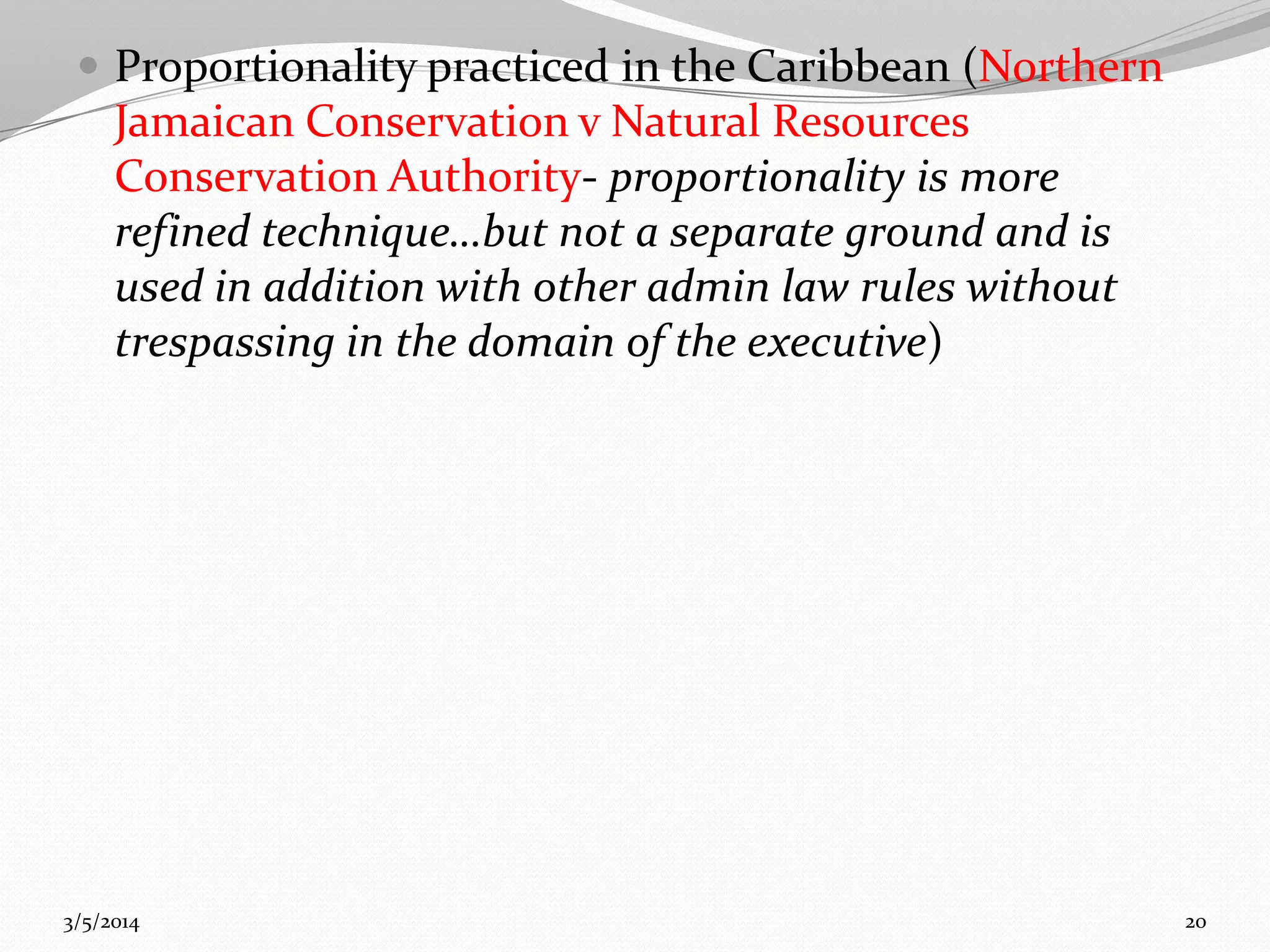
 Proportionality practiced in the Caribbean (Northern

Jamaican Conservation v Natural Resources
Conservation Authority- proportionality is more
refined technique…but not a separate ground and is
used in addition with other admin law rules without
trespassing in the domain of the executive)

3/5/2014

20

Ws 2 grounds for review

  • 1.
  • 2.
     Barbados AJAs 4; TT JRA s 5(3)  Public law not about rights per se but rather about wrongs/misuses of public power (AG St Christopher v Reynolds: retired inspector of Police detained unlawfully, no grounds for review)  Must show:  Person/body under legal duty to act a certain way  Decision made was lawful  Decision not UV  1) Jurisdiction  Where do powers come from (discretionary powers court may second guess)  Scope of the powers  Have they acted illegally (UV, irrational, proportionate)  Additional grounds:  Deprivation of legitimate expectation  Absentee of statutory basis 3/5/2014 2
  • 3.
     B. Errorsof law: AJA 4(j); JRA 5(3)(j)  1) Introduction  JR=legality of decision  Error in law amounts to: Purporting a non existent law (Stanislaus v AGTT_ magistrate prescribing a sentence that did not exist in law 5 years instead of 3)  Misinterpretation of statute  Legal basis upon which decision was made  2) Statutory interpretation  Check what the law is  Interpret the scope  Interpret application (Cable Bahamas v PUC: PUC to establish standard of technology to use not the type)  3) Service Commissions:  Subject to review  3/5/2014 3
  • 4.
     4) Fundamentalrights and freedoms  Must consider whether there is an infringement on rights  Must distinguish between substantive errors and procedural for the purposes of due process (Ali v AGTT)  5) Mistaken view of law  Error on the face of it court may require  Error on a complaint or indictment does not amount to an error in law and is not a ground for JR (Andrews v DPP – mistaken view of law not a ground for review)  6) Interim Relief  Judge makes error in granting relief where an issue exist (Belize Water services v AG – judge erred in law in holding that there was an arguable case)  7) Reasons: will be dealt with later on  C. Error of fact  1) Errors of law and facts: 3/5/2014 4
  • 5.
    Considers jurisdiction andform as bases of quashing decision of PA because:  Misunderstanding of legal terms by the PA in making decision  Incorrectly evaluate facts in determining its power  Re Doyll Insurance Company – registrar interpreted the law wrongly and there was no causal link between behaviour and the purported consequential loss.  2) no evidential basis – error of law/fact no factual basis for decisions made by the PA (Bovell v COP –no evidence to support the decisions made neither in law or reasoning).  D) Subjectivity  Manner in which discretion is exercised:  Did it consider the relevant matters  Was it reasonable and fair (usually affects areas where licenses are granted)  3/5/2014 5
  • 6.
     Burroughes v Katwaroo:COP having wide discretion to revoke gun licenses if he thinks fit – must include reasonability)  E) Non compliance with statutory requirement  PA did not confer with statute that conferred power equal unlawful decision  Cases:  Arawak trustee Co Ltd v Holden: Bank inspector has statutory authority to inspect personal and confidential files to facilitate the performance of his function not for mere suspicion  Mossell Ltd v Office of Utilities Regulation: Minister operated outside the scope of his power when it issued a specific instead of general direction regarding rates fixing. F) Mandatory/Directory Mandatory requirement: non observance leads to invalidity of the action and result in it being void (directory is the opposite) 3/5/2014 6
  • 7.
     1) Oldapproach  Old approach was rigid and kept in line with the procedure  Whether the requirement that was not complied with was mandatory or directory  Where legislation is not explicit courts decide considering:  Statutory intention(construction of statute)  Holding condition ineffective or rigid  Importance of the condition  Prejudice of rights, public interest  Cases:  Barrow v Hoyte: the effect of statute where a Christian mission is to hold meetings annually_ deemed mandatory  Biggs v COP: minister’s duty to lay SI before parliament for negative resolution-mandatory 3/5/2014 7
  • 8.
     2) Modernapproach:  Whether the statutory requirements were mandatory/directory  Court now exercises discretionary element because  Statutory requirement not intended to fetter the purpose of the law.  Charles v JLC: whether or not adhering to time limits for disciplinary action fetter the purpose of investigations. (Wang case was employed-avoid the use of rigid classification such as mandatory/directory consider whether legislature intended that the legislation be complied with; if so, did they intend that a failure to adhere to time to deprive the legislature from making a decision)  2) Retention of Discretion  A) Introduction  Discretion a legal power not a duty  Legislation confers the power 3/5/2014 8
  • 9.
     Consideration mustbe given to Nature of discretion  Presumed intention of parliament  Who should exercise the power  How should it be exercised? (reasonably, good faith, proper grounds, must not be abused) (EXP Thompson: though cabinet exercise its power it must be done discretionary)  PA does not have unfettered discretion  Court still maintains a reluctance to interfere with policy providing the above things are realized.  B) retention of discretion  1. General  Discretion conferred on PA by: statute, usually contains a proviso 3/5/2014 9  Discretion must be exercised in an open mind 
  • 10.
     Cases: Bahadur vAG TT: license suspended as a result of manslaughter charge. Upheld, no need for oral hearing, act empowered and provide reason.  Bahamas Air Traffic union v Bahamas government: suspending of air traffic controllers for investigation purpose was unlawful and the PS was unreasonable and arbitrary in his decision  2) Constitutionality of Discretion:  Presumption: legislation confers discretion and a decision may amount to going against the constitution (Bellot v AG Dominica: refusing permission for a march fell within the discretion of the minister who was responsible for public order-not necessarily unconstitutional   3) FA license 3/5/2014 10
  • 11.
      Burroughs v Katwaroo:revocation of FA license “if he thinks fit” wide discretion that must be administered within reason Narayinsingh v COP TT: revocation on the basis of house search…unfair and outside of the scope of the power that discretion endowed, oral hearing not necessary however written procedure acceptable  Difference between the two cases: Katwaroo employed an objective test and court did not wish to trample on powers of COP  Naraysingh: reasoning was not sufficient fair and without evidence  4) Liquor license  Usually policy based but court examines the exercising of the powers on the basis of the impact of the livelihood of the applicant or legitimate interest of the holder.  3/5/2014 11
  • 12.
     (Butler &Sands v Licensing authority: license refused because shares was transferred – unlawful because of misinterpreting the power of the statute.  5 )Immigration  Powers to expel or refuse entry (must exercise within reason done not be arbitrary (ExP Shafer: VP was revoked , court upheld and said the law intended that any permit can be revoke by the IO extension the Minister (Criticism: ventose does not agree-indicating that it is wrong precedence as decisions of the PA is not absolute and the court took a restrictive approach)  6 ) Telecommunication:  concerns the issuing of license and the exercise in discretion (Digecell Ltd V Telecom Regulations –unfair and inconsistent terms in the laying of applications for license…deemed unreasonable and inconsistent) 3/5/2014 12
  • 13.
     7) Environmental: same issues of when exercising discretion must not be arbitrary, must be within reason. (fisherman & Friends case: EMA was not arbitrary nor did not act illegal in issuing license)  C) Abdication  Per/Pa with authority to make decision cannot abdicate there responsibility (Bell v COP: COP was found not to have abdicate his responsibility when he forwarded appeal to GG, appeal was laid wrongly )  D) delegation:  PA cannot delegate its powers unless  There is a provision for it  Reasonable implication of circumstances  Ramdatt v PSAB: COP delegation of responsibility to the assistant commissioner was lawfully, mode of executing duty of the PSC  3) Abuse of power: 3/5/2014 13
  • 14.
     a. Introduction PA must not fetter discretion  Must not act in bad faith, but consider all relevant consideration  Must exercise discretion reasonably  b. Fettering discretion  Sticking to policy with no flexibility, no independent judgement – too much rigidity (granting a lic should be examined on its own merits)  Maharaj v Statutory Service commission: decision to appoint an officer was fettered by the objection of the PM without any objective reasoning  Campbell v COP TT: applicant seeks promotion says points system fettered discretion of COP and goes against the regulations, court did not agree 3/5/2014 14
  • 15.
     Determining whetherdecision fettered: Read and interpret the law  What is the scope of the power  What is the object of the law  How far did the decision go (check fact pattern)  c. Improper purpose  Statutory power must be exercised for the purpose for which it was intended  Determining general purpose:  Interpret statute (discern scope, power purpose, objective)  Glean from the facts the purpose of the particular exercise  Construe the power  How was the power used  3/5/2014 15
  • 16.
    Did it fallwithin the scope  Not allowed to operate UV  Francois v AG St Lucia: parliament did not act improper in the guaranteeing of a refinancing loan as it fell with capital and recurrent expenditure  Crutchfield, Re Belize: Immigration on the face of it did not operate on improper purpose but rather for a duality of purpose where the dominant purpose must be determined in an deportation case  d. Bad faith  Must exercise good faith(reasoning must be legitimate)  Bad faith (acting on unreasonable grounds) includes: dishonesty, fraud, intention to spite  Pleadings must be specific and must be proven (evidentiary base)  3/5/2014 16
  • 17.
    Andrews v DPP:DPP did not act in bad faith to discontinue a rape case…it amounted to an abuse of process (a busybody)  Ag St Lucia v Kenny Anthony: court found that cabinet had acted in bad faith in including a dwelling house a description among a villa that they had granted a tax exemption, belonging to a sitting minister-tampering with the administration of justice.  e. Irrelevant Consideration (Barbados AJA s 4(g); TT JRA s5(3)(g)  Considering materials that ought not impact the decision and has no bearing on the subject matter (Astephan v AG Dominica-consideration given to treaty for trading in OECs before granting an import licence when Dominica had not signed on to it)  Stepping outside of the powers conferred (Texaco Caribbean v Minister: law was correct, included relevant 3/5/2014 17 consideration 
  • 18.
     Tutorial 21.2.13-casestudy  4 Standard of review  a. Introduction  Court must be mindful of its role  Having a pragmatic approach in ensuring fairness/rationality in the review  b. Wednesbury reasonableness  Means: decision was unreasonable when it was so absurd that no reasonable authority could have come to that conclusion (Lord Dennning – Council of Civil Service Union v Minister of the Public Service)  Unreasonableness – established as an independent head of wrong doing  Wednesbury is wide test  Requires overwhelming evidence  Limbs include irrelevant consideration, unreasonableness (Bishop v HM corner – coroner was not unreasonable to draw the conclusion of the decease that he did as his findings are based on facts) 3/5/2014 18
  • 19.
     c. Proportionality Measures must not be more than is necessary to get the      3/5/2014 desired result Usually used in relation to human rights (Defreitas – locus for proportionality test: legislative objective, measure to achieve that and means used to impair right must not be no more than is necessary) Element of the test was missing (R v Oakes introduce the balance of the interest of society and the individuals/groups) Wednesdbury took blows from this because some deems that test to be too narrow and this one more expansive (Benjamin v AG Antigua) Caribbean courts have applied Wednesbury test with a degree of proportionality Criticism of Wednesbury: scope not expansive because it only apply when the decision was absurd and this gave undue deference to PA to the detriment of persons whose rights were implicated 19
  • 20.
     Proportionality practicedin the Caribbean (Northern Jamaican Conservation v Natural Resources Conservation Authority- proportionality is more refined technique…but not a separate ground and is used in addition with other admin law rules without trespassing in the domain of the executive) 3/5/2014 20