ESTOPPEL 


Estoppel ­ a doctrine of fairness 

Estoppel is a very important and often misunderstood doctrine of 
fairness.  Even where the collective agreement or an employer 
policy clearly does not establish an entitlement, a separate 
question may arise as to whether “fairness” would prevent its 
strict application. 

A frequently cited description of the doctrine of estoppel was 
provided by Lord Denning in the famous English case of Combe v 
       1 
Combe  . 

  The principle, as I understand it, is that where one party has, 
  by his words or conduct, made to the other a promise or 
  assurance which was intended to affect the legal relations 
  between them and to be acted on accordingly, then, once 
  the other party has taken him at his word and acted on it, 
  the one who gave the promise or assurance cannot 
  afterwards be allowed to revert to the previous legal 
  relations as if no such promise or assurance had been made 
  by him, but he must accept their legal relations subject to 
  the qualification which he himself has so introduced, even 
  though it is not supported in point of law by any 
  consideration, but only by his word.


                                                     PSAC ­ Education    1 
                                                             Estoppel 
Three conditions 

Arbitrators seem to agree that a party can be “estopped” if three 
conditions are satisfied. 

  1.  One of the parties, by its words or conduct (which may 
      include silence, inaction or past practice), makes a promise 
      or assurance (“representation by words or conduct”); 

  2.  This promise or assurance is intended to affect the legal 
      relationship between the parties, and the party to whom the 
      promise or assurance was made has taken the other party 
      at its word and acted upon it (“acted on it”); 

  3.  If the strict rights under the collective agreement or policy 
      were to apply, the party acting on the promise or assurance 
      would suffer hardship as a result, then the other party 
      cannot go back on its word and act as if the promise or 
      assurance had not been made (“detrimental reliance”). 


Some principles 

1.  The burden of proof that estoppel applies rests with a grievor. 

2.  “Detrimental reliance” may be the most difficult burden to 
    meet. 

    For example, in the case of a salary overpayment, it has 
    been found that “spending the money” does not of itself 
                                  2 
    establish detrimental reliance  .


                                                     PSAC ­ Education    2 
                                                             Estoppel 
However, if an employee undertakes a substantial financial 
    obligation based on the promise of the higher salary, 
    detrimental reliance may be successfully argued and then the 
    employer would be estopped from recovering the 
                                         3 
    overpayment and lowering the salary  . 

    In cases involving overpayment, an employee must be able 
    to demonstrate that s/he made significant financial 
    commitments, based on the reliance on the employer’s 
    representations regarding the amount(s), and that the 
    payment of such amount(s) would  continue.  In addition, 
    clear and convincing evidence would be required, including 
    financial documents demonstrating that any recovery would 
    result in a significant hardship. 

3.  Another feature of estoppel is that it is normally of limited 
    duration.  Where the representation is in the form of a 
    practice, a notice of reversion to the strict rights will break the 
    past practice and bring the estoppel to an end. 

    An example of this might be that the collective agreement 
    entitles the Alliance to a hearing with a particular employer 
    representative, e.g., the Chief Executive Officer (CEO), but 
    the practice has been to meet with the Director of Human 
    Resources.  The union would be estopped from insisting on 
    its strict rights to compel the CEO to hear a grievance until a 
    notice be served advising the employer that in future we will 
    be claiming our strict rights under the collective agreement. 

    Depending on the situation, a notice of reversion might have 
    to wait until the expiry of the collective agreement.


                                                        PSAC ­ Education    3 
                                                                Estoppel 
4.  Estoppel can also operate for a future period of time. 

    An example of this might be that the employer advises the 
    union at the bargaining table that it has no plans to introduce 
    a particular change, and, as a result, the union agrees to drop 
    the demand relating to that change.  Or, a long­standing 
    practice has resulted in no effort on the part of the union to 
    change the collective agreement to incorporate the practice. 
    In both situations, the employer might be estopped from 
    making any change until the current collective agreement 
    expires.  This would provide the union the opportunity to 
    address the changes at the bargaining table. 


Despite some inconsistency in its application by arbitrators, 
estoppel has resulted in a positive outcome for many PSAC 
members and it is important that stewards and other workplace 
representatives have an understanding of the doctrine.  Below 
are summaries of a number of cases. 


                                                                         4 
  Based on communications with the employer, Domenico Foglia 
  concluded he was in travel status during the early period of his relocation 
  to Ottawa.  After the employer decided the Relocation Directive and not 
  the Travel Directive applied, notice of recovery was served and monies 
  owed were deducted from Domenico’s pay.  The adjudicator found that 
  the grievor relied upon clear representation made by the employer that he 
  was in travel status and that he suffered detriment as a result.  Estoppel 
  applied and the employer was ordered to reimburse his expenses in 
  accordance with the Travel Directive.  (1993)


                                                            PSAC ­ Education    4 
                                                                    Estoppel 
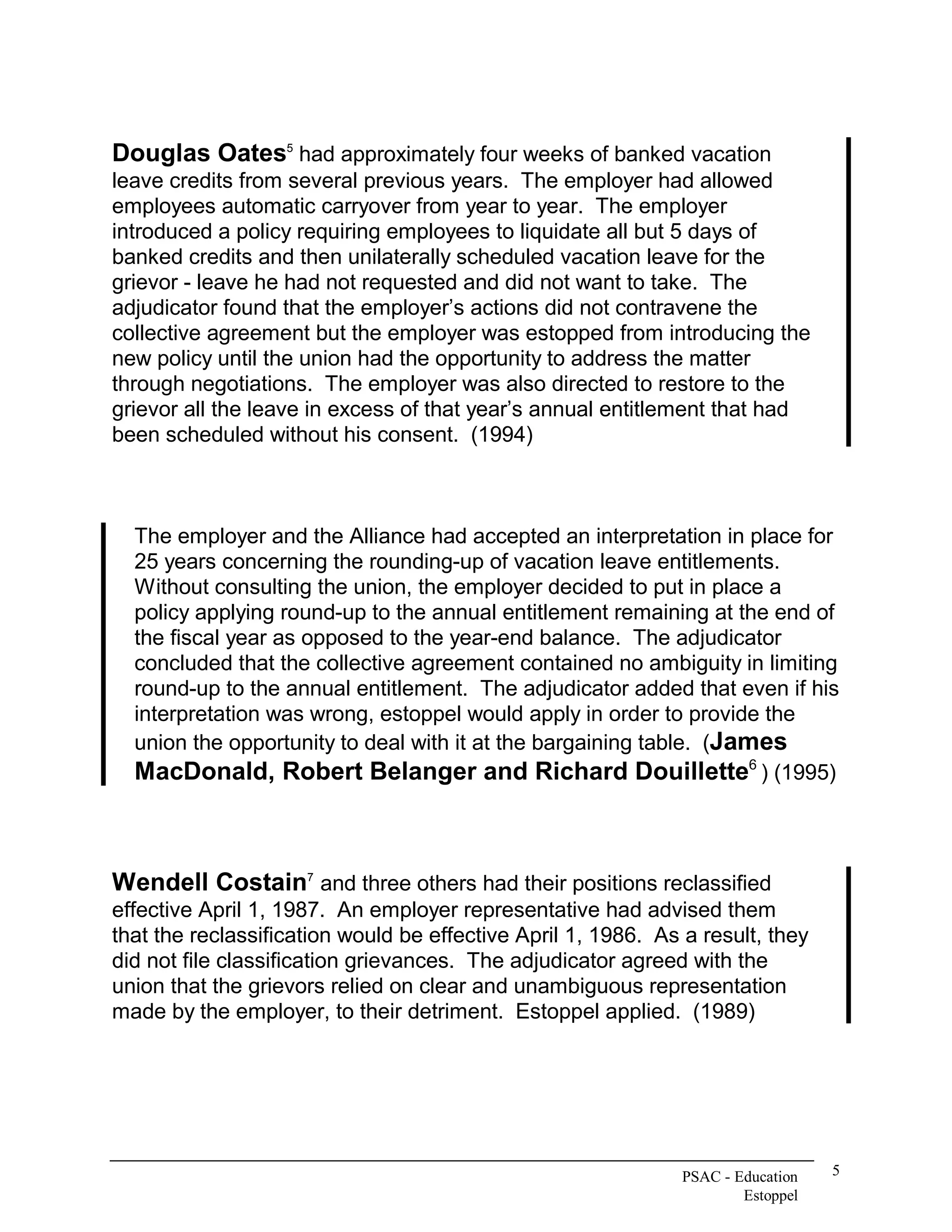
Douglas Oates  had approximately four weeks of banked vacation 
             5 


leave credits from several previous years.  The employer had allowed 
employees automatic carryover from year to year.  The employer 
introduced a policy requiring employees to liquidate all but 5 days of 
banked credits and then unilaterally scheduled vacation leave for the 
grievor ­ leave he had not requested and did not want to take.  The 
adjudicator found that the employer’s actions did not contravene the 
collective agreement but the employer was estopped from introducing the 
new policy until the union had the opportunity to address the matter 
through negotiations.  The employer was also directed to restore to the 
grievor all the leave in excess of that year’s annual entitlement that had 
been scheduled without his consent.  (1994) 


  The employer and the Alliance had accepted an interpretation in place for 
  25 years concerning the rounding­up of vacation leave entitlements. 
  Without consulting the union, the employer decided to put in place a 
  policy applying round­up to the annual entitlement remaining at the end of 
  the fiscal year as opposed to the year­end balance.  The adjudicator 
  concluded that the collective agreement contained no ambiguity in limiting 
  round­up to the annual entitlement.  The adjudicator added that even if his 
  interpretation was wrong, estoppel would apply in order to provide the 
  union the opportunity to deal with it at the bargaining table.  (James 
                                                                      6 
  MacDonald, Robert Belanger and Richard Douillette  ) (1995) 


Wendell Costain  and three others had their positions reclassified 
               7 


effective April 1, 1987.  An employer representative had advised them 
that the reclassification would be effective April 1, 1986.  As a result, they 
did not file classification grievances.  The adjudicator agreed with the 
union that the grievors relied on clear and unambiguous representation 
made by the employer, to their detriment.  Estoppel applied.  (1989)


                                                                PSAC ­ Education    5 
                                                                        Estoppel 
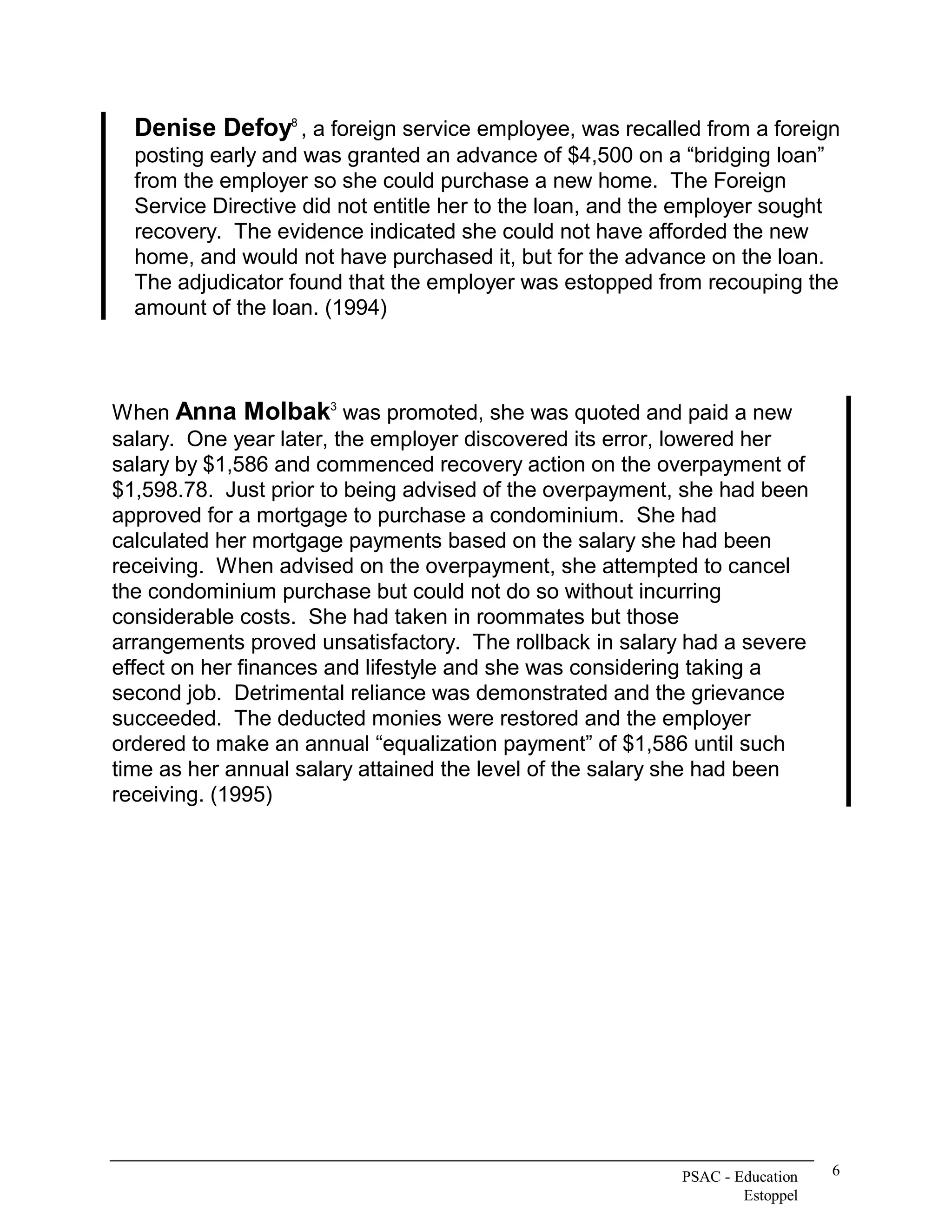
Denise Defoy  , a foreign service employee, was recalled from a foreign 
              8 


  posting early and was granted an advance of $4,500 on a “bridging loan” 
  from the employer so she could purchase a new home.  The Foreign 
  Service Directive did not entitle her to the loan, and the employer sought 
  recovery.  The evidence indicated she could not have afforded the new 
  home, and would not have purchased it, but for the advance on the loan. 
  The adjudicator found that the employer was estopped from recouping the 
  amount of the loan. (1994) 


When Anna Molbak  was promoted, she was quoted and paid a new 
                        3 


salary.  One year later, the employer discovered its error, lowered her 
salary by $1,586 and commenced recovery action on the overpayment of 
$1,598.78.  Just prior to being advised of the overpayment, she had been 
approved for a mortgage to purchase a condominium.  She had 
calculated her mortgage payments based on the salary she had been 
receiving.  When advised on the overpayment, she attempted to cancel 
the condominium purchase but could not do so without incurring 
considerable costs.  She had taken in roommates but those 
arrangements proved unsatisfactory.  The rollback in salary had a severe 
effect on her finances and lifestyle and she was considering taking a 
second job.  Detrimental reliance was demonstrated and the grievance 
succeeded.  The deducted monies were restored and the employer 
ordered to make an annual “equalization payment” of $1,586 until such 
time as her annual salary attained the level of the salary she had been 
receiving. (1995)


                                                           PSAC ­ Education    6 
                                                                   Estoppel 
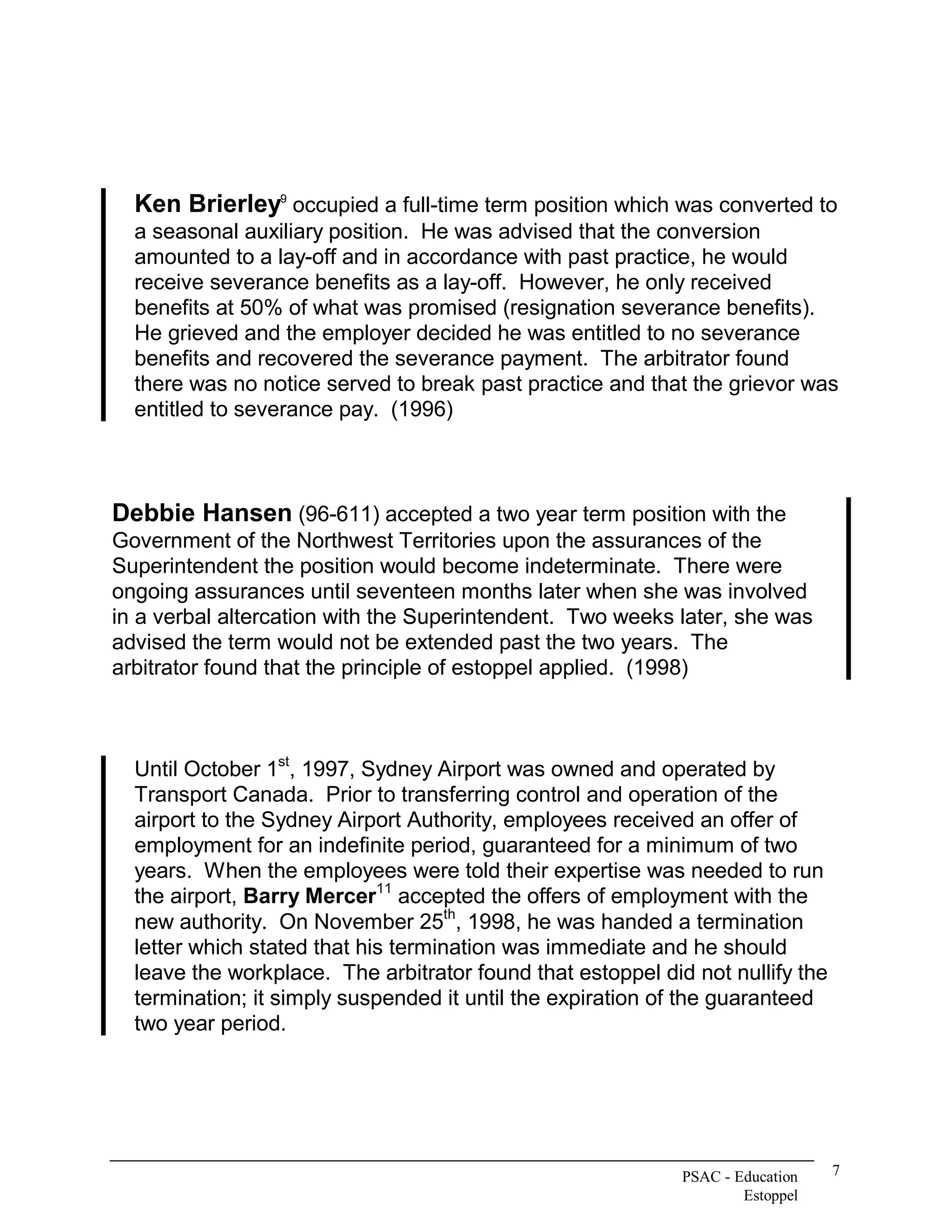
Ken Brierley  occupied a full­time term position which was converted to 
              9 


  a seasonal auxiliary position.  He was advised that the conversion 
  amounted to a lay­off and in accordance with past practice, he would 
  receive severance benefits as a lay­off.  However, he only received 
  benefits at 50% of what was promised (resignation severance benefits). 
  He grieved and the employer decided he was entitled to no severance 
  benefits and recovered the severance payment.  The arbitrator found 
  there was no notice served to break past practice and that the grievor was 
  entitled to severance pay.  (1996) 


Debbie Hansen (96­611) accepted a two year term position with the 
Government of the Northwest Territories upon the assurances of the 
Superintendent the position would become indeterminate.  There were 
ongoing assurances until seventeen months later when she was involved 
in a verbal altercation with the Superintendent.  Two weeks later, she was 
advised the term would not be extended past the two years.  The 
arbitrator found that the principle of estoppel applied.  (1998) 


                   st 
  Until October 1  , 1997, Sydney Airport was owned and operated by 
  Transport Canada.  Prior to transferring control and operation of the 
  airport to the Sydney Airport Authority, employees received an offer of 
  employment for an indefinite period, guaranteed for a minimum of two 
  years.  When the employees were told their expertise was needed to run 
                             11 
  the airport, Barry Mercer  accepted the offers of employment with the 
                                     th 
  new authority.  On November 25  , 1998, he was handed a termination 
  letter which stated that his termination was immediate and he should 
  leave the workplace.  The arbitrator found that estoppel did not nullify the 
  termination; it simply suspended it until the expiration of the guaranteed 
  two year period.


                                                              PSAC ­ Education    7 
                                                                      Estoppel 
1 
   Combe v Combe, [1951] 1 ALL E.R. 767 at p. 770 
2 
    Kirk Ellement, PSSRB File 166­2­27688 
3 
    Anna Molbak, PSSRB File 166­2­26472 
4 
   Domenico Foglia, PSSRB File 166­2­23755 
5 
    Douglas Oates, PSSRB File 166­2­25880 
6 
    James MacDonald, Robert Belanger and Richard Douillette, PSSRB Files 166­2­ 
26406, 26435 and 26440 
7 
    Wendell Costain, PSSRB File 166­2­18508 to 18511 
8 
   Denise Defoy, PSSRB File 166­2­25506 
9 
    Ken Brierley, 266­YG­82 
10 
    The Minister of Personnel for the Government of the Northwest Territories and Union 
of Northern Workers (Grievance of Debbie Hansen; 96­611) (Tom Jolliffe) 
11 
     Public Service Alliance of Canada and Sydney Airport Authority (Grievances of 
Barry Mercer) March 8, 2000 (Bruce Outhouse)


                                                                    PSAC ­ Education    8 
                                                                            Estoppel 

Doctrine of estoppel e

  • 1.
    ESTOPPEL  Estoppel ­ a doctrine of fairness  Estoppel is a very important and often misunderstood doctrine of  fairness.  Even where the collective agreement or an employer  policy clearly does not establish an entitlement, a separate  question may arise as to whether “fairness” would prevent its  strict application.  A frequently cited description of the doctrine of estoppel was  provided by Lord Denning in the famous English case of Combe v  1  Combe  .  The principle, as I understand it, is that where one party has,  by his words or conduct, made to the other a promise or  assurance which was intended to affect the legal relations  between them and to be acted on accordingly, then, once  the other party has taken him at his word and acted on it,  the one who gave the promise or assurance cannot  afterwards be allowed to revert to the previous legal  relations as if no such promise or assurance had been made  by him, but he must accept their legal relations subject to  the qualification which he himself has so introduced, even  though it is not supported in point of law by any  consideration, but only by his word. PSAC ­ Education  1  Estoppel 
  • 2.
    Three conditions  Arbitrators seem to agree that a party can be “estopped” if three  conditions are satisfied.  1. One of the parties, by its words or conduct (which may  include silence, inaction or past practice), makes a promise  or assurance (“representation by words or conduct”);  2.  This promise or assurance is intended to affect the legal  relationship between the parties, and the party to whom the  promise or assurance was made has taken the other party  at its word and acted upon it (“acted on it”);  3.  If the strict rights under the collective agreement or policy  were to apply, the party acting on the promise or assurance  would suffer hardship as a result, then the other party  cannot go back on its word and act as if the promise or  assurance had not been made (“detrimental reliance”).  Some principles  1.  The burden of proof that estoppel applies rests with a grievor.  2.  “Detrimental reliance” may be the most difficult burden to  meet.  For example, in the case of a salary overpayment, it has  been found that “spending the money” does not of itself  2  establish detrimental reliance  . PSAC ­ Education  2  Estoppel 
  • 3.
    However, if an employee undertakes a substantial financial  obligation based on the promise of the higher salary,  detrimental reliance may be successfully argued and then the  employer would be estopped from recovering the  3  overpayment and lowering the salary  .  In cases involving overpayment, an employee must be able  to demonstrate that s/he made significant financial  commitments, based on the reliance on the employer’s  representations regarding the amount(s), and that the  payment of such amount(s) would  continue.  In addition,  clear and convincing evidence would be required, including  financial documents demonstrating that any recovery would  result in a significant hardship.  3.  Another feature of estoppel is that it is normally of limited  duration.  Where the representation is in the form of a  practice, a notice of reversion to the strict rights will break the  past practice and bring the estoppel to an end.  An example of this might be that the collective agreement  entitles the Alliance to a hearing with a particular employer  representative, e.g., the Chief Executive Officer (CEO), but  the practice has been to meet with the Director of Human  Resources.  The union would be estopped from insisting on  its strict rights to compel the CEO to hear a grievance until a  notice be served advising the employer that in future we will  be claiming our strict rights under the collective agreement.  Depending on the situation, a notice of reversion might have  to wait until the expiry of the collective agreement. PSAC ­ Education  3  Estoppel 
  • 4.
    4.  Estoppel can also operate for a future period of time.  An example of this might be that the employer advises the  union at the bargaining table that it has no plans to introduce  a particular change, and, as a result, the union agrees to drop  the demand relating to that change.  Or, a long­standing  practice has resulted in no effort on the part of the union to  change the collective agreement to incorporate the practice.  In both situations, the employer might be estopped from  making any change until the current collective agreement  expires.  This would provide the union the opportunity to  address the changes at the bargaining table.  Despite some inconsistency in its application by arbitrators,  estoppel has resulted in a positive outcome for many PSAC  members and it is important that stewards and other workplace  representatives have an understanding of the doctrine.  Below  are summaries of a number of cases.  4  Based on communications with the employer, Domenico Foglia  concluded he was in travel status during the early period of his relocation  to Ottawa.  After the employer decided the Relocation Directive and not  the Travel Directive applied, notice of recovery was served and monies  owed were deducted from Domenico’s pay.  The adjudicator found that  the grievor relied upon clear representation made by the employer that he  was in travel status and that he suffered detriment as a result.  Estoppel  applied and the employer was ordered to reimburse his expenses in  accordance with the Travel Directive.  (1993) PSAC ­ Education  4  Estoppel 
  • 5.
    Douglas Oates  had approximately four weeks of banked vacation  5  leave credits from several previous years.  The employer had allowed  employees automatic carryover from year to year.  The employer  introduced a policy requiring employees to liquidate all but 5 days of  banked credits and then unilaterally scheduled vacation leave for the  grievor ­ leave he had not requested and did not want to take.  The  adjudicator found that the employer’s actions did not contravene the  collective agreement but the employer was estopped from introducing the  new policy until the union had the opportunity to address the matter  through negotiations.  The employer was also directed to restore to the  grievor all the leave in excess of that year’s annual entitlement that had  been scheduled without his consent.  (1994)  The employer and the Alliance had accepted an interpretation in place for  25 years concerning the rounding­up of vacation leave entitlements.  Without consulting the union, the employer decided to put in place a  policy applying round­up to the annual entitlement remaining at the end of  the fiscal year as opposed to the year­end balance.  The adjudicator  concluded that the collective agreement contained no ambiguity in limiting  round­up to the annual entitlement.  The adjudicator added that even if his  interpretation was wrong, estoppel would apply in order to provide the  union the opportunity to deal with it at the bargaining table.  (James  6  MacDonald, Robert Belanger and Richard Douillette  ) (1995)  Wendell Costain  and three others had their positions reclassified  7  effective April 1, 1987.  An employer representative had advised them  that the reclassification would be effective April 1, 1986.  As a result, they  did not file classification grievances.  The adjudicator agreed with the  union that the grievors relied on clear and unambiguous representation  made by the employer, to their detriment.  Estoppel applied.  (1989) PSAC ­ Education  5  Estoppel 
  • 6.
    Denise Defoy  , a foreign service employee, was recalled from a foreign  8  posting early and was granted an advance of $4,500 on a “bridging loan”  from the employer so she could purchase a new home.  The Foreign  Service Directive did not entitle her to the loan, and the employer sought  recovery.  The evidence indicated she could not have afforded the new  home, and would not have purchased it, but for the advance on the loan.  The adjudicator found that the employer was estopped from recouping the  amount of the loan. (1994)  When Anna Molbak  was promoted, she was quoted and paid a new  3  salary.  One year later, the employer discovered its error, lowered her  salary by $1,586 and commenced recovery action on the overpayment of  $1,598.78.  Just prior to being advised of the overpayment, she had been  approved for a mortgage to purchase a condominium.  She had  calculated her mortgage payments based on the salary she had been  receiving.  When advised on the overpayment, she attempted to cancel  the condominium purchase but could not do so without incurring  considerable costs.  She had taken in roommates but those  arrangements proved unsatisfactory.  The rollback in salary had a severe  effect on her finances and lifestyle and she was considering taking a  second job.  Detrimental reliance was demonstrated and the grievance  succeeded.  The deducted monies were restored and the employer  ordered to make an annual “equalization payment” of $1,586 until such  time as her annual salary attained the level of the salary she had been  receiving. (1995) PSAC ­ Education  6  Estoppel 
  • 7.
    Ken Brierley  occupied a full­time term position which was converted to  9  a seasonal auxiliary position.  He was advised that the conversion  amounted to a lay­off and in accordance with past practice, he would  receive severance benefits as a lay­off.  However, he only received  benefits at 50% of what was promised (resignation severance benefits).  He grieved and the employer decided he was entitled to no severance  benefits and recovered the severance payment.  The arbitrator found  there was no notice served to break past practice and that the grievor was  entitled to severance pay.  (1996)  Debbie Hansen (96­611) accepted a two year term position with the  Government of the Northwest Territories upon the assurances of the  Superintendent the position would become indeterminate.  There were  ongoing assurances until seventeen months later when she was involved  in a verbal altercation with the Superintendent.  Two weeks later, she was  advised the term would not be extended past the two years.  The  arbitrator found that the principle of estoppel applied.  (1998)  st  Until October 1  , 1997, Sydney Airport was owned and operated by  Transport Canada.  Prior to transferring control and operation of the  airport to the Sydney Airport Authority, employees received an offer of  employment for an indefinite period, guaranteed for a minimum of two  years.  When the employees were told their expertise was needed to run  11  the airport, Barry Mercer  accepted the offers of employment with the  th  new authority.  On November 25  , 1998, he was handed a termination  letter which stated that his termination was immediate and he should  leave the workplace.  The arbitrator found that estoppel did not nullify the  termination; it simply suspended it until the expiration of the guaranteed  two year period. PSAC ­ Education  7  Estoppel 
  • 8.
    Combe v Combe, [1951] 1 ALL E.R. 767 at p. 770  2  Kirk Ellement, PSSRB File 166­2­27688  3  Anna Molbak, PSSRB File 166­2­26472  4  Domenico Foglia, PSSRB File 166­2­23755  5  Douglas Oates, PSSRB File 166­2­25880  6  James MacDonald, Robert Belanger and Richard Douillette, PSSRB Files 166­2­  26406, 26435 and 26440  7  Wendell Costain, PSSRB File 166­2­18508 to 18511  8  Denise Defoy, PSSRB File 166­2­25506  9  Ken Brierley, 266­YG­82  10  The Minister of Personnel for the Government of the Northwest Territories and Union  of Northern Workers (Grievance of Debbie Hansen; 96­611) (Tom Jolliffe)  11  Public Service Alliance of Canada and Sydney Airport Authority (Grievances of  Barry Mercer) March 8, 2000 (Bruce Outhouse) PSAC ­ Education  8  Estoppel