Introduction to Chemistry and Matter Chapter 1 Pages 1-12, 238-243 Note: Periodic Table section contains more info than you need!
Science A. Science is a body of knowledge collected by scientists over many years and the methods used to obtain knowledge. B. Chemistry: the study of the composition, structure, and properties of matter and the changes it undergoes.
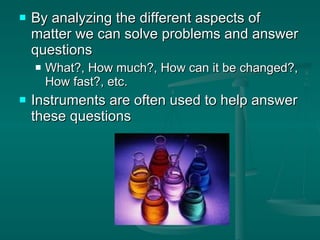
By analyzing the different aspects of matter we can solve problems and answer questions What?, How much?, How can it be changed?, How fast?, etc. Instruments are often used to help answer these questions
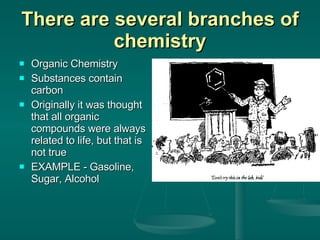
There are several branches of chemistry Organic Chemistry Substances contain carbon Originally it was thought that all organic compounds were always related to life, but that is not true EXAMPLE - Gasoline, Sugar, Alcohol
Inorganic Chemistry Substances that don’t contain Carbon Examples - Salt (NaCl), Calcium nitrate (CaNO 3 )
Physical Chemistry - deals with matter and energy (is the bridge between chemistry and physics) Analytical Chemistry - identification of substances (think CSI) Biochemistry - combines biology and chemistry, chemistry of living things Theoretical Chemistry - uses computers, advanced mathematical models
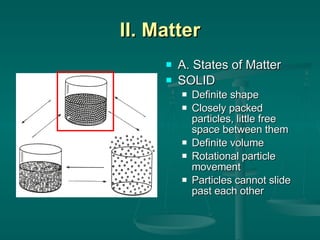
II. Matter A. States of Matter SOLID Definite shape Closely packed particles, little free space between them Definite volume Rotational particle movement Particles cannot slide past each other
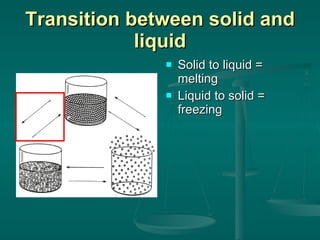
Transition between solid and liquid Solid to liquid = melting Liquid to solid = freezing
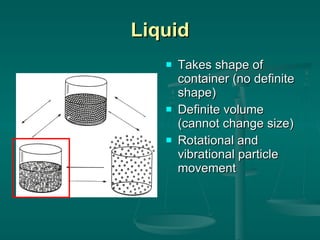
Liquid Takes shape of container (no definite shape) Definite volume (cannot change size) Rotational and vibrational particle movement
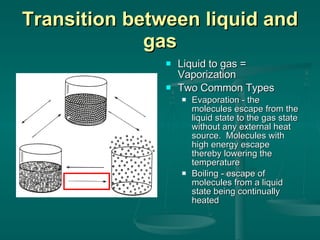
Transition between liquid and gas Liquid to gas = Vaporization Two Common Types Evaporation - the molecules escape from the liquid state to the gas state without any external heat source.  Molecules with high energy escape thereby lowering the temperature Boiling - escape of molecules from a liquid state being continually heated
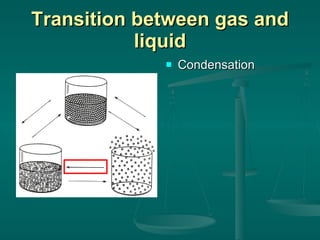
Transition between gas and liquid Condensation
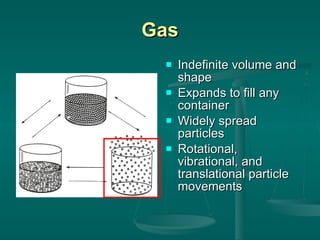
Gas Indefinite volume and shape Expands to fill any container Widely spread particles Rotational, vibrational, and translational particle movements
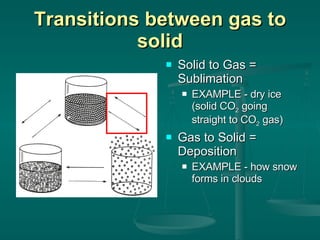
Transitions between gas to solid Solid to Gas = Sublimation  EXAMPLE - dry ice (solid CO 2  going straight to CO 2  gas) Gas to Solid = Deposition  EXAMPLE - how snow forms in clouds
B. Properties Physical Property: Doesn’t alter identify of substance Intensive - independent of amount (color, melting point, density, temperature, hardness) Extensive - depends on amount (mass, length, volume) Chemical Property: Ability of a substance to undergo a change that alters its identity EXAMPLE - rusting iron, milk turning sour, metals reacting with acids to form hydrogen gas
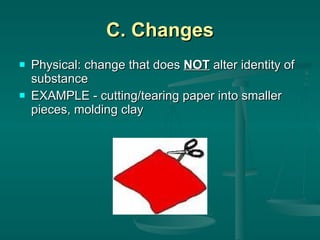
C. Changes Physical: change that does  NOT  alter identity of substance EXAMPLE - cutting/tearing paper into smaller pieces, molding clay
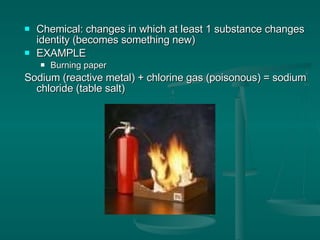
Chemical: changes in which at least 1 substance changes identity (becomes something new) EXAMPLE Burning paper  Sodium (reactive metal) + chlorine gas (poisonous) = sodium chloride (table salt)
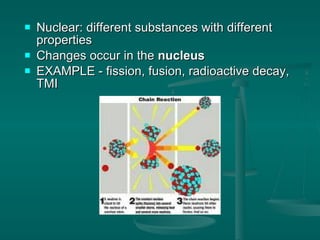
Nuclear: different substances with different properties Changes occur in the  nucleus EXAMPLE - fission, fusion, radioactive decay, TMI
Conservation of Matter and Energy In a reaction, the total amount of matter and energy stays the same In other words, if you start with 20 grams of a compound at the end you should still have 20 grams of the compound although it probably changed form. Very important for a lot of chemical ideas
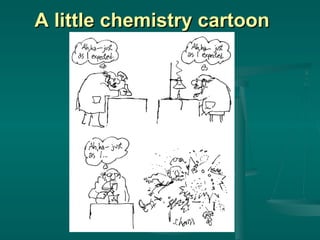
A little chemistry cartoon

Chapter 1 NOTES

  • 1.
    Introduction to Chemistryand Matter Chapter 1 Pages 1-12, 238-243 Note: Periodic Table section contains more info than you need!
  • 2.
    Science A. Scienceis a body of knowledge collected by scientists over many years and the methods used to obtain knowledge. B. Chemistry: the study of the composition, structure, and properties of matter and the changes it undergoes.
  • 3.
    By analyzing thedifferent aspects of matter we can solve problems and answer questions What?, How much?, How can it be changed?, How fast?, etc. Instruments are often used to help answer these questions
  • 4.
    There are severalbranches of chemistry Organic Chemistry Substances contain carbon Originally it was thought that all organic compounds were always related to life, but that is not true EXAMPLE - Gasoline, Sugar, Alcohol
  • 5.
    Inorganic Chemistry Substancesthat don’t contain Carbon Examples - Salt (NaCl), Calcium nitrate (CaNO 3 )
  • 6.
    Physical Chemistry -deals with matter and energy (is the bridge between chemistry and physics) Analytical Chemistry - identification of substances (think CSI) Biochemistry - combines biology and chemistry, chemistry of living things Theoretical Chemistry - uses computers, advanced mathematical models
  • 7.
    II. Matter A.States of Matter SOLID Definite shape Closely packed particles, little free space between them Definite volume Rotational particle movement Particles cannot slide past each other
  • 8.
    Transition between solidand liquid Solid to liquid = melting Liquid to solid = freezing
  • 9.
    Liquid Takes shapeof container (no definite shape) Definite volume (cannot change size) Rotational and vibrational particle movement
  • 10.
    Transition between liquidand gas Liquid to gas = Vaporization Two Common Types Evaporation - the molecules escape from the liquid state to the gas state without any external heat source. Molecules with high energy escape thereby lowering the temperature Boiling - escape of molecules from a liquid state being continually heated
  • 11.
    Transition between gasand liquid Condensation
  • 12.
    Gas Indefinite volumeand shape Expands to fill any container Widely spread particles Rotational, vibrational, and translational particle movements
  • 13.
    Transitions between gasto solid Solid to Gas = Sublimation EXAMPLE - dry ice (solid CO 2 going straight to CO 2 gas) Gas to Solid = Deposition EXAMPLE - how snow forms in clouds
  • 14.
    B. Properties PhysicalProperty: Doesn’t alter identify of substance Intensive - independent of amount (color, melting point, density, temperature, hardness) Extensive - depends on amount (mass, length, volume) Chemical Property: Ability of a substance to undergo a change that alters its identity EXAMPLE - rusting iron, milk turning sour, metals reacting with acids to form hydrogen gas
  • 15.
    C. Changes Physical:change that does NOT alter identity of substance EXAMPLE - cutting/tearing paper into smaller pieces, molding clay
  • 16.
    Chemical: changes inwhich at least 1 substance changes identity (becomes something new) EXAMPLE Burning paper Sodium (reactive metal) + chlorine gas (poisonous) = sodium chloride (table salt)
  • 17.
    Nuclear: different substanceswith different properties Changes occur in the nucleus EXAMPLE - fission, fusion, radioactive decay, TMI
  • 18.
    Conservation of Matterand Energy In a reaction, the total amount of matter and energy stays the same In other words, if you start with 20 grams of a compound at the end you should still have 20 grams of the compound although it probably changed form. Very important for a lot of chemical ideas
  • 19.