Housing and Human Needs
People and Their Housing
 Housing – as the word is used in this text, means any
dwelling that provides shelter.
 Housing is your Near Environment, a small and
distinct part of the total environment in which you live
 Your total environment includes all your interactions
with people and buildings as well as different
geographical areas outside your dwelling place,
neighborhood, and local community.
 Housing affects your actions, and in turn, your actions
affect your housing.
Housing Choices
 For example, if you live in a small
apartment, you will not be able to
host large parties.
 You will not have enough room, and
your neighbors might complain
about the noise.
 However, if you want to host large
parties, you might choose to live in a
large house that is set apart from
other houses.
Meeting Needs Through Housing
 Needs – are the basic requirements that people must
have filled in order to live.
 All people have physical, psychological, and other
needs.
 They share the need for shelter in which to eat, sleep,
and carry on daily living activities.
 Psychologist Abraham Maslow prioritized human
needs into a pyramid, as each type of need is met, you
progress up the pyramid to the next level.
Maslow’s Theory of Human Needs
Physical Needs
 Physical Needs – the most basic human needs.
 They have priority over other needs because they are
essential for survival.
 Physical needs include shelter, food, water, and rest.
 They are sometimes called basic needs or primary
needs.
Shelter
 The need for shelter and protection from the weather
has always been met by a dwelling of some type.
 Archeologists are social scientists who study ancient
cultures by unearthing dwelling places of past
civilizations.
 Archeological findings reveal how ancient structures
were made and used, and how they met the need for
shelter – a basic universal need.
Earliest Dwellings: Pueblo
 The earliest dwellings were
in natural settings, such as
caves and overhanging
cliffs.
 The Pueblo Native
Americans used
adobe, which is a building
material made of sun-dried
earth and straw.
 They also used rafters made
from native materials.
Earliest Dwellings: Apache
 Apache Native Americans
built houses from tree
branches.
 Their houses offered
protection from the
scorching sun, while
cooling breezes circulate
through the branches.
Earliest Dwellings: Nomads
 Some tribes throughout the
world called nomads
periodically move their
residences depending on
weather, available farmland,
and other factors.
 A yurt is a portable hut made
of several layers of felt covered
with canvas.
 These huts are use din
summer as the people move to
more fertile areas.
Food and Water
 In the past, people located their housing near sources
of food and water.
 Today, areas within dwellings are set aside storing,
preparing, and eating food.
 However, people still like to prepare food and eat
outside.
Psychological Needs
 Once the basic physical needs
are met, people strive to meet
the psychological needs, which
are higher on Maslow’s
pyramid of human needs.
 Psychological needs are needs
related to the mind and
feelings that must be met in
order to live a satisfying life.
Security
 Housing provides security
from the outside world.
 It offers protection from
physical danger and the
unknown.
 It helps you feel safe and
protected.
 Living in a dwelling that is well
built and locate din an area
from from crime can help you
feel secure.
Love and Acceptance
 Housing affects your feelings of being
loved and accepted.
 If you have your own bedroom or
private place, you know that others
care about you.
 They have accepted you as a person
who has needs.
 When you are assigned household
chores, it is because you have been
accepted as part of a group.
Esteem
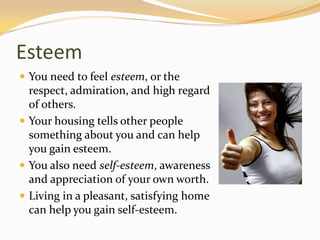
 You need to feel esteem, or the
respect, admiration, and high regard
of others.
 Your housing tells other people
something about you and can help
you gain esteem.
 You also need self-esteem, awareness
and appreciation of your own worth.
 Living in a pleasant, satisfying home
can help you gain self-esteem.
Self-Actualization
 When you meet the need for self-actualization, you
have developed to your full potential as a person.
 You have become the best you can be, and you are
doing what you do best.
 For self-actualizing people, housing is more than a
place to live.
 It is the place where each person can progress towards
becoming what he or she is capable of being.
Other Needs Met Through Housing
 Recognizing the levels of human
needs as described by Maslow can
help you understand how
important needs are in relation to
housing.
 Beauty, self-expression, and
creativity are also important
needs.
 They can be achieved through
your housing decisions.
Beauty
 Beauty is the quality or
qualities that give pleasure
to the senses.
 What is beautiful to you
may not be beautiful to
someone else.
 An appreciation of beauty
develops over time as
exposure to it increases.
Self-Expression
 Showing your true personality and taste is called self-
expression, evident when you choose colors to decorate your
house.
 Those colors are often a clue to your personality.
 For example, if you have an outgoing, vibrant personality, you
might show it by using bright, bold colors inside your house.
Creativity
 Creativity is the ability to
create imaginatively.
 It can be described as
combining two or more
things or ideas into a new
whole that as beauty or
value.
 Your housing provides
opportunities for you to
express your creativity.
Factors Affecting Housing Choices
 There are many factors
that influence choices in
housing.
 These include person
priorities, family
relationships, space
needs, costs, roles, and
lifestyle.
Personal Priorities
 Personal priorities are strong beliefs or ideas about
what is important.
 When you choose something freely and take action on
that choice, you are acting on a personal priority.
 All personal priorities you hold, such as
family, friendship, money, status, religion, and
independence, form your personal-priority system.
 Whenever you decide between two or more
choices, you use your personal-priority system.
How Needs and Personal Priorities
Relate
 Your needs and personal priorities
are closely related.
 For example, you need a place to
seep.
 A cot can satisfy this need.
 However, the cot may not meet your
priority for comfort.
 If you have a choice, your personal
priority for comfort may cause you
to choose a bed with a mattress
instead of the cot.
Space
 People have spatial needs.
 While too much space can make people feel lonely,
they need a certain amount of space around them to
avoid feeling crowded.
 They way space is used also influences the amount
that is needed.
 In places where space cannot be added or removed, the
right furnishings can make the space seem larger or
smaller.
Privacy
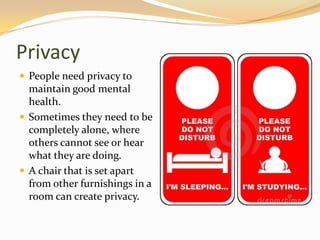
 People need privacy to
maintain good mental
health.
 Sometimes they need to be
completely alone, where
others cannot see or hear
what they are doing.
 A chair that is set apart
from other furnishings in a
room can create privacy.
Family Relationships
 Decisions in families that value relationships are made
to benefit all family members, not just some.
 A family is two or more people living together who are
related by birth, marriage, or adoption.
 When concern for family relationships is an important
personal priority, several areas of the house can be
designed for group living.
Costs
 For most people, the cost of
housing is an important factor
in making housing decisions.
 Whether people rent or buy
housing, it costs money.
 When money is very
limited, people choose
dwellings that provide just
enough space for their needs.
Roles
 Roles are patterns of behavior that people display in their
homes, the workplace, and their communities.
 Examples are: wife, mother, sister, co-worker, teacher,
hospital volunteer, etc.
 The roles people have can affect the type of housing they
choose and the way the housing is used.
 To fulfill the role of student, a home needs a quiet area for
studying.
 The role of wage earner can also impact housing choices.
 A lawyer may work from home, needing an office for working
and a seating area for greeting clients.
Housing Needs Vary
 On almost a daily basis, you can be sure of change.
 Life situations and circumstances cause change and
affect they way you live.
 In group housing, people generally are not related.
 Retirement complexes and college residence halls, are
some common examples.
 The occupants live in separate units within the group
dwelling.
 People in residential dwellings, on the other hand, are
usually related to each other.
Households
 The most common residential
dwelling is a household.
 A household is a group of
people sharing the same
dwelling
 The size of a household can
vary, but most households
contain families.
 There are five basic types of
families.
Nuclear Family
 This family includes
couples and their
children.
 The children are either
born into the family or
adopted.
 None of the children are
from a previous marriage.
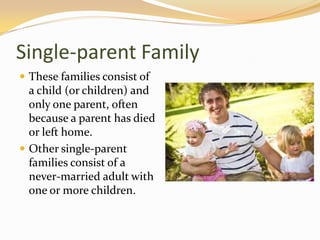
Single-parent Family
 These families consist of
a child (or children) and
only one parent, often
because a parent has died
or left home.
 Other single-parent
families consist of a
never-married adult with
one or more children.
Stepfamily
 This family consists of
parents, one or both of
whom have been married
before.
 The family also includes
one or more children from
a previous marriage.
Childless Family
 These families consist of a
husband and wife who have
not had children.
 For some couples this is a
temporary condition, delaying
the arrival of children until
their finances improve.
 For others, they may be unable
to have children or chooses to
remain childless, for whatever
reason.
Extended Family
 There a two basic types of extended
families, which are formed by
adding one or more relatives to a
household already identified.
 One type consists of several
generations of a family, such as
children, parents, and
grandparents.
 The second type of extended family
consists of members from the same
generation, such as brothers,
sisters, and cousins.
Single Person Household
 The smallest household is a
single-person
household, which consists of
one person living alone in
the dwelling.
 That person may be
someone who has never
married or whose marriage
has ended because of the
loss of a spouse through
death, desertion, or divorce.
Life Cycles
 Life cycles are another way to view your housing needs.
 A life cycle is a series of stages through which an
individual or family passes during its lifetime.
 In each stage, you have new opportunities and face
new challenges.
Individual Life Cycle
 Each person follows a pattern of development called
an individual life cycle
 It is divided according to age groups into the following
four stages:
 Infancy
 Childhood
 Youth
 Adulthood
 Each stage can be divided into sub stages.
Family Life Cycle
 Just as you have a place in
an individual life cycle,
your family has its place
in the family life cycle.
 A family life cycle has six
stages.
 In addition, one or more
sub stages may exist
within each stage.
Beginning Stage
 The beginning stage is
the early period of the
marriage when the
couple is without
children.
 The husband and wife
make adjustments to
married life and to each
other.
Childbearing Stage
 The childbearing stage is the time when the family is
growing.
 It includes the childbearing periods and the years of
caring for preschoolers.
Parenting Stage
 The parenting stage
occurs when the children
are in school.
 This stage includes the
years of caring for school-
age children and
teenagers.
Launching Stage
 The launching stage is the time when the children
become adults and leave their parents’ house.
 They may leave to go to college, take a job, or get
married.
Midyears Stage
 The midyears stage is the time between when the
children leave home and the parents retire.
 When all the children have left home, the couple is
again alone.
Aging Stage
 The aging stage begins
with retirement.
 Usually, at some point in
this stage, one spouse
lives alone after the death
of the other.
 As people live longer, the
length of this stage
increases.
Life cycles and Housing Needs
 As you move from one stage or sub stage of a life cycle
to another, your housing needs change.
 Therefore, you should consider what stage or sub stage
of the life cycles you are in as you plan your housing.
 If you think about both your present and future needs,
your housing can help you live the kind of life you
desire.
Housing and The Quality of Life
 Quality of life is the degree
of satisfaction obtained
from life.
 Housing is considered
“good” when it provides
people with satisfying
surroundings that can
improve their quality of
life.
Personal Quality of Life
 Quality of life is important to you as
an individual.
 Your idea of an improved quality of
life may not appeal to someone else.
 Your housing environment helps you
meet your needs and personal
priorities.
 It also adds satisfaction to your life
and, therefore, improves the quality
of your life.
Quality of Life for Society
 The future of a society depends on individuals and
groups who work to make life better for everyone.
 Some of the work is social in nature.
 People must also work together and use their resources
of time, money, and energy to maintain and support
beautiful surroundings.
 Examples of such surroundings are well-kept buildings
and natural landscapes.
Human Ecology
 Human ecology the study of people and their
environment, is the focus of considerable research.
 People are concerned about the problems caused by
pollutants entering streams, lakes, and underground
water supplies.
 Instead of wishing for the good old days to
return, people must move forward to find solutions
for today’s problems.
Chapter 1 housing and human needs

Chapter 1 housing and human needs

  • 1.
  • 2.
    People and TheirHousing  Housing – as the word is used in this text, means any dwelling that provides shelter.  Housing is your Near Environment, a small and distinct part of the total environment in which you live  Your total environment includes all your interactions with people and buildings as well as different geographical areas outside your dwelling place, neighborhood, and local community.  Housing affects your actions, and in turn, your actions affect your housing.
  • 3.
    Housing Choices  Forexample, if you live in a small apartment, you will not be able to host large parties.  You will not have enough room, and your neighbors might complain about the noise.  However, if you want to host large parties, you might choose to live in a large house that is set apart from other houses.
  • 4.
    Meeting Needs ThroughHousing  Needs – are the basic requirements that people must have filled in order to live.  All people have physical, psychological, and other needs.  They share the need for shelter in which to eat, sleep, and carry on daily living activities.  Psychologist Abraham Maslow prioritized human needs into a pyramid, as each type of need is met, you progress up the pyramid to the next level.
  • 5.
  • 6.
    Physical Needs  PhysicalNeeds – the most basic human needs.  They have priority over other needs because they are essential for survival.  Physical needs include shelter, food, water, and rest.  They are sometimes called basic needs or primary needs.
  • 7.
    Shelter  The needfor shelter and protection from the weather has always been met by a dwelling of some type.  Archeologists are social scientists who study ancient cultures by unearthing dwelling places of past civilizations.  Archeological findings reveal how ancient structures were made and used, and how they met the need for shelter – a basic universal need.
  • 8.
    Earliest Dwellings: Pueblo The earliest dwellings were in natural settings, such as caves and overhanging cliffs.  The Pueblo Native Americans used adobe, which is a building material made of sun-dried earth and straw.  They also used rafters made from native materials.
  • 9.
    Earliest Dwellings: Apache Apache Native Americans built houses from tree branches.  Their houses offered protection from the scorching sun, while cooling breezes circulate through the branches.
  • 10.
    Earliest Dwellings: Nomads Some tribes throughout the world called nomads periodically move their residences depending on weather, available farmland, and other factors.  A yurt is a portable hut made of several layers of felt covered with canvas.  These huts are use din summer as the people move to more fertile areas.
  • 11.
    Food and Water In the past, people located their housing near sources of food and water.  Today, areas within dwellings are set aside storing, preparing, and eating food.  However, people still like to prepare food and eat outside.
  • 12.
    Psychological Needs  Oncethe basic physical needs are met, people strive to meet the psychological needs, which are higher on Maslow’s pyramid of human needs.  Psychological needs are needs related to the mind and feelings that must be met in order to live a satisfying life.
  • 13.
    Security  Housing providessecurity from the outside world.  It offers protection from physical danger and the unknown.  It helps you feel safe and protected.  Living in a dwelling that is well built and locate din an area from from crime can help you feel secure.
  • 14.
    Love and Acceptance Housing affects your feelings of being loved and accepted.  If you have your own bedroom or private place, you know that others care about you.  They have accepted you as a person who has needs.  When you are assigned household chores, it is because you have been accepted as part of a group.
  • 15.
    Esteem  You needto feel esteem, or the respect, admiration, and high regard of others.  Your housing tells other people something about you and can help you gain esteem.  You also need self-esteem, awareness and appreciation of your own worth.  Living in a pleasant, satisfying home can help you gain self-esteem.
  • 16.
    Self-Actualization  When youmeet the need for self-actualization, you have developed to your full potential as a person.  You have become the best you can be, and you are doing what you do best.  For self-actualizing people, housing is more than a place to live.  It is the place where each person can progress towards becoming what he or she is capable of being.
  • 17.
    Other Needs MetThrough Housing  Recognizing the levels of human needs as described by Maslow can help you understand how important needs are in relation to housing.  Beauty, self-expression, and creativity are also important needs.  They can be achieved through your housing decisions.
  • 18.
    Beauty  Beauty isthe quality or qualities that give pleasure to the senses.  What is beautiful to you may not be beautiful to someone else.  An appreciation of beauty develops over time as exposure to it increases.
  • 19.
    Self-Expression  Showing yourtrue personality and taste is called self- expression, evident when you choose colors to decorate your house.  Those colors are often a clue to your personality.  For example, if you have an outgoing, vibrant personality, you might show it by using bright, bold colors inside your house.
  • 20.
    Creativity  Creativity isthe ability to create imaginatively.  It can be described as combining two or more things or ideas into a new whole that as beauty or value.  Your housing provides opportunities for you to express your creativity.
  • 21.
    Factors Affecting HousingChoices  There are many factors that influence choices in housing.  These include person priorities, family relationships, space needs, costs, roles, and lifestyle.
  • 22.
    Personal Priorities  Personalpriorities are strong beliefs or ideas about what is important.  When you choose something freely and take action on that choice, you are acting on a personal priority.  All personal priorities you hold, such as family, friendship, money, status, religion, and independence, form your personal-priority system.  Whenever you decide between two or more choices, you use your personal-priority system.
  • 23.
    How Needs andPersonal Priorities Relate  Your needs and personal priorities are closely related.  For example, you need a place to seep.  A cot can satisfy this need.  However, the cot may not meet your priority for comfort.  If you have a choice, your personal priority for comfort may cause you to choose a bed with a mattress instead of the cot.
  • 24.
    Space  People havespatial needs.  While too much space can make people feel lonely, they need a certain amount of space around them to avoid feeling crowded.  They way space is used also influences the amount that is needed.  In places where space cannot be added or removed, the right furnishings can make the space seem larger or smaller.
  • 25.
    Privacy  People needprivacy to maintain good mental health.  Sometimes they need to be completely alone, where others cannot see or hear what they are doing.  A chair that is set apart from other furnishings in a room can create privacy.
  • 26.
    Family Relationships  Decisionsin families that value relationships are made to benefit all family members, not just some.  A family is two or more people living together who are related by birth, marriage, or adoption.  When concern for family relationships is an important personal priority, several areas of the house can be designed for group living.
  • 27.
    Costs  For mostpeople, the cost of housing is an important factor in making housing decisions.  Whether people rent or buy housing, it costs money.  When money is very limited, people choose dwellings that provide just enough space for their needs.
  • 28.
    Roles  Roles arepatterns of behavior that people display in their homes, the workplace, and their communities.  Examples are: wife, mother, sister, co-worker, teacher, hospital volunteer, etc.  The roles people have can affect the type of housing they choose and the way the housing is used.  To fulfill the role of student, a home needs a quiet area for studying.  The role of wage earner can also impact housing choices.  A lawyer may work from home, needing an office for working and a seating area for greeting clients.
  • 29.
    Housing Needs Vary On almost a daily basis, you can be sure of change.  Life situations and circumstances cause change and affect they way you live.  In group housing, people generally are not related.  Retirement complexes and college residence halls, are some common examples.  The occupants live in separate units within the group dwelling.  People in residential dwellings, on the other hand, are usually related to each other.
  • 30.
    Households  The mostcommon residential dwelling is a household.  A household is a group of people sharing the same dwelling  The size of a household can vary, but most households contain families.  There are five basic types of families.
  • 31.
    Nuclear Family  Thisfamily includes couples and their children.  The children are either born into the family or adopted.  None of the children are from a previous marriage.
  • 32.
    Single-parent Family  Thesefamilies consist of a child (or children) and only one parent, often because a parent has died or left home.  Other single-parent families consist of a never-married adult with one or more children.
  • 33.
    Stepfamily  This familyconsists of parents, one or both of whom have been married before.  The family also includes one or more children from a previous marriage.
  • 34.
    Childless Family  Thesefamilies consist of a husband and wife who have not had children.  For some couples this is a temporary condition, delaying the arrival of children until their finances improve.  For others, they may be unable to have children or chooses to remain childless, for whatever reason.
  • 35.
    Extended Family  Therea two basic types of extended families, which are formed by adding one or more relatives to a household already identified.  One type consists of several generations of a family, such as children, parents, and grandparents.  The second type of extended family consists of members from the same generation, such as brothers, sisters, and cousins.
  • 36.
    Single Person Household The smallest household is a single-person household, which consists of one person living alone in the dwelling.  That person may be someone who has never married or whose marriage has ended because of the loss of a spouse through death, desertion, or divorce.
  • 37.
    Life Cycles  Lifecycles are another way to view your housing needs.  A life cycle is a series of stages through which an individual or family passes during its lifetime.  In each stage, you have new opportunities and face new challenges.
  • 38.
    Individual Life Cycle Each person follows a pattern of development called an individual life cycle  It is divided according to age groups into the following four stages:  Infancy  Childhood  Youth  Adulthood  Each stage can be divided into sub stages.
  • 39.
    Family Life Cycle Just as you have a place in an individual life cycle, your family has its place in the family life cycle.  A family life cycle has six stages.  In addition, one or more sub stages may exist within each stage.
  • 40.
    Beginning Stage  Thebeginning stage is the early period of the marriage when the couple is without children.  The husband and wife make adjustments to married life and to each other.
  • 41.
    Childbearing Stage  Thechildbearing stage is the time when the family is growing.  It includes the childbearing periods and the years of caring for preschoolers.
  • 42.
    Parenting Stage  Theparenting stage occurs when the children are in school.  This stage includes the years of caring for school- age children and teenagers.
  • 43.
    Launching Stage  Thelaunching stage is the time when the children become adults and leave their parents’ house.  They may leave to go to college, take a job, or get married.
  • 44.
    Midyears Stage  Themidyears stage is the time between when the children leave home and the parents retire.  When all the children have left home, the couple is again alone.
  • 45.
    Aging Stage  Theaging stage begins with retirement.  Usually, at some point in this stage, one spouse lives alone after the death of the other.  As people live longer, the length of this stage increases.
  • 46.
    Life cycles andHousing Needs  As you move from one stage or sub stage of a life cycle to another, your housing needs change.  Therefore, you should consider what stage or sub stage of the life cycles you are in as you plan your housing.  If you think about both your present and future needs, your housing can help you live the kind of life you desire.
  • 47.
    Housing and TheQuality of Life  Quality of life is the degree of satisfaction obtained from life.  Housing is considered “good” when it provides people with satisfying surroundings that can improve their quality of life.
  • 48.
    Personal Quality ofLife  Quality of life is important to you as an individual.  Your idea of an improved quality of life may not appeal to someone else.  Your housing environment helps you meet your needs and personal priorities.  It also adds satisfaction to your life and, therefore, improves the quality of your life.
  • 49.
    Quality of Lifefor Society  The future of a society depends on individuals and groups who work to make life better for everyone.  Some of the work is social in nature.  People must also work together and use their resources of time, money, and energy to maintain and support beautiful surroundings.  Examples of such surroundings are well-kept buildings and natural landscapes.
  • 50.
    Human Ecology  Humanecology the study of people and their environment, is the focus of considerable research.  People are concerned about the problems caused by pollutants entering streams, lakes, and underground water supplies.  Instead of wishing for the good old days to return, people must move forward to find solutions for today’s problems.