PURBANCHAL UNIVERSITY
KANTIPUR INTERNATIONAL COLLEGE
DEPARTMENT OF ARCHITECTURE
LUBHU
SUBMITTED BY: Group B
ALISHA SHRESTHA-2
BHUMIKA SHRESTHA-4
POOJA SHRESTHA-7
RASNA SHRESTHA-10
SHRADDHA DOTEL-15
What is meant by ‘Principles of interior design’
Principles of Interior design
Balance
Rhythm
Scale and
proportion
Emphasis
Harmony
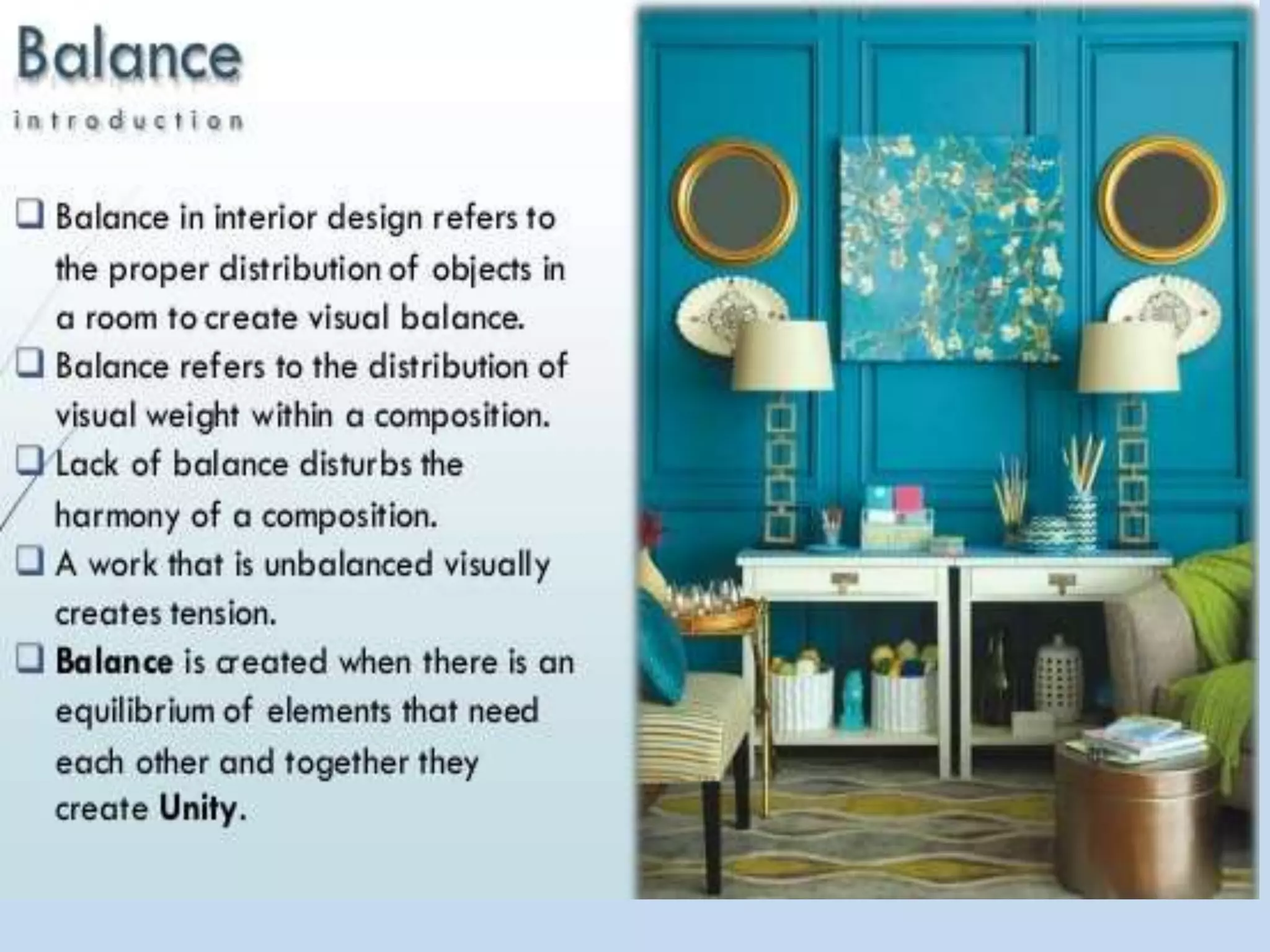
Asymmetrical balance
Visual balance
Rhythm
• Rhythm can be accomplished through the
following means:
1.Repetition
2.Transition
3.Radiation
4.Gradation
5.Opposition
Rhythm by repetition
• The repeated use of certain objects or physical attributes of décor
elements
• For example: a series of similar
vases lining a mantle or
a stock of books on the shelf
• Similarly themed homework and arts will also contribute to the
theme of your interior design
• Repetition is the simplest way to attain rhythm and can be achieved
by repeating any elements of design or design concepts in an
organized and regular way
Rhythm by transition
• Rhythm through transition gently leads the eye through a
continuous, uninterrupted flow from one area within a space
to another.
• For example, curved lines are generally used to lead the eye
along a desired path.
Rhythm by radiation
• Radiation is another type of Rhythm which is closely related
to radial balance
• This type of
rhythm can give a
room a circular
radiation feeling.
Rhythm by gradation
• Interior design elements placed according to size from smaller
to bigger ones, or perhaps according to gradient of colors
• Rhythm can also be achieved through gradation. Examples are
a gradation of color or a series of objects that start small and
become large in a very regular manner
Rhythm by opposition
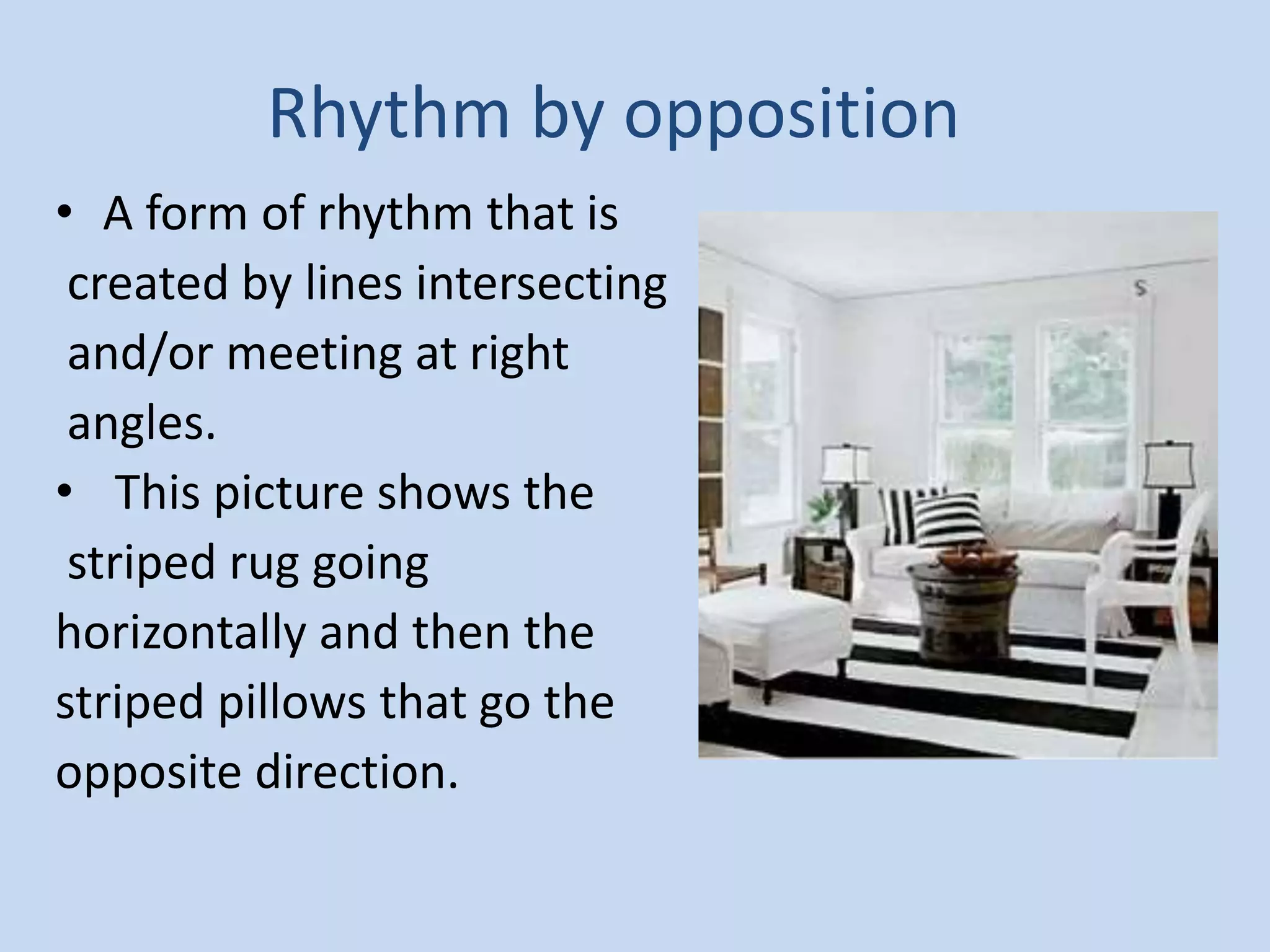
• A form of rhythm that is
created by lines intersecting
and/or meeting at right
angles.
• This picture shows the
striped rug going
horizontally and then the
striped pillows that go the
opposite direction.
Scale and proportion
• Proportion refers to how the elements within
an object relate to the object as a whole while
scale relates to the size of an object compared
to the space in which it is located.
Emphasis
The single element of emphasis in his bathroom is the sink structure.
The sink draws your eye to it because of the bold gold and brown
color, the shape and size of the element in the room.. The shape
provides movement in the space and the colors complement the wall
color behind it. In this small area, the sink dominates the space.
Elements
• The elements of design are the fundamental
building blocks of any composition.
• These pieces work together to form a unified
composition, and when utilized successfully,
create a strong, dynamic visual layout.
• The designer uses these elements as tools that
control how a message is delivered to an
audience.
• These elements can be applied to fine art,
photography and graphic design.
Elements of interior design
• SPACE
• SHAPE
• LINE
• FORM
• TEXTURE
• COLOR
• PATTERN
Shape
• A shape is defined as
• a two or more dimensional area.
• All objects are composed of shapes and all other 'Elements of
Design' are shapes in some way.
• Shape is a flat image with two dimensions: Length and Width.
• Any self-contained area with defined form or outline.
• It refers to the nature of an enclosure, actual or implied, formed by
a line/curve on a flat surface.
• Examples of "shape" in this context include "a geometric shape"
(e.g. square), "organic shape" (flower-shaped object).
• Perceivable area
• Shapes can be created by enclosing line, or by color and value
changes which define edges.
Lines
Lines
Lines
Lines
Form
• Form is the outlined edges of a three-dimensional object.
• It has length, width, and depth (or height) as well as volume and
mass
• Form can be measured, from top to bottom (height), side to side
(width), and from back to front (depth).
• Form is also defined by light and dark.
• It can be defined by the presence of shadows on surfaces or faces
of an object.
• There are two types of form, geometric (man- made) and natural
(organic form).
• Form maybe created by the combining of two or more shapes.
• It maybe enhanced by tone, texture and color
• It can be illustrated or constructed.
• It has volume and mass.
Form
Form
Form
RESIDENTIAL BUILDING
• A residence is an establishment where it was
originally or currently being used by a host as
their main place of dwelling or home.
• Architecturally, a residence is typically a house,
mansion, cottage or even grand castles and
palaces. A residence is offered to travelers as
temporary lodgings where they can rent a room.
• The rooms are generally furnished in the style
which complements the architecture type of the
building
Components of residence
• Bedroom
• Living room
• Drawing room
• Dining room
• kitchen
• Study room
DINING ROOM
• A dining room is a room for consuming food.
• In modern times it is usually
adjacent to the kitchen for
convenience in serving, although
in medieval times it was often on
an entirely different floor level.
• Historically the dining room is
furnished with a rather large dining table and a number of dining
chairs; the most common shape is generally rectangular with two
armed end chairs and an even number of un-armed side chairs
along the long sides.
DINING ROOM
• Radial symmetry
• Focus
• Similar arrangement of
dining chairs gives rhythm
by repetition
• Rhythm by radiation
• Rhythm by
gradation
• Horizontal and vertical
lines in book shelf
DINING ROOM
• If we cut the picture on its
centre, it gives symmetrical
balance
• Rhythm by repetition is
created by duplication of dining
chairs
• Picture on the centre creates the
focal point of the room
• Rhythm by opposition due to
earthy dining black and white
contrast
DINING ROOM
• Rhythm by radiation is created
by the flower vase at the centre
• Use of same colors creates
spacious and proportionate room
• Curved lines of chair legs
• Harmony of furniture and
color
KITCHEN
• Smooth and
rough texture on
wall
• Horizontal lines
KITCHEN
• Rhythm
KITCHEN
• Contrasting colors
DINING ROOM
• Focus of Vase
• Radiation is a balance around a central
point. Dining chairs around a round table radiate
around the center of the table. Tree branches
usually radiate around the tree's trunk.
DINING ROOM FURNITURE
• Dining table
• Dining chairs
• Bar and counter stool
• Dining benches
• Bar cabinets and carts
DINING ROOM FURNITURES
Dining table Dining chairs
Circular Dining Table Sizes
RECTANGULAR DINING TABLE
SQUARE DINING TABLE
Rectangular and Oval Dining
• Notes - the 'No shared area' column represents a
seating arrangement where there's nobody
occupying the ends of the table.
• For the 10 person 'minimum size' and 'ideal size'
arrangement there would be 1 person occupying
each end of the table.
• For the 12 person 'minimum size' and 'ideal size'
arrangement there would be 2 people occupying
each end of the table.
DINING ROOM FURNITURES
• Bar height designs are slightly higher, typically
featuring seat heights of 30"to 32". Counter
height chairs are generally 24" to 26" high. Plan
on leaving8" to 12" of leg room between the
stool and the bottom of your table for maximum
comfort.
Bar and counter stool
DINING ROOM FURNITURES
• Dining benches
DINING ROOM FURNITURES
• Bar cabinets and carts
Living room
LIVING ROOM
Definition and history
• In Western architecture, a living room or lounge room
(informal: lounge) is a room in a residential house or
apartment for relaxing and socializing.
• The term living room was coined in the late 19th or
early 20th century.
• A typical Western living room may contain furnishings
such as a sofa, chairs, occasional tables, coffee tables,
bookshelves, electric lamps, rugs, or other furniture.
• The term sitting room is sometimes used
synonymously with living room.
• The term sitting room is sometimes used
synonymously with living room
Example of living room
Cont..
• Tones of grey give this living room scheme a
warm and welcoming feel
• It follows the Industrial Modern style and
follow the Emphasis principle
• Focal point of this living room is its starburst
clock
• Due to its carpet, transform cardboard tubes
into a fun flower shape and mount on the wall
make it unique.
Living room example
Cont.…
• This room has been given lively authentic decor
with a mix of bright pattern and vintage finds.
• The neutral walls and wood floor is transformed
with furniture pieces in a complementary
combination of orange and blue.
• The floral sofa pops out in array of color and
pattern against a large red and white rug.
• Attention-to-detail accessories make the room
lived in, comfortable and fun.
• This living room follow the Gradation principle.
Example of living room
Cont.…
• The alcoves of this bright living room have been
put to good use
• This living room follow the Repetition Principle.
• Bespoke shelves display pretty objects while a
decorated Ikea cupboard fills the other. White
paint, soft grey, floral wallpaper and vintage
handles have transformed the otherwise plain
piece into something tailor made for the room
• A soft grey armchair fits perfectly underneath the
shelves, while smart stripes and a rattan wood
basket add texture.

interior of residence slides

  • 1.
    PURBANCHAL UNIVERSITY KANTIPUR INTERNATIONALCOLLEGE DEPARTMENT OF ARCHITECTURE LUBHU SUBMITTED BY: Group B ALISHA SHRESTHA-2 BHUMIKA SHRESTHA-4 POOJA SHRESTHA-7 RASNA SHRESTHA-10 SHRADDHA DOTEL-15
  • 2.
    What is meantby ‘Principles of interior design’
  • 3.
    Principles of Interiordesign Balance Rhythm Scale and proportion Emphasis Harmony
  • 7.
  • 10.
  • 11.
    Rhythm • Rhythm canbe accomplished through the following means: 1.Repetition 2.Transition 3.Radiation 4.Gradation 5.Opposition
  • 12.
    Rhythm by repetition •The repeated use of certain objects or physical attributes of décor elements • For example: a series of similar vases lining a mantle or a stock of books on the shelf • Similarly themed homework and arts will also contribute to the theme of your interior design • Repetition is the simplest way to attain rhythm and can be achieved by repeating any elements of design or design concepts in an organized and regular way
  • 13.
    Rhythm by transition •Rhythm through transition gently leads the eye through a continuous, uninterrupted flow from one area within a space to another. • For example, curved lines are generally used to lead the eye along a desired path.
  • 14.
    Rhythm by radiation •Radiation is another type of Rhythm which is closely related to radial balance • This type of rhythm can give a room a circular radiation feeling.
  • 15.
    Rhythm by gradation •Interior design elements placed according to size from smaller to bigger ones, or perhaps according to gradient of colors • Rhythm can also be achieved through gradation. Examples are a gradation of color or a series of objects that start small and become large in a very regular manner
  • 16.
    Rhythm by opposition •A form of rhythm that is created by lines intersecting and/or meeting at right angles. • This picture shows the striped rug going horizontally and then the striped pillows that go the opposite direction.
  • 17.
    Scale and proportion •Proportion refers to how the elements within an object relate to the object as a whole while scale relates to the size of an object compared to the space in which it is located.
  • 19.
    Emphasis The single elementof emphasis in his bathroom is the sink structure. The sink draws your eye to it because of the bold gold and brown color, the shape and size of the element in the room.. The shape provides movement in the space and the colors complement the wall color behind it. In this small area, the sink dominates the space.
  • 21.
    Elements • The elementsof design are the fundamental building blocks of any composition. • These pieces work together to form a unified composition, and when utilized successfully, create a strong, dynamic visual layout. • The designer uses these elements as tools that control how a message is delivered to an audience. • These elements can be applied to fine art, photography and graphic design.
  • 22.
    Elements of interiordesign • SPACE • SHAPE • LINE • FORM • TEXTURE • COLOR • PATTERN
  • 24.
    Shape • A shapeis defined as • a two or more dimensional area. • All objects are composed of shapes and all other 'Elements of Design' are shapes in some way. • Shape is a flat image with two dimensions: Length and Width. • Any self-contained area with defined form or outline. • It refers to the nature of an enclosure, actual or implied, formed by a line/curve on a flat surface. • Examples of "shape" in this context include "a geometric shape" (e.g. square), "organic shape" (flower-shaped object). • Perceivable area • Shapes can be created by enclosing line, or by color and value changes which define edges.
  • 26.
  • 27.
  • 28.
  • 29.
  • 30.
    Form • Form isthe outlined edges of a three-dimensional object. • It has length, width, and depth (or height) as well as volume and mass • Form can be measured, from top to bottom (height), side to side (width), and from back to front (depth). • Form is also defined by light and dark. • It can be defined by the presence of shadows on surfaces or faces of an object. • There are two types of form, geometric (man- made) and natural (organic form). • Form maybe created by the combining of two or more shapes. • It maybe enhanced by tone, texture and color • It can be illustrated or constructed. • It has volume and mass.
  • 31.
  • 32.
  • 33.
  • 40.
    RESIDENTIAL BUILDING • Aresidence is an establishment where it was originally or currently being used by a host as their main place of dwelling or home. • Architecturally, a residence is typically a house, mansion, cottage or even grand castles and palaces. A residence is offered to travelers as temporary lodgings where they can rent a room. • The rooms are generally furnished in the style which complements the architecture type of the building
  • 41.
    Components of residence •Bedroom • Living room • Drawing room • Dining room • kitchen • Study room
  • 42.
    DINING ROOM • Adining room is a room for consuming food. • In modern times it is usually adjacent to the kitchen for convenience in serving, although in medieval times it was often on an entirely different floor level. • Historically the dining room is furnished with a rather large dining table and a number of dining chairs; the most common shape is generally rectangular with two armed end chairs and an even number of un-armed side chairs along the long sides.
  • 43.
    DINING ROOM • Radialsymmetry • Focus • Similar arrangement of dining chairs gives rhythm by repetition • Rhythm by radiation • Rhythm by gradation • Horizontal and vertical lines in book shelf
  • 44.
    DINING ROOM • Ifwe cut the picture on its centre, it gives symmetrical balance • Rhythm by repetition is created by duplication of dining chairs • Picture on the centre creates the focal point of the room • Rhythm by opposition due to earthy dining black and white contrast
  • 45.
    DINING ROOM • Rhythmby radiation is created by the flower vase at the centre • Use of same colors creates spacious and proportionate room • Curved lines of chair legs • Harmony of furniture and color
  • 46.
    KITCHEN • Smooth and roughtexture on wall • Horizontal lines
  • 47.
  • 48.
  • 49.
  • 50.
    • Radiation isa balance around a central point. Dining chairs around a round table radiate around the center of the table. Tree branches usually radiate around the tree's trunk.
  • 52.
    DINING ROOM FURNITURE •Dining table • Dining chairs • Bar and counter stool • Dining benches • Bar cabinets and carts
  • 53.
    DINING ROOM FURNITURES Diningtable Dining chairs
  • 54.
  • 55.
  • 56.
  • 57.
    Rectangular and OvalDining • Notes - the 'No shared area' column represents a seating arrangement where there's nobody occupying the ends of the table. • For the 10 person 'minimum size' and 'ideal size' arrangement there would be 1 person occupying each end of the table. • For the 12 person 'minimum size' and 'ideal size' arrangement there would be 2 people occupying each end of the table.
  • 59.
    DINING ROOM FURNITURES •Bar height designs are slightly higher, typically featuring seat heights of 30"to 32". Counter height chairs are generally 24" to 26" high. Plan on leaving8" to 12" of leg room between the stool and the bottom of your table for maximum comfort. Bar and counter stool
  • 60.
  • 61.
    DINING ROOM FURNITURES •Bar cabinets and carts
  • 62.
  • 63.
  • 64.
    Definition and history •In Western architecture, a living room or lounge room (informal: lounge) is a room in a residential house or apartment for relaxing and socializing. • The term living room was coined in the late 19th or early 20th century. • A typical Western living room may contain furnishings such as a sofa, chairs, occasional tables, coffee tables, bookshelves, electric lamps, rugs, or other furniture. • The term sitting room is sometimes used synonymously with living room. • The term sitting room is sometimes used synonymously with living room
  • 65.
  • 66.
    Cont.. • Tones ofgrey give this living room scheme a warm and welcoming feel • It follows the Industrial Modern style and follow the Emphasis principle • Focal point of this living room is its starburst clock • Due to its carpet, transform cardboard tubes into a fun flower shape and mount on the wall make it unique.
  • 67.
  • 68.
    Cont.… • This roomhas been given lively authentic decor with a mix of bright pattern and vintage finds. • The neutral walls and wood floor is transformed with furniture pieces in a complementary combination of orange and blue. • The floral sofa pops out in array of color and pattern against a large red and white rug. • Attention-to-detail accessories make the room lived in, comfortable and fun. • This living room follow the Gradation principle.
  • 69.
  • 70.
    Cont.… • The alcovesof this bright living room have been put to good use • This living room follow the Repetition Principle. • Bespoke shelves display pretty objects while a decorated Ikea cupboard fills the other. White paint, soft grey, floral wallpaper and vintage handles have transformed the otherwise plain piece into something tailor made for the room • A soft grey armchair fits perfectly underneath the shelves, while smart stripes and a rattan wood basket add texture.