THE DATING GAME
What is dating?
   Date: a social meeting between two or more
    people.
   During adolescence, people become more
    aware of members of the opposite sex.
   Teens want members of the opposite sex to
    find them attractive and likeable.
   A date may be spent watching TV or dancing
    the night away. The activity rarely matters as
    much as the people who share it.
Back in the old days…
   When your great-grandparents
    were young, only young men
    called for dates.
   Dates at the time were special
    events that were planned well in
    advance.
   Today, however, dating is much
    more relaxed.
   Most people do not follow formal
    dating rules.
   The word date may not even be
    mentioned when couples make
    plans.
Functions of Dating
   Dating fulfills two main functions.
     It helps you learn how to relate to members of the
      opposite sex.
     It also prepares you for more lasting relationships
      as an adult.
   Most people marry at some point in their lives.
   Few young teens know what type of person to
    choose for a future spouse.
   Dating helps them learn what traits they want
    in a marriage partner.
Stages of Dating
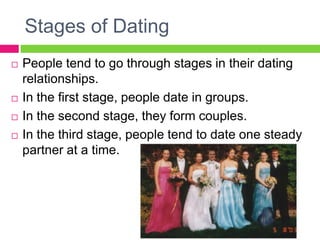
   People tend to go through stages in their dating
    relationships.
   In the first stage, people date in groups.
   In the second stage, they form couples.
   In the third stage, people tend to date one steady
    partner at a time.
Preparing for Dating
   Childhood relationships prepare people for
    dating.
   Many children have playmates of the opposite
    sex.
   Such playmates prepare people to relate to
    dating partners.
   People tend to treat their dates the way their
    parents treat each other.
   For instance, many children see their parents
    respond to each other with warmth and
    respect, these children will likely treat their
Stage One: Group Dating
   Young teens do not always
    feel comfortable around
    members of the opposite
    sex.
   This is why many young
    teens begin dating in
    groups.
   Group dating is less
    stressful.
   A group date may be a
    planned activity.
   For example, two or more
Stage Two: Early Pairing
   After some group dating, teens feel more
    confident around members of the opposite sex.
    They worry less about what to say and do.
   They feel secure enough to begin pairing off in
    couples. This starts the second stage of dating.
   You are not likely to learn private details about
    your partner during this stage of dating.
   A lack of closeness prevents most second-stage
    relationships from lasting.
   Partners in this stage enjoy spending time
    together.
   However, they don’t feel committed to each other.
Stage Three: Steady Dating
   A bond forms between partners in the third
    stage of dating.
   Steady dating partners feel true love and
    concern for each other.
   People in this stage focus less on their own
    needs and are more concerned about meeting
    needs of their partners.
   The first two stages of dating prepare you for
    this last stage.
   Knowing your needs prepares you to address
    a partner’s needs in steady dating.
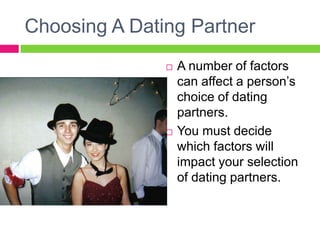
Choosing A Dating Partner
                  A number of factors
                   can affect a person’s
                   choice of dating
                   partners.
                  You must decide
                   which factors will
                   impact your selection
                   of dating partners.
Physical Traits
   A person’s physical
    features make the first
    impression.
   However, they are not the
    most important quality in a
    dating partner.
   People want to be liked for
    more than their looks.
   They want to be noticed
    for their other
    strengths, too.
Age
   Parents often have rules about how old their
    children’s dating partners can be.
   Therefore, age is a factor for many teens when
    choosing a partner.
   Partners who are close in age are likely to
    have more in common.
   Young women mature at an earlier age than
    young men. The gap in maturity narrows as
    teens near adulthood.
   In the early teen years, however, young
    women often prefer partners who are a little
    older.
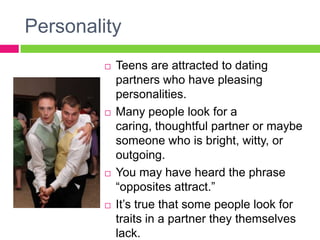
Personality
            Teens are attracted to dating
             partners who have pleasing
             personalities.
            Many people look for a
             caring, thoughtful partner or maybe
             someone who is bright, witty, or
             outgoing.
            You may have heard the phrase
             “opposites attract.”
            It’s true that some people look for
             traits in a partner they themselves
             lack.
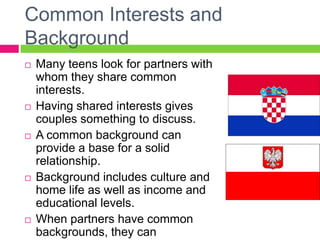
Common Interests and
Background
   Many teens look for partners with
    whom they share common
    interests.
   Having shared interests gives
    couples something to discuss.
   A common background can
    provide a base for a solid
    relationship.
   Background includes culture and
    home life as well as income and
    educational levels.
   When partners have common
    backgrounds, they can
Values and Goals
   You may not think much about values and
    goals when you start dating.
   You may not mind if they don’t have the same
    career goals as you.
   As you form closer
    relationships, however, values and goals will
    matter more.
   You may plan to marry when you are older and
    you will want your marriage partner to agree
    with you about important issues.
Dating Skills
                   A successful date is a
                    pleasant experience
                    for both people
                    involved.
                   However, good dates
                    don’t just happen.
                   They require some
                    social skills that take
                    thought and practice.
Being a Thoughtful Partner
   Dating partners will enjoy being with you more
    if you are thoughtful, keep your partner’s
    feelings in mind when you are on a date.
   Use good manners, remember to say “please”
    and “thank you”.
   Keeping your partners budget in mind shows
    thoughtfulness.
   Being a thoughtful dating partner also involves
    being honest.
   Don’t lead your partner to believe you like him
    or her more than you really do.
Asking for a Date
   Asking for a date
    takes a little courage
    the first few times.
   Asking will be easier
    if you plan what you
    want to say.
   Plan to explain when
    and where you’d like
    to go for a date.
Accepting or Refusing A Date
   When someone asks you for a date, try to
    respond promptly.
   Keeping the other person waiting is rude. He
    or she may need to make other plans if you
    cannot accept the date.
   Think of the other person’s feelings when you
    refuse a date.
   Remember he or she took a risk when asking
    you out, if you are not interested in dating that
    person, politely let him or her know that.
Dating Questions
                  Many teens have the
                   following questions
                   about dating: Am I in
                   love?
                  Will the relationship
                   last?
                  What will I do if we
                   stop seeing each
                   other?
                  Learning more about
                   dating relationships
                   may help answer
Infatuation
   Teen’s feelings for their first dating
    partners are often called “crushes” or
    “puppy love”.
   Infatuation: an intense feeling of
    admiration.
   It is often based on physical traits
   A young woman might have a crush on her
    friend’s tall, handsome older brother.
   The phrase “love is blind” refers to
    infatuation.
   It means you don’t notice faults when you
Love
   Love: a strong feeling of
    attachment, warmth, and understanding
    between two people.
   Love is less self-centered than infatuation, the
    feeling is based on more than physical traits.
   Love is based on a total caring for someone; it
    touches every part of a couple’s relationship.
   People who are in love enjoy being
    together, they have common
    interests, goals, and values.
   They talk about their thoughts and feelings
    and make plans for their future together.
Serious Relationships
   Many teens question how serious they should
    allow their relationships to become.
   Dating only one person has a number of
    advantages:
    A couple will grow to know each other better and
     will become more comfortable with each other.
   Serious dating may also be preparation for a
    mature committed relationship.
Serious Relationships Cont.
   Commitment: an
    emotional pledge to
    date only one
    person.
   Many of these
    couples later choose
    marriage.
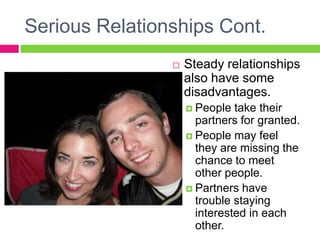
Serious Relationships Cont.
                   Steady relationships
                    also have some
                    disadvantages.
                     People  take their
                      partners for granted.
                     People may feel
                      they are missing the
                      chance to meet
                      other people.
                     Partners have
                      trouble staying
                      interested in each
                      other.
Serious Relationships Cont.
   Some couples stay together only for reasons
    of comfort and security.
   They may not want to “start over” with another
    partner.
   These are not good reasons to stay in a
    relationship with someone.
   These people may be keeping themselves and
    their partners from finding other, more fulfilling
    relationships.
Showing Affection
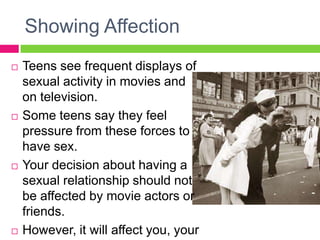
   Teens see frequent displays of
    sexual activity in movies and
    on television.
   Some teens say they feel
    pressure from these forces to
    have sex.
   Your decision about having a
    sexual relationship should not
    be affected by movie actors or
    friends.
   However, it will affect you, your
Showing Affection Cont.
   Your decision about how to show affection will
    be based partly on your beliefs about right and
    wrong behavior.
   Different people have different moral values.
   Along with your beliefs, you should consider
    some important facts.
     Think about your goals for the future.
     Consider how the consequences of sex might
      block those goals.
Showing Affection Cont.
   Having sex can harm a person’s self-image.
   Young teens may feel guilty for going against
    their moral values.
   They may feel weak for giving in to pressure
    from a partner.
   You can care about someone without having
    sex.
   Talking with your partner is one of the best
    ways to show you care.
Breaking Up
   Couples break up for many reasons.
   Partners may find they do not get along as well
    as they thought.
   Sometimes feelings fade and partners drift
    apart.
   Mature behavior can make a breakup easier
    for both partners.
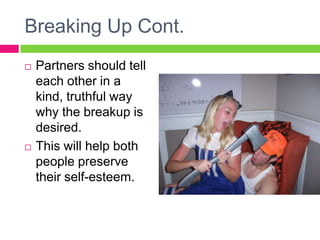
Breaking Up Cont.
   Partners should tell
    each other in a
    kind, truthful way
    why the breakup is
    desired.
   This will help both
    people preserve
    their self-esteem.
Parents and Dating
   Most parents do not want to be nosy; they just
    want to be informed.
   They want to be sure you will be safe.
   Make a point of introducing your dating
    partners to your parents.
   Communicating the details of your dates
    shows respect for your parents.
   Because of their concerns, parents may set
    some rules for dating, talk frankly with your
    parents.
Parents and Dating Cont.
   Ask your parents to let you help decide what
    rules are right for you.
   Knowing your limits in advance will help you
    avoid problems later.
   Parents can be a helpful resource in dating.

   Remember, they have dating experience, try
    talking to them.
   They can offer advice and answer your
    questions about dating.
The End!

Chapter 16 the dating game

  • 1.
  • 2.
    What is dating?  Date: a social meeting between two or more people.  During adolescence, people become more aware of members of the opposite sex.  Teens want members of the opposite sex to find them attractive and likeable.  A date may be spent watching TV or dancing the night away. The activity rarely matters as much as the people who share it.
  • 3.
    Back in theold days…  When your great-grandparents were young, only young men called for dates.  Dates at the time were special events that were planned well in advance.  Today, however, dating is much more relaxed.  Most people do not follow formal dating rules.  The word date may not even be mentioned when couples make plans.
  • 4.
    Functions of Dating  Dating fulfills two main functions.  It helps you learn how to relate to members of the opposite sex.  It also prepares you for more lasting relationships as an adult.  Most people marry at some point in their lives.  Few young teens know what type of person to choose for a future spouse.  Dating helps them learn what traits they want in a marriage partner.
  • 5.
    Stages of Dating  People tend to go through stages in their dating relationships.  In the first stage, people date in groups.  In the second stage, they form couples.  In the third stage, people tend to date one steady partner at a time.
  • 6.
    Preparing for Dating  Childhood relationships prepare people for dating.  Many children have playmates of the opposite sex.  Such playmates prepare people to relate to dating partners.  People tend to treat their dates the way their parents treat each other.  For instance, many children see their parents respond to each other with warmth and respect, these children will likely treat their
  • 7.
    Stage One: GroupDating  Young teens do not always feel comfortable around members of the opposite sex.  This is why many young teens begin dating in groups.  Group dating is less stressful.  A group date may be a planned activity.  For example, two or more
  • 8.
    Stage Two: EarlyPairing  After some group dating, teens feel more confident around members of the opposite sex. They worry less about what to say and do.  They feel secure enough to begin pairing off in couples. This starts the second stage of dating.  You are not likely to learn private details about your partner during this stage of dating.  A lack of closeness prevents most second-stage relationships from lasting.  Partners in this stage enjoy spending time together.  However, they don’t feel committed to each other.
  • 9.
    Stage Three: SteadyDating  A bond forms between partners in the third stage of dating.  Steady dating partners feel true love and concern for each other.  People in this stage focus less on their own needs and are more concerned about meeting needs of their partners.  The first two stages of dating prepare you for this last stage.  Knowing your needs prepares you to address a partner’s needs in steady dating.
  • 10.
    Choosing A DatingPartner  A number of factors can affect a person’s choice of dating partners.  You must decide which factors will impact your selection of dating partners.
  • 11.
    Physical Traits  A person’s physical features make the first impression.  However, they are not the most important quality in a dating partner.  People want to be liked for more than their looks.  They want to be noticed for their other strengths, too.
  • 12.
    Age  Parents often have rules about how old their children’s dating partners can be.  Therefore, age is a factor for many teens when choosing a partner.  Partners who are close in age are likely to have more in common.  Young women mature at an earlier age than young men. The gap in maturity narrows as teens near adulthood.  In the early teen years, however, young women often prefer partners who are a little older.
  • 13.
    Personality  Teens are attracted to dating partners who have pleasing personalities.  Many people look for a caring, thoughtful partner or maybe someone who is bright, witty, or outgoing.  You may have heard the phrase “opposites attract.”  It’s true that some people look for traits in a partner they themselves lack.
  • 14.
    Common Interests and Background  Many teens look for partners with whom they share common interests.  Having shared interests gives couples something to discuss.  A common background can provide a base for a solid relationship.  Background includes culture and home life as well as income and educational levels.  When partners have common backgrounds, they can
  • 15.
    Values and Goals  You may not think much about values and goals when you start dating.  You may not mind if they don’t have the same career goals as you.  As you form closer relationships, however, values and goals will matter more.  You may plan to marry when you are older and you will want your marriage partner to agree with you about important issues.
  • 16.
    Dating Skills  A successful date is a pleasant experience for both people involved.  However, good dates don’t just happen.  They require some social skills that take thought and practice.
  • 17.
    Being a ThoughtfulPartner  Dating partners will enjoy being with you more if you are thoughtful, keep your partner’s feelings in mind when you are on a date.  Use good manners, remember to say “please” and “thank you”.  Keeping your partners budget in mind shows thoughtfulness.  Being a thoughtful dating partner also involves being honest.  Don’t lead your partner to believe you like him or her more than you really do.
  • 18.
    Asking for aDate  Asking for a date takes a little courage the first few times.  Asking will be easier if you plan what you want to say.  Plan to explain when and where you’d like to go for a date.
  • 19.
    Accepting or RefusingA Date  When someone asks you for a date, try to respond promptly.  Keeping the other person waiting is rude. He or she may need to make other plans if you cannot accept the date.  Think of the other person’s feelings when you refuse a date.  Remember he or she took a risk when asking you out, if you are not interested in dating that person, politely let him or her know that.
  • 20.
    Dating Questions  Many teens have the following questions about dating: Am I in love?  Will the relationship last?  What will I do if we stop seeing each other?  Learning more about dating relationships may help answer
  • 21.
    Infatuation  Teen’s feelings for their first dating partners are often called “crushes” or “puppy love”.  Infatuation: an intense feeling of admiration.  It is often based on physical traits  A young woman might have a crush on her friend’s tall, handsome older brother.  The phrase “love is blind” refers to infatuation.  It means you don’t notice faults when you
  • 22.
    Love  Love: a strong feeling of attachment, warmth, and understanding between two people.  Love is less self-centered than infatuation, the feeling is based on more than physical traits.  Love is based on a total caring for someone; it touches every part of a couple’s relationship.  People who are in love enjoy being together, they have common interests, goals, and values.  They talk about their thoughts and feelings and make plans for their future together.
  • 23.
    Serious Relationships  Many teens question how serious they should allow their relationships to become.  Dating only one person has a number of advantages: A couple will grow to know each other better and will become more comfortable with each other.  Serious dating may also be preparation for a mature committed relationship.
  • 24.
    Serious Relationships Cont.  Commitment: an emotional pledge to date only one person.  Many of these couples later choose marriage.
  • 25.
    Serious Relationships Cont.  Steady relationships also have some disadvantages.  People take their partners for granted.  People may feel they are missing the chance to meet other people.  Partners have trouble staying interested in each other.
  • 26.
    Serious Relationships Cont.  Some couples stay together only for reasons of comfort and security.  They may not want to “start over” with another partner.  These are not good reasons to stay in a relationship with someone.  These people may be keeping themselves and their partners from finding other, more fulfilling relationships.
  • 27.
    Showing Affection  Teens see frequent displays of sexual activity in movies and on television.  Some teens say they feel pressure from these forces to have sex.  Your decision about having a sexual relationship should not be affected by movie actors or friends.  However, it will affect you, your
  • 28.
    Showing Affection Cont.  Your decision about how to show affection will be based partly on your beliefs about right and wrong behavior.  Different people have different moral values.  Along with your beliefs, you should consider some important facts.  Think about your goals for the future.  Consider how the consequences of sex might block those goals.
  • 29.
    Showing Affection Cont.  Having sex can harm a person’s self-image.  Young teens may feel guilty for going against their moral values.  They may feel weak for giving in to pressure from a partner.  You can care about someone without having sex.  Talking with your partner is one of the best ways to show you care.
  • 30.
    Breaking Up  Couples break up for many reasons.  Partners may find they do not get along as well as they thought.  Sometimes feelings fade and partners drift apart.  Mature behavior can make a breakup easier for both partners.
  • 31.
    Breaking Up Cont.  Partners should tell each other in a kind, truthful way why the breakup is desired.  This will help both people preserve their self-esteem.
  • 32.
    Parents and Dating  Most parents do not want to be nosy; they just want to be informed.  They want to be sure you will be safe.  Make a point of introducing your dating partners to your parents.  Communicating the details of your dates shows respect for your parents.  Because of their concerns, parents may set some rules for dating, talk frankly with your parents.
  • 33.
    Parents and DatingCont.  Ask your parents to let you help decide what rules are right for you.  Knowing your limits in advance will help you avoid problems later.  Parents can be a helpful resource in dating.  Remember, they have dating experience, try talking to them.  They can offer advice and answer your questions about dating.
  • 34.