The Moral Law Folk
Theory Explained
Presentation by John Slifko,
PhD
From the book, ‘Moral Imagination: Implications of Cognitive Science for Ethics’, by Mark Johnson
‘Moral Imagination: Implications of Cognitive
Science for Ethics’
❖ In this book, author Mark Johnson
argues that humans are
fundamentally imaginative moral
animals, challenging the view that
morality is simply a system of
universal laws dictated by reason.
❖ He uses key findings from
cognitive science research to help
prove this.
Johnson, M. (1993). Moral imagination: Implications of cognitive
science for ethics. Chicago: University of Chicago Press.
Western Tradition & Moral Reasoning
❖ According to the Western moral tradition, we make
ethical decisions by applying universal laws to concrete
situations. But Johnson shows how research in cognitive
science undermines this view and reveals that
imagination has an essential role in ethical deliberation.
❖ He says, “the way we frame and categorize a given
situation will determine how we reason about it, and
how we frame it will depend on which metaphorical
concepts we are using.”
Johnson, M. (1993). Moral imagination: Implications of cognitive
science for ethics. Chicago: University of Chicago Press.
Moral Law folk theory
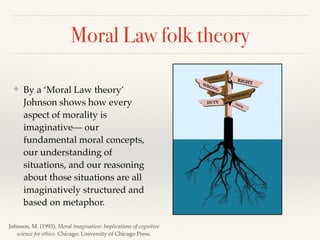
❖ By a ‘Moral Law theory’
Johnson shows how every
aspect of morality is
imaginative— our
fundamental moral concepts,
our understanding of
situations, and our reasoning
about those situations are all
imaginatively structured and
based on metaphor.
Johnson, M. (1993). Moral imagination: Implications of cognitive
science for ethics. Chicago: University of Chicago Press.
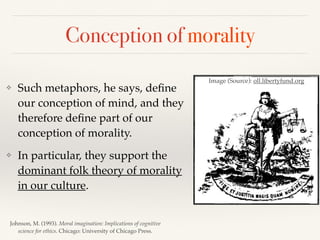
Conception of morality
❖ Such metaphors, he says, define
our conception of mind, and they
therefore define part of our
conception of morality.
❖ In particular, they support the
dominant folk theory of morality
in our culture.
Johnson, M. (1993). Moral imagination: Implications of cognitive
science for ethics. Chicago: University of Chicago Press.
Image (Source): oll.libertyfund.org
The Moral Law Folk Theory
Broken down & Explained
The Moral Law Folk Theory
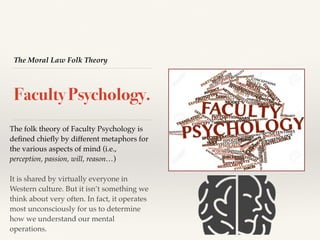
Faculty Psychology.
The folk theory of Faculty Psychology is
defined chiefly by different metaphors for
the various aspects of mind (i.e.,
perception, passion, will, reason…)
It is shared by virtually everyone in
Western culture. But it isn’t something we
think about very often. In fact, it operates
most unconsciously for us to determine
how we understand our mental
operations.
The Moral Law Folk Theory
Our dual nature.
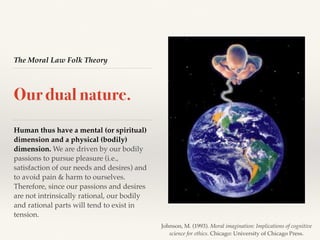
Human thus have a mental (or spiritual)
dimension and a physical (bodily)
dimension. We are driven by our bodily
passions to pursue pleasure (i.e.,
satisfaction of our needs and desires) and
to avoid pain & harm to ourselves.
Therefore, since our passions and desires
are not intrinsically rational, our bodily
and rational parts will tend to exist in
tension.
Johnson, M. (1993). Moral imagination: Implications of cognitive
science for ethics. Chicago: University of Chicago Press.
The Moral Law Folk Theory
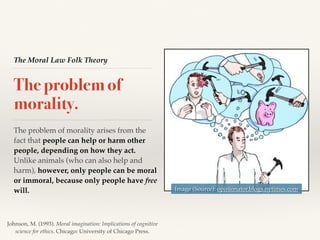
The problem of
morality.
The problem of morality arises from the
fact that people can help or harm other
people, depending on how they act.
Unlike animals (who can also help and
harm), however, only people can be moral
or immoral, because only people have free
will. Image (Source): opinionator.blogs.nytimes.com
Johnson, M. (1993). Moral imagination: Implications of cognitive
science for ethics. Chicago: University of Chicago Press.
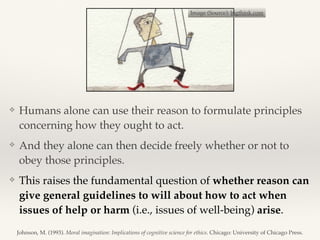
❖ Humans alone can use their reason to formulate principles
concerning how they ought to act.
❖ And they alone can then decide freely whether or not to
obey those principles.
❖ This raises the fundamental question of whether reason can
give general guidelines to will about how to act when
issues of help or harm (i.e., issues of well-being) arise.
Image (Source): bigthink.com
Johnson, M. (1993). Moral imagination: Implications of cognitive science for ethics. Chicago: University of Chicago Press.
The Moral Law Folk Theory
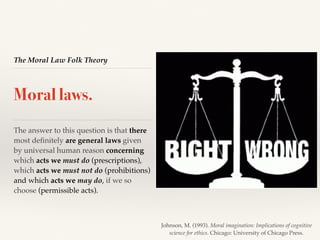
Moral laws.
The answer to this question is that there
most definitely are general laws given
by universal human reason concerning
which acts we must do (prescriptions),
which acts we must not do (prohibitions)
and which acts we may do, if we so
choose (permissible acts).
Johnson, M. (1993). Moral imagination: Implications of cognitive
science for ethics. Chicago: University of Chicago Press.
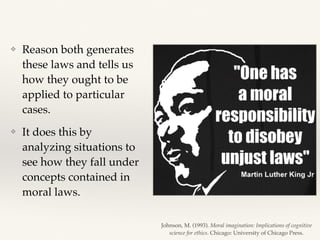
❖ Reason both generates
these laws and tells us
how they ought to be
applied to particular
cases.
❖ It does this by
analyzing situations to
see how they fall under
concepts contained in
moral laws.
Johnson, M. (1993). Moral imagination: Implications of cognitive
science for ethics. Chicago: University of Chicago Press.
The Moral Law Folk Theory
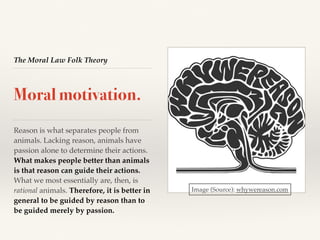
Moral motivation.
Reason is what separates people from
animals. Lacking reason, animals have
passion alone to determine their actions.
What makes people better than animals
is that reason can guide their actions.
What we most essentially are, then, is
rational animals. Therefore, it is better in
general to be guided by reason than to
be guided merely by passion.
Image (Source): whywereason.com
❖ When will chooses to go against reason and with
passion, it is seen as being immoral, since it is better to
be guided by reason whenever it conflicts with passion.
❖ When will lacks the power to resist passion, it is seen as
being weak. Acting morally requires building a strong
will that can resist passion.
❖ And we have a moral duty to do so, since it is better to
be guided by reason than by passion alone.
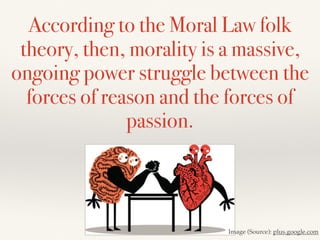
According to the Moral Law folk
theory, then, morality is a massive,
ongoing power struggle between the
forces of reason and the forces of
passion.
Image (Source): plus.google.com
Moral Behavior
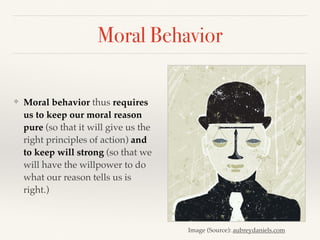
❖ Moral behavior thus requires
us to keep our moral reason
pure (so that it will give us the
right principles of action) and
to keep will strong (so that we
will have the willpower to do
what our reason tells us is
right.)
Image (Source): aubreydaniels.com
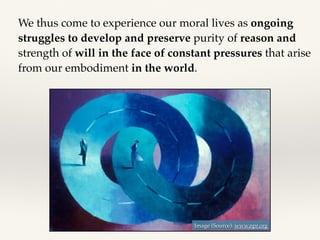
We thus come to experience our moral lives as ongoing
struggles to develop and preserve purity of reason and
strength of will in the face of constant pressures that arise
from our embodiment in the world.
Image (Source): www.npr.org
If you liked this piece, please visit: johnslifko.com
❖ John has dedicated his work to
issues around the world for
democratic civil society with
major contributions to global
efforts in improving the
education of young women. He
supports the study of the historic
links between advancing
women’s rights, education and
democracy in the United States.
About John Slifko

The Moral Law Folk Theory Explained

  • 1.
    The Moral LawFolk Theory Explained Presentation by John Slifko, PhD From the book, ‘Moral Imagination: Implications of Cognitive Science for Ethics’, by Mark Johnson
  • 2.
    ‘Moral Imagination: Implicationsof Cognitive Science for Ethics’ ❖ In this book, author Mark Johnson argues that humans are fundamentally imaginative moral animals, challenging the view that morality is simply a system of universal laws dictated by reason. ❖ He uses key findings from cognitive science research to help prove this. Johnson, M. (1993). Moral imagination: Implications of cognitive science for ethics. Chicago: University of Chicago Press.
  • 3.
    Western Tradition &Moral Reasoning ❖ According to the Western moral tradition, we make ethical decisions by applying universal laws to concrete situations. But Johnson shows how research in cognitive science undermines this view and reveals that imagination has an essential role in ethical deliberation. ❖ He says, “the way we frame and categorize a given situation will determine how we reason about it, and how we frame it will depend on which metaphorical concepts we are using.” Johnson, M. (1993). Moral imagination: Implications of cognitive science for ethics. Chicago: University of Chicago Press.
  • 4.
    Moral Law folktheory ❖ By a ‘Moral Law theory’ Johnson shows how every aspect of morality is imaginative— our fundamental moral concepts, our understanding of situations, and our reasoning about those situations are all imaginatively structured and based on metaphor. Johnson, M. (1993). Moral imagination: Implications of cognitive science for ethics. Chicago: University of Chicago Press.
  • 5.
    Conception of morality ❖Such metaphors, he says, define our conception of mind, and they therefore define part of our conception of morality. ❖ In particular, they support the dominant folk theory of morality in our culture. Johnson, M. (1993). Moral imagination: Implications of cognitive science for ethics. Chicago: University of Chicago Press. Image (Source): oll.libertyfund.org
  • 6.
    The Moral LawFolk Theory Broken down & Explained
  • 7.
    The Moral LawFolk Theory Faculty Psychology. The folk theory of Faculty Psychology is defined chiefly by different metaphors for the various aspects of mind (i.e., perception, passion, will, reason…) It is shared by virtually everyone in Western culture. But it isn’t something we think about very often. In fact, it operates most unconsciously for us to determine how we understand our mental operations.
  • 8.
    The Moral LawFolk Theory Our dual nature. Human thus have a mental (or spiritual) dimension and a physical (bodily) dimension. We are driven by our bodily passions to pursue pleasure (i.e., satisfaction of our needs and desires) and to avoid pain & harm to ourselves. Therefore, since our passions and desires are not intrinsically rational, our bodily and rational parts will tend to exist in tension. Johnson, M. (1993). Moral imagination: Implications of cognitive science for ethics. Chicago: University of Chicago Press.
  • 9.
    The Moral LawFolk Theory The problem of morality. The problem of morality arises from the fact that people can help or harm other people, depending on how they act. Unlike animals (who can also help and harm), however, only people can be moral or immoral, because only people have free will. Image (Source): opinionator.blogs.nytimes.com Johnson, M. (1993). Moral imagination: Implications of cognitive science for ethics. Chicago: University of Chicago Press.
  • 10.
    ❖ Humans alonecan use their reason to formulate principles concerning how they ought to act. ❖ And they alone can then decide freely whether or not to obey those principles. ❖ This raises the fundamental question of whether reason can give general guidelines to will about how to act when issues of help or harm (i.e., issues of well-being) arise. Image (Source): bigthink.com Johnson, M. (1993). Moral imagination: Implications of cognitive science for ethics. Chicago: University of Chicago Press.
  • 11.
    The Moral LawFolk Theory Moral laws. The answer to this question is that there most definitely are general laws given by universal human reason concerning which acts we must do (prescriptions), which acts we must not do (prohibitions) and which acts we may do, if we so choose (permissible acts). Johnson, M. (1993). Moral imagination: Implications of cognitive science for ethics. Chicago: University of Chicago Press.
  • 12.
    ❖ Reason bothgenerates these laws and tells us how they ought to be applied to particular cases. ❖ It does this by analyzing situations to see how they fall under concepts contained in moral laws. Johnson, M. (1993). Moral imagination: Implications of cognitive science for ethics. Chicago: University of Chicago Press.
  • 13.
    The Moral LawFolk Theory Moral motivation. Reason is what separates people from animals. Lacking reason, animals have passion alone to determine their actions. What makes people better than animals is that reason can guide their actions. What we most essentially are, then, is rational animals. Therefore, it is better in general to be guided by reason than to be guided merely by passion. Image (Source): whywereason.com
  • 14.
    ❖ When willchooses to go against reason and with passion, it is seen as being immoral, since it is better to be guided by reason whenever it conflicts with passion. ❖ When will lacks the power to resist passion, it is seen as being weak. Acting morally requires building a strong will that can resist passion. ❖ And we have a moral duty to do so, since it is better to be guided by reason than by passion alone.
  • 15.
    According to theMoral Law folk theory, then, morality is a massive, ongoing power struggle between the forces of reason and the forces of passion. Image (Source): plus.google.com
  • 16.
    Moral Behavior ❖ Moralbehavior thus requires us to keep our moral reason pure (so that it will give us the right principles of action) and to keep will strong (so that we will have the willpower to do what our reason tells us is right.) Image (Source): aubreydaniels.com
  • 17.
    We thus cometo experience our moral lives as ongoing struggles to develop and preserve purity of reason and strength of will in the face of constant pressures that arise from our embodiment in the world. Image (Source): www.npr.org
  • 18.
    If you likedthis piece, please visit: johnslifko.com ❖ John has dedicated his work to issues around the world for democratic civil society with major contributions to global efforts in improving the education of young women. He supports the study of the historic links between advancing women’s rights, education and democracy in the United States. About John Slifko