THE
FUNDAMENTALS
OF ETHICS
THE ORIGIN OF ETHICS
 Ethics comes from the Greek word ethos, means
character, customs or habit.
 Ethics, in ancient Greece, was concerned with
the development of a virtuous and moral
character.
 The great Greek moralist, Socrates, was the
First recognize the value of questions that effect
how a person should alive.
 Socratic method consist of asking people
questions about ideas they presumably know a
about.
DEFINED ETHICS
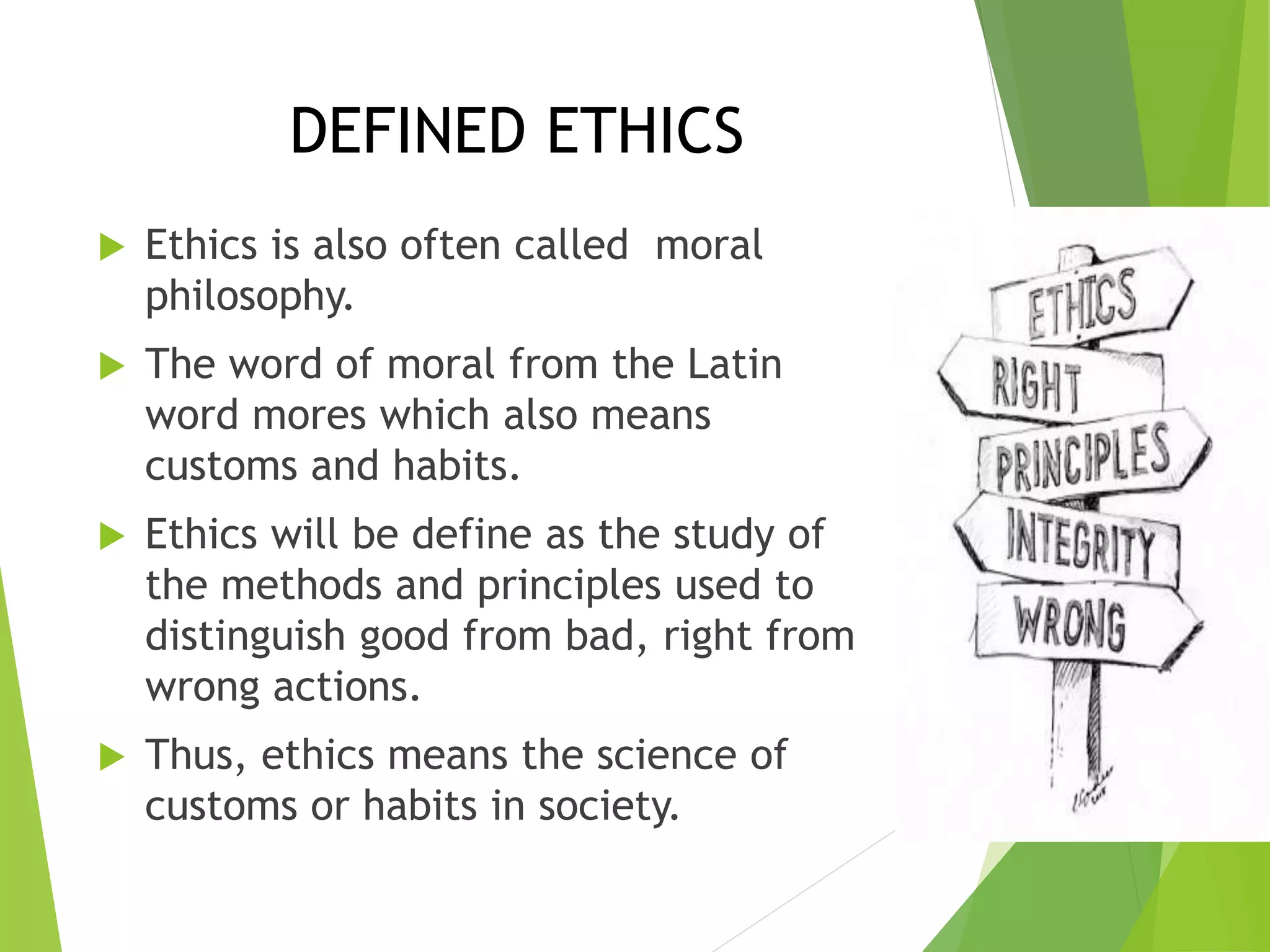
 Ethics is also often called moral
philosophy.
 The word of moral from the Latin
word mores which also means
customs and habits.
 Ethics will be define as the study of
the methods and principles used to
distinguish good from bad, right from
wrong actions.
 Thus, ethics means the science of
customs or habits in society.
THE ASSUMPTIONS OF ETHICS
 Like any other discipline, ethics
proceeds from some basic
assumptions.
 Assumptions are the
fundamentals beliefs or
statements that are accepted to
be true without burden of
proving or of proof.
 Most books concerning the study
of ethics present a long list of
assumptions.
THE TWO MOST IMPORTANT AND MOST
COMMON ASSUMPTION OF ETHICS
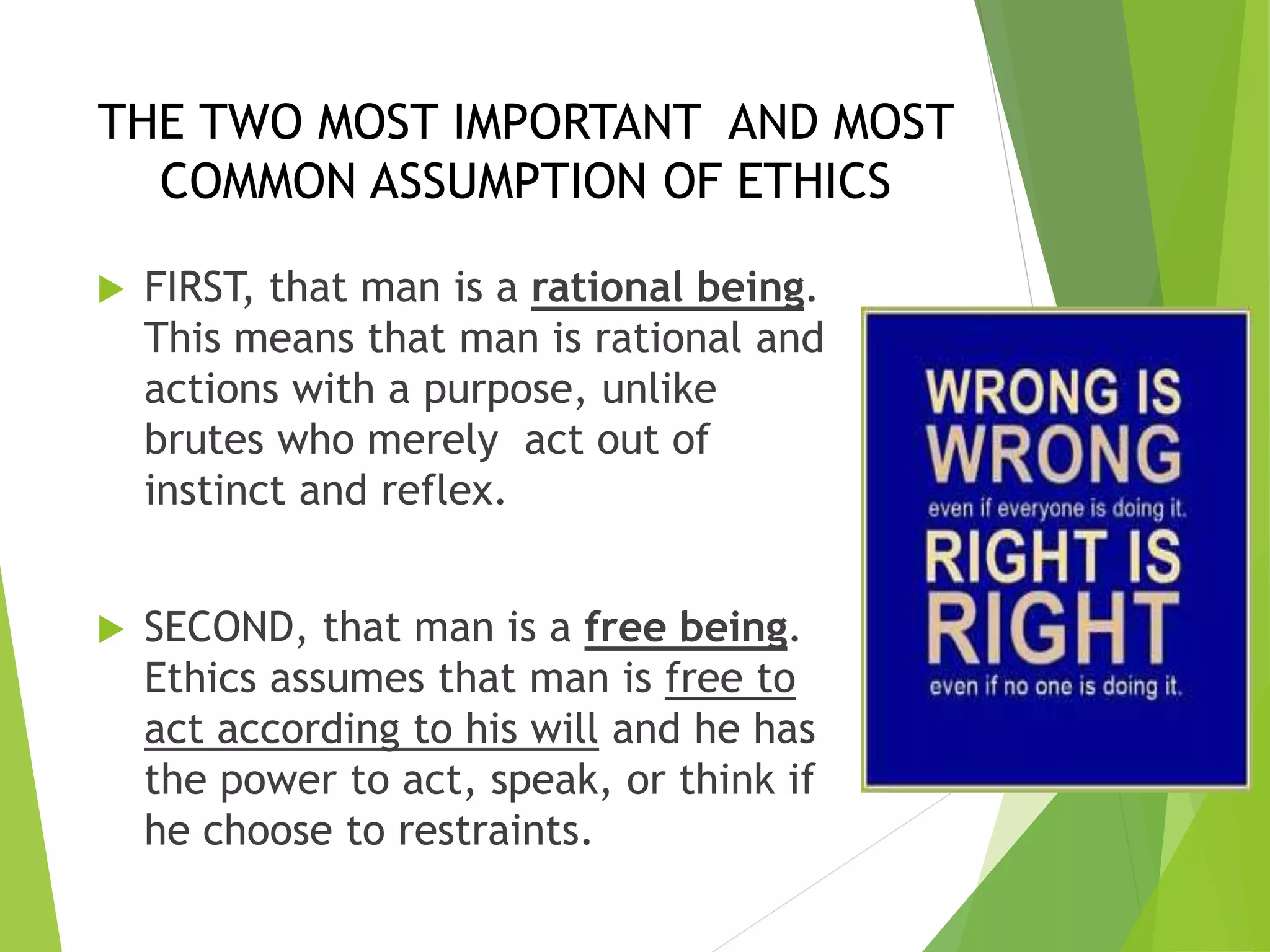
 FIRST, that man is a rational being.
This means that man is rational and
actions with a purpose, unlike
brutes who merely act out of
instinct and reflex.
 SECOND, that man is a free being.
Ethics assumes that man is free to
act according to his will and he has
the power to act, speak, or think if
he choose to restraints.
THE OBJECTS OF ETHICS
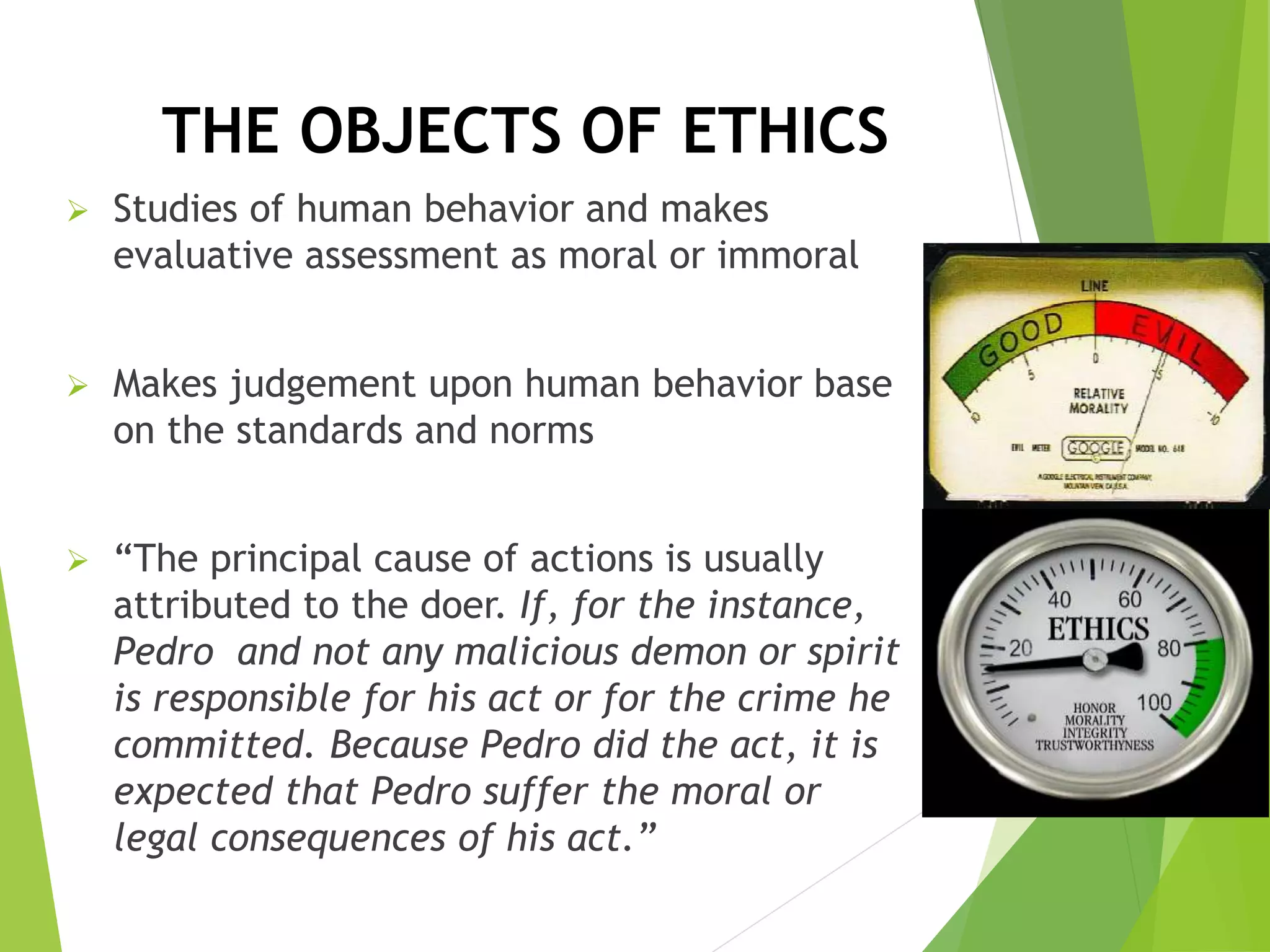
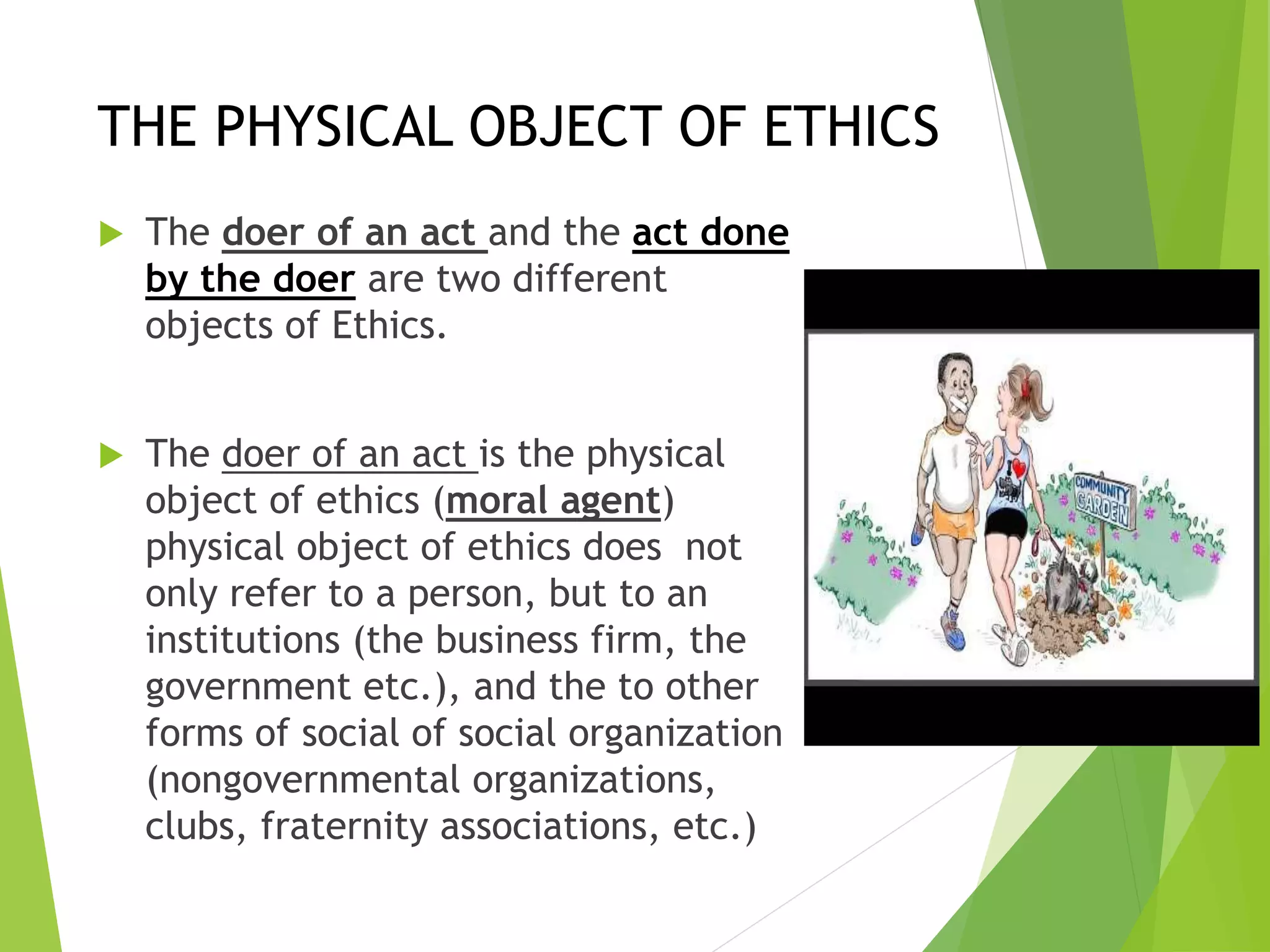
 Studies of human behavior and makes
evaluative assessment as moral or immoral
 Makes judgement upon human behavior base
on the standards and norms
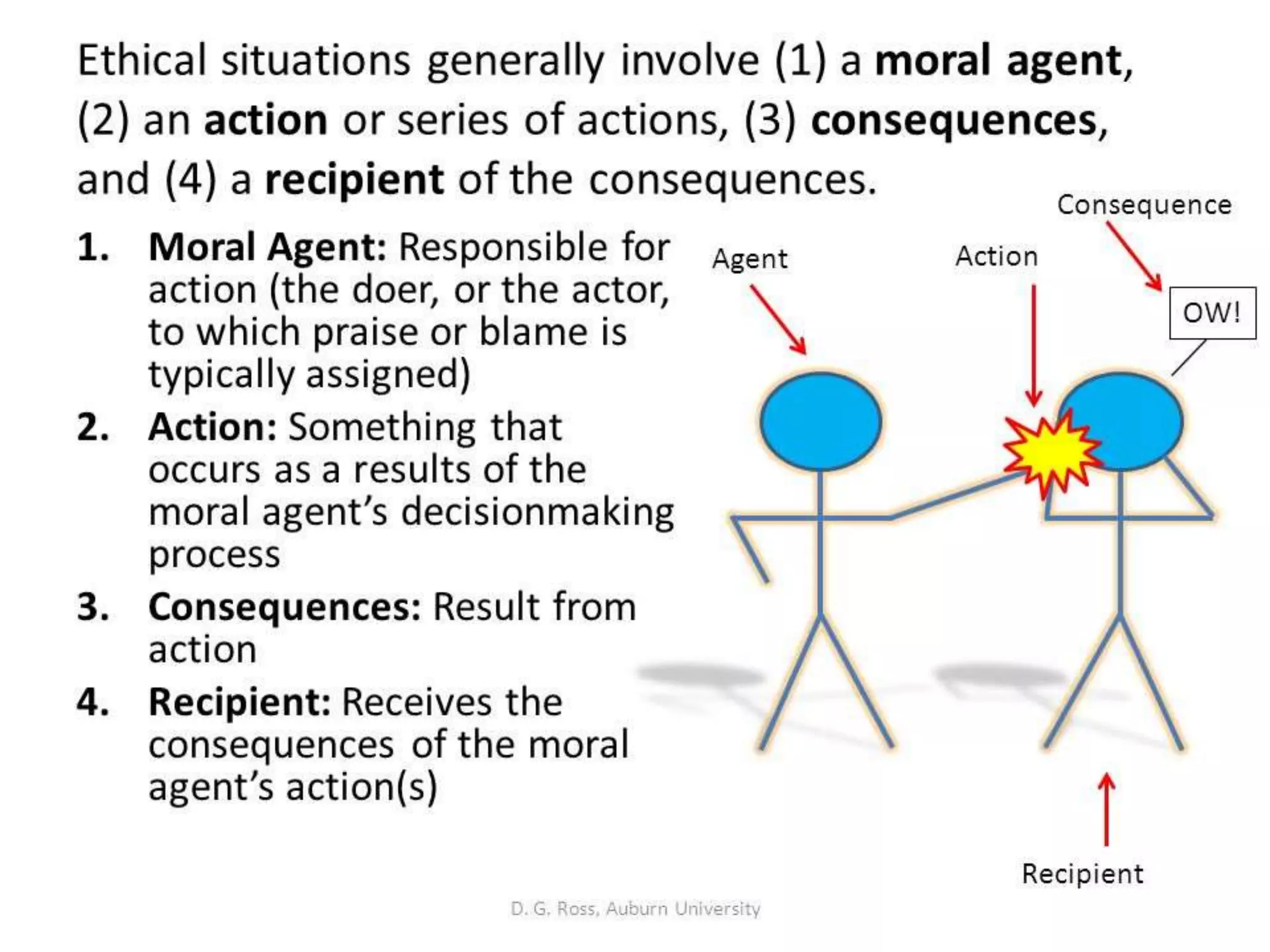
 “The principal cause of actions is usually
attributed to the doer. If, for the instance,
Pedro and not any malicious demon or spirit
is responsible for his act or for the crime he
committed. Because Pedro did the act, it is
expected that Pedro suffer the moral or
legal consequences of his act.”
THE PHYSICAL OBJECT OF ETHICS
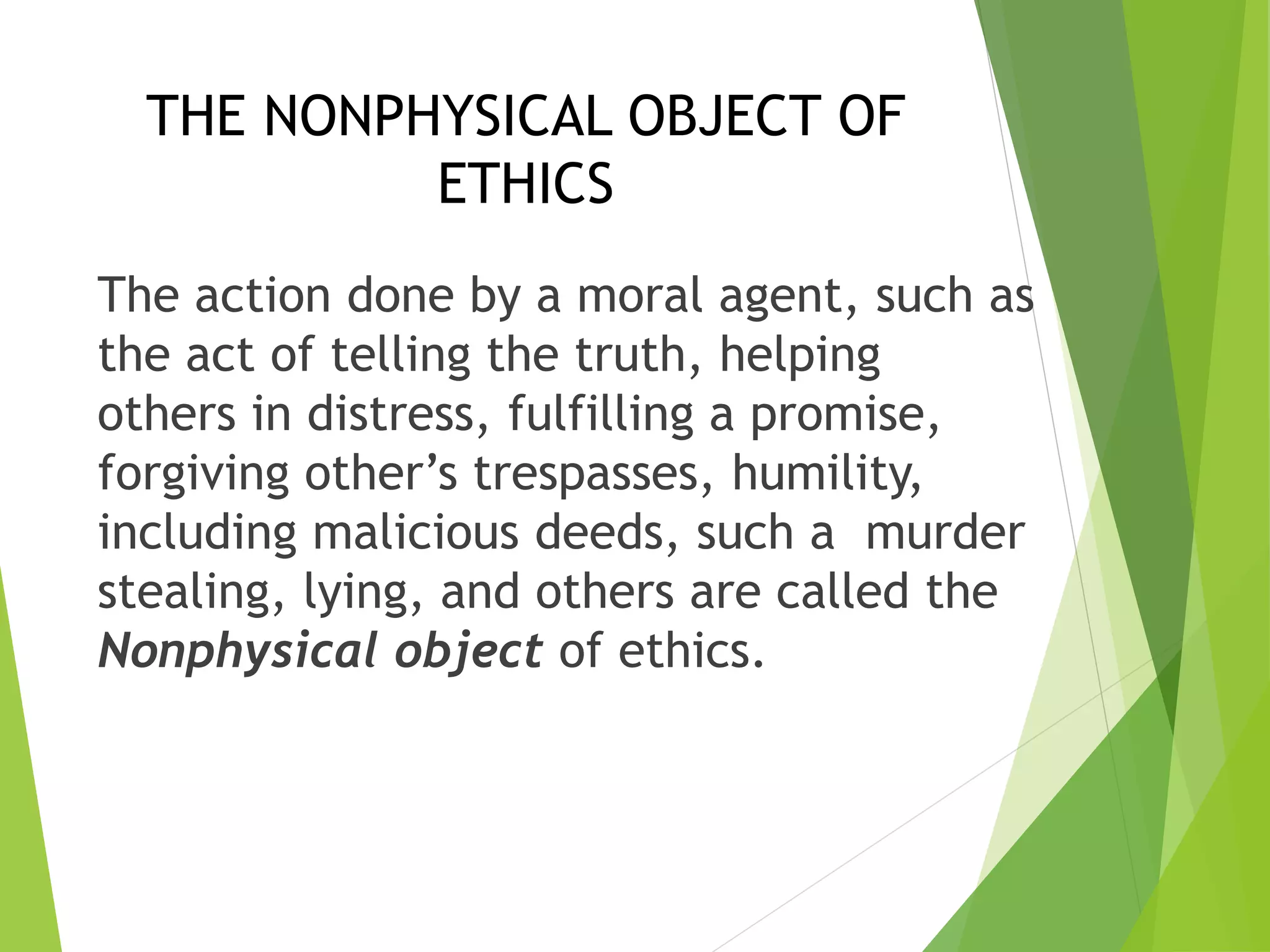
 The doer of an act and the act done
by the doer are two different
objects of Ethics.
 The doer of an act is the physical
object of ethics (moral agent)
physical object of ethics does not
only refer to a person, but to an
institutions (the business firm, the
government etc.), and the to other
forms of social of social organization
(nongovernmental organizations,
clubs, fraternity associations, etc.)
THE NONPHYSICAL OBJECT OF
ETHICS
The action done by a moral agent, such as
the act of telling the truth, helping
others in distress, fulfilling a promise,
forgiving other’s trespasses, humility,
including malicious deeds, such a murder
stealing, lying, and others are called the
Nonphysical object of ethics.
Two general forms of act
1. ACTS OF A MAN
1. Involuntary Natural Acts
ACTS OF MAN, are of two types: the
first type is called involuntary natural
acts. These include the involuntary,
intuitive or reflex acts exhibited by
man, such as the blinking of the eye,
the beating of the heart, sneezing,
yawning, breathing, scratching, and
others.
 Stop blinking for five to ten minutes
 Stop breathing for five to ten
minutes
 Stop your heart from breathing
 Stop your stomach from digesting
the food you have taken during
breakfast.
Try doing the following and confirm it
for yourself if they are indeed
voluntary
Voluntary Natural acts
 The second type of normal acts are
called voluntary acts. They include
voluntary and natural, but not
necessarily reflexive acts, such as
sleeping, eating drinking.
 Performs as part of our daily,
activities socially learned activities,
example : brushing our teeth,
combing our hair, cutting our nails
taking a bath etc.
2. HUMAN ACTS
The second general form of acts is
called human acts.
 Human are included actions that
are conscious, deliberate,
intentional, voluntary and are
within the preview of human value
judgement.
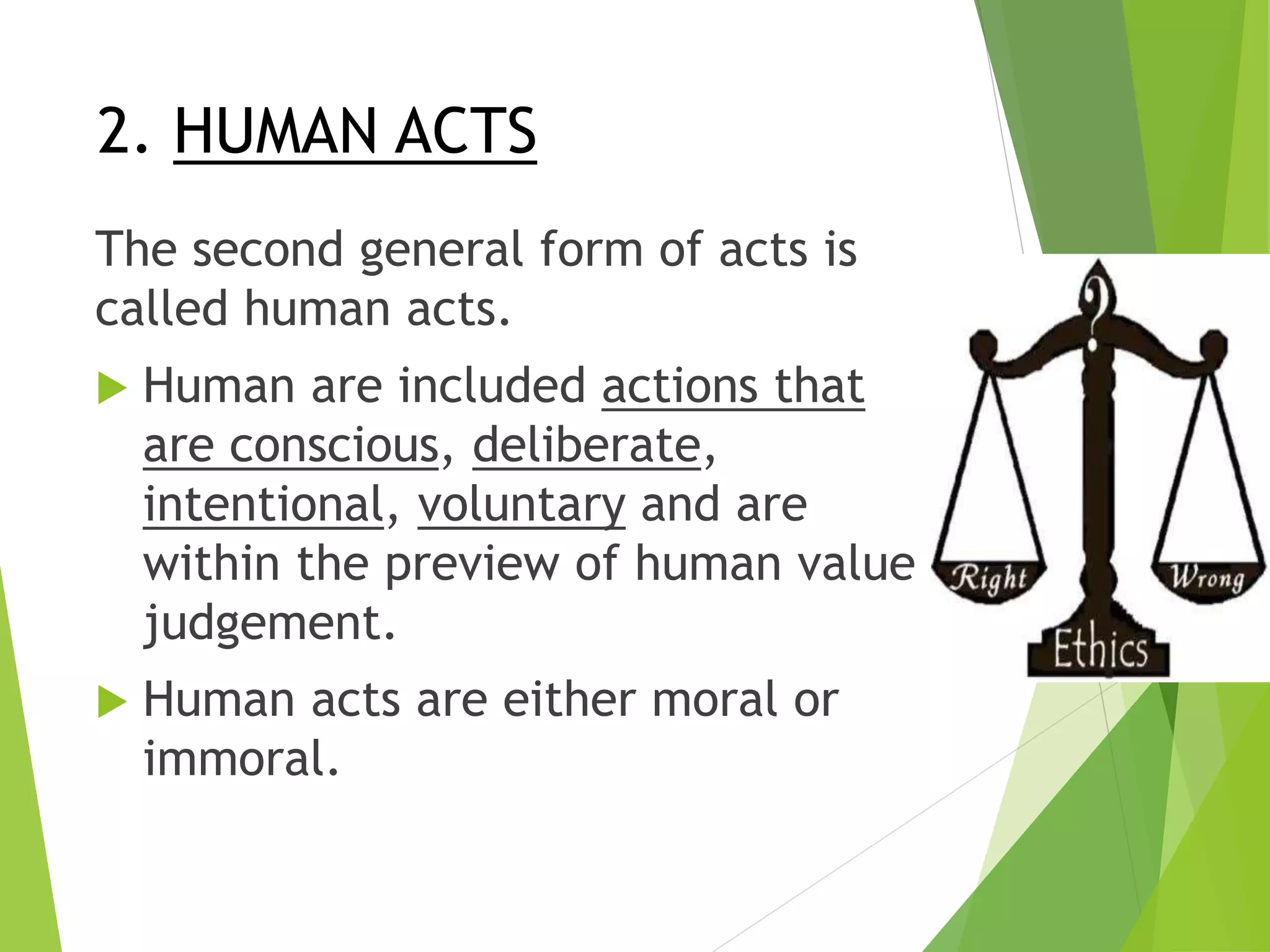
 Human acts are either moral or
immoral.
Classification of human acts
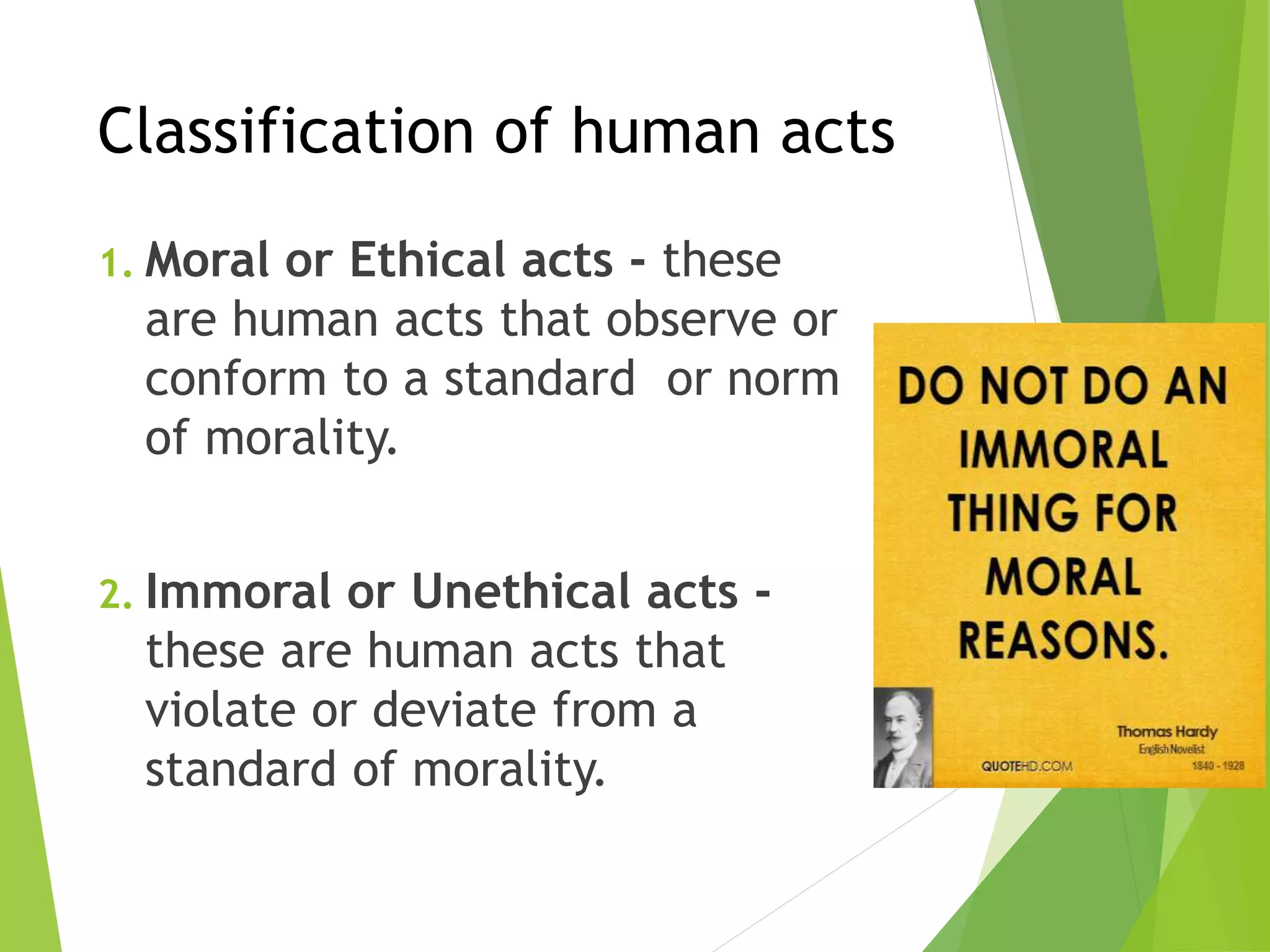
1. Moral or Ethical acts - these
are human acts that observe or
conform to a standard or norm
of morality.
2. Immoral or Unethical acts -
these are human acts that
violate or deviate from a
standard of morality.
Forms of Ethical
Analysis
DESCRIPTIVE ETHICS
It is more suited to empirical
sciences like sociology,
psychology, or political science as
it aims to discover what moral
beliefs are held by a given
society, social group or social
organization.
NORMATIVES ETHICS
Many part, philosophers believe that ethics
is for the most part, a normative study.
Normative study is not merely a description
of what people find morally good.
MAJOR NORMATIVE ETHICS
CONSIQUENTIALIST (TELEOLOGICAL) ETHICS
 This school of thought maintains that the morality
of an action is determined solely by its
consequences
example: Consequences is Utilitarianism
NONCONSIQUENTIALIST (DEONTOLOGICAL)ETHICS
 Deontological theories assert that the morality of
an action depend on its intrinsic nature, its
motives, or its accordance with so rules or
principles and not n its consequences
examples: Immanuel Kant’s Categorical
Imperative
FORMS OF ETHYCAL ANALYSIS
 AUTHORTARIAN ETHICS
 The Authoritarian Theory morality of appeals
to authority and force in determining what
constitute right from wrong, good from bad,
moral from immoral
 THEOLOGICAL ETHICS
 This holds that the will of God is what
determines the rightness and wrongness of an
act
 LEGALISM OF LEGALISTIC MORALITY
 Determines right from wrong, based on a body
of clearly state and well-documented body of
laws
FORMS OF ETHICAL ANALYSIS
 ETHICAL EGOISM
 Maintains that an action is right only if it is
in the interest of the agent of the doer of
the act.
 Ethical egoism is not a simple theory of
morality.
 SITUATONAL ETHICS
 Asserts that the morality of an action
depends on the situation and not the
application of moral laws to the case.
FORMS of ETHICS
PRACTICAL ETHICS
 Is a primarily concerned with
answering matter- of-fact
questions, such as the questions
posed by the situations presented
above.
 Is a essentially normative, that is .
It prescribes courses of action for
moral issue where clear answers
are lacking.
THEORETICAL ETHICS
 Is a primarily aims to study
the meaning of ethical
concepts such as good, right,
fairness, etc.
 Attempts to study of moral
acts, inquires into what
makes a right, and
determines the relation
between facts and values.
PERSONAL AND SOCIAL ETHICS
 Personal Ethics tries to study
how a person should act in
relation to himself,
 Social Ethics concerns how a
person should act in relation to
others, such a distinction rest
on differentiating between to
one’s self and duties to others.
Thank you!

Lesson 1 Introduction to Ethics.pptx

  • 1.
  • 2.
    THE ORIGIN OFETHICS  Ethics comes from the Greek word ethos, means character, customs or habit.  Ethics, in ancient Greece, was concerned with the development of a virtuous and moral character.  The great Greek moralist, Socrates, was the First recognize the value of questions that effect how a person should alive.  Socratic method consist of asking people questions about ideas they presumably know a about.
  • 3.
    DEFINED ETHICS  Ethicsis also often called moral philosophy.  The word of moral from the Latin word mores which also means customs and habits.  Ethics will be define as the study of the methods and principles used to distinguish good from bad, right from wrong actions.  Thus, ethics means the science of customs or habits in society.
  • 4.
    THE ASSUMPTIONS OFETHICS  Like any other discipline, ethics proceeds from some basic assumptions.  Assumptions are the fundamentals beliefs or statements that are accepted to be true without burden of proving or of proof.  Most books concerning the study of ethics present a long list of assumptions.
  • 5.
    THE TWO MOSTIMPORTANT AND MOST COMMON ASSUMPTION OF ETHICS  FIRST, that man is a rational being. This means that man is rational and actions with a purpose, unlike brutes who merely act out of instinct and reflex.  SECOND, that man is a free being. Ethics assumes that man is free to act according to his will and he has the power to act, speak, or think if he choose to restraints.
  • 6.
    THE OBJECTS OFETHICS  Studies of human behavior and makes evaluative assessment as moral or immoral  Makes judgement upon human behavior base on the standards and norms  “The principal cause of actions is usually attributed to the doer. If, for the instance, Pedro and not any malicious demon or spirit is responsible for his act or for the crime he committed. Because Pedro did the act, it is expected that Pedro suffer the moral or legal consequences of his act.”
  • 7.
    THE PHYSICAL OBJECTOF ETHICS  The doer of an act and the act done by the doer are two different objects of Ethics.  The doer of an act is the physical object of ethics (moral agent) physical object of ethics does not only refer to a person, but to an institutions (the business firm, the government etc.), and the to other forms of social of social organization (nongovernmental organizations, clubs, fraternity associations, etc.)
  • 8.
    THE NONPHYSICAL OBJECTOF ETHICS The action done by a moral agent, such as the act of telling the truth, helping others in distress, fulfilling a promise, forgiving other’s trespasses, humility, including malicious deeds, such a murder stealing, lying, and others are called the Nonphysical object of ethics.
  • 9.
  • 10.
    1. ACTS OFA MAN 1. Involuntary Natural Acts ACTS OF MAN, are of two types: the first type is called involuntary natural acts. These include the involuntary, intuitive or reflex acts exhibited by man, such as the blinking of the eye, the beating of the heart, sneezing, yawning, breathing, scratching, and others.
  • 11.
     Stop blinkingfor five to ten minutes  Stop breathing for five to ten minutes  Stop your heart from breathing  Stop your stomach from digesting the food you have taken during breakfast. Try doing the following and confirm it for yourself if they are indeed voluntary
  • 12.
    Voluntary Natural acts The second type of normal acts are called voluntary acts. They include voluntary and natural, but not necessarily reflexive acts, such as sleeping, eating drinking.  Performs as part of our daily, activities socially learned activities, example : brushing our teeth, combing our hair, cutting our nails taking a bath etc.
  • 13.
    2. HUMAN ACTS Thesecond general form of acts is called human acts.  Human are included actions that are conscious, deliberate, intentional, voluntary and are within the preview of human value judgement.  Human acts are either moral or immoral.
  • 14.
    Classification of humanacts 1. Moral or Ethical acts - these are human acts that observe or conform to a standard or norm of morality. 2. Immoral or Unethical acts - these are human acts that violate or deviate from a standard of morality.
  • 15.
  • 16.
    DESCRIPTIVE ETHICS It ismore suited to empirical sciences like sociology, psychology, or political science as it aims to discover what moral beliefs are held by a given society, social group or social organization.
  • 17.
    NORMATIVES ETHICS Many part,philosophers believe that ethics is for the most part, a normative study. Normative study is not merely a description of what people find morally good.
  • 19.
    MAJOR NORMATIVE ETHICS CONSIQUENTIALIST(TELEOLOGICAL) ETHICS  This school of thought maintains that the morality of an action is determined solely by its consequences example: Consequences is Utilitarianism NONCONSIQUENTIALIST (DEONTOLOGICAL)ETHICS  Deontological theories assert that the morality of an action depend on its intrinsic nature, its motives, or its accordance with so rules or principles and not n its consequences examples: Immanuel Kant’s Categorical Imperative
  • 21.
    FORMS OF ETHYCALANALYSIS  AUTHORTARIAN ETHICS  The Authoritarian Theory morality of appeals to authority and force in determining what constitute right from wrong, good from bad, moral from immoral  THEOLOGICAL ETHICS  This holds that the will of God is what determines the rightness and wrongness of an act  LEGALISM OF LEGALISTIC MORALITY  Determines right from wrong, based on a body of clearly state and well-documented body of laws
  • 22.
    FORMS OF ETHICALANALYSIS  ETHICAL EGOISM  Maintains that an action is right only if it is in the interest of the agent of the doer of the act.  Ethical egoism is not a simple theory of morality.  SITUATONAL ETHICS  Asserts that the morality of an action depends on the situation and not the application of moral laws to the case.
  • 23.
  • 24.
    PRACTICAL ETHICS  Isa primarily concerned with answering matter- of-fact questions, such as the questions posed by the situations presented above.  Is a essentially normative, that is . It prescribes courses of action for moral issue where clear answers are lacking.
  • 25.
    THEORETICAL ETHICS  Isa primarily aims to study the meaning of ethical concepts such as good, right, fairness, etc.  Attempts to study of moral acts, inquires into what makes a right, and determines the relation between facts and values.
  • 26.
    PERSONAL AND SOCIALETHICS  Personal Ethics tries to study how a person should act in relation to himself,  Social Ethics concerns how a person should act in relation to others, such a distinction rest on differentiating between to one’s self and duties to others.
  • 27.