1
Information Systems Planning
2
Opening Case: Kmart
• Issue: whether & how extending e-business
capabilities would revive the company’s
competitive position
• The IT initiatives must be based on
planning issues
– Aligning information systems with business
strategy
– Deciding what projects to do, etc.
3
The Process of Information
System Planning
4
What Is an Information Systems
Plan?
• Information systems planning should be an
integral part of business planning
– Business planning – the process of identifying
the firm’s goals, objectives, and priorities +
developing action plans for accomplishing
them.
– Information systems planning – the part of
business planning concerned with developing
the firm’s information systems resources
5
Challenges in Business Planning
• Foreseeing and assessing opportunities
• Assuring consistency with organizational
plans and objectives
• Building systems
• Maintaining information system
performance
• Collaborating with IT professionals
6
Principles for IS Planning
• Support the firm’s business strategy with
appropriate technical architecture
• Evaluate technology as a component of a
larger system
• Recognize life cycle costs, not just
acquisition costs
7
• Design information systems to be
maintainable
• Recognize the human side of technology
use
• Support and control the technical system
8
Planning Role of the IS and User
Departments
• The IS department is responsible for
producing the IS plan in conjunction with
the user departments
• Chief information officer (CIO)
– Leads the IS function, and is responsible for
making sure that the IS plan supports the firm's
business plan
9
• User roles in IS planning – roles:
– Sponsors – senior managers who make sure
resources are allocated for building and
maintaining the system
– Champions – individuals that recognize the
importance of an IS, and exert effort to make
sure that others share that recognition
– IS steering committees – make sure that the IS
reflects business priorities
10
Allocating Resources Between New
and Old ISs
• Maintaining existing ISs and supporting
users
– User support projects
– Enhancements
– Bug fixes
11
• New development, infrastructure, and other
projects
– Major new applications projects
– IT infrastructure
– Research projects
• Pilot project
12
Project Roles of IT Professionals
• Project managers
• Application
programmers
• System analysts
• Programmer-analyst
• Technical writers
• Computer operators
• Database
administrators
• System managers
• System
programmers
• User support staff
13
Strategic Alignment of Business
and IT
14
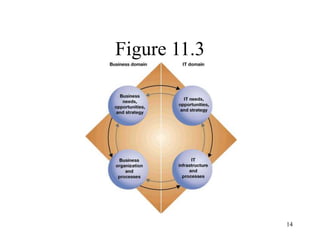
Figure 11.3
15
Consistency With Business Priorities
• Critical success factors (CSF) – the
things that must go right for a business to
succeed
– Identify the firm’s primary mission and the
objectives that determine satisfactory overall
performance
– Executives identify a relatively small number of
CSFs
16
Reengineering and Downsizing
• Business process reengineering (BPR) – the
fundamental rethinking and radical redesign of
business processes to achieve dramatic
improvements in critical measures of performance
– Difficult and risky
• Downsizing – improve process efficiency by
reducing the number of people involved in the
process
17
Enterprise-wide and
Interorganizational Systems
• Interorganizational systems – reflect the
customer and supplier aspects of the
integration issues addressed by ERP
systems
– Integration between ERP packages and supply
chain management
• Virtual organizations – major aspects of
core processes are outsourced to companies
that specialize in these areas
18
Information System Architecture
• The basic blueprint showing how the firm’s
data processing systems, networks, and data
are integrated
• Must incorporate legacy systems
– Old, and often obsolete systems that are still in use
• Computing platform
– The basic types of computers, operating system,
and network
19
Centralization vs.
Decentralization
• Location of hardware and data
– Corporate headquarters
– Regional processing centers
– Site processing centers
– Department processors
– Work group processors
– Individual workstations
20
• Standards, ownership, and guidelines for
action
• Position of the IS staff
21
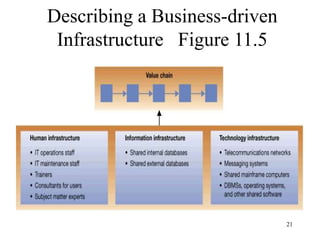
Describing a Business-driven
Infrastructure Figure 11.5
22
Outsourcing
• A long-standing practice in IS departments
• Application service provider (ASP)
– Operate a firm’s application on remote servers on a
WAN
– Advantage: the firm no longer needs to install and
maintain the software
– Disadvantage: the firm has less control over the
application, and may have difficulty transferring to
another ASP if needed
23
International Issues
• Technical incompatibilities
• Social and political issues
• Telecommunication issues
– Transborder data flow
• Economic issues
24
Selecting Systems to Invest In
25
Cost/Benefit Analysis
• The process of evaluating proposed projects
by comparing estimated benefits and costs
• Key issues:
– Tangible and intangible benefits
– Tendency to understate costs
– Timing of costs and benefits
26
Risks
• Desired benefits are not achieved
• The project is late and/or over budget
• The system’s technical performance is
inadequate
• User acceptance is low
• Shifting priorities reduce the project’s
importance, etc.
27
Financial Comparisons
• Some common criteria used for comparing
and ranking projects:
– Net present value (NPV)
– Internal rate of return (IRR)
– Payback
28
Project Management Issues
• Division of labor between the IS department
and users
• Keeping the project on schedule
– Goals, deliverables, schedules
– Challenges in information system projects
29
Systems Analysis Revisited
30
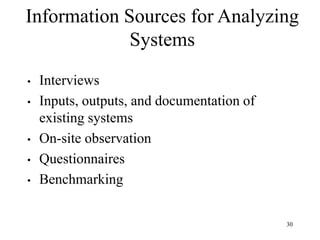
Information Sources for Analyzing
Systems
• Interviews
• Inputs, outputs, and documentation of
existing systems
• On-site observation
• Questionnaires
• Benchmarking

COMPUTER ORGANIZATION AND ARCHITECTURE NOTES

  • 1.
  • 2.
    2 Opening Case: Kmart •Issue: whether & how extending e-business capabilities would revive the company’s competitive position • The IT initiatives must be based on planning issues – Aligning information systems with business strategy – Deciding what projects to do, etc.
  • 3.
    3 The Process ofInformation System Planning
  • 4.
    4 What Is anInformation Systems Plan? • Information systems planning should be an integral part of business planning – Business planning – the process of identifying the firm’s goals, objectives, and priorities + developing action plans for accomplishing them. – Information systems planning – the part of business planning concerned with developing the firm’s information systems resources
  • 5.
    5 Challenges in BusinessPlanning • Foreseeing and assessing opportunities • Assuring consistency with organizational plans and objectives • Building systems • Maintaining information system performance • Collaborating with IT professionals
  • 6.
    6 Principles for ISPlanning • Support the firm’s business strategy with appropriate technical architecture • Evaluate technology as a component of a larger system • Recognize life cycle costs, not just acquisition costs
  • 7.
    7 • Design informationsystems to be maintainable • Recognize the human side of technology use • Support and control the technical system
  • 8.
    8 Planning Role ofthe IS and User Departments • The IS department is responsible for producing the IS plan in conjunction with the user departments • Chief information officer (CIO) – Leads the IS function, and is responsible for making sure that the IS plan supports the firm's business plan
  • 9.
    9 • User rolesin IS planning – roles: – Sponsors – senior managers who make sure resources are allocated for building and maintaining the system – Champions – individuals that recognize the importance of an IS, and exert effort to make sure that others share that recognition – IS steering committees – make sure that the IS reflects business priorities
  • 10.
    10 Allocating Resources BetweenNew and Old ISs • Maintaining existing ISs and supporting users – User support projects – Enhancements – Bug fixes
  • 11.
    11 • New development,infrastructure, and other projects – Major new applications projects – IT infrastructure – Research projects • Pilot project
  • 12.
    12 Project Roles ofIT Professionals • Project managers • Application programmers • System analysts • Programmer-analyst • Technical writers • Computer operators • Database administrators • System managers • System programmers • User support staff
  • 13.
  • 14.
  • 15.
    15 Consistency With BusinessPriorities • Critical success factors (CSF) – the things that must go right for a business to succeed – Identify the firm’s primary mission and the objectives that determine satisfactory overall performance – Executives identify a relatively small number of CSFs
  • 16.
    16 Reengineering and Downsizing •Business process reengineering (BPR) – the fundamental rethinking and radical redesign of business processes to achieve dramatic improvements in critical measures of performance – Difficult and risky • Downsizing – improve process efficiency by reducing the number of people involved in the process
  • 17.
    17 Enterprise-wide and Interorganizational Systems •Interorganizational systems – reflect the customer and supplier aspects of the integration issues addressed by ERP systems – Integration between ERP packages and supply chain management • Virtual organizations – major aspects of core processes are outsourced to companies that specialize in these areas
  • 18.
    18 Information System Architecture •The basic blueprint showing how the firm’s data processing systems, networks, and data are integrated • Must incorporate legacy systems – Old, and often obsolete systems that are still in use • Computing platform – The basic types of computers, operating system, and network
  • 19.
    19 Centralization vs. Decentralization • Locationof hardware and data – Corporate headquarters – Regional processing centers – Site processing centers – Department processors – Work group processors – Individual workstations
  • 20.
    20 • Standards, ownership,and guidelines for action • Position of the IS staff
  • 21.
  • 22.
    22 Outsourcing • A long-standingpractice in IS departments • Application service provider (ASP) – Operate a firm’s application on remote servers on a WAN – Advantage: the firm no longer needs to install and maintain the software – Disadvantage: the firm has less control over the application, and may have difficulty transferring to another ASP if needed
  • 23.
    23 International Issues • Technicalincompatibilities • Social and political issues • Telecommunication issues – Transborder data flow • Economic issues
  • 24.
  • 25.
    25 Cost/Benefit Analysis • Theprocess of evaluating proposed projects by comparing estimated benefits and costs • Key issues: – Tangible and intangible benefits – Tendency to understate costs – Timing of costs and benefits
  • 26.
    26 Risks • Desired benefitsare not achieved • The project is late and/or over budget • The system’s technical performance is inadequate • User acceptance is low • Shifting priorities reduce the project’s importance, etc.
  • 27.
    27 Financial Comparisons • Somecommon criteria used for comparing and ranking projects: – Net present value (NPV) – Internal rate of return (IRR) – Payback
  • 28.
    28 Project Management Issues •Division of labor between the IS department and users • Keeping the project on schedule – Goals, deliverables, schedules – Challenges in information system projects
  • 29.
  • 30.
    30 Information Sources forAnalyzing Systems • Interviews • Inputs, outputs, and documentation of existing systems • On-site observation • Questionnaires • Benchmarking