1
Class 8:
MAKETING MANAGEMENT
Instructor: Asso.Prof.Dr. Le Thi My Linh
Designing and Managing
Integrated Marketing
Communications
2
What are
Marketing Communications?
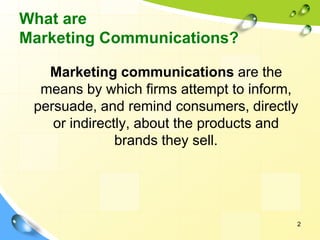
Marketing communications are the
means by which firms attempt to inform,
persuade, and remind consumers, directly
or indirectly, about the products and
brands they sell.
3
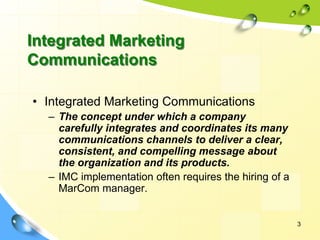
• Integrated Marketing Communications
– The concept under which a company
carefully integrates and coordinates its many
communications channels to deliver a clear,
consistent, and compelling message about
the organization and its products.
– IMC implementation often requires the hiring of a
MarCom manager.
Integrated Marketing
Communications
4
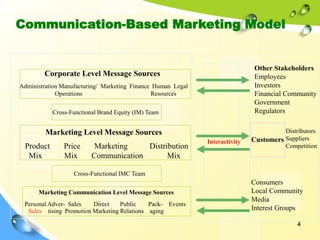
Corporate Level Message Sources
Administration Manufacturing/ Marketing Finance Human Legal
Operations Resources
Cross-Functional Brand Equity (IM) Team
Marketing Level Message Sources
Product Price Marketing Distribution
Mix Mix Communication Mix
Cross-Functional IMC Team
Marketing Communication Level Message Sources
Personal Adver- Sales Direct Public Pack- Events
Sales tising Promotion Marketing Relations aging
Interactivity
Other Stakeholders
Employees
Investors
Financial Community
Government
Regulators
Customers
Distributors
Suppliers
Competition
Consumers
Local Community
Media
Interest Groups
Communication-Based Marketing Model
5
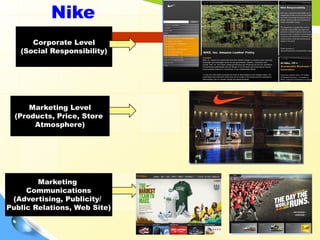
Marketing
Communications
(Advertising, Publicity/
Public Relations, Web Site)
Marketing Level
(Products, Price, Store
Atmosphere)
Corporate Level
(Social Responsibility)
Nike
6
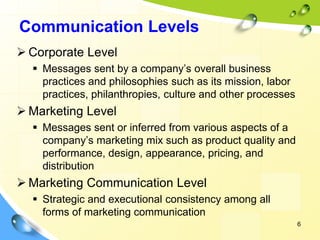
Communication Levels
➢ Corporate Level
▪ Messages sent by a company’s overall business
practices and philosophies such as its mission, labor
practices, philanthropies, culture and other processes
➢ Marketing Level
▪ Messages sent or inferred from various aspects of a
company’s marketing mix such as product quality and
performance, design, appearance, pricing, and
distribution
➢ Marketing Communication Level
▪ Strategic and executional consistency among all
forms of marketing communication
7
What is Integrated Marketing
Communications (IMC)?
IMC is a strategic business process used to:
▪ plan, develop, execute and evaluate coordinated,
measurable, persuasive brand communication
programs
▪ with consumers, customers, prospects
employees and other relevant external and
internal audiences
▪ goal is to generate short-term financial returns
and build long-term brand value
Dr. George Belch,San Diego State University
8
Marketing Communications Mix
• Advertising
• Sales promotion
• Events and
experiences
• Public relations and
publicity
• Direct marketing
• Interactive marketing
• Word-of-mouth
marketing
• Personal selling
12
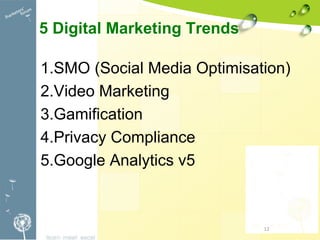
5 Digital Marketing Trends
1.SMO (Social Media Optimisation)
2.Video Marketing
3.Gamification
4.Privacy Compliance
5.Google Analytics v5
12
13
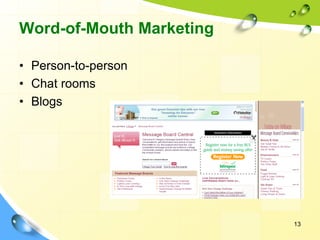
Word-of-Mouth Marketing
• Person-to-person
• Chat rooms
• Blogs
14
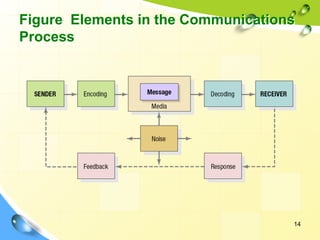
Figure Elements in the Communications
Process
15
The Communications Process
Selective attention
Selective distortion
Selective retention
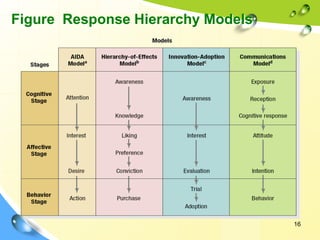
16
Figure Response Hierarchy Models
17
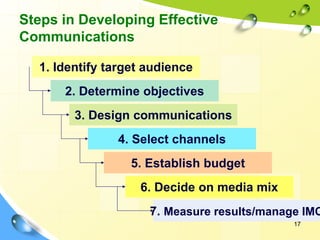
Steps in Developing Effective
Communications
1. Identify target audience
2. Determine objectives
3. Design communications
4. Select channels
5. Establish budget
6. Decide on media mix
7. Measure results/manage IMC
Step 1:
Identify Target Audience
• assessing the audience’s current image of the
company, the products, and the competitors.
– First step is to measure target audience’s knowledge of
the subject
– Second step is to determine feelings toward the product
• checking on the image variance:
Copyright Š 2011 Pearson
Step 2:
Communications Objectives
• Category need
• Brand awareness
• Brand attitude
• Purchase intention
20
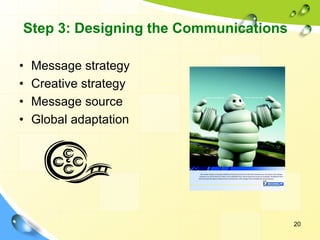
Step 3: Designing the Communications
• Message strategy
• Creative strategy
• Message source
• Global adaptation
j0349642
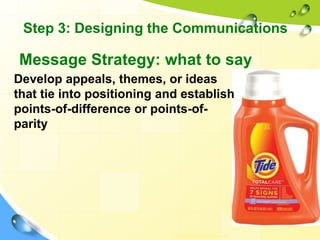
Message Strategy: what to say
Copyright Š 2011 Pearson
Develop appeals, themes, or ideas
that tie into positioning and establish
points-of-difference or points-of-
parity
Step 3: Designing the Communications
22
Creative Strategy: how to say
• Informational and transformational appeals:
– Informational: elaborates on attributes or
benefits
– Transformational: elaborates on a non-product-
related benefit or image
Step 3: Designing the Communications
23
– AIDA framework guides message design
– Message content contains appeals or themes
designed to produce desired results
• Rational appeals
• Emotional appeals (positive and negative)
– Love, pride, joy, humor, fear, guilt, shame
• Moral appeals
Step 3: Designing the Communications
Creative Strategy: how to say
24
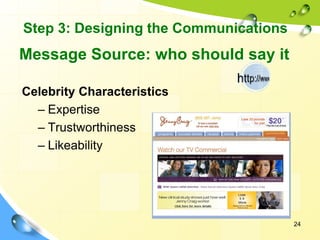
Message Source: who should say it
Celebrity Characteristics
– Expertise
– Trustworthiness
– Likeability
wwwcirc
Step 3: Designing the Communications
25
– Message Structure: Key decisions are required
with respect to three message structure issues:
• Whether or not to draw a conclusion
• One-sided vs. two-sided argument
• Order of argument presentation
– Message Format: Design, layout, copy, color,
shape, movement, words, sounds, voice, body
language, dress, etc.
Step 3: Designing the Communications
Evaluate the : Marketing
communication design?
• Is it original?
• Is it clear?
• Does it create the right feeling for the right
impression?
• Does the feeling of the creative solution fit
the brand personality?
(Does the design make the right
impression for your organisation?)
26
27
Does the design make the right
impression for your organisation?
• Does the design meet the requirement
which were established at the beginning of
the project?
– Is it appropriate for the target audience?
– Does it support the posionning goal?
– Does it describe the benefits of key features?
– Does it leave the viewer wiwth a dominant
uncluttered message?
28
Does the design make the right
impression for your organisation?
• Does the design convey the feeling which is
appropriate for positionning goal?
– Visual elements have personalities. Examine them
individually to see if they contribute to the goal
• Have the core identity elements been used
correctly?
• Have they been used in a way which
communicates your organization's identity
effectively?
29
• Step 4: Select channels
– Personal communication channels
• Includes face-to-face, phone, mail, and Internet chat
communications
• Word-of-mouth influence is often critical
• Buzz marketing cultivates opinion leaders
– Nonpersonal communication channels
• Includes media, atmosphere, and events
Developing Effective
Communication
30
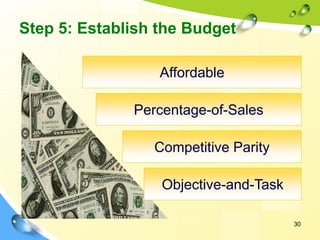
Step 5: Establish the Budget
Affordable
Percentage-of-Sales
Competitive Parity
Objective-and-Task
31
Objective-and-Task Method
• Establish the market share goal
• Determine the percentage that should be reached
• Determine the percentage of aware prospects that
should be persuaded to try the brand
• Determine the number of advertising impressions
per 1% trial rate
• Determine the number of gross rating points that
would have to be purchased
• Determine the necessary advertising budget on
the basis of the average cost of buying a GRP
32
• Checklist: Integrating the Promotion Mix
– Analyze trends (internal and external)
– Audit communications spending
– Identify all points of contact
– Team up in communications planning
– Make all communication elements compatible
– Create performance measures
– Appoint an IMC manager
Setting the Promotional Budget
and Mix
Step 6: Deciding on the Marketing
Communications Mix
❖Characteristics of the Marketing
Communications Mix (eight major modes of
communication)
❖Factors in Setting the Marketing
Communications Mix
Copyright Š 2011 Pearson
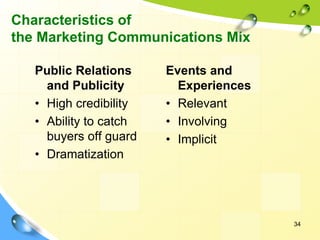
34
Characteristics of
the Marketing Communications Mix
Public Relations
and Publicity
• High credibility
• Ability to catch
buyers off guard
• Dramatization
Events and
Experiences
• Relevant
• Involving
• Implicit
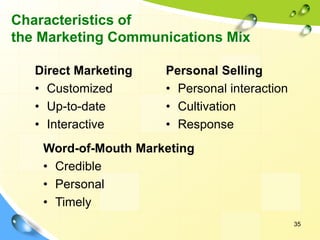
35
Characteristics of
the Marketing Communications Mix
Direct Marketing
• Customized
• Up-to-date
• Interactive
Personal Selling
• Personal interaction
• Cultivation
• Response
Word-of-Mouth Marketing
• Credible
• Personal
• Timely
Copyright Š 2011 Pearson
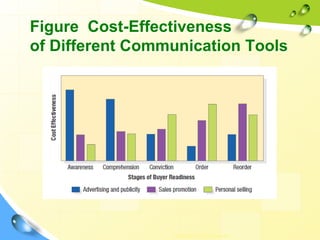
Factors in Setting
Communications Mix
• Type of product market
• Buyer readiness stage
• Product life cycle stage
Figure Cost-Effectiveness
of Different Communication Tools
Copyright Š 2011 Pearson
38
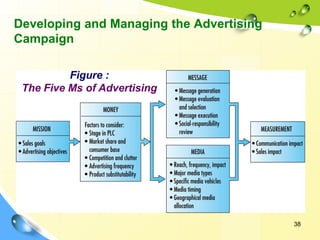
Developing and Managing the Advertising
Campaign
Figure :
The Five Ms of Advertising
39
Sales Promotion
• Sales promotions are short-term incentives
designed to stimulate purchase among
consumers or trade
• Purpose of sales promotion
– Attract new triers or brand switchers
– Reward loyal customers
– Increase repurchase rates
40
Sales Promotion
Prizes Coupons
POP Displays & Demonstrations
Cross-Promotions
Patronage Awards
Samples
Product Warranties
Cash Refunds
Free Trials
Premiums
Tie-in Promotions
Major
Consumer
Sales
Promotion
Tools
41
Direct Marketing
• Direct marketing uses consumer-direct channels
to reach and deliver offerings to consumers
without intermediaries.
• Direct marketing is growing and offers
consumers key benefits.
• Firms are recognizing the importance of
integrated direct marketing efforts.
Viral Marketing
• The digital version of word of mouth
marketing, videos, ads, and other
marketing content that is so infectious that
customers will seek it out or pass it along
to friends
• Eg. Google Android’s “Friends Furever”
video was shared more than 6.4 million
times in its first nice months making it the
most shared video of all the time
42
43
Social Media
▪ Online technologies and practices that
people use to share content, opinions,
insights, experiences, perspectives and
media themselves.
▪ Created, initiated, circulated and used by
consumers intent on educating one
another about products, brands, services,
people and issues
44
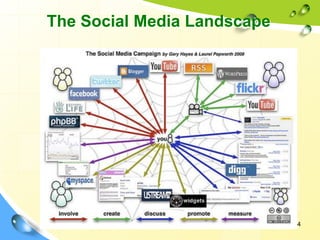
The Social Media Landscape
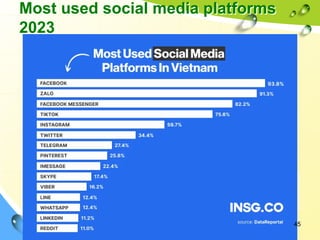
Most used social media platforms
2023
45
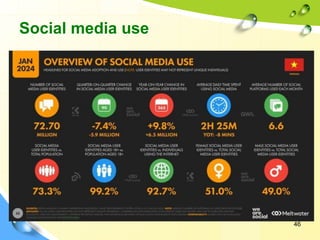
Social media use
46
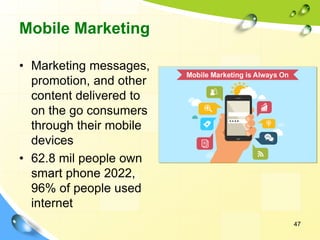
Mobile Marketing
• Marketing messages,
promotion, and other
content delivered to
on the go consumers
through their mobile
devices
• 62.8 mil people own
smart phone 2022,
96% of people used
internet
47
Communication tools vary at
different product life-cycle stages
– Introduction stage – most cost effective are
advertising, events and experiences, and
publicity
– Growth stage –all tools can be toned down
because word-of-mouth and interactive
marketing.
– Maturity stage: Advertising, events and
experiences and personal become more
important.
– Decline stage – sales promotion continues
strong, other communication tools are reduced
48
Step 7:
Measuring Communication Results
– Measure impact by measuring target
audience recall, impressions or feelings
about the message, and previous attitudes
versus current attitudes
– Collect behavioral measures of audience
response including transactional data and
word-of-mouth
49
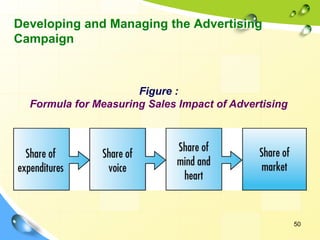
50
Developing and Managing the Advertising
Campaign
Figure :
Formula for Measuring Sales Impact of Advertising
For Review
• What is the role of marketing
communications?
• What are the major steps in developing
effective communications?
• What is the communications mix and how
should it be set?
• What is an integrated marketing
communications program?
Copyright Š 2011 Pearson

Class 8 marketing communication mkt mana

  • 1.
    1 Class 8: MAKETING MANAGEMENT Instructor:Asso.Prof.Dr. Le Thi My Linh Designing and Managing Integrated Marketing Communications
  • 2.
    2 What are Marketing Communications? Marketingcommunications are the means by which firms attempt to inform, persuade, and remind consumers, directly or indirectly, about the products and brands they sell.
  • 3.
    3 • Integrated MarketingCommunications – The concept under which a company carefully integrates and coordinates its many communications channels to deliver a clear, consistent, and compelling message about the organization and its products. – IMC implementation often requires the hiring of a MarCom manager. Integrated Marketing Communications
  • 4.
    4 Corporate Level MessageSources Administration Manufacturing/ Marketing Finance Human Legal Operations Resources Cross-Functional Brand Equity (IM) Team Marketing Level Message Sources Product Price Marketing Distribution Mix Mix Communication Mix Cross-Functional IMC Team Marketing Communication Level Message Sources Personal Adver- Sales Direct Public Pack- Events Sales tising Promotion Marketing Relations aging Interactivity Other Stakeholders Employees Investors Financial Community Government Regulators Customers Distributors Suppliers Competition Consumers Local Community Media Interest Groups Communication-Based Marketing Model
  • 5.
    5 Marketing Communications (Advertising, Publicity/ Public Relations,Web Site) Marketing Level (Products, Price, Store Atmosphere) Corporate Level (Social Responsibility) Nike
  • 6.
    6 Communication Levels ➢ CorporateLevel ▪ Messages sent by a company’s overall business practices and philosophies such as its mission, labor practices, philanthropies, culture and other processes ➢ Marketing Level ▪ Messages sent or inferred from various aspects of a company’s marketing mix such as product quality and performance, design, appearance, pricing, and distribution ➢ Marketing Communication Level ▪ Strategic and executional consistency among all forms of marketing communication
  • 7.
    7 What is IntegratedMarketing Communications (IMC)? IMC is a strategic business process used to: ▪ plan, develop, execute and evaluate coordinated, measurable, persuasive brand communication programs ▪ with consumers, customers, prospects employees and other relevant external and internal audiences ▪ goal is to generate short-term financial returns and build long-term brand value Dr. George Belch,San Diego State University
  • 8.
    8 Marketing Communications Mix •Advertising • Sales promotion • Events and experiences • Public relations and publicity • Direct marketing • Interactive marketing • Word-of-mouth marketing • Personal selling
  • 9.
    12 5 Digital MarketingTrends 1.SMO (Social Media Optimisation) 2.Video Marketing 3.Gamification 4.Privacy Compliance 5.Google Analytics v5 12
  • 10.
  • 11.
    14 Figure Elements inthe Communications Process
  • 12.
    15 The Communications Process Selectiveattention Selective distortion Selective retention
  • 13.
  • 14.
    17 Steps in DevelopingEffective Communications 1. Identify target audience 2. Determine objectives 3. Design communications 4. Select channels 5. Establish budget 6. Decide on media mix 7. Measure results/manage IMC
  • 15.
    Step 1: Identify TargetAudience • assessing the audience’s current image of the company, the products, and the competitors. – First step is to measure target audience’s knowledge of the subject – Second step is to determine feelings toward the product • checking on the image variance:
  • 16.
    Copyright © 2011Pearson Step 2: Communications Objectives • Category need • Brand awareness • Brand attitude • Purchase intention
  • 17.
    20 Step 3: Designingthe Communications • Message strategy • Creative strategy • Message source • Global adaptation j0349642
  • 18.
    Message Strategy: whatto say Copyright Š 2011 Pearson Develop appeals, themes, or ideas that tie into positioning and establish points-of-difference or points-of- parity Step 3: Designing the Communications
  • 19.
    22 Creative Strategy: howto say • Informational and transformational appeals: – Informational: elaborates on attributes or benefits – Transformational: elaborates on a non-product- related benefit or image Step 3: Designing the Communications
  • 20.
    23 – AIDA frameworkguides message design – Message content contains appeals or themes designed to produce desired results • Rational appeals • Emotional appeals (positive and negative) – Love, pride, joy, humor, fear, guilt, shame • Moral appeals Step 3: Designing the Communications Creative Strategy: how to say
  • 21.
    24 Message Source: whoshould say it Celebrity Characteristics – Expertise – Trustworthiness – Likeability wwwcirc Step 3: Designing the Communications
  • 22.
    25 – Message Structure:Key decisions are required with respect to three message structure issues: • Whether or not to draw a conclusion • One-sided vs. two-sided argument • Order of argument presentation – Message Format: Design, layout, copy, color, shape, movement, words, sounds, voice, body language, dress, etc. Step 3: Designing the Communications
  • 23.
    Evaluate the :Marketing communication design? • Is it original? • Is it clear? • Does it create the right feeling for the right impression? • Does the feeling of the creative solution fit the brand personality? (Does the design make the right impression for your organisation?) 26
  • 24.
    27 Does the designmake the right impression for your organisation? • Does the design meet the requirement which were established at the beginning of the project? – Is it appropriate for the target audience? – Does it support the posionning goal? – Does it describe the benefits of key features? – Does it leave the viewer wiwth a dominant uncluttered message?
  • 25.
    28 Does the designmake the right impression for your organisation? • Does the design convey the feeling which is appropriate for positionning goal? – Visual elements have personalities. Examine them individually to see if they contribute to the goal • Have the core identity elements been used correctly? • Have they been used in a way which communicates your organization's identity effectively?
  • 26.
    29 • Step 4:Select channels – Personal communication channels • Includes face-to-face, phone, mail, and Internet chat communications • Word-of-mouth influence is often critical • Buzz marketing cultivates opinion leaders – Nonpersonal communication channels • Includes media, atmosphere, and events Developing Effective Communication
  • 27.
    30 Step 5: Establishthe Budget Affordable Percentage-of-Sales Competitive Parity Objective-and-Task
  • 28.
    31 Objective-and-Task Method • Establishthe market share goal • Determine the percentage that should be reached • Determine the percentage of aware prospects that should be persuaded to try the brand • Determine the number of advertising impressions per 1% trial rate • Determine the number of gross rating points that would have to be purchased • Determine the necessary advertising budget on the basis of the average cost of buying a GRP
  • 29.
    32 • Checklist: Integratingthe Promotion Mix – Analyze trends (internal and external) – Audit communications spending – Identify all points of contact – Team up in communications planning – Make all communication elements compatible – Create performance measures – Appoint an IMC manager Setting the Promotional Budget and Mix
  • 30.
    Step 6: Decidingon the Marketing Communications Mix ❖Characteristics of the Marketing Communications Mix (eight major modes of communication) ❖Factors in Setting the Marketing Communications Mix Copyright © 2011 Pearson
  • 31.
    34 Characteristics of the MarketingCommunications Mix Public Relations and Publicity • High credibility • Ability to catch buyers off guard • Dramatization Events and Experiences • Relevant • Involving • Implicit
  • 32.
    35 Characteristics of the MarketingCommunications Mix Direct Marketing • Customized • Up-to-date • Interactive Personal Selling • Personal interaction • Cultivation • Response Word-of-Mouth Marketing • Credible • Personal • Timely
  • 33.
    Copyright © 2011Pearson Factors in Setting Communications Mix • Type of product market • Buyer readiness stage • Product life cycle stage
  • 34.
    Figure Cost-Effectiveness of DifferentCommunication Tools Copyright Š 2011 Pearson
  • 35.
    38 Developing and Managingthe Advertising Campaign Figure : The Five Ms of Advertising
  • 36.
    39 Sales Promotion • Salespromotions are short-term incentives designed to stimulate purchase among consumers or trade • Purpose of sales promotion – Attract new triers or brand switchers – Reward loyal customers – Increase repurchase rates
  • 37.
    40 Sales Promotion Prizes Coupons POPDisplays & Demonstrations Cross-Promotions Patronage Awards Samples Product Warranties Cash Refunds Free Trials Premiums Tie-in Promotions Major Consumer Sales Promotion Tools
  • 38.
    41 Direct Marketing • Directmarketing uses consumer-direct channels to reach and deliver offerings to consumers without intermediaries. • Direct marketing is growing and offers consumers key benefits. • Firms are recognizing the importance of integrated direct marketing efforts.
  • 39.
    Viral Marketing • Thedigital version of word of mouth marketing, videos, ads, and other marketing content that is so infectious that customers will seek it out or pass it along to friends • Eg. Google Android’s “Friends Furever” video was shared more than 6.4 million times in its first nice months making it the most shared video of all the time 42
  • 40.
    43 Social Media ▪ Onlinetechnologies and practices that people use to share content, opinions, insights, experiences, perspectives and media themselves. ▪ Created, initiated, circulated and used by consumers intent on educating one another about products, brands, services, people and issues
  • 41.
  • 42.
    Most used socialmedia platforms 2023 45
  • 43.
  • 44.
    Mobile Marketing • Marketingmessages, promotion, and other content delivered to on the go consumers through their mobile devices • 62.8 mil people own smart phone 2022, 96% of people used internet 47
  • 45.
    Communication tools varyat different product life-cycle stages – Introduction stage – most cost effective are advertising, events and experiences, and publicity – Growth stage –all tools can be toned down because word-of-mouth and interactive marketing. – Maturity stage: Advertising, events and experiences and personal become more important. – Decline stage – sales promotion continues strong, other communication tools are reduced 48
  • 46.
    Step 7: Measuring CommunicationResults – Measure impact by measuring target audience recall, impressions or feelings about the message, and previous attitudes versus current attitudes – Collect behavioral measures of audience response including transactional data and word-of-mouth 49
  • 47.
    50 Developing and Managingthe Advertising Campaign Figure : Formula for Measuring Sales Impact of Advertising
  • 48.
    For Review • Whatis the role of marketing communications? • What are the major steps in developing effective communications? • What is the communications mix and how should it be set? • What is an integrated marketing communications program? Copyright © 2011 Pearson