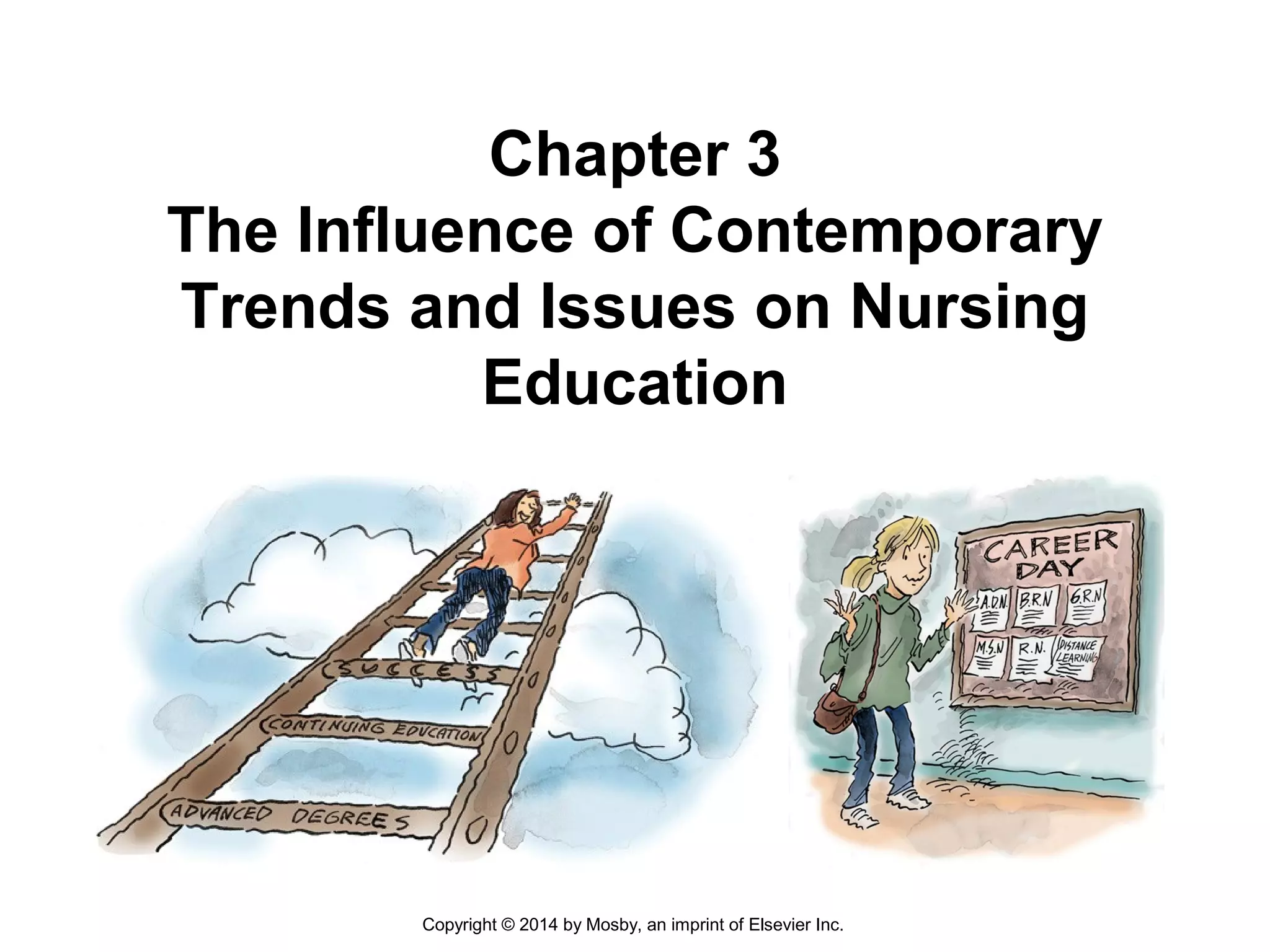
Chapter 3
The Influence of Contemporary
Trends and Issues on Nursing
Education
Copyright © 2014 by Mosby, an imprint of Elsevier Inc.
 Knowledge expansion, use of technology, the Internet
 Unlimited information is available
• Use of digital technology to guide patient care
 Requires more time and skill to navigate the Web, even though
most students have less time for study
• Peer to peer learning
 Faculty revising curriculum and courses
 More courses and degree programs delivered online
• Simulation to evaluate competency
 Increase in social media
• Code of ethics being developed by employers and professional
nursing organizations
 Informatics competencies developed
• QSEN
• NONPF
Trends and Issues in
Contemporary Nursing Education
Copyright © 2014 by Mosby, an imprint of Elsevier Inc. 2
 Practice-based competency outcomes
 Business world uses competency outcomes to set
directions and goals
 Students (nurses) must achieve the competency
outcomes that develop the skills actually needed in
practice
 Competence in realistic, practice-based outcomes is
the target
Trends and Issues in Contemporary
Nursing Education (cont'd)
Copyright © 2014 by Mosby, an imprint of Elsevier Inc. 3
 Outcomes approach is very different for students
and teachers
 Students must change from memorizing class notes
and readings to learning to integrate knowledge,
make decisions, and be competent and confident in
the abilities contained in course outcomes
Trends and Issues in Contemporary
Nursing Education (cont'd)
Copyright © 2014 by Mosby, an imprint of Elsevier Inc. 4
 Performance-based learning, assessment methods
 Related issues
• Changes in roles of teachers and learners
• Refocusing responsibility and accountability
• Shifting the perception of students from passive receivers of
information to active learners
 Skills required of nurses
• Problem solving
• Communication
• Teaching
• Caring
• Management
Trends and Issues in Contemporary
Nursing Education (cont'd)
Copyright © 2014 by Mosby, an imprint of Elsevier Inc. 5
 These skills are most effectively learned through
activities such as:
• Problem-based learning
• Case studies
• Diverse projects in many community agencies
 Evaluation is based on documenting competence
• Performance-based examinations
• Developing a structured portfolio
 Faculty issues
• Creating interactive learning strategies
• Creating performance examinations
Trends and Issues in
Contemporary Nursing Education
(cont'd)
Copyright © 2014 by Mosby, an imprint of Elsevier Inc. 6
 Sociodemographics, cultural diversity, economic and
political changes
 Aging population—people living longer
 Diverse population
• Use of traditional practitioners and treatments other than traditional
Western medicine
 Increasing number of people living in poverty, homeless, and/or
uninsured
 Disrespect for others
 Domestic abuse of women and children
 Various forms of violence in homes, schools, and public places
 Obesity epidemic
 Nontraditional families
Trends and Issues in Contemporary
Nursing Education (cont'd)
Copyright © 2014 by Mosby, an imprint of Elsevier Inc. 7
 Community-focused, interdisciplinary
approaches
 Interprofessional emphasis
 Influenced by efforts to reduce health care costs
 Shift from “illness care” to “health promotion”
 Challenge for faculty to prepare students to care for
critically ill patients in acute care, as well as culturally
diverse clients in community settings
 Global health
Trends and Issues in Contemporary
Nursing Education (cont'd)
Copyright © 2014 by Mosby, an imprint of Elsevier Inc. 8
 Consumer-oriented care: engagement, safety, and
privacy
 Shift from “giving care” to “working with” the patient as a
member of the health care team
 Increased number of medical errors leading to lawsuits have
supported the need to insist on competency-based
performance examinations in schools of nursing and as part of
employer evaluations and accreditation
 Ethics and bioethical concerns
 Different ways of responding to illness, care providers, and
therapies raise ethical issues of who is right and who has the
right to prevail
Trends and Issues in Contemporary
Nursing Education (cont'd)
Copyright © 2014 by Mosby, an imprint of Elsevier Inc. 9
 Diversity in backgrounds conveys diversity in interpretation of
behaviors, events, and language
 Faculty must teach ethical concepts, use case studies, guide
learning experiences, and focus discussions to explore ways of
interacting with patients who present behaviors that are very
different from the norm
 Shortage of nurses and faculty
 Trend over past decades
 Consequence is medical errors
 Current workforce is older, with fewer nurses available
 Fewer qualified preceptors for students
Trends and Issues in Contemporary
Nursing Education (cont'd)
10Copyright © 2014 by Mosby, an imprint of Elsevier Inc.
 Disasters, violence, and terrorism
 Domestic violence has increased
 Violence in the workplace and schools
 More mass disasters such as hurricanes, floods, and
earthquakes
 Nurses need to be prepared to function effectively
with other first responders
11Copyright © 2014 by Mosby, an imprint of Elsevier Inc.
Trends and Issues in Contemporary
Nursing Education (cont'd)
 Explosion of new information and technology
 Interactive out of class learning
 New health information technology
 Multiple care settings
 Increasing responsibilities for aging parents and children
 Professional requirements to stay current and pursue
professional development
 Higher stress related to personal and professional
demands
 Importance of self-care and “caring communities”
Increasing Professional and
Personal Responsibilities
Copyright © 2014 by Mosby, an imprint of Elsevier Inc. 12
1. A nurse is preparing to talk at a community meeting about
current trends that affect nursing and nursing education. Which
of the following should be included in this discussion?
A. Citizens are living longer, resulting in a shift in nursing practice
from community-based care to the acute care setting.
B. As our population is becoming more diverse in ethnicity, sexual
preference, and how family is defined, ethical decisions are less
clear because the values and preferences of the individual who
is seeking care must be taken into consideration.
C. Fewer individuals are choosing and entering nursing, which is
causing a near-crisis situation in terms of the nursing shortage.
D. The focus of caring for individuals suffering from domestic
violence continues to decrease, with an increase in the need to
be competent in biochemical containments in the event of
terrorist acts.
Copyright © 2014 by Mosby, an imprint of Elsevier Inc. 13
 Licensed practical nurse/licensed vocational
nurse (LPN/LVN) programs
 Shortest programs that prepare students for
licensure
 LPN/LVN programs are 9 to 12 months long and
focus on technical aspects of nursing care
 State boards of nursing set scope of practice in each
state
Major Types of Education
Programs
Copyright © 2014 by Mosby, an imprint of Elsevier Inc. 14
 Hospital diploma programs
 Linda Richards: the first nursing diploma graduate in
1873; began the movement of nurses teaching and
supervising nurses rather than those functions being
the exclusive domain of physicians
 Length of program was 1 to 2 years in the late 1800s
but subsequently changed to 3 calendar years of
practice and study
Major Types of Education
Programs (cont'd)
Copyright © 2014 by Mosby, an imprint of Elsevier Inc. 15
 All classes/experiences were under the authority of the
funding hospital
 Operated as apprenticeship programs to meet staffing
needs of the hospital until more recent times when
education took a more primary role
 Number has drastically declined because of changes in
the marketplace and a new concept of nursing education
 As programs are phasing out, some have partnered with
community colleges to provide an associate degree, and
some have become college programs
 In 2012, only 64 diploma programs remained in the U.S.
• Only 78% are accredited programs
Major Types of Education
Programs (cont'd)
Copyright © 2014 by Mosby, an imprint of Elsevier Inc. 16
 Associate degree programs
 Developed in the 1950s to shift nursing education
from the vocational and apprenticeship orientation of
LPN/LVN and hospital diploma schools to the college
environment
 Require 2 years of academic study with 2 semesters
of liberal arts and sciences
 Today largest percentage of nurses are ADN
graduates
Major Types of Education
Programs (cont'd)
Copyright © 2014 by Mosby, an imprint of Elsevier Inc. 17
 Baccalaureate degree programs
 First nursing program in a collegiate setting opened in 1909 at
University of Minnesota as a diploma school under the College
of Medicine; completion did not result in a college degree
 In 1924 Yale University had first separate department of nursing
and offered the first BSN degree
 BSN programs were developed on the premise that nurses could
provide more comprehensive and compassionate care if they
had a foundation in the arts and sciences
 BSNs require 2 years of arts and sciences and 2 years of
nursing courses and completion of 126 to 136 credits
 In 2008 about 610 generic, and 621 RN-BSN programs were
available
 In 2011 there were and 235 accelerated programs and 33 in
planning stage
Major Types of Education
Programs (cont'd)
Copyright © 2014 by Mosby, an imprint of Elsevier Inc. 18
 Master’s degree nursing programs
 Developed because of increasing complexity of health care and
need for nurse educators, administrators, expert clinicians
 National and federal recognition of the shortage of master’s- and
doctorate-prepared nurses led to increased funding for programs
and individual students
• Health Amendment Act of 1956 provided education funds for RNs to
prepare for positions in teaching, supervision, and administration
• Nurse Practice Act of 1964 provided construction costs for nursing
school buildings and funds for traineeships and fellowships for
nurses to obtain advanced degrees for positions in education,
administration, practice, and research
• Most MSN programs prepare advanced nurse practitioners and
clinical specialists
Major Types of Education
Programs (cont'd)
Copyright © 2014 by Mosby, an imprint of Elsevier Inc. 19
 LACE Report–Model of Regulation
 Licensure, accreditation of programs, certification and
education programs
 4 APRN Roles
• Nurse anesthetist
• Nurse midwife
• Clinical nurse specialist
• Nurse practitioner
Major Types of Education
Programs (cont'd)
Copyright © 2014 by Mosby, an imprint of Elsevier Inc. 20
 Clinical nurse leader program
 New role
 White paper on CNL 2007
 2007 AACN began certifying CNL’s
 Academic and practice partners are working together
to develop academic programs and to integrate CNLs
into health care systems
 Master’s prepared generalist clinician
• As of 2011 there were 99 programs across the county
• As of February 2012 there are 1926 certified CNL’s
Major Types of Education
Programs (cont'd)
Copyright © 2014 by Mosby, an imprint of Elsevier Inc. 21
 Types of MSN programs
 Most require BSN for admission
 2011–63 accelerated master’s programs and 10 in
planning stage
 RN to MSN
• Vanderbilt
• University of Maryland
 Bachelor’s degree in any field to MSN
• Yale University
• University of Tennessee
• University of Texas at Austin
Major Types of
Education Programs (cont'd)
22Copyright © 2014 by Mosby, an imprint of Elsevier Inc.
 Doctoral degree programs
 Undergone major changes during the past 4 decades
 For many years the only program was offered by
Teachers College, Columbia University; the first nurse
graduated in 1932 with an EdD degree in nursing
education
 More than 30 years elapsed before doctoral programs
in the discipline of nursing were offered, resulting in
the doctor of nursing science degree (DNS, DNSc)
 By the 1990s the number of universities offering the
EdD degree declined and the number of nursing
doctoral degree programs increased to more than 50
Major Types of Education
Programs (cont'd)
Copyright © 2014 by Mosby, an imprint of Elsevier Inc. 23
 Two doctoral degree options
• Doctor of Philosophy (PhD)—for students interested in
research and generating new knowledge
• Doctor of Nursing Practice (DNP)—for students
interested in advanced clinical nursing practice and
clinical leadership
 As of 2012 there were 184 programs in 40 states
– 65 accredited programs and 110 programs pursuing
accreditation
 AACN position statement—by 2015 DNP should be the
entry into advanced practice nursing
Major Types of Education
Programs (cont'd)
Copyright © 2014 by Mosby, an imprint of Elsevier Inc. 24
 Distance mobility programs
 External degree model
 Makes it possible for experienced adult learners to
earn one of many degrees, including ADN and BSN,
by taking college level examinations or by combining
college coursework with specialized standardized and
performance examinations without attending class
 Known as “classroom without walls”
• Excelsior College: previously known as the New York
Regents College
• University of Phoenix Online
Flexible Education Mobility and
Distance Learning Programs
Copyright © 2014 by Mosby, an imprint of Elsevier Inc. 25
2. An RN received a diploma as entry into
professional nursing. The RN was able to
progress to an academic degree by completing
an RN-to-BSN program. This progression from
diploma preparation to an academic degree is
known as:
A. Performance-based assessment
B. Educational mobility
C. Practice-based competency
D. Continuing education
Copyright © 2014 by Mosby, an imprint of Elsevier Inc. 26
 Challenges for students
 Access to current technology and the time, money,
and ability to use it
 Students must have discipline and determination
 Career ladder programs
 Systems that offer a stepwise progression within a
single school
Flexible Education Mobility and
Distance Learning Programs
(cont'd)
Copyright © 2014 by Mosby, an imprint of Elsevier Inc. 27

Chapter 03

  • 1.
    Chapter 3 The Influenceof Contemporary Trends and Issues on Nursing Education Copyright © 2014 by Mosby, an imprint of Elsevier Inc.
  • 2.
     Knowledge expansion,use of technology, the Internet  Unlimited information is available • Use of digital technology to guide patient care  Requires more time and skill to navigate the Web, even though most students have less time for study • Peer to peer learning  Faculty revising curriculum and courses  More courses and degree programs delivered online • Simulation to evaluate competency  Increase in social media • Code of ethics being developed by employers and professional nursing organizations  Informatics competencies developed • QSEN • NONPF Trends and Issues in Contemporary Nursing Education Copyright © 2014 by Mosby, an imprint of Elsevier Inc. 2
  • 3.
     Practice-based competencyoutcomes  Business world uses competency outcomes to set directions and goals  Students (nurses) must achieve the competency outcomes that develop the skills actually needed in practice  Competence in realistic, practice-based outcomes is the target Trends and Issues in Contemporary Nursing Education (cont'd) Copyright © 2014 by Mosby, an imprint of Elsevier Inc. 3
  • 4.
     Outcomes approachis very different for students and teachers  Students must change from memorizing class notes and readings to learning to integrate knowledge, make decisions, and be competent and confident in the abilities contained in course outcomes Trends and Issues in Contemporary Nursing Education (cont'd) Copyright © 2014 by Mosby, an imprint of Elsevier Inc. 4
  • 5.
     Performance-based learning,assessment methods  Related issues • Changes in roles of teachers and learners • Refocusing responsibility and accountability • Shifting the perception of students from passive receivers of information to active learners  Skills required of nurses • Problem solving • Communication • Teaching • Caring • Management Trends and Issues in Contemporary Nursing Education (cont'd) Copyright © 2014 by Mosby, an imprint of Elsevier Inc. 5
  • 6.
     These skillsare most effectively learned through activities such as: • Problem-based learning • Case studies • Diverse projects in many community agencies  Evaluation is based on documenting competence • Performance-based examinations • Developing a structured portfolio  Faculty issues • Creating interactive learning strategies • Creating performance examinations Trends and Issues in Contemporary Nursing Education (cont'd) Copyright © 2014 by Mosby, an imprint of Elsevier Inc. 6
  • 7.
     Sociodemographics, culturaldiversity, economic and political changes  Aging population—people living longer  Diverse population • Use of traditional practitioners and treatments other than traditional Western medicine  Increasing number of people living in poverty, homeless, and/or uninsured  Disrespect for others  Domestic abuse of women and children  Various forms of violence in homes, schools, and public places  Obesity epidemic  Nontraditional families Trends and Issues in Contemporary Nursing Education (cont'd) Copyright © 2014 by Mosby, an imprint of Elsevier Inc. 7
  • 8.
     Community-focused, interdisciplinary approaches Interprofessional emphasis  Influenced by efforts to reduce health care costs  Shift from “illness care” to “health promotion”  Challenge for faculty to prepare students to care for critically ill patients in acute care, as well as culturally diverse clients in community settings  Global health Trends and Issues in Contemporary Nursing Education (cont'd) Copyright © 2014 by Mosby, an imprint of Elsevier Inc. 8
  • 9.
     Consumer-oriented care:engagement, safety, and privacy  Shift from “giving care” to “working with” the patient as a member of the health care team  Increased number of medical errors leading to lawsuits have supported the need to insist on competency-based performance examinations in schools of nursing and as part of employer evaluations and accreditation  Ethics and bioethical concerns  Different ways of responding to illness, care providers, and therapies raise ethical issues of who is right and who has the right to prevail Trends and Issues in Contemporary Nursing Education (cont'd) Copyright © 2014 by Mosby, an imprint of Elsevier Inc. 9
  • 10.
     Diversity inbackgrounds conveys diversity in interpretation of behaviors, events, and language  Faculty must teach ethical concepts, use case studies, guide learning experiences, and focus discussions to explore ways of interacting with patients who present behaviors that are very different from the norm  Shortage of nurses and faculty  Trend over past decades  Consequence is medical errors  Current workforce is older, with fewer nurses available  Fewer qualified preceptors for students Trends and Issues in Contemporary Nursing Education (cont'd) 10Copyright © 2014 by Mosby, an imprint of Elsevier Inc.
  • 11.
     Disasters, violence,and terrorism  Domestic violence has increased  Violence in the workplace and schools  More mass disasters such as hurricanes, floods, and earthquakes  Nurses need to be prepared to function effectively with other first responders 11Copyright © 2014 by Mosby, an imprint of Elsevier Inc. Trends and Issues in Contemporary Nursing Education (cont'd)
  • 12.
     Explosion ofnew information and technology  Interactive out of class learning  New health information technology  Multiple care settings  Increasing responsibilities for aging parents and children  Professional requirements to stay current and pursue professional development  Higher stress related to personal and professional demands  Importance of self-care and “caring communities” Increasing Professional and Personal Responsibilities Copyright © 2014 by Mosby, an imprint of Elsevier Inc. 12
  • 13.
    1. A nurseis preparing to talk at a community meeting about current trends that affect nursing and nursing education. Which of the following should be included in this discussion? A. Citizens are living longer, resulting in a shift in nursing practice from community-based care to the acute care setting. B. As our population is becoming more diverse in ethnicity, sexual preference, and how family is defined, ethical decisions are less clear because the values and preferences of the individual who is seeking care must be taken into consideration. C. Fewer individuals are choosing and entering nursing, which is causing a near-crisis situation in terms of the nursing shortage. D. The focus of caring for individuals suffering from domestic violence continues to decrease, with an increase in the need to be competent in biochemical containments in the event of terrorist acts. Copyright © 2014 by Mosby, an imprint of Elsevier Inc. 13
  • 14.
     Licensed practicalnurse/licensed vocational nurse (LPN/LVN) programs  Shortest programs that prepare students for licensure  LPN/LVN programs are 9 to 12 months long and focus on technical aspects of nursing care  State boards of nursing set scope of practice in each state Major Types of Education Programs Copyright © 2014 by Mosby, an imprint of Elsevier Inc. 14
  • 15.
     Hospital diplomaprograms  Linda Richards: the first nursing diploma graduate in 1873; began the movement of nurses teaching and supervising nurses rather than those functions being the exclusive domain of physicians  Length of program was 1 to 2 years in the late 1800s but subsequently changed to 3 calendar years of practice and study Major Types of Education Programs (cont'd) Copyright © 2014 by Mosby, an imprint of Elsevier Inc. 15
  • 16.
     All classes/experienceswere under the authority of the funding hospital  Operated as apprenticeship programs to meet staffing needs of the hospital until more recent times when education took a more primary role  Number has drastically declined because of changes in the marketplace and a new concept of nursing education  As programs are phasing out, some have partnered with community colleges to provide an associate degree, and some have become college programs  In 2012, only 64 diploma programs remained in the U.S. • Only 78% are accredited programs Major Types of Education Programs (cont'd) Copyright © 2014 by Mosby, an imprint of Elsevier Inc. 16
  • 17.
     Associate degreeprograms  Developed in the 1950s to shift nursing education from the vocational and apprenticeship orientation of LPN/LVN and hospital diploma schools to the college environment  Require 2 years of academic study with 2 semesters of liberal arts and sciences  Today largest percentage of nurses are ADN graduates Major Types of Education Programs (cont'd) Copyright © 2014 by Mosby, an imprint of Elsevier Inc. 17
  • 18.
     Baccalaureate degreeprograms  First nursing program in a collegiate setting opened in 1909 at University of Minnesota as a diploma school under the College of Medicine; completion did not result in a college degree  In 1924 Yale University had first separate department of nursing and offered the first BSN degree  BSN programs were developed on the premise that nurses could provide more comprehensive and compassionate care if they had a foundation in the arts and sciences  BSNs require 2 years of arts and sciences and 2 years of nursing courses and completion of 126 to 136 credits  In 2008 about 610 generic, and 621 RN-BSN programs were available  In 2011 there were and 235 accelerated programs and 33 in planning stage Major Types of Education Programs (cont'd) Copyright © 2014 by Mosby, an imprint of Elsevier Inc. 18
  • 19.
     Master’s degreenursing programs  Developed because of increasing complexity of health care and need for nurse educators, administrators, expert clinicians  National and federal recognition of the shortage of master’s- and doctorate-prepared nurses led to increased funding for programs and individual students • Health Amendment Act of 1956 provided education funds for RNs to prepare for positions in teaching, supervision, and administration • Nurse Practice Act of 1964 provided construction costs for nursing school buildings and funds for traineeships and fellowships for nurses to obtain advanced degrees for positions in education, administration, practice, and research • Most MSN programs prepare advanced nurse practitioners and clinical specialists Major Types of Education Programs (cont'd) Copyright © 2014 by Mosby, an imprint of Elsevier Inc. 19
  • 20.
     LACE Report–Modelof Regulation  Licensure, accreditation of programs, certification and education programs  4 APRN Roles • Nurse anesthetist • Nurse midwife • Clinical nurse specialist • Nurse practitioner Major Types of Education Programs (cont'd) Copyright © 2014 by Mosby, an imprint of Elsevier Inc. 20
  • 21.
     Clinical nurseleader program  New role  White paper on CNL 2007  2007 AACN began certifying CNL’s  Academic and practice partners are working together to develop academic programs and to integrate CNLs into health care systems  Master’s prepared generalist clinician • As of 2011 there were 99 programs across the county • As of February 2012 there are 1926 certified CNL’s Major Types of Education Programs (cont'd) Copyright © 2014 by Mosby, an imprint of Elsevier Inc. 21
  • 22.
     Types ofMSN programs  Most require BSN for admission  2011–63 accelerated master’s programs and 10 in planning stage  RN to MSN • Vanderbilt • University of Maryland  Bachelor’s degree in any field to MSN • Yale University • University of Tennessee • University of Texas at Austin Major Types of Education Programs (cont'd) 22Copyright © 2014 by Mosby, an imprint of Elsevier Inc.
  • 23.
     Doctoral degreeprograms  Undergone major changes during the past 4 decades  For many years the only program was offered by Teachers College, Columbia University; the first nurse graduated in 1932 with an EdD degree in nursing education  More than 30 years elapsed before doctoral programs in the discipline of nursing were offered, resulting in the doctor of nursing science degree (DNS, DNSc)  By the 1990s the number of universities offering the EdD degree declined and the number of nursing doctoral degree programs increased to more than 50 Major Types of Education Programs (cont'd) Copyright © 2014 by Mosby, an imprint of Elsevier Inc. 23
  • 24.
     Two doctoraldegree options • Doctor of Philosophy (PhD)—for students interested in research and generating new knowledge • Doctor of Nursing Practice (DNP)—for students interested in advanced clinical nursing practice and clinical leadership  As of 2012 there were 184 programs in 40 states – 65 accredited programs and 110 programs pursuing accreditation  AACN position statement—by 2015 DNP should be the entry into advanced practice nursing Major Types of Education Programs (cont'd) Copyright © 2014 by Mosby, an imprint of Elsevier Inc. 24
  • 25.
     Distance mobilityprograms  External degree model  Makes it possible for experienced adult learners to earn one of many degrees, including ADN and BSN, by taking college level examinations or by combining college coursework with specialized standardized and performance examinations without attending class  Known as “classroom without walls” • Excelsior College: previously known as the New York Regents College • University of Phoenix Online Flexible Education Mobility and Distance Learning Programs Copyright © 2014 by Mosby, an imprint of Elsevier Inc. 25
  • 26.
    2. An RNreceived a diploma as entry into professional nursing. The RN was able to progress to an academic degree by completing an RN-to-BSN program. This progression from diploma preparation to an academic degree is known as: A. Performance-based assessment B. Educational mobility C. Practice-based competency D. Continuing education Copyright © 2014 by Mosby, an imprint of Elsevier Inc. 26
  • 27.
     Challenges forstudents  Access to current technology and the time, money, and ability to use it  Students must have discipline and determination  Career ladder programs  Systems that offer a stepwise progression within a single school Flexible Education Mobility and Distance Learning Programs (cont'd) Copyright © 2014 by Mosby, an imprint of Elsevier Inc. 27

Editor's Notes

  • #14 ANS: B Rationale: B is correct because we have an increasing multicultural, multiethnic population, whose values are very different and must be considered when care is planned, implemented, and delivered. A is incorrect because as the population ages and chronic illness become more common, care will be delivered in the community setting. C is incorrect because applicants to nursing schools have increased; however, the shortage and aging of nursing faculty have limited the acceptance of applicants into programs. D is incorrect because nurses continue to care for an increasing number of victims of domestic violence and must also be competent to provide care in the event of a terrorist attack. Level of Difficulty: Application
  • #27 ANS: B Rationale: B is correct because educational mobility is the progressive advancement from one type or level of education to another, as in the instance of moving from a diploma program to a bachelor’s degree program. A is incorrect because performance-based assessment consists of evaluation of the performance of skills or tasks rather than the assessment of level of knowledge. C is incorrect because practice-based competencies, which are learning experiences that are focused on core practice competency outcomes, may be incorporated into the curriculum for RNs, with a diploma progressing toward a bachelor’s degree, but it is only one component of the degree. D is incorrect because continuing education is a method by which RNs can remain current and competent in today’s dynamic health care environment, but participants are not awarded college credit. Level of Difficulty: Comprehension