2-1
Job Order Costing
Learning Objectives
After studying this chapter, you should be able to:
[1] Explain the characteristics and purposes of cost accounting.
[2] Describe the flow of costs in a job order cost system.
[3] Explain the nature and importance of a job cost sheet.
[4] Indicate how the predetermined overhead rate is determined and used.
[5] Prepare entries for jobs completed and sold.
[6] Distinguish between under- and overapplied manufacturing overhead.
2-2
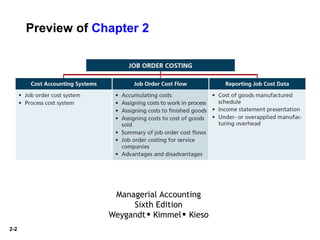
Preview of Chapter 2
Managerial Accounting
Sixth Edition
Weygandt Kimmel Kieso
2-3
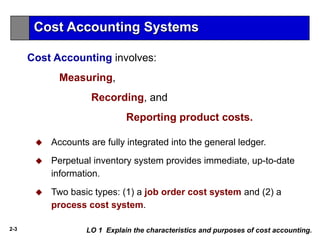
Cost Accounting involves:
Measuring,
Recording, and
Reporting product costs.
 Accounts are fully integrated into the general ledger.
 Perpetual inventory system provides immediate, up-to-date
information.
 Two basic types: (1) a job order cost system and (2) a
process cost system.
Cost Accounting Systems
LO 1 Explain the characteristics and purposes of cost accounting.
2-4
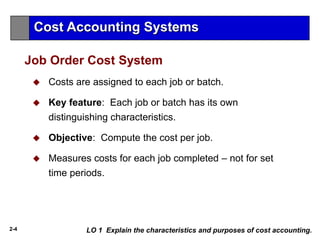
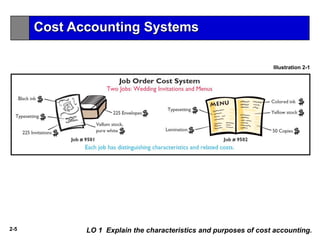
Job Order Cost System
 Costs are assigned to each job or batch.
 Key feature: Each job or batch has its own
distinguishing characteristics.
 Objective: Compute the cost per job.
 Measures costs for each job completed – not for set
time periods.
Cost Accounting Systems
LO 1 Explain the characteristics and purposes of cost accounting.
2-5
Illustration 2-1
Cost Accounting Systems
LO 1 Explain the characteristics and purposes of cost accounting.
2-6
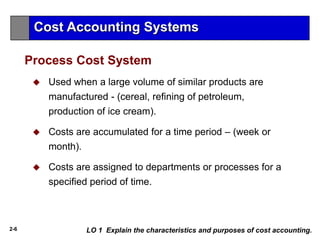
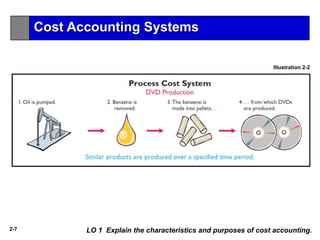
 Used when a large volume of similar products are
manufactured - (cereal, refining of petroleum,
production of ice cream).
 Costs are accumulated for a time period – (week or
month).
 Costs are assigned to departments or processes for a
specified period of time.
Process Cost System
Cost Accounting Systems
LO 1 Explain the characteristics and purposes of cost accounting.
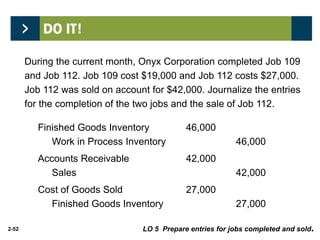
2-7 LO 1 Explain the characteristics and purposes of cost accounting.
Cost Accounting Systems
Illustration 2-2
2-8
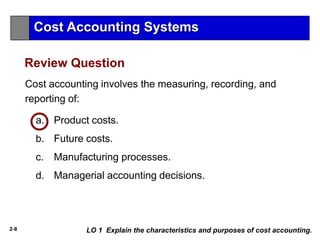
Cost accounting involves the measuring, recording, and
reporting of:
a. Product costs.
b. Future costs.
c. Manufacturing processes.
d. Managerial accounting decisions.
Review Question
LO 1 Explain the characteristics and purposes of cost accounting.
Cost Accounting Systems
2-9
2-10
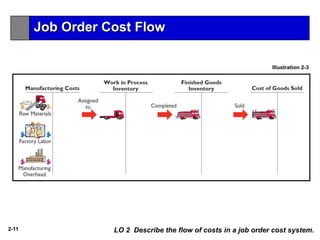
The cost flow parallels the physical flow of the materials as
they are converted into finished goods
 Manufacturing costs are assigned to Work in Process
(WIP).
 Cost of completed jobs is transferred to Finished
Goods.
 When units are sold, the cost is transferred to Cost of
Goods Sold.
LO 2 Describe the flow of costs in a job order cost system.
Job Order Cost Flow
2-11
Illustration 2-3
LO 2 Describe the flow of costs in a job order cost system.
Job Order Cost Flow
2-12
Accumulating Manufacturing Costs
Raw Material Costs
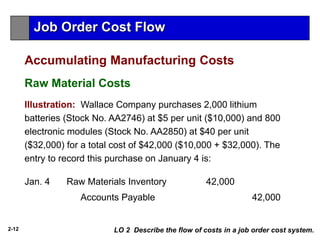
Illustration: Wallace Company purchases 2,000 lithium
batteries (Stock No. AA2746) at $5 per unit ($10,000) and 800
electronic modules (Stock No. AA2850) at $40 per unit
($32,000) for a total cost of $42,000 ($10,000 + $32,000). The
entry to record this purchase on January 4 is:
Jan. 4 Raw Materials Inventory 42,000
Accounts Payable 42,000
LO 2 Describe the flow of costs in a job order cost system.
Job Order Cost Flow
2-13
Factory Labor Costs
Consists of three costs:
1. Gross earnings of factory workers,
2. Employer payroll taxes on these earnings, and
3. Fringe benefits incurred by the employer.
LO 2 Describe the flow of costs in a job order cost system.
Job Order Cost Flow
2-14
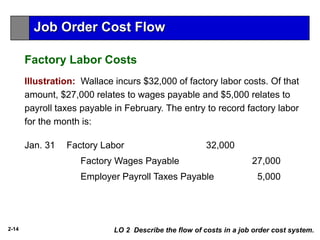
Illustration: Wallace incurs $32,000 of factory labor costs. Of that
amount, $27,000 relates to wages payable and $5,000 relates to
payroll taxes payable in February. The entry to record factory labor
for the month is:
Jan. 31 Factory Labor 32,000
Factory Wages Payable 27,000
Employer Payroll Taxes Payable 5,000
LO 2 Describe the flow of costs in a job order cost system.
Job Order Cost Flow
Factory Labor Costs
2-15
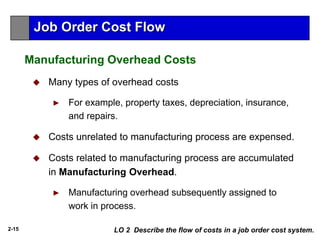
 Many types of overhead costs
► For example, property taxes, depreciation, insurance,
and repairs.
 Costs unrelated to manufacturing process are expensed.
 Costs related to manufacturing process are accumulated
in Manufacturing Overhead.
► Manufacturing overhead subsequently assigned to
work in process.
LO 2 Describe the flow of costs in a job order cost system.
Job Order Cost Flow
Manufacturing Overhead Costs
2-16
Manufacturing Overhead Costs
Illustration: Using assumed data, the summary entry for
manufacturing overhead in Wallace Manufacturing Company is:
Jan. 31 Manufacturing Overhead 13,800
Utilities Payable 4,800
Prepaid Insurance 2,000
Accounts Payable (for repairs) 2,600
Accumulated Depreciation 3,000
Property Taxes Payable 1,400
LO 2 Describe the flow of costs in a job order cost system.
Job Order Cost Flow
2-17
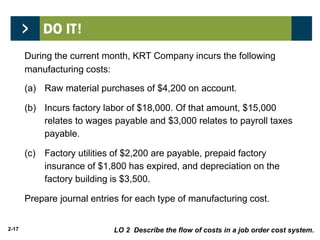
During the current month, KRT Company incurs the following
manufacturing costs:
(a) Raw material purchases of $4,200 on account.
(b) Incurs factory labor of $18,000. Of that amount, $15,000
relates to wages payable and $3,000 relates to payroll taxes
payable.
(c) Factory utilities of $2,200 are payable, prepaid factory
insurance of $1,800 has expired, and depreciation on the
factory building is $3,500.
Prepare journal entries for each type of manufacturing cost.
LO 2 Describe the flow of costs in a job order cost system.
2-18 LO 2
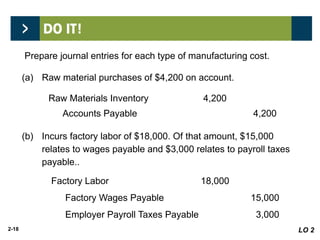
(a) Raw material purchases of $4,200 on account.
Raw Materials Inventory 4,200
Accounts Payable 4,200
(b) Incurs factory labor of $18,000. Of that amount, $15,000
relates to wages payable and $3,000 relates to payroll taxes
payable..
Factory Labor 18,000
Factory Wages Payable 15,000
Employer Payroll Taxes Payable 3,000
Prepare journal entries for each type of manufacturing cost.
2-19
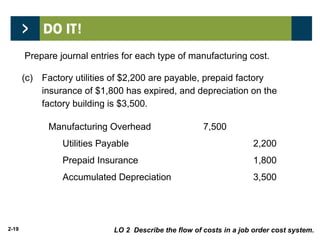
(c) Factory utilities of $2,200 are payable, prepaid factory
insurance of $1,800 has expired, and depreciation on the
factory building is $3,500.
Manufacturing Overhead 7,500
Utilities Payable 2,200
Prepaid Insurance 1,800
Accumulated Depreciation 3,500
LO 2 Describe the flow of costs in a job order cost system.
Prepare journal entries for each type of manufacturing cost.
2-20
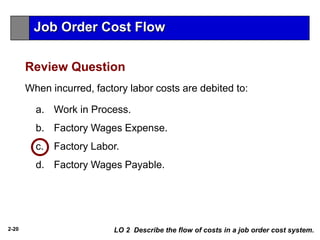
When incurred, factory labor costs are debited to:
a. Work in Process.
b. Factory Wages Expense.
c. Factory Labor.
d. Factory Wages Payable.
Review Question
LO 2 Describe the flow of costs in a job order cost system.
Job Order Cost Flow
2-21
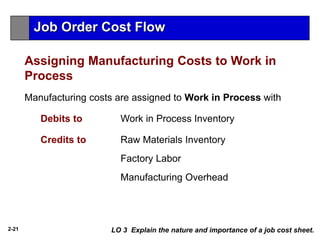
Manufacturing costs are assigned to Work in Process with
Debits to Work in Process Inventory
Credits to Raw Materials Inventory
Factory Labor
Manufacturing Overhead
LO 3 Explain the nature and importance of a job cost sheet.
Assigning Manufacturing Costs to Work in
Process
Job Order Cost Flow
2-22
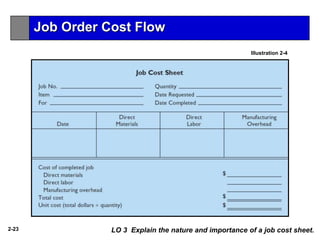
Job Cost Sheet
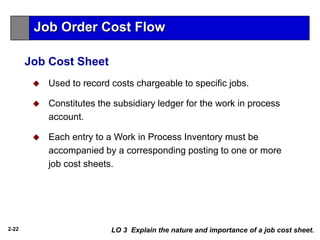
 Used to record costs chargeable to specific jobs.
 Constitutes the subsidiary ledger for the work in process
account.
 Each entry to a Work in Process Inventory must be
accompanied by a corresponding posting to one or more
job cost sheets.
LO 3 Explain the nature and importance of a job cost sheet.
Job Order Cost Flow
2-23
Illustration 2-4
LO 3 Explain the nature and importance of a job cost sheet.
Job Order Cost Flow
2-24
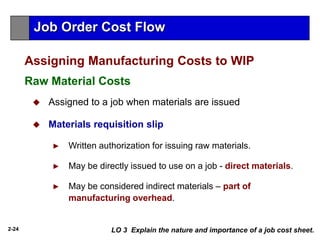
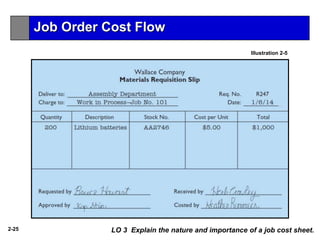
 Assigned to a job when materials are issued
 Materials requisition slip
► Written authorization for issuing raw materials.
► May be directly issued to use on a job - direct materials.
► May be considered indirect materials – part of
manufacturing overhead.
LO 3 Explain the nature and importance of a job cost sheet.
Assigning Manufacturing Costs to WIP
Raw Material Costs
Job Order Cost Flow
2-25 LO 3 Explain the nature and importance of a job cost sheet.
Job Order Cost Flow
Illustration 2-5
2-26
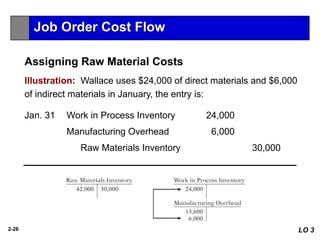
Assigning Raw Material Costs
Illustration: Wallace uses $24,000 of direct materials and $6,000
of indirect materials in January, the entry is:
Jan. 31 Work in Process Inventory 24,000
Manufacturing Overhead 6,000
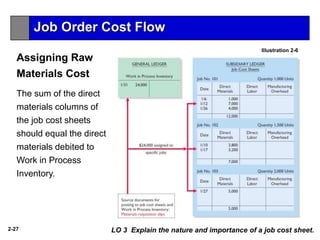
Raw Materials Inventory 30,000
LO 3
Job Order Cost Flow
2-27
Assigning Raw
Materials Cost
The sum of the direct
materials columns of
the job cost sheets
should equal the direct
materials debited to
Work in Process
Inventory.
Illustration 2-6
LO 3 Explain the nature and importance of a job cost sheet.
Job Order Cost Flow
2-28
2-29
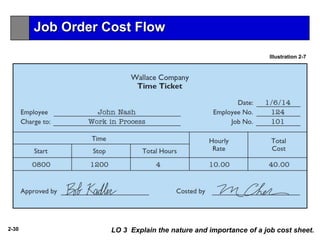
 Assigned to jobs on the basis of time tickets
 Time tickets are prepared when the work is performed
 Time tickets indicate
► Employee
► Hours worked
► Account and job charged
► Total labor cost
Factory Labor Costs
LO 3 Explain the nature and importance of a job cost sheet.
Job Order Cost Flow
2-30
Illustration 2-7
LO 3 Explain the nature and importance of a job cost sheet.
Job Order Cost Flow
2-31
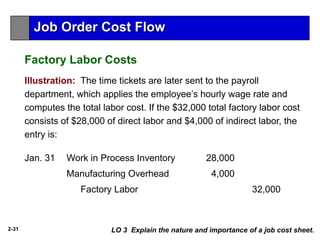
Illustration: The time tickets are later sent to the payroll
department, which applies the employee’s hourly wage rate and
computes the total labor cost. If the $32,000 total factory labor cost
consists of $28,000 of direct labor and $4,000 of indirect labor, the
entry is:
Jan. 31 Work in Process Inventory 28,000
Manufacturing Overhead 4,000
Factory Labor 32,000
LO 3 Explain the nature and importance of a job cost sheet.
Job Order Cost Flow
Factory Labor Costs
2-32
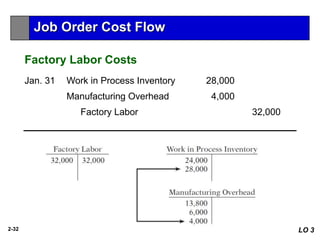
Jan. 31 Work in Process Inventory 28,000
Manufacturing Overhead 4,000
Factory Labor 32,000
LO 3
Job Order Cost Flow
Factory Labor Costs
2-33
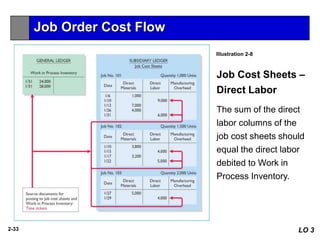
Job Cost Sheets –
Direct Labor
The sum of the direct
labor columns of the
job cost sheets should
equal the direct labor
debited to Work in
Process Inventory.
Illustration 2-8
LO 3
Job Order Cost Flow
2-34
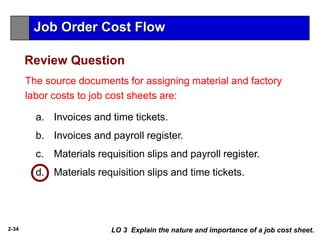
The source documents for assigning material and factory
labor costs to job cost sheets are:
a. Invoices and time tickets.
b. Invoices and payroll register.
c. Materials requisition slips and payroll register.
d. Materials requisition slips and time tickets.
Review Question
LO 3 Explain the nature and importance of a job cost sheet.
Job Order Cost Flow
2-35
 Relates to production operations as a whole.
 Cannot be assigned to specific jobs based on actual
costs incurred.
 Companies assign to work in process and to specific jobs
on an estimated basis through the use of a …
Manufacturing Overhead Costs
LO 4 Indicate how the predetermined overhead rate is determined and used.
Predetermined Overhead Rate
Job Order Cost Flow
2-36
 Based on the relationship between estimated annual
overhead costs and expected annual operating activity
 Expressed in terms of an activity base such as
► Direct labor costs
► Direct labor hours
► Machine hours
► Any other activity that is an equitable base for applying
overhead costs to jobs
LO 4 Indicate how the predetermined overhead rate is determined and used.
Job Order Cost Flow
Predetermined Overhead Rate
2-37
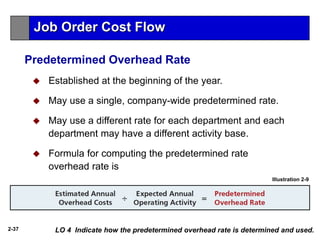
 Established at the beginning of the year.
 May use a single, company-wide predetermined rate.
 May use a different rate for each department and each
department may have a different activity base.
 Formula for computing the predetermined rate
overhead rate is
Illustration 2-9
LO 4 Indicate how the predetermined overhead rate is determined and used.
Job Order Cost Flow
Predetermined Overhead Rate
2-38
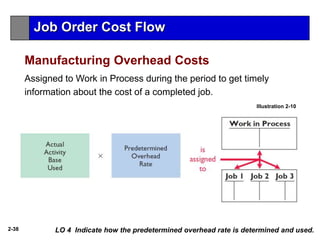
Assigned to Work in Process during the period to get timely
information about the cost of a completed job.
Illustration 2-10
LO 4 Indicate how the predetermined overhead rate is determined and used.
Job Order Cost Flow
Manufacturing Overhead Costs
2-39
This means that for every dollar of direct labor, Wallace will
assign _______ of manufacturing overhead to a job.
LO 4 Indicate how the predetermined overhead rate is determined and used.
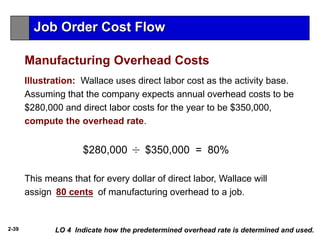
Illustration: Wallace uses direct labor cost as the activity base.
Assuming that the company expects annual overhead costs to be
$280,000 and direct labor costs for the year to be $350,000,
compute the overhead rate.
$280,000 $350,000 = 80%
80 cents
Job Order Cost Flow
Manufacturing Overhead Costs
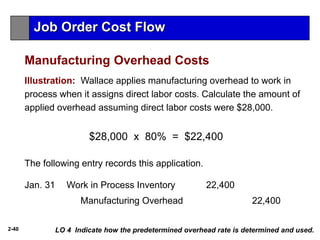
2-40 LO 4 Indicate how the predetermined overhead rate is determined and used.
Illustration: Wallace applies manufacturing overhead to work in
process when it assigns direct labor costs. Calculate the amount of
applied overhead assuming direct labor costs were $28,000.
$28,000 x 80% = $22,400
The following entry records this application.
Jan. 31 Work in Process Inventory 22,400
Manufacturing Overhead 22,400
Job Order Cost Flow
Manufacturing Overhead Costs
2-41
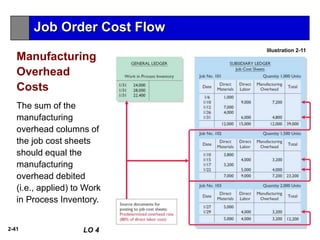
Manufacturing
Overhead
Costs
The sum of the
manufacturing
overhead columns of
the job cost sheets
should equal the
manufacturing
overhead debited
(i.e., applied) to Work
in Process Inventory.
Illustration 2-11
LO 4
Job Order Cost Flow
2-42
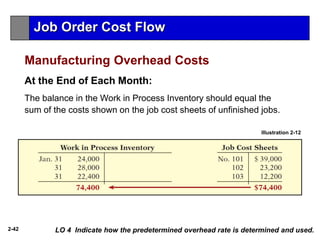
At the End of Each Month:
The balance in the Work in Process Inventory should equal the
sum of the costs shown on the job cost sheets of unfinished jobs.
Illustration 2-12
LO 4 Indicate how the predetermined overhead rate is determined and used.
Job Order Cost Flow
Manufacturing Overhead Costs
2-43
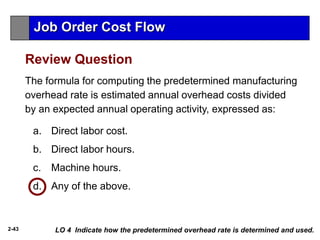
The formula for computing the predetermined manufacturing
overhead rate is estimated annual overhead costs divided
by an expected annual operating activity, expressed as:
a. Direct labor cost.
b. Direct labor hours.
c. Machine hours.
d. Any of the above.
Review Question
LO 4 Indicate how the predetermined overhead rate is determined and used.
Job Order Cost Flow
2-44
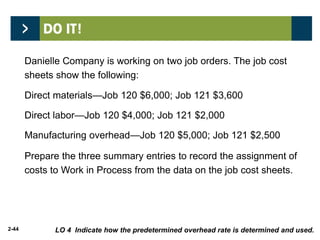
Danielle Company is working on two job orders. The job cost
sheets show the following:
Direct materials—Job 120 $6,000; Job 121 $3,600
Direct labor—Job 120 $4,000; Job 121 $2,000
Manufacturing overhead—Job 120 $5,000; Job 121 $2,500
Prepare the three summary entries to record the assignment of
costs to Work in Process from the data on the job cost sheets.
LO 4 Indicate how the predetermined overhead rate is determined and used.
2-45 LO 4 Indicate how the predetermined overhead rate is determined and used.
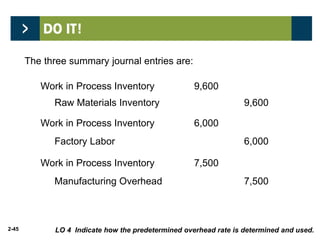
Work in Process Inventory 9,600
Raw Materials Inventory 9,600
Work in Process Inventory 6,000
Factory Labor 6,000
Work in Process Inventory 7,500
Manufacturing Overhead 7,500
The three summary journal entries are:
2-46
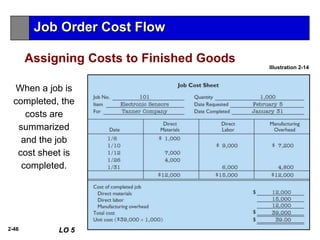
Assigning Costs to Finished Goods
LO 5
When a job is
completed, the
costs are
summarized
and the job
cost sheet is
completed.
Illustration 2-14
Job Order Cost Flow
2-47
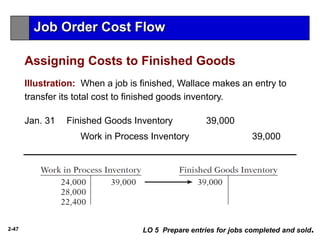
Illustration: When a job is finished, Wallace makes an entry to
transfer its total cost to finished goods inventory.
Jan. 31 Finished Goods Inventory 39,000
Work in Process Inventory 39,000
LO 5 Prepare entries for jobs completed and sold.
Job Order Cost Flow
Assigning Costs to Finished Goods
2-48
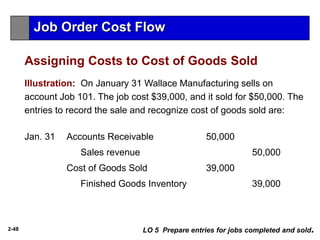
Illustration: On January 31 Wallace Manufacturing sells on
account Job 101. The job cost $39,000, and it sold for $50,000. The
entries to record the sale and recognize cost of goods sold are:
Jan. 31 Accounts Receivable 50,000
Sales revenue 50,000
Cost of Goods Sold 39,000
Finished Goods Inventory 39,000
LO 5 Prepare entries for jobs completed and sold.
Job Order Cost Flow
Assigning Costs to Cost of Goods Sold
2-49
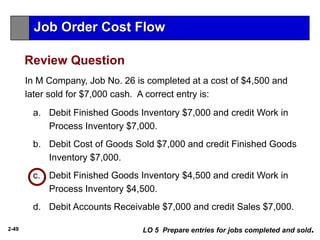
In M Company, Job No. 26 is completed at a cost of $4,500 and
later sold for $7,000 cash. A correct entry is:
a. Debit Finished Goods Inventory $7,000 and credit Work in
Process Inventory $7,000.
b. Debit Cost of Goods Sold $7,000 and credit Finished Goods
Inventory $7,000.
c. Debit Finished Goods Inventory $4,500 and credit Work in
Process Inventory $4,500.
d. Debit Accounts Receivable $7,000 and credit Sales $7,000.
Review Question
LO 5 Prepare entries for jobs completed and sold.
Job Order Cost Flow
2-50
LO 5
Job Order Cost Flow
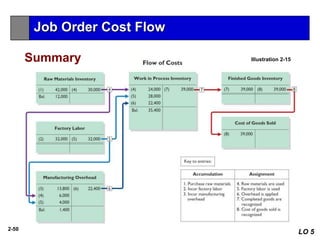
Summary Illustration 2-15
2-51
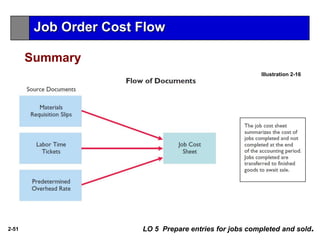
Illustration 2-16
LO 5 Prepare entries for jobs completed and sold.
Job Order Cost Flow
Summary
2-52
During the current month, Onyx Corporation completed Job 109
and Job 112. Job 109 cost $19,000 and Job 112 costs $27,000.
Job 112 was sold on account for $42,000. Journalize the entries
for the completion of the two jobs and the sale of Job 112.
Finished Goods Inventory 46,000
Work in Process Inventory 46,000
Accounts Receivable 42,000
Sales 42,000
Cost of Goods Sold 27,000
Finished Goods Inventory 27,000
LO 5 Prepare entries for jobs completed and sold.
2-53
While service companies do not have inventory, the
techniques of job order costing are still quite useful in many
service-industry environments. Consider, for example, the
Mayo Clinic (health care), PricewaterhouseCoopers
(accounting), and Goldman Sachs (investment banking).
Job Order Costing for Service Companies
LO 5 Prepare entries for jobs completed and sold.
Job Order Cost Flow
2-54
2-55
Advantages
 More precise in assignment of costs to projects than process
costing.
 Provides more useful information for determining the
profitability of particular projects and for estimating costs
when preparing bids on future jobs.
LO 5 Prepare entries for jobs completed and sold.
Disadvantage
 Requires a significant amount of data entry.
Job Order Cost Flow
2-56
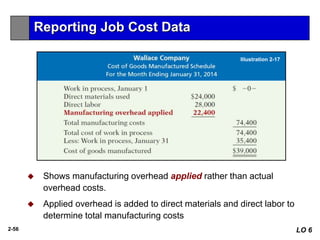
 Shows manufacturing overhead applied rather than actual
overhead costs.
 Applied overhead is added to direct materials and direct labor to
determine total manufacturing costs
Illustration 2-17
LO 6
Reporting Job Cost Data
2-57
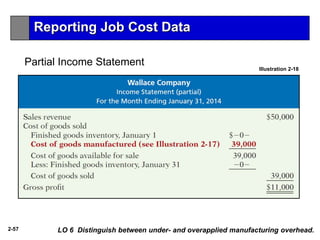
Partial Income Statement
Illustration 2-18
Reporting Job Cost Data
LO 6 Distinguish between under- and overapplied manufacturing overhead.
2-58 LO 6 Distinguish between under- and overapplied manufacturing overhead.
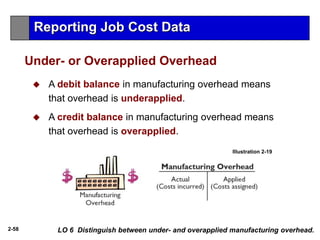
Under- or Overapplied Overhead
 A debit balance in manufacturing overhead means
that overhead is underapplied.
 A credit balance in manufacturing overhead means
that overhead is overapplied.
Illustration 2-19
Reporting Job Cost Data
2-59
Any Year-End Balance in manufacturing overhead is
eliminated by adjusting cost of goods sold.
 Underapplied overhead is debited to COGS
 Overapplied overhead is credited to COGS
LO 6 Distinguish between under- and overapplied manufacturing overhead.
Reporting Job Cost Data
Under- or Overapplied Overhead
2-60
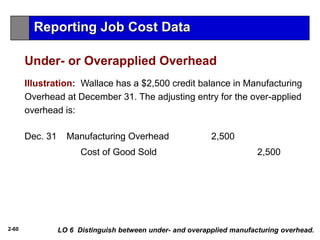
Illustration: Wallace has a $2,500 credit balance in Manufacturing
Overhead at December 31. The adjusting entry for the over-applied
overhead is:
Dec. 31 Manufacturing Overhead 2,500
Cost of Good Sold 2,500
Under- or Overapplied Overhead
LO 6 Distinguish between under- and overapplied manufacturing overhead.
Reporting Job Cost Data
2-61
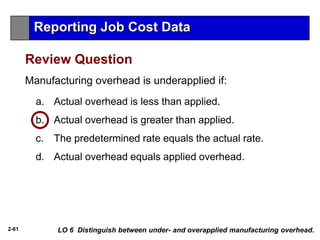
Manufacturing overhead is underapplied if:
a. Actual overhead is less than applied.
b. Actual overhead is greater than applied.
c. The predetermined rate equals the actual rate.
d. Actual overhead equals applied overhead.
Review Question
LO 6 Distinguish between under- and overapplied manufacturing overhead.
Reporting Job Cost Data
2-62
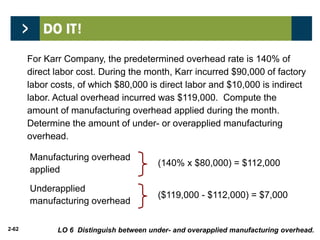
For Karr Company, the predetermined overhead rate is 140% of
direct labor cost. During the month, Karr incurred $90,000 of factory
labor costs, of which $80,000 is direct labor and $10,000 is indirect
labor. Actual overhead incurred was $119,000. Compute the
amount of manufacturing overhead applied during the month.
Determine the amount of under- or overapplied manufacturing
overhead.
Manufacturing overhead
applied
Underapplied
manufacturing overhead
(140% x $80,000) = $112,000
($119,000 - $112,000) = $7,000
LO 6 Distinguish between under- and overapplied manufacturing overhead.
2-63
“Copyright © 2012 John Wiley & Sons, Inc. All rights reserved.
Reproduction or translation of this work beyond that permitted in
Section 117 of the 1976 United States Copyright Act without the
express written permission of the copyright owner is unlawful.
Request for further information should be addressed to the
Permissions Department, John Wiley & Sons, Inc. The purchaser
may make back-up copies for his/her own use only and not for
distribution or resale. The Publisher assumes no responsibility for
errors, omissions, or damages, caused by the use of these
programs or from the use of the information contained herein.”
Copyright

chapter 02 managerial accounting, job order

  • 1.
    2-1 Job Order Costing LearningObjectives After studying this chapter, you should be able to: [1] Explain the characteristics and purposes of cost accounting. [2] Describe the flow of costs in a job order cost system. [3] Explain the nature and importance of a job cost sheet. [4] Indicate how the predetermined overhead rate is determined and used. [5] Prepare entries for jobs completed and sold. [6] Distinguish between under- and overapplied manufacturing overhead.
  • 2.
    2-2 Preview of Chapter2 Managerial Accounting Sixth Edition Weygandt Kimmel Kieso
  • 3.
    2-3 Cost Accounting involves: Measuring, Recording,and Reporting product costs.  Accounts are fully integrated into the general ledger.  Perpetual inventory system provides immediate, up-to-date information.  Two basic types: (1) a job order cost system and (2) a process cost system. Cost Accounting Systems LO 1 Explain the characteristics and purposes of cost accounting.
  • 4.
    2-4 Job Order CostSystem  Costs are assigned to each job or batch.  Key feature: Each job or batch has its own distinguishing characteristics.  Objective: Compute the cost per job.  Measures costs for each job completed – not for set time periods. Cost Accounting Systems LO 1 Explain the characteristics and purposes of cost accounting.
  • 5.
    2-5 Illustration 2-1 Cost AccountingSystems LO 1 Explain the characteristics and purposes of cost accounting.
  • 6.
    2-6  Used whena large volume of similar products are manufactured - (cereal, refining of petroleum, production of ice cream).  Costs are accumulated for a time period – (week or month).  Costs are assigned to departments or processes for a specified period of time. Process Cost System Cost Accounting Systems LO 1 Explain the characteristics and purposes of cost accounting.
  • 7.
    2-7 LO 1Explain the characteristics and purposes of cost accounting. Cost Accounting Systems Illustration 2-2
  • 8.
    2-8 Cost accounting involvesthe measuring, recording, and reporting of: a. Product costs. b. Future costs. c. Manufacturing processes. d. Managerial accounting decisions. Review Question LO 1 Explain the characteristics and purposes of cost accounting. Cost Accounting Systems
  • 9.
  • 10.
    2-10 The cost flowparallels the physical flow of the materials as they are converted into finished goods  Manufacturing costs are assigned to Work in Process (WIP).  Cost of completed jobs is transferred to Finished Goods.  When units are sold, the cost is transferred to Cost of Goods Sold. LO 2 Describe the flow of costs in a job order cost system. Job Order Cost Flow
  • 11.
    2-11 Illustration 2-3 LO 2Describe the flow of costs in a job order cost system. Job Order Cost Flow
  • 12.
    2-12 Accumulating Manufacturing Costs RawMaterial Costs Illustration: Wallace Company purchases 2,000 lithium batteries (Stock No. AA2746) at $5 per unit ($10,000) and 800 electronic modules (Stock No. AA2850) at $40 per unit ($32,000) for a total cost of $42,000 ($10,000 + $32,000). The entry to record this purchase on January 4 is: Jan. 4 Raw Materials Inventory 42,000 Accounts Payable 42,000 LO 2 Describe the flow of costs in a job order cost system. Job Order Cost Flow
  • 13.
    2-13 Factory Labor Costs Consistsof three costs: 1. Gross earnings of factory workers, 2. Employer payroll taxes on these earnings, and 3. Fringe benefits incurred by the employer. LO 2 Describe the flow of costs in a job order cost system. Job Order Cost Flow
  • 14.
    2-14 Illustration: Wallace incurs$32,000 of factory labor costs. Of that amount, $27,000 relates to wages payable and $5,000 relates to payroll taxes payable in February. The entry to record factory labor for the month is: Jan. 31 Factory Labor 32,000 Factory Wages Payable 27,000 Employer Payroll Taxes Payable 5,000 LO 2 Describe the flow of costs in a job order cost system. Job Order Cost Flow Factory Labor Costs
  • 15.
    2-15  Many typesof overhead costs ► For example, property taxes, depreciation, insurance, and repairs.  Costs unrelated to manufacturing process are expensed.  Costs related to manufacturing process are accumulated in Manufacturing Overhead. ► Manufacturing overhead subsequently assigned to work in process. LO 2 Describe the flow of costs in a job order cost system. Job Order Cost Flow Manufacturing Overhead Costs
  • 16.
    2-16 Manufacturing Overhead Costs Illustration:Using assumed data, the summary entry for manufacturing overhead in Wallace Manufacturing Company is: Jan. 31 Manufacturing Overhead 13,800 Utilities Payable 4,800 Prepaid Insurance 2,000 Accounts Payable (for repairs) 2,600 Accumulated Depreciation 3,000 Property Taxes Payable 1,400 LO 2 Describe the flow of costs in a job order cost system. Job Order Cost Flow
  • 17.
    2-17 During the currentmonth, KRT Company incurs the following manufacturing costs: (a) Raw material purchases of $4,200 on account. (b) Incurs factory labor of $18,000. Of that amount, $15,000 relates to wages payable and $3,000 relates to payroll taxes payable. (c) Factory utilities of $2,200 are payable, prepaid factory insurance of $1,800 has expired, and depreciation on the factory building is $3,500. Prepare journal entries for each type of manufacturing cost. LO 2 Describe the flow of costs in a job order cost system.
  • 18.
    2-18 LO 2 (a)Raw material purchases of $4,200 on account. Raw Materials Inventory 4,200 Accounts Payable 4,200 (b) Incurs factory labor of $18,000. Of that amount, $15,000 relates to wages payable and $3,000 relates to payroll taxes payable.. Factory Labor 18,000 Factory Wages Payable 15,000 Employer Payroll Taxes Payable 3,000 Prepare journal entries for each type of manufacturing cost.
  • 19.
    2-19 (c) Factory utilitiesof $2,200 are payable, prepaid factory insurance of $1,800 has expired, and depreciation on the factory building is $3,500. Manufacturing Overhead 7,500 Utilities Payable 2,200 Prepaid Insurance 1,800 Accumulated Depreciation 3,500 LO 2 Describe the flow of costs in a job order cost system. Prepare journal entries for each type of manufacturing cost.
  • 20.
    2-20 When incurred, factorylabor costs are debited to: a. Work in Process. b. Factory Wages Expense. c. Factory Labor. d. Factory Wages Payable. Review Question LO 2 Describe the flow of costs in a job order cost system. Job Order Cost Flow
  • 21.
    2-21 Manufacturing costs areassigned to Work in Process with Debits to Work in Process Inventory Credits to Raw Materials Inventory Factory Labor Manufacturing Overhead LO 3 Explain the nature and importance of a job cost sheet. Assigning Manufacturing Costs to Work in Process Job Order Cost Flow
  • 22.
    2-22 Job Cost Sheet Used to record costs chargeable to specific jobs.  Constitutes the subsidiary ledger for the work in process account.  Each entry to a Work in Process Inventory must be accompanied by a corresponding posting to one or more job cost sheets. LO 3 Explain the nature and importance of a job cost sheet. Job Order Cost Flow
  • 23.
    2-23 Illustration 2-4 LO 3Explain the nature and importance of a job cost sheet. Job Order Cost Flow
  • 24.
    2-24  Assigned toa job when materials are issued  Materials requisition slip ► Written authorization for issuing raw materials. ► May be directly issued to use on a job - direct materials. ► May be considered indirect materials – part of manufacturing overhead. LO 3 Explain the nature and importance of a job cost sheet. Assigning Manufacturing Costs to WIP Raw Material Costs Job Order Cost Flow
  • 25.
    2-25 LO 3Explain the nature and importance of a job cost sheet. Job Order Cost Flow Illustration 2-5
  • 26.
    2-26 Assigning Raw MaterialCosts Illustration: Wallace uses $24,000 of direct materials and $6,000 of indirect materials in January, the entry is: Jan. 31 Work in Process Inventory 24,000 Manufacturing Overhead 6,000 Raw Materials Inventory 30,000 LO 3 Job Order Cost Flow
  • 27.
    2-27 Assigning Raw Materials Cost Thesum of the direct materials columns of the job cost sheets should equal the direct materials debited to Work in Process Inventory. Illustration 2-6 LO 3 Explain the nature and importance of a job cost sheet. Job Order Cost Flow
  • 28.
  • 29.
    2-29  Assigned tojobs on the basis of time tickets  Time tickets are prepared when the work is performed  Time tickets indicate ► Employee ► Hours worked ► Account and job charged ► Total labor cost Factory Labor Costs LO 3 Explain the nature and importance of a job cost sheet. Job Order Cost Flow
  • 30.
    2-30 Illustration 2-7 LO 3Explain the nature and importance of a job cost sheet. Job Order Cost Flow
  • 31.
    2-31 Illustration: The timetickets are later sent to the payroll department, which applies the employee’s hourly wage rate and computes the total labor cost. If the $32,000 total factory labor cost consists of $28,000 of direct labor and $4,000 of indirect labor, the entry is: Jan. 31 Work in Process Inventory 28,000 Manufacturing Overhead 4,000 Factory Labor 32,000 LO 3 Explain the nature and importance of a job cost sheet. Job Order Cost Flow Factory Labor Costs
  • 32.
    2-32 Jan. 31 Workin Process Inventory 28,000 Manufacturing Overhead 4,000 Factory Labor 32,000 LO 3 Job Order Cost Flow Factory Labor Costs
  • 33.
    2-33 Job Cost Sheets– Direct Labor The sum of the direct labor columns of the job cost sheets should equal the direct labor debited to Work in Process Inventory. Illustration 2-8 LO 3 Job Order Cost Flow
  • 34.
    2-34 The source documentsfor assigning material and factory labor costs to job cost sheets are: a. Invoices and time tickets. b. Invoices and payroll register. c. Materials requisition slips and payroll register. d. Materials requisition slips and time tickets. Review Question LO 3 Explain the nature and importance of a job cost sheet. Job Order Cost Flow
  • 35.
    2-35  Relates toproduction operations as a whole.  Cannot be assigned to specific jobs based on actual costs incurred.  Companies assign to work in process and to specific jobs on an estimated basis through the use of a … Manufacturing Overhead Costs LO 4 Indicate how the predetermined overhead rate is determined and used. Predetermined Overhead Rate Job Order Cost Flow
  • 36.
    2-36  Based onthe relationship between estimated annual overhead costs and expected annual operating activity  Expressed in terms of an activity base such as ► Direct labor costs ► Direct labor hours ► Machine hours ► Any other activity that is an equitable base for applying overhead costs to jobs LO 4 Indicate how the predetermined overhead rate is determined and used. Job Order Cost Flow Predetermined Overhead Rate
  • 37.
    2-37  Established atthe beginning of the year.  May use a single, company-wide predetermined rate.  May use a different rate for each department and each department may have a different activity base.  Formula for computing the predetermined rate overhead rate is Illustration 2-9 LO 4 Indicate how the predetermined overhead rate is determined and used. Job Order Cost Flow Predetermined Overhead Rate
  • 38.
    2-38 Assigned to Workin Process during the period to get timely information about the cost of a completed job. Illustration 2-10 LO 4 Indicate how the predetermined overhead rate is determined and used. Job Order Cost Flow Manufacturing Overhead Costs
  • 39.
    2-39 This means thatfor every dollar of direct labor, Wallace will assign _______ of manufacturing overhead to a job. LO 4 Indicate how the predetermined overhead rate is determined and used. Illustration: Wallace uses direct labor cost as the activity base. Assuming that the company expects annual overhead costs to be $280,000 and direct labor costs for the year to be $350,000, compute the overhead rate. $280,000 $350,000 = 80% 80 cents Job Order Cost Flow Manufacturing Overhead Costs
  • 40.
    2-40 LO 4Indicate how the predetermined overhead rate is determined and used. Illustration: Wallace applies manufacturing overhead to work in process when it assigns direct labor costs. Calculate the amount of applied overhead assuming direct labor costs were $28,000. $28,000 x 80% = $22,400 The following entry records this application. Jan. 31 Work in Process Inventory 22,400 Manufacturing Overhead 22,400 Job Order Cost Flow Manufacturing Overhead Costs
  • 41.
    2-41 Manufacturing Overhead Costs The sum ofthe manufacturing overhead columns of the job cost sheets should equal the manufacturing overhead debited (i.e., applied) to Work in Process Inventory. Illustration 2-11 LO 4 Job Order Cost Flow
  • 42.
    2-42 At the Endof Each Month: The balance in the Work in Process Inventory should equal the sum of the costs shown on the job cost sheets of unfinished jobs. Illustration 2-12 LO 4 Indicate how the predetermined overhead rate is determined and used. Job Order Cost Flow Manufacturing Overhead Costs
  • 43.
    2-43 The formula forcomputing the predetermined manufacturing overhead rate is estimated annual overhead costs divided by an expected annual operating activity, expressed as: a. Direct labor cost. b. Direct labor hours. c. Machine hours. d. Any of the above. Review Question LO 4 Indicate how the predetermined overhead rate is determined and used. Job Order Cost Flow
  • 44.
    2-44 Danielle Company isworking on two job orders. The job cost sheets show the following: Direct materials—Job 120 $6,000; Job 121 $3,600 Direct labor—Job 120 $4,000; Job 121 $2,000 Manufacturing overhead—Job 120 $5,000; Job 121 $2,500 Prepare the three summary entries to record the assignment of costs to Work in Process from the data on the job cost sheets. LO 4 Indicate how the predetermined overhead rate is determined and used.
  • 45.
    2-45 LO 4Indicate how the predetermined overhead rate is determined and used. Work in Process Inventory 9,600 Raw Materials Inventory 9,600 Work in Process Inventory 6,000 Factory Labor 6,000 Work in Process Inventory 7,500 Manufacturing Overhead 7,500 The three summary journal entries are:
  • 46.
    2-46 Assigning Costs toFinished Goods LO 5 When a job is completed, the costs are summarized and the job cost sheet is completed. Illustration 2-14 Job Order Cost Flow
  • 47.
    2-47 Illustration: When ajob is finished, Wallace makes an entry to transfer its total cost to finished goods inventory. Jan. 31 Finished Goods Inventory 39,000 Work in Process Inventory 39,000 LO 5 Prepare entries for jobs completed and sold. Job Order Cost Flow Assigning Costs to Finished Goods
  • 48.
    2-48 Illustration: On January31 Wallace Manufacturing sells on account Job 101. The job cost $39,000, and it sold for $50,000. The entries to record the sale and recognize cost of goods sold are: Jan. 31 Accounts Receivable 50,000 Sales revenue 50,000 Cost of Goods Sold 39,000 Finished Goods Inventory 39,000 LO 5 Prepare entries for jobs completed and sold. Job Order Cost Flow Assigning Costs to Cost of Goods Sold
  • 49.
    2-49 In M Company,Job No. 26 is completed at a cost of $4,500 and later sold for $7,000 cash. A correct entry is: a. Debit Finished Goods Inventory $7,000 and credit Work in Process Inventory $7,000. b. Debit Cost of Goods Sold $7,000 and credit Finished Goods Inventory $7,000. c. Debit Finished Goods Inventory $4,500 and credit Work in Process Inventory $4,500. d. Debit Accounts Receivable $7,000 and credit Sales $7,000. Review Question LO 5 Prepare entries for jobs completed and sold. Job Order Cost Flow
  • 50.
    2-50 LO 5 Job OrderCost Flow Summary Illustration 2-15
  • 51.
    2-51 Illustration 2-16 LO 5Prepare entries for jobs completed and sold. Job Order Cost Flow Summary
  • 52.
    2-52 During the currentmonth, Onyx Corporation completed Job 109 and Job 112. Job 109 cost $19,000 and Job 112 costs $27,000. Job 112 was sold on account for $42,000. Journalize the entries for the completion of the two jobs and the sale of Job 112. Finished Goods Inventory 46,000 Work in Process Inventory 46,000 Accounts Receivable 42,000 Sales 42,000 Cost of Goods Sold 27,000 Finished Goods Inventory 27,000 LO 5 Prepare entries for jobs completed and sold.
  • 53.
    2-53 While service companiesdo not have inventory, the techniques of job order costing are still quite useful in many service-industry environments. Consider, for example, the Mayo Clinic (health care), PricewaterhouseCoopers (accounting), and Goldman Sachs (investment banking). Job Order Costing for Service Companies LO 5 Prepare entries for jobs completed and sold. Job Order Cost Flow
  • 54.
  • 55.
    2-55 Advantages  More precisein assignment of costs to projects than process costing.  Provides more useful information for determining the profitability of particular projects and for estimating costs when preparing bids on future jobs. LO 5 Prepare entries for jobs completed and sold. Disadvantage  Requires a significant amount of data entry. Job Order Cost Flow
  • 56.
    2-56  Shows manufacturingoverhead applied rather than actual overhead costs.  Applied overhead is added to direct materials and direct labor to determine total manufacturing costs Illustration 2-17 LO 6 Reporting Job Cost Data
  • 57.
    2-57 Partial Income Statement Illustration2-18 Reporting Job Cost Data LO 6 Distinguish between under- and overapplied manufacturing overhead.
  • 58.
    2-58 LO 6Distinguish between under- and overapplied manufacturing overhead. Under- or Overapplied Overhead  A debit balance in manufacturing overhead means that overhead is underapplied.  A credit balance in manufacturing overhead means that overhead is overapplied. Illustration 2-19 Reporting Job Cost Data
  • 59.
    2-59 Any Year-End Balancein manufacturing overhead is eliminated by adjusting cost of goods sold.  Underapplied overhead is debited to COGS  Overapplied overhead is credited to COGS LO 6 Distinguish between under- and overapplied manufacturing overhead. Reporting Job Cost Data Under- or Overapplied Overhead
  • 60.
    2-60 Illustration: Wallace hasa $2,500 credit balance in Manufacturing Overhead at December 31. The adjusting entry for the over-applied overhead is: Dec. 31 Manufacturing Overhead 2,500 Cost of Good Sold 2,500 Under- or Overapplied Overhead LO 6 Distinguish between under- and overapplied manufacturing overhead. Reporting Job Cost Data
  • 61.
    2-61 Manufacturing overhead isunderapplied if: a. Actual overhead is less than applied. b. Actual overhead is greater than applied. c. The predetermined rate equals the actual rate. d. Actual overhead equals applied overhead. Review Question LO 6 Distinguish between under- and overapplied manufacturing overhead. Reporting Job Cost Data
  • 62.
    2-62 For Karr Company,the predetermined overhead rate is 140% of direct labor cost. During the month, Karr incurred $90,000 of factory labor costs, of which $80,000 is direct labor and $10,000 is indirect labor. Actual overhead incurred was $119,000. Compute the amount of manufacturing overhead applied during the month. Determine the amount of under- or overapplied manufacturing overhead. Manufacturing overhead applied Underapplied manufacturing overhead (140% x $80,000) = $112,000 ($119,000 - $112,000) = $7,000 LO 6 Distinguish between under- and overapplied manufacturing overhead.
  • 63.
    2-63 “Copyright © 2012John Wiley & Sons, Inc. All rights reserved. Reproduction or translation of this work beyond that permitted in Section 117 of the 1976 United States Copyright Act without the express written permission of the copyright owner is unlawful. Request for further information should be addressed to the Permissions Department, John Wiley & Sons, Inc. The purchaser may make back-up copies for his/her own use only and not for distribution or resale. The Publisher assumes no responsibility for errors, omissions, or damages, caused by the use of these programs or from the use of the information contained herein.” Copyright