Managerial Accounting 
Prepared by: 
M.Com (numl)
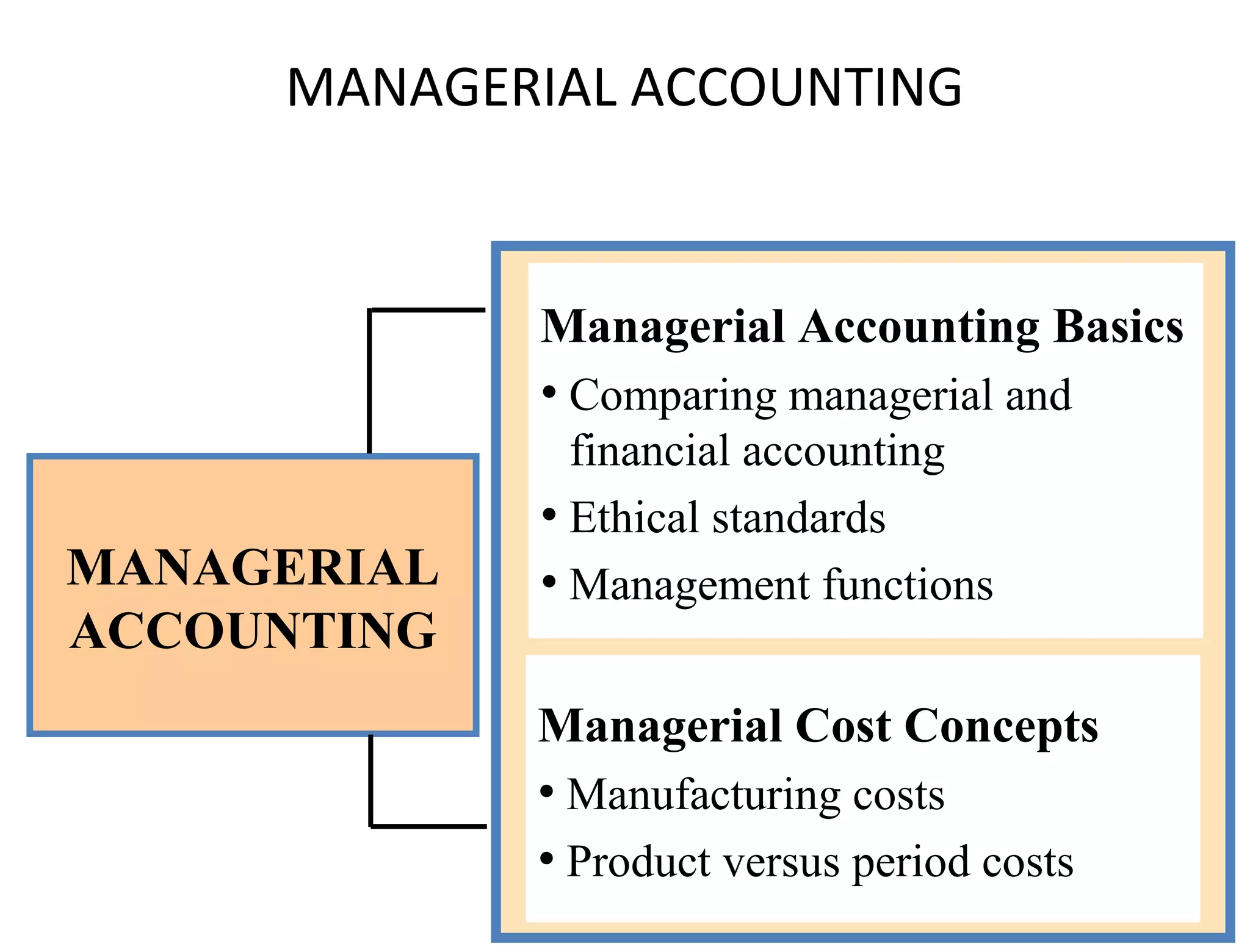
MANAGERIAL ACCOUNTING 
Managerial Accounting Basics 
• Comparing managerial and 
financial accounting 
• Ethical standards 
• Management functions 
Managerial Cost Concepts 
• Manufacturing costs 
• Product versus period costs 
MANAGERIAL 
ACCOUNTING
Managerial Accounting Basics 
Managerial accounting (management 
accounting) is a field of accounting that 
provides economic and financial information 
for managers and other internal users.
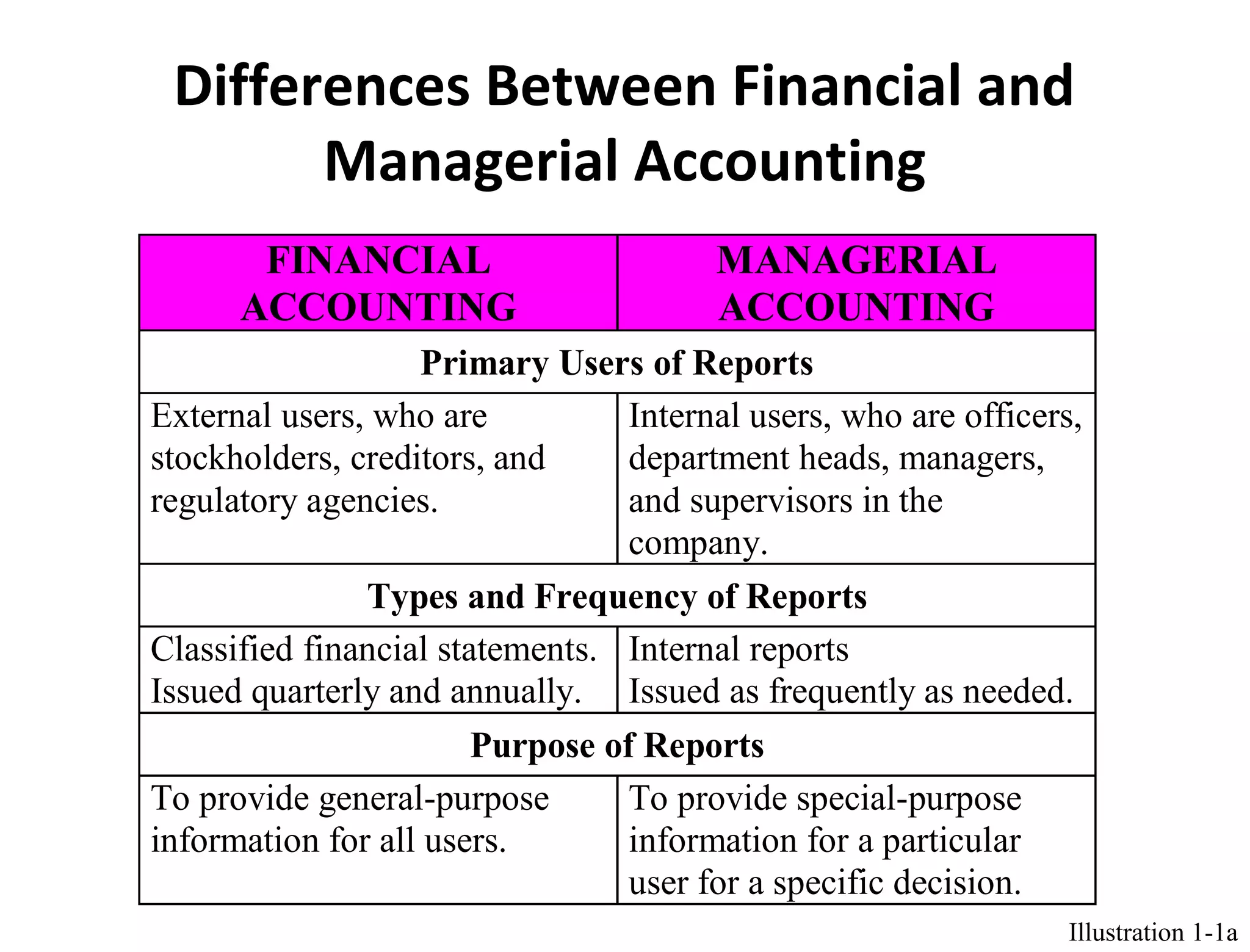
Differences Between Financial and 
Managerial Accounting 
FINANCIAL 
ACCOUNTING 
MANAGERIAL 
ACCOUNTING 
Primary Users of Reports 
External users, who are 
stockholders, creditors, and 
regulatory agencies. 
Internal users, who are officers, 
department heads, managers, 
and supervisors in the 
company. 
Types and Frequency of Reports 
Classified financial statements. 
Issued quarterly and annually. 
Internal reports 
Issued as frequently as needed. 
Purpose of Reports 
To provide general-purpose 
information for all users. 
To provide special-purpose 
information for a particular 
user for a specific decision. 
Illustration 1-1a
Managerial Cost Concepts 
To perform the three management functions effectively, 
management needs information. One very important type 
of information is related to costs. For example, questions 
such as the following need answering: 
– What costs are involved in making the product? 
– If production volume is decreased, will costs decrease? 
– What impact will automation have on total costs? 
– How can costs best be controlled in the organization?
MANAGERIAL ACCOUNTING 
Define the three classes of 
manufacturing costs.
Managerial Cost Concepts 
Manufacturing consists of activities and 
processes that convert raw materials into 
finished goods. Manufacturing costs are usually 
classified as follows: 
– Direct Materials 
– Direct Labor 
– Manufacturing Overhead
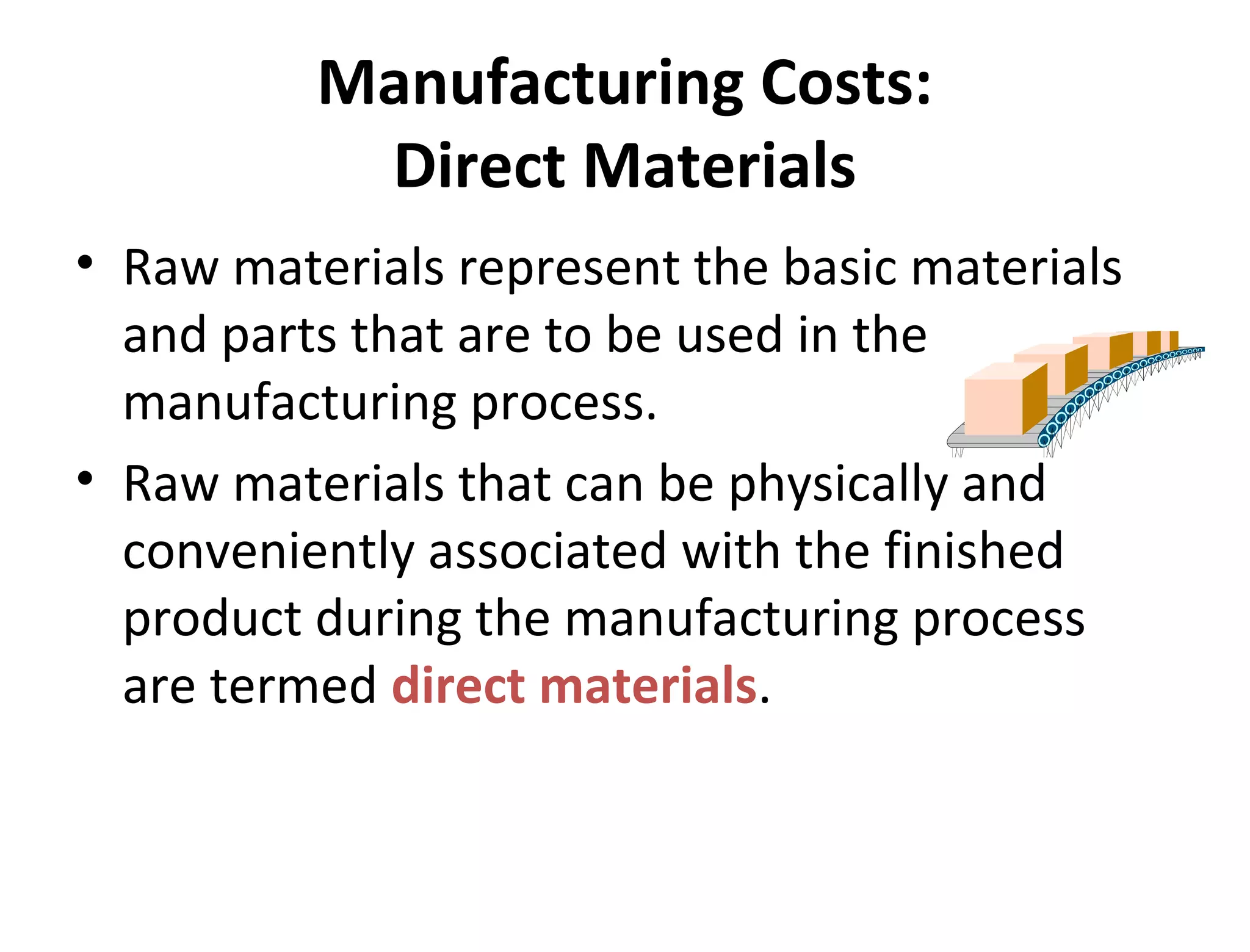
Manufacturing Costs: 
Direct Materials 
• Raw materials represent the basic materials 
and parts that are to be used in the 
manufacturing process. 
• Raw materials that can be physically and 
conveniently associated with the finished 
product during the manufacturing process 
are termed direct materials.
Manufacturing Costs: 
Indirect Materials 
Some raw materials cannot be easily associated with 
the finished product. These are considered indirect 
materials. 
Indirect materials 
– do not physically become part of the finished 
product 
– Indirect materials are accounted for as part of 
manufacturing overhead.
Manufacturing Costs: 
Direct Labor 
Direct labor is the work of factory 
employees that can be physically and 
conveniently associated with 
converting raw materials into finished 
goods. 
DIRECT LABOR
Manufacturing Costs: 
Indirect Labor 
The wages of maintenance people, 
timekeepers, and supervisors are normally 
categorized as indirect labor 
Like: Indirect materials, indirect labor is part of 
manufacturing overhead.
Manufacturing Costs: Manufacturing 
Overhead 
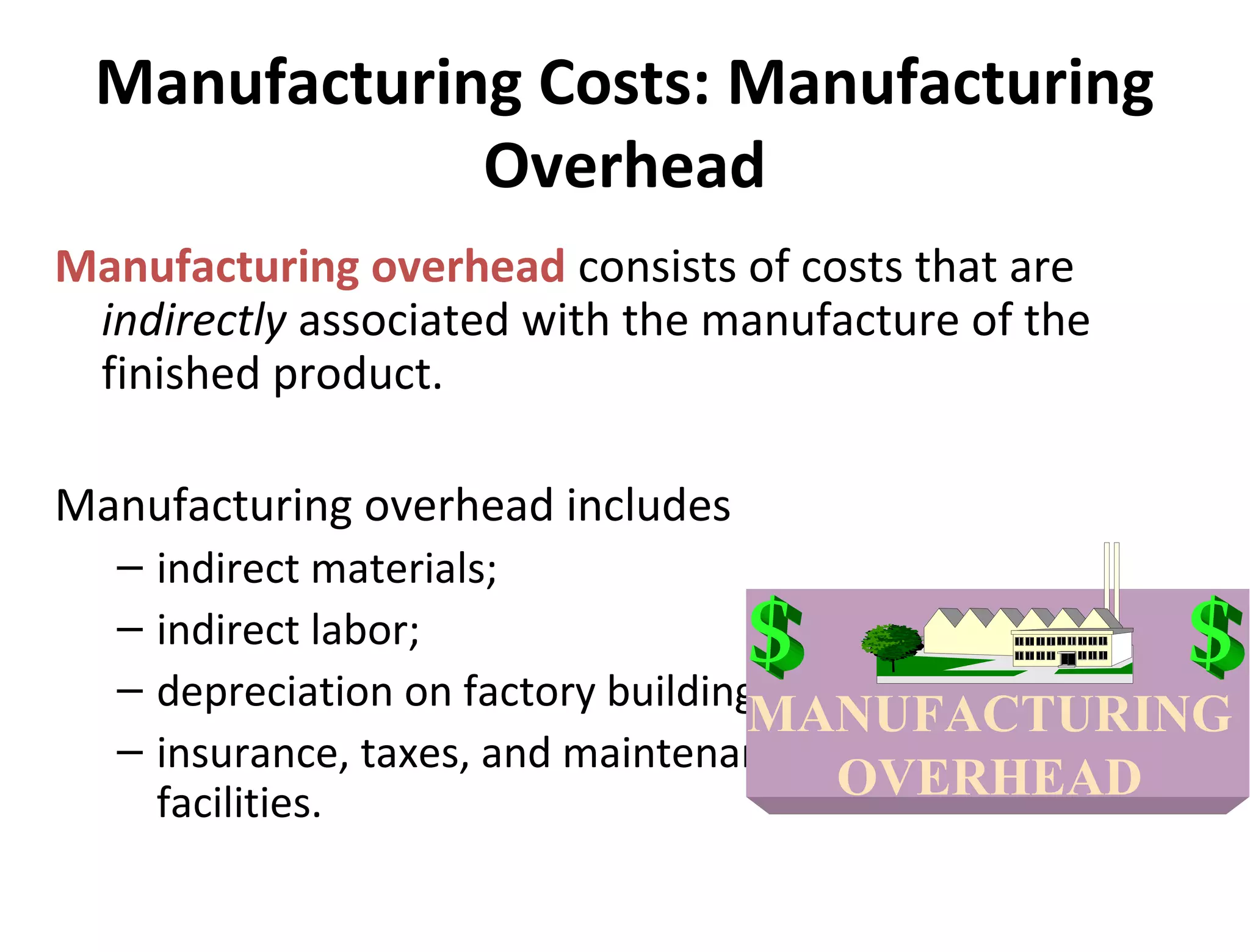
Manufacturing overhead consists of costs that are 
indirectly associated with the manufacture of the 
finished product. 
Manufacturing overhead includes 
– indirect materials; 
– indirect labor; 
– depreciation on factory buildings and machinery; and 
– insurance, taxes, and maintenance on factory 
facilities. 
MANUFACTURING 
OVERHEAD
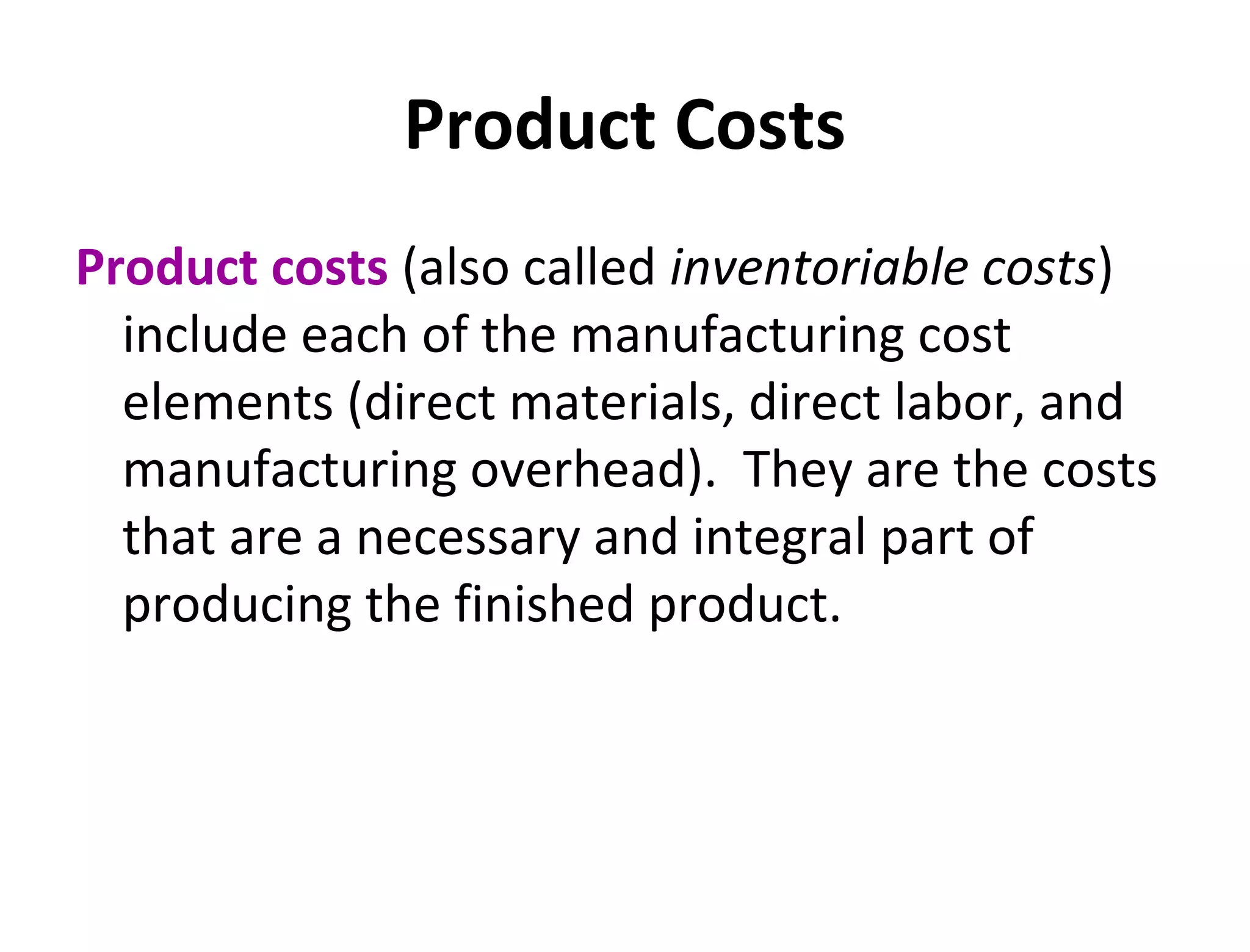
Product Costs 
Product costs (also called inventoriable costs) 
include each of the manufacturing cost 
elements (direct materials, direct labor, and 
manufacturing overhead). They are the costs 
that are a necessary and integral part of 
producing the finished product.
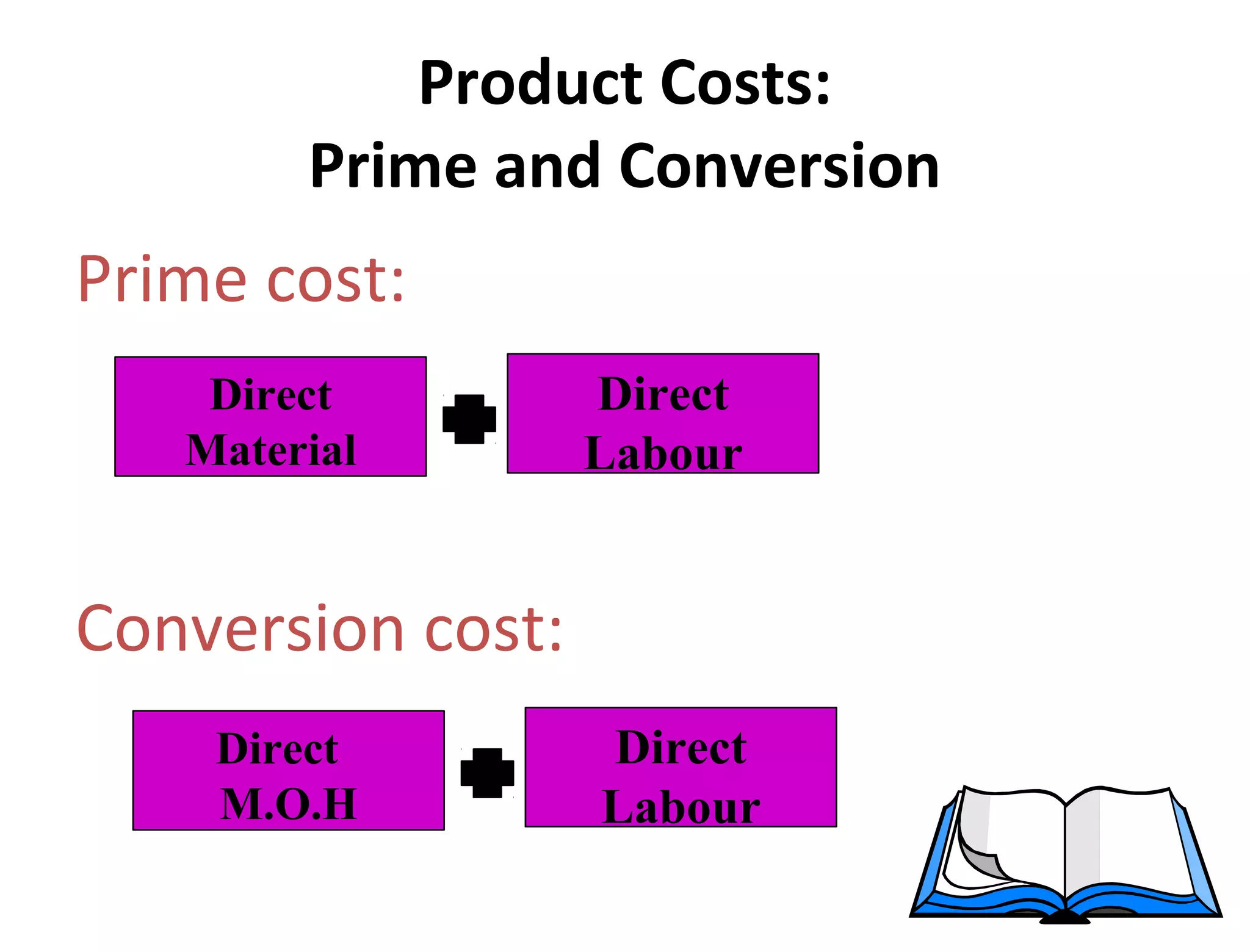
Product Costs: 
Prime and Conversion 
Prime cost: 
Direct 
Material 
Conversion cost: 
Direct 
Labour 
Direct 
M.O.H 
Direct 
Labour
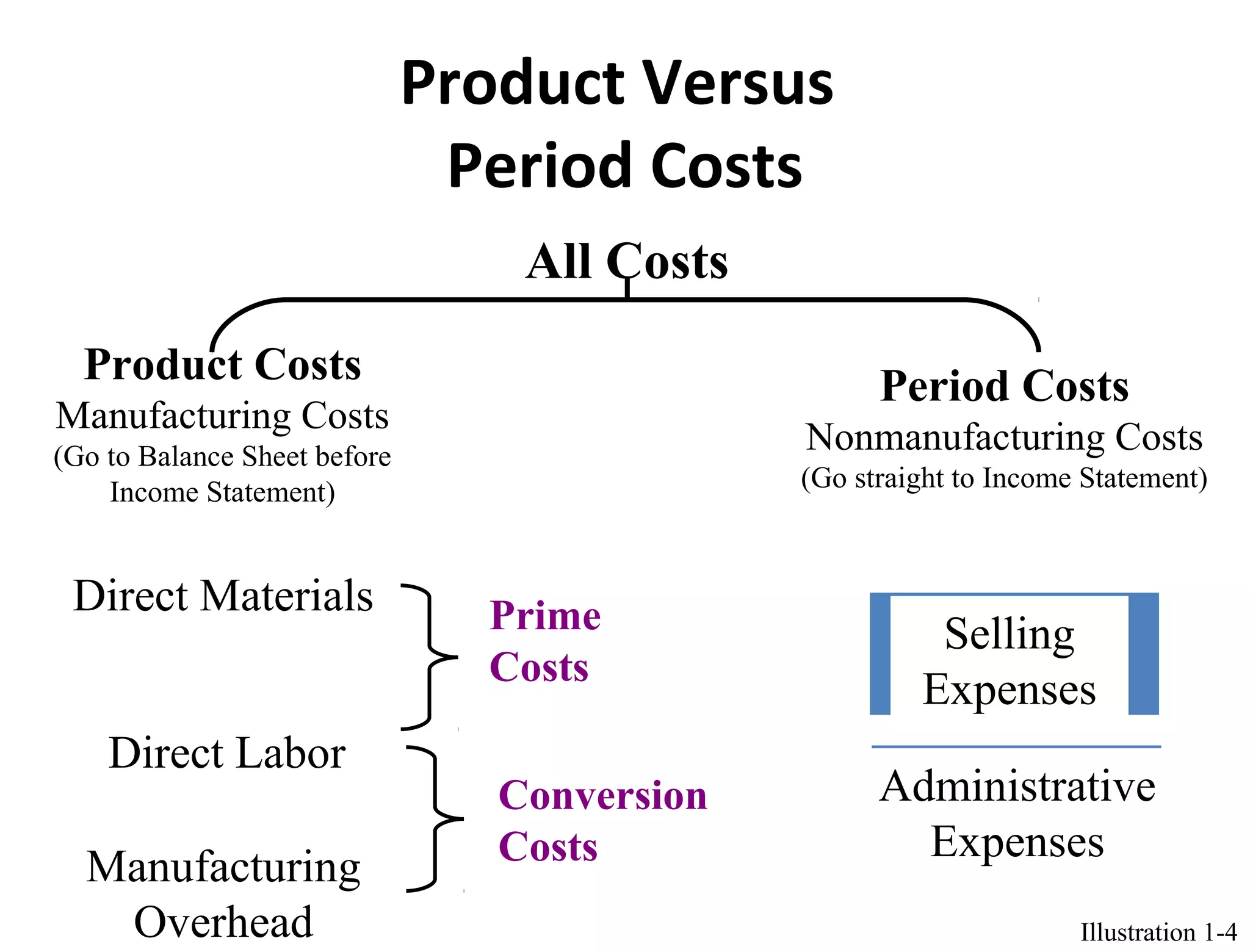
Product Versus 
Period Costs 
All Costs 
Direct Materials 
Direct Labor 
Manufacturing 
Overhead 
Selling 
Expenses 
Administrative 
Expenses 
Prime 
Costs 
Conversion 
Costs 
Product Costs 
Manufacturing Costs 
(Go to Balance Sheet before 
Income Statement) 
Period Costs 
Nonmanufacturing Costs 
(Go straight to Income Statement) 
Illustration 1-4
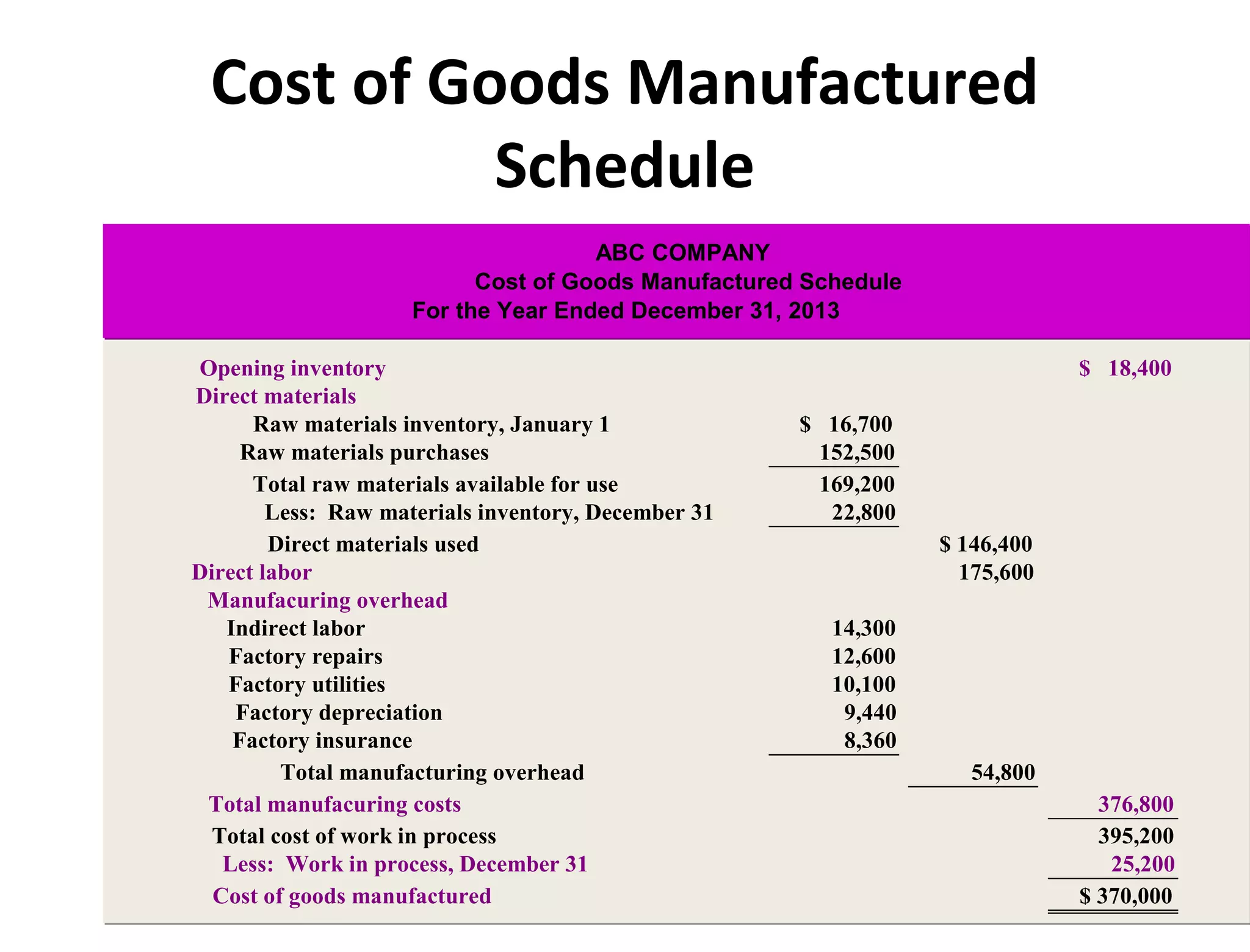
Cost of Goods Manufactured 
Schedule 
ABC COMPANY 
Cost of Goods Manufactured Schedule 
For the Year Ended December 31, 2013 
Opening inventory $ 18,400 
Direct materials 
Raw materials inventory, January 1 $ 16,700 
Raw materials purchases 152,500 
Total raw materials available for use 169,200 
Less: Raw materials inventory, December 31 22,800 
Direct materials used $ 146,400 
Direct labor 175,600 
Manufacuring overhead 
Indirect labor 14,300 
Factory repairs 12,600 
Factory utilities 10,100 
Factory depreciation 9,440 
Factory insurance 8,360 
Total manufacturing overhead 54,800 
Total manufacuring costs 376,800 
Total cost of work in process 395,200 
Less: Work in process, December 31 25,200 
Cost of goods manufactured $ 370,000
Job order cost accounting 
Cost Accounting Systems 
Job Order Cost Flow 
• Accumulating Manufacturing 
Costs 
• Assigning Manufacturing 
Costs to Work in Process 
• Assigning Costs to Finished 
Goods 
• Assigning Costs to Cost of 
Goods Sold 
• Summary 
JOB ORDER 
COST 
ACCOUNTING
Process Cost System 
Process costing accounts for and 
accumulates product-related costs for a 
period of time, as opposed to assigning costs 
to specific products or jobs.
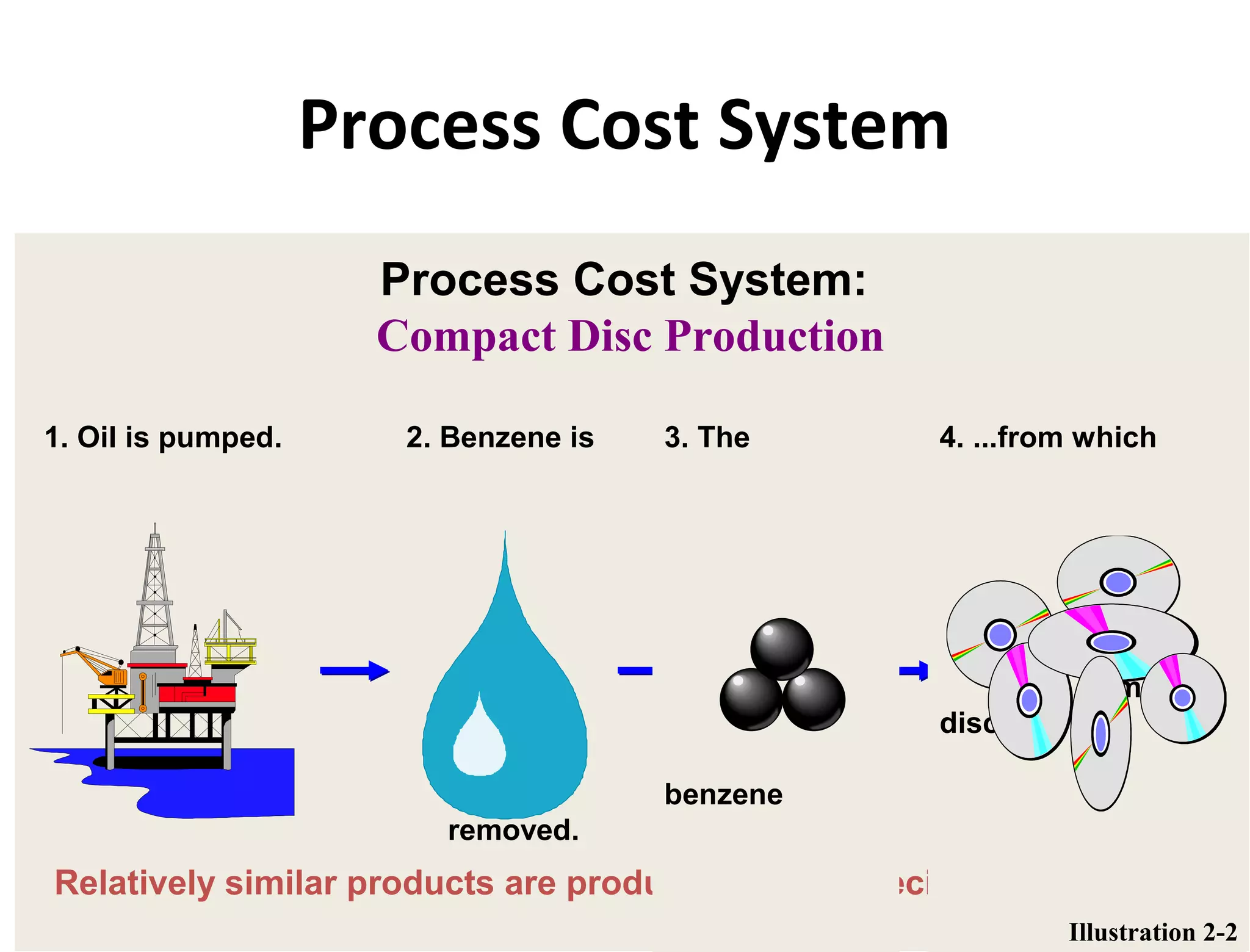
Process Cost System: 
Compact Disc Production 
1. Oil is pumped. 2. Benzene is 
removed. 
3. The 
benzene 
4. ...from which 
compact 
discs are 
Relatively similar products are produced over a specified time period. 
made. 
Illustration 2-2 
Process Cost System
Job Order Cost Flow 
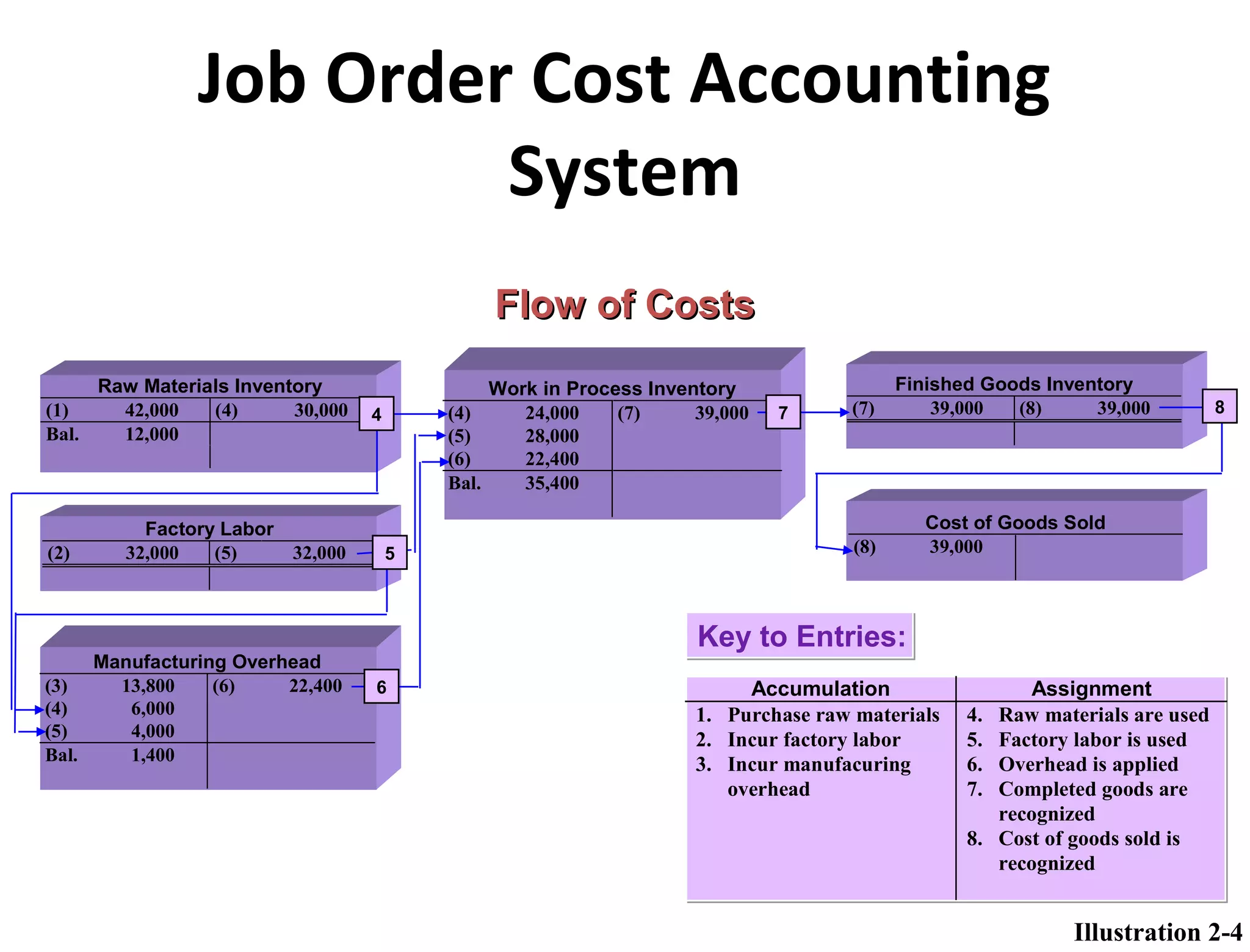
There are 2 major steps in the flow of costs: 
– accumulating the manufacturing costs incurred 
and 
– assigning the accumulated costs to the work 
done.
Job Order Cost Accounting 
System 
FFllooww ooff CCoossttss 
4 8 
Accumulation Assignment 
1. Purchase raw materials 4. Raw materials are used 
2. Incur factory labor 5. Factory labor is used 
3. Incur manufacuring 6. Overhead is applied 
overhead 7. Completed goods are 
recognized 
8. Cost of goods sold is 
recognized 
Key to Entries: 
Raw Materials Inventory 
(1) 42,000 (4) 30,000 
Bal. 12,000 
Factory Labor 
(2) 32,000 (5) 32,000 
Manufacturing Overhead 
(3) 13,800 (6) 22,400 
(4) 6,000 
(5) 4,000 
Bal. 1,400 
Finished Goods Inventory 
(7) 39,000 (8) 39,000 
Work in Process Inventory 
(4) 24,000 (7) 39,000 
(5) 28,000 
(6) 22,400 
Bal. 35,400 
Cost of Goods Sold 
(8) 39,000 
7 
5 
6 
Illustration 2-4
Job Cost Sheet 
• A separate job cost sheet is kept for each job. 
Job cost sheets constitute the subsidiary 
ledger for the Work in Process Inventory 
account. 
• Each entry to Work in Process Inventory must 
be accompanied by a corresponding posting 
to one or more job cost sheets.
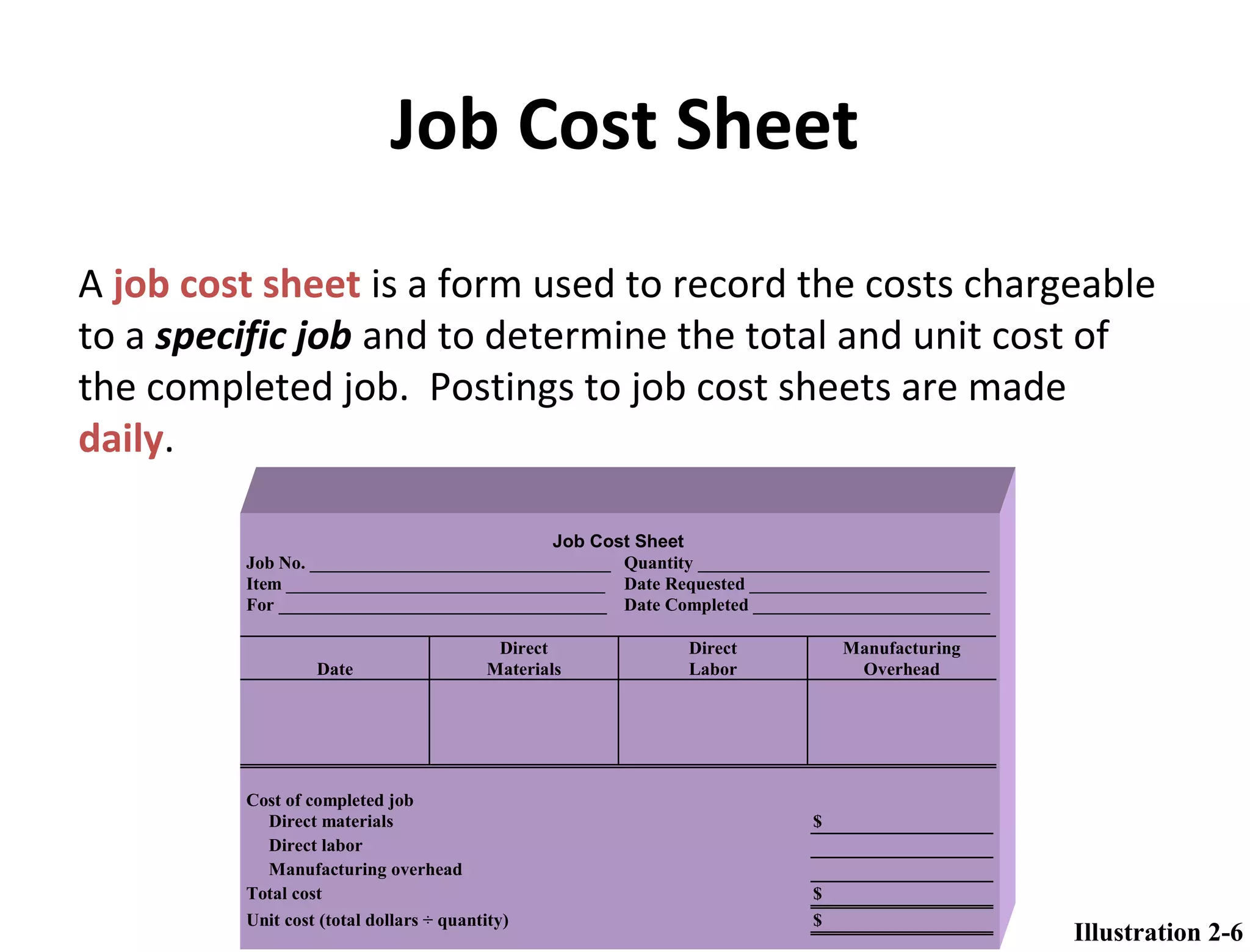
Job Cost Sheet 
A job cost sheet is a form used to record the costs chargeable 
to a specific job and to determine the total and unit cost of 
the completed job. Postings to job cost sheets are made 
daily. 
Job Cost Sheet 
Job No. _________________________________ Quantity ________________________________ 
Item ___________________________________ Date Requested __________________________ 
For ____________________________________ Date Completed __________________________ 
Direct Direct Manufacturing 
Date Materials Labor Overhead 
Cost of completed job 
Direct materials $ 
Direct labor 
Manufacturing overhead 
Total cost $ 
Unit cost (total dollars ÷ quantity) $ 
Illustration 2-6
Assigning Manufacturing Costs to 
Work in Process 
Raw materials costs 
are assigned to 
jobs when the 
materials are 
issued by the 
storeroom.
Bob 
Kadler 
M.Che 
r 
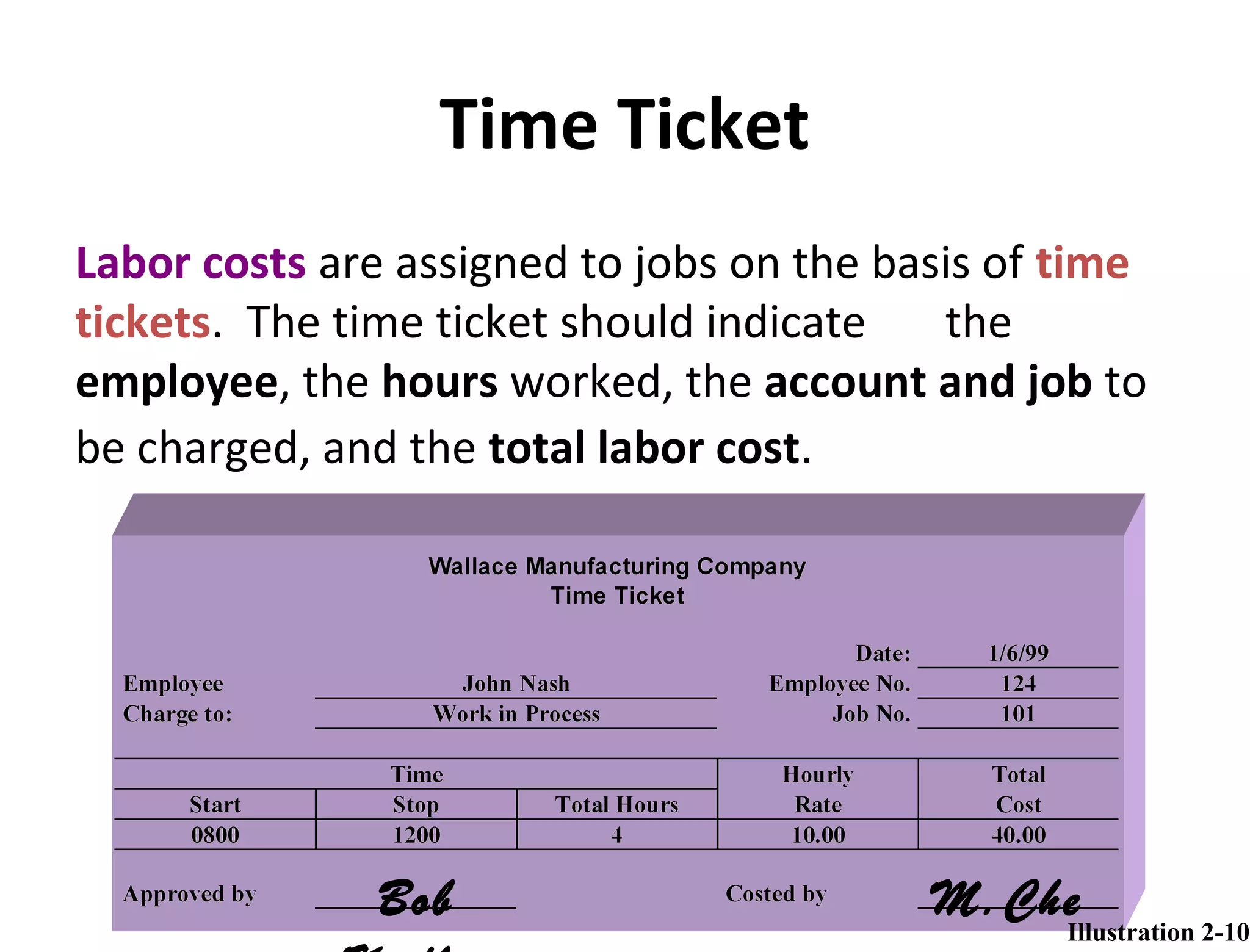
Time Ticket 
Labor costs are assigned to jobs on the basis of time 
tickets. The time ticket should indicate the 
employee, the hours worked, the account and job to 
be charged, and the total labor cost. 
Illustration 2-10
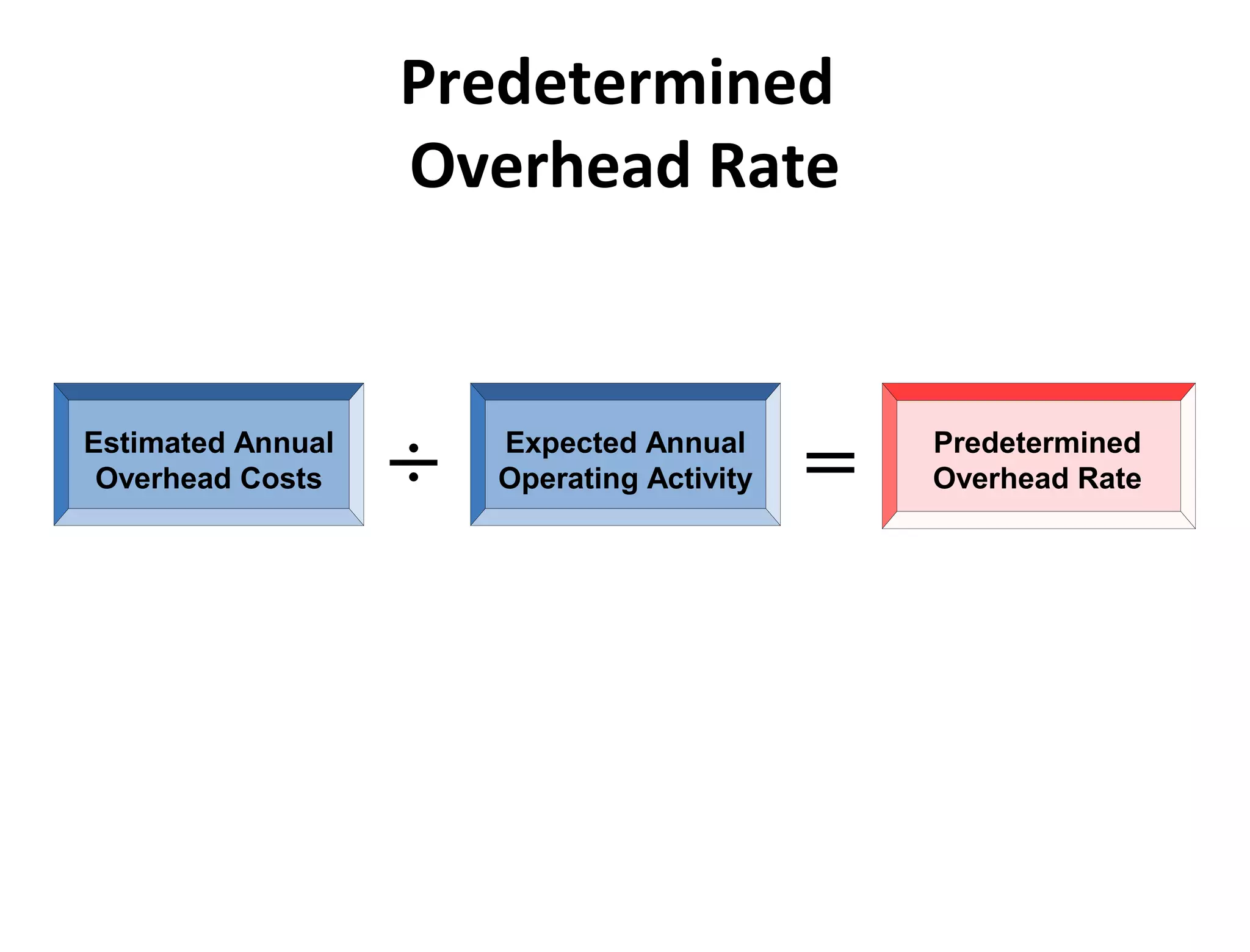
Estimated Annual 
Overhead Costs 
Expected Annual 
÷ Operating Activity = Predetermined 
Overhead Rate 
Predetermined 
Overhead Rate
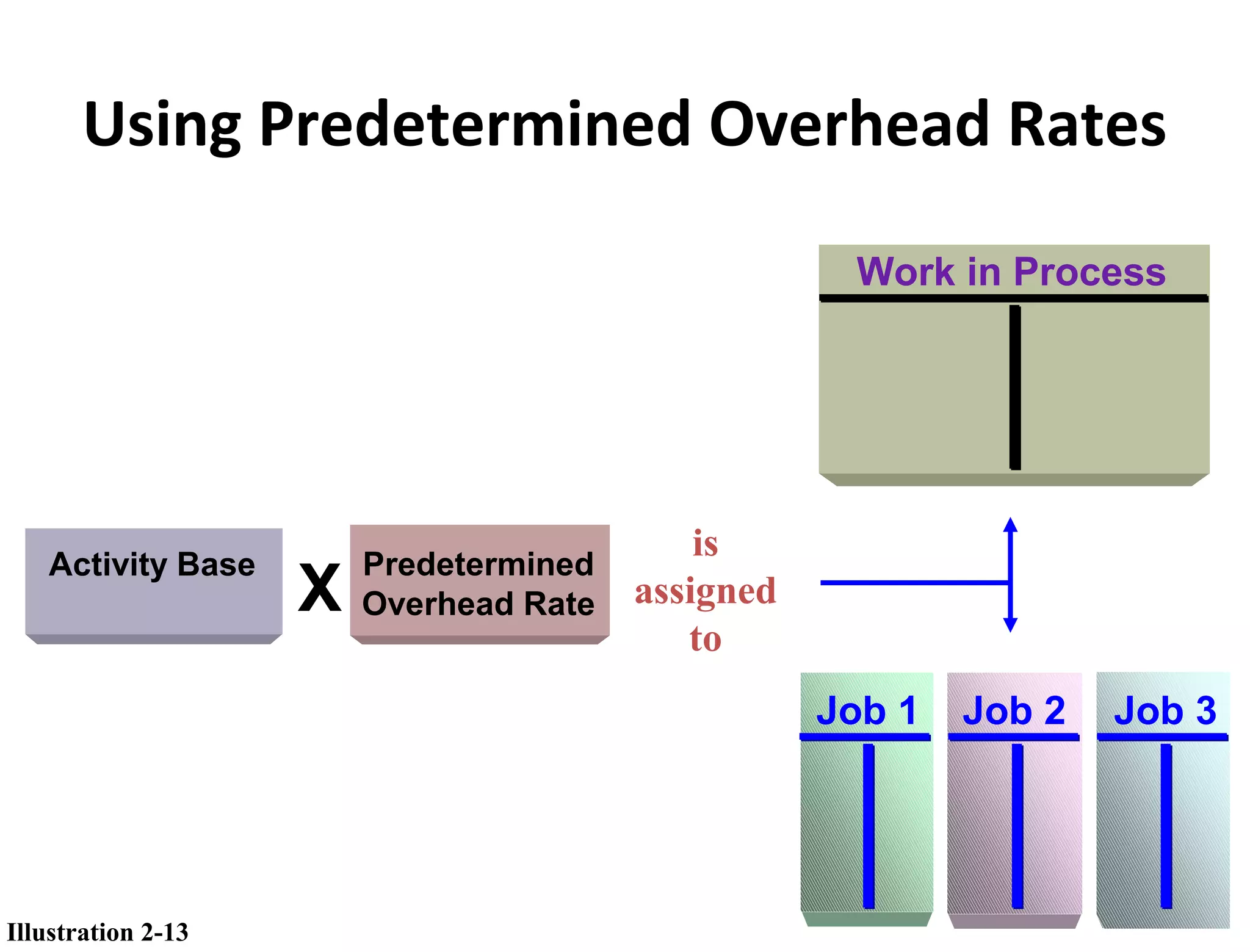
Using Predetermined Overhead Rates 
X Activity Base Predetermined 
Overhead Rate 
is 
assigned 
to 
Work in Process 
Job 1 Job 2 Job 3 
Illustration 2-13
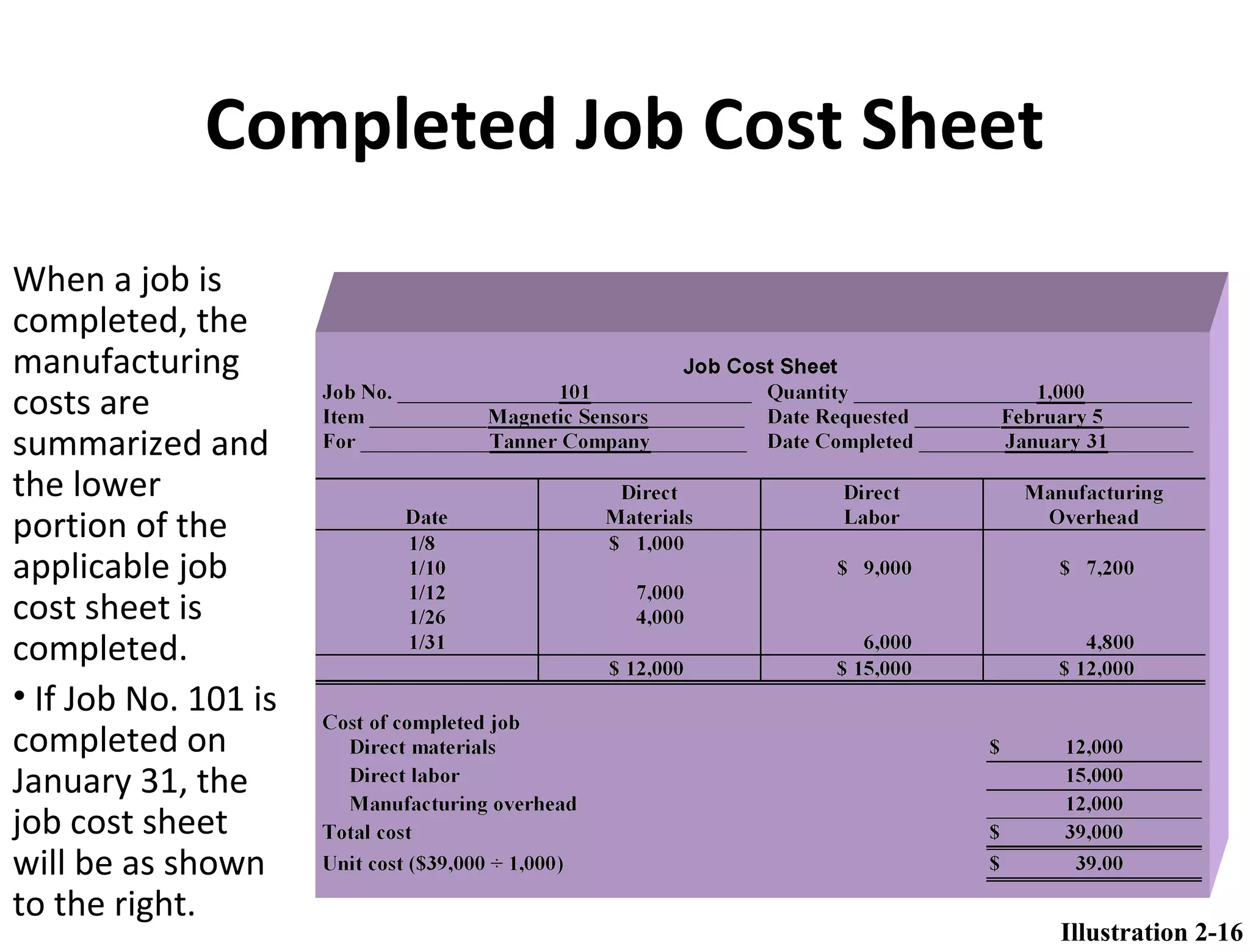
Completed Job Cost Sheet 
When a job is 
completed, the 
manufacturing 
costs are 
summarized and 
the lower 
portion of the 
applicable job 
cost sheet is 
completed. 
• If Job No. 101 is 
completed on 
January 31, the 
job cost sheet 
will be as shown 
to the right. 
Illustration 2-16
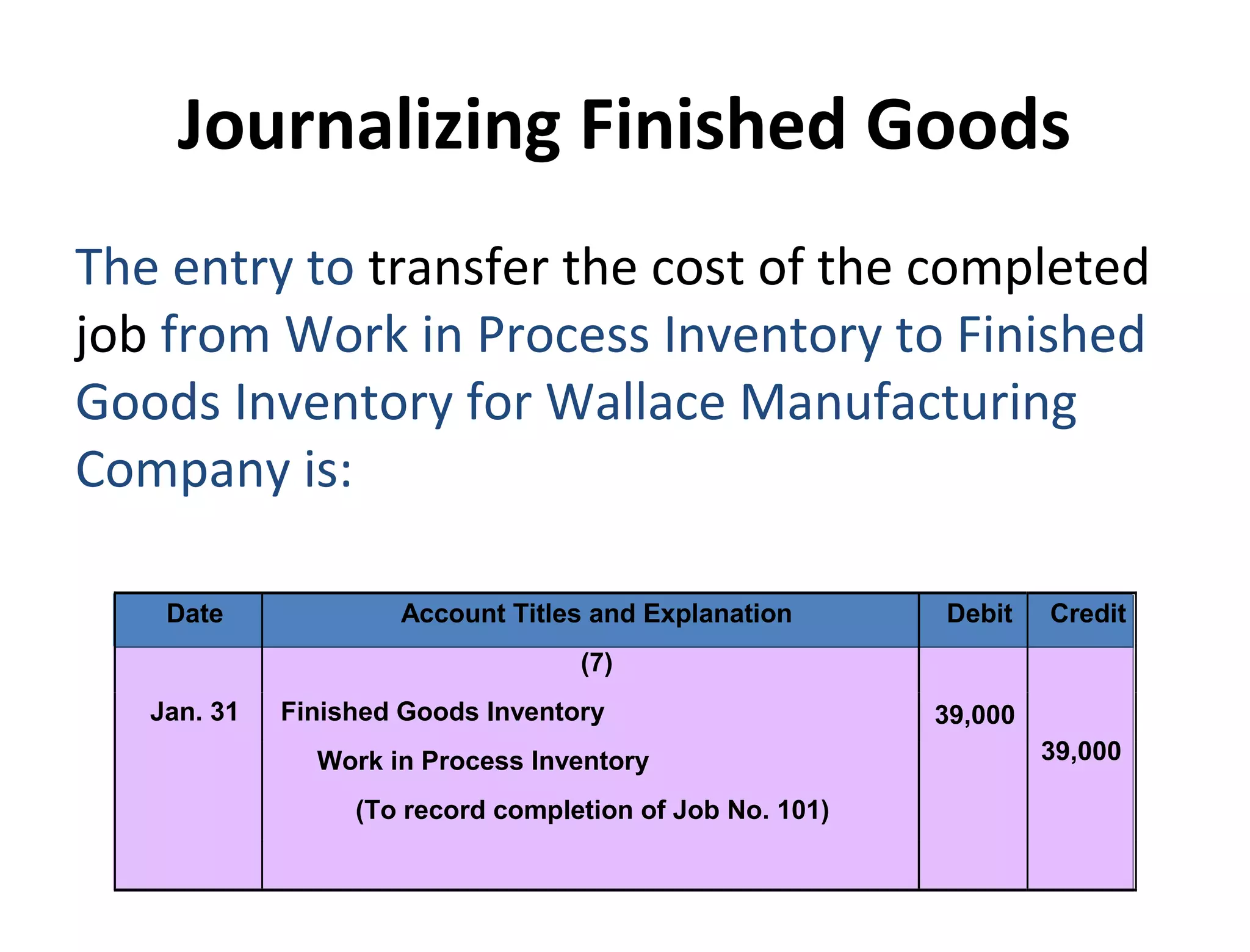
Journalizing Finished Goods 
The entry to transfer the cost of the completed 
job from Work in Process Inventory to Finished 
Goods Inventory for Wallace Manufacturing 
Company is: 
Date Account Titles and Explanation Debit Credit 
(7) 
Jan. 31 Finished Goods Inventory 
Work in Process Inventory 
(To record completion of Job No. 101) 
39,000 
39,000
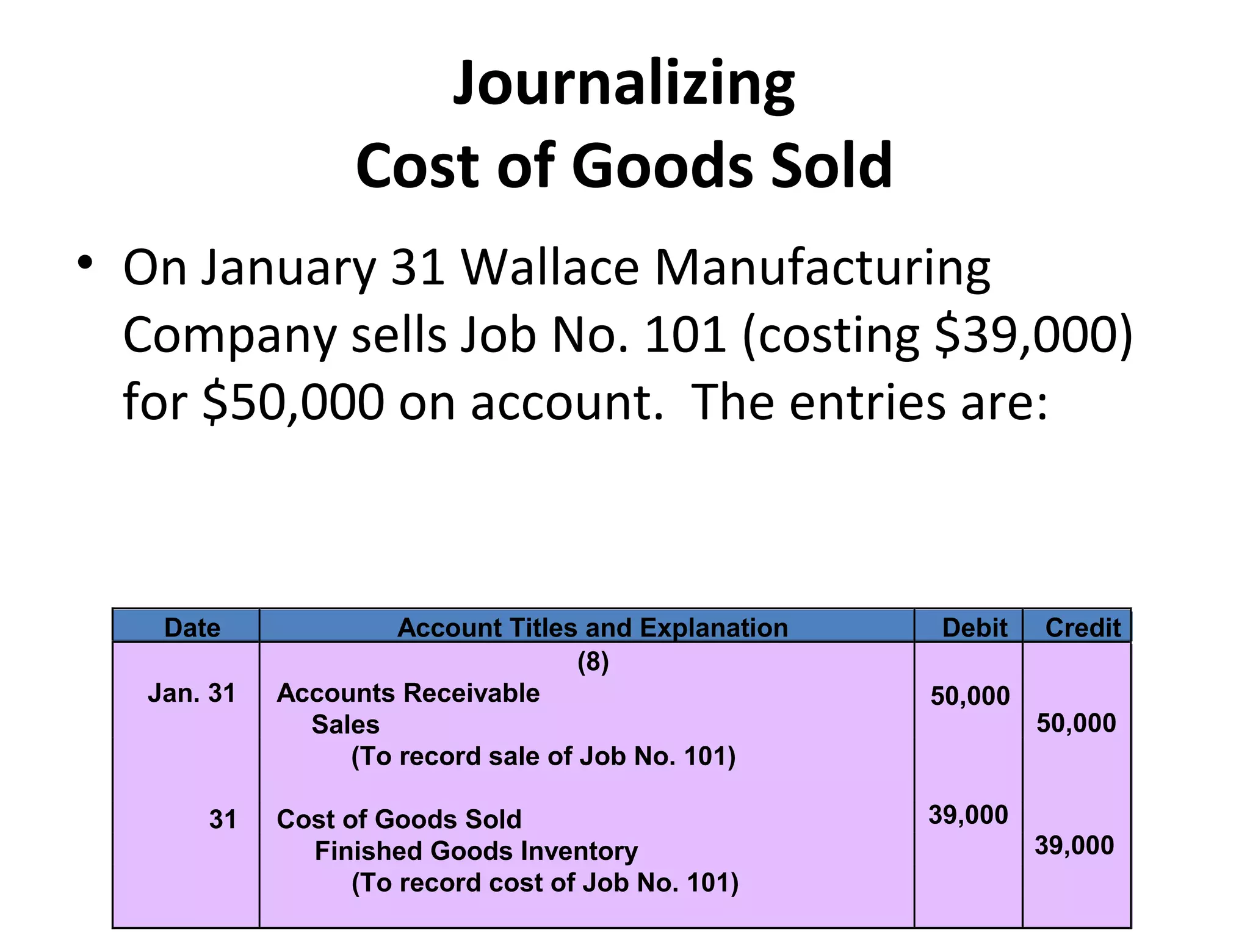
Journalizing 
Cost of Goods Sold 
• On January 31 Wallace Manufacturing 
Company sells Job No. 101 (costing $39,000) 
for $50,000 on account. The entries are: 
Date Account Titles and Explanation Debit Credit 
(8) 
Jan. 31 Accounts Receivable 
Sales 
(To record sale of Job No. 101) 
31 Cost of Goods Sold 
Finished Goods Inventory 
(To record cost of Job No. 101) 
50,000 
50,000 
39,000 
39,000
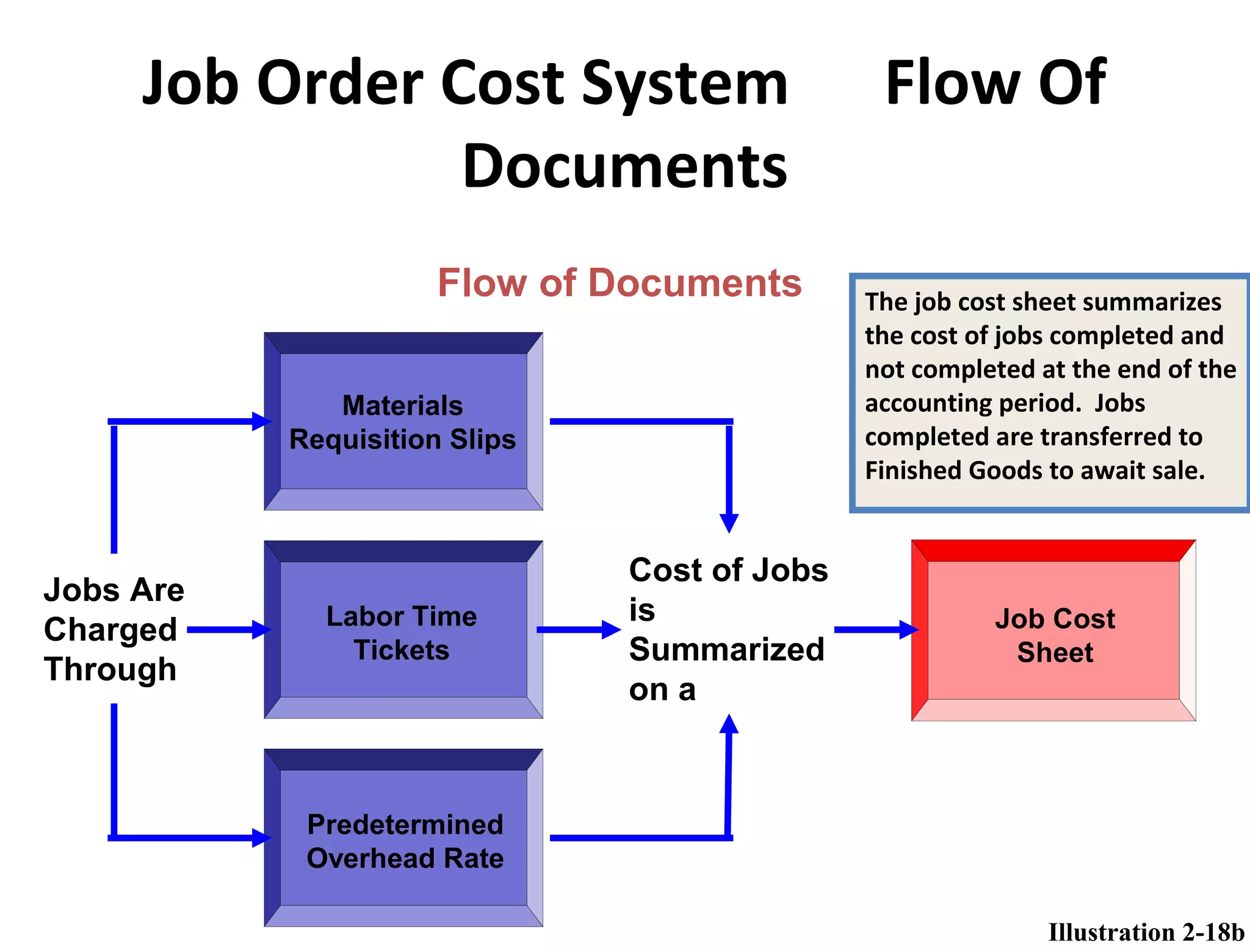
Job Order Cost System Flow Of 
Documents 
Flow of Documents 
Materials 
Requisition Slips 
Labor Time 
Tickets 
Predetermined 
Overhead Rate 
Job Cost 
Sheet 
Jobs Are 
Charged 
Through 
Cost of Jobs 
is 
Summarized 
on a 
The job cost sheet summarizes 
the cost of jobs completed and 
not completed at the end of the 
accounting period. Jobs 
completed are transferred to 
Finished Goods to await sale. 
Illustration 2-18b

M.com (4)

  • 1.
  • 2.
    MANAGERIAL ACCOUNTING ManagerialAccounting Basics • Comparing managerial and financial accounting • Ethical standards • Management functions Managerial Cost Concepts • Manufacturing costs • Product versus period costs MANAGERIAL ACCOUNTING
  • 3.
    Managerial Accounting Basics Managerial accounting (management accounting) is a field of accounting that provides economic and financial information for managers and other internal users.
  • 4.
    Differences Between Financialand Managerial Accounting FINANCIAL ACCOUNTING MANAGERIAL ACCOUNTING Primary Users of Reports External users, who are stockholders, creditors, and regulatory agencies. Internal users, who are officers, department heads, managers, and supervisors in the company. Types and Frequency of Reports Classified financial statements. Issued quarterly and annually. Internal reports Issued as frequently as needed. Purpose of Reports To provide general-purpose information for all users. To provide special-purpose information for a particular user for a specific decision. Illustration 1-1a
  • 5.
    Managerial Cost Concepts To perform the three management functions effectively, management needs information. One very important type of information is related to costs. For example, questions such as the following need answering: – What costs are involved in making the product? – If production volume is decreased, will costs decrease? – What impact will automation have on total costs? – How can costs best be controlled in the organization?
  • 6.
    MANAGERIAL ACCOUNTING Definethe three classes of manufacturing costs.
  • 7.
    Managerial Cost Concepts Manufacturing consists of activities and processes that convert raw materials into finished goods. Manufacturing costs are usually classified as follows: – Direct Materials – Direct Labor – Manufacturing Overhead
  • 8.
    Manufacturing Costs: DirectMaterials • Raw materials represent the basic materials and parts that are to be used in the manufacturing process. • Raw materials that can be physically and conveniently associated with the finished product during the manufacturing process are termed direct materials.
  • 9.
    Manufacturing Costs: IndirectMaterials Some raw materials cannot be easily associated with the finished product. These are considered indirect materials. Indirect materials – do not physically become part of the finished product – Indirect materials are accounted for as part of manufacturing overhead.
  • 10.
    Manufacturing Costs: DirectLabor Direct labor is the work of factory employees that can be physically and conveniently associated with converting raw materials into finished goods. DIRECT LABOR
  • 11.
    Manufacturing Costs: IndirectLabor The wages of maintenance people, timekeepers, and supervisors are normally categorized as indirect labor Like: Indirect materials, indirect labor is part of manufacturing overhead.
  • 12.
    Manufacturing Costs: Manufacturing Overhead Manufacturing overhead consists of costs that are indirectly associated with the manufacture of the finished product. Manufacturing overhead includes – indirect materials; – indirect labor; – depreciation on factory buildings and machinery; and – insurance, taxes, and maintenance on factory facilities. MANUFACTURING OVERHEAD
  • 13.
    Product Costs Productcosts (also called inventoriable costs) include each of the manufacturing cost elements (direct materials, direct labor, and manufacturing overhead). They are the costs that are a necessary and integral part of producing the finished product.
  • 14.
    Product Costs: Primeand Conversion Prime cost: Direct Material Conversion cost: Direct Labour Direct M.O.H Direct Labour
  • 15.
    Product Versus PeriodCosts All Costs Direct Materials Direct Labor Manufacturing Overhead Selling Expenses Administrative Expenses Prime Costs Conversion Costs Product Costs Manufacturing Costs (Go to Balance Sheet before Income Statement) Period Costs Nonmanufacturing Costs (Go straight to Income Statement) Illustration 1-4
  • 16.
    Cost of GoodsManufactured Schedule ABC COMPANY Cost of Goods Manufactured Schedule For the Year Ended December 31, 2013 Opening inventory $ 18,400 Direct materials Raw materials inventory, January 1 $ 16,700 Raw materials purchases 152,500 Total raw materials available for use 169,200 Less: Raw materials inventory, December 31 22,800 Direct materials used $ 146,400 Direct labor 175,600 Manufacuring overhead Indirect labor 14,300 Factory repairs 12,600 Factory utilities 10,100 Factory depreciation 9,440 Factory insurance 8,360 Total manufacturing overhead 54,800 Total manufacuring costs 376,800 Total cost of work in process 395,200 Less: Work in process, December 31 25,200 Cost of goods manufactured $ 370,000
  • 17.
    Job order costaccounting Cost Accounting Systems Job Order Cost Flow • Accumulating Manufacturing Costs • Assigning Manufacturing Costs to Work in Process • Assigning Costs to Finished Goods • Assigning Costs to Cost of Goods Sold • Summary JOB ORDER COST ACCOUNTING
  • 18.
    Process Cost System Process costing accounts for and accumulates product-related costs for a period of time, as opposed to assigning costs to specific products or jobs.
  • 19.
    Process Cost System: Compact Disc Production 1. Oil is pumped. 2. Benzene is removed. 3. The benzene 4. ...from which compact discs are Relatively similar products are produced over a specified time period. made. Illustration 2-2 Process Cost System
  • 20.
    Job Order CostFlow There are 2 major steps in the flow of costs: – accumulating the manufacturing costs incurred and – assigning the accumulated costs to the work done.
  • 21.
    Job Order CostAccounting System FFllooww ooff CCoossttss 4 8 Accumulation Assignment 1. Purchase raw materials 4. Raw materials are used 2. Incur factory labor 5. Factory labor is used 3. Incur manufacuring 6. Overhead is applied overhead 7. Completed goods are recognized 8. Cost of goods sold is recognized Key to Entries: Raw Materials Inventory (1) 42,000 (4) 30,000 Bal. 12,000 Factory Labor (2) 32,000 (5) 32,000 Manufacturing Overhead (3) 13,800 (6) 22,400 (4) 6,000 (5) 4,000 Bal. 1,400 Finished Goods Inventory (7) 39,000 (8) 39,000 Work in Process Inventory (4) 24,000 (7) 39,000 (5) 28,000 (6) 22,400 Bal. 35,400 Cost of Goods Sold (8) 39,000 7 5 6 Illustration 2-4
  • 22.
    Job Cost Sheet • A separate job cost sheet is kept for each job. Job cost sheets constitute the subsidiary ledger for the Work in Process Inventory account. • Each entry to Work in Process Inventory must be accompanied by a corresponding posting to one or more job cost sheets.
  • 23.
    Job Cost Sheet A job cost sheet is a form used to record the costs chargeable to a specific job and to determine the total and unit cost of the completed job. Postings to job cost sheets are made daily. Job Cost Sheet Job No. _________________________________ Quantity ________________________________ Item ___________________________________ Date Requested __________________________ For ____________________________________ Date Completed __________________________ Direct Direct Manufacturing Date Materials Labor Overhead Cost of completed job Direct materials $ Direct labor Manufacturing overhead Total cost $ Unit cost (total dollars ÷ quantity) $ Illustration 2-6
  • 24.
    Assigning Manufacturing Coststo Work in Process Raw materials costs are assigned to jobs when the materials are issued by the storeroom.
  • 25.
    Bob Kadler M.Che r Time Ticket Labor costs are assigned to jobs on the basis of time tickets. The time ticket should indicate the employee, the hours worked, the account and job to be charged, and the total labor cost. Illustration 2-10
  • 26.
    Estimated Annual OverheadCosts Expected Annual ÷ Operating Activity = Predetermined Overhead Rate Predetermined Overhead Rate
  • 27.
    Using Predetermined OverheadRates X Activity Base Predetermined Overhead Rate is assigned to Work in Process Job 1 Job 2 Job 3 Illustration 2-13
  • 28.
    Completed Job CostSheet When a job is completed, the manufacturing costs are summarized and the lower portion of the applicable job cost sheet is completed. • If Job No. 101 is completed on January 31, the job cost sheet will be as shown to the right. Illustration 2-16
  • 29.
    Journalizing Finished Goods The entry to transfer the cost of the completed job from Work in Process Inventory to Finished Goods Inventory for Wallace Manufacturing Company is: Date Account Titles and Explanation Debit Credit (7) Jan. 31 Finished Goods Inventory Work in Process Inventory (To record completion of Job No. 101) 39,000 39,000
  • 30.
    Journalizing Cost ofGoods Sold • On January 31 Wallace Manufacturing Company sells Job No. 101 (costing $39,000) for $50,000 on account. The entries are: Date Account Titles and Explanation Debit Credit (8) Jan. 31 Accounts Receivable Sales (To record sale of Job No. 101) 31 Cost of Goods Sold Finished Goods Inventory (To record cost of Job No. 101) 50,000 50,000 39,000 39,000
  • 31.
    Job Order CostSystem Flow Of Documents Flow of Documents Materials Requisition Slips Labor Time Tickets Predetermined Overhead Rate Job Cost Sheet Jobs Are Charged Through Cost of Jobs is Summarized on a The job cost sheet summarizes the cost of jobs completed and not completed at the end of the accounting period. Jobs completed are transferred to Finished Goods to await sale. Illustration 2-18b