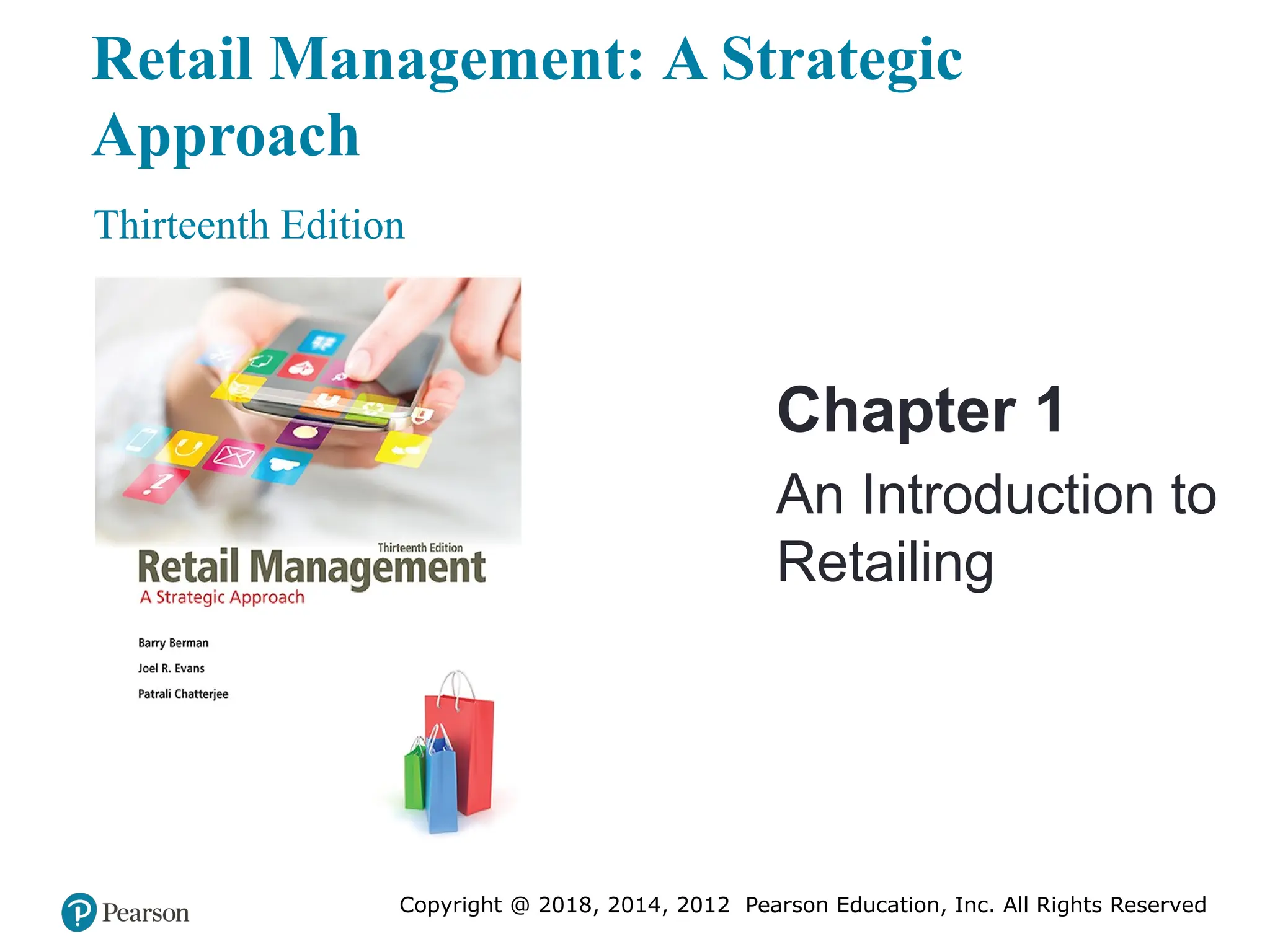
Retail Management: A Strategic
Approach
Thirteenth Edition
Chapter 1
An Introduction to
Retailing
Copyright @ 2018, 2014, 2012 Pearson Education, Inc. All Rights Reserved
Learning Objectives
1.1 To define retailing, consider it from different perspectives,
demonstrate its impact, and note its special characteristics
1.2 To introduce the concept of strategic planning and apply it
1.3 To show why the retailing concept is the foundation of a successful
business, with an emphasis on the total retail experience, customer
service, and relationship retailing
1.4 To indicate the focus and format of the text
Copyright @ 2018, 2014, 2012 Pearson Education, Inc. All Rights Reserved
Retailing
• Retailing encompasses the business activities involved in selling
goods and services to consumers for their personal, family, or
household use. It includes every sale to the final consumer.
Copyright @ 2018, 2014, 2012 Pearson Education, Inc. All Rights Reserved
Issues in Retailing
• How can we best serve our customers while earning a fair profit?
• How can we stand out in a highly competitive environment where
consumers have so many choices?
• Low consumer confidence and high savings rates have reduced
consumer spending. At the same time retail competition has
increased through increased format blurring (e.g., sales of cameras at
office supply stores, carpeting and major appliances at home
improvement centers).
• How can we grow our business while retaining a core of loyal
customers?
Copyright @ 2018, 2014, 2012 Pearson Education, Inc. All Rights Reserved
The Philosophy
• Retailers can best address these questions by fully understanding
and applying the basic principles of retailing, as well as the elements
in a well-structured, systematic, and focused retail strategy.
Copyright @ 2018, 2014, 2012 Pearson Education, Inc. All Rights Reserved
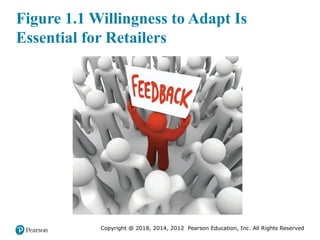
Figure 1.1 Willingness to Adapt Is
Essential for Retailers
Copyright @ 2018, 2014, 2012 Pearson Education, Inc. All Rights Reserved
An Ideal Candidate for a Retailing
Career
• Must be a people person (more important than technical knowledge).
Technical skills can be taught more easily than people skills
• Must be flexible
• Should be decisive
• Must have analytical skills
• Must have stamina
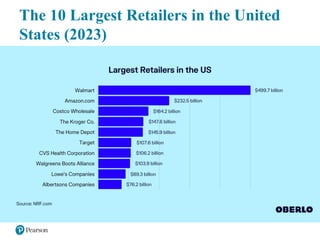
The 10 Largest Retailers in the United
States (2023)
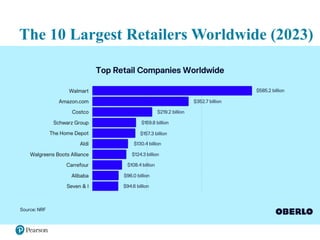
The 10 Largest Retailers Worldwide (2023)
Copyright @ 2018, 2014, 2012 Pearson Education, Inc. All Rights Reserved
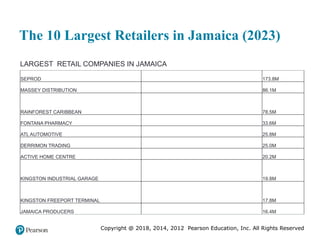
The 10 Largest Retailers in Jamaica (2023)
LARGEST RETAIL COMPANIES IN JAMAICA
SEPROD 173.8M
MASSEY DISTRIBUTION 86.1M
RAINFOREST CARIBBEAN 78.5M
FONTANA PHARMACY 33.6M
ATL AUTOMOTIVE 25.8M
DERRIMON TRADING 25.0M
ACTIVE HOME CENTRE 20.2M
KINGSTON INDUSTRIAL GARAGE 19.8M
KINGSTON FREEPORT TERMINAL 17.8M
JAMAICA PRODUCERS 16.4M
Copyright @ 2018, 2014, 2012 Pearson Education, Inc. All Rights Reserved
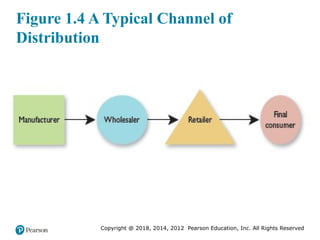
Figure 1.4 A Typical Channel of
Distribution
Copyright @ 2018, 2014, 2012 Pearson Education, Inc. All Rights Reserved
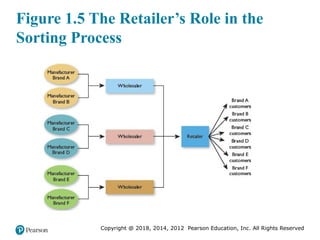
Figure 1.5 The Retailer’s Role in the
Sorting Process
Copyright @ 2018, 2014, 2012 Pearson Education, Inc. All Rights Reserved
Omnichannel Retailing (1 of 2)
•A retailer sells to consumers through multiple retail formats:
– Web sites
– Physical stores
– Smartphone apps
– Social media
Copyright @ 2018, 2014, 2012 Pearson Education, Inc. All Rights Reserved
Omnichannel Retailing (2 of 2)
• Cross selling across channels (in-store product availability info on
Web site)
• Consistent pricing in all channels (credibility)
• Can buy, and return product regardless of channel
• Role of each channel
– Store– try on, ease of return, fast availability (immediacy), compare
offerings
– Web– 24/7, product information, product reviews by customers,
personalization (tailored assortment based on past purchases),
most current pricing, closeout sales
– Catalog-permanency, true color
Copyright @ 2018, 2014, 2012 Pearson Education, Inc. All Rights Reserved
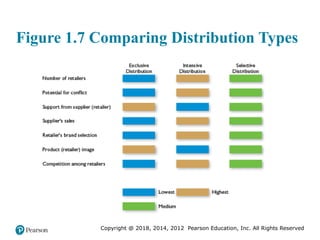
Distribution Types
• Exclusive: Suppliers make agreements with one or few retailers,
designating such retailers as the only ones to carry certain brands or
products within a specified geographic area
• Intensive: Suppliers sell through as many retailers as possible
• Selective: Suppliers sell through a moderate number of retailers
Copyright @ 2018, 2014, 2012 Pearson Education, Inc. All Rights Reserved
Exclusive Vs Intensive Distribution
• Exclusive Distribution: Fate of retailer is tied to manufacturer
success, retailer has no “free-rider” concerns, retailer has less price
competition, manufacturer is better assured of high levels of customer
support
• Intensive Distribution: Manufacturer is better assured of maximizing
sales (especially for convenience goods), retailers face strong
competition for price and service, intratype competition
Copyright @ 2018, 2014, 2012 Pearson Education, Inc. All Rights Reserved
Figure 1.7 Comparing Distribution Types
Copyright @ 2018, 2014, 2012 Pearson Education, Inc. All Rights Reserved
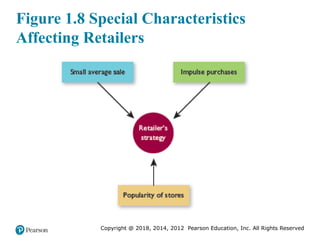
Figure 1.8 Special Characteristics
Affecting Retailers
Copyright @ 2018, 2014, 2012 Pearson Education, Inc. All Rights Reserved
Retail Strategy
• An overall plan for guiding a retail firm
• Influences the firm’s business activities
• Influences firm’s response to market forces
Copyright @ 2018, 2014, 2012 Pearson Education, Inc. All Rights Reserved
Six Steps in Strategic Planning
1. Define the type of business (corporate mission)
2. Set long-run and short-run objectives
3. Determine the customer market
4. Devise an overall, long-run plan
5. Implement an integrated strategy
6. Evaluate and correct (fine-tune)
Copyright @ 2018, 2014, 2012 Pearson Education, Inc. All Rights Reserved
Aspects of Home Depot’s Strategy
• Growth through product
authority
• Targeted appeal to
multiple segments
• Distinctive image
• Seamless customer
service
• Multiple points of contact
• Employee relations
• Innovation
• Commitment to technology
• Community involvement
• Adaptive to omnichannel
trends
Copyright @ 2018, 2014, 2012 Pearson Education, Inc. All Rights Reserved
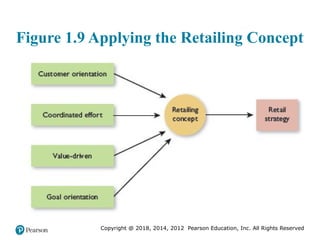
Figure 1.9 Applying the Retailing Concept
Copyright @ 2018, 2014, 2012 Pearson Education, Inc. All Rights Reserved
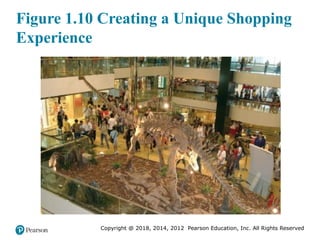
Figure 1.10 Creating a Unique Shopping
Experience
Copyright @ 2018, 2014, 2012 Pearson Education, Inc. All Rights Reserved
The Store of the Future
Please click URL to view:
https://youtu.be/IKouQFI1aM4
Copyright @ 2018, 2014, 2012 Pearson Education, Inc. All Rights Reserved
Customer Service
• Activities undertaken by a retailer in conjunction with the basic goods
and services it sells. This includes:
– Store hours
– Parking
– Shopper-friendliness
– Credit acceptance
– Salespeople
Copyright @ 2018, 2014, 2012 Pearson Education, Inc. All Rights Reserved
Figure 1.11 A Customer Respect
Checklist
•Do we trust our customers?
•Do we stand behind what we sell?
•Is keeping commitments to customers important to our
company?
•Do we value customer time?
•Do we communicate with customers respectfully?
•Do we treat all customers with respect?
•Do we thank customers for their business?
•Do we respect employees?
Copyright @ 2018, 2014, 2012 Pearson Education, Inc. All Rights Reserved
Customer Service Lessons: Richard
Branson and Virgin Airlines
Read post here:
https://www.forbes.com/forbes/welcome/?toURL=https://www.forbes.com
/sites/carminegallo/2013/05/09/seven-customer-service-lessons-i-learne
d-in-one-day-with-richard-branson-video/&refURL=&referrer=
Copyright @ 2018, 2014, 2012 Pearson Education, Inc. All Rights Reserved
Relationship Retailing
• Retailers seek to establish and maintain long-term bonds with
customers, rather than act as if each sales transaction is a completely
new encounter
– Concentrate on the total retail experience
– Monitor satisfaction
– Stay in touch with customers
Copyright @ 2018, 2014, 2012 Pearson Education, Inc. All Rights Reserved
Effective Relationship Retailing
• Use a “win-win” approach
– It is easier to keep existing customers happy than to gain new
ones (present value of current customers income stream– cost of
keeping existing customers content versus cost of replacing them
with new customer
• Develop a customer database (loyalty programs)
– Ongoing customer contact is improved with information on
people’s attributes and shopping behaviors
Copyright @ 2018, 2014, 2012 Pearson Education, Inc. All Rights Reserved
Relationship Management Among
Retailers and Suppliers
•Disagreements may occur in the following areas (channel conflict):
– control over channel (private label)
– profit allocation (resale price control)
– number of competing retailers (exclusive, selective or intensive
distribution)
– product displays
– promotional support (cooperative advertising funds and restrictions)
– payment terms (payment on time)
– operating flexibility
– gray market sales
– markdown monies, chargebacks by dominant retailers
Copyright @ 2018, 2014, 2012 Pearson Education, Inc. All Rights Reserved
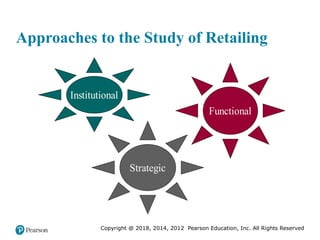
Approaches to the Study of Retailing
Institutional
Functional
Strategic
Copyright @ 2018, 2014, 2012 Pearson Education, Inc. All Rights Reserved
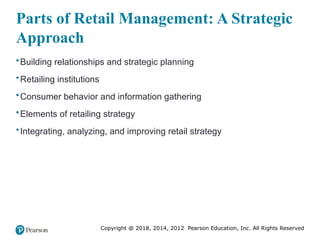
Parts of Retail Management: A Strategic
Approach
•Building relationships and strategic planning
•Retailing institutions
•Consumer behavior and information gathering
•Elements of retailing strategy
•Integrating, analyzing, and improving retail strategy

Chapter 01-Berman 13th Ed...............

  • 1.
    Retail Management: AStrategic Approach Thirteenth Edition Chapter 1 An Introduction to Retailing Copyright @ 2018, 2014, 2012 Pearson Education, Inc. All Rights Reserved
  • 2.
    Copyright @ 2018,2014, 2012 Pearson Education, Inc. All Rights Reserved Learning Objectives 1.1 To define retailing, consider it from different perspectives, demonstrate its impact, and note its special characteristics 1.2 To introduce the concept of strategic planning and apply it 1.3 To show why the retailing concept is the foundation of a successful business, with an emphasis on the total retail experience, customer service, and relationship retailing 1.4 To indicate the focus and format of the text
  • 3.
    Copyright @ 2018,2014, 2012 Pearson Education, Inc. All Rights Reserved Retailing • Retailing encompasses the business activities involved in selling goods and services to consumers for their personal, family, or household use. It includes every sale to the final consumer.
  • 4.
    Copyright @ 2018,2014, 2012 Pearson Education, Inc. All Rights Reserved Issues in Retailing • How can we best serve our customers while earning a fair profit? • How can we stand out in a highly competitive environment where consumers have so many choices? • Low consumer confidence and high savings rates have reduced consumer spending. At the same time retail competition has increased through increased format blurring (e.g., sales of cameras at office supply stores, carpeting and major appliances at home improvement centers). • How can we grow our business while retaining a core of loyal customers?
  • 5.
    Copyright @ 2018,2014, 2012 Pearson Education, Inc. All Rights Reserved The Philosophy • Retailers can best address these questions by fully understanding and applying the basic principles of retailing, as well as the elements in a well-structured, systematic, and focused retail strategy.
  • 6.
    Copyright @ 2018,2014, 2012 Pearson Education, Inc. All Rights Reserved Figure 1.1 Willingness to Adapt Is Essential for Retailers
  • 7.
    Copyright @ 2018,2014, 2012 Pearson Education, Inc. All Rights Reserved An Ideal Candidate for a Retailing Career • Must be a people person (more important than technical knowledge). Technical skills can be taught more easily than people skills • Must be flexible • Should be decisive • Must have analytical skills • Must have stamina
  • 8.
    The 10 LargestRetailers in the United States (2023)
  • 9.
    The 10 LargestRetailers Worldwide (2023)
  • 10.
    Copyright @ 2018,2014, 2012 Pearson Education, Inc. All Rights Reserved The 10 Largest Retailers in Jamaica (2023) LARGEST RETAIL COMPANIES IN JAMAICA SEPROD 173.8M MASSEY DISTRIBUTION 86.1M RAINFOREST CARIBBEAN 78.5M FONTANA PHARMACY 33.6M ATL AUTOMOTIVE 25.8M DERRIMON TRADING 25.0M ACTIVE HOME CENTRE 20.2M KINGSTON INDUSTRIAL GARAGE 19.8M KINGSTON FREEPORT TERMINAL 17.8M JAMAICA PRODUCERS 16.4M
  • 11.
    Copyright @ 2018,2014, 2012 Pearson Education, Inc. All Rights Reserved Figure 1.4 A Typical Channel of Distribution
  • 12.
    Copyright @ 2018,2014, 2012 Pearson Education, Inc. All Rights Reserved Figure 1.5 The Retailer’s Role in the Sorting Process
  • 13.
    Copyright @ 2018,2014, 2012 Pearson Education, Inc. All Rights Reserved Omnichannel Retailing (1 of 2) •A retailer sells to consumers through multiple retail formats: – Web sites – Physical stores – Smartphone apps – Social media
  • 14.
    Copyright @ 2018,2014, 2012 Pearson Education, Inc. All Rights Reserved Omnichannel Retailing (2 of 2) • Cross selling across channels (in-store product availability info on Web site) • Consistent pricing in all channels (credibility) • Can buy, and return product regardless of channel • Role of each channel – Store– try on, ease of return, fast availability (immediacy), compare offerings – Web– 24/7, product information, product reviews by customers, personalization (tailored assortment based on past purchases), most current pricing, closeout sales – Catalog-permanency, true color
  • 15.
    Copyright @ 2018,2014, 2012 Pearson Education, Inc. All Rights Reserved Distribution Types • Exclusive: Suppliers make agreements with one or few retailers, designating such retailers as the only ones to carry certain brands or products within a specified geographic area • Intensive: Suppliers sell through as many retailers as possible • Selective: Suppliers sell through a moderate number of retailers
  • 16.
    Copyright @ 2018,2014, 2012 Pearson Education, Inc. All Rights Reserved Exclusive Vs Intensive Distribution • Exclusive Distribution: Fate of retailer is tied to manufacturer success, retailer has no “free-rider” concerns, retailer has less price competition, manufacturer is better assured of high levels of customer support • Intensive Distribution: Manufacturer is better assured of maximizing sales (especially for convenience goods), retailers face strong competition for price and service, intratype competition
  • 17.
    Copyright @ 2018,2014, 2012 Pearson Education, Inc. All Rights Reserved Figure 1.7 Comparing Distribution Types
  • 18.
    Copyright @ 2018,2014, 2012 Pearson Education, Inc. All Rights Reserved Figure 1.8 Special Characteristics Affecting Retailers
  • 19.
    Copyright @ 2018,2014, 2012 Pearson Education, Inc. All Rights Reserved Retail Strategy • An overall plan for guiding a retail firm • Influences the firm’s business activities • Influences firm’s response to market forces
  • 20.
    Copyright @ 2018,2014, 2012 Pearson Education, Inc. All Rights Reserved Six Steps in Strategic Planning 1. Define the type of business (corporate mission) 2. Set long-run and short-run objectives 3. Determine the customer market 4. Devise an overall, long-run plan 5. Implement an integrated strategy 6. Evaluate and correct (fine-tune)
  • 21.
    Copyright @ 2018,2014, 2012 Pearson Education, Inc. All Rights Reserved Aspects of Home Depot’s Strategy • Growth through product authority • Targeted appeal to multiple segments • Distinctive image • Seamless customer service • Multiple points of contact • Employee relations • Innovation • Commitment to technology • Community involvement • Adaptive to omnichannel trends
  • 22.
    Copyright @ 2018,2014, 2012 Pearson Education, Inc. All Rights Reserved Figure 1.9 Applying the Retailing Concept
  • 23.
    Copyright @ 2018,2014, 2012 Pearson Education, Inc. All Rights Reserved Figure 1.10 Creating a Unique Shopping Experience
  • 24.
    Copyright @ 2018,2014, 2012 Pearson Education, Inc. All Rights Reserved The Store of the Future Please click URL to view: https://youtu.be/IKouQFI1aM4
  • 25.
    Copyright @ 2018,2014, 2012 Pearson Education, Inc. All Rights Reserved Customer Service • Activities undertaken by a retailer in conjunction with the basic goods and services it sells. This includes: – Store hours – Parking – Shopper-friendliness – Credit acceptance – Salespeople
  • 26.
    Copyright @ 2018,2014, 2012 Pearson Education, Inc. All Rights Reserved Figure 1.11 A Customer Respect Checklist •Do we trust our customers? •Do we stand behind what we sell? •Is keeping commitments to customers important to our company? •Do we value customer time? •Do we communicate with customers respectfully? •Do we treat all customers with respect? •Do we thank customers for their business? •Do we respect employees?
  • 27.
    Copyright @ 2018,2014, 2012 Pearson Education, Inc. All Rights Reserved Customer Service Lessons: Richard Branson and Virgin Airlines Read post here: https://www.forbes.com/forbes/welcome/?toURL=https://www.forbes.com /sites/carminegallo/2013/05/09/seven-customer-service-lessons-i-learne d-in-one-day-with-richard-branson-video/&refURL=&referrer=
  • 28.
    Copyright @ 2018,2014, 2012 Pearson Education, Inc. All Rights Reserved Relationship Retailing • Retailers seek to establish and maintain long-term bonds with customers, rather than act as if each sales transaction is a completely new encounter – Concentrate on the total retail experience – Monitor satisfaction – Stay in touch with customers
  • 29.
    Copyright @ 2018,2014, 2012 Pearson Education, Inc. All Rights Reserved Effective Relationship Retailing • Use a “win-win” approach – It is easier to keep existing customers happy than to gain new ones (present value of current customers income stream– cost of keeping existing customers content versus cost of replacing them with new customer • Develop a customer database (loyalty programs) – Ongoing customer contact is improved with information on people’s attributes and shopping behaviors
  • 30.
    Copyright @ 2018,2014, 2012 Pearson Education, Inc. All Rights Reserved Relationship Management Among Retailers and Suppliers •Disagreements may occur in the following areas (channel conflict): – control over channel (private label) – profit allocation (resale price control) – number of competing retailers (exclusive, selective or intensive distribution) – product displays – promotional support (cooperative advertising funds and restrictions) – payment terms (payment on time) – operating flexibility – gray market sales – markdown monies, chargebacks by dominant retailers
  • 31.
    Copyright @ 2018,2014, 2012 Pearson Education, Inc. All Rights Reserved Approaches to the Study of Retailing Institutional Functional Strategic
  • 32.
    Copyright @ 2018,2014, 2012 Pearson Education, Inc. All Rights Reserved Parts of Retail Management: A Strategic Approach •Building relationships and strategic planning •Retailing institutions •Consumer behavior and information gathering •Elements of retailing strategy •Integrating, analyzing, and improving retail strategy

Editor's Notes

  • #1 If this PowerPoint presentation contains mathematical equations, you may need to check that your computer has the following installed: 1) MathType Plugin 2) Math Player (free versions available) 3) NVDA Reader (free versions available)
  • #3 DISCUSSION: Why study retailing? Retailing does not have to involve a store. Mail and phone orders, direct selling to consumers in their homes and offices, Web transactions, and vending machine sales are part of retailing. Retailing does not have to include a “retailer.” Manufacturers, importers, nonprofit firms, and wholesalers act as retailers when they sell to final consumers. There are several reasons for studying retailing. Retailing is a significant part of the U.S. economy. Annual retail store sales are nearly $5 trillion. Telephone and mail orders, vending machines, direct selling, and the Web generate hundreds of billions of dollars in additional revenues. Personal consumption spending on services account for another several hundred billion dollars in annual retail revenues. Durable goods stores account for 30 percent of total sales. Nondurable goods and service stores account for the other 70 percent. The largest 250 retailers in the world generate more than $4.6 trillion in annual revenues. They represent 29 nations.
  • #4 Retailing today is at a complex crossroads. Retail sales are at their highest point in history, new technologies are improving productivity, there are opportunities to start a new business or work for an existing one, and global retailing possibilities abound. Yet, retailers face many challenges: The weak economy in recent years has had a major impact on many retailers, their suppliers, and consumers. Many consumers are bored with shopping or do not have much time for it. Some locales have too many stores. Competitors often spur one another into frequent price cutting and low profit margins. Customer service expectations are high. Some retailers remain unsure about their online strategy.
  • #6 Can retailers flourish in today’s tough marketplace? Look at the success of retailers such as Costco, Starbucks, L Brands (whose major brands include Victoria’s Secret and Bath & Body Works), and Amazon.com. What do they have in common? A desire to please the customer and a strong market niche. The most successful retailers over the long run are those which recognize that consumers and the marketplace are constantly evolving. They do research to get feedback and then act accordingly.
  • #7 Retailing is the largest private-sector employer in the United States. According to the National Retail Federation, anyone whose employment results in a consumer product—from those who supply raw materials to manufacturers to truck drivers who deliver goods—counts on retail for their livelihood, With 35 million stores and the vast number of suppliers, the retail industry is responsible for 42 million jobs, $1.6 trillion in labor income, and it accounts for $2.6 trillion of the U.S. gross domestic product (GDP).
  • #12 Retailing is the last stage in a channel of distribution. See Figure 1-5 for an illustration of a typical distribution channel. Retailers often act as the contact between manufacturers, wholesalers, and the consumer. Retailers collect an assortment of goods and services from various sources, buy them in large quantity, and sell in small amounts. This is known as the sorting process. See Figure 1-5. Retailers communicate with their customers and suppliers. Retailers complete transactions with their customers. This means having convenient locations, filling orders promptly and accurately, and processing credit purchases. Some retailers also provide customer services such as gift wrapping, delivery, and installation. Many retailers now engage in multi-channel retailing, whereby they sell to consumers through multiple retail formats.
  • #13 Many firms now engage in omnichannel retailing, whereby a retailer sells to consumers through multiple retail formats (points of contact). Most large retailers operate both physical stores and Web sites to make shopping easier and to accommodate consumer desires. Omnichannel retail firms provide information and sell to customers through multiple touch points: retail stores, mail order, Web sites, tablets, smartphones, and a toll-free phone number
  • #15 Channel relations tend to be smoothest with exclusive distribution.. This stimulates both parties to work together to maintain an image, assign shelf space, allot profits and costs, and advertise. It also usually requires that retailers limit their brand selection in the specified product lines; they might have to decline to handle other suppliers’ brands. From the manufacturers’ perspective, exclusive distribution may limit their long-run total sales. Channel relations tend to be most volatile with intensive distribution. This often maximizes suppliers’ sales and lets retailers offer many brands and product versions. Competition among retailers selling the same items is high; retailers may use tactics not beneficial to individual suppliers, because they are more concerned about their own results. Retailers may assign little space to specific brands, set very high prices on them, and not advertise them. Selective distribution, combines aspects of exclusive and intensive distribution. Suppliers have higher sales than in exclusive distribution, and retailers carry some competing brands. It encourages suppliers to provide some marketing support and retailers to give adequate shelf space.
  • #18 Retailing has several special characteristics. See Figure 1-8. 1. The average amount of a sales transaction for retailers is much less than for manufacturers. Average transactions per trip are well under $100 for department stores, specialty stores, and supermarkets. Due to the low average size of retail sales: a. Costs need to be controlled. b. The number of customers needs to be maximized through advertising and special promotions. c. Impulse sales need to be increased by more aggressive selling. d. Inventory management is complex. For example, a typical supermarket has several thousand transactions per week; this makes it difficult to determine the levels of existing stock and the popularity of various brands, sizes, and prices of merchandise.
  • #20 All retailers should utilize these six steps in strategic planning: 1. Define the type of business in terms of the goods or service category and the company’s specific orientation. 2. Set long-run and short-run objectives for sales and profit, market share, image, etc. 3. Determine the customer market to target on the basis of its characteristics and needs. 4. Devise an overall, long-run plan that gives general direction to the firm and its employees. 5. Implement an integrated strategy that combines such factors as store location, product assortment, pricing, and advertising and displays to achieve objectives. 6. Regularly evaluate performance and correct weaknesses or problems when observed.
  • #21 The Home Depot Corporation: Successfully Navigating the Omnichannel Landscape The Home Depot Corporation (HD) describes itself as “one-stop shopping for the do-it-yourselfer.” The first store opened in Atlanta in 1979. Today, there are 2,275 stores with 370,000 employees. Throughout its existence, HD has followed a consistent, far-sighted, customer-oriented strategy. This encompasses these elements: 1. Growth-oriented objectives 2. Targeted appeal to multiple growing segments 3. Distinctive company image 4. Focus 5. Strong customer service for its retail category 6. Multiple points of contact 7. Employee relations 8. Innovation 9. Commitment to technology 10. Community involvement 11. Constantly monitoring performance
  • #22 HD uses a customer-centered, chainwide approach to strategy development and implementation; it is value-driven; and it has clear goals. These principles form the retailing concept. See Figure 1-9. The retailing concept consists of these elements: 1. Customer orientation 2. Coordinated effort 3. Value driven 4. Goal orientation The retailing concept is a guide to company strategy as it offers a broad framework for planning. The total retail experience includes all the elements in a retail offering that encourage or inhibit consumers during their contact with a retailer. i. A retailer must ensure that all of its strategic elements are in place. ii. For the shopper segment to which a particular retailer appeals, the total retail experience must be aimed at fulfilling customer expectations. iii. A big challenge for retailers is generating customer excitement. See Figure 1.0 (next slide).
  • #23 At this Hong Kong shopping center, an exciting and distinctive customer experience was formed by featuring an enormous dinosaur skeleton in the middle of the shopping center.
  • #24 Published on Nov 10, 2015 (2:14) We travel to Chicago to check out the Store of the Future, an immersive retail experience that combines the high-touch benefits of brick-and-mortar with the high-tech features of online shopping.
  • #25 Customer service refers to the identifiable, but sometimes intangible, activities undertaken by a retailer in conjunction with the basic goods and services it sells. It has a strong impact on the total retail experience. Among the factors that comprise a customer service strategy are store hours, parking, shopper friendliness of the store layout, credit acceptance, salespeople, amenities such as gift wrapping, rest rooms, employee politeness, etc. Satisfaction with a retailer’s customer service is affected by expectations and past experience.
  • #26 Do the retailer and its employees honor all promises that are made to customers—and strive not to mislead shoppers? Do employees avoid being confrontational with customers if the latter make a complaint about merchandise or service? Are customer phone calls, E-mails, and other contacts with the retailer directed to the right employees and handled promptly? For a retailer that operates both store and online businesses, are policies clearly stated and distinctions between the two formats with regard to purchase, shipping, and return policies noted in the store and online? Does the retailer monitor online customer reviews and social media discussions and work to resolve any problems that are noted there? Does the retailer treat every customer respectfully, regardless of age, gender, race, ethnicity, and other factors? Does the retailer recognize and reward its most loyal customers? Does the retailer’s employee review process include how well the employees are rated by customers?
  • #27 Forbes.com contributor and communications coach, Carmine Gallo, learned 7 valuable customer service lessons in a day with Richard Branson and the Virgin America team. Read post here: http://www.forbes.com/sites/carminega...
  • #28 Relationship retailing is the process whereby retailers seek to establish and maintain long-term bonds with customers. To be effective in relationship retailing, a firm should keep these two points in mind: i. Because it is harder to lure new customers than to make existing ones happy, a “win-win” approach is critical. For the retailer to “win,” the customer must also “win.” ii. Due to advances in computer, mobile, and social media technology, it is now much easier to develop a customer data base with information on people’s attributes and past shopping behavior. Ongoing customer contact can be better, more frequent, and more focused.
  • #31 There are various approaches to the study of retailing, as follows: Institutional—Describes the types of retailers and their development. Functional—Concentrates on the activities that retailers perform. Strategic—Centers on defining the retail business, setting objectives, appealing to an appropriate customer market, developing an overall plan, implementing an integrated strategy, and regularly reviewing operations. This text focuses on the strategic approach. This accomplishes the following: 1. It stresses the need for retailers to plan for and adapt to a complex, changing environment. 2. It considers both opportunities and threats. 3. It encourages the study of competitors, suppliers, economic factors, consumer changes, marketplace trends, legal restrictions, and other elements.