INTRODUCTION
TO
SALESMANSHIP
Chapter 1
WHAT IS SELLING?
WHAT IS SELLING?
• Sale is the last step in selling goods or services in
exchange for money or something else value.
• When a “deal is closed,” it means that the
customer has agreed to buy the product or
service and paid for it in full or in part.
WHAT IS SELLING?
• It starts with consent (or agreement) to an acquisition,
appropriation, or request.This is followed by the passing of title
(property or ownership) in the item and the application and due
settlement of a price the seller’s need to pass ownership, being a
price the seller is happy to give up ownership of or any claim on the
item
• Even though the buyer is part of the sale, he or she doesn’t carry out
the sale. Only the seller does that.
SALES MANAGEMENT
TRENDS
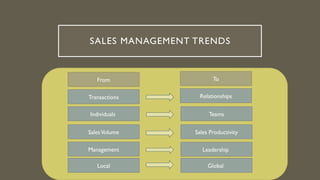
SALES MANAGEMENT TRENDS
From To
SalesVolume
Management
Local Global
Leadership
Sales Productivity
Teams
Relationships
Individuals
Transactions
MARKETING VS. SELLING
MARKETING VS SELLING
• Marketing and sales are very different, but they are
both trying to get the same thing done.
• Marketing improves the selling environment and is
very important part of sales. If the marketing
department makes a list of potential customers, it
can be helpful for sales.
MARKETING VS. SELLING
• The marketing department’s goal is to increase the
number of interactions between potential
customer and the sales team.
• They do this through advertising, sales promotion,
publicity, public relations, creating new sales
channels, or making new products (new product
development), among other things.
WHAT IS
SALESMANSHIP?
WHAT IS SALESMANSHIP?
• Most of the time, the word “salesmanship”
is used to refer to selling goods one-on-
one. However it shouldn’t be confused with
personal selling.To sell a product to
someone, you need skills. It’s not the kind of
job that everyone can do.
WHAT IS SALESMANSHIP
• Salesmanship is a skill that a salesperson
uses when making personal sales.
• Salesmanship is the art of face-to-face
communication between a seller uses his
skills at persuasion to convince the buyer to
make the final purchase decision.
WHAT IS SALESMANSHIP
• To get a buyer to buy a product, the seller must
give all the information about the product and
show customers how the product can meet their
needs.
• It’s not an easy as it seems because, in modern
times, a salesperson has to talk to a lot of different
people.
SELLING VS. SALESMANSHIP
• If you ask most people to differentiate between
salesmanship and selling, they will be unable to do
so. Salesmanship and Selling are viewed as
synonymous terms. People sometimes conflate
salesmanship and selling, yet in business, they are
quite distinct concepts.
SELLING VS. SALESMANSHIP
• Selling is the process by which business transfers goods or services to
the buyer in exchange for money or another commodity. Salesmanship
on the other hand, is the process of convincing a prospect to purchase
from you as opposed to other sellers through the use of reasoning,
reasons, and product features.
• Salesmanship is a technique, a skill acquired by exposure to various
selling approaches. It is a complex process that requires effort to
master. It cannot be accomplished easily; selling also requires field
expertise whereas selling is a straightforward operation that even
children can execute.
SALESMANSHIP OBJECTIVES
• Attracting and Engaging the potential Buyer/Lead.The first
objective to attract a potential customer who has shown
any interest in your product or service.
• Properly Educating the Potential Client. It involves properly
educating about the benefits, value-added features, price
and everything about a product or service.
• Urging or Convincing the Potential Client to Buy. Educating
the potential client is not enough.A salesperson needs to
convince the potential buyer this product or service is the
best solution to the specific needs.
SALESMANSHIP OBJECTIVES
• Making the Sales.This is indeed the basic motive to
conclude the sale. In fact, the number of sales is
the measure of success in personal selling.
• Sales Repetition.As mentioned earlier, it is about
making sales and building a long-lasting, profitable
relation.
FORMS OF SELLING
FORMS OF SELLING
• Selling Across the Table
• Under this selling strategy, the firm’s sales
executives or salesmen negotiate sales or sales
transactions across the table by inviting
prospective customers to the company
premises or a meeting venue, usually a hotel.
• This strategy is used for long-term, high value
deals that develop buyer-supplier relationships.
FORMS OF SELLING
• Selling at the Counter;
• It’s the most prevalent way corporate salesman sell
things in their own store.
• A salesman at a certain counter attends to customers in
the shop, exhibits the product, provides all the
information needed by the consumer, and participates to
the client’s decision-making process so the customer
buys the product discussed and displayed.
FORMS OF SELLING
• Selling at the door-step
• Instead of greeting customers at company stores, salespeople visit
potential purchasers at their homes or offices to market their
products.
• These buyers are primarily merchant-middlemen, but end-users are
possible. Merchant-middlemen are business purchasers with a place
in the company’s distribution system.
• Salespeople visit buyers, offer product samples, answer questions,
arouse interest, and negotiate contract by booking the order.
THE PROFESSIONAL SALESMAN’S
CREED
THE PROFESSIONAL SALESMAN’S
CREED
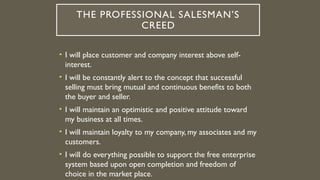
• I will place customer and company interest above self-
interest.
• I will be constantly alert to the concept that successful
selling must bring mutual and continuous benefits to both
the buyer and seller.
• I will maintain an optimistic and positive attitude toward
my business at all times.
• I will maintain loyalty to my company, my associates and my
customers.
• I will do everything possible to support the free enterprise
system based upon open completion and freedom of
choice in the market place.
THE PROFESSIONAL SALESMAN’S
CREED
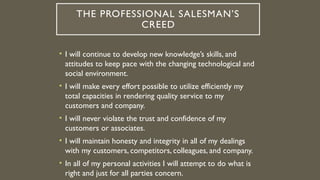
• I will continue to develop new knowledge’s skills, and
attitudes to keep pace with the changing technological and
social environment.
• I will make every effort possible to utilize efficiently my
total capacities in rendering quality service to my
customers and company.
• I will never violate the trust and confidence of my
customers or associates.
• I will maintain honesty and integrity in all of my dealings
with my customers, competitors, colleagues, and company.
• In all of my personal activities I will attempt to do what is
right and just for all parties concern.
ADVANTAGES
AND
DISADVANTAGES
OF
SALESMANSHIP
ADVANTAGES OF SALESMANSHIP
1. It is a two way communication. So the selling
agent can receive immediate feedback from the
potential purchasers.
2. Because it is a participatory method of selling it
helps to establish a customer’s trust.
3. It is a more convincing kind of advertising.
4. It allows us to reach an audience that we cannot
reach through other channels.
DISADVANTAGES
1. It is somewhat costly means of selling,
2. It is a labor-intensive strategy because a large sales staff is
required for successful personal selling.
3. Salesman training is a time-consuming and expensive
process.
4. The strategy can only reach a limited number of
individuals.

professional salesmanship chapter 1 (introduction) ppt

  • 1.
  • 2.
  • 3.
    WHAT IS SELLING? •Sale is the last step in selling goods or services in exchange for money or something else value. • When a “deal is closed,” it means that the customer has agreed to buy the product or service and paid for it in full or in part.
  • 4.
    WHAT IS SELLING? •It starts with consent (or agreement) to an acquisition, appropriation, or request.This is followed by the passing of title (property or ownership) in the item and the application and due settlement of a price the seller’s need to pass ownership, being a price the seller is happy to give up ownership of or any claim on the item • Even though the buyer is part of the sale, he or she doesn’t carry out the sale. Only the seller does that.
  • 5.
  • 6.
    SALES MANAGEMENT TRENDS FromTo SalesVolume Management Local Global Leadership Sales Productivity Teams Relationships Individuals Transactions
  • 7.
  • 8.
    MARKETING VS SELLING •Marketing and sales are very different, but they are both trying to get the same thing done. • Marketing improves the selling environment and is very important part of sales. If the marketing department makes a list of potential customers, it can be helpful for sales.
  • 9.
    MARKETING VS. SELLING •The marketing department’s goal is to increase the number of interactions between potential customer and the sales team. • They do this through advertising, sales promotion, publicity, public relations, creating new sales channels, or making new products (new product development), among other things.
  • 10.
  • 11.
    WHAT IS SALESMANSHIP? •Most of the time, the word “salesmanship” is used to refer to selling goods one-on- one. However it shouldn’t be confused with personal selling.To sell a product to someone, you need skills. It’s not the kind of job that everyone can do.
  • 12.
    WHAT IS SALESMANSHIP •Salesmanship is a skill that a salesperson uses when making personal sales. • Salesmanship is the art of face-to-face communication between a seller uses his skills at persuasion to convince the buyer to make the final purchase decision.
  • 13.
    WHAT IS SALESMANSHIP •To get a buyer to buy a product, the seller must give all the information about the product and show customers how the product can meet their needs. • It’s not an easy as it seems because, in modern times, a salesperson has to talk to a lot of different people.
  • 14.
  • 15.
    SELLING VS. SALESMANSHIP •If you ask most people to differentiate between salesmanship and selling, they will be unable to do so. Salesmanship and Selling are viewed as synonymous terms. People sometimes conflate salesmanship and selling, yet in business, they are quite distinct concepts.
  • 16.
    SELLING VS. SALESMANSHIP •Selling is the process by which business transfers goods or services to the buyer in exchange for money or another commodity. Salesmanship on the other hand, is the process of convincing a prospect to purchase from you as opposed to other sellers through the use of reasoning, reasons, and product features. • Salesmanship is a technique, a skill acquired by exposure to various selling approaches. It is a complex process that requires effort to master. It cannot be accomplished easily; selling also requires field expertise whereas selling is a straightforward operation that even children can execute.
  • 17.
  • 18.
    SALESMANSHIP OBJECTIVES • Attractingand Engaging the potential Buyer/Lead.The first objective to attract a potential customer who has shown any interest in your product or service. • Properly Educating the Potential Client. It involves properly educating about the benefits, value-added features, price and everything about a product or service. • Urging or Convincing the Potential Client to Buy. Educating the potential client is not enough.A salesperson needs to convince the potential buyer this product or service is the best solution to the specific needs.
  • 19.
    SALESMANSHIP OBJECTIVES • Makingthe Sales.This is indeed the basic motive to conclude the sale. In fact, the number of sales is the measure of success in personal selling. • Sales Repetition.As mentioned earlier, it is about making sales and building a long-lasting, profitable relation.
  • 20.
  • 21.
    FORMS OF SELLING •Selling Across the Table • Under this selling strategy, the firm’s sales executives or salesmen negotiate sales or sales transactions across the table by inviting prospective customers to the company premises or a meeting venue, usually a hotel. • This strategy is used for long-term, high value deals that develop buyer-supplier relationships.
  • 22.
    FORMS OF SELLING •Selling at the Counter; • It’s the most prevalent way corporate salesman sell things in their own store. • A salesman at a certain counter attends to customers in the shop, exhibits the product, provides all the information needed by the consumer, and participates to the client’s decision-making process so the customer buys the product discussed and displayed.
  • 23.
    FORMS OF SELLING •Selling at the door-step • Instead of greeting customers at company stores, salespeople visit potential purchasers at their homes or offices to market their products. • These buyers are primarily merchant-middlemen, but end-users are possible. Merchant-middlemen are business purchasers with a place in the company’s distribution system. • Salespeople visit buyers, offer product samples, answer questions, arouse interest, and negotiate contract by booking the order.
  • 24.
  • 25.
    THE PROFESSIONAL SALESMAN’S CREED •I will place customer and company interest above self- interest. • I will be constantly alert to the concept that successful selling must bring mutual and continuous benefits to both the buyer and seller. • I will maintain an optimistic and positive attitude toward my business at all times. • I will maintain loyalty to my company, my associates and my customers. • I will do everything possible to support the free enterprise system based upon open completion and freedom of choice in the market place.
  • 26.
    THE PROFESSIONAL SALESMAN’S CREED •I will continue to develop new knowledge’s skills, and attitudes to keep pace with the changing technological and social environment. • I will make every effort possible to utilize efficiently my total capacities in rendering quality service to my customers and company. • I will never violate the trust and confidence of my customers or associates. • I will maintain honesty and integrity in all of my dealings with my customers, competitors, colleagues, and company. • In all of my personal activities I will attempt to do what is right and just for all parties concern.
  • 27.
  • 28.
    ADVANTAGES OF SALESMANSHIP 1.It is a two way communication. So the selling agent can receive immediate feedback from the potential purchasers. 2. Because it is a participatory method of selling it helps to establish a customer’s trust. 3. It is a more convincing kind of advertising. 4. It allows us to reach an audience that we cannot reach through other channels.
  • 29.
    DISADVANTAGES 1. It issomewhat costly means of selling, 2. It is a labor-intensive strategy because a large sales staff is required for successful personal selling. 3. Salesman training is a time-consuming and expensive process. 4. The strategy can only reach a limited number of individuals.