Copyright  ©  The McGraw-Hill Companies, Inc. Permission required for reproduction or display. CHAPTER 2 LECTURE SLIDES
The Nature of Molecules and the Properties of Water Chapter 2
Nature of Atoms Matter has mass and occupies space All matter is composed of atoms Understanding the structure of atoms is critical to understanding the nature of biological molecules
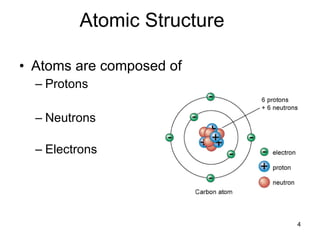
Atomic Structure Atoms are composed of Protons Neutrons Electrons
Atomic number Number of protons equals number of electrons Atoms are electrically neutral Atomic number = number of protons Every atom of a particular element has the same number of protons Element Any substance that cannot be broken down to any other substance by ordinary chemical means
Atomic mass Mass or weight? Mass – refers to amount of substance Weight – refers to force gravity exerts on substance Sum of protons and neutrons is the atom’s atomic mass Each proton and neutron has a mass of approximately 1 dalton
Electrons Negatively charged particles located in orbitals Neutral atoms have same number of electrons and protons Ions are charged particles – unbalanced Cation – more protons than electrons = net positive charge Anion – fewer protons than electrons = net negative charge
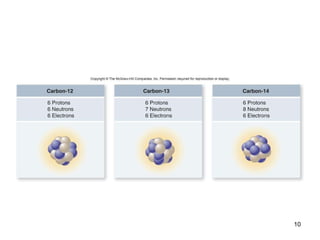
Isotopes Atoms of a single element that possess different numbers of neutrons Radioactive isotopes are unstable and emit radiation as the nucleus breaks up Half-life  –  time it takes for one-half of the atoms in a sample to decay
Electron arrangement Key to the chemical behavior of an atom lies in the number and arrangement of its electrons in their orbitals Bohr model – electrons in discrete orbits Modern physics defines orbital as area around a nucleus where an electron is most likely to be found No orbital can contain more than two electrons
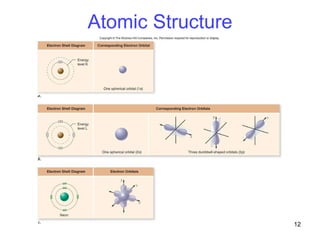
Atomic Structure
Energy levels Electrons have potential energy related to their position Electrons farther from nucleus have more energy Be careful not to confuse energy levels, which are drawn as rings to indicate an electron’s  energy, with orbitals, which have a variety of three dimensional  shapes and indicate an electron’s most likely  location
Atomic Structure
Redox During some chemical reactions, electrons can be transferred from one atom to another Still retain the energy of their position in the atom Oxidation = loss of an electron Reduction = gain of an electron
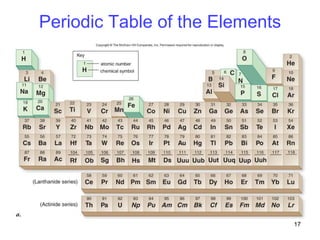
Elements Periodic table displays elements according to valence electrons Valence electrons – number of electrons in outermost energy level Inert (nonreactive) elements have all eight electrons Octet rule – atoms tend to establish completely full outer energy levels
Periodic Table of the Elements
Principles of Chemistry
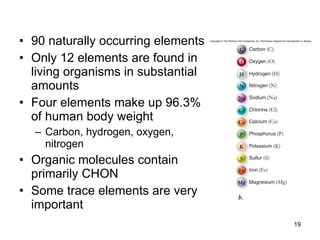
90 naturally occurring elements Only 12 elements are found in living organisms in substantial amounts Four elements make up 96.3% of human body weight Carbon, hydrogen, oxygen, nitrogen Organic molecules contain primarily CHON Some trace elements are very important
Chemical Bonds Molecules are groups of atoms held together in a stable association Compounds are molecules containing more than one type of element Atoms are held together in molecules or compounds by chemical bonds
Ionic bonds Formed by the attraction of oppositely charged ions Gain or loss of electrons forms ions Na atom loses an electron to become Na + Cl atom gains an electron to become Cl – Opposite charges attract so that Na +  and Cl –  remain associated as an ionic compound Electrical attraction of water molecules can disrupt forces holding ions together
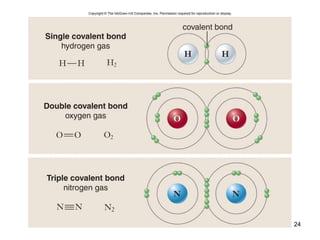
Covalent bonds Form when atoms share 2 or more valence electrons Results in no net charge, satisfies octet rule, no unpaired electrons Strength of covalent bond depends on the number of shared electrons Many biological compounds are composed of more than 2 atoms – may share electrons with 2 or more atoms
Electronegativity Atom’s affinity for electrons Differences in electronegativity dictate how electrons are distributed in covalent bonds Nonpolar covalent bonds = equal sharing of electrons Polar covalent bonds = unequal sharing of electrons O >> N > C    H
 
Chemical reactions Chemical reactions involve the formation or breaking of chemical bonds Atoms shift from one molecule to another without any change in number or identity of atoms Reactants = original molecules Products = molecules resulting from reaction 6H 2 O  +  6CO 2   ->  C 6 H 12 O 6   +  6O 2 reactants   products
Extent of chemical reaction influenced by Temperature Concentration of reactants and products Catalysts Many reactions are reversible
Quantifying Molecules The  molecular weight  of a molecule is the sum of the mass numbers of all the atoms in the molecule. One  mole , or  6.022    10 23  molecules , has a mass equal to the molecular weight expressed in grams. The concentration of a substance in a  solution  is typically expressed as  molarity  (M), which is the number of moles per  liter .
6.022    10 23  molecules is 1 mole; NaCl’s molecular weight is 58, H 2 ’s molecular weight is 2. Answer following questions: How many molecules does 0.5 mole NaCl have? How many molecules does 0.5 mole H 2  have? How many grams does 0.5 mole NaCl weigh? How many grams does 0.5 mole H 2  weigh? You need to make 500 ml  1 M NaCl solution, how many gram NaCl do you need? Example:

Chapt02 chemistry

  • 1.
    Copyright © The McGraw-Hill Companies, Inc. Permission required for reproduction or display. CHAPTER 2 LECTURE SLIDES
  • 2.
    The Nature ofMolecules and the Properties of Water Chapter 2
  • 3.
    Nature of AtomsMatter has mass and occupies space All matter is composed of atoms Understanding the structure of atoms is critical to understanding the nature of biological molecules
  • 4.
    Atomic Structure Atomsare composed of Protons Neutrons Electrons
  • 6.
    Atomic number Numberof protons equals number of electrons Atoms are electrically neutral Atomic number = number of protons Every atom of a particular element has the same number of protons Element Any substance that cannot be broken down to any other substance by ordinary chemical means
  • 7.
    Atomic mass Massor weight? Mass – refers to amount of substance Weight – refers to force gravity exerts on substance Sum of protons and neutrons is the atom’s atomic mass Each proton and neutron has a mass of approximately 1 dalton
  • 8.
    Electrons Negatively chargedparticles located in orbitals Neutral atoms have same number of electrons and protons Ions are charged particles – unbalanced Cation – more protons than electrons = net positive charge Anion – fewer protons than electrons = net negative charge
  • 9.
    Isotopes Atoms ofa single element that possess different numbers of neutrons Radioactive isotopes are unstable and emit radiation as the nucleus breaks up Half-life – time it takes for one-half of the atoms in a sample to decay
  • 11.
    Electron arrangement Keyto the chemical behavior of an atom lies in the number and arrangement of its electrons in their orbitals Bohr model – electrons in discrete orbits Modern physics defines orbital as area around a nucleus where an electron is most likely to be found No orbital can contain more than two electrons
  • 12.
  • 13.
    Energy levels Electronshave potential energy related to their position Electrons farther from nucleus have more energy Be careful not to confuse energy levels, which are drawn as rings to indicate an electron’s energy, with orbitals, which have a variety of three dimensional shapes and indicate an electron’s most likely location
  • 14.
  • 15.
    Redox During somechemical reactions, electrons can be transferred from one atom to another Still retain the energy of their position in the atom Oxidation = loss of an electron Reduction = gain of an electron
  • 16.
    Elements Periodic tabledisplays elements according to valence electrons Valence electrons – number of electrons in outermost energy level Inert (nonreactive) elements have all eight electrons Octet rule – atoms tend to establish completely full outer energy levels
  • 17.
    Periodic Table ofthe Elements
  • 18.
  • 19.
    90 naturally occurringelements Only 12 elements are found in living organisms in substantial amounts Four elements make up 96.3% of human body weight Carbon, hydrogen, oxygen, nitrogen Organic molecules contain primarily CHON Some trace elements are very important
  • 20.
    Chemical Bonds Moleculesare groups of atoms held together in a stable association Compounds are molecules containing more than one type of element Atoms are held together in molecules or compounds by chemical bonds
  • 21.
    Ionic bonds Formedby the attraction of oppositely charged ions Gain or loss of electrons forms ions Na atom loses an electron to become Na + Cl atom gains an electron to become Cl – Opposite charges attract so that Na + and Cl – remain associated as an ionic compound Electrical attraction of water molecules can disrupt forces holding ions together
  • 23.
    Covalent bonds Formwhen atoms share 2 or more valence electrons Results in no net charge, satisfies octet rule, no unpaired electrons Strength of covalent bond depends on the number of shared electrons Many biological compounds are composed of more than 2 atoms – may share electrons with 2 or more atoms
  • 25.
    Electronegativity Atom’s affinityfor electrons Differences in electronegativity dictate how electrons are distributed in covalent bonds Nonpolar covalent bonds = equal sharing of electrons Polar covalent bonds = unequal sharing of electrons O >> N > C  H
  • 26.
  • 27.
    Chemical reactions Chemicalreactions involve the formation or breaking of chemical bonds Atoms shift from one molecule to another without any change in number or identity of atoms Reactants = original molecules Products = molecules resulting from reaction 6H 2 O + 6CO 2 -> C 6 H 12 O 6 + 6O 2 reactants products
  • 28.
    Extent of chemicalreaction influenced by Temperature Concentration of reactants and products Catalysts Many reactions are reversible
  • 29.
    Quantifying Molecules The molecular weight of a molecule is the sum of the mass numbers of all the atoms in the molecule. One mole , or 6.022  10 23 molecules , has a mass equal to the molecular weight expressed in grams. The concentration of a substance in a solution is typically expressed as molarity (M), which is the number of moles per liter .
  • 30.
    6.022  10 23 molecules is 1 mole; NaCl’s molecular weight is 58, H 2 ’s molecular weight is 2. Answer following questions: How many molecules does 0.5 mole NaCl have? How many molecules does 0.5 mole H 2 have? How many grams does 0.5 mole NaCl weigh? How many grams does 0.5 mole H 2 weigh? You need to make 500 ml 1 M NaCl solution, how many gram NaCl do you need? Example: