Human Physiology
Chemistry
• Atoms of elements link together to form
molecules
• Molecules form cells.
• Cell is smallest unit capable of carrying out all
life processes.
– Is a collection of molecules separated from the
external environment by a physical barrier= plasma
membrane
– Simple organisms have 1 cell but complex organisms
have many cells with different structural and
functional specialisations
• Tissues
– collections of cells that carry out related functions
– 4 tissue types-Epithelial, Connective, Muscle and Nervous
(see chapter 3 in text)
• Organs
– composed of different types of tissues arranged in various
proportions and patterns to perform a certain function
– Anatomical structure supports function
• Organ systems
– groups of organs with integrated functions
• Organism
– body as a whole
• A simple substance that cannot be decomposed by ordinary
chemical means. It is the basic “stuff” which all matter is
composed.
• There are at least 105 elements known.
• There are 24 essential elements found in human body
– 3 make up over 90% of the body mass-Oxygen (O), Carbon
(C), Hydrogen (H), Nitrogen (N)
– Major essential elements (4): H (63%), O (26%), C (9%), N (1%)
Ca, P, K, S, Na, Cl, Mg
– Minor essential elements (13): Fe, I, Cu, Zn, Mn, Co, Cr, Se,
Mo, F, Sn, Si, & V.
Elements
• Elements are composed of atoms
• Atom is the smallest particle of an element that
has all properties of the element.
• Atom consists of 3 types of particles:-
– protons (p+)- has positive charge
– neutrons (n)- neutral charge
– electrons (e-)- has negative charge
• Atoms contain equal numbers of protons and
electrons hence have an overall charge of zero
Atoms
• Nucleus = centre of atom- contains the protons and
neutrons,
is dense- contains most of the mass of the atom
• Space around the nucleus contains electrons
- electrons are rapidly moving, lightweight,
- move in orbits- are held in orbit by electrical
attraction to nucleus due to positively charged
protons
• Remember- like charges repel and opposite charges
attract
Structure of Atom
Atomic Number = the amount of protons in the
nucleus of an atom (= amount of electrons)
The atomic number determines which element
the atom is.
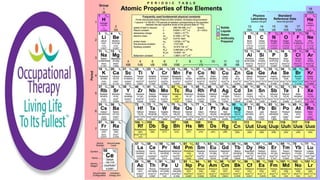
Periodic Table of Elements lists over 100 different
elements
Each element has a name and a symbol and an
atomic number
Atomic Number
• Oxygen (O) 8
• Hydrogen (H) 1
• Carbon(C) 6
• Nitrogen (N) 7
• Phosphorus (P) 15
• Sodium (Na) 11
• Potassium (K) 19
• Calcium (Ca) 20
• Magnesium (Mg) 12
• Sulfur (S) 16
• Chlorine (Cl) 17
Chemical Symbols ( ) and Atomic Numbers
Iron (Fe) 26
Iodine (I) 53
Copper (Cu) 29
Zinc (Zn) 30
Manganese (Mn) 25
Cobalt (Co) 27
Chromium (Cr) 24
Selenium (Se) 34
Molybdenum (Mo) 42
Flourine (F) 9
Tin (Sn) 50
Silicon (Si) 14
Vanadium (V) 23
Minor Essential Elements (Trace Elements)
Chemical Symbols ( ) and Atomic Numbers
• Proton has a mass of 1 dalton(Da) = 1 Atomic Mass
Unit (amu)
• Neutron has a mass of 1 Da = 1 amu
• Electron has zero mass (negligible)
• Mass Number = sum of protons + neutrons in an
atom
• Mass Number – Atomic Number = number of
neutrons in the atom
Mass Number
• An element will always have the same number
of protons but they have varying numbers of
neutrons
• Isotopes = atoms of an element that have
different numbers of neutrons
• All Isotopes of an element have the same
chemical properties because the chemical
properties are determined by the electron
configuration not the number of neutrons
Isotopes
• Atomic mass (weight) is derived from taking the
average weight of all of the isotopes for a
particular atom
Atomic mass (weight)
• The weight of 1 mole (6.02  1023) atoms equals
the atomic mass in grams.
602,000,000,000,000,000,000,000 atoms = ? Grams
= Avogadro’s Number
This information is used to calculate the concentration of
atoms or molecules in a solution in Molarity (= moles per
litre). This measure tells us how many molecules there are in
a given volume of solution. You will not have to do this
calculation but you will have to understand the concept.
Moles
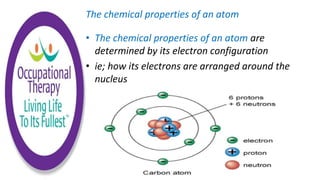
The chemical properties of an atom
• The chemical properties of an atom are
determined by its electron configuration
• ie; how its electrons are arranged around the
nucleus
The Behaviour of Electrons
• Electrons move around nucleus at different levels.
Their orbits are termed electron shells (or energy
levels).
• Each shell contains a fixed maximal number of
electrons (2n2) where n = the level of the shell.
However, the maximal number in the outer shell is
always 8 (except the first shell which has 2).
E.g. 2) 8) 18) 32) 8)
• For the main elements, the number of electrons in
the outer shell determines the chemical property of
the atom.
The Behaviour of Electrons
• Atoms with incompletely filled outer shell (<8 electrons)
tend to combine with other atoms in a chemical reaction.
• Atoms can donate, accept, or share electrons to stabilise
their outer energy levels.
• E.g. Calcium has 20 protons and electrons
2) 8) 8) 2 so calcium has 2 electrons in its outer shell. It
is these 2 electrons that will participate in chemical
reactions.
The Behaviour of Electrons
• Shells fill with electrons in sequence from inner to
outer shell.
• It is the arrangement of electrons in the outer shell
of an atom that determines its ability to bind with
other atoms.
• Periodic Table- all elements in a ‘Group’ will have
the same number of electrons in their outer shell,
and hence, will behave similarly in a chemical
reaction
• When atoms combine with other atoms, or break
apart from other atoms, the process is called a
chemical reaction.
• When two or more atoms combine in a chemical
reaction, the resulting combination is called a
molecule.
– E.g. O2, H2
• A molecule that contains two or more different
kinds of atoms is called a compound.
– E.g. CO2, H2CO3
Molecules
4 Main Types-
1. Covalent Bonds- strong
2. Ionic Bonds- strong
3. Hydrogen Bonds- weak
4. Van der Waals forces- weak
Molecular Bonds- link atoms together
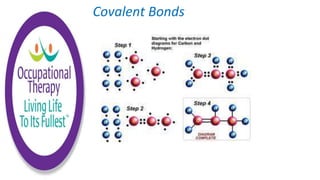
Covalent Bonds
• Covalent Bonds- form when 2 atoms share a
pair of electrons- 1 from each atom.
• Most molecules are formed via covalent bonds.
• Energy is required to break the bonds apart.
• An atom is most stable when all its electrons are
paired so it will share its unpaired electrons with
another atom that has unpaired electrons
Covalent Bonds
• You can predict the number of covalent bonds an
atom will form by counting the number of
unpaired electrons in the outer shell.
• E.g.; Carbon -Atomic Number 6
Outer shell has 4 electrons so will form 4 covalent
bonds
• Double Bond = adjacent atoms share 2 pairs of
electrons rather than just 1 e.g.; C : : C
Covalent Bonds
Polar and Non-polar Molecules
• Electron pairs in covalent molecules are not
always evenly shared between the linked
atoms.
• The atom with the stronger attraction for the
electrons will gain a slight negative charge
and the atom with the lesser pull will gain a
slight positive charge
• Overall charge on the molecule is neutral
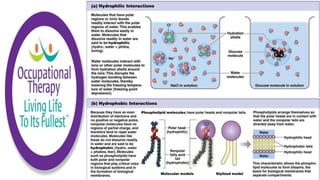
Polar Molecules
• Polar Molecules- have +ve and –ve poles. O
and N in particular have strong attraction
for electrons and often are found in polar
molecules
• Polar Molecules will dissolve in water =
Hydrophilic- water loving e.g.; sugar
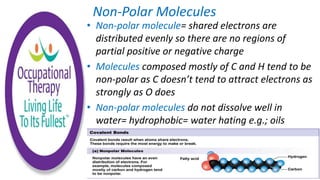
Non-Polar Molecules
• Non-polar molecule= shared electrons are
distributed evenly so there are no regions of
partial positive or negative charge
• Molecules composed mostly of C and H tend to be
non-polar as C doesn’t tend to attract electrons as
strongly as O does
• Non-polar molecules do not dissolve well in
water= hydrophobic= water hating e.g.; oils
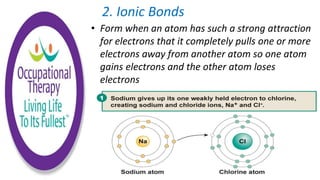
• Form when an atom has such a strong attraction
for electrons that it completely pulls one or more
electrons away from another atom so one atom
gains electrons and the other atom loses
electrons
2. Ionic Bonds
2. Ionic Bonds
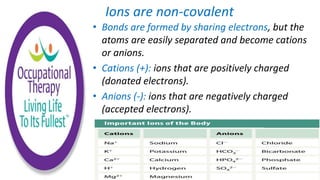
Ions are non-covalent
• Bonds are formed by sharing electrons, but the
atoms are easily separated and become cations
or anions.
• Cations (+): ions that are positively charged
(donated electrons).
• Anions (-): ions that are negatively charged
(accepted electrons).
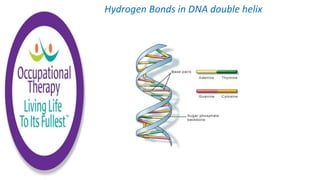
3. Hydrogen Bonds
• A weak attractive force between a hydrogen atom
and a nearby Oxygen, Nitrogen or Fluorine atom.
• Can occur between neighbouring atoms or
molecules or between portions of the same
molecule
• E.g.; water molecules are attracted to each other
and line up in an ordered fashion creating surface
tension.
• Impt for protein folding and shape of DNA
Hydrogen Bonds in DNA double helix
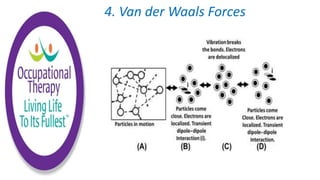
4. Van der Waals Forces
= weak non-specific attractions of nucleus of any
atom and the electrons of nearby atoms.
These forces allow atoms to pack closely together
and take up minimum space.
• A single Van der Waals attraction is very weak
but multiple ones supplement Hydrogen bonds
that hold proteins in their 3-D shapes
4. Van der Waals Forces
• Molecular shape is closely related to its function
• Molecular bonds play a critical role in
determining molecular shape
• Molecular formula doesn’t tell you anything
about shape just tells you the number and type of
atoms NOT what is joined to what
Molecular Shape
• You can draw out a molecule so it shows where
the covalent bonds are and get an idea of
molecular shape e.g.; is it a ring structure or a
chain
Molecular Shape
• Covalent bonds between atoms will form at
various angles giving a molecule its characteristic
shape
• Weak bonds also help shape molecules e.g.;
protein folding, DNA double helix
Human Physiology Chemistry

Human Physiology Chemistry

  • 1.
  • 3.
    • Atoms ofelements link together to form molecules • Molecules form cells. • Cell is smallest unit capable of carrying out all life processes. – Is a collection of molecules separated from the external environment by a physical barrier= plasma membrane – Simple organisms have 1 cell but complex organisms have many cells with different structural and functional specialisations
  • 4.
    • Tissues – collectionsof cells that carry out related functions – 4 tissue types-Epithelial, Connective, Muscle and Nervous (see chapter 3 in text) • Organs – composed of different types of tissues arranged in various proportions and patterns to perform a certain function – Anatomical structure supports function • Organ systems – groups of organs with integrated functions • Organism – body as a whole
  • 5.
    • A simplesubstance that cannot be decomposed by ordinary chemical means. It is the basic “stuff” which all matter is composed. • There are at least 105 elements known. • There are 24 essential elements found in human body – 3 make up over 90% of the body mass-Oxygen (O), Carbon (C), Hydrogen (H), Nitrogen (N) – Major essential elements (4): H (63%), O (26%), C (9%), N (1%) Ca, P, K, S, Na, Cl, Mg – Minor essential elements (13): Fe, I, Cu, Zn, Mn, Co, Cr, Se, Mo, F, Sn, Si, & V. Elements
  • 6.
    • Elements arecomposed of atoms • Atom is the smallest particle of an element that has all properties of the element. • Atom consists of 3 types of particles:- – protons (p+)- has positive charge – neutrons (n)- neutral charge – electrons (e-)- has negative charge • Atoms contain equal numbers of protons and electrons hence have an overall charge of zero Atoms
  • 7.
    • Nucleus =centre of atom- contains the protons and neutrons, is dense- contains most of the mass of the atom • Space around the nucleus contains electrons - electrons are rapidly moving, lightweight, - move in orbits- are held in orbit by electrical attraction to nucleus due to positively charged protons • Remember- like charges repel and opposite charges attract Structure of Atom
  • 8.
    Atomic Number =the amount of protons in the nucleus of an atom (= amount of electrons) The atomic number determines which element the atom is. Periodic Table of Elements lists over 100 different elements Each element has a name and a symbol and an atomic number Atomic Number
  • 9.
    • Oxygen (O)8 • Hydrogen (H) 1 • Carbon(C) 6 • Nitrogen (N) 7 • Phosphorus (P) 15 • Sodium (Na) 11 • Potassium (K) 19 • Calcium (Ca) 20 • Magnesium (Mg) 12 • Sulfur (S) 16 • Chlorine (Cl) 17 Chemical Symbols ( ) and Atomic Numbers
  • 10.
    Iron (Fe) 26 Iodine(I) 53 Copper (Cu) 29 Zinc (Zn) 30 Manganese (Mn) 25 Cobalt (Co) 27 Chromium (Cr) 24 Selenium (Se) 34 Molybdenum (Mo) 42 Flourine (F) 9 Tin (Sn) 50 Silicon (Si) 14 Vanadium (V) 23 Minor Essential Elements (Trace Elements) Chemical Symbols ( ) and Atomic Numbers
  • 11.
    • Proton hasa mass of 1 dalton(Da) = 1 Atomic Mass Unit (amu) • Neutron has a mass of 1 Da = 1 amu • Electron has zero mass (negligible) • Mass Number = sum of protons + neutrons in an atom • Mass Number – Atomic Number = number of neutrons in the atom Mass Number
  • 12.
    • An elementwill always have the same number of protons but they have varying numbers of neutrons • Isotopes = atoms of an element that have different numbers of neutrons • All Isotopes of an element have the same chemical properties because the chemical properties are determined by the electron configuration not the number of neutrons Isotopes
  • 13.
    • Atomic mass(weight) is derived from taking the average weight of all of the isotopes for a particular atom Atomic mass (weight)
  • 14.
    • The weightof 1 mole (6.02  1023) atoms equals the atomic mass in grams. 602,000,000,000,000,000,000,000 atoms = ? Grams = Avogadro’s Number This information is used to calculate the concentration of atoms or molecules in a solution in Molarity (= moles per litre). This measure tells us how many molecules there are in a given volume of solution. You will not have to do this calculation but you will have to understand the concept. Moles
  • 15.
    The chemical propertiesof an atom • The chemical properties of an atom are determined by its electron configuration • ie; how its electrons are arranged around the nucleus
  • 16.
    The Behaviour ofElectrons • Electrons move around nucleus at different levels. Their orbits are termed electron shells (or energy levels). • Each shell contains a fixed maximal number of electrons (2n2) where n = the level of the shell. However, the maximal number in the outer shell is always 8 (except the first shell which has 2). E.g. 2) 8) 18) 32) 8) • For the main elements, the number of electrons in the outer shell determines the chemical property of the atom.
  • 17.
    The Behaviour ofElectrons • Atoms with incompletely filled outer shell (<8 electrons) tend to combine with other atoms in a chemical reaction. • Atoms can donate, accept, or share electrons to stabilise their outer energy levels. • E.g. Calcium has 20 protons and electrons 2) 8) 8) 2 so calcium has 2 electrons in its outer shell. It is these 2 electrons that will participate in chemical reactions.
  • 18.
    The Behaviour ofElectrons • Shells fill with electrons in sequence from inner to outer shell. • It is the arrangement of electrons in the outer shell of an atom that determines its ability to bind with other atoms. • Periodic Table- all elements in a ‘Group’ will have the same number of electrons in their outer shell, and hence, will behave similarly in a chemical reaction
  • 20.
    • When atomscombine with other atoms, or break apart from other atoms, the process is called a chemical reaction. • When two or more atoms combine in a chemical reaction, the resulting combination is called a molecule. – E.g. O2, H2 • A molecule that contains two or more different kinds of atoms is called a compound. – E.g. CO2, H2CO3 Molecules
  • 21.
    4 Main Types- 1.Covalent Bonds- strong 2. Ionic Bonds- strong 3. Hydrogen Bonds- weak 4. Van der Waals forces- weak Molecular Bonds- link atoms together
  • 22.
    Covalent Bonds • CovalentBonds- form when 2 atoms share a pair of electrons- 1 from each atom. • Most molecules are formed via covalent bonds. • Energy is required to break the bonds apart. • An atom is most stable when all its electrons are paired so it will share its unpaired electrons with another atom that has unpaired electrons
  • 23.
    Covalent Bonds • Youcan predict the number of covalent bonds an atom will form by counting the number of unpaired electrons in the outer shell. • E.g.; Carbon -Atomic Number 6 Outer shell has 4 electrons so will form 4 covalent bonds • Double Bond = adjacent atoms share 2 pairs of electrons rather than just 1 e.g.; C : : C
  • 24.
  • 25.
    Polar and Non-polarMolecules • Electron pairs in covalent molecules are not always evenly shared between the linked atoms. • The atom with the stronger attraction for the electrons will gain a slight negative charge and the atom with the lesser pull will gain a slight positive charge • Overall charge on the molecule is neutral
  • 26.
    Polar Molecules • PolarMolecules- have +ve and –ve poles. O and N in particular have strong attraction for electrons and often are found in polar molecules • Polar Molecules will dissolve in water = Hydrophilic- water loving e.g.; sugar
  • 27.
    Non-Polar Molecules • Non-polarmolecule= shared electrons are distributed evenly so there are no regions of partial positive or negative charge • Molecules composed mostly of C and H tend to be non-polar as C doesn’t tend to attract electrons as strongly as O does • Non-polar molecules do not dissolve well in water= hydrophobic= water hating e.g.; oils
  • 29.
    • Form whenan atom has such a strong attraction for electrons that it completely pulls one or more electrons away from another atom so one atom gains electrons and the other atom loses electrons 2. Ionic Bonds
  • 30.
  • 31.
    Ions are non-covalent •Bonds are formed by sharing electrons, but the atoms are easily separated and become cations or anions. • Cations (+): ions that are positively charged (donated electrons). • Anions (-): ions that are negatively charged (accepted electrons).
  • 32.
    3. Hydrogen Bonds •A weak attractive force between a hydrogen atom and a nearby Oxygen, Nitrogen or Fluorine atom. • Can occur between neighbouring atoms or molecules or between portions of the same molecule • E.g.; water molecules are attracted to each other and line up in an ordered fashion creating surface tension. • Impt for protein folding and shape of DNA
  • 33.
    Hydrogen Bonds inDNA double helix
  • 34.
    4. Van derWaals Forces = weak non-specific attractions of nucleus of any atom and the electrons of nearby atoms. These forces allow atoms to pack closely together and take up minimum space. • A single Van der Waals attraction is very weak but multiple ones supplement Hydrogen bonds that hold proteins in their 3-D shapes
  • 35.
    4. Van derWaals Forces
  • 36.
    • Molecular shapeis closely related to its function • Molecular bonds play a critical role in determining molecular shape • Molecular formula doesn’t tell you anything about shape just tells you the number and type of atoms NOT what is joined to what Molecular Shape • You can draw out a molecule so it shows where the covalent bonds are and get an idea of molecular shape e.g.; is it a ring structure or a chain
  • 37.
    Molecular Shape • Covalentbonds between atoms will form at various angles giving a molecule its characteristic shape • Weak bonds also help shape molecules e.g.; protein folding, DNA double helix